
Saturday, 28 November 2026
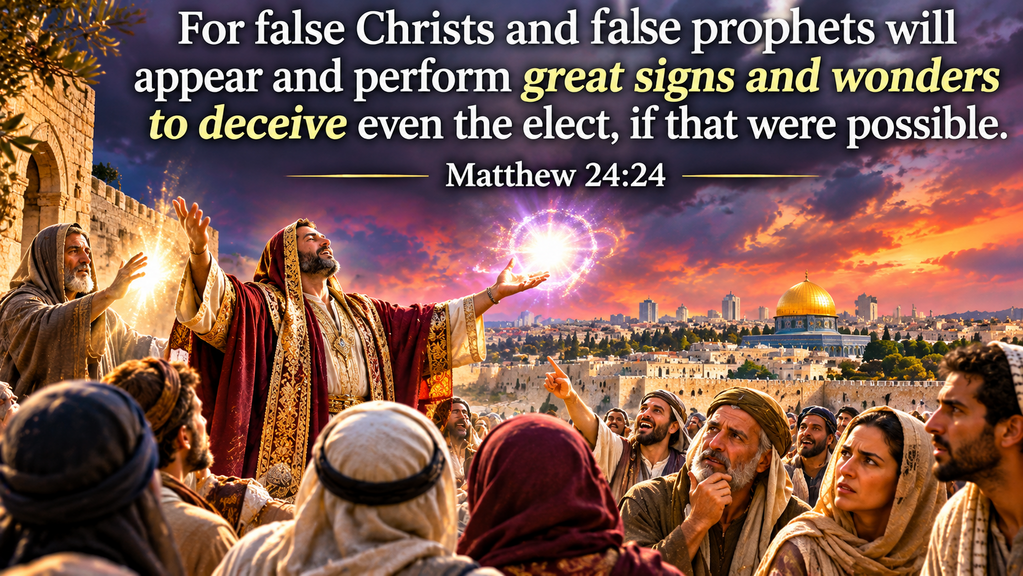
For false christs and false prophets will rise and show great signs and wonders to deceive, if possible, even the elect. Matthew 24:24
Note: You can listen to today’s commentary courtesy of our friends at the “Bible in Ten” podcast. (Click Here to listen)
You can also read this commentary, scrolling with music, courtesy of our friends at “Discern the Bible” on YouTube. (Click Here to listen), or at Rumble (Click Here to listen).
“They will arouse, indeed, false christs and false prophets, and they will give ‘signs, great’, and wonders so to mislead, if possible, even the selected.” (CG)
In the previous verse, Jesus told those who will heed His word that if anyone says to them the Christ is here or here, not to believe it. He continues, saying, “They will arouse, indeed, false christs and false prophets.”
Of these words, various views have been suggested. Ellicott refers to Simon the Sorcerer in Acts 8 and Elymas the false prophet in Acts 13. That is convenient if you want to shove replacement theology down the throats of others. If Jesus’ words are fulfilled for Israel, then the church must have replaced Israel. Neither claimed to be the Christ, and the context of Jesus’ words is the end times, not the time leading up to Israel’s dispersion.
The Pulpit Commentary says, “Without assuming the name of Christ, many impostors shall be found who, professing to be inspired or lawful teachers, shall lead hearers into false doctrine, or claim to possess a new revelation, or something additional and supplemental to the eternal gospel. Such was Mohammed; such were the founders of Buddhism, Mormonism, and other so-called religions.”
These are indeed people who started false religions or cults, but the address is to the disciples in response to their question about events related to Israel. Jewish people have followed false religions since they stood at the foot of Mount Sinai and received the law. That isn’t what is being addressed.
The context is not about religions outside of their culture, but in relation to Scripture and from within their society. Jesus refers to people in the end times who will claim to be Israel’s Messiah in fulfillment of their Scriptures. Jesus also says, “and they will give ‘signs, great’.”
The semeion, sign, has already been seen ten times in Matthew. It is a presumed derivative of the base of sémainó, an indication, meaning something that signifies something. Jesus also says, “and wonders.”
The teras, wonder, is first seen here. Helps Word Studies says it is “done to elicit a reaction from onlookers; an extraordinary event with its supernatural effect left on all witnessing it, i.e. a portent from heaven to earth.”
Of these two together, Vincent’s Word Studies says, “The words do not denote different classes of supernatural manifestations, but these manifestations regarded from different points of view. The same miracle may be a mighty work, or a glorious work, regarded with reference to its power and grandeur; or a sign of the doer’s supernatural power; or a wonder, as it appeals to the spectator.”
His thought is incomplete. HELPS Word Studies says of the sign, “given especially to confirm, corroborate or authenticate. [The sign] then emphasizes the end-purpose which exalts the one giving it. Accordingly, it is used dozens of times in the NT for what authenticates the Lord and His eternal purpose, especially by doing what mere man can not replicate or take credit for.”
Signs are given to validate. The sign of Jonah (his preaching) was given to validate the word of the Lord concerning the destruction of Jerusalem. The sign of circumcision (Romans 4:11) was given to reveal the sinless nature of Christ. A sign always points to something else. Of these things, Jesus says that when they are given, they will be convincing “so to mislead, if possible, even the selected.”
The elect are those “who choose to follow the Lord, i.e. become God’s choice by freely receiving faith” HELPS Word Studies. The point, therefore, is that people who choose to accept the word, believe that Jesus is the Messiah, and intend to follow Him, may even possibly get duped by these false christs and false prophets. To ensure this doesn’t happen, Jesus will continue instructing the people.
Life application: It is common for the words of Jesus to be spoken in churches, telling believers that they can lose their salvation because of what Jesus says. First, He is speaking to His disciples about matters related to Israel, the temple, and the end times.
Second, He had not yet died for the sin of the world. The New Covenant had not been initiated, and what He says refers to Israel under this paradigm. To this day, they have not entered into the New Covenant.
Third, Scripture is abundantly clear that salvation is eternal. There is no verse, taken in its proper context, that can be used to justify a loss of salvation. Further, such a thought goes against the nature of God, who will never break His covenant promises. Our faithlessness does not, and indeed, it cannot, negate His faithfulness.
When you are sealed with the Spirit, it is a guarantee. God is not in the business of breaking His promises. To the point, though, Matthew 24:43 does not apply to those who have called on Jesus and been saved. So you can punt that teaching out the door.
Lord God, thank You for our salvation through faith in Christ. We are weak, prone to stray, and often misdirected. But You have Your faithful seal resting upon us, ensuring us that we will be brought home to You. Thank You for this wonderful assurance. Amen.