
Tuesday, 3 November 2026
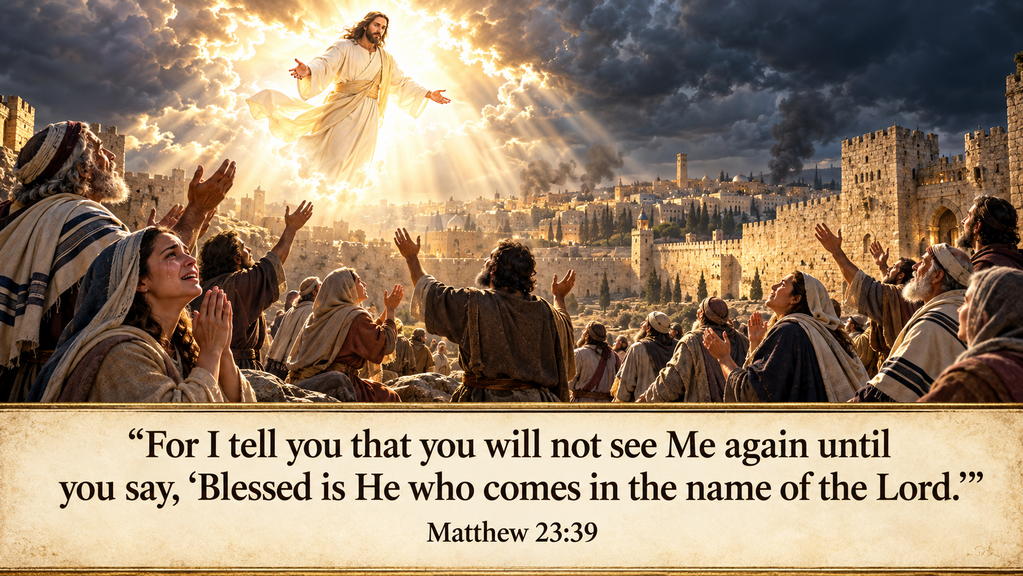
for I say to you, you shall see Me no more till you say, ‘Blessed is He who comes in the name of the Lord!’” Matthew 23:39
Note: You can listen to today’s commentary courtesy of our friends at the “Bible in Ten” podcast. (Click Here to listen).
You can also read this commentary, scrolling with music, courtesy of our friends at “Discern the Bible” on YouTube. (Click Here to listen), or at Rumble (Click Here to listen).
“I say, indeed, to you, no, not Me you should see from now, until if you should speak, ‘Having been blessed, the ‘Coming in Name, Lord’.’” (CG)
In the previous verse, Jesus told the city of Jerusalem, meaning its leaders within it, that its house was left to them desolate. Next, He finishes Chapter 23, saying, “I say, indeed, to you, no, not Me you should see from now.”
There should be no debate about the meaning. Jesus is set to be crucified. The leaders of Israel, of which Jerusalem is emblematic, would have their hand in what was coming. Their continued rejection of Him after the resurrection and growth of the church is what brought about their destruction, something they openly called for –
“When Pilate saw that he could not prevail at all, but rather that a tumult was rising, he took water and washed his hands before the multitude, saying, ‘I am innocent of the blood of this just Person. You see to it.’
25 And all the people answered and said, ‘His blood be on us and on our children.’” Matthew 27:24, 25
Jesus is speaking to this group of people. They are representatives of the nation in religious matters. Today, they are the religious elite in Israel, but this extends to the civil leadership as well. Together, they work to direct the nation. This is what leadership does. At this point in Israel’s history, they are in complete personal enmity with the message of Jesus. As such, they will not see Him until there is a change. That is seen in Jesus’ continued words, saying, “until if.”
It is a conditional phrase. Leaving off the word an, if, as most translations do, damages the intent of what is said. Matthew Poole, relying on the word “till” alone, says, “For whereas some interpret the term till, & c. of the day of judgment, or the time when the Jews shall be converted, I take them to be strained interpretations.” Continuing, he says –
“Till here certainly is to be interpreted, as Psalm 110:1, Matthew 1:25; and this comports with the history, for after this time our Saviour appeared in the temple publicly no more. For the disputes raised from Matthew 23:37, about God’s secret will, whether he seriously willed the salvation of the Jews, &c., I take the affirmative part to have no foundation in this text”
It is incredible to think that people can read the Bible and think that God doesn’t will the salvation of the Jews. Further, it makes no sense to make a conditional statement, relaying it as an absolute assertion, just to deny what the conditional statement says. He will do this thing when they do what He says they must do, which is when, as He says to Jerusalem, “you should speak, ‘Having been blessed, the ‘Coming in Name, Lord’.’”
Jesus tells Jerusalem exactly when He will return. There is no ambiguity in His words. He is not speaking to the church (which didn’t exist at the time). If He intended permanent and complete separation from the Jewish people, His proclamation would have been completely different.
Israel, led by Jerusalem, which is led by its civil/religious leaders, must call out concerning Jesus the words of Psalm 118:26, “Blessed the ‘coming in name, Yehovah’.” (CG). In other words, whenever Jerusalem acknowledges Jesus as their Messiah and the One who was sent in the name of the covenant-keeping Lord they committed to at Mount Sinai, Jesus will return to them.
It is solely up to the nation for Him to deliver them. This is the point and purpose of the coming tribulation period, something that has nothing to do with the church. The church will not be here for that. Why? Because they have already called on Jesus as Lord. There is no need for them to enter into the tribulation. They are His.
Life application: There are two predominant positions on Jesus’ words of this verse. We have already heard from Matthew Poole. Here is one more aligned with Poole and then two that take the other view –
“There can be little doubt that our Lord points to the second Advent, and to the welcome that will then be given Him by all the true Israel of God. For that generation, and for the outward Israel as such, the abandonment was final.” Charles Ellicott
“Blessed be he that comes as the Messiah, to bring deliverance. This has not been yet accomplished, but the days will come when the Jews, long cast out and rejected, will hail Jesus as the Messiah, and receive him whom their fathers killed as the merciful Saviour, Romans 11:25-32.” Albert Barnes
“The time intended is that when Israel shall repent of its rejection of the Messiah, and in bitter contrition look on him whom it pierced, owning and receiving Jesus with glad ‘Hosannahs!’ Then shall they behold him coming in power and glory, and shall regain their old position as beloved of God (see Hosea 3:4, 5; Zechariah 12:10). Then ‘all Israel shall be saved’ (Romans 11:26).” Pulpit Commentary
Ellicott says the abandonment of “outward Israel”, meaning the Jews, is final. Barnes and the Pulpit Commentary assert that Israel, meaning the nation comprised of the Jewish people, will be saved when they call out to God through Jesus. Either one view is wrong, and the other is right, or they are both wrong, but they cannot both be right. Which do you think is correct?
If you are not sure, you should start reading your Bible more. Further, when you read the Bible, you should consider what God says as absolutely true at all times. And more, ignoring or mixing the boxes of dispensationalism inevitably leads to very crummy theology. Don’t have very crummy theology by ignoring or mixing dispensations.
If you get what God is doing with the nation of Israel wrong, your doctrine and theology in other areas will inevitably be wrong. Be sure to get what God is doing with Israel right. It really matters.
Lord God, Your faithfulness to Israel is beyond our imagination. They have rejected You continuously for over three millennia. Very few times have they pursued You as they should have during all that time. Mostly, it’s been lip service or completely ignoring You. And yet, You have remained faithfully faithful to them. Thank You for Your faithfulness to those You have covenanted with. Amen.