
Tuesday, 20 October 2026
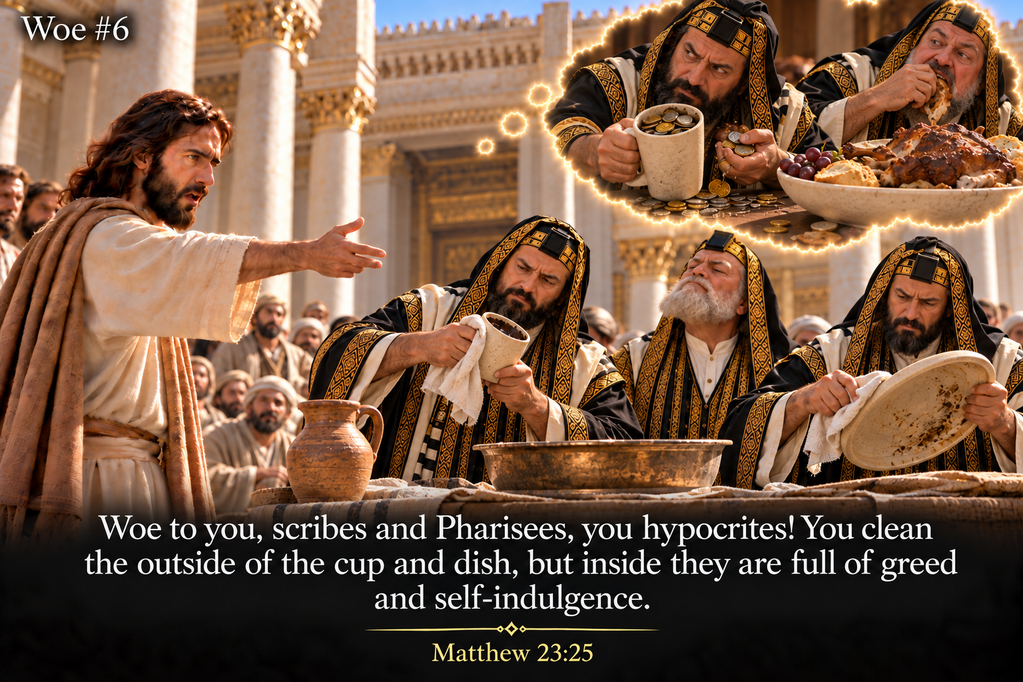
“Woe to you, scribes and Pharisees, hypocrites! For you cleanse the outside of the cup and dish, but inside they are full of extortion and self-indulgence. Matthew 23:25
Note: You can listen to today’s commentary courtesy of our friends at the “Bible in Ten” podcast. (Click Here to listen)
You can also read this commentary, scrolling with music, courtesy of our friends at “Discern the Bible” on YouTube. (Click Here to listen), or at Rumble (Click Here to listen).
“Woe to you, scribes and Pharisees! Hypocrites! Because you cleanse the ‘outwardly, the cup and the side-dish’. Inwardly, also, they swell from pillage and unrestraint.” (CG)
In the previous verse, Jesus finished His fifth woe pronouncement upon the scribes and Pharisees. With that complete, He immediately moves to the sixth, saying, “Woe to you, scribes and Pharisees! Hypocrites!”
In Isaiah, the Lord pronounces a series of woes upon the people of the land. They had acted wickedly and would be punished for their conduct. The same Lord came and stood among the people. His pronouncements upon the scribes and Pharisees will end in no less judgment than what the people received in the past.
One would think the direct and truthful nature of Jesus’ words would have affected them, but they continued down their stubborn path. For now, Jesus continues His words, saying, “Because you cleanse the ‘outwardly, the cup and the side-dish’.”
New words are seen. The first is the adverb exóthen, outside, outward, etc. It is derived from exó, external. Being an adverb, saying “the outside” fails to give the proper sense. The second new word is paropsis, a side-dish.
It is derived from para, near or beside, and opsarion, a relish to other food (as if cooked sauce), but specifically fish. The word is found only here and in the next verse. The cup and side dish are outwardly clean. This refers to what is outside, which is evident to all.
Thus, there is the sense of doing things for show. However, there is an underlying problem that the Lord sees, even if it is not outwardly evident to others. He continues, saying, “Inwardly, also, they swell from pillage and unrestraint.”
Three new words are seen here. The first is gemó, to swell out and thus full. HELPS Word Studies says it signifies “totally characterized by (in every sense).” The next word is harpagé, pillage. Thus, abstractly, it refers to extortion, ravening, or spoiling. It is derived from the word harpazó, to snatch away, as what will take place at the rapture.
In this case, the usage identifies a violently greedy attitude among these men. That is accompanied by the third new word of the clause, akrasia, want of self-restraint. Thus, it means excess or incontinence. It is only seen again in 1 Corinthians 7:5.
The Lord, who reads the hearts and minds, sees beyond the exterior appearance of these men, knowing that inside there is corruption and wickedness.
Life application: Remember that Paul was a Pharisee. He is one of the men Jesus is speaking to at this time. He was outwardly showy, but inwardly corrupt. This attitude is seen in his early appearances in Acts. The chance of him waking up and realizing his corrupt state before the Lord was extremely thin. However, by an act of grace, He was offered salvation and a chance to serve the Lord with his life.
After his conversion, he pressed forward in Christ, never forgetting who he was or the depths from which the Lord had pulled him. Imagine it! One of Israel’s elites was a great offender who later acknowledged how terrible he truly was –
“This is a faithful saying and worthy of all acceptance, that Christ Jesus came into the world to save sinners, of whom I am chief. 16 However, for this reason I obtained mercy, that in me first Jesus Christ might show all longsuffering, as a pattern to those who are going to believe on Him for everlasting life.” 1 Timothy 1:15, 16
Understanding Paul’s words, think about how they reflect our own state before the Lord. Paul says he was a pattern to those who are going to believe. What we have received in Christ was unmerited. We may not have been as bad as the scribes and Pharisees in one way, but we may have been far worse than them in others.
No person deserves grace. It is unmerited favor. As this is true, there is nothing you can do to earn it. Therefore, the life we now live in Christ should be one that is grateful, willing to serve, and filled with thanks at all times. If we start feeling smug in our salvation, looking down on others, all we need to do is remember that we stand before the Lord solely because of His grace.
Let us remain humble and willing to share the good news with others at all times. It is God who deserves all the glory for having pulled us out of the pit we were in. Praise God for His goodness to us.
“But God forbid that I should boast except in the cross of our Lord Jesus Christ, by whom the world has been crucified to me, and I to the world.” Galatians 6:14
Lord God, thank You for looking down on each of us, miserable sinners, and seeing something of value in what we could become. Because of Your love for Your creatures, You were willing to do the unimaginable. Thank You for Jesus Christ our Lord. Amen.