
Sunday, 11 October 2026
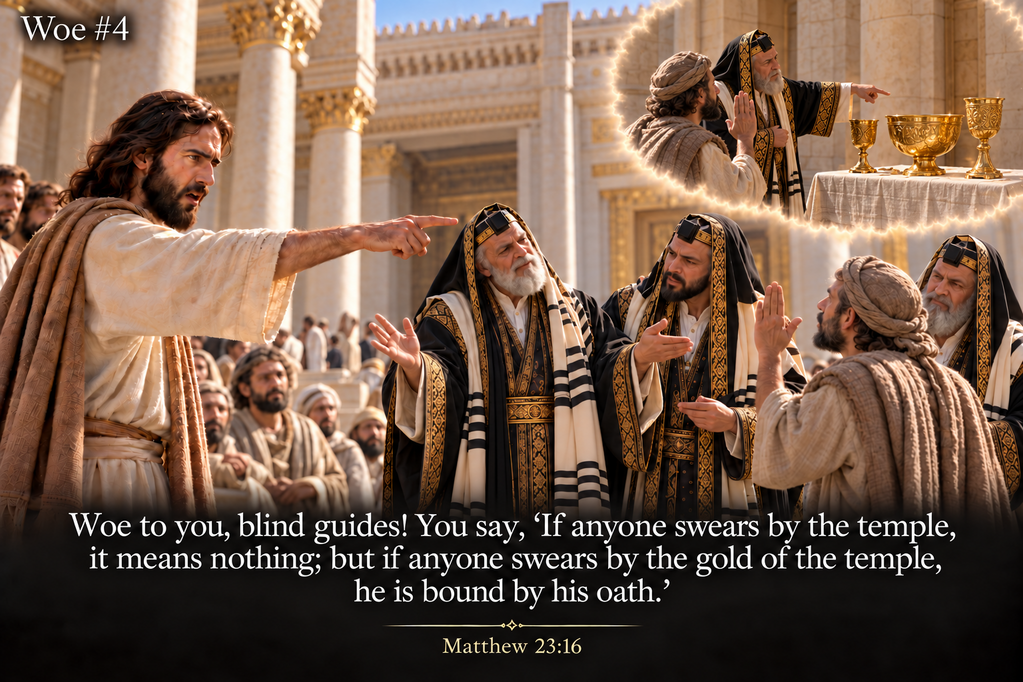
“Woe to you, blind guides, who say, ‘Whoever swears by the temple, it is nothing; but whoever swears by the gold of the temple, he is obliged to perform it.’ Matthew 23:16
Note: You can listen to today’s commentary courtesy of our friends at the “Bible in Ten” podcast. (Click Here to listen)
You can also read this commentary, scrolling with music, courtesy of our friends at “Discern the Bible” on YouTube. (Click Here to listen), or at Rumble (Click Here to listen).
“Woe to you, ‘conductors, blind’! Those saying, ‘Who, if he should swear ‘in the temple’, nothing, it is. Who, also, if he should swear ‘in the gold, the temple’, he is obligated.’” (CG)
In the previous verse, Jesus gave a third woe to the scribes and Pharisees concerning their gaining converts. He now moves to a fourth woe, saying, “Woe to you, ‘conductors, blind’!”
This is just the second time the hodégos, conductor, is seen. It is a person who conducts another, like a guide. The problem is, if they are blind, they will only cause disaster to those they are conducting. The intent is that they are leading people with false doctrine.
If they don’t even know what they are talking about, the people they are conducting will be led to faulty thinking and faulty conclusions as well. Jesus next openly states their false teaching, saying, “Those saying, ‘Who, if he should swear ‘in the temple’, nothing, it is.’”
The meaning of “in the temple” is “in the name of the temple,” or “by the temple.” The intent of the words is plain on the surface. People were in the habit of making oaths. To strengthen the surety of the oath, an object would be affixed to it. People do this today, such as “I swear on my mother’s grave.”
These blind conductors said that it didn’t matter if they swore by the temple. People say things not really meaning it, and such a vow could be ignored. However, they made another claim that put a burden on the people which could not be ignored, saying, “Who, also, if he should swear ‘in the gold, the temple’, he is obligated.”
What the gold of the temple refers to is debated. Some say it is a reference to the items of gold in the temple which are fashioned for sacred use or the gold of the temple kept in the treasury. Others say this refers to the offerings made to the temple, elsewhere noted as corban. If the latter, it would mean that the term “gold” was being applied to whatever was offered as corban, even if it wasn’t actual gold.
The latter seems to stretch the intent. Rather, in the Bible, there is precedent for considering the gold objects holy. This is found in the handling of them by the priests, and the mishandling of them by others. For example, in Daniel 5, we read –
“And you have lifted yourself up against the Lord of heaven. They have brought the vessels of His house before you, and you and your lords, your wives and your concubines, have drunk wine from them.” Daniel 5:23
Belshazzar had defiled the sacred vessels of the temple. It would cost him dearly. As for these scribes and Pharisees, they taught that when a vow was made in the name of the gold of the temple, the vow was sacred and had to be kept. As such, they have elevated the lesser to the position of greater importance. Jesus will challenge and chide them on this before moving on to another pronouncement of woe.
Life application: False teaching, whether intentional or unintentional, is wrongdoing. In the case of these scribes and Pharisees, they had so mangled the intent of vows that their thinking was completely unbiblical. In Numbers 30, clear wording was given concerning vows –
“If a man makes a vow to the Lord, or swears an oath to bind himself by some agreement, he shall not break his word; he shall do according to all that proceeds out of his mouth.” Numbers 30:2
There is nothing about adding an object to the vow to firm it up. Rather, when a person said he was going to do something in an oath, he was to do it. Jesus clarifies this elsewhere concerning the need for absolute reliability of the content in the words we speak. For now, He is making a point about the illogical nature of their claims concerning vows.
By stating what they are stating, they are teaching falsely. The motive behind their teaching aside, they err because their words are unsound and will lead those they teach to erroneous belief in how to interact with God. As noted above, it doesn’t matter if this was intentional or unintentional. Either way, they sinned through their bad doctrine.
In the church today, it is no different. Teachers will be held accountable for their improper doctrine. James sums up the thought, saying –
“My brethren, let not many of you become teachers, knowing that we shall receive a stricter judgment.” James 3:1
If the teacher is a saved believer, he is not imputed with sin (2 Corinthians 5:19). However, he will lose rewards for his false doctrines when he is judged at the Bema Seat of Christ. If he is not a saved believer, his false doctrine is imputed to him as sin. Thus, his condemnation will be greater
There can be no excuse for improper teaching of God’s word. If you intend to teach a Bible class, be sure to study properly, ensuring what you teach will be in accord with the word. In all things, do what you do to the glory of God.
Lord God, help us to rightly understand Your word. And when we talk to others about it, may we properly instruct them on what is correct. May we never intentionally misuse Your word, but may we not unintentionally mishandle it as well. Help us to have right and proper doctrine as we instruct others on the truth contained in Your precious word. Amen.