
Sunday, 2 August 2026
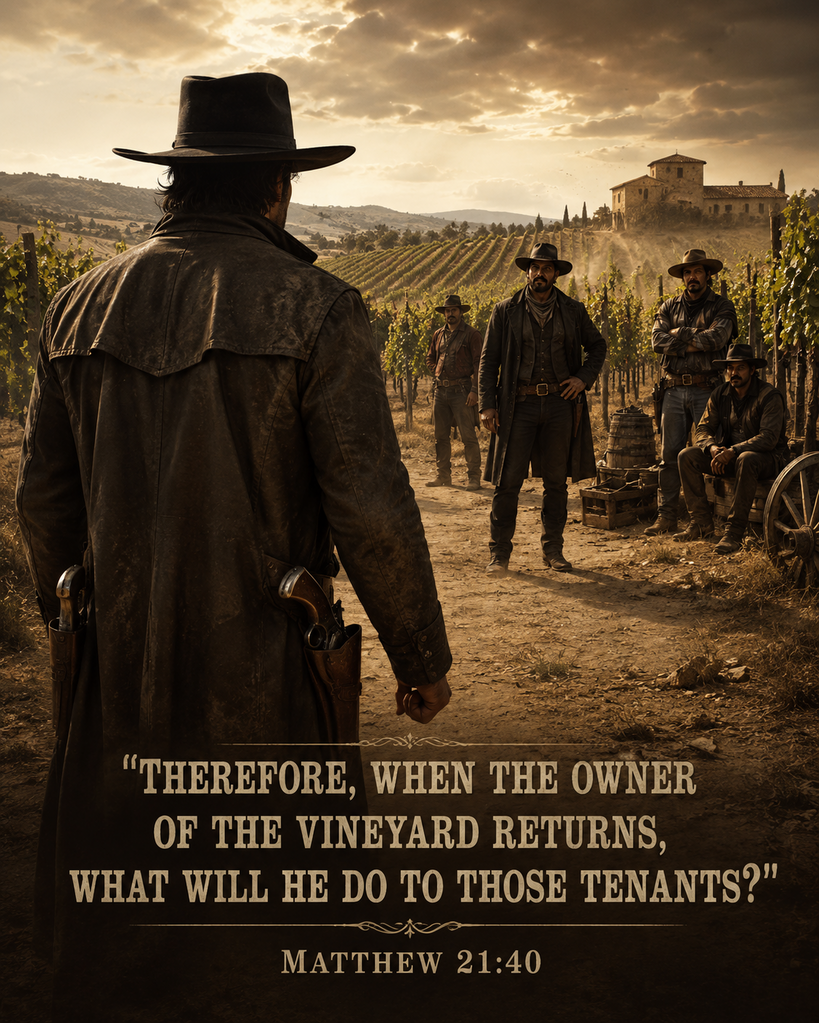
“Therefore, when the owner of the vineyard comes, what will he do to those vinedressers?” Matthew 21:40
Note: You can listen to today’s commentary courtesy of our friends at the “Bible in Ten” podcast. (Click Here to listen).
You can also read this commentary, scrolling with music, courtesy of our friends at “Discern the Bible” on YouTube. (Click Here to listen), or at Rumble (Click Here to listen).
“When, therefore, he should come, the ‘lord, the vineyard’, what he will do to the agronomists, to those?” (CG).
In the previous verse, Jesus said that the agronomists took the son, cast him out of the vineyard, and killed him. He now questions Israel’s leaders concerning the matter, beginning with, “When, therefore, he should come, the ‘lord, the vineyard’.”
This is the time of judgment that will come upon Israel for their having crucified the Son of God. Paul explains this in 1 Thessalonians –
“For this reason we also thank God without ceasing, because when you received the word of God which you heard from us, you welcomed it not as the word of men, but as it is in truth, the word of God, which also effectively works in you who believe. 14 For you, brethren, became imitators of the churches of God which are in Judea in Christ Jesus. For you also suffered the same things from your own countrymen, just as they did from the Judeans, 15 who killed both the Lord Jesus and their own prophets, and have persecuted us; and they do not please God and are contrary to all men, 16 forbidding us to speak to the Gentiles that they may be saved, so as always to fill up the measure of their sins; but wrath has come upon them to the uttermost.” 1 Thessalonians 2:13-16
For Israel, there was a certain amount of sin that the Jews could expect to be dismissed by God through His grace and mercy, but there is a point at which that amount would be filled up, and beyond which only destruction could be the result. This same concept is true with any given nation, church, or person. There is a point where sin finally fills up to its measure, and then only wrath can be the inevitable result.
This is what Paul is saying concerning his people of national heritage. They had filled up the measure of their sins, and he knew, as he says, “that wrath has come upon them to the uttermost.” Understanding this, Jesus asks the question: “what he will do to the agronomists, to those?”
The answer is obvious, and Jesus is asking them this for a particular reason. In their response, they will indict themselves. As for Paul’s words in 1 Thessalonians, he knew that the time had come, that Israel had r ejected Christ, and that there was no remedy left for them as a nation.
The cup was full, the wrath had been ordained, and it was only a matter of time before the wine would be poured out. This would be realized at the destruction of the temple in Jerusalem, and the dispersion of the nation to the four corners of heaven, just as their response will indicate.
Life application: The words of Isaiah are calling out to the people of Israel, instructing them on exactly what Jesus conveys to them. The leaders, without considering their own Scriptures, were being presented with the fulfillment of the prophetic word –
“And now, O inhabitants of Jerusalem and men of Judah,
Judge, please, between Me and My vineyard.
4 What more could have been done to My vineyard
That I have not done in it?
Why then, when I expected it to bring forth good grapes,
Did it bring forth wild grapes?
5 And now, please let Me tell you what I will do to My vineyard.”
Israel was filled with bad grapes. To this day, it is that way. There was a portion of the people who believed, but they were a fraction of the whole. Today, this is true as well. The messianic believers who look to Jesus as the fulfillment of their Scriptures are taunted by the observant Jews.
But the observant Jews are observant in a system of pick-and-choose religiosity that ignores precepts of the law they are unable or unwilling to observe, while proclaiming their “holiness” by the things they do observe. They may hold fast to the Sabbath and dietary laws, but they ignore innumerable other laws found in their Scriptures.
It’s the problem with the law. It always reflects back on us. We pick and choose our “holiness” through law. But it doesn’t work. Only when Jesus is our holiness do we come to the point of having fulfilled the law. His righteousness is granted to us. In Him, we now have rest and fellowship with God. Thank God for Jesus.
Lord God, help us to remember to set aside attempts at justifying ourselves before You through our own efforts. Rather, keep us trusting in what Jesus has done. May pride in our accomplishments never cloud our understanding that we need Jesus. He alone is our righteousness. Amen.