
Friday, 26 June 2026
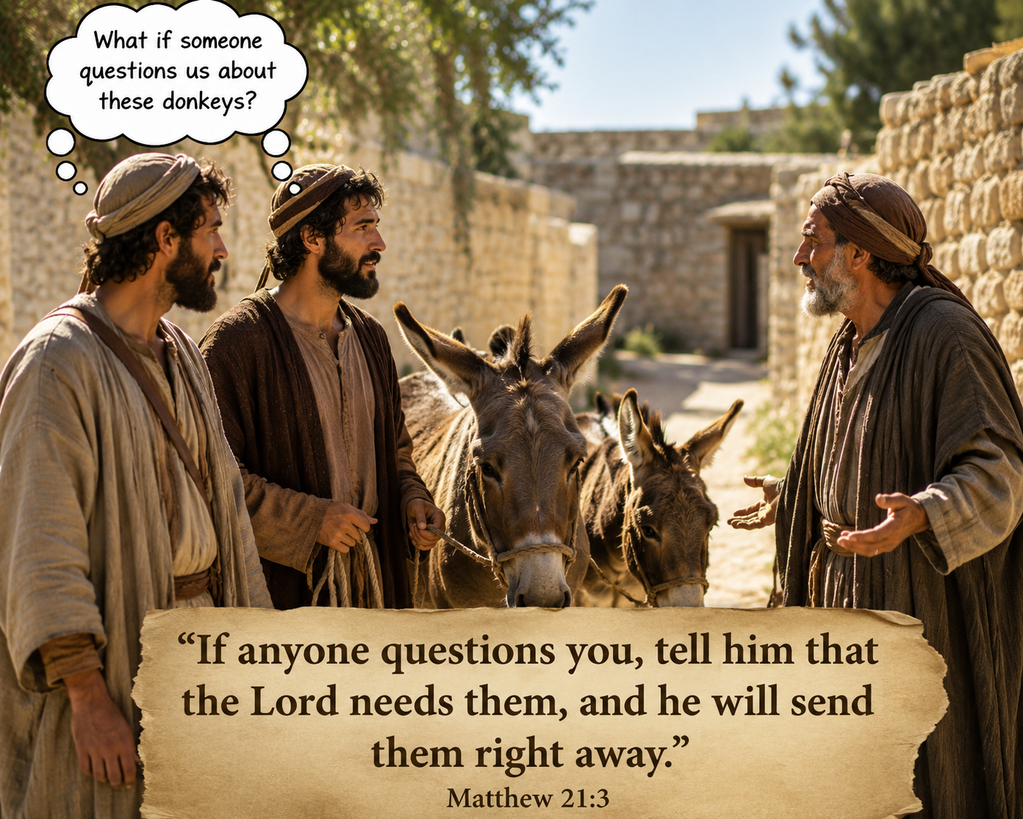
And if anyone says anything to you, you shall say, ‘The Lord has need of them,’ and immediately he will send them.” Matthew 21:3
Note: You can listen to today’s commentary courtesy of our friends at the “Bible in Ten” podcast. (Click Here to listen)
You can also read this commentary, scrolling with music, courtesy of our friends at “Discern the Bible” on YouTube. (Click Here to listen), or at Rumble (Click Here to listen).
“And if anyone, to you, he says anything, you will say that the Lord, these – need, He has. Immediately, also, he will send them.” (CG)
In the previous verse, Jesus instructed two of His disciples to go to the village opposite them, where they would find a donkey tied and with her colt. He instructed them to loosen them and bring them to Him. He continues this instruction, saying, “And if anyone, to you, he says anything.”
It is something one would expect. Imagine being told to go to the nearest village, and when you find a silver Toyota Corolla parked by a bank, you are to get in it and bring it back to your boss. You would expect someone to say something as you got into it. This is the same general sense.
Donkeys were personal property. They were used for transportation, and they were generally parked somewhere accessible for the owner to load them up with goods or himself and move along.
Therefore, one would expect to be challenged when two unknown people came up and started untying donkeys that didn’t belong to them. If such were the case, Jesus continues, “you will say that the Lord, these – need, He has.”
The meaning of “Lord” is not easily discernible. The word can mean the Lord, Yehovah. If this is the intent, it does not mean that the disciples thought Jesus was Yehovah. That will only be understood later. However, it could be a way of saying, “Yehovah has a need for this,” just as we might say, “I am doing this on behalf of God.”
It could also mean Lord in the sense of the Messiah. The word “Lord” is preceded by the definite article. It doesn’t say “our Lord,” but “the Lord.” Lazarus has been raised. People at this time, who lived in this area, would have come to believe Jesus was the promised Messiah. The events of the triumphal entry certainly indicate this. That is seen in John’s gospel –
“Then many of the Jews who had come to Mary, and had seen the things Jesus did, believed in Him. 46 But some of them went away to the Pharisees and told them the things Jesus did. 47 Then the chief priests and the Pharisees gathered a council and said, “What shall we do? For this Man works many signs. 48 If we let Him alone like this, everyone will believe in Him, and the Romans will come and take away both our place and nation.” John 11:45-48
The term Lord can also mean “master” when spoken by any given person. Thus, the disciples could have been saying, “Our master needs it, and it will be returned in due time.” The second option seems the most likely.
They are in the area where Lazarus was raised. Jesus had many disciples who thought He was the Messiah. The local people were already believing this as well. And so, saying the Lord needed the donkey would be sufficiently understood that the owners would agree. This is debated, and the true intent can only be speculated. No matter which is correct, Jesus confidently says, “Immediately, also, he will send them.”
This almost gives the sense that Jesus had talked with these people and told them that in a day (or a few days), He would send men to come borrow their donkeys. If so, then it would resolve any hint of questioning, apart from the initial encounter. “Oh, you are Jesus’ disciples. Yes, go ahead and take them.”
Life application: As you can see, any of the three options for what is occurring is possible. The word kurios, lord, is used to describe Yehovah in Matthew 1:20. In Matthew 20, the blind men called out to Jesus, calling Him Lord while asking for healing. They probably meant “Lord” as in Messiah.
In 1 Peter 3:6, the term is used of Abraham being called lord by Sarah. He is the master of the house. One can see that care needs to be taken when trying to determine who is being referred to when such a word is used.
If there is this much difficulty over a single word, it shows us that we should be attentive to what is going on in Scripture, considering all possibilities. Reading commentaries can help clarify such difficulties, or they can further muddy the waters, especially when two sound theologians come to differing conclusions.
As the proverb says –
“The first one to plead his cause seems right,
Until his neighbor comes and examines him.” Proverb 18:17
Don’t just jump on the first explanation of a matter without considering that there may be better options to explain it.
O God, Your word is big and often complicated, but it is not impossible to understand. It gives us many challenges to consider and many options we can explore before grasping what is being said. What a treat this is for us! Thank You for Your wonderful word. Amen.