
Thursday, 9 July 2026
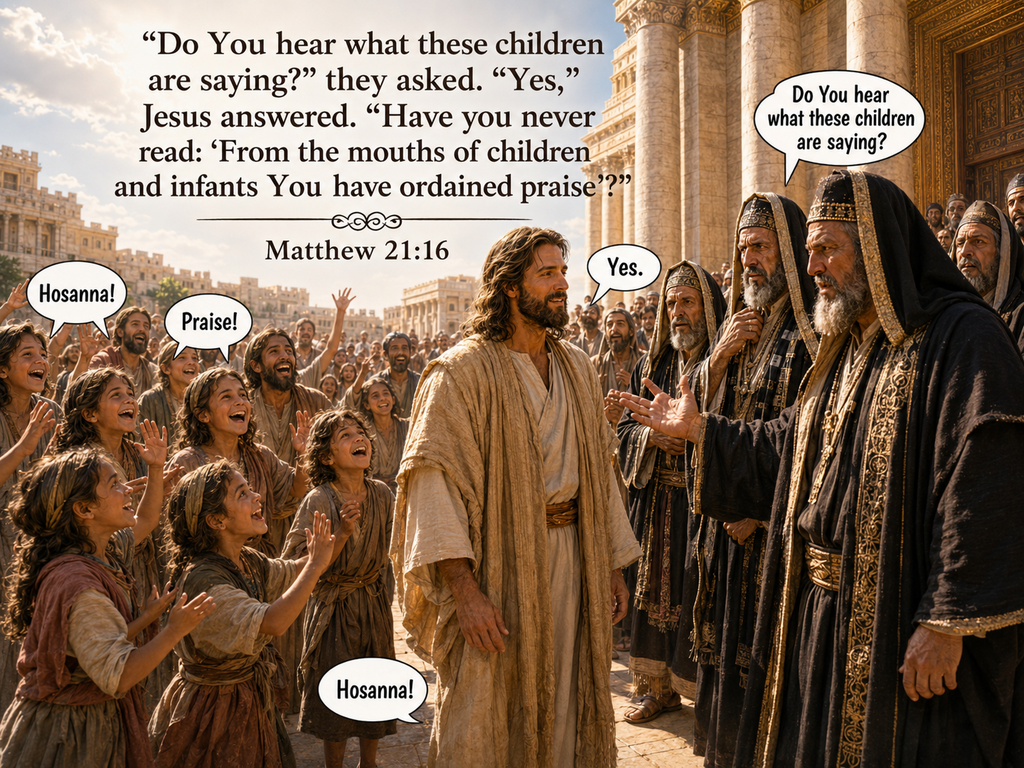
and said to Him, “Do You hear what these are saying?”
And Jesus said to them, “Yes. Have you never read,
‘Out of the mouth of babes and nursing infants
You have perfected praise’?” Matthew 21:16
Note: You can listen to today’s commentary courtesy of our friends at the “Bible in Ten” podcast. (Click Here to listen)
You can also read this commentary, scrolling with music, courtesy of our friends at “Discern the Bible” on YouTube. (Click Here to listen), or at Rumble (Click Here to listen).
“And they said to Him, ‘You hear what these, they say?’ The ‘also Jesus’, He says to them, ‘Yes. Never, you read that, “From ‘mouth, infants and sucklings’ You prepared praise.”’?” (CG).
In the previous verse, the chief priests and the scribes were jealous of Jesus and how the youths praised Him. They were outraged, “And they said to Him, ‘You hear what these, they say?’”
These jealous leaders thought they were supposed to be the highlight of people’s visit to the temple complex. Like someone visiting the White House would want to see the president, the chief priests and scribes would have thought they were the point of the masses’ desire to be there.
But like going to the White House, there is a reason beyond the person sitting at the President’s desk that the White House exists. The temple was erected to honor the Lord. With the children crying out, “Hosanna to the Son of David,” they were honoring the Lord who had sent His Messiah, someone of greater importance than the temporary leaders of Israel.
Scripture gave them the authority to minister, but each was only an incidental part of the ongoing line of priests. On
If Jesus were the fulfillment of those types and prophecies, He deserved their adoration. This outraged the self-aggrandizing leaders at the temple. As such, Matthew next records, “The ‘also Jesus’, He says to them, ‘Yes. Never, you read…’”
Once again, as He commonly did, Jesus answered their question with another question. He affirms that He, in fact, heard their cries of exaltation, but His question is then directed to their own Scriptures. If their Scriptures approve of what is occurring, the leaders could not reasonably find fault in it. And so He continues, saying, “that, ‘From ‘mouth, infants and sucklings’ You prepared praise.’?”
A new word is seen, thélazó, to suckle. It is derived from thélé, a nipple. Thus, it signifies a suckling infant. The word translated as “prepared” has been seen in Matthew 4:21, where it referred to the mending of nets. It signifies to complete thoroughly. It is as if God had fully prepared His praise through the praises of these little ones. The quote itself is from the Greek translation of Psalm 8:2 –
“Out of the mouth of babes and sucklings hast thou perfected praise” (Brenton Septuagint).
While the leaders of the temple complex were moaning about the prospects of Jesus being the Messiah, it was the little ones in the compound who had recognized what the leaders had intentionally shut their eyes to. As Jesus cited Scripture to back up their conduct, they would be silenced for the time being, unable to argue against what Scripture said would be the case.
The words of Jesus are a note concerning the incarnation. The Psalm notes that it is the Lord, Yehovah, who is the focus of attention by the babes and nursing infants. However, Jesus’ words imply that the praise given to Him fulfills the words of that Psalm. As such, it signifies that He is the Lord incarnate.
Life application: In once Christian nations, those who do not accept the authority of Scripture have taken over many governments. In doing so, there is no longer an established scriptural basis that is recognizable for right and proper conduct.
In other words, Christians will appeal to Scripture to justify their moral codes. But if those in government reject Scripture’s authority, there is an apples-against-oranges attitude. The philosophies of the warring bodies have nothing in common to agree on.
But more, those opposed to the Christian message hypocritically misuse the contents of Scripture to shut up or confound the masses who have no idea what “context” their hypocritical citations belong in. The reason their citations are hypocritical is that they wholly reject the authority of Scripture, and yet they cite Scripture to form illicit doctrines that have nothing to do with Scripture.
What Christians must be prepared to do when challenged about such things is to be bold enough to ask what right those citing Scripture have to cite it. In other words, “Oh, you are citing Scripture. Therefore, you must accept the authority of Scripture. Is this so?”
The trap is now set for them. If they acknowledge the authority of Scripture (which they normally won’t), and if the Christian properly cites Scripture that condemns the actions of these detestable people, then they no longer have an argument in their misciting of Scripture. Care and planning must be made to fend off the unholy attacks by such people. If handled properly, their hypocritical position will be evident, just as when Jesus challenged the leader of His day.
Lord God, may we carefully defend against those who mishandle Your word, considering how to rightly challenge them and then demonstrating where their hypocrisy lies. Give us wisdom in this so that we can stand against their ungodly attacks. Amen.