
Saturday, 20 June 2026
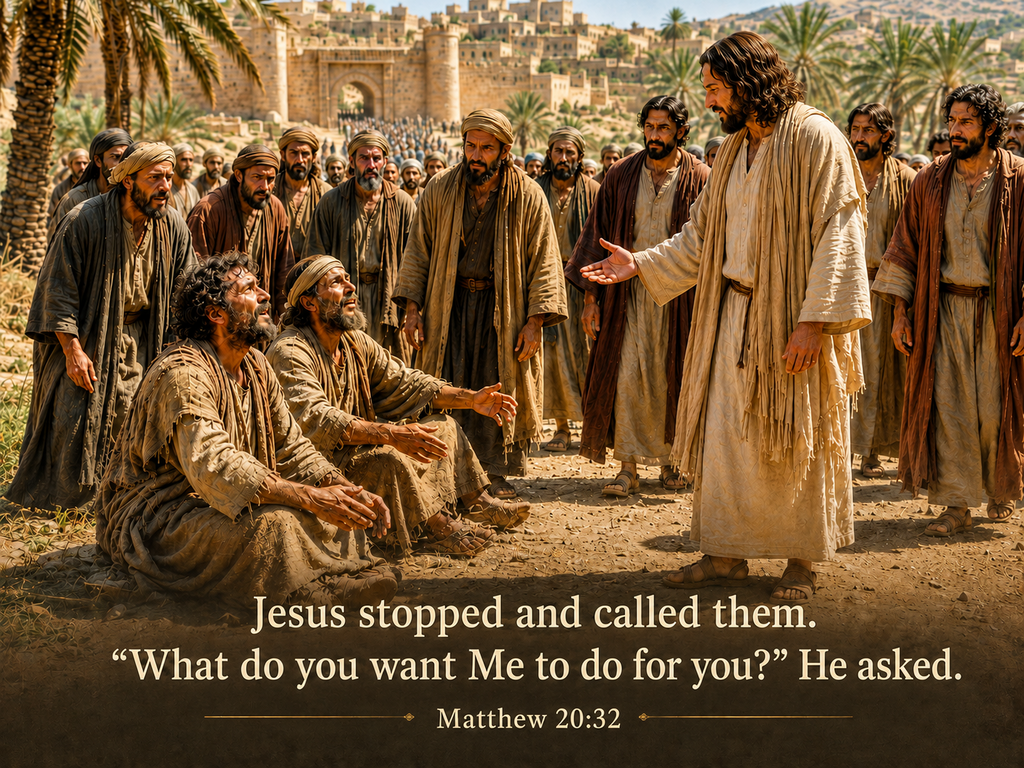
So Jesus stood still and called them, and said, “What do you want Me to do for you?” Matthew 20:32
Note: You can listen to today’s commentary courtesy of our friends at the “Bible in Ten” podcast. (Click Here to listen).
You can also read this commentary, scrolling with music, courtesy of our friends at “Discern the Bible” on YouTube. (Click Here to listen), or at Rumble (Click Here to listen).
“And having stood, Jesus, He vocalized to them, and He said, ‘What you ‘will’ I should do to you?’” (CG)
In the previous verse, the two blind men continued to cry out to Jesus, begging for His mercy upon them. Their persistence paid off, as noted by Matthew. He notes, “And having stood, Jesus.”
Eventually, Jesus neared the blind men enough so that their voices could no longer be drowned out by the crowds. As such, and certainly wanting to know why they remained at a distance, it next says that “He vocalized to them.”
A new word is seen, phóneó, to emit a sound, and thus, to vocalize. It is used when a rooster crows. It was used to describe when Jesus cried out on the cross. One can see the etymological ancestor of our modern word “phone.” Of this word, the Topical Lexicon says –
“Strong’s Greek 5455 portrays the purposeful use of the voice—whether summoning, exhorting, pleading, or proclaiming. It occurs forty-three times across the New Testament, spanning the earthly ministry of Jesus Christ, the life of the early church, and a single eschatological scene. The verb’s settings cluster around five broad spheres: personal encounters with Jesus, miraculous works, parabolic instruction, apostolic ministry, and final judgment.”
Mark and Luke give different details concerning this. Mark says that Jesus commanded (using the word “vocalized”) that the blind should be called. They called Bartimaeus, telling him that he was being called. With that, he cast aside his garment and went to Jesus. Luke agrees with this, leaving off the details about the garment.
Each account agrees, but is given from a different perspective that builds into one full scene. With the details of the calling stated, all three accounts agree on the next words, “and He said, ‘What you ‘will’ I should do to you?’”
In Matthew, the address is plural. In Mark and Luke, it is singular. The attention being on one as opposed to two was addressed in an earlier verse. If there are two, then there is one. For whatever reason, Matthew chose to focus on both while Mark and Luke focused on one individual.
One possible explanation for the difference is that despite being at the exit of the city, they were on opposite sides of the gate. If two were sitting side by side, it may be that people would only give to one, and some would go to the opposite side to avoid giving at all. But with both sides of the gate covered, the potential for more givers would be realized.
As such, Matthew, being a tax collector, would have been keenly aware of such a system. The other two accounts focused on the one specifically called first, Bartimaeus. This is speculation, but it is a logical reason why the two accounts differ in this detail.
Life application: If you have ever been to a place where people beg, you will see the proposed scenario played out. Beggars don’t just lump together, as if a person will stop and give every person a coin. Rather, they divide up in order to avoid overwhelming someone to the point where nothing is given.
Having both sides of the gate covered reasonably resolves the variation between the two accounts. The two could talk between the two of them, both raised their voices as Jesus neared, and one could speak for the other if he were called. Bartimaeus could have been called and directly asked what he wanted, and then said, “I want to see, but so does that guy over there. We are blind, Sir.”
We should not have any doubt that the accounts happened exactly as all three gospels describe, even if the details seem contradictory at first. A little thought about how things actually work in such a situation makes the entire scene understandable.
Lord God, Your word is a treasure that we can study and contemplate for all our days. Even doing this, we will never be able to fully plumb its depths. Thank You that we have it to guide us, instruct us, and challenge us as we walk before You. Amen.