
Wednesday, 10 June 2026
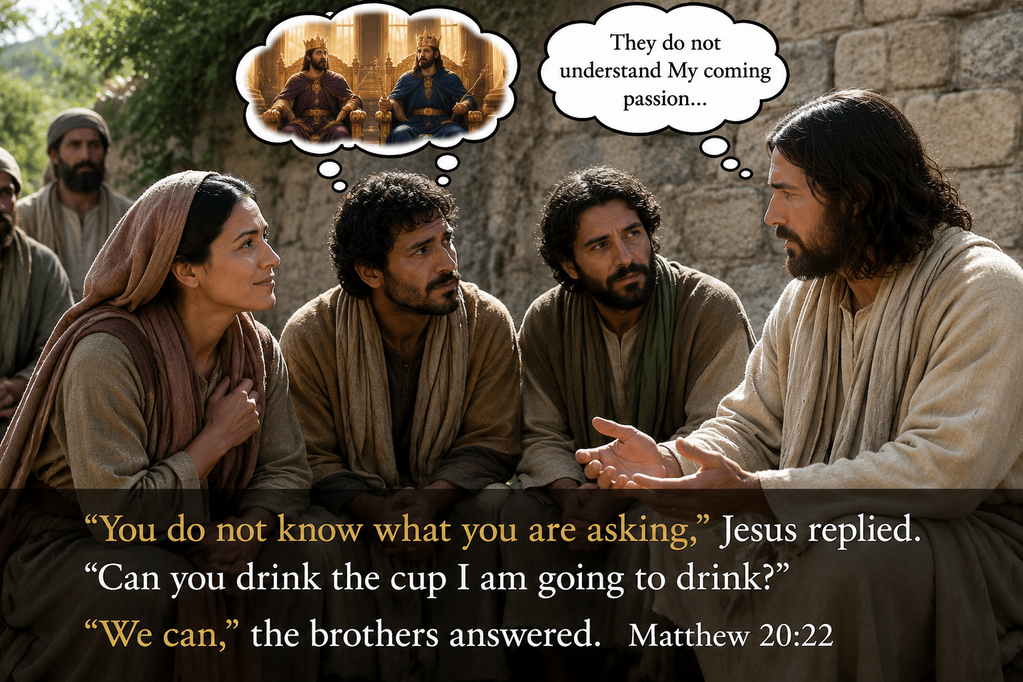
But Jesus answered and said, “You do not know what you ask. Are you able to drink the cup that I am about to drink, and be baptized with the baptism that I am baptized with?”
They said to Him, “We are able.” Matthew 20:22
Note: You can listen to today’s commentary courtesy of our friends at the “Bible in Ten” podcast. (Click Here to listen)
You can also read this commentary, scrolling with music, courtesy of our friends at “Discern the Bible” on YouTube. (Click Here to listen), or at Rumble (Click Here to listen).
“Answering, also, Jesus, He said, ‘Not you have known what you ask! Are you able to drink the cup, the ‘I, I am about to drink,’ or the immersion, the ‘I, I am immersed’ to be immersed?’
They say to Him, ‘We are able.’” (CG).
In the previous verse, the mother of Zebedee’s sons asked Jesus to grant that her two sons could sit on His right and left sides in His kingdom. In response, Matthew records, “Answering, also, Jesus, He said, ‘Not you have known what you ask!’”
As noted in the previous verse, a question like this can cause real problems for the one being asked. His mind will have to consider every contingency that may arise in the future, something such a spur-of-the-moment question will not normally allow.
Because of this, a tension arises between granting and not granting the request. In the case of Jesus, no such tension would arise. He would know and understand all future possibilities, including the negatives such a question would entail.
In this case, one of the immediate negatives is that the asker, not the one being asked, really has no idea what they (the verb is plural) are truly asking for. In the case of this question, Ellicott correctly states, “That nearness to Him in His glory could be obtained only by an equal nearness in suffering.”
It isn’t that they counted such a cost. Rather, they have no idea about such a cost. They think Jesus will be hailed by the people as the Messiah and Israel’s King, but there is not an inkling in their mind what He will go through for that to come about.
As this is so, these two men have actually put themselves ahead of Jesus. They are asking for a position in Jesus’ kingdom before He has gone through what is necessary to obtain that kingdom. It is true that their request is conditional on His securing the kingdom, but because of their ignorance of what that involves, it’s like saying, “Whatever happens that causes You to be king, we want to be there on seats with You when it is over.”
This is a natural human way of looking at things, and it is just what Jonathan did with David when he was set to become the king –
“And he said to him, ‘Do not fear, for the hand of Saul my father shall not find you. You shall be king over Israel, and I shall be next to you. Even my father Saul knows that.’” 1 Samuel 23:17
Jonathan assumed that the future was set by his words, but God’s plans and purposes must come to pass according to His will. Jesus, knowing what lies ahead in His ministry, hints that it will not be what these two men think, asking, “Are you able to drink the cup, the ‘I, I am about to drink’?”
The cup signifies one’s lot, good and bad. When one drinks from a cup of sweetness, the sweetness becomes a part of that person, invigorating him. When he drinks hemlock, it becomes a part of him, destroying his life. Jesus had come to deal with sin in humanity. Such a cup would mean God’s wrath on sin would be poured out. Israel sinned, and they received God’s cup of wrath –
“Awake, awake!
Stand up, O Jerusalem,
You who have drunk at the hand of the Lord
The cup of His fury;
You have drunk the dregs of the cup of trembling,
And drained it out.” Isaiah 51:17
Jesus’ cup would be sufficient to deal with all of the sins of humanity. Thus, it would be a terrifying cup of wrath and judgment. He continues, asking, “or the immersion, the ‘I, I am immersed’ to be immersed?”
Immersion signifies a change in direction and even in nature. John’s immersion was one of repentance, turning from sin and returning to the way of the Lord. Jesus’ immersion is found in the cross. It is the instrument of His immersion, going from life with God in Christ to immersion in death and separation from God for man’s sin.
These together, the cup and the immersion, were what Jesus was destined for. And they were not for His sake but for the world. Despite this, and having no clue what this meant, the brothers chimed in with words of confidence. Matthew records, “They say to Him, ‘We are able.’”
It is a noble and confident affirmation lacking any comprehension of what lay ahead for Jesus.
Life application: Imagine what God in Christ was willing to do to restore us to Himself. He was under no obligation to suffer the indignation, torture, and humility of the cross in order to restore us to Him. And yet, He willingly did it.
What value does God see in us? It is hard to figure but it is there. His infinite goodness meant setting aside His glory and taking on a frail, human form. And His humanity went through all the struggles and trials humans face. And then it went through more when He was judged for our sins.
If you feel you are lacking value, look to the cross of Christ. You have infinite value in God’s eyes when you accept the gospel and follow Jesus in faith.
Lord God, it is beyond our comprehension when we try to consider what the cross of Jesus truly signifies. It is the highest point of our existence when we to look and accept what it means. Everything changes from that moment on. Thank You, O God, for Jesus Christ our Lord. Thank You. Amen.