
Friday, 23 January 2026
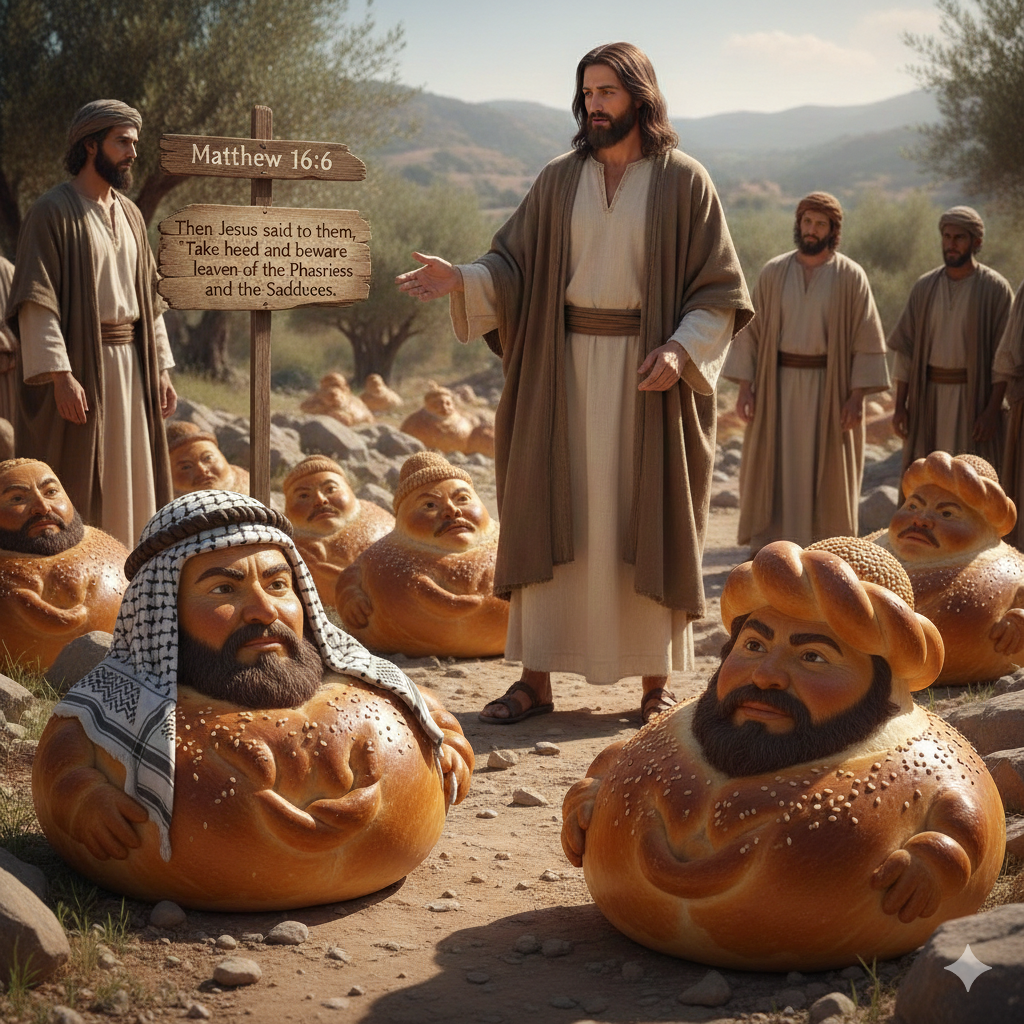
Then Jesus said to them, “Take heed and beware of the leaven of the Pharisees and the Sadducees.” Matthew 16:6
Note: You can listen to today’s commentary courtesy of our friends at the “Bible in Ten” podcast. (Click Here to listen)
You can also read this commentary, scrolling with music, courtesy of our friends at “Discern the Bible” on YouTube. (Click Here to listen), or at Rumble (Click Here to listen).
“And Jesus, He said to them, ‘You behold, and you caution from the leaven of the Pharisees and Sadducees’” (CG).
In the previous verse, it was noted that the disciples had forgotten to take bread as they traveled. Matthew next records, “And Jesus, He said to them, ‘You behold, and you caution from the leaven of the Pharisees and Sadducees.’”
Leaven, yeast, is something that has been noted many times in Scripture. It was something the people knew was forbidden during the Passover –
“Seven days you shall eat unleavened bread. On the first day you shall remove leaven from your houses. For whoever eats leavened bread from the first day until the seventh day, that person shall be cut off from Israel. 16 On the first day there shall be a holy convocation, and on the seventh day there shall be a holy convocation for you. No manner of work shall be done on them; but that which everyone must eat—that only may be prepared by you. 17 So you shall observe the Feast of Unleavened Bread, for on this same day I will have brought your armies out of the land of Egypt. Therefore you shall observe this day throughout your generations as an everlasting ordinance. 18 In the first month, on the fourteenth day of the month at evening, you shall eat unleavened bread, until the twenty-first day of the month at evening. 19 For seven days no leaven shall be found in your houses, since whoever eats what is leavened, that same person shall be cut off from the congregation of Israel, whether he is a stranger or a native of the land. 20 You shall eat nothing leavened; in all your dwellings you shall eat unleavened bread.” Exodus 12:15-20
Elsewhere, leaven is forbidden at various times during the instructions for the sacrificial offerings, etc. The disciples would probably not understand Jesus’ words outside of that type of context.
In Hosea 7:4, the use of leaven is used in a metaphorical sense, but it is not a verse that most people would look at and understand the scriptural idea that is to be explained by Jesus. There, it says –
“They are all adulterers.
Like an oven heated by a baker—
He ceases stirring the fire after kneading the dough,
Until it is leavened.” Hosea 7:4
Jesus used leaven in a parable in Matthew 13:33. That too would be tough to get metaphorical meaning out of unless the disciples specially asked Him what He was talking about. In Matthew 13:51, Jesus asked the disciples if they understood everything He had spoken to them, but it is questionable if they understood it as He is now relaying.
Their thoughts would be directed to Jesus’ words being literal, something Matthew will confirm.
Life application: As you read the Bible, there are thoughts that are presented, such as having no leaven in the house during the time of Passover and Unleavened Bread. It is right to stop and ask why that would be included.
Eventually, when you get to the New Testament, the idea of leaven being a metaphor for sin is explained several times. As this is so, we can know exactly why the Lord instructed the people as He did.
It was an instructional tool to teach us about the nature of sin, how God would deal with it in Christ, and our responsibilities, as well as our position in Christ. Because it is explained in the New Testament, we should go no further with metaphorical applications. Scripture has interpreted Scripture –
“Your glorying is not good. Do you not know that a little leaven leavens the whole lump? 7 Therefore purge out the old leaven, that you may be a new lump, since you truly are unleavened. For indeed Christ, our Passover, was sacrificed for us. 8 Therefore let us keep the feast, not with old leaven, nor with the leaven of malice and wickedness, but with the unleavened bread of sincerity and truth.” 1 Corinthians 5:6-8
Look for the meaning of things in the unfolding pages of Scripture. If no explanation is given, then careful thought should be given to why certain things are presented. Don’t just make stuff up out of your head.
Instead, let the Bible provide insights into the typology. If it is correct, a panorama of interesting information will arise that will then be consistent throughout the rest of Scripture. If this doesn’t happen and things don’t fit elsewhere, it means your original idea was not correct.
Be careful and contemplative as you consider what the word is saying.
Lord God, what a great and precious word You have given us. May we handle it carefully and analyze it in hope of finding what You intend for it to say, not what we want it to say. Help us in this endeavor, O God. Amen.