Saturday, 17 January 2026
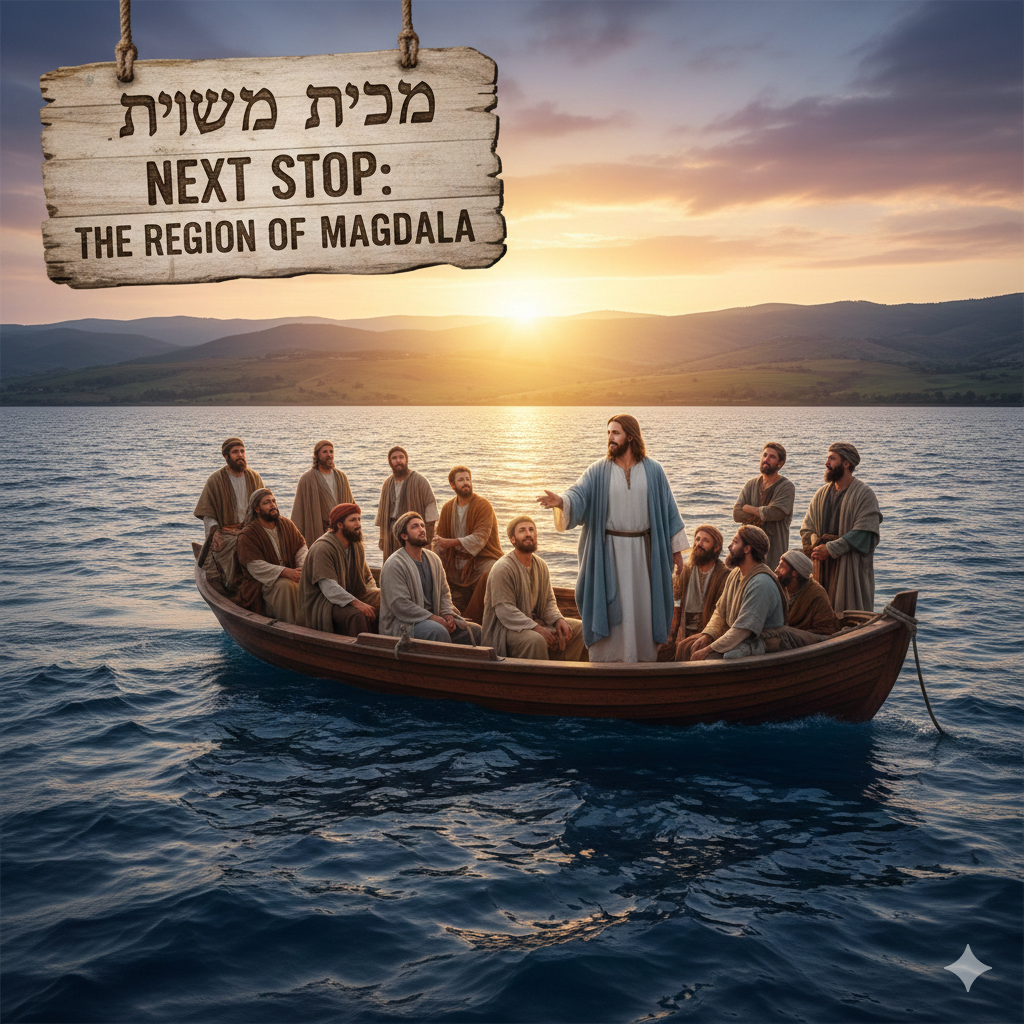
And He sent away the multitude, got into the boat, and came to the region of Magdala. Matthew 15:39
Note: You can listen to today’s commentary courtesy of our friends at the “Bible in Ten” podcast. (Click Here to listen)
You can also read this commentary, scrolling with music, courtesy of our friends at “Discern the Bible” on YouTube, (Click Here to listen), and part II (Click Here to listen).
or at Rumble (Click Here to listen), and part II (Click Here to listen).
To read the CG translation of Matthew 15, scrolling with music, on YouTube (Click Here to listen), or on Rumble (Click Here to listen).
An extra bonus from Daniel Higgins at “Bible in Ten” podcast. His input on links between Ezra and Matthew 15. (Click here to listen).
“And having dismissed the crowds, He in-stepped into the boat, and He came to the borders of Magdala” (CG).
In the previous verse, it was noted that there were four thousand men, besides women and children, who comprised the multitudes Jesus fed. With that portion of the narrative complete, and to close out the chapter, Matthew next notes, “And having dismissed the crowds, He in-stepped into the boat.”
They have been on the eastern side of the Sea of Galilee. With this cycle of attending to a Gentile woman in the allotments of Tyre and Sidon noted, followed by a time in the Gentile-led eastern regions near the Decapolis completed, He got into a boat, “and He came to the borders of Magdala.”
This is a location not named this way anywhere else in Scripture. Some manuscripts note the location as Magadan, meaning Megiddo, but that is incorrect based on Matthew 16:5, which notes they are still in the region of the lake. Rather, the town Magdala in Hebrew is Migdal-el, Tower of God, a city of Naphtali recorded in Joshua 19:38.
This is also known as Al-Majdal (Mejdel) on the western shore of the Sea of Galilee, north of Tiberias. Mark 8:10 notes that when they got in the boat, they came to the allotments of Dalmanutha. Saying it this way, there is no contradiction to be found. Just as Jesus went to the “allotments” of Tyre and Sidon, meaning the surrounding areas, in Matthew 15:21, so they went to Magdala in the allotments, meaning the surrounding areas, of Dalmanutha.
Life application: Chapter 15 of Matthew gives a picture of what is going on in the world from the time Jesus fulfilled the law until the rapture. The verses, though literally occurring at the time of Jesus, point to truths after the completion of Jesus’ ministry. The New Covenant is now what God is doing in the world. Israel as a whole, however, rejected that.
Though they no longer observe the Law of Moses, they remain bound to it. During this dispensation, they are spiritually led by rabbis, both in their writings in the Talmud as well as in their cultural and religious life.
These are reflected by the scribes and Pharisees who came from Jerusalem (verse 1) to challenge Jesus. Paul explains in Galatians 4:21-31 that the earthly Jerusalem reflects them and their teaching. The main point for now says –
“But he who was of the bondwoman was born according to the flesh, and he of the freewoman through promise, 24 which things are symbolic. For these are the two covenants: the one from Mount Sinai which gives birth to bondage, which is Hagar— 25 for this Hagar is Mount Sinai in Arabia, and corresponds to Jerusalem which now is, and is in bondage with her children— 26 but the Jerusalem above is free, which is the mother of us all.” Galatians 4:23-26
In verses 2-9, Jesus explains the state of Israel at this time, living by the laws of men rather than by the law of God. After the introduction of the New Covenant, the law of God is not the Law of Moses. Rather, that is fulfilled.
At this time, religious Israel draws near to the Lord with their lips, but their hearts, because of their rejection of Jesus, are far away from Him.
In verse 11, Jesus stated that what goes into the mouth does not defile. Rather, what comes out of it does. Though that was a truth concerning the traditions of these elders, it is a truth that is spiritually seen in Israel to this day. They refuse to proclaim Jesus.
This is their defilement. But what does Paul say concerning this? In Romans 10, he says –
“The word is near you, in your mouth and in your heart” (that is, the word of faith which we preach): 9 that if you confess with your mouth the Lord Jesus and believe in your heart that God has raised Him from the dead, you will be saved. 10 For with the heart one believes unto righteousness, and with the mouth confession is made unto salvation. 11 For the Scripture says, “Whoever believes on Him will not be put to shame.” 12 For there is no distinction between Jew and Greek, for the same Lord over all is rich to all who call upon Him. 13 For “whoever calls on the name of the Lord shall be saved.” Romans 10:8-13
The only thing that can cleanse a person from sin is Jesus. Anything else, meaning any other proclamation, defiles that person. As such, Jesus says in verse 14 to let them alone. They are blind leaders of the blind, and both will fall into a pit.
In verse 15, Jesus reexplained to dull Peter (later, the Apostle to the Jews) the matter of the heart and what it is that causes defilement. While Israel remains in their state of defilement because of their oral proclamations, something else takes place. This is seen in verse 21, where Jesus “went out from there,” meaning from the Jewish people to the allotments of Tyre and Sidon, a Gentile area.
Tyre (Hebrew: Tsor) signifies Rock. While Israel abandoned their Rock, the Gentiles received Him. That this is speaking of Christ is seen, for example, in Deuteronomy 32:32, where it says, “For their rock is not like our Rock.” There are those who are confident in their rock (tsur), and yet their rock is not the Lord who is the Rock (tsur).
Sidon (Hebrew: Tsidon) signifies Fishery. It is a place for catching fish. Everyone is like a fish. When Jesus said to Simon and Andrew that they would be fishers of men, He meant that men are like fish to be caught.
While in this area (verse 22), a Canaanite woman came to Jesus and begged for compassion for her demon-possessed daughter. Canaan signifies Humbled, Humiliated, or even Subdued. She pictures those of faith who have humbled themselves before the word of Christ.
The issue is the daughter. In Scripture, a son or a daughter is representative of the state of something. A “son of death,” for example, is a person deserving of death. That is his state. A daughter, in this case, is the state of a group of people, such as “daughter of Jerusalem,” “daughter of Tarshish,” etc. What is the state of the Daughter of the Humbled who are also Gentiles?
Jesus said in verse 24 that He had come “if not to the sheep, the ‘having been lost’ – House Israel.” Despite there being a New Covenant, with whom was that covenant made? The answer is found in both Jeremiah and Hebrews –
“Behold, the days are coming, says the Lord, when I will make a new covenant with the house of Israel and with the house of Judah.” Jeremiah 31:31
The early church did not understand that the word was to go to the Gentiles. That is a major subject found in Acts. It is representative of the disciples’ comments found previously in verse 23 when they told Jesus to dismiss her.
It literally took an act of God to get them to see that the New Covenant included Gentiles, first with the Ethiopian eunuch and then the house of Cornelius. Jesus’ calling, though, to redeem the House of Judah and Israel, is inclusive of the Gentiles of faith, as seen in this account. It is something prophesied in Isaiah 49:6, but which is revealed in typology here.
The woman was told that it wasn’t “good to take the children’s bread and cast to the puppies.” In the Bible, dogs represent Gentiles. That is seen in the Caleb series of sermons. Caleb, kalev, is from kelev, dog. It is also seen in the account of Gideon and his men, who lapped like dogs, a typological picture dealing with the Gentiles.
The woman didn’t argue Jesus’ point. Instead, she noted that “even the puppies – he eats from the crumbs, the ‘falling from their master’s table.” Jesus thus remarked concerning her great faith, something evidenced in the Gentile world. At that time, it noted the child was cured. Salvation, in fact, is also directed to the Gentiles. They are brought into the commonwealth of Israel (Ephesians 2:12).
From there, verse 29 said of Jesus that “He went near the Sea of the Galilee, and having ascended to the mountain, He sat there.” The Galilee has previously been explained as “the Liberty.” It is a picture of freedom from sin. As sin stems from a violation of law, it ultimately signifies freedom from law.
A mountain in the Bible represents a lot of something gathered. In typology, it is synonymous with a large but centralized group of people. Though it is only stated in Mark, the last area noted was the Decapolis, a Gentile controlled area.
Thus, this is typologically referring to a large but centralized group (meaning under Jesus) of Gentile people. The Canaanite woman already established that, but this is an extension of the thought, explaining the result of the dispensation of the Gentiles. In other words, “What will happen in the world once it is established that Gentiles are to be included in the New Covenant?”
In verses 30 and 31, multitudes came to Jesus for healing, so many that they were strewn about Him. It is reflective of the broken Gentile world coming to Christ for healing and salvation. As many came, He healed them so that “they glorified the God of Israel.”
As noted at that time, the term is unique in the New Testament. It suggested the presence of Gentiles on the mountain, but it typologically asserts this fact. Paul’s ministry literally shouts out the parallel to this thought in Matthew –
“Now God worked unusual miracles by the hands of Paul, 12 so that even handkerchiefs or aprons were brought from his body to the sick, and the diseases left them and the evil spirits went out of them.” Acts 19:11, 12
Was the God of Israel glorified through this? The answer is found in Romans –
“Now I say that Jesus Christ has become a servant to the circumcision for the truth of God, to confirm the promises made to the fathers, 9 and that the Gentiles might glorify God for His mercy, as it is written:
‘For this reason I will confess to You among the Gentiles,
And sing to Your name.’” Romans 15:8, 9
And…
“For I will not dare to speak of any of those things which Christ has not accomplished through me, in word and deed, to make the Gentiles obedient— 19 in mighty signs and wonders, by the power of the Spirit of God, so that from Jerusalem and round about to Illyricum I have fully preached the gospel of Christ.” Romans 15:18, 19
In verses 32-38, the feeding of the four thousand is recorded. Jesus said they had been with Him three days. In Scripture, three “stands for that which is solid, real, substantial, complete, and entire. … Hence the number three points us to what is real, essential, perfect, substantial, complete, and Divine.” Bullinger
The time these people have been with Jesus speaks of a divine fullness, something reflected in Romans 11:25, “that blindness in part has happened to Israel until the fullness of the Gentiles has come in.” It goes right back to the state of Israel, noted in Matthew 15:14, where the blind are leading the blind.
While Israel is blinded, the blind of the Gentiles (Matthew 15:31) are brought to sight. The miracle of the bread (think of Jesus, the Bread of Life) and fish (a word which signifies “increase” in Hebrew) speaks of the immense harvest. There were seven loaves, the number of spiritual perfection, and a few tiddlers. However, they were enough to feed the multitude of four thousand. The number is a product of four and tens.
Four is the number of material creation, the world number. It speaks of the entirety of the world hearing the gospel, just as Jesus said it would. Ten is the number where nothing is wanting, and the whole cycle is complete. The entire world of the Gentiles will be evangelized before the end comes.
To demonstrate the immense harvest that will be realized in the church age, the baskets of fragments were collected, totaling seven large baskets. Notice the difference from the feeding of the five thousand –
“And they ate all, and they gorged, and they lifted the superabounding pieces – twelve handbaskets full. 21And those eating, they were about five thousand men, besides women and children.”
“And they ate all, and they gorged, and the superabounding of the fragments they lifted – seven hampers full. 38And those eating, they were four thousand men, besides women and children.”
Whereas a remnant of the twelve tribes of Israel represented by the twelve small handbaskets (Greek: kophinos) was collected, there will be an immense harvest of the seven churches (as defined in Revelation 2 & 3), represented by the seven large hampers (Greek: spuris).
The chapter ended with a location only mentioned here in Scripture, saying of Jesus, “And having dismissed the crowds, He in-stepped into the boat, and He came to the borders of Magdala.”
The town Magdala in Hebrew is Migdal-el, Tower of God, a city of Naphtali recorded in Joshua 19:38. Migdal El is contrasted to the tower of man, meaning Babel and all that accompanies her. Thus, this is implicitly a picture of the ending of the church age, where believers are delivered from the Babylon of the end times recorded in Revelation.
To understand why these conclusions have been made, one should refer to the descriptions of these locations found in the Old Testament sermons given by the Superior Word. Each location, number, or other reference has been drawn from the information already recorded there. Thus, the typology is not new. It has already been seen and has been reused without change, confirming that this analysis of Matthew 15 is sound.
Lord God, Your word is beyond amazing. It is a lifeline for the soul caught in despair. It is a treasure for the seeker of riches. It is a guide for the path of our lives. And Lord, it is so much more. It is so glorious to enter into its pages and find rest for our souls in the Person of Jesus Christ, our Lord. Thank You for this precious word. Amen.
Matthew 15 (CG)
1Then they came to Jesus from Jerusalem, scribes and Pharisees, saying, 2“Through what – Your disciples, they sidestep the tradition of the elders? For they wash not their hands when they may eat bread.”
3And answering, He said, to them, “Through what – also you, you sidestep the ‘God’s commandment’ through your tradition? 4For God, He enjoined, saying, ‘You honor your father and your mother,’ and the ‘disparaging father or mother,’ death – he expires!’ 5And you, you say, ‘Whoever, he should say to father or mother, “Gift – whatever if from me you should benefit.”’ 6And no, not he should honor his father or his mother. And you invalidated God’s commandment through your tradition. 7Hypocrites! Well, Isaiah, he prophesied concerning you, saying,
8‘He neared Me, this people – the mouth,
And the lips – he honors Me,
And their heart, it distances far from Me.
9And vainly they revere Me,
Teaching instructions – men’s injunctions.’”
10And having summoned the crowd, He said to them, “You hear and comprehend! 11Not the ‘entering into the mouth’ it profanes the man, but the ‘proceeding from the mouth,’ this, it profanes the man.”
12Then His disciples, having come near, they said to Him, “You have known that the Pharisees, having heard the saying, they stumbled!” 13And having answered, He said, “Every planting that not He planted, My heavenly Father, it will be uprooted. 14You leave them! They are blind, blind-conductors. And blind, if they should conduct, both – they will fall into a pit.”
15And Peter, having answered, he said to Him, “You expound to us this parable.”
16And Jesus, He said, “And yet, you, you are unintelligent! 17Not yet you grasp that all, the ‘entering into the mouth,’ into the stomach it contains, and into the john it ejects? 18And those proceeding from the mouth, it comes from the heart, and those, it commonizes the man. 19For from the heart, they come: evil meanderings, murders, adulteries, harlotries, thefts, false-witnessings, blasphemies. 20These, they are, the ‘defiling the man,’ but to eat with unwashed hands, not it defiles the man.”
21And having departed thence, Jesus, He withdrew to the allotments – Tyre and Sidon. 22And you behold! A Canaanite woman from those same borders, having come, she cried to Him, saying, “You compassionate me, Lord, Son of David! My daughter, she is demon possessed-badly.”
23And He answered not a word.
And having approached, His disciples, they entreated Him, saying, “You dismiss her! For she cries after us.”
24And answering, He said, “Not, I was sent, if not to the sheep, the ‘having been lost’ – House Israel.”
25And having come, she worshipped Him, saying, “Lord, You rush-relieve me!”
26And answering, He said, “It is not good to take the children’s bread and cast to the puppies.”
27And she said, “Yes, Lord. And even the puppies – he eats from the crumbs, the ‘falling from their master’s table.’”
28Then, Jesus answering, He said to her, “O! Woman, your faith is great! It become to you as you determine.” And she’s cured, her daughter, from that hour.
29And having departed thence, Jesus, He went near the Sea of the Galilee, and having ascended to the mountain, He sat there. 30And they came to Him, great crowds, having with them lame, cripples, blind, mutes, and others – many, and they strewed them near Jesus’ feet, and He healed them. 31So too, the crowds marveled, seeing mutes speaking, cripples healthy, lame walking, and blind seeing, and they glorified the God of Israel.
32And Jesus, having summoned His disciples, He said, “I gut-wrench upon the crowd because already three days they bivouac with Me, and naught they have that they may eat. And I wish not to dismiss them unfed, not lest they should collapse in the way.”
33And the disciples, they say to Him, “Whence to us in solitude – loaves so many as to gorge a crowd so vast?”
34And He says to them, Jesus, “How many loaves do you have?”
And they said, “Seven, and a few tiddlers.”
35And He ordered the crowds to sit upon the ground. 36And having taken the seven loaves and the fish, and having thanked, He broke, and He gave to His disciples, and the disciples to the crowd. 37And they ate, all, and they gorged, and the superabounding of the fragments they lifted – seven hampers full. 38And those eating, they were four thousand men, besides women and children. 39And having dismissed the crowds, He in-stepped into the boat, and He came to the borders of Magdala.