Acts 17:2

Medal of Honor recipients. Washington Capitol.

Tuesday, 23 May 2023

Then Paul, as his custom was, went in to them, and for three Sabbaths reasoned with them from the Scriptures, Acts 17:2

Note: You can listen to today’s commentary courtesy of our friends at “Bible in Ten” podcast. (Click Here to listen).

You can also read this commentary, with music, courtesy of our friends at “Discern the Bible” on YouTube. (Click Here to listen), or at Rumble (Click Here to listen).

The previous verse noted that Paul and Silas had passed through Amphipolis and Apollonia, and had arrived at Thessalonica, noting that there was a synagogue of the Jews there. Now, the narrative continues with, “Then Paul, as his custom was.”

Rather, the verb is a perfect participle. Though a little clunky, it more rightly reads, “And Paul, as customized.” He was habitual in this regard, always following the same pattern which was that he “went in to them.”

As seen elsewhere, such as in Acts 13 and 14, Paul made it his habit to go into the synagogue of whatever city he traveled to. Being a rabbi, he would be respected for his training and sought after concerning his knowledge. This is no different than visiting pastors in churches today. They may be tested to check their doctrine, asked specific questions about various matters, and even asked to say a word at times. As for Paul in Thessalonica, it next says, “and for three Sabbaths reasoned with them.”

Paul’s reasoning would be concerning Christ Jesus. He certainly took the time to carefully show all the key details concerning what the ministry of the Messiah would be. The word translated as “reasoned” is dialegomai. It comes from dia, through, and legó, to say. According to HELPS Word Studies, it “is the process of giving and receiving information with someone to reach deeper understanding – a “going back-and-forth” of thoughts and ideas so people can better know the Lord (His word, will).”

As for these reasonings, it was not just something made up in his own head or that was passed down from other rabbis as tradition. Rather, he reasoned with them “from the Scriptures.” As Scripture is inspired by God, it is the ultimate source for people to know the Lord. Many of the things prophesied about the Messiah can only be clearly understood after the coming of Jesus. Even today, those who reject Jesus cannot clearly understand what is being conveyed concerning the role of the Messiah.

Thus, one may carefully reason from Scripture, aligning what it says with what Jesus has done. In this type of exchange of thoughts, if a person is willing to accept what is presented, there will be the illumination of Scripture so that it is properly understood. This is what Paul strove to do over those three Sabbaths at the synagogue in Thessalonica.

Life application: Paul took his time and reasoned from the Scriptures in order to bring understanding to those he spoke with. One cannot reasonably reason from Scriptures if those Scriptures are manipulated. It is the job of a translator to do what? Yes, you in the third row. Correct! The job of a translator is to translate.

In the case of the verb of this verse, often translated as “his custom was,” which is a noun and a verb, a verbal form was used to get a clearer sense, “And Paul, as customized.” The meaning here is not that much different and anyone would get the sense of what was being said from either translation. However, can you see any marked and purposeful change between these versions of Acts 17:2 –

According to his usual practice, Sha’ul went in; and on three Shabbats he gave them drashes from the Tanakh, (CJB)

And as he did bekvius (regularly), Rav Sha’ul joined their minyan, and on shloshah Shabbatot, he gave them drashot from the Kitvei HaKodesh, (OJB)

And according to his practice, Sha’ul went in unto them, and for three Shabbathoth was reasoning with them from the Scriptures. (Hallelujah Scriptures)

Then Paul, as his custom was, went in to them, and for three Sabbaths reasoned with them from the Scriptures,

Some of the differences are the use of Jewish wording to convey the same idea, making it simpler for a Jewish person to understand. That is an acceptable way of making something more understandable for a target audience. Obviously, if a person was never Jewish, it would be pointless to try to learn all new terminology just to understand what the Bible is saying.

However, in all three of these Jewish Bibles, there is a purposeful manipulation of the name Paul. As noted above by the person in the third row, the job of a translator is to translate, not manipulate. Paul’s Hebrew name, Saul, is stated 21 times in Acts 1-12. In those same chapters, the name Paul is never stated. However, in Acts 13-28, the name Paul is mentioned 132 times, whereas Saul is mentioned twice and only as an explanation of past events.

There is a reason for this that is completely obliterated by these manipulated Bibles. To change the name Paul to Saul as they have done is to change Scripture. As noted above, one cannot reasonably reason from Scriptures if those Scriptures are manipulated. God has revealed the redemptive narrative in His word. This includes the renaming of Saul to Paul.

When people with a set and perverse agenda purposefully twist what He has presented, it undermines the very intent of what God has put forth. The changing of Paul’s name is not an irrelevant issue. It is a key and central point of doctrine when rightly studied and understood. Further, combining a study of the uses of Peter’s name in relation to Paul’s name gives an even deeper understanding of what God is presenting. These things can no longer be rightly understood, studied, and discussed when the Scriptures have been so thoroughly distorted.

Don’t get caught up in the “Hebrew Hype” that all things Jewish are better than what has been presented for the past two thousand years. God has given us His word. When it is translated, the translator is to translate, not manipulate. Pay heed to this. Study to show yourself approved. And don’t get sidetracked by those who purposefully try to sway you away from what is proper.

Heavenly Father, Your word is far too precious to be marginalized, twisted, manipulated, trifled with, or distorted. Keep us from unsound translations of it and keep us from unsound teachers of it. May we carefully and tenderly consider this precious and sacred word all our days. Amen.




Acts 17:1

Monday, 22 May 2023

Now when they had passed through Amphipolis and Apollonia, they came to Thessalonica, where there was a synagogue of the Jews. Acts 17:1

Note: You can listen to today’s commentary courtesy of our friends at “Bible in Ten” podcast. (Click Here to listen)

You can also read this commentary, with music, courtesy of our friends at “Discern the Bible” on YouTube. (Click Here to listen), or at Rumble (Click Here to listen).

As Acts 16 ended, Paul and Silas were noted as having departed from Philippi. It may be that Timothy or others accompanied them, but this is unstated. With their departure, Acts 17 now begins, saying, “Now when they had passed through Amphipolis and Apollonia.”

Of these two cities, Albert Barnes notes the following –

Amphipolis – This was the capital of the eastern province of Macedonia. It was originally a colony of the Athenians, but under the Romans it was made the capital of that part of Macedonia. It was near to Thrace, and was situated not far from the mouth of the river Strymon, which flowed around the city, and thus occasioned its name, around the city. … The position of Amphipolis is one of the most important in Greece. It stands in a pass which Traverses the mountains bordering the Strymonic Gulf, and it commands the only easy communication from the coast of that gulf into the great Macedonian plains, which extend, for 60 miles, from beyond Meleniko to Philippi. The ancient name of the place was ‘Nine Ways,’ from the great number of Thracian and Macedonian roads which met at this point. The Athenians saw the importance of the position, and established a colony there, which they called Amphipolis, because the river surrounded it.

Apollonia – This city was situated between Amphipolis and Thessalonica, and was formerly much celebrated for its trade.

After having passed through these two cities, it next says that “they came to Thessalonica.” Again, Albert Barnes provides a description for us to consider –

“This was a seaport of the second part of Macedonia. It is situated at the head of the Bay Thermaicus. It was made the capital of the second division of Macedonia by Aemilius Paulus, when he divided the country into four districts. It was formerly called Therma, but afterward received the name of Thessalonica, either from Cassander, in honor of his wife Thessalonica, the daughter of Philip, or in honor of a victory which Philip obtained over the armies of Thessaly. It was inhabited by Greeks, Romans, and Jews. It is now called Saloniki, and, from its situation, must always be a place of commercial importance. It is situated on the inner bend of the Thermaic Gulf, halfway between the Adriatic and the Hellespont, on the sea margin of a vast plain, watered by several rivers, and was evidently designed for a commercial emporium.”

Of Thessalonica, it says, “where there was a synagogue of the Jews.” The account doesn’t say why the two passed through the other two cities without stopping, but it could be that there was no synagogue. This even seems likely because, in the text used by the NKJV, there is an article before the word synagogue, thus it is “the synagogue.” Thus, it would explain why they simply passed through the other two cities.

However, it may be that the two arrived in Thessalonica on a Friday and decided to attend the synagogue on a Saturday. Without knowing why this city was chosen, only speculation can be made.

As for the distances between the cities, it was about 33 miles from Philippi to Amphipolis. It was then about 30 miles from Amphipolis to Apollonia. From there, it was about 37 miles from Apollonia to Thessalonica. Each is about one day’s journey, and so it could be that this is how they went, arriving at Thessalonica late on the third day. It is only speculation, but the distances make this a possibility. If so, the journey was in three parts and so it is recorded as such.

Life application: The difficulties and trials of Philippi are behind the missionaries. They may have wondered why things happened as they did, but later understanding came to them. Paul explains this in his first letter to those at Thessalonica –

“For you yourselves know, brethren, that our coming to you was not in vain. But even after we had suffered before and were spitefully treated at Philippi, as you know, we were bold in our God to speak to you the gospel of God in much conflict.” 1 Thessalonians 2:1, 2

Those in Thessalonica had been evangelized because Paul and Silas had been treated shamefully at Philippi. What was certainly considered evil to them turned out for good for those at Thessalonica. And Paul would certainly not trade a single stripe on his back once he realized how things turned out. Each new convert was seen to be worth the troubles they had faced. And with a church up and running at Philippi, things were moving forward for them as well.

Trust that God’s plan is unfolding as it should. Despite the enormous trials we may face, He is not unaware of them, nor is He not caring about them. Our patience and trust will be rewarded someday. God will not leave anything unremembered. So, stand fast in Him and in the surety that you are just where He wants you.

Lord God, how good it is to know that You have it all under control. For sure, we can trust this and be confident that what You have purposed will come about. As glory is said to be ahead of us, why should we be overwhelmed with the troubles of today. Help us to keep an eternal perspective as we live out our lives. Amen.


Acts 16:40

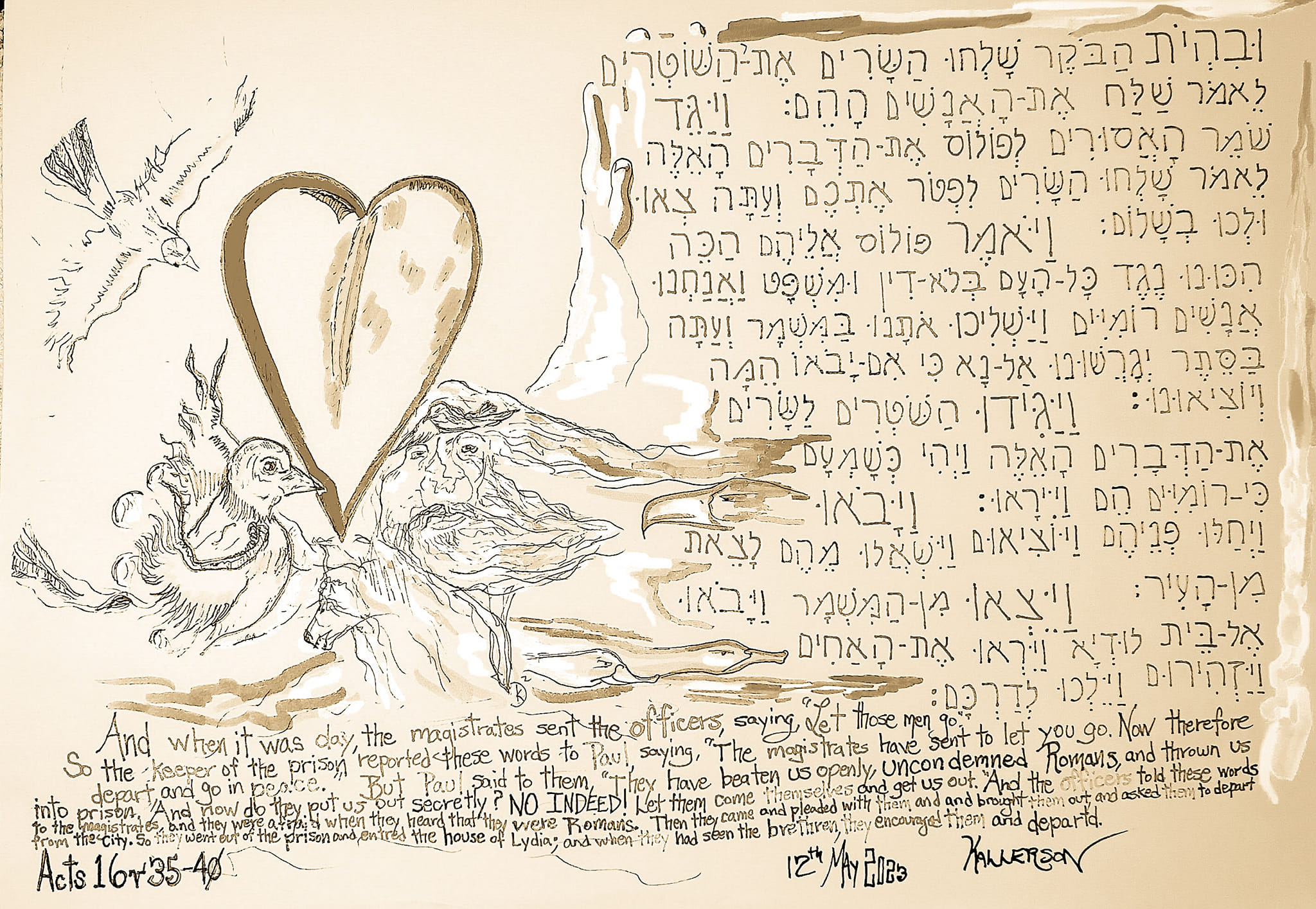
Artwork by Douglas Kallerson

Sunday, 21 May 2023

So they went out of the prison and entered the house of Lydia; and when they had seen the brethren, they encouraged them and departed. Acts 16:40

Note: You can listen to today’s commentary courtesy of our friends at “Bible in Ten” podcast. (Click Here to listen)

You can also read this commentary, with music, courtesy of our friends at “Discern the Bible” on YouTube. (Click Here to listen), or at Rumble (Click Here to listen).

Note: This translation will be used for the analysis: “And having gone forth from the prison, they came to Lydia, and having seen them, they exhorted the brothers and departed” (CG).

Paul and Silas had been asked to depart from the city by the magistrates. In response to that, it now says, “And having gone forth from the prison, they came to Lydia.” The meaning is that they came to Lydia’s house. The reason for going to Lydia’s house goes back to verse 16:15. There, she implored the men to stay with her and they were persuaded to do so. Upon arriving there, it says, “and having seen them.”

The meaning is that Paul and Silas saw the others who had accompanied them. Lydia and others may have been there as well. The words are not specific, but it at a minimum means the brothers. That is seen in the next words where it says that “they exhorted the brothers and departed.”

Luke returns to the third person here. Thus, it means that Paul and Silas exhorted the brothers, and they left without Luke joining them. From the account, it can be inferred that Luke stayed in Philippi. He will be with them again in Acts 20.

As for Timothy, it is uncertain what he did at this time. He may have remained in Philippi and then met up with Paul and Silas in Berea, or he may have gone with Paul and Silas to their next stop of Thessalonica, simply not being mentioned while there. Either way, he will specifically be noted as with Paul and Silas in Berea in verse 17:14.

Life application: Luke appears to have stayed in Philippi, making it his home base for evangelism. As he was not considered a part of the trouble that arose with the magistrates, he was a good candidate to remain there and work with the church. This is speculation, but the next time he will be mentioned, it will be connected with Philippi, so this is a good guess.

The Lord is working things out according to a plan that is far greater than any single person. What we may see as an unhappy occasion may turn out to be a more effective chance to evangelize. This is certainly the case now. Paul and Silas will depart and head to their next location. There, a church will be established. With brothers already established in Philippi, there will be a greater chance for further evangelism there. There will also be the chance to grow in the faith there as well.

Don’t look at setbacks as events that are out of control. It may be true from our perspective, but it never will be from God’s. Trust that. You are a part of something that is bigger than you, and God is working out His plans accordingly.

O God, there are times when it feels like our wheels are spinning and we are not getting any traction at all. At such times, help us to focus on the bigger picture. Your word is going out around the world and churches are faithfully teaching it. Our lack of progress does not mean that the whole world has stopped. And so, may we pray for the others as we await our forward movement once again. Amen.


Acts 16:39

Saturday, 20 May 2023

Then they came and pleaded with them and brought them out, and asked them to depart from the city. Acts 16:39

Note: You can listen to today’s commentary courtesy of our friends at “Bible in Ten” podcast. (Click Here to listen)

You can also read this commentary, with music, courtesy of our friends at “Discern the Bible” on YouTube. (Click Here to listen), or at Rumble (Click Here to listen).

The NKJV does not properly translate the verbs. For this verse, the following will be used – “And having come, they consoled them, and having brought them out, they were asking them to go out from the city” (CG).

With the demand by Paul in verse 16:27 having been communicated to the magistrates to come and usher Paul and Silas out of the prison personally, it now says, “And having come, they consoled them.”

The word translated as consoled has a wide variety of significations, and so the context will determine what is said. Various translations say besought, pleaded, apologized, placated, appeased, appealed, etc. One can put themselves in the place of these magistrates to consider what occurred.

They certainly did not want to come to the prison, but under the circumstances, they really had no choice. They had violated the rights of Roman citizens and could have been held liable for what had transpired. Despite the utterly humiliating state they found themselves in, they came to the prison and probably fell all over themselves with apologies, reassurances, promises of restitution, or whatever else would come to the minds of people in such a situation. Hence, they were trying to console or placate Paul and Silas.

With that noted, it next says, “and having brought them out, they were asking them to go out from the city.” The main reason for this request would probably be to allow the magistrates to save face. One can see them having placated Paul and Silas enough to not bring charges against them. But even if they didn’t, the magistrates were afraid that others might find out about their wrongdoing if the two of them stayed. They would be humiliated and may lose their jobs simply because word would eventually get around. One can imagine the magistrates saying, “Please, just go. We don’t want any more trouble.”

Along with this, but still tied into it, would be the thought that there could be more trouble stirred up if some of the mob later came across Paul and Silas. Still not knowing Paul and Silas were Romans, more trouble could arise from their taunts or actions. This would eventually necessitate the intervention of the magistrates. At that time, the truth would come out and things would devolve for the magistrates from that point on. Therefore, getting these two to depart would be the happiest resolution for them.

Life application: Paul and Silas had to decide what was the best course of action to take. They could have stirred up the masses and gotten the magistrates in trouble, but who would that have helped?

They had converts in the city, including the jailor who was probably standing right there listening to the entire conversation. He would evaluate his own walk with the Lord by the actions of Paul and Silas.

In being gracious to their persecutors, he would learn to be gracious in his own actions. He would probably be more willing to speak about Jesus as well. Instead of fighting for his own gain in life, he would learn a valuable lesson about priorities.

Paul and Silas could come back at any point and there were others from their group who could stay and continue the work. Each thing had to be considered and weighed out accordingly. We too should look at the whole situation when something arises and consider what will bring the glory to God while maintaining or strengthening the faith of those who are involved. Let us consider this as we go forth each day.

Lord God, give us wisdom in our dealings with others. May we always strive to find the right balance in our actions so that people will see that we are people of integrity and who are rightly directed to follow You as we continue on life’s path. May it be so, O God. Amen.


Acts 16:38

Artwork by Douglas Kallerson

Friday, 19 May 2023

And the officers told these words to the magistrates, and they were afraid when they heard that they were Romans. Acts 16:38

Note: You can listen to today’s commentary courtesy of our friends at “Bible in Ten” podcast. (Click Here to listen)

You can also read this commentary, with music, courtesy of our friends at “Discern the Bible” on YouTube. (Click Here to listen), or at Rumble (Click Here to listen).

In the previous verse, Paul refused the notion that he and Silas were to be released secretly. Rather, he demanded that the magistrates come and personally release them. Luke now continues with, “And the officers told these words to the magistrates.”

A different word is translated as “words” here than in verse 16:36. There it was logos, the expression of a thought to the jailor – “let those men go.” Now, the word rhéma is used. It signifies an utterance or saying. Paul had thoroughly conveyed the situation in verse 16:37, and the sayings which he spoke forth have been transmitted to the magistrates by those who received them – “they have beaten us openly, uncondemned Romans, and have thrown us into prison.”

It is those sayings that were carried back to the magistrates by those who were sent. This is now the second and last use of the word rhabdouchos, or rod-bearer, in Scripture. They had been sent to tell Paul and Silas they could leave. With Paul’s refusal, they have carried their report back to the magistrates. Upon hearing these sayings, it next says of the magistrates that “they were afraid.”

Rather than Paul and Silas, it is the city’s magistrates who are the offenders. They were now liable for what had occurred under their direction and authority. This certainly came as an enormous shock to them “when they heard that they were Romans.”

It probably never dawned on them to even stop and ask. A complaint was made against them, noting that they were Jews. Further, the one complaining said that these Jews were teaching “customs which are not lawful for us, being Romans.” A contrast was made between “these Jews” and “us Romans” by the accusers. And so, without doing what they should have done, they shamefully treated Paul and Silas, Roman citizens.

Life application: If you are in a position of authority, the best thing to do is to try to seek out the details of a matter clearly and precisely. Sometimes, something seemingly convincing may not be that way at all. To assume without verification can lead to all kinds of trouble. Enmity between friends can arise. Divisions in the church may crop up. Jobs can be lost. One might become legally liable for making such a hasty and incorrect decision.

It is best to step back from a matter, do a careful check of the relevant details, and then act. Keep this in mind. Things that may seem small or unimportant may carry more weight than you realize.

Lord God, help us to use wisdom in how we interact with others, especially when there may be a point of conflict or trouble that arises. A little bit of due diligence can go a long way, so help us to remember this and apply it to our daily lives. Give us discernment and right thinking in this, O God. Amen.