Acts 10:21

Science and Technology Statues, capitol, Salt Lake City, Utah.

Saturday, 17 September 2022

Then Peter went down to the men who had been sent to him from Cornelius, and said, “Yes, I am he whom you seek. For what reason have you come?” Acts 10:21

Note: You can listen to today’s commentary courtesy of our friends at “Bible in Ten” podcast. (Click Here to listen).

You can also read this commentary, with music, courtesy of our friends at “Discern the Bible” on YouTube. (Click Here to listen), or at Rumble (Click Here to listen).

In the previous verse, the Spirit had told Peter to go down and go with the men who were at the gate and to not doubt. Now, the thought continues with, “Then Peter went down to the men.”

With immediate compliance to the word, he descended from the roof and proceeded to the gate. There, he met the men “who had been sent to him from Cornelius.” These words are not found in most manuscripts. John Gill notes that the clause “is not in Beza’s most ancient copy, nor in the Alexandrian copy, nor in the Vulgate Latin, Syriac, Arabic, and Ethiopic versions.”

Despite this, it is already understood that this is who he is meeting. Whether the words are original or not, it does not leave any void in one’s understanding concerning those whom Peter had gone down to meet. With this understood, Luke next records, “and said, ‘Yes, I am he whom you seek.’”

These words are in response to verse 10:19, which said, “While Peter thought about the vision, the Spirit said to him, ‘Behold, three men are seeking you.’” Peter already knew that he was being sought. This was probably told to him again by those who met the three at the gate (as is seen in verses 17 & 18).

Therefore, he was certainly fully prepared to find out what was so important that God had given him a vision and that the Spirit had expressly spoken to him about the events that were now taking place. And so, probably very excitedly, he asked them, “For what reason have you come?”

The vision had left him with more questions than answers. The Spirit’s directives had certainly hinted to him that the answers were to be found in the arrival of these three men, and so the question must have burst out of him like the breach of a dam. The inquisitive excitement of the moment will find its fulfillment in the verses ahead.

Life application: Peter wanted to know what the word of the Lord that had been conveyed to him meant, and so he asked those who had been sent (albeit indirectly) by the direction of the Lord to interpret the meaning of the matter.

The Lord does not give His word in a manner that cannot be determined, even if it takes a process to find out what that meaning is. Peter had to go through a process in order to understand what was being conveyed and so will we, but it is worth the time and effort to find out why things are the way they are in the word of God.

And so, when you come to an interesting passage or story in Scripture and think, “I wonder why the Lord included that in the Bible?”, don’t just ignore it, but ask Him – “Lord, what is the meaning of this passage.” Then think about it, ask about it, and try connecting it to other things going on in Scripture. Eventually, you will come across a commentary, a sermon, or a personal insight that may bring you to understand that passage.

The Lord wants His word known and understood, and He will reward those who diligently seek it out.

Lord God, thank You for the many treasures laid up in Your word. It is a never-ending well of wonder and delight. The more we know and understand it, the more new insights it continues to provide. How great is Your word that gives us a lifetime of new and precious detail to consider! Amen.



Acts 10:20

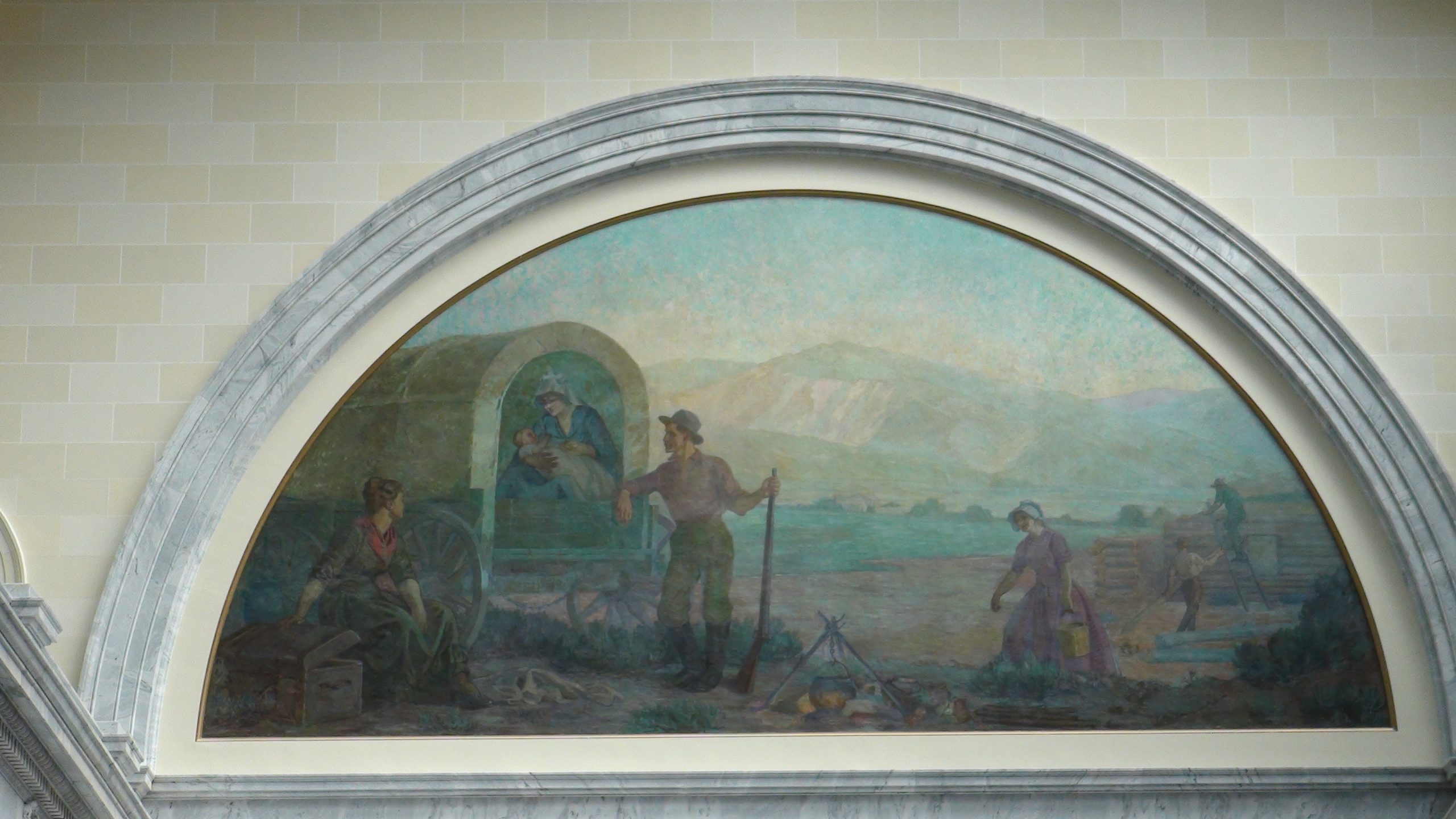
Land and community statutue. Capitol building, Salt Lake City, Utah.

Friday, 16 September 2022

Arise therefore, go down and go with them, doubting nothing; for I have sent them.” Acts 10:20

Note: You can listen to today’s commentary courtesy of our friends at “Bible in Ten” podcast. (Click Here to listen).

You can also read this commentary, with music, courtesy of our friends at “Discern the Bible” on YouTube. (Click Here to listen), or at Rumble (Click Here to listen).

Peter was just informed by the Spirit with the words, “Behold, three men are seeking you.” The Spirit’s words now continue, saying, “Arise therefore.”

Peter was obviously still sitting or lying on the roof wondering about the vision when the Spirit spoke to him. But with the arrival of the three men, the time to ponder had ended and he was called to get up. The connection to the vision he sought was soon to be revealed. Continuing His words, the Spirit next said, “go down.”

Rather, the verb is an aorist participle, “having gone down.” It is making a future assumption that he has already obeyed and that the next step is about to come to pass. In other words, “Once you have done this, then you are to next do this.” The next thing to do is then stated, which is, “and go with them.”

This has nothing to do yet with intermingling with Gentiles. There was nothing wrong with a Jew walking along with a Gentile. Rather, this is to assure Peter, in advance, that these men’s intentions are proper and nothing untoward is going on. He can be confident that what they have come for is appropriate, and that it surely has something to do with the very vision he received and was even at that moment pondering. Therefore, he should be “doubting nothing.”

Because this has been explained to him in advance, he shouldn’t be at all concerned about the course of events, as if it is either out of the will of God, or that it is the wrong path to take in relation to the vision. Rather, it is exactly what has been planned for. This is then confirmed by the words, “for I have sent them.”

In reading the entire account, and without understanding the way things work, one could be a bit confused about this statement. In verse 10:3, it says that “an angel [messenger] of God” came to Cornelius and spoke to him, directing him concerning what he should do. Then, in verse 10:4, it said “Your prayers and your alms have come up for a memorial before God.”

Now, it says that the Spirit had sent these men. As the Spirit is God, there is no contradiction here. The works of God, within the Godhead, are clearly and unambiguously seen in this exchange.

Life application: The Jehovah’s Witnesses deny that Jesus is God. They also deny the deity of the Holy Spirit, saying that the Spirit is an “active force” but not a member of the Godhead. Some accept the deity of Jesus but say that this is God working through modes (modalism) where Jesus is the Father and the Spirit is the Father (or any slight variation on this concept), and that He is expressing Himself in these various ways – somewhat like an actor going behind a screen and putting on a different mask for a different part of the show.

These are heresies. They do not fit what the Bible teaches. Each member of the Godhead is separate as a “Person” and yet is one in essence in God. To divert from this is to run off on an avenue that can only lead to further heresy. And because there are so many forms of diverting from what is orthodox, there are innumerable little heretics, influenced by Satan, pulling people away from the truth of how God presents Himself in Scripture.

One must be clear, precise, and extremely careful with one’s knowledge. A small divergence can turn into an entirely convoluted approach to how theology is understood and presented. If anyone comes to you and presents a doctrine that diverts from standard orthodoxy, warn him once and then a second time. After that, have nothing to do with him. And most important of all is what John says concerning the Father/Son relationship –

“For many deceivers have gone out into the world who do not confess Jesus Christ as coming in the flesh. This is a deceiver and an antichrist. Look to yourselves, that we do not lose those things we worked for, but that we may receive a full reward.
Whoever transgresses and does not abide in the doctrine of Christ does not have God. He who abides in the doctrine of Christ has both the Father and the Son. 10 If anyone comes to you and does not bring this doctrine, do not receive him into your house nor greet him; 11 for he who greets him shares in his evil deeds.” 2 John -7-11

Keep away from those who twist the roles of the Father and the Son within the Godhead. They are not to be greeted once they have been shown what is right and who then reject correct doctrine.

Lord God, may we be clear, concise, and careful in how we present what You have already revealed in Your word. Help us not to get sidetracked by those who think they know it all, but who are actually twisting and manipulating Scripture to tear us away from a right understanding of who You are. Be glorified in our worship of You – Father, Son, and Holy Spirit. Amen.


Acts 10:19

Early settler painting, capitol building, Salt Lake City, Utah.

Thursday, 15 September 2022

While Peter thought about the vision, the Spirit said to him, “Behold, three men are seeking you. Acts 10:19

Note: You can listen to today’s commentary courtesy of our friends at “Bible in Ten” podcast. (Click Here to listen)

You can also read this commentary, with music, courtesy of our friends at “Discern the Bible” on YouTube. (Click Here to listen), or at Rumble (Click Here to listen).

The previous verse noted that those sent from Cornelius asked whether Peter was lodging at the house. That was occurring even while Peter was coming out of his vision –

From the BLB translation –

a. And while Peter was perplexed in himself what the vision that he had seen might be, behold.

b. The men having been sent from Cornelius, having inquired for the house of Simon, stood at the gate.

b. And having called out, they were asking if Simon who is called Peter is lodged here.

a. And of Peter thinking over the vision, the Spirit said to him, “Behold, three men are seeking you.

One can see how Luke carefully gives an “a b b a” pattern to show that these things were occurring at the same time. With this noted, the verse now begins with, “While Peter thought about the vision.”

The verb is a present participle, “And while Peter, thinking about the vision…” Depending on the text, the word translated as thinking either means to ponder or to ponder thoroughly. Either way, Peter was mulling over what had happened at the same time that the travelers were arriving and asking whether Peter was there. It is at this time, while Peter is trying to figure out the meaning of the vision, that it next says, “the Spirit said to him.”

Nothing is said about how this occurs, whether audibly or internally, but it appears to be similar to that of Acts 8:29 where the Spirit told Philip to go near the chariot of the Ethiopian Eunuch. A message was conveyed that was clear enough for Peter to know that it was real, saying, “Behold, three men are seeking you.”

The fact that the Spirit said this while he was pondering the purpose of the vision is a clear indication that these three have something to do with it. It is similar to that which was prophesied by Isaiah many centuries earlier concerning the millennium, saying –

“It shall come to pass
That before they call, I will answer.” Isaiah 65:24

Peter had not yet asked the Lord what the meaning of the vision was, and yet he is being given directions that will explain what the vision means.

Life application: Peter’s vision, the coming of these Gentiles to meet him, and the Spirit speaking to Peter are all things that are leading to the inclusion of Gentiles in the body of believers. These were necessary steps to establish a baseline of what is allowed and acceptable within the church. Their inclusion in the word is thus also necessary so that subsequent generations of believers would know these things as well.

And that is the purpose of the Bible. It is to tell us of the things God has done within the stream of time so that we can know what is right and proper. This includes the inspiration of these men of God to relay what was to be written down. Once it was, such revelation is no longer needed. We now know that Gentiles were accepted. We now know that meats are not what God is focusing on and that we are free to eat anything set before us. And so on.

This is why it is so important to know your Bible. In knowing what it says, we can live our lives in the freedom offered to us because of the finished work of Christ. The Bible is not a book of bondage, but of life and fellowship with God. May we see it as such and not use it as a tool to unnecessarily impose bondage on ourselves and those we instruct.

It is true that there are confines we are to remain within, but these are still confines of freedom, meaning freedom from sin. Sin is bondage (John 8:34, Romans 6:6), and so to be kept from sin is its own type of freedom. If we can view the word from this perspective, our lives will be happy and prosperous in the Lord.

Heavenly Father, may we find joy in Your word each day. Help us to be faithful and careful stewards of it. And, Lord, help us to apply its precepts to our walk each day. Thank You for Your precious word. Amen.


Acts 10:18

Settler painting. Capitol, Salt Lake City, Utah.

Wednesday, 14 September 2022

And they called and asked whether Simon, whose surname was Peter, was lodging there. Acts 10:18

Note: You can listen to today’s commentary courtesy of our friends at “Bible in Ten” podcast. (Click Here to listen)

You can also read this commentary, with music, courtesy of our friends at “Discern the Bible” on YouTube. (Click Here to listen), or at Rumble (Click Here to listen).

The last verse had the men who were sent from Cornelius arriving at the gate of Simon’s house. With that, the next words are given. The NKJV doesn’t do a great job in its translation of the verbs in this verse. Therefore, the BLB will be used. Notice the difference –

And they called and asked whether Simon, whose surname was Peter, was lodging there. NKJV
And having called out, they were asking if Simon who is called Peter is lodged here. BLB

With that noted, the verse begins with, “And having called out.” Those who had arrived at the gate had called out. In their having called out, a response was obviously received, either from a window or from someone directly coming out to them. Either way, Luke has the reader involved in the action that is ongoing because he next notes, “they were asking.”

The verb is imperfect, giving the sense of continuance. In this case, it probably isn’t, “They asked and continued to ask,” as if the people inside didn’t understand the first time. Rather, it is probably, “They asked and were waiting for a response.” That sense of continuance is then explained in the coming verse where Peter will gather himself from his pondering about the vision. For now, the question they put forth was “if Simon who is called Peter is lodged here.”

Again, as in verse 10:5, both names are given. This is to ensure that the right Simon is summoned. The house belonged to Simon the tanner, and it would be normal for someone to come looking for him, maybe to get a hide tanned or to pick one up. And so, to avoid any confusion, the men were instructed to ask for Simon who is called Peter.

Along with this, the certainty that the correct Simon is summoned will also be confirmed by the Spirit speaking to Peter in the next verse. Everything about the account is precisely stated, and the verbs are carefully used by Luke to give us an intimate look into the events as they occur.

Life application: Why is Peter being summoned when it is Paul who is the apostle to the Gentiles? That doesn’t seem to make sense unless one takes in the whole account of what is going on. Like the Greek language, which is very precise, the overall narrative is also very precise.

There is a reason why Peter is called, and it is not to tell Cornelius that he has to wait for someone named Paul to show up and give him the Gentile gospel. It is because Peter’s gospel is the same gospel as Paul’s. Only the prime focus of Peter’s gospel is to the Jews. And yet, he wasn’t called only to the Jews. Likewise, Paul wasn’t called only to the Gentiles. Even the poorest of scholars can figure that out when taking things in the proper context.

Unfortunately, there are those who evaluate the word in an unscholarly manner. In this, they come to unfounded conclusions, ignoring the overall message and focusing on division rather than unity of thought. Despite this, the word must be rightly divided. It is a unified whole. Therefore, any division is for a logical analysis of Scripture, not to divide the overall message.

Be sure to keep things in context and be sure to avoid people who proclaim a false gospel, which is no gospel at all. Jews and Gentiles are saved in the exact same way – by faith in the finished work of Jesus and in nothing else.

Lord God how blessed we are to be saved in the simplest manner of all which is by faith in the finished work of Christ. Anything else would make it too complicated for most to understand. And even the simple gospel eludes so many. Help us to not add to or divide this precious offer of life, the gospel of our salvation. Amen.


Acts 10:17

Another painting under rotunda at the capitol, Salt Lake City, Utah.

Tuesday, 13 September 2022

Now while Peter wondered within himself what this vision which he had seen meant, behold, the men who had been sent from Cornelius had made inquiry for Simon’s house, and stood before the gate. Acts 10:17

Note: You can listen to today’s commentary courtesy of our friends at “Bible in Ten” podcast. (Click Here to listen)

You can also read this commentary, with music, courtesy of our friends at “Discern the Bible” on YouTube. (Click Here to listen), or at Rumble (Click Here to listen).

Peter’s vision ended in the previous verse with the object being taken up into heaven again. Luke next records, “Now while Peter wondered within himself.”

The word translated as “wondered” is stronger, meaning totally perplexed. This is the last of four times it is seen. Two of its other uses in Acts were in Acts 2:12 and Acts 5:24. HELPS Word Studies says it “refers to ‘one who goes through the whole list of possible ways, and finds no way out.’” In other words, Peter was perfectly perplexed as to “what this vision which he had seen meant.”

Because he is working it out in his mind, he may have thought it was just a delusion because he was overly hungry, or maybe he got too much sun on the roof, or maybe it really was a vison. If it was, then there must be some connection that he had not yet made.

The answer to his state of confusion was, literally, just about to knock on the door. The vision was real, and the Lord was going to tie it into the stream of events that were coming to pass at that moment. As it next says, “behold, the men who had been sent from Cornelius had made inquiry for Simon’s house.”

Here is a word found only this one time in Scripture, dierótaó, translated as “made inquiry.” It comes from dia (through) and erótaó (to ask). As such, one gets the sense of the men arriving at Joppa and then asking their way through the streets until they finally found the right house. Once that was ascertained, they came to it “and stood before the gate.”

The word “and” is not in the Greek. It simply shows the events as they took place –

“having made inquiry for the house of Simon, stood before the gate.”

Luke masterfully leaves the reader ready for the next action to take place, setting the actions of those sent from Cornelius to align perfectly with the ponderings of Peter. The timing of the events shows that God was in total control of the events that took place so that they would come to pass together at the same moment.

Life application: There are things that happen in life that we often call chance or coincidence. Or we may brush them off with the words, “What synchronicity!” But we often go no further. However, for those who know the Lord, such events can be looked at with a different view.

We can ascribe them to the working of God in our lives to bring about a good end in whatever matter we thought was, at first, total calamity. This doesn’t mean we should go looking for signs and ascribing goofy things like getting $7.77 change back at 7-11 to be a sign that the rapture will happen next Tuesday. There is a difference between seeing the Lord’s hand working out a good end for a certain matter and the type of thinking that is just plain goofy.

And more, the rapture is not dependent on events that occur in our lives, as if the Lord is using us as an instrument of His will to bring it about. That is a “me” centered theology and it is quite harmful.

On the other hand, if we have calamity today and suddenly something amazingly good replaces it, we can ascribe that to the Lord’s kind hand upon our affliction (think of Job 42), and praise Him for His tender care of us. That is a “Him” centered theology because it always ascribes events from the top down, not the bottom up.

Let us remember this. In such times, we have not erred by giving Him the glory, even if it was mere chance (if you believe in that). But in ascribing things in a bottom-up manner, when such events do not take place, you have erred. You have brought disgrace upon the name, and you have made yourself look foolish. In all things, and in all ways, glorify God, not yourself, for the events that take place in your life, whether good or bad. In the end, and because of Jesus Christ, good will ultimately come to pass.

Lord God, help us to not error in our thinking by making events that happen around us all about us. Rather, when we see the marvelous occur, may we rightly ascribe it to Your hand and be grateful for Your grace and mercy upon us. In all things, may we remember to glorify You above all else. Amen.