
Acts 13:28

Teddy Roosevelt comments about Vermont, Vermont State Capitol.

Sunday, 8 January 2023

“And though they found no cause for death in Him, they asked Pilate that He should be put to death. Acts 13:28

Note: You can listen to today’s commentary courtesy of our friends at “Bible in Ten” podcast. (Click Here to listen).

You can also read this commentary, with music, courtesy of our friends at “Discern the Bible” on YouTube. (Click Here to listen), or at Rumble (Click Here to listen).

The previous verse contained Paul’s continuing words concerning Jesus, noting that those in Jerusalem and their rulers fulfilled Scripture in condemning Jesus. With that, Paul continues, saying, “And though they found no cause for death in Him.”

The verb is an aorist participle, and the word “though” is not in the Greek. The words are more closely rendered, “And having found no cause of death.” Jesus was put on trial in a manner that was in violation of the Law of Moses as well as the later codes of the Jewish people. In fact, it has been noted that as many as eighteen violations of law occurred during His trial. Despite even having false witnesses presented, there was nothing found in Him that was worthy of condemning Him. Even a charge that He committed blasphemy was completely subjective and could not in any way align with the Law of Moses’ statutes and judgments.

Further, this charge of blasphemy could not stand the scrutiny of Pilate. Therefore, they went to him with a different charge, pitting Jesus against the Roman authority and claiming His actions were seditious, something the gospel records completely refute. Despite all of this, Paul simply states that “they asked Pilate that He should be put to death.”

Jesus was a threat to the leadership of Israel. It was quite apparent that He was approved of God, and they knew He was who He claimed to be. This is not explicitly stated in the gospels, but it is perfectly evident at every turn of a page. They, however, were not looking to cede their power, status, and authority to anyone. Also, they did everything in their power to frustrate Jesus’ work every step of the way.

Eventually, Jesus became such a threat to their positions within the nation that they illegally set about to have Him done away with. In this, they had no authority to put Him to death and so they appealed to Pilate to do so. Despite Pilate not desiring to be a part of the matter, the rulers of Israel manipulated him to the point that he conceded to allow the execution of Jesus.

Of the words of this verse, Charles Ellicott does a magnificent job of tying the entire scenario of what Paul says together with references from the gospels –

“And though they found no cause of death in him.—Technically, the Sanhedrin had condemned our Lord on the charge of blasphemy (Matthew 26:66), but they had been unable to prove the charge by any adequate evidence (Matthew 26:60), and finally condemned him by extorting words from His own lips. When they came before Pilate they shrank at first from urging that accusation, and contented themselves with stating in general terms that they had condemned Him as a malefactor (John 18:30); though afterwards, as if seeking to terrify the wavering governor, they added that by their law He ought to die because He made Himself the Son of God (John 19:7), and that by making Himself a king He spake against the emperor (John 19:12).”

Life application: Despite all that occurred in the illegal trial of Jesus, the death of Jesus was preordained by God. And more, John confirms that even the high priest of Israel prophesied of this fact –

And one of them, Caiaphas, being high priest that year, said to them, “You know nothing at all, 50 nor do you consider that it is expedient for us that one man should die for the people, and not that the whole nation should perish.” 51 Now this he did not say on his own authority; but being high priest that year he prophesied that Jesus would die for the nation, 52 and not for that nation only, but also that He would gather together in one the children of God who were scattered abroad.” John 11:49-52

The death of Jesus was necessary for the people of the world to be reconciled to God. However, this does not in any way mitigate the crimes committed by the Jewish leaders. They were responsible for their actions which were contrary to the law of God, despite the overall matter being in accord with the will of God.

This should give us comfort when we see wrongs committed against Christians, or even if they are committed against us because we are Christians. God’s ultimate purposes are being met, even through our trials, whether the events are contrary to God’s law or not.

As an example, a missionary may be martyred for his faith by a bunch of Hindus. This is against the law of God and those Hindus will be punished for what they have done if they fail to come to Christ. However, many may see the death of this missionary and convert to Christianity, maybe even one of the perpetrators. The expansion of God’s kingdom has occurred, and His ultimate will for this to come about has been met, even though the details were contrary to His law.

This is what happened with Joseph when he was sold by his brothers to Egypt, and it is something that occurs elsewhere in the Bible. God takes the wrongdoings of man, and He turns them into wonderful things that ultimately bring Him great glory. So, when evil comes upon you or others, trust that God is in control, and He is working out something far greater than any of us could ever imagine.

Lord God, how grateful we are to know that You are in total control of all things. We need not worry one iota about what lies ahead because we know that through good or bad or life or death, our salvation and eternal destiny are set because of what Jesus has done for us. Thank You, O God, for Your kind hand upon our eternal destiny. Amen.



Acts 13:27

Ethan Allen quote, Vermont State Capitol.

Saturday, 7 January 2023

“For those who dwell in Jerusalem, and their rulers, because they did not know Him, nor even the voices of the Prophets which are read every Sabbath, have fulfilled them in condemning Him. Acts 13:27

Note: You can listen to today’s commentary courtesy of our friends at “Bible in Ten” podcast. (Click Here to listen).

You can also read this commentary, with music, courtesy of our friends at “Discern the Bible” on YouTube. (Click Here to listen), or at Rumble (Click Here to listen).

Paul just mentioned that the word of salvation had been sent to his people, the sons of the family of Abraham, and to those among them who feared God. Now Paul explains the purpose of the mission going forth, beginning with, “For those who dwell in Jerusalem.”

Paul brings the attention of the matter back to where it began. Jerusalem was the seat of power in Israel. It was where the temple was, where the high priest ministered, where the oracles of God and the genealogical records were maintained, and so on. It is the focal point of God’s dealing with the people, even if events in Jesus’ ministry occurred elsewhere in the land. Paul next says, “and their rulers.”

The rulers of the land determine its direction. This is a precept found both implicitly and explicitly throughout Scripture. All people are individually responsible for their actions, but the rulers of a land direct how the land, meaning the nation of the land, will be determined in the eyes of the Lord. In the case of Jerusalem, being the seat of power, what occurred there was because of what the rulers determined. In the case of their Messiah, Paul continues, saying, “because they did not know Him.”

This does not mean:

1) That they didn’t know who Jesus was as an individual. The gospels are replete with the rulers’ interactions with Him. There was certainly not a ruler in Jerusalem who didn’t know who He was.

2) That the rulers didn’t know His claim to be the Messiah. He told them, but they didn’t listen (John 10:25). Many of the people either proclaimed Him the Christ or learned through interacting with Him that He was the Christ.

3) That there wasn’t sufficient evidence that He was the Christ. He had performed many miracles, fulfilled ancient prophecies, and walked in sinless perfection before them.

In saying that the rulers did not know Him, it means that they willingly failed to recognize Him for who He truly is. He even said this explicitly in John 10:40, saying, “But you are not willing to come to Me that you may have life.” And more, Paul demonstrates that they were wholly without excuse in this, saying, “nor even the voices of the Prophets.”

Being the stewards of the oracles of God, they had direct access to every prophecy ever recorded in their Scriptures. These were both exacting and readily available to them. In fact, when Herod wanted to know where the Christ would be born, this is exactly what He did –

“When Herod the king heard this, he was troubled, and all Jerusalem with him. And when he had gathered all the chief priests and scribes of the people together, he inquired of them where the Christ was to be born.
So they said to him, ‘In Bethlehem of Judea, for thus it is written by the prophet:
“But you, Bethlehem, in the land of Judah,
Are not the least among the rulers of Judah;
For out of you shall come a Ruler
Who will shepherd My people Israel.”’” Matthew 2:3-6

As such, these rulers of Jerusalem were completely without excuse. Again, Jesus told them this explicitly in John 5 –

“Do not think that I shall accuse you to the Father; there is one who accuses you—Moses, in whom you trust. 46 For if you believed Moses, you would believe Me; for he wrote about Me.” John 5:45, 46

And again, not only did Israel have the voice of the prophets, but he notes that these were the prophets “which are read every Sabbath.” Rather, the verb is a present participle. They “are being read every Sabbath.” The process continues even to this day.

It wasn’t as if the oracles of God were sequestered away and taken out only when a person claimed to be the Messiah, at which time the sages poured over the Scriptures hoping to remember what they said and where to find out the needed details to confirm or disprove a claim. Rather, they were read every Sabbath in synagogues throughout the land and even throughout the dispersion, as evidenced by Paul’s commenting on a Sabbath day reading now in the synagogue in Pisidia of Antioch.

With this marked stain upon those in Jerusalem who had personally seen, interacted with, and rejected their Messiah, Paul next says that they “have fulfilled them in condemning Him.” This is the height of irony. The very people who had the oracles of God before them, and who had interacted with the living fulfillment of those oracles, rejected Him and condemned Him. Paul says that they were so blind to their own Scriptures that they could not even see what was plainly before them.

Life application: The point of Paul’s words is that those in the synagogue were about to be on a sort of trial, just like those in Jerusalem. They were Jews, they had the oracles of God laid out before them, and they had eyewitness testimony of who Jesus is and what He did while among the people. And more, the oracles before them in the synagogue not only told of the things that transpired up until the time of Jesus’ rejection and crucifixion, but they also even told of those things.

In other words, when Paul finishes, they would be just as responsible for their acceptance or rejection of Jesus as were the leaders of Israel who were in Jerusalem. And that same type of trial continues to this day.

The word of God contains the same message today that it did two thousand years ago. We have the exact same witness and testimony that those in the synagogue in Pisidia of Antioch had because we have Luke’s record of it. We also have the rest of the New Testament which is now written and on permanent record before us.

And yet, despite it being read in churches all over the world, many are just as blinded to what it says as the Jews in the synagogue Paul is speaking to. They open up the word, read what it says, and say something ridiculous like, “Jesus is not God.” Or they might say, “Jesus is loving and love wins, we will ordain a homosexual to be a leader over us.”

The very oracles that tell us what God expects of us are ignored, manipulated, or dismissed as archaic writings with no bearing on how we should conduct our affairs before God now. Those with such attitudes will receive their just condemnation. Let us hold the word close to our lives, live in accord with its precepts, and be willing to never waffle in our convictions concerning what it proclaims. God has spoken. Let us consider this soberly.

Lord God, help us to accept Your word for exactly what it is, Your unchanging, infallible, and complete revelation to us concerning the redemption of mankind. May we never trifle with it. Instead, help us to hold it in the highest reverence while we walk in Your presence. It is our light and our guide to return us to You. Thank You for Your precious word. Amen.


Acts 13:26

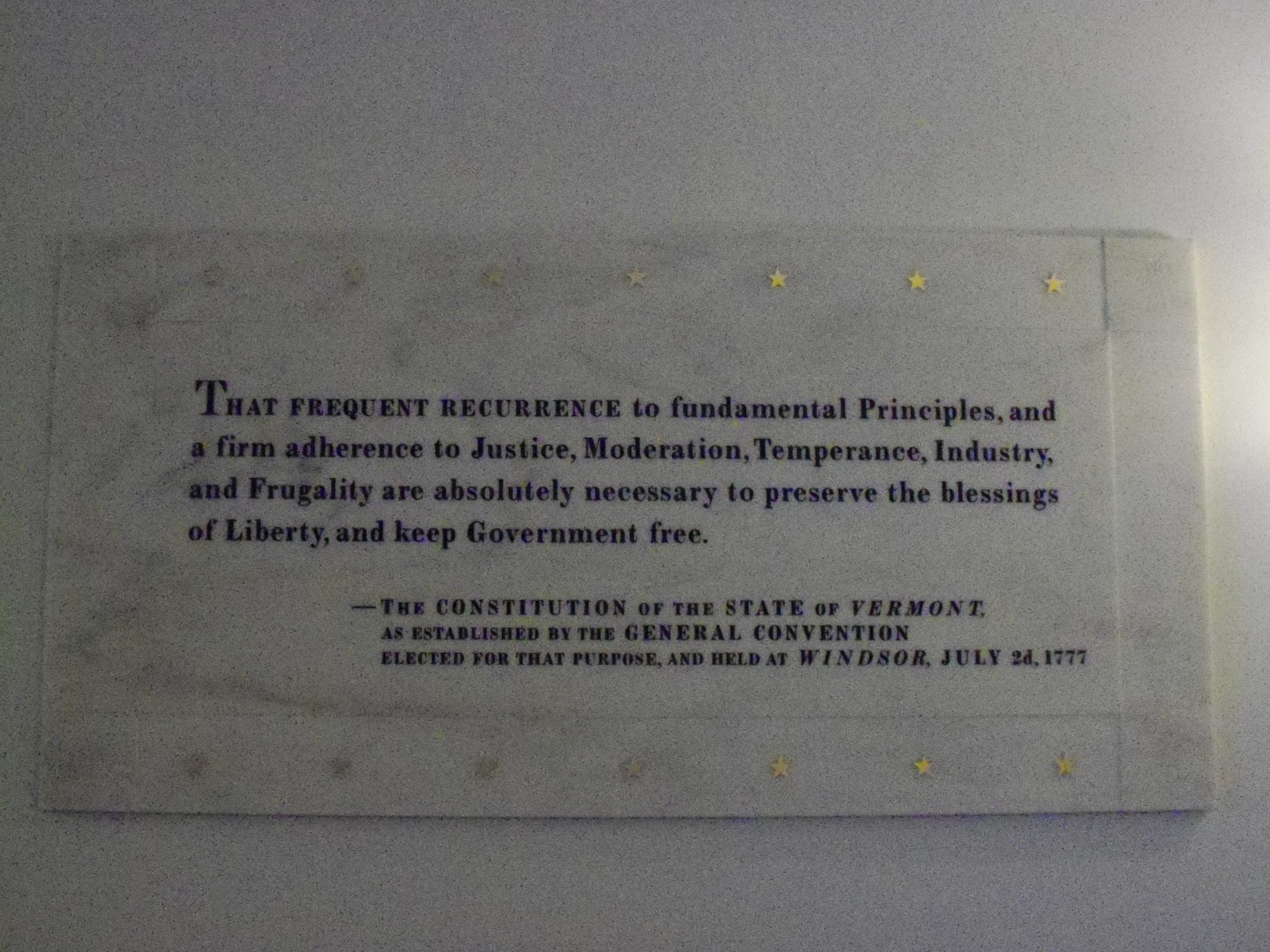
Excerpt from Vermont Constitution.

Friday, 6 January 2023

“Men and brethren, sons of the family of Abraham, and those among you who fear God, to you the word of this salvation has been sent. Acts 13:26

Note: You can listen to today’s commentary courtesy of our friends at “Bible in Ten” podcast. (Click Here to listen).

You can also read this commentary, with music, courtesy of our friends at “Discern the Bible” on YouTube. (Click Here to listen), or at Rumble (Click Here to listen).

Paul had just spoken of John the Baptist’s denial of being the Messiah, instead pointing the people of Israel to the One who was coming after him. Paul now proclaims that this One has come. His words begin with, “Men and brethren, sons of the family of Abraham,”

The words are surprisingly widely translated, dividing the three designations into two or three categories. Literally, the words read, “Men, brothers, sons of the stock of Abraham.” This is probably how Paul intended. He is speaking to the men of the synagogue. He refers to them next as brothers. And then, he notes their lineage being traced back to Abraham as a particular point of note because of what he will say in verse 13:32 concerning the promise made to the fathers, a promise that first came to Abraham.

He is carefully defining them so that they pay heed to the details of what he will say. The importance of heeding or not heeding will make all the difference in their eternal future. Therefore, he speaks precisely so that they will be without excuse in their decision concerning the matter presented. Next, he adds another category, saying, “and those among you who fear God.”

An important question arises here: Is this another descriptor of those he just addressed or is it a separate category altogether? In other words, is this a way of saying, “You sons of Abraham who fear God,” or is it “and anyone who is not a son of Abraham but who fears God” as in verse 13:16? Notice the difference between the two verses:

13:16 – and those fearing God
13:26 – and those among you fearing God

The reason this is important is that these are words of warning to his people as much as they are words heralding the good news concerning Jesus. The two are actually inseparable. To reject the good news will lead to being handed the results of that rejection.

The confusion continues with the next words to some degree. They say, “to you the word of this salvation has been sent.” In this, the words are directed to whoever is hearing, be it Jew or Gentile. However, some manuscripts say, “to us.”

In this, it may or may not change the meaning. It still could mean that God’s salvation has been sent to both Jew and Gentile, but it also may be that he is saying that God’s salvation was sent to the literal descendants of Abraham who fear God as opposed to Abraham’s literal descendants and those Gentiles who fear God as well.

In Acts 10:2, the same term is used when referring to Cornelius. He was a man “that feared God.” Because of this, it is hard to be dogmatic, but even if it extends to proselytes of the gate who are in attendance, the result will ultimately remain unchanged. If those proselytes were to reject the message of Paul and continue with observance of Moses, they would – henceforth – be separated from what God is doing in Christ.

This is to be seen quite clearly in verses 13:38 & 39 –

“Therefore let it be known to you, brethren, that through this Man is preached to you the forgiveness of sins; 39 and by Him everyone who believes is justified from all things from which you could not be justified by the law of Moses.”

Whether Paul’s words include the proselytes of the gate, or whether they are solely directed to the Jews at this point, an absolute distinction is made between “everyone who believes” and “the law of Moses.” To follow the law will mean that you are not included in everyone who believes. That then means no justification and thus eternal separation from God. This is because, as Paul says in Galatians –

“…knowing that a man is not justified by the works of the law but by faith in Jesus Christ, even we have believed in Christ Jesus, that we might be justified by faith in Christ and not by the works of the law; for by the works of the law no flesh shall be justified.” Galatians 2:16

&

“For as many as are of the works of the law are under the curse; for it is written, ‘Cursed is everyone who does not continue in all things which are written in the book of the law, to do them.’ 11 But that no one is justified by the law in the sight of God is evident, for ‘the just shall live by faith.’ 12 Yet the law is not of faith, but ‘the man who does them shall live by them.’” Galatians 3:10-12

Life application: Faith in Jesus Christ saves. Nothing else will do.

Heavenly Father, help us to be people of faith, trusting in the merits of Jesus Christ alone for our salvation. And then, Lord, help us to be faithful people, working out our salvation in righteousness and holiness all our days. May our walk be in accord with the honor bestowed upon us when we first believed. To Your glory, we pray. Amen.


Acts 13:25

Toes on grating.

Thursday, 5 January 2023

“And as John was finishing his course, he said, ‘Who do you think I am? I am not He. But behold, there comes One after me, the sandals of whose feet I am not worthy to loose.’ Acts 13:25

Note: You can listen to today’s commentary courtesy of our friends at “Bible in Ten” podcast. (Click Here to listen).

You can also read this commentary, with music, courtesy of our friends at “Discern the Bible” on YouTube. (Click Here to listen), or at Rumble (Click Here to listen).

The previous verse referred to John’s preaching a baptism of repentance to all the people of Israel. Paul continues now with, “And as John was finishing his course.”

Paul uses the term dromos or “course” for the first time in Scripture. It signifies a racetrack where runners on foot competed in the Greek games of old. It will only be seen again in Acts 20:24 and 2 Timothy 4:7, both of which give us the same sense as he now uses –

“But none of these things move me; nor do I count my life dear to myself, so that I may finish my race with joy, and the ministry which I received from the Lord Jesus, to testify to the gospel of the grace of God.” Acts 20:24

“For I am already being poured out as a drink offering, and the time of my departure is at hand. I have fought the good fight, I have finished the race, I have kept the faith.” 2 Timothy 4:6, 7

Paul equated the ministry of John the Baptist to such a course and noted that as he was coming to the end of it, “he said, ‘Who do you think I am? I am not He.’”

Paul again uses a new word, huponoeó. Literally, it signifies “to think under” and thus privately. As such, it means to suppose or conjecture. The people were thinking privately about who John might be. He was aware of it and asked them to consider what he would reveal. As for what Paul has said, his words of the previous verse and this one now follow the narrative of Luke 3 closely. In the previous verse, it mentioned the preaching of repentance to Israel. That was seen in Luke 3:3. It continued with instruction after that. Then, it next says –

“Now as the people were in expectation, and all reasoned in their hearts about John, whether he was the Christ or not.” Luke 3:15

The question was proffered. From there, John’s denial of being the Messiah is not explicitly spoken in the same manner that Paul speaks to those in the synagogue. Rather it is implied in John’s response to the people’s question which Paul states as, “But behold, there comes One after me, the sandals of whose feet I am not worthy to loose.”

Rather, the word is “sandal” in the singular. John is saying that he was unworthy to undo even a single sandal on the feet of the Messiah, much less both of them. This follows Luke’s narrative –

“Now as the people were in expectation, and all reasoned in their hearts about John, whether he was the Christ or not, 16 John answered, saying to all, ‘I indeed baptize you with water; but One mightier than I is coming, whose sandal strap I am not worthy to loose. He will baptize you with the Holy Spirit and fire. 17 His winnowing fan is in His hand, and He will thoroughly clean out His threshing floor, and gather the wheat into His barn; but the chaff He will burn with unquenchable fire.’” Luke 3:15-17

Untying the feet of one’s master would have been the most menial of all tasks. As today, it would be considered degrading to be told to remove the shoes of someone as he sat and relaxed. John, however, knew that even such a lowly assignment was above his right to perform. It is a surprising statement when considering Jesus’ words to the people –

“But what did you go out to see? A prophet? Yes, I say to you, and more than a prophet. 27 This is he of whom it is written:
‘Behold, I send My messenger before Your face,
Who will prepare Your way before You.’
28 For I say to you, among those born of women there is not a greater prophet than John the Baptist; but he who is least in the kingdom of God is greater than he.” Luke 7:26-28

John was highlighted by Jesus in this manner and yet he knew his unworthy state before the Lord. It makes the rest of the narrative of Israel’s interactions with Jesus all the more relevant and striking. Their rejection of John was like their rejection of all the prophets who came before him. Their rejection of Jesus, of whom all those prophets spoke, was intolerable and inexcusable.

Life application: In considering our position in relation to Jesus, there is a dichotomy that needs to be considered. He has given His life for us and there is a bond of closeness that arises from that where we can speak to Him now in the most intimate way. He is nearer to us than any blood relative and He should be dearer to us than our own spouse or children.

And yet, we must also consider the absolute magnificence, splendor, and holiness of the Lord as well. We stand before the perfection of God when we stand before the Lord Jesus. He is our Creator, Sustainer, and continued life. Our conduct before Him should be that of reverential fear and always conducting our lives in a circumspect manner.

Even if those who are “least in the kingdom of God” are greater than John the Baptist, we are no more worthy than he was to untie the strap of one of His sandals. Let us remember this and share our lives and intimate thoughts with Him as our nearest and truest love, and yet let us honor Him with the due respect that is owed to our God. All glory to Jesus, our All in all.

Glorious Lord Jesus, we stand in awe of You. We were created by You, we exist because You allow it to be so, and yet You came to die for us so that we could be reconciled to God through You. How great You are. How magnificent, splendid, and beautiful! Glory to You in the highest, Lord Jesus. Amen.


Acts 13:24

Hallway in Vermont State Capitol building.

Wednesday, 4 January 2023

“after John had first preached, before His coming, the baptism of repentance to all the people of Israel. Acts 13:24

Note: You can listen to today’s commentary courtesy of our friends at “Bible in Ten” podcast. (Click Here to listen).

You can also read this commentary, with music, courtesy of our friends at “Discern the Bible” on YouTube. (Click Here to listen), or at Rumble (Click Here to listen).

Paul is in the synagogue in Antioch of Pisidia. He has been addressing those gathered on the Sabbath, telling them about God’s plan of salvation. In the previous verse, he specifically introduced Jesus as the Savior. He now notes that Jesus’ ministry began “after John had first preached.”

This is referring to John’s preaching which immediately preceded the ministry of Jesus. It was not that John preached before the coming of Jesus at His birth, but before the designated time for His ministry to begin.

The significance of this was that John didn’t preach like the other prophets, as if the Messiah was coming at some unstated point in the future. Rather, his words indicated that the Messiah was right at hand and ready to appear. This was, as Paul continues to note, “before His coming.” The Greek literally reads “before the face of His entrance.”

It is a Hebrew expression indicating an appearance, the face representing the person’s presence. In this, a new word is used, eisodos. It is essentially the opposite of exodus. It indicates an entrance and extends to a means or place of entrance. Because Paul is connecting John’s ministry to that of the coming of the Messiah, he is indicating that the two events are inextricably linked. The herald had come and then the One he proclaimed had immediately followed. As for John, his proclamation was “the baptism of repentance.”

The meaning is that John called the people to repent. In his calling, those who agreed with his proposition were then baptized to outwardly acknowledge the inner change that had taken place. It was a symbolic act of repentance. The word “repent” must be defined to understand what is being said –

“A word compounded of the preposition μετά, after, with; and the verb νοέω, to perceive, and to think, as the result of perceiving or observing. In this compound the preposition combines the two meanings of time and change, which may be denoted by after and different; so that the whole compound means to think differently after. Μετάνοια (repentance) is therefore, primarily, an after-thought, different from the former thought; then, a change of mind which issues in regret and in change of conduct. These latter ideas, however, have been imported into the word by scriptural usage, and do not lie in it etymologically nor by primary usage. Repentance, then, has been rightly defined as ‘Such a virtuous alteration of the mind and purpose as begets a like virtuous change in the life and practice.’ Sorrow is not, as is popularly conceived, the primary nor the prominent notion of the word. Paul distinguishes between sorrow (λύπη) and repentance (μετάνοια), and puts the one as the outcome of the other. ‘Godly sorrow worketh repentance’ (2 Corinthians 7:10).” Vincent’s Word Studies

It was this changing of the mind that John was called to proclaim. The Messiah was soon to appear and there was to be a national preparing for His arrival –

“In those days John the Baptist came preaching in the wilderness of Judea, and saying, ‘Repent, for the kingdom of heaven is at hand!’ For this is he who was spoken of by the prophet Isaiah, saying:
‘The voice of one crying in the wilderness:
“Prepare the way of the Lord;
Make His paths straight.”’” Matthew 3:1-3

This call for the people to change their minds was “to all the people of Israel.” Jesus came to the people of Israel. His ministry was to the nation of Israel. No Gentiles were a part of the nation. He had come to fulfill the law and then initiate a New Covenant. This covenant was to be “with the House of Israel and with the house of Judah” as stated in Jeremiah 31:31.

As such, what Paul is conveying to those at the synagogue is a restating of the process of preparation for Israel to enter into this New Covenant based on their lives under the Law of Moses. As the Gentiles were never under the law of Moses, what Paul says here does not apply to them. It is simply a restating of the facts as they occurred just as the Messiah was ready to come forth. That was prophesied by the prophet Malachi –

“Remember the Law of Moses, My servant,
Which I commanded him in Horeb for all Israel,
With the statutes and judgments.
Behold, I will send you Elijah the prophet
Before the coming of the great and dreadful day of the Lord.
And he will turn
The hearts of the fathers to the children,
And the hearts of the children to their fathers,
Lest I come and strike the earth with a curse.” Malachi 4:4-6

Commentaries quite often shove Paul’s words here in Acts 13 into their “Gentile” theology concerning entry into the New Covenant, meaning “how to be saved.” But this is entirely inappropriate. Christ has come. And more, the Law of Moses was never in effect for any Gentile at any time or place in human history. The entrance of Gentiles into the New Covenant was anticipated by Isaiah, and it is something that was only available after the work of Christ was accomplished –

“And now the Lord says,
Who formed Me from the womb to be His Servant,
To bring Jacob back to Him,
So that Israel is gathered to Him
(For I shall be glorious in the eyes of the Lord,
And My God shall be My strength),
Indeed He says,
‘It is too small a thing that You should be My Servant
To raise up the tribes of Jacob,
And to restore the preserved ones of Israel;
I will also give You as a light to the Gentiles,
That You should be My salvation to the ends of the earth.’” Isaiah 49:5, 6

Israel had to repent because they were under the law. To be brought out of that state, they needed to be in the right condition for that to occur. Now, with Christ’s work complete, salvation is solely by faith in what He has accomplished.

Life application: Remember the basics of the gospel –

“For I delivered to you first of all that which I also received: that Christ died for our sins according to the Scriptures, and that He was buried, and that He rose again the third day according to the Scriptures.” 1 Corinthians 15:3:4

By faith in this message, one is saved. At that time, the Holy Spirit is given as a seal, a guarantee, of that salvation –

“In Him you also trusted, after you heard the word of truth, the gospel of your salvation; in whom also, having believed, you were sealed with the Holy Spirit of promise, 14 who is the guarantee of our inheritance until the redemption of the purchased possession, to the praise of His glory.” Ephesians 1:13, 14

The process is of God. The work is accomplished by Jesus. Belief in this results in eternal salvation. Nothing can be added to this message without causing damage to its purity.

Glorious God, we stand in awe of what You have done. You have brought us from darkness into the wonderful light of Christ. Thank You for restoring us to Yourself. And thank You for Your word that reveals these things to us. We can have confidence in our walk and hope concerning our future because of what You have provided for us. Hallelujah! Amen.