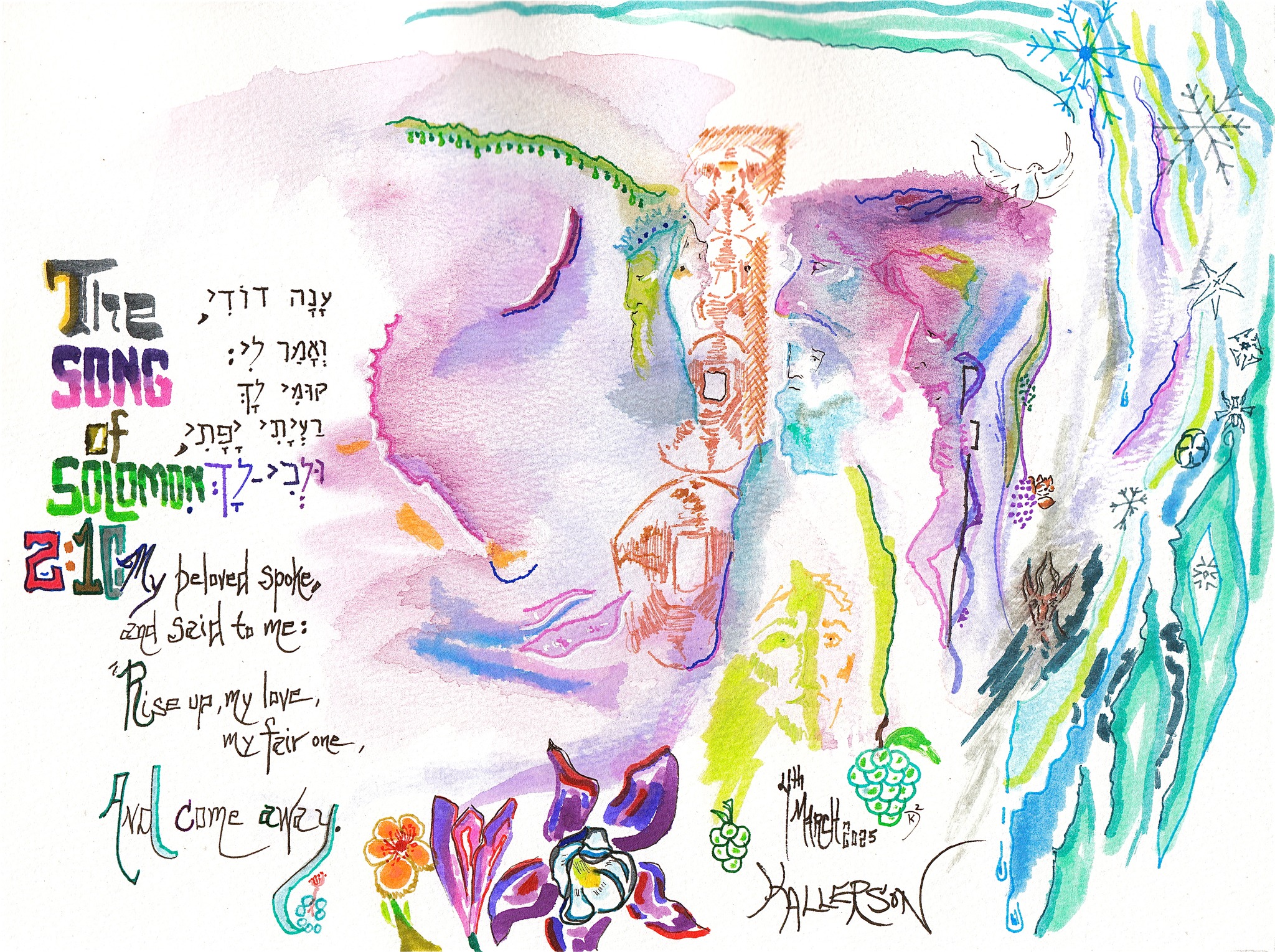
Artwork by Douglas Kallerson.
Song of Songs 2:8-17
Cause Me to Hear Your Voice
(Typed 16 December 2024) For the Christian, one thing that the Bible is clear about is doctrine matters. It is something that is seen in typology throughout the Old Testament. It is also on prominent display in the New Testament.
A particular passage might, on the surface, be thought of as a basis for proper Christian doctrine. For example, a passage in the gospels or in Acts. A teacher may make a convincing argument as to why something is expected of Christians because of what is said there. And yet, because he failed to consider the context, what he teaches is completely false.
The verses today include a few lines that hint at maintaining proper doctrine. A general reading of them might make one question how. But in understanding the broader context taught throughout Scripture and the meaning of the words, it becomes clear and understandable.
This is one of the marvelous facets of God’s word. The more you study it, and the more you consider what is presented, the more it begins to harmoniously come together in your mind.
Text Verse: “And this occurred because of false brethren secretly brought in (who came in by stealth to spy out our liberty which we have in Christ Jesus, that they might bring us into bondage), 5 to whom we did not yield submission even for an hour, that the truth of the gospel might continue with you.” Galatians 2:4, 5
Paul speaks of false brethren. False brethren bring with them false doctrine. The two go hand in hand. Peter, who had been with Jesus throughout His ministry, was duped by false brethren. He accepted a false teaching and Paul had to openly call him out for it.
The words of Paul are recorded in Galatians. Thus, they are given as a permanent reminder that even a person who has all of the knowledge you might expect to keep him from such things can still be led astray. Admittedly, Peter’s failing was less from not knowing than it was from simply being weak in his adherence to what he knew.
What can we do to avoid such pitfalls? First, read and know your Bible. Second, determine to not get lulled into falsity for any reason whatsoever. And third, pray to the Lord for wisdom in the word and stamina in pursuing right doctrine.
Such things are necessary lest we stumble in our walk with the Lord, as will be seen in our verses today. Learning and maintaining proper doctrine is a hugely important aspect of His superior word. And so, let us turn to that precious word once again, and… May God speak to us through His word today, and may His glorious name ever be praised.
I. Blossoming From the Lattices (verses 8 & 9)
Verse 2:7 ended with the first noticeable break in the “Song the songs.” They were the words of the woman saying –
Adjured you – daughters Jerusalem,
In gazelles or in does the field,
If awaken and if awaken the love –
Until she inclined.
Thus, it completed the first song within the song. With those verses complete, the second song now begins. Without being dogmatic, it appears that the woman is going back in time to when she first was enticed by her beloved.
The rest of the chapter will then be an explanation of her doing exactly what she just adjured the daughters of Jerusalem to do…
8 The voice of my beloved!
qol dodi – “Voice! My beloved.” The words can be rendered either as the NKJV says, “I hear the voice of my beloved,” or as an interjection, “Hark! My beloved.” The decision in translation is like that of Genesis 4:10, where the same word, qol, voice, is used –
“The LORD said, ‘What have you done? Listen [qol]! Your brother’s blood cries out to me from the ground.” (NIV)
“‘What have you done?’ replied the LORD. ‘The voice [qol] of your brother’s blood cries out to Me from the ground.’” (BSB)
Based on the next clause, it seems she is calling out an interjection. Her beloved has been gone, and now he is returning.
The length of their separation is unknown. Some believe these individual songs cover the days of a marriage festival. Thus, this begins the second day.
Verse 11 notes the ending of the winter. Therefore, some think there was an extended separation. They were previously in a green garden, which meant summer or fall, and then they separated until the spring. But this is poetry, so that seems unnecessary.
Steinbeck wrote The Winter of Our Discontent. It wasn’t just a literal winter he was referring to. Other writers and poets have used similar literary devices. No matter the length of separation, in the return of her beloved, she calls out…
8 (con’t) Behold, he comes
hineh zeh ba – “Behold! This coming!” One can see how the previous clause might logically be taken as an interjection. If taken in that manner, it forms parallelism, something which the two clauses after this certainly do –
Voice! My beloved.
Behold! This coming!
She is using the word qol, voice, to call attention to who he is in relation to her. She then calls for him to be beheld, highlighting his coming with verbal explanations. This would be a possible translation of Isaiah 40:3 –
Voice! [Listen!] Crying in the wilderness.
Prepare way Yehovah!
Straighten in the Aravah –
Highway to our God! (CG).
Either way, in this clause, she is calling out an interjection, “Behold! This coming!” She is preparing the minds of her audience, making them anticipate more words…
8 (con’t) Leaping upon the mountains,
m’daleg al heharim – “Springing upon the mountains.” The word dalag comes from a primitive root signifying to spring. It is as if he is excitedly bouncing upon the mountains as he approaches.
In Scripture, a har, mountain, is a lot of something gathered. In typology, it is synonymous with a large but centralized group of people. With her first verbal descriptor called out, she calls out again in parallel words, highlighting his approach…
8 (con’t) Skipping upon the hills.
m’qapets al hag’vaoth – “Leaping upon the hills.” She now uses the word qaphats. It is derived from a primitive root signifying to draw together. One can see him contracting his limbs (drawing them together) and then leaping up. It is the same imagery as the previous clause –
Springing upon the mountains.
Leaping upon the hills.
The mountains of the previous clause are now restated as givah, hills, in this clause. The word is etymologically connected to the New Testament Aramaic word Gabbatha, the Stone Pavement upon which Christ stood and was judged by Pilate. The name indicates it was a raised platform, like a hill.
The woman’s words are intended to equate her lover to an animal of the wilderness in the minds of her audience. This is what they should mentally see, but to ensure they get it, she next says…
9 My beloved is like a gazelle or a young stag.
domeh dodi litsvi o l’opher ha’ayalim –
“Comparing my beloved
To gazelle or to fawn, the stags.”
She has already noted the gazelle and the stag in previous verses. Now, she brings in the opher, a fawn of the stags. The word is derived from aphar, dust, thus signifying the dusty color of the fawn.
The ts’viy, gazelle, comes from tsavah, to amass or swell, and thus prominent. That leads also to the idea of beauty or splendor which is a prominent trait. As such, the word is used to describe the gazelle because of its graceful beauty.
The ayyalah, doe, is the feminine form of ayal, a stag. That ultimately comes from a root signifying strength. Being the fawn of the stags, one can see a strong form but one which is dusty in appearance.
She has transitioned the use of these animals from their speed and agility (springing and leaping on the mountains and hills) to their beautiful form and appearance. Her imagery paints a marvelous picture of her beloved for her audience. With his approach complete and her description noted, she next says…
9 (con’t) Behold, he stands behind our wall;
hineh zeh omed akhar katlenu – “Behold! This standing behind our wall.” She uses a word found only here in Scripture, kothel, a wall. It comes from an unused root meaning to compact, as in gathering in or enclosing.
It is the same word used today to describe ha’kothel, The Wall, which refers to the Western Wall of the Temple Mount in Jerusalem. She is saying that the beautiful animal (this) – a metaphor for her beloved – that leaped across the mountains and hills to come to her has come as close as the wall itself.
Who “our” is referring to is not stated. Some think she is looking back to when she lived with her family at their first meeting. Some think it is her with the court ladies. Etc.
The words do not say. The point is not when, where, etc. Attempting to determine this removes the words into a world of our own speculation, something not intended. Rather, we are to take the words as they come and see the excitement in the interactions between the two.
He has come, he is here, he is outside the wall, and…
9 (con’t) He is looking through the windows,
More simply: mashgiakh min ha’khalonoth – “Looking from the windows.” The meaning of the word min, from, has to be determined based on the context. In this case, she described him as having approached to where she is. Thus, he is outside looking in through the windows.
The window is not like what we have today, meaning something paneled with glass. Rather, it is an opening in a wall. It would normally be framed in and then have a lattice or shutters that could be opened, partially closed to block wind or sun, or they could be fully closed and locked tightly when necessary.
Understanding this explains the next words which are parallel in thought…
9 (con’t) Gazing through the lattice.
metsits min ha’kharakim – “Blossoming from the lattices.” She uses a rare and beautiful word to describe his peering, tsuts. It comes from a primitive root signifying to twinkle. Thus, it means to glance. But to get the sense of the word, by analogy, it means to blossom. This is seen in Numbers 17:8 when Aaron’s rod blossomed overnight –
“And was from morrow, and comes Moses unto Tent the Witness, and behold, bloomed rod Aaron – to house Levi – and outs bloom, and blossoms [tsuts] blossom, and ripens almonds.” (CG)
Even though she is describing him glancing through the lattices, she is poetically noting his eyes as they glance, being like opened blossoms. As for the kharakim, lattices, it is a plural word also found only here in Scripture.
It is derived from kharak, to braid. Thus, it signifies netting and, by analogy, lattices. She is spying his eyes as they blossom through these lattices. It is a beautiful image for the mind’s eye to behold.
The time was set for Christ’s coming
And He arrived just as the word foretold
Like beating an anvil or someone steadily drumming
The event was carefully controlled
God united with humanity to repair the breach
An infinite gap that laid between the two
But in Christ, reconciliation is reached
The God/Man did it, and nothing else will do
Now for His redeemed, there is work to be done
Until the day He calls us to Himself
We are to share the gospel of God’s only begotten Son
So let’s get at it! Don’t leave it on the shelf
II. My Beautiful (verses 10-17)
10 My beloved spoke, and said to me:
anah dodi v’amar li – “Answered, my beloved, and said to me.” To answer does not necessarily mean responding to something said. The Hebrew thought is inclusive of responding to a situation, need, etc. We see this in the New Testament also, such as –
“Then they laid their hands on Him and took Him. 47 And one of those who stood by drew his sword and struck the servant of the high priest, and cut off his ear.
48 Then Jesus answered and said to them, ‘Have you come out, as against a robber, with swords and clubs to take Me? 49 I was daily with you in the temple teaching, and you did not seize Me. But the Scriptures must be fulfilled.’” Mark 14:46-49
Jesus didn’t answer a question. Rather He answered to a situation. This is what is happening here. Her beloved has come to her from a distance, then to the wall, next to the window, and now stands opposite her. He answers to the situation…
10 (con’t) “Rise up, my love, my fair one,
And come away.
qumi lakh rayati yaphati ul’khi lakh –
“Arise, to you, my querida, my beautiful –
And walk to you.”
He is asking her to join him and walk outside. This was his purpose in coming. He wanted to be with her and it is a beautiful day to go out and behold the creation together…
11 For lo, the winter is past,
ki hineh has’thav avar – “For, behold, the winter passed over.” The word sethav, winter, is found only here in the Bible. It is derived from an unused root meaning to hide. Thus, it is the dark season, where the sky is veiled in clouds.
The usual word for winter, khoreph, signifies the end of the harvest season when the crops are gathered. This is followed by the time of dormancy in the land.
The idea is that the veiled skies of clouds and gray came and finally passed over. They have come to the other side of it. Whether actual or poetic, the idea is that a time of change from dull to lively has taken place. To complement that thought, he next says…
11 (con’t) The rain is over and gone.
ha’geshem khalaph halakh lo – “The rain slid by – walked to it.” With the passing of the clouds, the rain slid by as well. One can mentally imagine the scene, watching as the clouds and rain disappear into the distance. As they go, it is as if the streams of rain in the distance are like legs, walking away. Next, something else takes their place…
12 The flowers appear on the earth;
hanitsanim niru baarets – “The inflorescences seen in the land.” Here is another word found only this once in Scripture, nitstsan. It comes from nets, a flower. That comes from natsats, to glare or sparkle. The word inflorescence refers to the budding and unfolding of blossoms, particularly in how they are arranged on an axis.
As such, it is like the grouping of sparkles in the arrangement of the flowers. As other words are used to describe both flowers and blossoms, saying inflorescences gives uniqueness to this also unique Hebrew word. Along with this wonder, a parallel thought is stated…
12 (con’t) The time of singing has come,
eth hazamiyr higiya – “Time the song touched.” Some versions incorrectly translate this as “pruning” instead of singing. Pruning, however, is accomplished in the dormant months, not after they have ended.
The word is zamir, which is etymologically connected to zamar, to prune, and also to make music. The connection is that when one plays a stringed instrument, his hands clip at it, like when a person clips with his pruners.
The idea expressed here is that of beauty, joy, and the life of spring, hence, singing. Whether this is of man, of bird, or both, the time is one of song. Next comes a third parallel thought…
12 (con’t) And the voice of the turtledove
Is heard in our land.
v’qol ha’tor nishma b’artsenu – “And voice the turtledove heard in our land.” The tor, turtledove, isn’t what one would think of as a singing bird. Rather, it is a cooing bird. The idea is not that the bird’s voice is given as a parallel to singing. Instead, its voice signifies it is present. Thus, the parallel is to the time of year –
“Even the stork in the heavens
Knows her appointed times;
And the turtledove [tor], the swift, and the swallow
Observe the time of their coming.
But My people do not know the judgment of the Lord.” Jeremiah 8:7
Knowing this, we can see the parallelism –
Flowers appearing
Voices singing
Arrival of the turtledove
It is the springtime, the time of renewal. It is the time of Christ’s death and resurrection. As such…
13 The fig tree puts forth her green figs,
hat’enah han’tah pageha – “The fig spiced her crudes.” The word khanat signifies to spice. Thus, it is used when referring to embalming. The meaning isn’t that of putting forth but of the sweetening, or spicing, of the fruit as it ripens for harvesting. This process then explains the word pagah, a crude, meaning an unripe fig.
The fig is already on the tree, but until it goes through the spicing process, it otherwise remains an inedible crude unless it is properly prepared to make chutneys, jams, and preserves. However, once it is spiced by the season, it becomes edible right off the tree.
In Scripture, the fig does not refer to Israel, the nation. That misinterpretation has been passed around for eons. Rather, the fig speaks of the spiritual connection between God and man.
When this was lost in the Garden of Eden, Adam and Eve attempted, by their own works, to restore that connection through the use of fig leaves covering the disconnect, the shame of sin.
When Jesus cursed the fig tree, it was a parable concerning the place He was coming from and going to, the temple, which is the place where the spiritual connection with God was effected for the people.
In His words, “Let no one eat fruit from you ever again” (Mark 11:14), He was indicating that the temple that served the law would never again be the source of connection to God. Instead, that connection would only come through Him.
The beloved continues his words…
13 (con’t) And the vines with the tender grapes
Give a good smell.
More precisely: v’hagphaniym s’madar nat’nu reakh – “And the vines cluster – gave aroma.” The s’madar, cluster, is introduced. It will only be seen two more times, both in “Song the songs.” The grapevine puts out its arms with leaves and tendrils. As it continues, it puts out clusters that start with teeny weeny, eensy weensy flowers that pollinate.
These then turn into teeny weeny, eensy weensy grapes. It is these clusters that continue to grow into the large, super delicious, and ultra yummy grapes that adorn the vine, are clipped off, and used for the many things grapes ultimately become.
It is the time of the flowering of the grapes that is being referred to as their aroma wafts into the surrounding area. The flower clusters first emerge on the vine about mid-March, and they typically bloom in May.
In Scripture, the vine represents the basic expression of a thing. Jerusalem is equated to an outcast vine in Ezekiel 15. It was only good to be burned. The expression of Judah was supposed to reveal God, but it was worthless and revealed nothing of value.
Jesus, however, says He is the true vine in John 15. He is the true expression of God. His branches, His people, come forth from Him as an expression of Himself to bear fruit in that new state in which they exist.
As for the man, because the time of year is so beautiful and aromatic, he calls out to his beloved…
13 (con’t) Rise up, my love, my fair one,
And come away!
Rather, the written Hebrew reads: qumi lekhi rayathi yaphathi ul’khi lakh –
“Arise, walk, my querida, my beautiful –
And walk to you.”
The text is read differently than it is written –
“Arise, to you, my querida, my beautiful –
And walk to you.”
This was written this way because of a clause in verse 10 that would otherwise be identical to this clause.
10: “Arise, to you, my querida, my beautiful –
And walk to you.”
13: “Arise, walk, my querida, my beautiful –
And walk to you.”
The Jews must have thought some scribe along the way made an error, so they amended the words to read consistently with verse 10. However, it is a perfectly natural expression seen elsewhere. In 2 Samuel 13:15, Amnon told his half-sister whom he had just raped, qumi lekhi – “Arise, walk!” In that case, he was telling her to beat it.
In this verse, the change is completely expected. “You arise…” “Arise and walk.” It is a way of stressing the walk this time over the first instance.
We do the same thing all the time. “C’mon, let’s go for a walk.” A bit later, “C’mon, walk with me! Let’s go for a walk!” The change with added repetition is its own stress. He is antsy about adorning the already beautiful creation with his even more beautiful beloved, enjoying her presence in the midst of the land…
14 “O my dove, in the clefts of the rock,
yonati b’khagve ha’sela – “My dove in rifts the rock.” In verse 1:15, he said her eyes were doves. Now, he says this of her in toto. To him, she is glistening, beautiful, shapely, and so forth. He wants to get her out where he can see her with the wonder of the world around her, accentuating her beauty.
The clause introduces a word into the Bible that will only be seen again in Jeremiah 49:16 and Obadiah 1:3, khagavim. It is from an unused root signifying to take refuge. Thus, he is comparing her to a dove which secrets itself away in the rifts of the rocks.
He is probably still standing on one side of the lattices while she is on the other side. As such, it is as if she is hidden away in such a rift, just out of his reach. She is…
14 (con’t) In the secret places of the cliff,
All translations paraphrase the words: b’sether ha’madregah – “In cover the step.” The word sether comes from a verb indicating to hide by covering. Thus, this is a cover that could be paraphrased as a hiding place, a secret place, etc.
That is said to be on the madregah, a word introduced here and which will only be seen again in Ezekiel 38:20. It comes from an unused root signifying to step. Thus, it is a step. Only by implication does it refer to a steep or inaccessible place.
For all we know, he is thinking about seeing a dove resting in a step of an ascent of some sort, something not uncommon. It is what she would resemble standing there behind the lattices. And so he says…
14 (con’t) Let me see your face,
Let me hear your voice;
For your voice is sweet,
And your face is lovely.”
The words form an a/* b/+ c/+ d/* pattern, and the verbs are in a form that is causative and imperative: harini eth marayikh hashmi’ini eth qolekh ki qolekh arev umarekh naveh –
- a) “Cause me to see your appearances,*
- b) Cause me to hear your voice.+
- c) For your voice+ – pleasant,
- d) And your appearance* – beautiful.”
Rather than merely saying “let me,” it is more like Jean Luc Picard, as he instructs her to “Make it so.” In other words, “Come out so I can see you and hear you!” But then he moderates his words, explaining with enticing commendations why he so commands her to come out.
As for the plural, appearances, it is a way of saying, “Let me see you in all your beauty by viewing you from every angle.” He is looking at her through lattices, only catching glimpses of her as he talks. He wants more than this. That is explained by the final clause, noting that her appearance (the whole) is beautiful.
He also uses a word, arev, pleasant, found only here. It is derived from arav, to pledge or become surety. As such, there is an intermingling that takes place, making something agreeable, pleasant, or sweet. The sound of her voice is, to him, agreeable and thus pleasant.
The direction of the narrative changes as the words are in the plural. It is debated who says this, but it is likely her in an answer to the words, “Cause me to hear your voice.”
In other words, she starts singing to him a song of the vineyard workers, something she would have either heard or made up while tending to the family vineyard that made her so dark and attractive to him in the first place…
15 Catch us the foxes,
The little foxes that spoil the vines,
That this is a song sung by the woman seems correct. The words flow naturally and beautifully when sang: ekhezu lanu shualim shualim q’tanim m’khab’lim k’ramim –
“Grasp to us foxes,
Foxes little, binding vines.”
Foxes are known to be a giant problem with vinedressers. They dig holes in the vineyards, exposing roots. They gnaw at the roots, break the branches, and mangle the leaves. Cambridge notes that some foxes in Australia have been found with nothing in their stomachs but grapes. Thus, they “bind” the vines.
The word is khaval, which means to bind, specifically by a pledge. In taking a pledge, the one whose pledge is taken can be brought into a difficult ordeal or even destroyed. As such, the word is widely translated as destroy, ruin, or broken. It can even refer to a woman in labor.
15 (con’t) For our vines have tender grapes.
ukramenu s’madar – “And our vines cluster.” It is at the beginning of the grape growing season when the vines are starting to put out their s’madar, cluster. The same word was introduced in verse 2:13. The foxes could reap havoc on the vines at this time, even before the grapes have a chance to develop.
She is probably singing this song as an excuse for why she is staying behind the wall. The shual, fox, comes from shoal, hollow hand, or handful, and the meaning extends to this.
The connection is that foxes dig out a hollow to live in. In the gospels, Jesus said, “Foxes have holes and birds of the air have nests, but the Son of Man has nowhere to lay His head” (Matthew 8:20). In Luke, it says –
“On that very day some Pharisees came, saying to Him, ‘Get out and depart from here, for Herod wants to kill You.’
32 And He said to them, ‘Go, tell that fox, “Behold, I cast out demons and perform cures today and tomorrow, and the third day I shall be perfected.”’ 33 Nevertheless I must journey today, tomorrow, and the day following; for it cannot be that a prophet should perish outside of Jerusalem.” Luke 13:31-33
The significance of a fox is that of a hole digger, and thus, one who is there to trip others up. She wants nothing to trip up their relationship, so she sings the song of the vineyard to him hinting as to why she stays secluded. Next, to reassure him that she isn’t going anywhere else for a relationship, she says…
16 My beloved is mine, and I am his.
dodi li vaani lo – “My beloved to me, and I to him.” She reassures him of her love. She knows he loves her, and she isn’t worried about him walking away from this. She, too, feels that way. She then poetically describes him, saying…
16 (con’t) He feeds his flock among the lilies.
The words are a paraphrase. Rather: ha’roeh bashoshanim – “The ‘pasturing in the lilies.’” Using a verb as a noun, which is quite common in both testaments, she describes him. He has already been identified with pasturing in Chapter 1.
At the beginning of this chapter, she said she was a lily of the vales. He, in turn, called her a lily between the thorns. As such, she may be speaking metaphorically of him being a shepherd among the beautiful women. This seems likely based on what it will say in Chapter 6 –
“There are sixty queens
And eighty concubines,
And virgins without number.
9 My dove, my perfect one,
Is the only one,
The only one of her mother,
The favorite of the one who bore her.
The daughters saw her
And called her blessed,
The queens and the concubines,
And they praised her.” Song of Songs 6:8, 9
Because she is one of his lilies, and reassuring him as such, she now follows through with her adjuration to the daughters of Jerusalem by practicing what she preached…
17 Until the day breaks
ad sheyaphuakh hayom – “Until that puffs the day.” The meaning is when the day begins to wane, and the evening breeze gives a puff upon the land. That is then set in parallel to the next words…
17 (con’t) And the shadows flee away,
v’nasu hatslalim – “And flit the shadows.” It speaks of the setting, not the rising, of the sun. At the sun’s rising, the shadows begin to form. Here, they flit away into the oncoming darkness. She is telling him that until then, he is to…
17 (con’t) Turn,
The word is imperative, as a command: sov – “Revolve!” The word savav can mean to circle, encompass, revolve, etc. The sense here is like that of when Joseph spoke with his brothers –
“And he turned himself away (savav) from them and wept. Then he returned to them again, and talked with them. And he took Simeon from them and bound him before their eyes.” Genesis 42:24
She is telling him to revolve away from her until the time when evening sets in…
17 (con’t) my beloved,
And be like a gazelle
Or a young stag
The NKJV fiddles with the structure and blows the meaning: dameh l’kha dodi litsviy o l’opher ha’ayalim –
“Resemble to you, my beloved
To gazelle or to fawn, the stags.”
In revolving away from her, she tells him to be just as she described him when he came in verse 2:9, “Comparing my beloved to gazelle or to fawn, the stags.” In that verse, she used the same word, damah, to excitedly compare him to one of these animals. Now, she tells him to resemble one of them.
In other words, “You were like this when you came, now be like this as you depart.” He must depart until the set time. As such, “Go like the gazelle or the fawn of the stags…”
*17 (fin) Upon the mountains of Bether.
al harei bather – “Upon the mountains division.” The word is bether, a section, a part, or a piece, coming from bathar, to cut up or divide. Thus, it refers to division.
The meaning, though lost to almost all translations, is that she is calling the same mountains that he leaped over to come to her, thus uniting them, the mountains that will now again divide them.
Most translations do not understand the context, incorrectly translating bether into something it doesn’t mean. Or, like the NKJV, they punt, calling them the mountains of Bether. Though not incorrect, they could translate Bether as a proper name, Division, but saying Bether doesn’t explain anything.
She will continue alone, and he will head back over the mountains and hills that will separate them until the time when the love is awakened and she is so inclined.
We can now turn our focus to evaluating a few of the verses to learn the tenor of what is being presented concerning Christ and the redeemed.
Arise, to you, my querida, my beautiful (the redeemed of the Lord) –
And walk to you (to walk is the conduct of one’s life, as in Ephesians 2, etc.).
11 For, behold, the winter passed over (the hidden time, before Christ’s coming),
The rain slid by – walked to it (the rainy season, the time of preparation for the harvest cycle, is over).
12 The inflorescences seen in the land (life and abundance has come).
Time the song touched (a time of jubilation and joy),
And voice the turtledove heard in our land (the tor, dove and emblematic of Christ, is given as an offering for trespasses, as in Leviticus 5, etc.).
13 The fig spiced her crudes (the time of Christ’s cross, his interment, being “spiced” as in John 19:40, which then brings about the restored spiritual connection to God, represented by the fig),
And the vines cluster – gave aroma (the time when the basic expression of the True Vine is revealed and His branches begin their growth to maturity).
Arise, walk, my querida, my beautiful –
And walk to you (begin the conduct of the redeemed).
Then the Beloved described how His beloved appears to Him, asking to see her appearances and hear her voice. It is the call of Christ for His people to conduct their lives properly and proclaim the word.
Her song of the vineyard was an appeal to grasp the foxes that bind the vines. It is a note by the redeemed to keep anything that trips one up (foxes) out of the vineyard. In other words, it is a note of protecting against false doctrines within the vineyard, the opposite of what Israel did as noted by Jesus in Matthew 21:33-44.
Without stretching the typology too far, the notes concerning Christ are exceptional. The time of His coming, the time of year that He was crucified, the events surrounding it, such as in the giving of the Spirit at the time when the grape clusters begin to turn to fruit approximately fifty days after the first appearance of the buds (Pentecost), etc., fit perfectly with what is presented here.
This explains why “Song the songs” is read at the Passover each year. It explains the love of God for the people of the world that is found in Christ, the true Passover Lamb.
God has set the cycles, seasons, geography, etc., in Israel so that they match the life and events of Jesus and His ministry. God is telling the people of the world a story that revolves around His life and which is directed toward those who are His, the redeemed of mankind.
The time of night, when the day has puffed, refers to the time when our work will cease and the Lord will return for His beloved. Our closing verse will explain that.
The cross of Jesus Christ is the highest expression of God’s love for the people of the world. To appropriate what it signifies, God merely asks you to believe the gospel. He is looking for faith from His faithless creatures. Be a person of faith. Believe!
Closing Verse: “But you, brethren, are not in darkness, so that this Day should overtake you as a thief. 5 You are all sons of light and sons of the day. We are not of the night nor of darkness. 6 Therefore let us not sleep, as others do, but let us watch and be sober. 7 For those who sleep, sleep at night, and those who get drunk are drunk at night. 8 But let us who are of the day be sober, putting on the breastplate of faith and love, and as a helmet the hope of salvation. 9 For God did not appoint us to wrath, but to obtain salvation through our Lord Jesus Christ, 10 who died for us, that whether we wake or sleep, we should live together with Him.” 1 Thessalonians 5:4-10
Next Week: Song of Songs 3:1-5 Such a beautiful passage, not a part but the whole… (I Shall Seek Whom Loved, My Soul) (7th Song of Solomon Sermon)
The Lord has you exactly where He wants you. He has a good plan and purpose for you. He alone is the perfect example of love – untarnished, unblemished, and completely pure and holy. He offers this love to you. So, follow Him, live for Him, and trust Him, and He will do marvelous things for you and through you.
Song of Songs 2:8-17 (CG)
8 Voice! My beloved –
Behold! This coming!
Springing upon the mountains,
Leaping upon the hills.
9 Comparing my beloved
To gazelle or to fawn, the stags.
Behold! This standing behind our wall –
Looking from the windows,
Blossoming from the lattices.
10 Answered, my beloved, and said to me:
Arise, to you, my querida, my beautiful –
And walk to you.
11 For, behold, the winter passed over,
The rain slid by – walked to it.
12 The inflorescences seen in the land.
Time the song touched,
And voice the turtledove heard in our land.
13 The fig spiced her crudes,
And the vines cluster – gave aroma.
Arise, walk, my querida, my beautiful –
And walk to you.
14 My dove in rifts the rock,
In cover the step,
Cause me to see your appearances,
Cause me to hear your voice.
For your voice – pleasant,
And your appearance – beautiful.”
15 Grasp to us foxes,
Foxes little, binding vines,
And our vines cluster.
16 My beloved to me, and I to him –
The “pasturing in the lilies.”
17 Until that puffs the day,
And flit the shadows.
Revolve!
Resemble to you, my beloved
To gazelle or to fawn, the stags,
Upon the mountains division.
Song of Songs 2:8-17 (NKJV)
8 The voice of my beloved!
Behold, he comes
Leaping upon the mountains,
Skipping upon the hills.
9 My beloved is like a gazelle or a young stag.
Behold, he stands behind our wall;
He is looking through the windows,
Gazing through the lattice.
10 My beloved spoke, and said to me:
“Rise up, my love, my fair one,
And come away.
11 For lo, the winter is past,
The rain is over and gone.
12 The flowers appear on the earth;
The time of singing has come,
And the voice of the turtledove
Is heard in our land.
13 The fig tree puts forth her green figs,
And the vines with the tender grapes
Give a good smell.
Rise up, my love, my fair one,
And come away!
14 “O my dove, in the clefts of the rock,
In the secret places of the cliff,
Let me see your face,
Let me hear your voice;
For your voice is sweet,
And your face is lovely.”
15 Catch us the foxes,
The little foxes that spoil the vines,
For our vines have tender grapes.
16 My beloved is mine, and I am his.
He feeds his flock among the lilies.
17 Until the day breaks
And the shadows flee away,
Turn, my beloved,
And be like a gazelle
Or a young stag
Upon the mountains of Bether.