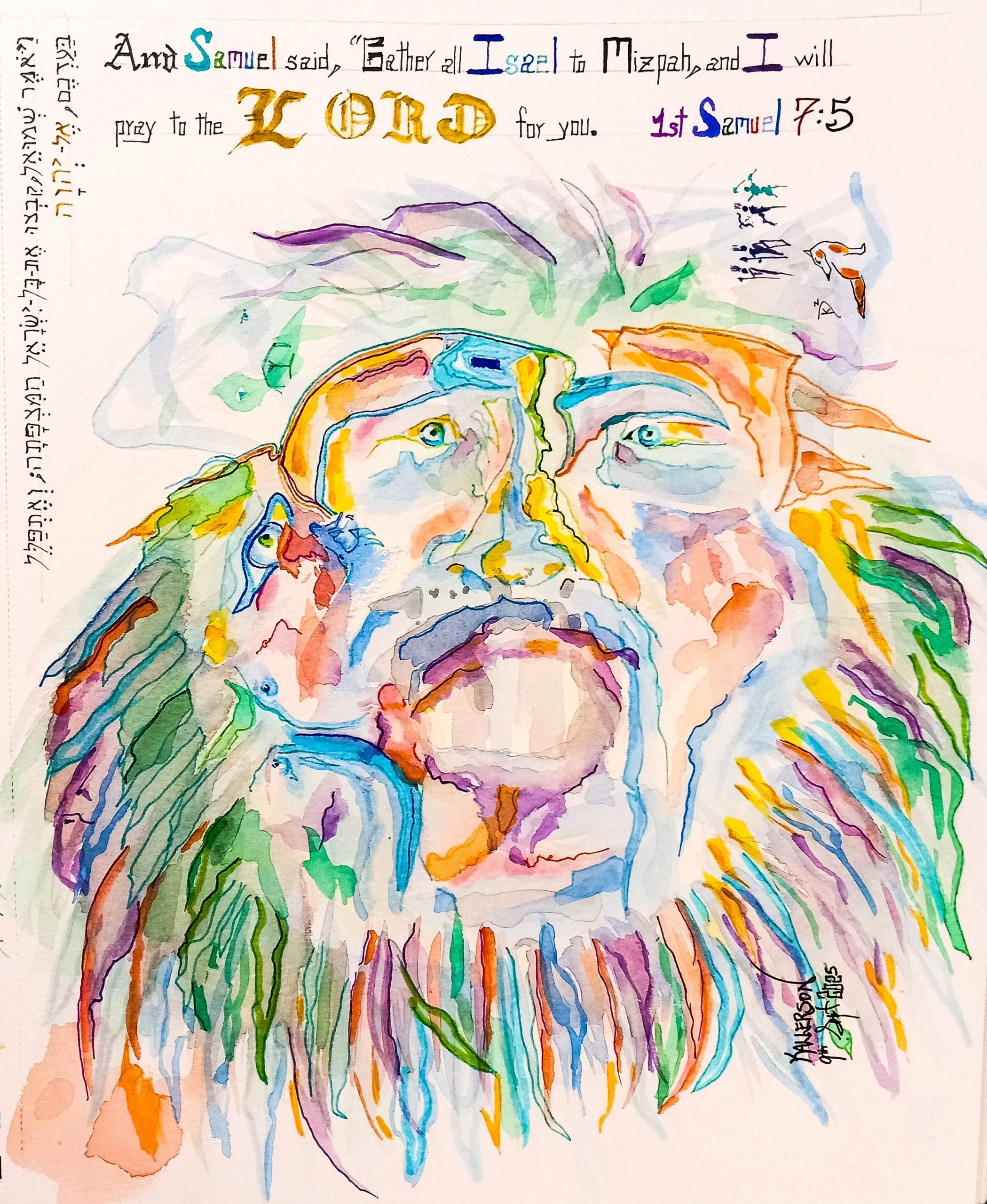
Artwork by Douglas Kallerson
1 Samuel 7:1-9
The Stone of the Helper, Part I
(Typed 23 July 2025) In the account today, there are things that don’t seem to make sense to scholars. In fact, some find them completely inexplicable. Because of this, a multitude of explanations have arisen to try to make sense of what is being said.
John Lange gives a lengthy commentary on the matter, citing other scholars and explaining their views. His commentary is long and complicated, and I will explain it as simply as possible.
What he writes is worth reading, but his conclusions are incorrect. The other scholars he cites know there is a problem with the information as given, and they come up with various explanations, which are also incorrect. I am assuming that what I propose is correct.
If that is the case, what would be the reason that these great scholars have not figured out how to reconcile the narrative, which is obviously confusing and which doesn’t logically flow as it is presented in the narrative?
Text Verse: “Behold, we heard of it in Ephrathah;
We found it in the fields of the woods.
7 Let us go into His tabernacle;
Let us worship at His footstool.
8 Arise, O Lord, to Your resting place,
You and the ark of Your strength.” Psalm 132:6-8
The words of the text verse refer to the ark. The psalm saying, “We found it in the fields of the woods” is a reference to where it is now in the Samuel narrative, Kirjath Jearim. The psalmist was remembering the time when David had the ark moved from there.
The reason the scholars cannot figure out why the text is the way it is and how to reconcile its peculiarities is that they are not looking for Jesus. None of their analyses attempts to fit Him into the picture. Instead, they are looking at the account as literal history (which it is) and attempting to analyze it solely from that perspective.
But as I have said many times, there are innumerable things that happened in Israel that are not recorded. Despite all of the history that occurred there, God chose only a few stories, and the word doesn’t tell us why this story was chosen while that one wasn’t.
Wait. Yes, it does. Luke 24:27 says concerning Jesus, “And beginning at Moses and all the Prophets, He expounded to them in all the Scriptures the things concerning Himself.” Jesus, in John 5:39, says, “You search the Scriptures, for in them you think you have eternal life; and these are they which testify of Me.” Paul, speaking of the account of Sarah and Hagar said, “which things are symbolic” (Galatians 4:24).
God selected real events before and during Israel’s history so that we could understand Jesus, future history in relation to Jesus, etc. Unless we stand back and look at these stories as typological representations, we will not be able to understand why the text is often so complicated.
This is why translators often change what the text is saying. Most don’t do so with malicious intent, but they feel that what is literally stated is incomprehensible. Only when thinking about what is going on from a greater perspective, meaning what God is telling us about Jesus and what is going on in redemptive history, will we find that what was seemingly incomprehensible is actually reasonable.
In Chapters 3 and 4, I made some assumptions about what is presented here in Chapter 7. At the time, it was guesswork because I had not evaluated what was said here. Were my suppositions correct? You can decide after hearing the explanation of Chapter 7.
That starts in just seconds. Great things are to be found in His superior word. And so, let us turn to that precious word once again, and… May God speak to us through His word today, and may His glorious name ever be praised.
I. And They Served Yehovah (verses 1-4)
Then the men of Kirjath Jearim came and took the ark of the Lord,
vayavou anshe qiryath yearim vayaalu eth aron Yehovah – “And they came, men Kirjath Jearim, and they caused to ascend Ark Yehovah.” Kirjath Jearim was mentioned in the previous chapter. After the people of Beth Shemesh looked into the ark, the Lord struck them greatly. Because of that, Chapter 6 closes out saying –
“And the men of Beth Shemesh said, ‘Who is able to stand before this holy Lord God? And to whom shall it go up from us?’ 21 So they sent messengers to the inhabitants of Kirjath Jearim, saying, ‘The Philistines have brought back the ark of the Lord; come down and take it up with you.’” 1 Samuel 6:20, 21
The narrative continues as the men who were summoned from Kirjath Jearim come and accept the Ark of Yehovah as petitioned. As noted, Kirjath Jearim means City of Forests or City of Honeycombs. With the ark in their possession, it next says…
1 (con’t) and brought it into the house of Abinadab on the hill,
vayaviu otho el beith avinadav bagivah – “And they caused to bring it unto house Abinadab in the hill.” The glaring omission of what tribe Abinadab belonged to is purposeful. Scholars insist he must have been from the tribe of Levi, or it “would be a gross violation of the Law” (Barnes, et al.).
It is irrelevant what tribe he belonged to. Not naming his tribe is purposeful. Abinadab comes from av, father, and nadav, willing, as in “willing to share,” generous, etc. As such, it means something like My Father is Generous, Father of Liberality, etc.
As for the location of the house, it says bagivah. The meaning is either “in the hill” or “in the Gibeah.” The latter was proposed by the Coverdale Bible of 1535. One Catholic version also uses that.
Either way, the word givah, hill, is etymologically connected to Gabbatha. It was typologically used in this manner on several occasions in the book of Judges. With the ark brought to this house in this location, it next says…
1 (con’t) and consecrated Eleazar his son to keep the ark of the Lord.
veeth Eleazar beno qideshu lishmor eth aron Yehovah – “And Eleazar, his son, they will consecrate to guard Ark Yehovah.” Bucking against most others, the JFB Commentary says, “He was not a Levite, and was therefore only set apart or appointed to be keeper of the place.”
They may be right, but as noted above, what tribe they belonged to is purposefully left out of the narrative. All it says is that this son of Abinadab was consecrated to guard the ark. Eleazer means Whom God Helps.
2 So it was that the ark remained in Kirjath Jearim a long time;
The expression is unusual: vayhi miyom sheveth ha’aron beqiryath yearim vayirbu ha’yamim – “And it was from day dwelling the ark in Kirjath Jearim, and they increased – the days.” The ark was taken from Israel’s open possession, and the days it was gone were purposefully increased, each being added with no known time when the cycle would end.
Of this time, and without making any typological connections to its significance, the Pulpit Commentary says the following –
“The words dwell wearily upon the length of this mournful period, during which Israel was in a state of subjection to the Philistines, with its national life crushed to the ground, and its strength wasted by unjust exactions and misrule. For though the Philistines gave up the ark, there was no restoration of the national worship, nor did they abandon the political fruits of their victory at Eben-ezer. But quietly and calmly Samuel was labouring to put all things right. It was the principle of the theocracy that Jehovah punished his subjects for their sins by withdrawing his protection, and that on their repentance he took again his place at their head as their king, and delivered them.” Pulpit Commentary
Despite not making any typological connections, their words exactingly reflect the typological future being hinted at. As for the ark’s stay at this location…
2 (con’t) it was there twenty years.
The NKJV inserts the word “there” without italicizing it. The word does not belong. Further, the subject is not the ark but the number of days. The verb is masculine plural, corresponding to the word “days”: vayihyu esrim shanah “And they were twenty years.”
This clause does not describe the amount of time the ark is at the house of Abinadab. This is proven from 2 Samuel 6 when David has it brought from there to take it to Jerusalem. Rather, the words anticipate the next clause. However, the ark will be mentioned again in 1 Samuel 14:18 –
“And Saul said to Ahijah, “Bring the ark of God here” (for at that time the ark of God was with the children of Israel).”
Despite this, 2 Samuel 6 notes that the ark was still at the house of Abinadab until the time of David.
As for the number twenty, Bullinger says –
“TWENTY is the double of ten, and may in some cases signify its concentrated meaning. But its significance seems rather to be connected with the fact that it is one short of twenty-one, 21 – 1 = 20; that is to say, if 21 is the three-fold 7, and signifies Divine (3) completion as regards spiritual perfection (7), then twenty, being one short of 21, it would signify what Dr. Milo Mahan calls expectancy.” E. W. Bullinger
During this twenty-year period of expectancy, it next says…
2 (con’t) And all the house of Israel lamented after the Lord.
Again, the verb is masculine plural: vayinahu kal beith Yisrael akhare Yehovah – “And they were groaned, all house Israel, after Yehovah.” The word nahal is introduced. It is a rare word signifying to groan or bewail. The days that multiplied and became years were a point of bewailing to the house of Israel.
And now, we come to a pivotal point in the narrative that was noted in Chapter 3…
3 Then Samuel spoke to all the house of Israel,
“Then” is a time marker not stated or implied in the words: vayomer shemuel el kal beith Yisrael – “And he said, Samuel unto all house Israel.” The words don’t logically follow in thought after the previous verse. A scholar named Otto Thenius understood this and stated there is a gap between the two verses. Despite this, Keil and Lange disagree. They say the five-fold repetition of the word “and” distinctly connects them.
I have no idea what Thenius’ solution to or analysis of the gap is, but in Chapter 3, I suggested that the final three verses were not given as a chronological marker that occurs before the events of Chapters 4-6. Rather, they were simply points of fact –
1) Samuel grew and the Lord was with him, and He caused none of his words to fall groundward, 2) All Israel, from Dan to Beersheba, knew that Samuel had been established a prophet of the Lord, and 3) Yehovah appeared again in Shiloh and he was denuded (made fully known) unto Samuel “in Shilo in word Yehovah.”
Dropping the “h” in Shiloh was purposeful and instructive, telling us that typology is being conveyed. It is our job to figure out why such changes are made. I also noted that the opening clause of Chapter 4 actually belongs chronologically after the events of Chapters 4 through 6, which were a parenthetical insert –
Points of fact concerning Samuel:
3:19 “And he will grow, Samuel. And Yehovah, He was with him. And not he caused to fall from all His words, ground-ward. 20 And it will know, all Israel, from Dan and until Beer-Sheba, for being faithful, Samuel, to prophet to Yehovah. 21 And He will cause to add, Yehovah, to be seen in Shiloh. For He was denuded, Yehovah, unto Samuel in Shilo in word Yehovah.”
Narrative of Samuel’s interaction with Israel:
4:1 “And it is, word Samuel, to all Israel. (…) 7:3 And he said, Samuel, unto all house Israel, to say, “If in all your heart you returning unto Yehovah, you must cause to turn aside gods the foreign from your midst, and the Ashtoreth. And you must cause to erect your heart unto Yehovah. And you must serve Him to His separation. And may He cause to snatch away, you, from hand Philistines.”
Though confusing, this is similar to what occurred in the book of Judges. This parenthesis explains the abrupt change between verses 2 and 3 here, and why Keil and Lange are incorrect. The consecutive “and” is perfectly explained by adjoining the first clause of verse 4:1 with this narrative in verse 7:3.
We are being shown information that belongs to one dispensation or another that has to be inserted somewhere. The way the narrative is laid out is precise and purposeful, even if it is a bit complicated.
Remembering that Samuel thus far has pictured the Seed of Grace, (he is the son of Hannah, Grace), the entire picture, as it is laid out, makes complete sense. Samuel, the Seed of Grace, speaks to Israel…
3 (con’t) saying, “If you return to the Lord with all your hearts,
lemor im bekhal levavkhem atem shavim el Yehovah – “to say, ‘If in all your heart you returning unto Yehovah.” The words imply that Israel is not right with the Lord. They have no relationship with Him, and are instead following other gods.
As such, things are not going well for them. That will be seen as the verse continues. In order to correct that, Samuel is calling for them to return their hearts to Yehovah and act in accord with the change…
3 (con’t) then put away the foreign gods and the Ashtoreths from among you,
Rather: hasiru eth elohe ha’nekhar mitokh’khem veha’ashtaroth – “you must cause to turn aside gods the foreign from your midst, and the Ashtaroth.” The people were following various gods, not the One true God. These gods are defined by the word nekhar, signifying foreign or strange.
Also noted is the Ashtaroth. It is a proper noun. The word Ashtaroth (not Ashtoreths) is plural. However, the reason why it is considered singular as a name is, as Abarim explains, “to reflect an intense veneration of one.”
The etymology of the name is rather complicated, but Abarim defines it as Unity of Instruction or One Law. Samuel continues, saying…
3 (con’t) and prepare your hearts for the Lord, and serve Him only;
vehakhinu levavkhem el Yehovah veivduhu levado – “And you must cause to erect your heart unto Yehovah. And you must serve Him to His separation.” One cannot serve the Lord and other gods. This is similar to what is seen in Paul’s words in Acts –
“…testifying to Jews, and also to Greeks, repentance toward God and faith toward our Lord Jesus Christ.” Acts 20:21
The meaning of “repentance toward God” is reconsidering who God is. Samuel is saying, “Give up on the other gods and the Ashtaroth and establish their (pl.) national heart (heart is singular) unto Yehovah…
3 (con’t) and He will deliver you from the hand of the Philistines.”
Rather, the verb is a jussive: veyatsel ethkhem miyad pelishtim – “And may He cause to snatch away, you, from hand Philistines.” It is not saying that the Lord will do it. Instead, it is a petition from Samuel, stated in a softened but authoritative manner for Him to do it.
Philistines means Weakeners.
With Samuel’s words stated to Israel, there is a response…
4 So the children of Israel put away the Baals and the Ashtoreths,
vayasiru bene Yisrael eth habealim veeth ha’ashtaroth – “And they caused to turn aside, sons Israel, the Baals and the Ashtaroth.” The foreign gods of the previous verse are now called ha’bealim, the Baals. The word signifies a lord or master. Thus, it is an identification with foreign gods, accepting them as lords or masters over them.
Just as Samuel instructed, the people did. They reconsidered what they were doing and mentally turned from it, giving up on the false lords and the Ashtaroth…
4 (con’t) and served the Lord only.
vayaavdu eth Yehovah levado – And they served Yehovah to His separation.” The words “to His separation” mean to Him alone. All other gods and allegiances are separated and thus excluded.
The Philistines want to get you
They want to possess your very soul
There is nothing they won’t do
To wield over you total control
This is what they want, nothing less
And they will do it by weakening your will
If they get it, your life will be a mess
For you, it will be a sad, bitter pill
Eyes on Jesus! Fix them on Him alone
Don’t let the Philistines ruin your soul
If they weasel in, your joy will be blown
And your life will spin out of control
II. In the Mizpah (verses 5-9)
5 And Samuel said, “Gather all Israel to Mizpah, and I will pray to the Lord for you.”
vayomer shemuel qivtsu eth kal Yisrael ha’mishpathah veethpalel baadkhem el Yehovah – “And he said, Samuel, ‘You must gather all Israel the Mizpah-ward, and I will intercede myself for you unto Yehovah.’” Samuel calls a national gathering of the people.
It is possible that he called only the elders who stand as representatives of their clans. Or it could be that the entire congregation came together as at the time of a pilgrim feast. Either way, the point is that the people were to gather and Samuel would be among them and intercede for them.
The Mizpah means The Watchtower.
In response to Samuel’s petition…
6 So they gathered together at Mizpah,
vayiqavetsu ha’mitspathah – “And they were gathered the Mizpah-ward.” If this is a literal watchtower and not merely a location, it would then explain why it says Mizpah-ward. You can only fit so many people into an edifice. The people would be gathered toward that location, assembling in the general area. Once they were in the area of the Mizpah, they…
6 (con’t) drew water, and poured it out before the Lord.
vayishavu mayim vayishpekhu liphne Yehovah – “and they drew waters, and they poured to faces Yehovah.” Without an explanation of the intent of this ritual, which is not found elsewhere, only speculation can be made as to its significance. However, the upcoming clauses give a hint of the matter.
Water has various meanings in Scripture, including life, death (when poured out, as in the dissolution of life), cleansing, judgment, the Spirit, etc.
An ancient paraphrase says, “They poured out their heart like water in penitence before the Lord.” This is probably much of the intent. In Lamentations, it says –
“Arise, cry out in the night,
At the beginning of the watches;
Pour out your heart like water before the face of the Lord.
Lift your hands toward Him
For the life of your young children,
Who faint from hunger at the head of every street.” Lamentations 2:19
Lamentations ties the state of the heart when it is poured out to water. In the next clause, lifting of hands is a sign of petition “for the life of your young children.”
As such, the pouring of the heart like water would be a sign of contrition and penitence to include seeking spiritual cleansing. The water was drawn and then poured out…
6 (con’t) And they fasted that day,
vayatsumu bayom ha’hu – “and they fasted in the day, the it.” The word tsum signifies to not eat, and thus to fast. It comes from a primitive root signifying “to cover over.” As such, it is as if the people covered their mouths to purposefully not eat.
For all we know, it could mean they actually covered their mouths as an open display of their fast. Fasting signifies denial and mourning. The only other time it has been seen so far was in Judges 20 –
“Then all the children of Israel, that is, all the people, went up and came to the house of God and wept. They sat there before the Lord and fasted that day until evening; and they offered burnt offerings and peace offerings before the Lord.” Judges 20:26
Based on this state of contrition, which probably included mourning as in Judges, it can be assumed that drawing and pouring out the water is likewise a sign of mourning and contrition. This seems even more likely when considering the next words…
6 (con’t) and said there, “We have sinned against the Lord.”
vayomeru sham khatanu leYehovah – “And they said there, ‘We have sinned to Yehovah.’” Their words are an acknowledgement of their sin against the Lord. As such, pouring the water and fasting are connected to that.
Both water and food are necessary to sustain oneself. And so, one might say, “I have laid my very existence before You. It is an existence that, like water, will disappear in the dust of the earth without Your intervention. And as a man without food, I will perish. I have sinned against you, and I acknowledge that.”
6 (con’t) And Samuel judged the children of Israel at Mizpah.
vaayishpot shemuel eth bene Yisrael ba’mitspah – “And he judged, Samuel, sons Israel in the Mizpah.” The verb is imperfect. Therefore, it doesn’t mean he became a judge at this time. Nor does it mean that he judged Israel at this time or only at this time.
Rather, as will be seen in verse 15, where the verb is imperfect, it means that Samuel conducted his judging at the Mizpah. This is supplemented by his judging at Bethel and Gilgal, as to be noted in verse 16. He called the assembly there, and from that time on, it became a place where he judged the people.
7 Now when the Philistines heard that the children of Israel had gathered together at Mizpah,
The word “when” gives a false sense of the intent: vayishmeu phelishtim ki hitqabetsu vene Yisrael ha’mitspatah – “And they heard, Philistines, for they gathered themselves, sons Israel the Mizpah-ward.” The words are a statement of fact. The Philistines heard that Israel had gathered.
At this time, Israel was under the authority of the Philistines. Therefore, it is likely that they assumed the gathering was for the purpose of revolting against Philistine rule. If for this or some other reason, the gathering of the people elicited a response…
7 (con’t) the lords of the Philistines went up against Israel.
vayaalu sarne phelishtim el Yisrael – “And they ascended, axles Philistines, unto Israel.” This doesn’t mean only the leaders of the Philistines. It means that they mustered the people under them as a fighting force, joining with the other leaders and those they mustered. Because of the sizable force set to wage war…
7 (con’t) And when the children of Israel heard of it, they were afraid of the Philistines.
vayishmeu bene Yisrael vayiru mipene phelishtim – “And they heard, sons Israel, and they feared from faces Philistines.” The people had not come prepared for battle. They were called by Samuel for a public assembly. This doesn’t mean they weren’t armed, as will be seen in verse 10. However, it was not something they expected when they were called to gather.
Even if their intent was to fight the Philistines, seeing that all five of their enclaves were coming would mean they had a sizeable force to engage. Therefore, the people were afraid.
8 So the children of Israel said to Samuel, “Do not cease to cry out to the Lord our God for us,
vayomeru vene Yisrael el shemuel al takharesh mimenu mizeoq el Yehovah elohenu – “And they said, sons Israel unto Samuel, ‘Not may you cause to be silent from us from shrieking unto Yehovah our God.” The NKJV is a suitable paraphrase. They want Samuel to purposefully and continuously call out to the Lord on their behalf. If they have to engage in battle, they desire his constant intercession.
This is a much different attitude than the time they faced the Philistines in Chapter 4, where the people treated the ark as a talisman for victory. The ark is not in sight. Rather, they are trusting that the Lord will respond because of Samuel’s petition, regardless of its location…
8 (con’t) that He may save us from the hand of the Philistines.”
veyoshienu miyad pelishtim – “And He will cause to save us from hand Philistines.” In verse 3, Samuel told the people to put away the hindrances to serving the Lord, erect their heart toward Him, and serve Him only. In doing this, Samuel said, “And may He cause to snatch away, you, from hand Philistines.”
As noted then, it wasn’t a claim that He would save them from their hands. Being a jussive, it was a petition stated in a softened, authoritative manner. Because of that, the people have asked Samuel to cry out to the Lord for a hopeful response to his previous words. To begin that process, it next says…
9 And Samuel took a suckling lamb
vayiqakh shemuel teleh khalav ekhad – “And he took, Samuel, lamb – milk, one.” A particular lamb, taleh, is introduced here. It will only be seen again in Isaiah 65:25, where it says that the wolf and the lamb shall feed together. It is derived from tala, to patch or cover with pieces. The idea is probably a lamb born with mottled colors.
This root occurs eight times. Six are in the account of Jacob having spotted animals which are contrasted to Laban’s flocks. Once it is seen in Joshua 9 concerning patched sandals which made those who wore them look like they had traveled a long time, when in fact they were from just down the road.
The last use is in Ezekiel 16, where the people took their fine garments given to them by the Lord and mottled them on high places, playing the harlot with other gods. What appears to be the case, then, is that there is a contrast in the lives of the people as they turned to Him, and Samuel is using this lamb to indicate that to the Lord.
They had foreign gods and the Astaroth, but now they sought only the Lord through contrition and Samuel’s intercession.
Adding the word “milk” signifies it was a young lamb, still drinking its mother’s milk. That would mean a lamb up to about four months old. However, Leviticus says –
“When a bull or a sheep or a goat is born, it shall be seven days with its mother; and from the eighth day and thereafter it shall be accepted as an offering made by fire to the Lord.” Leviticus 22:27
Having procured this young lamb, it next says…
9 (con’t) and offered it as a whole burnt offering to the Lord.
vayaaleh olah kalil leYehovah – “And he caused to ascend burnt offering, whole, to Yehovah.” Samuel is not of the priestly line, but he has interceded to the Lord for the people. That is an intercessory function generally conducted by priests.
However, in 1 Kings 8, Solomon prayed to the Lord at the dedication of the temple. This and other such examples appear to indicate that praying in such a manner extended beyond a priestly duty alone.
Samuel is also making an offering to the Lord, something designated for priests to do. However, both Gideon and Manoah were also instructed to offer a sacrifice to the Lord. As such, it appears Samuel, as Israel’s judge, has been given dispensation to do so as well.
It is possible, but otherwise unstated, that he directed a priest to perform the offering, something that would still be credited to him. Regardless of that, it next says…
9 (con’t) Then Samuel cried out to the Lord for Israel,
vayizaq shemuel el Yehovah bead Yisrael – “And he shrieked, Samuel, unto Yehovah for Israel.” With the offering made, Samuel then complied with the request of the people from verse 8, where they petitioned him to continuously cry out to the Lord for them. Having cried out, it next says…
*9 (fin) and the Lord answered him.
vayaanehu Yehovah – “And He answered him, Yehovah.” The people’s actions mingled with the acknowledgment of their sins, combined with Samuel’s offering and shrieks to the Lord, have brought the Lord’s attention and response to the situation.
This is where we will end the verses today, anticipating interesting things as the narrative continues. If you have been considering what has been explained and the meanings of various things in relation to the Lord and future events, you may have an idea of what the narrative is pointing to.
If not, consider it until next week, and the Lord willing, we’ll find a resolution concerning everything as the Lord has laid it out in His word.
Remember that these stories are in here for a reason that extends beyond just a literal historical account of Israel’s history and their interactions with the Lord. Jesus, Paul, and the other New Testament authors said as much.
Through His word, God is providing information for us to consider, understand His will and actions, and for us to act upon at times as well. When you read the Bible, you are mentally interacting with God through His word.
Therefore, take advantage of this wonderful tool of instruction each day. You will be renewed, and God will certainly be pleased with you. May it guide your steps and comfort your souls always.
Paul, in our closing verse, will give us instruction concerning our lives as we walk before the Lord. The way that we will be able to comply with what he says is by reading and heeding the word.
Closing Verse: “I beseech you therefore, brethren, by the mercies of God, that you present your bodies a living sacrifice, holy, acceptable to God, which is your reasonable service. 2 And do not be conformed to this world, but be transformed by the renewing of your mind, that you may prove what is that good and acceptable and perfect will of God.” Romans 12:1, 2
Next Week: 1 Samuel 7:10-17 With the Lord, it will go well, it is true… (The Stone of the Helper, Part II) (14th 1 Samuel Sermon)
The Lord has you exactly where He wants you. He has a good plan and purpose for you. He is the One who abases the haughty and exalts the humble. He regards the lowly, and the proud He knows from afar. So yield yourself to Him, trust Him, and believe His word. In this, He will do great things for you and through you.
1 Samuel 7:1-9 (CG)
1 And they came, men Kirjath Jearim, and they caused to ascend Ark Yehovah. And they caused to bring it unto house Abinadab in the hill. And Eleazar, his son, they will consecrate to guard Ark Yehovah.
2 And it was from day dwelling the ark in Kirjath Jearim, and they increased the days. And they were twenty years. And they were groaned, all house Israel, after Yehovah.’’
———————
The main narrative resumes from 1 Samuel 4:1
3 And he said, Samuel, unto all house Israel, to say, “If in all your heart you returning unto Yehovah, you must cause to turn aside gods the foreign from your midst, and the Ashtaroth. And you must cause to erect your heart unto Yehovah. And you must serve Him to His separation. And may He cause to snatch away, you, from hand Philistines.” 4 And they caused to turn aside, sons Israel, the Baals and the Ashtaroth. And they served Yehovah to His separation.
5 And he said, Samuel, “You must gather all Israel the Mizpah-ward, and I will intercede myself for you unto Yehovah.” 6 And they were gathered the Mizpah-ward, and they drew waters, and they poured to faces Yehovah, and they fasted in the day, the it. And they said there, “We have sinned to Yehovah.” And he judged, Samuel, sons Israel in the Mizpah.
7 And they heard, Philistines, for they gathered themselves, sons Israel the Mizpah-ward. And they ascended, axles Philistines, unto Israel. And they heard, sons Israel, and they feared from faces Philistines. 8 And they said, sons Israel unto Samuel, “Not may you cause to be silent from us from shrieking unto Yehovah our God. And He will cause to save us from hand Philistines.”
9 And he took, Samuel, lamb – milk, one. And he caused to ascend burnt offering, whole, to Yehovah. And he shrieked, Samuel, unto Yehovah for Israel. And He answered him, Yehovah.
1 Samuel 7:1-9 (NKJV)
1 Then the men of Kirjath Jearim came and took the ark of the Lord, and brought it into the house of Abinadab on the hill, and consecrated Eleazar his son to keep the ark of the Lord.
2 So it was that the ark remained in Kirjath Jearim a long time; it was there twenty years. And all the house of Israel lamented after the Lord.
3 Then Samuel spoke to all the house of Israel, saying, “If you return to the Lord with all your hearts, then put away the foreign gods and the Ashtoreths from among you, and prepare your hearts for the Lord, and serve Him only; and He will deliver you from the hand of the Philistines.” 4 So the children of Israel put away the Baals and the Ashtoreths, and served the Lord only.
5 And Samuel said, “Gather all Israel to Mizpah, and I will pray to the Lord for you.” 6 So they gathered together at Mizpah, drew water, and poured it out before the Lord. And they fasted that day, and said there, “We have sinned against the Lord.” And Samuel judged the children of Israel at Mizpah.
7 Now when the Philistines heard that the children of Israel had gathered together at Mizpah, the lords of the Philistines went up against Israel. And when the children of Israel heard of it, they were afraid of the Philistines. 8 So the children of Israel said to Samuel, “Do not cease to cry out to the Lord our God for us, that He may save us from the hand of the Philistines.”
9 And Samuel took a suckling lamb and offered it as a whole burnt offering to the Lord. Then Samuel cried out to the Lord for Israel, and the Lord answered him.