Song of Songs 5:1-8
My Hands Dripped Myrrh
(Typed 27 January 2025) In the Bible, the heart is mentioned over eight hundred times, and yet, it never refers to the literal, physical pump that pulses the blood through the body. Rather, it is used figuratively in Scripture.
P. Hughes defines it as “‘the affective center of our being’ and the capacity of moral preference.” G. Archer says it is the “desire-producer that makes us tick.” In essence, it is our seat of moral reasoning.
For example, Genesis 6:5 is the first mention of the heart. There it says of man that “every intent of the thoughts of his heart was only evil continually.” The last use of the heart in the Old Testament says that the Lord, “will turn the hearts of the fathers to the children, and the hearts of the children to their fathers.”
In the New Testament, the first use happens to be the first verse I ever learned, because it was on a magnet on our refrigerator. Matthew 5:8 says, “Blessed are the pure in heart, for they shall see God.”
The New Testament’s last use, referring to the Great Harlot of the end times, says “…for she says in her heart, ‘I sit as a queen, and am no widow, and will not see sorrow’” (Revelation 18:7).
Text Verse: “As many as I love, I rebuke and chasten. Therefore be zealous and repent. 20 Behold, I stand at the door and knock. If anyone hears My voice and opens the door, I will come in to him and dine with him, and he with Me.” Revelation 3:19, 20
The understood meaning of the words of Jesus is based on 1) what the purpose of knocking is, 2) what a door signifies, and 3) what result Jesus is attempting to obtain.
Jesus is not standing at a literal door and knocking with his knuckles in an appeal for someone to open it and allow Him to come strolling in. Rather, the words are being used metaphorically.
The knocking is an appeal to the intellect of a person. He explained the problem that was found in the Laodicean church. He told them of their condition and warned them of the consequences of what would happen if they didn’t change. The appeal is expressed in the words “be zealous and repent.”
Understanding this, and based on what we reviewed, we know that the heart is consistently used as a metaphor to identify the seat of reason, intellect, and the inner person. Paul says in Romans 10 –
“But what does it say? ‘The word is near you, in your mouth and in your heart’ (that is, the word of faith which we preach): 9 that if you confess with your mouth the Lord Jesus and believe in your heart that God has raised Him from the dead, you will be saved. 10 For with the heart one believes unto righteousness, and with the mouth confession is made unto salvation.” Romans 10:8-10
Paul is using the heart, as the Bible does consistently, as the seat of reason and intellect. The seat of reason and intellect is where one acts zealously to repent. Therefore, the door that is being knocked on is to be taken metaphorically for the heart. It doesn’t need to say that. Rather, it is implied from even a minimal understanding of how the heart is presented in Scripture.
Understanding this will help us understand the symbolism presented in the passage today, and it is what is seen in the verses in Revelation. Don’t expect Jesus to come knocking on the door of a church and calling out for the people inside to repent. That ain’t gonna happen.
Rather, Jesus is knocking on the hearts of the people in the church, imploring them to reconsider their ways and return to Him. It’s something many who fall under the umbrella of what is known as “the church” need to pay heed to today.
Unfortunately, many churches don’t even refer to the Bible, but if they do, Revelation is the last place they would consider referring to. It’s sad, because without that, they don’t even know he is knocking.Such interesting things as properly applying metaphor are to be found in His superior word. And so, let us turn to that precious word once again, and… May God speak to us through His word today, and may His glorious name ever be praised.
I. My Dove, My Perfect (verses 1-3)
The words of this first verse are stated by Solomon, responding to the words of his beloved that closed out Chapter 4 –
The beloved:
Fountain gardens,
Well waters – living,
And gushings from Lebanon.
16 Awake, north!
And go, south!
Puff my garden,
Gushes its fragrances.
Come, my beloved, to his garden,
And eat fruit – his preciousnesses.
Solomon:
Came to my garden, my sister – completer.
Plucked my myrrh with my fragrance.
Eaten my forest with my honey.
Drank my wine with my milk.
Eat friends!
Drink and intoxicate, lovers!
Understanding this structure, let’s evaluate the words individually with that in mind…
I have come to my garden, my sister, my spouse;
bathi l’gani akhothi khalah – “Came to my garden, my sister – completer.” In the previous chapter, she had said, “Come, my beloved, to his garden.” She offered herself to him. He came to her as she implored, enjoyed what she provided, and is now recounting his experience.
As seen in Chapter 4, he called her his sister three times. This identifies her nature. She is a member of the same people, nation, etc.
Also, five times in Chapter 4, he called her his kalah, his completer. He uses that term for the sixth and last time in the book here. She is his completer, and she has made him complete. With that understood, he explains his time with her…
1 (con’t) I have gathered my myrrh with my spice;
Rather, he states more strongly: arithi mori im b’sami – “Plucked my myrrh with my fragrance.” His beloved’s fragrances were seen in Chapter 4. He only mentions myrrh by name here, maybe as a catchall for the whole list.
As for its meaning, mor, myrrh, signifies bitterness, but it symbolizes love. More especially, however, love in intimate union, but not necessarily sexual in nature.
As for the action of plucking, the word arah, to pluck, is found only here and in Psalm 80 –
“Why have You broken down her hedges,
So that all who pass by the way pluck [arah] her fruit?
13 The boar out of the woods uproots it,
And the wild beast of the field devours it.” Psalm 80:12, 13
He is describing his union with his beloved almost forcefully, as if he plucked the fragrances right off of her. As it is in the garden, it is as if he took the fragrant flowers and broke them off in a passion. The reason for the hungrily-stated words seems rightly reflected by Keil –
“The road by which Solomon reached this full and entire possession was not short, and especially for his longing it was a lengthened one. He now triumphs in the final enjoyment which his ardent desire had found.” Keil
He had longed for the union but had to wait for it to come about. When the time came, he could no longer restrain himself. Next…
1 (con’t) I have eaten my honeycomb with my honey;
akhalti yari im divshi – “Eaten my forest with my honey.” The word ya’ar means to thicken with verdure, as a forest, and this is how it is elsewhere translated. However, it doesn’t seem to make sense to say he ate his forest.
Because of this, the thought by scholars is that the honeycomb must be what is referred to as if the comb is hived in trees. That seems to stretch the intent. Rather, verse 4:11 said, “Honey and milk under your tongue.” Verse 4:13 noted the shoots of the garden, which included the pomegranates.
He is going back to those verses and equating her loving assets to a forest. Its fruit, which the forest stands as representative, is what he has hungrily eaten along with the honey. That would mean kissing her and receiving the transfer of honey through the kisses.
As for devash, honey, it is equated to the word of God several times in Scripture. He is describing their union as a trip through her garden, (meaning her) because she was a “garden locked” in verse 4:12. He has unlocked her for himself and is describing the experience. Next…
1 (con’t) I have drunk my wine with my milk.
shathithi yeni im khalavi – “Drank my wine with my milk.” The word yayin, wine, comes from an unused root meaning to effervesce. Thus it is fermented wine, an intoxicant. He is essentially saying he is love drunk.
The word khalav, milk, comes from khelev, fat. It is used to describe the richest or choicest part. As such, he is love drunk over partaking of her assets. The experience was that memorable to him.
The two, wine and milk, are found together again in Isaiah 55 –
“Ho! Everyone who thirsts,
Come to the waters;
And you who have no money,
Come, buy and eat.
Yes, come, buy wine and milk
Without money and without price.” Isaiah 55:1
After speaking of his memorable moment, he next addresses his hearers…
1 (con’t) Eat, O friends!
Drink, yes, drink deeply,
O beloved ones!
The verbs are imperative and plural: ikhlu reim shethu v’shikhru dodim –
“Eat friends!
Drink and intoxicate, lovers!”
Solomon is so overwhelmed with the experience that he wants everybody to feel the way he does. He essentially shouts out to them (Don’t miss the opportunity!) to experience what he has just gone through. He is telling them to make a meal and a banqueting feast out of their own lovers.
The verb shakhar signifies to become tipsy through satiating oneself via stimulating drink. He wants his hearers, called friends and lovers, to experience love so strongly and deeply that they become as intoxicated as if they each drank their own bottle of Old Rip Van Winkle.
The words now close the third major part of the song. The previous parts ended at 2:7 and 3:5. From here, a new direction takes place.
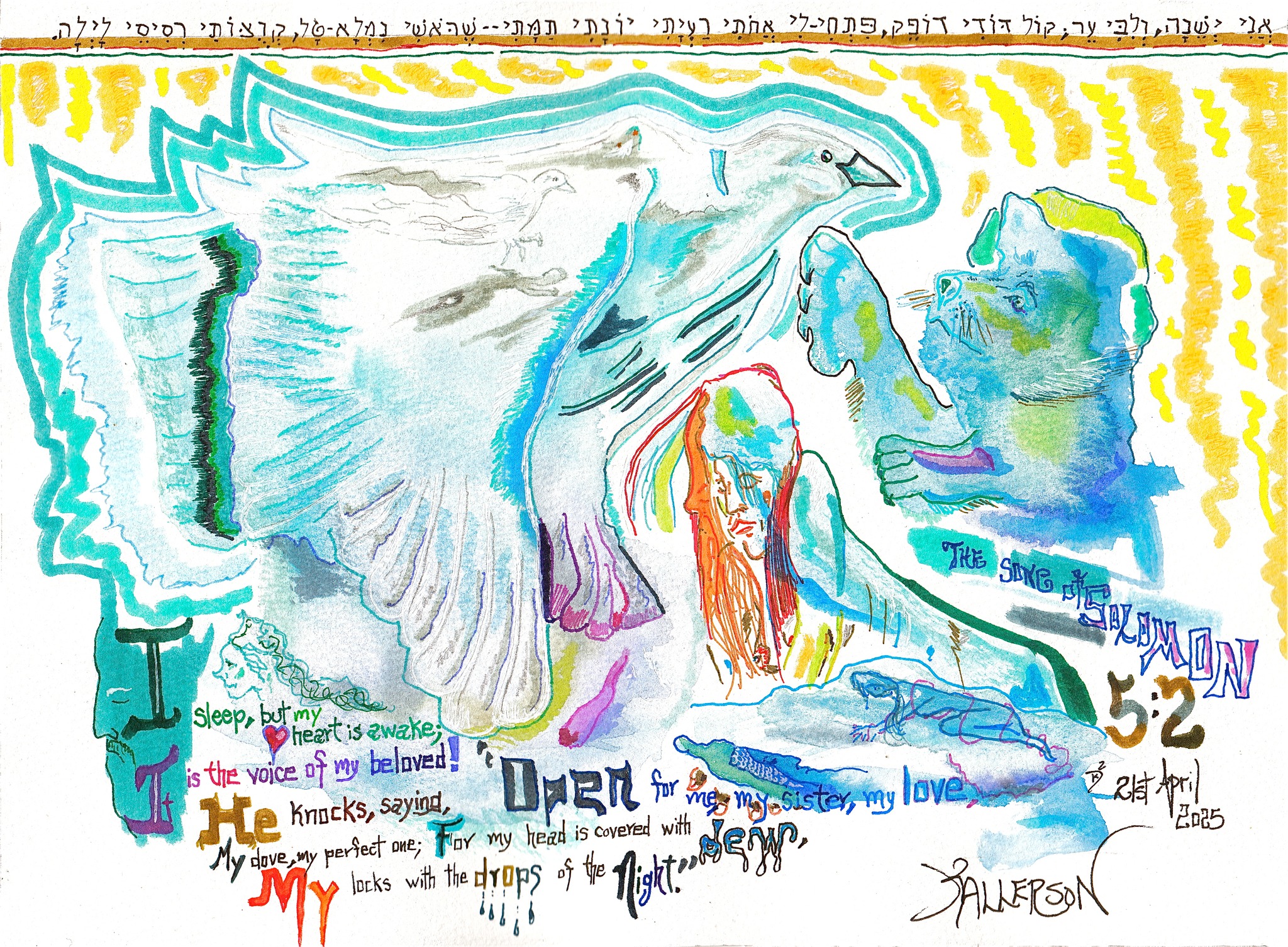
2 I sleep, but my heart is awake;
ani y’shenah v’libi er – “I asleep, and my heart awaking.” The words are like the words of 3:1-4. There, she was dreaming of going out to find her beloved. Here, she appears to describe dreaming once again, and is recounting the dream’s contents.
She is lying down and asleep, but her heart starts stirring. The verb is a participle, awaking. She is describing the stirring of her heart because of something. It is calling her to also wake up…
2 (con’t) It is the voice of my beloved!
qol dodi – “Voice my beloved!” This is what has stirred her from her slumber. She hears his voice as he calls to her…
2 (con’t) He knocks, saying,
Rather, it is an abrupt stand-alone thought, stated with a participle: Dopheq – “Knocking.” It is what you would expect from a poetically expressed dream. The word calls for the mind to join in the moment, “Do you hear it? Knocking…”
The act of knocking is an appeal to the heart, just as are his coming words. That is why she said her heart was awaking. In the Bible, the heart is used metaphorically when referring to the inner person, the mind, the intellect, the will, etc. He is making an appeal to her heart, her seat of reason, speaking while knocking.
Next, the hurriedness of her beloved is expressed. She hasn’t responded and yet he calls out, certainly while still knocking…
2 (con’t) “Open for me, my sister, my love,
My dove, my perfect one;
pithkhi li akhothi rayathi yonathi thamathi –
“Open to me, my sister, my querida,
My dove, my perfect.”
His excitedly expressed words are as if he is in pain at not seeing her. He can’t wait to be with her, and so he practically bribes her to open up with his alluring words. To make his request even more urgent, he next says…
2 (con’t) For my head is covered with dew,
My locks with the drops of the night.”
sheroshi nimla tal q’vutsothay r’sisey lay’lah –
“That my head filled – dew,
My locks – drops, night.”
His words attempt to convince her to open up and let him in. The alluring words are mixed with words of distress accompanied by knocking. They form a hopefully irresistible appeal to her heart to mercifully let him in to dry off and see his querida.
As for his locks, the word is found only here and in verse 11, qevutstsoth, coming from quts, to spend the harvest season, but that is from a primitive root signifying to clip off. It is this root that defines them as locks. He is speaking in parallelism. His head is filled with dew, and his locks are soaked in the night drops.
These drops are also another new and rare word, rasiys, coming from rasas, to moisten. That, in turn, comes from another primitive root that signifies to comminute (crush, grind, mill, pound, pulverize, triturate, etc.). It is as if the moisture in the sky has broken down into small particles of dew. These have completely covered his head.
He might get a sniffle! Let him in! But she, certainly disappointing him, says…
3 I have taken off my robe;
How can I put it on again?
pashat’ti eth kutan’ti eikhakhah elbashenah –
“Stripped my robe.
How don it?”
In this dream, she is thinking about her life before becoming a princess. She has one robe that she has removed before getting into bed. The meaning is, then, that she is in bed. To don her robe would only lead to another problem…
3 (con’t) I have washed my feet;
How can I defile them?
rakhats’ti eth raglay eikhkhah atan’phem –
“Washed my feet.
How soil them?”
She uses the word found only this one time in the Bible, tanaph, to soil. To get to her robe, she would have to get out of bed. But before going to bed, she would have lifted her feet and washed them to keep the bed from being dirtied. She probably had one pair of sandals that she kept by the door for walking around outside. But inside, she didn’t have a second pair for walking around.
This is what necessitated washing her feet. The floor was probably nothing more than stamped dirt. Getting up would defile her feet, demanding her to redo the whole process before going to bed again.
The excuses are weak, but she is following the advice that she has, and will again, express to the daughters of Jerusalem about not rushing love.
In a curiosity of the Hebrew, the word feet is a feminine noun, but the word translated as “soil them” is masculine. It would be like she was saying of her feet, “I have washed my girls, how can I soil my boys?” Despite her protestations, he is determined to obtain his goal. Therefore, he will act further to convince her…
Seek the Lord while He may be found
Respond to the call that He makes
When you hear that knocking sound
Be sure to respond, whatever it takes
When it means setting aside your pride
That is what you must do
If you want to be on the Lord’s side
Then do what He expects of you.
He is knocking on the door of your heart
Asking you to begin a new way
Put away the old and make a new start
Don’t delay the decision another day.
II. My Soul Went Out (verses 4-8)
4 My beloved put his hand
By the latch of the door,
dodi shalakh yado min ha’khor – “My beloved sent his hand from the hole.” It is debated what the meaning of the hole is. It would not be a hole to unlatch the door, as that would defeat the purpose of latching it. It may have been something like our mail slot, where someone could drop something off or pass something through without the need to open the door.
Regardless, the intent of sending his hand from the hole seems to be urging her further. Not only has he knocked, wooed, and sought for sympathy, but he put his hand through this hole, either making a grasping motion, as in, “Come here, I need you,” or a waving motion, as in, “Come on, come on, come on,” imploring her to respond.
The poor guy is like a buck in rut, beside himself with love and yearning to be with her. But she also admits that of herself…
4 (con’t) And my heart yearned for him.
Rather: u-meai hamu alav – “And my innards clamored upon him.” The word meeh signifies the bowels, intestines, etc. It is plural here. Translating it as heart blows the symbolism. Likewise, the word hamah signifies to make a loud sound like our English word hum.
She is saying that she feels sorry for him because of his many, fervent appeals. It may go further, though, to the point that she is also churning inside for him, but she has more restraint than he does. At least for a moment or two.
However, she finally acquiesces to his appeals, not being able to bear the thought of him out there while she is inside. And so, she dirties her feet and (well, maybe) puts on her robe…
5 I arose to open for my beloved,
qamti ani liphtoakh l’dodi – “Arose, I, to open to my beloved.” Breaking down from the strain, she arises, gets her feet dirty, and heads to the door. She has decided to let him in…
5 (con’t) And my hands dripped with myrrh,
v’yadai nat’phu mor – “And my hands dripped myrrh.” She gets to the door and finds that her hands have myrrh all over them. It appears that when he put his hand through, he not only beckoned to her, but he also took a vial of myrrh and shook it all around through the hole, maybe attempting to lure her to come.
It may even be why she came to the door. The smell became irresistible. To accentuate and explain the matter, she next says…
5 (con’t) My fingers with liquid myrrh,
Rather: v’etsb’othay mor over – “And my fingers myrrh passing over.” The verb avar means to cross over or pass over. Here, it is a participle, passing over. It doesn’t mean liquid, flowing, choice, sweet smelling, or any of the innumerable attempts to explain what is being said.
It means that the myrrh was on the other side of the door, and then passed over to her side. The use of the participle tells us that it was his and was passing over to become hers, an anointing from her beloved. When he did this, it dripped…
5 (con’t) On the handles of the lock.
Rather: al kapoth ha’man’ul – “Upon palms the bolt.” Like door bolts today, this one would have flat protrusions, looking like palms, that you would grab and pull to unlock the door. His hand came in through the hole which was above the bolt. He knew this and shook out the myrrh all over it.
Even if she didn’t get up to open the door right away, eventually she would, and her hands would be anointed with the myrrh. The use of the word palms to describe the handles is a nice touch to assist in forming parallelism in all three clauses. The word myrrh, though not stated, is implied in the third clause –
And my hands dripped myrrh.
And my fingers myrrh crossing over.
(From myrrh) Upon palms the bolt.
Having grabbed the palms and unfastened the bolt…
6 I opened for my beloved,
But my beloved had turned away and was gone.
pathakhthi ani l’dodi v’dodi khamaq avar –
“Opened, I, to my beloved,
And my beloved wrapped – passed over.”
As is typical in a dream, in opening the door for him, her heart sank. Thus, she uses words appropriate to the situation. First, the word khamaq, is rare, being found only here and in Jeremiah 31:22.
It comes from a primitive root meaning to wrap. As such, it means to be gone from sight, just as when something is wrapped, it is no longer in sight. Thus, an understandable paraphrase might be “My beloved was gone from sight.”
That is supplemented with the word avar, passed over. His hands had passed over from the other side of the door to anoint her lock. Now he has passed over from her presence.
The moment when the two were close enough to touch had passed, and he was no longer there to join her. As such, she calls to mind what prompted her to get up and go to the door…
6 (con’t) My heart leaped up when he spoke.
Rather: naphshi yats’ah v’dab’ro – “My soul went out in his speaking.” The meaning is that his words cut her soul from her. First, it was as if she went through the hole in her door to be with him. When she could no longer stand it, she was then compelled to actually go to the door and be with him. However, she now returns to the reality of the situation in her dream…
6 (con’t) I sought him, but I could not find him;
biqashtihu v’lo m’tsatihu – “Sought him, and no found him.” The Hebrew is almost identical to the corresponding clause in verse 3:2, while the English translation is identical. In her dream world, she has failed in her endeavor.
She looked, but he elusively remained out of her sight. It is a common situation in such dreams or dreamlike states. In this case, her efforts are intensified by new words…
6 (con’t) I called him, but he gave me no answer.
q’rativ v’lo anani – “Called him, and no answered me.” I have a dog a lot like this. Pi Shnai is a little son of a gun at times. He will take off for the hills when you least expect it. And so out we go, calling. He doesn’t respond. I can sympathize with this lady. It is frustrating to seek and to not find. With her seeking and calling, she wound up running into a bit of trouble…
7 The watchmen who went about the city found me.
She uses verbs to explain to those she encountered: m’tsauni ha’shom’rim ha’shov’vim bair – “Found me, the guardings, the ‘compassings in the city.’” The words are letter for letter identical to the corresponding words of 3:3.
While going throughout the city, those who guard it, regularly compassing it while looking for miscreants, found her. She had done her search and come up with nothing. However, unlike the dream in Chapter 3 where she inquired of them without incident, this time, there is trouble…
7 (con’t) They struck me, they wounded me;
hikuni p’tsauni – “Struck me. Wounded me.” It doesn’t say why they did this to her. Maybe they just got sick of being repetitively stuck in her dreams… probably not. They may have thought she was out doing evil as a woman alone might. No matter what, they treated her shamefully and with contempt. That is highlighted in the next words…
7 (con’t) The keepers of the walls
Took my veil away from me.
The NKJV reverses the clauses, confusing the tempo and balance of her words: nas’u eth r’didi mealay shom’rei ha’kohm’oth – “Lifted my shawl from upon me, keepers the walls.” This is the first of two uses of the word radid. The other will be in Isaiah 3:23. It is derived from radad, to tread in pieces. As such, it is something that spreads out. It is most likely a shawl that can be spread out to cover the head when needed. The dew of the night is probably why she had it with her.
Due to the violence of the previous clause, it appears likely that they just grabbed it and tore it right off of her. That may have been her chance to escape, as often happens in dreams. Now, she has something to share with the women…
8 I charge you, O daughters of Jerusalem,
hishbati etkhem b’noth y’rushalim – “Adjured you, daughters Jerusalem.” The words are identical to the corresponding clauses in 2:7 and 3:5. However, the adjuration this time is a bit different than the previous two times. She is calling upon them to avow that…
8 (con’t) If you find my beloved,
That you tell him
Rather, it appears she is asking a question and then giving the answer: im timts’u eth dodi mah tagidu lo –
“If find my beloved,
What declare to him?”
The word mah, what, is an interrogative. Her adjuration is two-fold. The first part is if they find him, they are to do something. She then pauses and ponders how she should direct them, asking what she should say and, thus, in turn, what they should say. That is the second half of the adjuration. They are to tell him…
*8 (fin) I am lovesick!
shekholath ahavah ani – “That rubbing love, I.” It is the same word, khalah, to be rubbed or worn, that she used in verse 2:5 –
“Prop me in the pressed-cakes,
Spread me in the apples,
For rubbing love – I.”
The use of the participle signifies her state: she is being worn down by the love she feels. She has ongoing lovesickness that tears at her. She wants nothing more than for him to return so that she can have what she previously refused.
It appears that this verse transitions from the dream to reality. Whether this is a part of the dream, or whether it is expressed to the daughters after telling them the dream is hard to know. Either way, the verses ahead are similar to others that have already been seen as she describes her beloved to the daughters.
As for the contents of the verses today, verse 1 closed out the previous thought. Its words refer to the consummation of the love between them. All of the things he previously described, and which he was so attracted to, were offered to him. He accepted, and the union was realized.
This is how it is with the Lord and His church. The things that He sees of value in us are the things we have offered to Him. At some point, there will be a uniting of the two, the Lord and His completer.
As was seen in previous sermons, the times when others are spoken to in the plural may have a dual meaning. There is the single body represented by the many redeemed. As such, the citation of Isaiah 55:1 would make sense. It is an invitation to come and participate freely in what the Lord offers. Solomon implored his friends to eat, drink, and intoxicate in the love of God found in Christ.
After that, the words returned to Solomon’s beloved as she described her dream about his coming. The words are similar enough to Chapter 3 to tell us that a lesson concerning our relationship with the Lord is being spoken of.
It is certain this is a dream because she knows it is her beloved and yet she rejects him. She is relaying what it would be like if she actually rejected his advances.
The woman is sleeping but her heart is awakening at the voice of the Lord. There He is, knocking. This is to be taken with the same symbolism as Revelation 3:20. He is “knocking on her heart,” her intellect and seat of reasoning.
He implores her to open, speaks terms of endearment, and gives more reasons why she should let Him in. He has gone out of his way to be with her, and yet, she hesitates and gives weak excuses for why she is inconvenienced to respond.
The gender discord in verse 4 (where the feet are referred to in the feminine and then the masculine) can be explained by the fact that feet in Hebrew are feminine, but in Greek they are masculine. Peter at first refused to allow the Lord to wash his feet.
However, when he heard he had no part with Him if he didn’t, he yielded to the Lord, allowing Him to do so. It is the Lord who sanctifies His people. The woman has indicated in her dream that she has washed her feet, so she doesn’t desire to come to the door and let Him in.
After that, He put his hand through the hole and put myrrh on the bolt. As noted, the prominent idea of myrrh speaks of bitterness but symbolizes love. More especially, however, love in intimate union, but not necessarily sexual in nature.
The Lord continues to coax her and she finally goes to open the door. There comes a time, however, when the Lord will depart. He had gone away, she sought Him, but she did not find him. But the city guards found her, struck her, wounded her, and removed her shawl from her.
She understands the consequences of rejecting His advances. This forms a warning to those who have received the advances of the Lord. Maybe they heard the gospel on the radio, were invited to a church, or were handed a tract.
There is a smugness in humans. We believe we can do it on our own. We always want to add ourselves into the equation when it comes to being right with God. However, people will find out when it is too late that the Lord can no longer be found.
For her, this is only a dream, just as in Chapter 3. But it conveys truths concerning the “Song the songs.” When the Lord calls, we are under obligation to respond. Like the dream in Chapter 3, both accounts speak of free will. Let us use that will and respond to this call.
This is the greatest of all love songs because it speaks of the mutual love found between God and His people, made possible through the giving of His Son. The fact that people are given the choice to respond to the call makes this true love, not something forced apart from their will.
This is what God is looking for in His people: faith. God has extended Himself for us. Let us be faithful to accept His call.
Closing Verse: “Seek the Lord while He may be found,
Call upon Him while He is near.” Isaiah 55:6
Next Week: Song of Songs 5:9-16 Love cannot be forced or shoved, but to it, we must attend… (This My Beloved, This My Friend) (13th Song of Songs sermon)
The Lord has you exactly where He wants you. He has a good plan and purpose for you. He alone is the perfect example of love – untarnished, unblemished, and completely pure and holy. He offers this love to you. So, follow Him, live for Him, and trust Him, and He will do marvelous things for you and through you.
Song of Songs 5:1-8 (CG)
5 Came to my garden, my sister – completer.
Plucked my myrrh with my fragrance.
Eaten my forest with my honey.
Drank my wine with my milk.
Eat friends!
Drink and intoxicate, lovers!
2 I asleep, and my heart awaking,
Voice my beloved!
Knocking –
“Open to me, my sister, my querida,
My dove, my perfect –
That my head filled – dew,
My locks – drops, night.”
3 Stripped my robe.
How don it?
Washed my feet.
How soil them?
4 My beloved sent his hand from the hole,
And my innards clamored upon him.
5 Arose, I, to open to my beloved,
And my hands dripped myrrh.
And my fingers myrrh crossing over,
Upon palms the bolt.
6 Opened, I, to my beloved,
And my beloved wrapped – passed over.
My soul went out in his speaking.
Sought him, and no found him.
Called him, and no answered me.
7 Found me, the guardings, the ‘compassings in the city.’
Struck me. Wounded me.
Lifted my shawl from upon me, keepers the walls.
8 Adjured you, daughters Jerusalem,
If find my beloved,
What declare to him?
That rubbing love, I.
Song of Songs 5:1-8 (NKJV)
I have come to my garden, my sister, my spouse;
I have gathered my myrrh with my spice;
I have eaten my honeycomb with my honey;
I have drunk my wine with my milk.
Eat, O friends!
Drink, yes, drink deeply,
O beloved ones!
2 I sleep, but my heart is awake;
It is the voice of my beloved!
He knocks, saying,
“Open for me, my sister, my love,
My dove, my perfect one;
For my head is covered with dew,
My locks with the drops of the night.”
3 I have taken off my robe;
How can I put it on again?
I have washed my feet;
How can I defile them?
4 My beloved put his hand
By the latch of the door,
And my heart yearned for him.
5 I arose to open for my beloved,
And my hands dripped with myrrh,
My fingers with liquid myrrh,
On the handles of the lock.
6 I opened for my beloved,
But my beloved had turned away and was gone.
My heart leaped up when he spoke.
I sought him, but I could not find him;
I called him, but he gave me no answer.
7 The watchmen who went about the city found me.
They struck me, they wounded me;
The keepers of the walls
Took my veil away from me.
8 I charge you, O daughters of Jerusalem,
If you find my beloved,
That you tell him I am lovesick!