2 Thessalonians 3:13

Wednesday, 25 October 2017

But as for you, brethren, do not grow weary in doing good. 2 Thessalonians 3:13

Here we have a subtle jab at those referenced in the previous two verses. Paul has said that he who “will not work, neither shall he eat.” He then built upon that, pointing out these sluggards and what they should do in verse 12. Now, he gives a contrast to them with the words, “But as for you, brethren.”

In other words, he is making a distinction between the two. He has cumulatively called all (both hard worker and sluggard) “brethren” quite a few times already, but he has told those who are diligent and industrious to “withdraw from every brother who walks disorderly and not according to the tradition which he received from us” (verse 6).

He acknowledges that they are brothers, but now in this verse he gives them a poke by using the term “brethren” as applying to those who aren’t like them. There are brothers, and then there are brothers! The intent here is to convict those who are sitting around watching crazy YouTube rapture videos all day, and who then pass on this false information to the church, to stop doing this, to get to work, to be examples of Christ, and to be obedient to His will.

After this direct and convicting opening, he then tells the “brethren” that they are to “not grow weary in doing good.” The word translated as “weary” is used once by Luke and five times by Paul. It gives the sense of fainting. Paul is exhorting the brethren to not allow anything to interfere with doing good, even exhaustion itself. The word translated as “doing good” is used just this once in the Bible. It comes from two Greek words which together give the sense of “doing good that inspires others to rise up and do what is noble” (HELPS Word Studies).

This exhortation is tied back to the “patience of Christ” of verse 5. Just as Christ continued in His ministry, never faltering in His work, so we are to likewise act. And, we are to do so by inspiring others in the process. The contrast between the sluggardly rapture/Day of the Lord date-setters and those who are acting properly is crystal clear. While they are doing nothing of value, wasting time, and harming the walk of others, those who are obedient to the word are productively working, making the best use of the time they are allotted, and their work is inspiring others on to their noble work as well.

Life application: Are you a rapture date-setting sluggard, or are you a person interested in the whole counsel of God, and in sharing your interest in the word with others? Paul has set a distinction between the two. If you are the former, he tells the rest to withdraw from you. If you are the latter, he tells others to emulate you. Which behavior will receive commendation from the Lord on that Day? Hmmm… I wonder which.

Lord God, our main hope and goal in this life, and in everything we do, should be to receive commendation from You on the Day we stand before You. What a waste to think that You would save us through the agonizing cross of Calvary, and then after accepting what You have done, fritter our time away doing nothing productive in return! Help us to think this through clearly. This life is a breath and then it will be gone. We should endeavor to use it to Your glory right up until the end. Amen.

2 Thessalonians 3:12

Tuesday, 24 October 2017

Now those who are such we command and exhort through our Lord Jesus Christ that they work in quietness and eat their own bread. 2 Thessalonians 3:12

It is of note that Paul uses the word translated as “command” a total of 12 times in all of his letters, and yet four (one-third) of them are in 2 Thessalonians, and all four are in this chapter. It is, therefore, a clear indication that he is not just a bit miffed about the attitude of those sponging off of others in the church, but he is highly upset about it. These, the forerunners of “rapture date-setters,” are uninterested in hard work and sound doctrine, and they are an annoyance to the body. Each time they believe someone who says, “The day of the Lord has come,” and then pass it on to others, they cause harm. Each time they say, “The rapture will be on this day because…,” they cause people to stop their productive lives, and to hope on that which is not based on any type of reality.

Paul had already told the church the things he knows of concerning the end-times when he was with them (2:5), and then he repeated that in this letter. No “word from the Lord” will come along and change these things, and no special insights into when these things will occur will ever be forth-coming, thus contradicting Paul’s words of this letter. Therefore, it is a waste of time and energy to focus on them. Instead, he directs his words to this particular group saying, “Now those who are such…”

It is those who are not willing to work, but are spending all their time being unproductive and passing on unsound theology that he is writing to. Instead of living productive lives, they sponge off of those who do, and sway them with words which have no basis in authoritative words of the apostles (today, those words of the apostles which have been recorded and saved are a portion of the Bible).

It is to these that he says, “we command and exhort.” A command is a directive – “You are to do this thing.” The words require attention and action. However, he immediately follows up with “and exhort” in order to lesson the chance of angry rebellion by those he is commanding. These are, after all, date-setters who are easily miffed over being told their doctrine is unsound. Thus, the word “exhort” is given as a friendly, hopeful way of them taking the “command” in a positive way instead of stomping off in an angry huff.

Remember that it is the same group of people whom he commanded to be withdrawn from in verse 6. Those words were for the people of the congregation who weren’t caught up in the idle speculation. These words are for those who are. “The congregation is to withdraw from you, but you can be brought back into a right relationship with them if you stop this nonsense, get to work, and earn your own bread.” This is still applicable today. We are to withdraw from rapture date-setters until they stop their disturbing posts and learn to be productive. They can then be brought again into a right relationship with the church.

And to bolster his words, Paul continues on with the note that the command and exhortation is “through our Lord Jesus Christ.” Some manuscripts say “in” instead of “through,” but the title is where the main focus is. Whether Christ directly gave this command (which He in fact did in Acts 1:7, 8), or whether Paul is simply giving it under inspiration as an apostle, the words are given by authority of the name of the Lord. And the command and exhortation is “that they work in quietness and eat their own bread.”

Folks, it’s time to stop listening to non-biblical things, to stop spreading those things, and to get to work. At the end of the day, you’ll have your pay, and you can go buy your own food with it. Stop interrupting the church. Stop idly speculating on the day of the rapture. Get wisdom. Get sound instruction. Stand approved before the Lord.” All of this and so much more is tied up in Paul’s words. There are souls who need to hear about Jesus, and it won’t get done while people are watching videos about the rapture coming up on Friday. There are people who see Christians watching those videos and who laugh at them each time another date passes by without anything happening. And there is the name of the Lord which is brought to shame each time this occurs.

Life application: If you see what appears to be a really interesting looking video about the prophetic timeline pointing to the coming tribulation and the rapture of the church, don’t watch it.

Heavenly Father, You have a wonderful plan of redemption laid out for the world. It’s been going on for a long, long time. We are living in a small moment of that plan, and we have this one short chance to be a productive part of it. Help us to be properly directed in our attitude towards the gospel. Help us not to waste our time on idle speculation about the rapture or the coming tribulation period, but to quietly tuck those things into our minds, and keep on working diligently in our daily lives as workers at our jobs, and as Christians with a duty to share the good news of redemption in Christ. Amen.

2 Thessalonians 3:11

Monday, 23 October 2017

For we hear that there are some who walk among you in a disorderly manner, not working at all, but are busybodies. 2 Thessalonians 3:11

The words “For we hear,” are an indication that some were at the church in Thessalonica, and they were personal witnesses of those who were being lazy and sponging off of others. It was probably the carriers of his first letter back to the church. They took the letter and had a visit, probably a bit horrified that those who had accepted Paul’s gospel presentation and instruction were already departing from it, and receiving false words from others.

The source may have been someone from the church itself as well, dispatched to get Paul’s thoughts on what was going on. Either way, he has been giving direction, instruction, and correction based on this saddening news, which is “that there are some who walk among you in a disorderly manner.”

He has already instructed that the church members were to “withdraw from every brother who walks disorderly” among them (verse 3:6). Now he shows that this wasn’t just an arbitrary statement of instruction, but a preparation for specific accusation, which is now given. Those who were disorderly (and they were already there in the church) were to be withdrawn from. Here they were, repeating false doctrines which had been received from unreliable sources, and they were spreading them around like a growing virus. The way to end this was to end any contact with them.

While most in the church were being productive, living their lives out in a sound and reasonable manner, these sensationalists were “not working at all.” Instead, they were “busybodies.” In the Greek, there is a play on words which is wholly lacking in the English translation. The word “working” is ergazomai. The word “busybodies” is periergazomai. It is used only here in the Bible, and it is a superlative word. Peri means “all around,” and so one gets the idea of “working all around,” and thus meddling.

Instead of doing what should be done, they had their noses in the work of everyone else, fixating on what they were up to. In this, one can almost see then what they would do next. “Gee, you are too busy making a living. Don’t you know that the Day of the Lord has come (or the rapture is going to happen on 23 September). Why are you wasting your time? But, seeing as how you have your wages coming in, why don’t you give me a bit for lunch…”

Whatever attitude was demonstrated in these people, it included a theological misunderstanding (or intentional falsification) of the sequence of events concerning the return of Christ and the tribulation period. In their mishandling of what was to occur, they were not being productive, and they were leeching off of those who were. And doesn’t this sound like the rapture date-setters of today! They put out video after video, monetizing those videos, robbing people of their time which would otherwise be spent more productively, and leading those uninformed in Scripture down unsound paths of doctrine. And with the link to the DONATE button, they rake it in at the expense of people who are too unclear in their life and doctrine to see they are being duped.

Paul has set the timeline of events in his writings; but because people are unwilling to study the word, they get caught up in the false teachings of these people who should otherwise be, as Paul directly commands, stayed away from. How sad it is that people won’t take the time to simply learn the Bible. If they did learn the Bible, the would stop speculating. Instead, they would learn to devote their time, work, and resources to productive things. Rapture-schmapture. It will happen when it happens, and so we can cherish the thought in our heart without becoming duped into false hopes by these abhorrent people.

Life application: Still watching videos and reading commentaries about a particular date for the rapture? Try reading your Bible instead.

Lord God, there have been enough false-predictions about the return of Jesus that maybe it’s time we should just stop paying attention to this nonsense. Maybe… maybe we should instead just read our Bibles each day, and then get out to our jobs, be industrious and hard working there, and then devote our free time to something worthwhile, like telling people about their need for Jesus. What an innovative idea… maybe we should. Amen.

Leviticus 16:23-34 (Yom Kippur, The Day of Atonement, Part III)

Leviticus 16:23-34
Yom Kippur
The Day of Atonement, Part III

Of the book of Leviticus, Mattew Easton says the following –

No book contains more of the very words of God. He is almost throughout the whole of it the direct speaker. This book is a prophecy of things to come, a shadow whereof the substance is Christ and his kingdom. The principles on which this book is to be interpreted are laid down in the Epistle to the Hebrews. It contains in its complicated ceremonial the gospel of the grace of God.” Matthew Easton

He is right, and in the book of Leviticus, there is one chapter that stands out above the others. It is this chapter which we have been in for two weeks already. You might say at this point, “Charlie, the things we’ve seen are simply more types and pictures like we’ve already seen a thousand times since we started the book.”

This is true, but there is more. Not only do these things point to Christ, as we have seen and will continue to see today, but they also are presented in such a way that when they were fulfilled, Israel should have seen it a mile away. But they missed it. Right in human history, recorded there in the pages of the New Testament, is a parallel event which occurred to help us fully process the marvel of what Jesus Christ did for us. May we all, Jew and Gentile, unstop our ears and open our eyes…

Text Verse:“Hear, you deaf;
And look, you blind, that you may see.
19 Who is blind but My servant,
Or deaf as My messenger whom I send?
Who is blind as he who is perfect,
And blind as the Lord’s servant?
20 Seeing many things, but you do not observe;
Opening the ears, but he does not hear.” Isaiah 42:18-20

Concerning the Day of Atonement, there is the type. That is found in Leviticus 16. Then, there is the Anti-type. That is found is Christ’s atoning death. And then, there is also a parallel account to show us what the ramifications of rejecting Christ will lead to. That is found in the gospels, the epistles, and from the words of the Lord in the book of Revelation.

Rejecting Christ isn’t a minor issue. The premise of the Bible is that all people have but one master. We are either slaves of sin, bound under Satan, or we are slaves of righteousness, bound to Christ. There is no other position, and apart from Christ, there is no other way to be reconciled to God.

Even the Law of Moses itself, given to Israel under a set covenant with the Lord, only pointed to Christ Jesus. It never saved anyone, and it cannot do so now. Only Christ can do this. As you will see today, Israel’s attempts to fulfill the law on their own were futile.

And, in their supposed attempt of finding Jesus at fault under the law, and doing away with Him because of it, they actually violated that same law. As happens in Scripture, there is a sad irony in the outcome of things when we attempt to usurp God’s plans.

May we never attempt to do so. Instead, let us cherish what He has done, revel in the grace of Christ, and accept that grace for the saving of our souls. It’s all to be found in His superior word. And so let’s turn to that precious word once again and… May God speak to us through His word today and may His glorious name ever be praised.

I. Washed in Water (verses 23-34)

23 “Then Aaron shall come into the tabernacle of meeting, shall take off the linen garments which he put on when he went into the Holy Place, and shall leave them there.

For the Day of Atonement sin offering sacrifices, all picturing Christ, the high priest wore his special white garments which were detailed in verse 4. With those sacrifices accomplished, he now takes them off. It notes here the words, “which he put on when he went into the Holy Place.” These special garments are tied into his entrance into the Holy Place. With these duties conducted there complete, they are now removed.

The word used for “take off” is pashat. It is a word used only twice so far, one in the stripping of Joseph of his coat of many colors, and then in the skinning of the burnt offering of Leviticus 1:6. The word is used in the sense of raiding, as in raiding enemy cities. This isn’t a simple removal of clothes, but an active, vibrant stripping of them.

There, within the tent of meeting, the garments are so removed, and they are left there. The root of the word “leave” means “to rest.” They are laid up, or rested in the tabernacle, they will not be used again. What we are seeing here is symbolically revealed in the gospel of John –

Peter therefore went out, and the other disciple, and were going to the tomb. 4So they both ran together, and the other disciple outran Peter and came to the tomb first. 5 And he, stooping down and looking in, saw the linen cloths lying there; yet he did not go in. 6Then Simon Peter came, following him, and went into the tomb; and he saw the linen cloths lying there, 7 and the handkerchief that had been around His head, not lying with the linen cloths, but folded together in a place by itself. 8 Then the other disciple, who came to the tomb first, went in also; and he saw and believed. 9 For as yet they did not know the Scripture, that He must rise again from the dead.” John 20:3-9

Like the high priest’s garments, the grave clothes of Christ were worn once, never to be worn again. They were stripped off and rested up as a witness to the resurrection. But these in type were only given as a greater parable of the true clothes of Christ, His humanity, which had defeated death, and the body transforming to its eternal glory. Here we see that the annual Day of Atonement putting up of these white garments is seen as a one-time event.

24 And he shall wash his body with water in a holy place,

This is the second and final washing to be accomplished by the high priest. The first was in verse 4 which occurred prior to his putting on the white holy garments. With them now taken off, he again washes his body. As seen in verse 4, donning these was a picture of Christ’s coming at His first advent. The washing at that time was explained as His birth in a pure and sinless state. He was at that time, robed in pure white garments of righteousness.

Now that His advent is complete through His sacrifice, He washes again. It is emblematic of His second birth through the resurrection where he was cleared of any wrongdoing, acquitted of any guilt, and justified before the Lord, having performed His earthly duties without fault. The iniquities He bore for us are symbolically washed away in this picture, a picture fulfilled in His resurrection. The washing signifies acceptance for His entrance into heaven itself. That this is so, is stated twice in the New Testament. In Colossians 1:18, Paul calls Jesus, “the firstborn from the dead.” Jesus then repeats this exact same terminology in Revelation 1:5.

24 (con’t) put on his garments,

This is referring to Aaron’s customary high priestly garments, every detail of which points to Christ and His ministry on our behalf. If you missed that sermon, you can go back and watch or read it to see the amazing details. The advent is complete, and now Christ, pictured by Aaron in these garments, retakes His heavenly position as the true High Priest and Mediator.

24 (con’t) come out and offer his burnt offering and the burnt offering of the people, and make atonement for himself and for the people.

The burnt offering follows the sin offering because only after sin is atoned for can such an offering be considered acceptable to God. This burnt offering consists of the ram of verse 3 which was for Aaron, and the ram of verse 5 which was for the people. In type, both picture Christ.

To understand the detailed meaning of every aspect of the burnt offering, you would need to go back and watch the earlier Leviticus sermons. In short, these rams picture a complete surrender of the will to God. This follows with Paul’s words of Romans 6:7-11 –

For he who has died has been freed from sin. Now if we died with Christ, we believe that we shall also live with Him, knowing that Christ, having been raised from the dead, dies no more. Death no longer has dominion over Him. 10 For the death that He died, He died to sin once for all; but the life that He lives, He lives to God. 11 Likewise you also, reckon yourselves to be dead indeed to sin, but alive to God in Christ Jesus our Lord.”

These rams then symbolize what Paul calls in Romans a “living sacrifice” to God. As contradictory as a “living sacrifice” may sound, it is pictured here in the death of these rams. The ram, or ayil, denotes strength. The rams as a burnt-offering reflect the total commitment of the High Priest and the people. Their natural strength is symbolically being offered to God as a living sacrifice. In picture, it looks to Christ who offered all of His natural strength to His Father in His more perfect ministry, and it looks to those who follow Christ who are to do likewise.

25 The fat of the sin offering he shall burn on the altar.

v’eth khelev ha’khatat yaqtir ha’mizbeakh – “and the fat the sin-offering, burn like incense on the altar.” Only the fat of the sin offering is burned on the altar. This is the fat of the bull of verse 11, and the fat of the goat of verse 15. The pieces of fat of the animals, and what they symbolize, was recorded in in earlier sermons.

Every detail of it points to Christ. In short, they represent the abundance of the very deepest parts of Christ the Man. Fat is the abundance and health of life. The fat on the entrails represents the inner purity of Christ. The fatty lobe on the liver represents His emotions and feelings, and the two kidneys with their fat signify His mind and reasoning.

These are offered to the Lord by fire, burning as if incense as the word qatar here denotes, because they symbolize Christ’s most intimate aspects. They are the very substance of who He is, and are thus returned to the Lord by fire. His earthly work was complete, it was executed perfectly, and the substance of who He is now returns to God as a sweet fragrance to Him.

26 And he who released the goat as the scapegoat shall wash his clothes and bathe his body in water, and afterward he may come into the camp.

This is now the last time in Scripture that la’azazel or “for Azazel” is mentioned. The person who conducted the goat for Azazel was noted with a unique word, used just once in the Bible, itti. It is a man who stands in readiness. The word comes from eth, meaning time, and thus he is a timely man, or a man of years and discretion suitable to the task. He pictures Christ as we saw last week.

This man had to wash both his garments and his body in water, and then he was allowed to come again into the camp. This person is typical of Christ who alone carried away the sins of man, and who then was purified in His flesh, which bore our sin, at the resurrection before He again entered heaven.

27 The bull for the sin offering and the goat for the sin offering, whose blood was brought in to make atonement in the Holy Place, shall be carried outside the camp. And they shall burn in the fire their skins, their flesh, and their offal.

The fat, symbolizing the most intimate aspects of Christ, and the blood of the atonement, are taken from the animals. The disposal of the rest of the animal is determined by the use of the blood. Because their blood was brought into the most holy place, the animal must be burned and not consumed. They are taken outside of the camp to a clean place and burned.

The acceptance of these animal’s deaths as substitutes highlights the extremely merciful act of forgiveness granted to the people. In their cleansing, the animal’s bodies now bear the sin of the mediator and the people. Because of this, they were required to be purged from the camp entirely.

And not only were they purged from the camp, but they were completely burned up. The word used for “burn” here is saraph. It is the word used, for example, when burning a leprous garment. It is never used in the sense of an offering. Rather, it more reflects the rejection of a thing, and a divine purification through incineration. It is a picture of the consequences of sin, the Lake of Fire. And so what a picture of Christ. In Hebrews 13, we see why these requirements were given here and what they prefigure –

The high priest carries the blood of animals into the Most Holy Place as a sin offering, but the bodies are burned outside the camp. 12 And so Jesus also suffered outside the city gate to make the people holy through his own blood. 13 Let us, then, go to him outside the camp, bearing the disgrace he bore. Hebrews 13:11-13

What was given to Israel in type and shadow is realized in its fullness in Christ. There is a problem which infects man, and its source is that of the devil himself. The only way to defeat what he did was for Christ to take it away from us. We are told that He was made to be sin for us so that we could then become the righteousness of God in Him. What a bargain God has offered us!

28 Then he who burns them shall wash his clothes and bathe his body in water, and afterward he may come into the camp.

This is the fourth and final washing mentioned in the passage. It again pictures Christ, just as the washing of the one who led the goat into the wilderness. Both are typical of Christ who alone carried away the sins of those who receive Him. This is certain, because in both verse 26 & 28, the verb for wash is singular.

Tradition says that the animals were carried on poles by four people. But that isn’t what the Lord wants us to see. The wording points to One alone who does this work. We are to see Christ alone who was purified in His flesh which bore our sin in His earthly body before again entering the presence of His heavenly Father.

29 This shall be a statute forever for you:

The words here are l’khuqat olam – “for a statute forever.” The word olam means, “to the vanishing point.” As long as the Law of Moses was in effect, this rite was to be conducted, exactly as prescribed. As the law is fulfilled in Christ, this is no longer a statute for God’s people. Christ is our Atonement, full and forever.

29 (con’t) In the seventh month, on the tenth day of the month,

The seventh month was originally known as Ethanim. This is found in 1 Kings 8:2. After the Babylonian exile, the Aramaic name, Tishri, is now used. On the first day of the month was Yom Teruah, the Day of Trumpets, a day which looks forward to the birth of Israel’s true King, Jesus. On the 10th day was Yom Kippur, the Day of Atonement, a day which looks forward to the crucifixion and atoning death of Jesus. And beginning on the 15th day commenced Sukkoth, or the Feast of Tabernacles, a day fulfilled in the coming of Christ – God residing with man, something verified by the resurrection.

The year of Jubilee found in Leviticus 25 was also proclaimed on this 10th day of the month, the Day of Atonement, every 50th year. It is this year of Jubilee, or liberty, that Isaiah wrote about concerning the future work of the coming Christ. The first few lines of that proclamation were read by Christ Jesus at the start of His ministry, and which anticipated the fulfillment of the Day of Atonement –

So He came to Nazareth, where He had been brought up. And as His custom was, He went into the synagogue on the Sabbath day, and stood up to read. 17 And He was handed the book of the prophet Isaiah. And when He had opened the book, He found the place where it was written:

18 “The Spirit of the Lord is upon Me,
Because He has anointed Me
To preach the gospel to 
the poor;
He has sent Me to heal the brokenhearted,
To proclaim liberty to 
the captives
And recovery of sight to 
the blind,
To set at liberty those who are oppressed;
19 To proclaim the acceptable year of the Lord.”

20 Then He closed the book, and gave it back to the attendant and sat down. And the eyes of all who were in the synagogue were fixed on Him. 21 And He began to say to them, “Today this Scripture is fulfilled in your hearing.” Luke 4:16-20

29 (con’t) you shall afflict your souls, and do no work at all, whether a native of your own country or a stranger who dwells among you.

It is generally accepted that “afflict your souls” means to fast. The people were to deny themselves food. However, it certainly also included refraining from any other pleasures, and also an active affliction of remembering the sins of the past year and mourning over them. But the word has a greater meaning in Christ where the word anah, or afflict, is used twice concerning this exact scene –

Surely He has borne our griefs
And carried our sorrows;
Yet we esteemed Him stricken,
Smitten by God, and afflicted.
But He was wounded for our transgressions,
He was bruised for our iniquities;
The chastisement for our peace was upon Him,
And by His stripes we are healed.
All we like sheep have gone astray;
We have turned, every one, to his own way;
And the Lord has laid on Him the iniquity of us all.

He was oppressed and He was afflicted,
Yet He opened not His mouth;
He was led as a lamb to the slaughter,
And as a sheep before its shearers is silent,
So He opened not His mouth.
He was taken from prison and from judgment,
And who will declare His generation?
For He was cut off from the land of the living;
For the transgressions of My people He was stricken.” Isaiah 53:4-8

As Christ was so afflicted, the people were to anticipate this day with the afflicting of their own souls. They were not to do any work of any kind as well, acknowledging that they were in a state of affliction. Nothing regular was to be done, but rather this was to be a high Sabbath. But this goes further than just Israelites. It also says v’hager ha’gar b’tok-kem – “the foreigner dwelling among you” was also to afflict his own soul. As they received the blessings and protections provided by the law, they were likewise bound to observe this day.

30 For on that day the priest shall make atonement for you, to cleanse you, that you may be clean from all your sins before the Lord.

The words, “the priest,” are inserted here, and they are probably incorrect. The priest also needed atonement for himself. It is the Lord who provides the atonement. The priest merely accomplishes the ritual. Atonement is solely a gracious granting by the Lord. Aaron is specifically named nine times in this chapter, the last being in verse 23. But he, whose name means “Very High,” is only a type of Christ to come. In the end, it is all about the Lord, either in the granting of the grace, or in the typology fulfilled in these many pictures. In the fulfillment of these things, the Lord’s people are atoned for, and are pronounced clean from all their sins. The words of this verse are reflected in Paul’s words of Colossians 1:21, 22 –

And you, who once were alienated and enemies in your mind by wicked works, yet now He has reconciled 22 in the body of His flesh through death, to present you holy, and blameless, and above reproach in His sight.”

31 It is a sabbath of solemn rest for you, and you shall afflict your souls. It is a statute forever.

shabath shabbathon – “(a) resting day of solemn resting.” This specific term is only used six times in Scripture. Four times is speaks of the weekly Sabbath, once for the Day of Atonement, and once concerning the year of Jubilee. The people are to rest, and to contemplate God and His works on behalf of the people. And again, it says, khuqat olam, or “a statute forever.” This was to be observed without fail until its fulfillment was realized in Christ.

32 And the priest, who is anointed and consecrated to minister as priest in his father’s place, shall make atonement, and put on the linen clothes, the holy garments;

The verbs are third person, masculine, singular. They could be translated as here, “And the priest, who is anointed and consecrated,” but the intent is surely, “And the priest, whom He shall anoint, and whom He shall consecrate.” It is God who ultimately anoints and consecrates. And in type, it is God who anointed and consecrated Christ in fulfillment of these pictures. It is He who came without sin, donning garments of untainted righteousness, termed here in Leviticus 16, “the holy garments.” His garments, undefiled by sin, are truly “holy garments.”

33 then he shall make atonement for the Holy Sanctuary, and he shall make atonement for the tabernacle of meeting and for the altar, and he shall make atonement for the priests and for all the people of the assembly.

This verse summarizes the duties outlined in the chapter, and they acknowledge that this was to be done by the subsequent high priest, just as Aaron was specifically noted above. The Day of Atonement is an expansion of the meaning of the sin and burnt offerings given on that day, just as our Resurrection Day celebration is an expansion of the regular Sundays which we meet on in honor of the Lord’s resurrection. All of what has been noted, to the finest detail, has been a picture of Christ’s work.

34 This shall be an everlasting statute for you,

This is the third time in four verses that khuqat olam, or statute forever, is repeated. This is highlighted to show the extreme importance of the law, to take note of it, and to not miss the moment when it would be fulfilled.

34 (con’t) to make atonement for the children of Israel, for all their sins, once a year.”

Year by year, atonement was to be made for the children of Israel until they reached their maturity in Christ, and who are then not just children, but sons of God through adoption. The rights and rituals were carefully recorded, and they were to be exactingly followed, so that when they were fulfilled, it would be evident to even the blind, if the blind would but open their eyes and see.

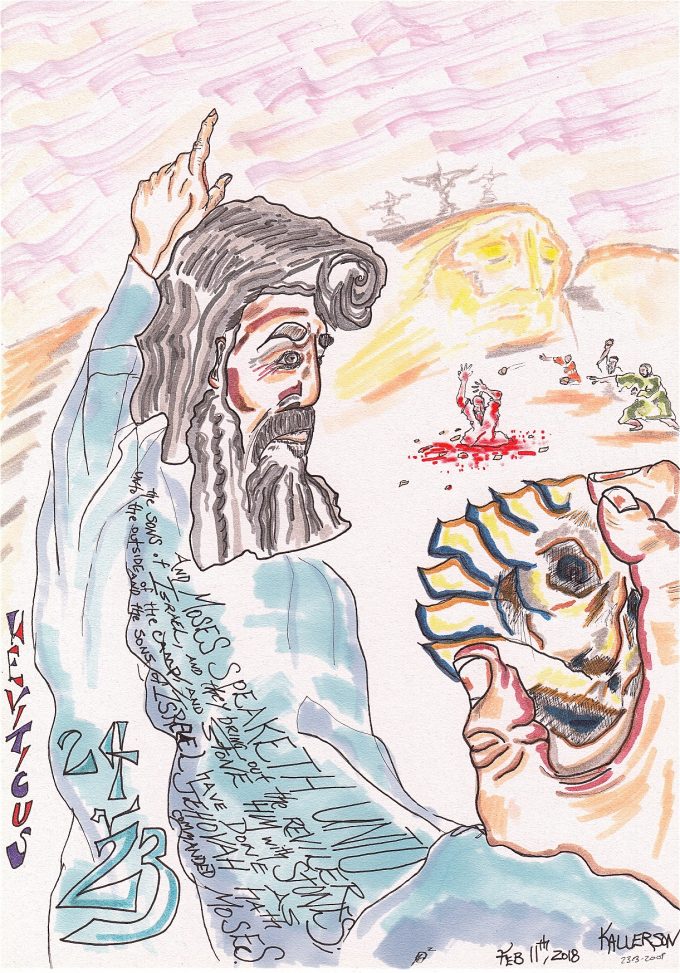
*34 (fin) And he did as the Lord commanded Moses.

Is this speaking of the first time it was conducted? If so, then these words were written at least six months later. It is now only the first month of the year. Or, it could be that the words are anticipatory, stated as an accomplished fact, of that which still lay ahead. A third view is that this is speaking of Aaron assuming the official duties in obedience to the command given by God to Moses. No. Rather these words are speaking not of Aaron, but of Moses. In verse 2, it said “Tell Aaron your brother…” Since then, it has said “Aaron” eight more times in instructions given to Moses to relay to him. Moses did as commanded, and passed on the instructions as noted.

A day on which atonement is made
A day when our sins are covered and taken away
What a glorious, marvelous trade
When by faith we were cleansed. Oh what a day!

The goat is sacrificed for our atonement
Another goat has taken our sins far, far away
We accept that this is true, God’s wrath is spent
We are free from our sin. Oh what a day!

Thank You, O God, for Jesus Christ our Lord
Who fulfills what occurred, our sin debt He did pay
Thank You for what we have learned from Your word
Thank You, O God, for this marvelous, glorious day!

II. Fulfilled in Christ

We’ve read the instructions given by the Lord to Moses. We have analyzed them verse by verse, and even at times word by word. We have seen the prophetic fulfillment of them in Christ. “This is a type of Christ…,” “This pictures Christ…,” “This points to Christ….” But what we have seen is not the end of the pictures.

Our text verse today spoke of those who are deaf and blind. The Lord called Israel “His servant,” and said they were blind. He said they failed to observe as well. Those verses came from a chapter dealing with the Servant of the Lord, meaning Christ, who is set in contrast to the servant of the Lord, meaning Israel. In opening the passage, He spoke of the true Servant, Christ, with these words –

Behold! My Servant whom I uphold,
My Elect One in whom My soul delights!
I have put My Spirit upon Him;
He will bring forth justice to the Gentiles.
He will not cry out, nor raise His voice,
Nor cause His voice to be heard in the street.
A bruised reed He will not break,
And smoking flax He will not quench;
He will bring forth justice for truth.
He will not fail nor be discouraged,
Till He has established justice in the earth;
And the coastlands shall wait for His law.” Isaiah 42:1-3

This sets up both the contrast between, and the call made to, Israel and the Gentiles, and how each would respond. Reading the New Testament, we see that Christ is truly the fulfillment of all of these things. The patterns are deep, they are exact, and they are rich. But we only can receive them by faith, not by sight. Jesus cited the substance of the words from Isaiah concerning the deaf and blind in the New Testament –

And Jesus said, “For judgment I have come into this world, that those who do not see may see, and that those who see may be made blind.”

40 Then some of the Pharisees who were with Him heard these words, and said to Him, “Are we blind also?”

41 Jesus said to them, “If you were blind, you would have no sin; but now you say, ‘We see.’ Therefore your sin remains. John 9:39-41

In Leviticus 16, Aaron, or “Very High,” was to bathe and then put on the special, holy, linen garments. That was Christ’s incarnation, coming in human flesh. It is He who is Very High, and our true High Priest. The garments, as we carefully detailed, point to Christ and His earthly body – pure, unsullied, perfect, and yet coming in the likeness of sinful human flesh.

Immediately the account goes from donning the holy garments into mentioning the offerings of the Israelites, two kid goats as a sin offering, and a ram as a burnt offering. They were specifically stated to be “from the congregation of the children of Israel.” Thus in type, they are Christ, descended from Israel, coming from them.

The entirety of Christ’s life is summed up in these two events – His coming, and His offering. Everything between those is implied in the offering – holy perfection. This shows us that even though the Day of Atonement was a set day for Israel, it is not a set day for its fulfillment. Rather, it is the span of the life of Christ, culminating in His Sacrifice, on whatever day that would occur.

After this, a bull for Aaron’s sin offering was mandated. As we saw, the bull is Christ. It was required for Aaron and his household; Christ gave of Himself for them. Following this, it notes bringing the two goats before the Lord, both picturing Christ’s work. But this is where Israel turns from the Lord. Instead of recognizing His Person, His nature, and His work, as a nation, they rejected Him. To demonstrate how blind they had become, He gave them an object lesson to consider. They missed it in its totality.

What the Gentiles accepted by faith, the Jews rejected by sight, literally. In all four gospels, Christ’s work is carefully recorded. Just prior to His crucifixion, we read the following –

Now at the feast the governor was accustomed to releasing to the multitude one prisoner whom they wished. 16 And at that time they had a notorious prisoner called Barabbas. 17 Therefore, when they had gathered together, Pilate said to them, “Whom do you want me to release to you? Barabbas, or Jesus who is called Christ?” 18 For he knew that they had handed Him over because of envy.

19 While he was sitting on the judgment seat, his wife sent to him, saying, “Have nothing to do with that just Man, for I have suffered many things today in a dream because of Him.”

20 But the chief priests and elders persuaded the multitudes that they should ask for Barabbas and destroy Jesus. 21 The governor answered and said to them, “Which of the two do you want me to release to you?”

They said, “Barabbas!”

22 Pilate said to them, “What then shall I do with Jesus who is called Christ?”

They all said to him, “Let Him be crucified!”

23 Then the governor said, “Why, what evil has He done?”

But they cried out all the more, saying, “Let Him be crucified!”

24 When Pilate saw that he could not prevail at all, but rather that a tumult was rising, he took water and washed his hands before the multitude, saying, “I am innocent of the blood of this just Person. You see to it.

25 And all the people answered and said, “His blood be on us and on our children.”

26 Then he released Barabbas to them; and when he had scourged Jesus, he delivered Him to be crucified.” Matthew 27:15-26

Why is this recorded? Christ is the fulfillment of all of the types and shadows given. Israel should have seen this and believed. The Gentiles did and they still do. What we have here is an object lesson for Israel, not an actual enactment of the Day of Atonement rituals, but a contrast to them, showing what Israel did accept instead of what they should have accepted.

Two men who are probably very close in age, stand before Pilate and the congregation of Israel. Both are named Yeshua, Jesus. Although not all Bibles record the full name Jesus Barabbas, some do, but most reliable Bibles do footnote it. This was his true name. Thus, both have the same title – Barabbas is Aramaic for “Son of Abba.” One of Jesus’ titles is the Son of God – whom He called Abba. Therefore, you have two men, like named – Jesus, (S)son of (A)abba, standing and awaiting a decision from Pilate.

Christ came to be both our atoning Sacrifice la’Yehovah, or “for the Lord,” and the bearer of our sins la‘Azazel, or “for Azazel.” But Israel rejected this. It was determined before creation that Christ would come and fulfill these pictures. It was also known to God that Israel would reject Him when He came. And so, to show them their rejection of Christ’s completed work, this account is recorded to stand as a witness against them.

Christ did, in fact, die for our sins. And Christ did, in fact, bear our sins away. But both of these actions were rejected by Israel. After the bull of the high priest, the goat for the people which was selected la‘Yehovah, or “for the Lord,” was brought forth and slaughtered. Christ died for the people of Israel, but they rejected His offering, explicitly and from their own mouths. In defiance of the Lord, and in contempt of Christ who came to show them the Father, they called out, “His blood be on us and on our children.” The sin offering was rejected.

The blood of bulls and goats, according to the book of Hebrews, can never take away sin. Only Christ, Israel’s Messiah could do so. But collectively, they rejected their only means of salvation, calling down upon themselves a curse rather than a blessing. They subconsciously know this is true. When Mel Gibson filmed the Passion of the Christ, the one line that the Jews demanded he remove from the movie is that very line they spoke in defiance of the Lord, “His blood be on us and on our children.” Until they retract this, there can be no atonement for national Israel. Each Jew must come to Christ individually, just as with all people.

Again, the goat is Christ, the blood is Christ’s, the atonement is Christ’s, the purification is Christ’s. It is all Christ. As we saw, Paul says in Romans 8:3 that “Christ came in the likeness of sinful flesh, on account of sin.” In this, “He condemned sin in the flesh.” This is the purpose of designating hairy goats. They picture Christ who came in the likeness of sinful flesh, but who prevailed over it. That Christ died for both Israel and Gentile is recorded by John –

And one of them, Caiaphas, being high priest that year, said to them, “You know nothing at all, nor do you consider that it is expedient for us that one man should die for the people, and not that the whole nation should perish.” Now this he did not say on his own authority; but being high priest that year he prophesied that Jesus would die for the nation, and not for that nation only, but also that He would gather together in one the children of God who were scattered abroad.” John 11:49-52

And in Hebrews 9:11, 12 we read –

But Christ came as High Priest of the good things to come, with the greater and more perfect tabernacle not made with hands, that is, not of this creation. Not with the blood of goats and calves, but with His own blood He entered the Most Holy Place once for all, having obtained eternal redemption.”

After the atoning Sacrifice came the second part of Christ’s work, that of the goat la‘Azazel, or “for Azazel.” Concerning this term, there are quite a few opinions about what this word means. One view is that is is a mountain about 12 miles east of Jerusalem, known by Jewish writings as har’Azazel. This is wrong from the outset. The Torah was received by Moses in the wilderness. It wasn’t until eons later, at the time of David or even Solomon, that this would have been done at Jerusalem. It is incorrect.

The second is that this is the same concept as the two birds used for the purification of a leper. The ritual for the two, and the symbolism of the birds, is actually entirely different. One bird was set free after being plunged into the water/blood mixture of the other. Nothing like that is done here. That was a picture of Christ’s atoning death and resurrection. This is Christ’s atoning death and bearing away of our sins.

The most common translation of Azazel is “She-Goat Of Going Away,” thus, “the Scapegoat.” But Leviticus 16 never uses the word ez, or she-goat. Instead it uses sa’ir, or he-goat. One would have to use the gender inversion principle in this, making Christ, a male, into the Body of Christ, a female. But the work is done for the body, not by the body. This does not match – “scapegoat” is incorrect.

The correct option is that Azazel is Satan, he in opposition to God. Some say that Azazel can’t be Satan because that name is never used again for the devil in the Bible. But that is no argument. In the New Testament, Jesus and others call Satan Beelzebub. That comes from the Old Testament Baal-zebub, the God of Ekron, a false god. The reason why he can be called Satan in the New is because an offering to any false god is, by default, an offering to the devil.

Satan is also called the devil, the tempter, the wicked one, the ruler of this world, the god of this age, the prince of the power of the air, etc. And, metaphors are used to describe him – a wolf, a roaring lion, a great dragon, and a serpent. Many of these are used only once in Scripture. LaAzazel, set in opposition to la’Yehovah, describes one in type who is set in opposition to the Lord. And this is a natural translation of Azazel, “one who has separated himself from God.” That Azazel is pointing to Satan is attested to by the passage in Zechariah 3 where Joshua, typical of Christ, is stood before the Angel of the Lord and Satan. The picture being made in these two goats bears this out.

As a marvelous clue that this is the case, the first time la’azazel is used is in Leviticus 16:8. Exactly 33 verses later, in Leviticus 17:7, it says this –

They shall no more offer their sacrifices to demons, after whom they have played the harlot. This shall be a statute forever for them throughout their generations.” Leviticus 17:7

The word translated as “demons” there is “la’seirim,” or “for the goats.” It is the same word, sa’iyr, used for the goat of Leviticus 16. Luke says that Jesus began His ministry “at about thirty years of age.” His ministry was three years, meaning that He was about 33 when He was crucified. These 33 years are prefigured in the 33 verses from the introduction of la‘azaael to what that term is pointing to, the goat demons.

The goat “for Azazel” was to be taken into the wilderness, a place which in Scripture is noted as the abode of evil spirits. There it was to be released. It was never to return again to the people. Christ is our sin-Bearer. He went into the pit of death and there delivered the sins of mankind to that pit where the devil and his demons will someday be cast. The goat “for Azazel” is Christ carrying our sins to where, and to whom, they belong.

Not only did Israel reject their atonement pictured in the first goat, they also rejected the removal of sins, pictured in the second. Both Mark and Luke specifically record that Barabbas was a murderer. But more, Peter in Acts does as well, saying this to the people –

The God of Abraham, Isaac, and Jacob, the God of our fathers, glorified His Servant Jesus, whom you delivered up and denied in the presence of Pilate, when he was determined to let Him go. 14 But you denied the Holy One and the Just, and asked for a murderer to be granted to you15 and killed the Prince of life, whom God raised from the dead, of which we are witnesses. 16 And His name, through faith in His name, has made this man strong, whom you see and know. Yes, the faith which comes through Him has given him this perfect soundness in the presence of you all.
17 ‘Yet now, brethren, I know that you did it in ignorance, as did also your rulers.’” Acts 3:13-17

In the goat, the guilt for the sin was to be removed; taken from the Lord’s sight so that the people stood before Him faultless. But they rejected the atonement, and they rejected the removal. And even more, they collectively violated their own law, the Law of Moses, in the process of rejecting Christ. In Numbers 35, we read this –

Moreover you shall take no ransom for the life of a murderer who is guilty of death, but he shall surely be put to death. Numbers 35:31

This is exactly what they did. They took a ransom in Christ Jesus to pay the price of a murderer who was already condemned. And so why is this account of Jesus and Barabbas important? It is because Christ was intended to fulfill each picture of this scene. He was to be the Sacrifice; He was to be the sin-Bearer; and he was to be the timely Man. But Israel rejected each. They called for the blood of the sacrifice to return to them. They called for a murderer instead of a sin-Bearer, and they rejected the return of the timely-Man. In rejecting these, they have then rejected Him as High Priest under the New Covenant.

Their guilt according to the Law of Moses stands as a witness against them, and their guilt in rejecting what the law pointed to likewise stands. Because of failing to have their sin carried away “for Azazel,” twice in Revelation, Jesus calls them “a synagogue of Satan.” Until they come to Christ, Satan is their god. It is with anti-Christ, not Christ, that they will sign a 7-year peace deal. As Christ is the final sacrifice for the sins of the people, there can be no atonement for their national guilt. Such is the nature of rejecting the One to whom the rites and rituals of the law pointed.

As an extra note concerning the three fall feasts, all of them are recorded in order in Christ’s birth, trial & death, and resurrection. As I said, Yom Teruah, the Day of Trumpets, pictures Christ’s birth as Israel’s King. Pilate asked, “Shall I crucify your King?” After that, He was crucified in fulfillment of Yom Kippur. And after that, the Feast of Tabernacles is seen in the words of John 1:14–

And the Word became flesh and dwelt among us, and we beheld His glory, the glory as of the only begotten of the Father, full of grace and truth.”

These are the things that the Bible testifies to. I have attempted to stick to the Bible in almost all circumstances, and for the simple reason that the Bible stands alone as the witness of God to what He has done through His Son, our Lord. Having said that, I would like to add in a final thought, derived from the Talmud. There was, according to the Talmud, a tradition that a scarlet thread held by the high priest of Israel would miraculously turn white each year on the Day of Atonement after the goat for Azazel was led away. The Talmud, however, states in Tractate Yoma 39b –

The Rabbis taught that forty years prior to the destruction of the Temple the lot did not come up in the [high priest’s] right hand nor did the tongue of scarlet wool become white…” Talmud, Tractate Yoma 39b

The changing of the scarlet thread to white was an annual acknowledgment to the people of the words of Isaiah –

Come now, and let us reason together,”
Says the Lord,
“Though your sins are like scarlet,
They shall be as white as snow;
Though they are red like crimson,
They shall be as wool.” Isaiah 1:18

Among other things, the Talmud is a recorded history of the Jewish people, and thus it stands as an evidence that something historically occurred. I read a Rabbinic commentary which chastised Christians for using the Talmud as a polemic against Jews (as if we have no right to refer to their own writings), stating that the statement is taken out of context, and implying that it would be more likely that the scarlet thread didn’t turn white because of the Jews who apostatized and followed Jesus, rather than the traditional Christian thought that Jesus is actually the One, and final Atonement for the people’s sins.

He further went on to say that the miraculous events in Israel were already steadily on the decline for a lengthy period of time, because the people had also been in a steady decline in their attitude towards God. Thus, he said it was actually not a surprise that the thread didn’t change.

But that is both illogical, and it is supporting of the Bible itself. Both John the Baptist and Jesus actually spoke against Israel’s moral decline. If they had listened and repented, according to the Bible, so God would have pardoned. How much more so when they rejected the Only one who could truly take away their sin!

Further, it is recorded history that Jesus gave Israel the sign of Jonah as a warning. Jonah proclaimed, “Yet forty days and Nineveh will be destroyed.” Jesus told Israel that as Jonah so proclaimed, so they would be destroyed, a year for a day until judgment. And so they were, just as He prophesied, and just as Scripture and the Talmud both record.

The Day of Atonement passage here in Leviticus 16, the record of the Lord’s promised severity in punishment upon Israel for rejecting both Him and the Prophet whom He promised to send, the witness of the New Testament authors, and a note of confirmation of no atonement for the people of Israel in their own Talmud, all show that there is no atonement for Israel apart from Christ.

Further, the Bible goes on to state that there is no atonement for any – Jew or Gentile, apart from Christ. The Bible bears witness to us of what the Lord has done in redemptive history for the people of the world. He has shown us what the consequences for rejecting this work are, and He offers us unlimited grace if we will turn to Him through Christ, and put away deeds of an already fulfilled law.

If you are a Jew or a Gentile who is attempting to merit God’s favor through observance of the Law of Moses, you are God’s enemy, and you will perish in your arrogance for rejecting what He alone can do, and what He alone has done. He stepped out of the eternal realm, He put on garments of flesh, He walked among His people, and He fulfilled the law which He gave to them.

After this, He gave His life in exchange for the sins of the world. His work demonstrates that He is fully capable of this, and His resurrection proves that it is so. He is the timely Man who came back from the barren wilderness after conducting away our sins forever, proven in His glorious resurrection. Come unto Christ, be reconciled to God through His shed blood, and put away your selfish, arrogant deeds which can never satisfy God.

Everyone who thirsts, come unto the waters. And you who have no money, come, buy, and eat. Yes, come, buy wine and milk without money and without price (Isaiah 55:1). Christ Jesus, our salvation offers you pardon, full atonement, and the carrying away of your sin-burden, once and for all time. Come poor sinner to the Fount of everlasting blessing which is found at the foot of Calvary’s cross.

Closing Verse: “For I do not desire, brethren, that you should be ignorant of this mystery, lest you should be wise in your own opinion, that blindness in part has happened to Israel until the fullness of the Gentiles has come in. 26 And so all Israel will be saved, as it is written:

The Deliverer will come out of Zion,
And He will turn away ungodliness from Jacob;
27 For this is My covenant with them,
When I take away their sins.” Romans 11:25-27

Next Week: Leviticus 17:1-16 In Christ, there is a cleansing flood… (The Sanctity of Blood) (30th Leviticus Sermon)

The Lord has you exactly where He wants you. He has a good plan and purpose for you. Even if you have a lifetime of sin heaped up behind you, He can wash it away and purify you completely and wholly. So follow Him and trust Him and He will do marvelous things for you and through you.

Yom Kippur, The Day of Atonement

Then Aaron shall come into the tabernacle of meeting
Shall take off the linen garments which he put on, so he shall do
When he went into the Holy Place
And shall leave them there, as I am now instructing you

And he shall wash his body with water in a holy place
Put on his garments, come out and offer his burnt offering
And the burnt offering of the people
And make atonement for himself and for the people
———-with this proffering

The fat of the sin offering he shall burn on the altar
In this precept he shall not falter

And he who released the goat as the scapegoat
Shall wash his clothes and bathe his body in water
And afterward he may come into the camp, so to you I note

The bull for the sin offering
And the goat for the sin offering too
Whose blood was brought in to make atonement in the Holy Place
Shall be carried outside the camp, so you shall do

And they shall burn in the fire, so to you I tell
Their skins, their flesh, and their offal as well

Then he who burns them shall wash his clothes
And bathe his body in water, so shall he do
And afterward he may come into the camp
These things shall be done as I am instructing you

This shall be a statute forever for you:
In the seventh month, on the tenth day of the month you shall do

You shall afflict your souls
And do no work at all, to this law you shall be true
Whether a native of your own country
Or a stranger who dwells among you

For on that day the priest shall make atonement for you
According to this word
To cleanse you, that you may be clean
From all your sins before the Lord

It is a sabbath of solemn rest for you
And so be sure to depart from this law never
And you shall afflict your souls
It is a statute forever

And the priest, who is anointed
And consecrated to minister as priest in his father’s place
Shall make atonement, and put on the linen clothes
The holy garments; to minister before the Lord’s face

Then he shall make atonement for the Holy Sanctuary
And he shall make atonement for the tabernacle of meeting
———-so shall it be
And for the altar, and he shall make atonement for the priests
And for all the people of the assembly

This shall be an everlasting statute for you
To make atonement for the children of Israel
For all their sins, once a year
And he did as the Lord commanded Moses; as to him He did tell

Lord God, You have sent Jesus to atone for sin
We thank You for doing what we could not do
Through Him new life can begin
And so, O God, we call out through Him to You

Hear our cry for mercy, upon sinners such as us
Know that we trust in Your word, and Your power to save
We are freed from sin’s bondage through Jesus
It was for us that His precious life You gave

Hallelujah! To You, O God, our voices we raise
Hallelujah! To You, O God, we give all of our praise

Hallelujah and Amen…


2 Thessalonians 3:10

Sunday, 22 October 2017

For even when we were with you, we commanded you this: If anyone will not work, neither shall he eat. 2 Thessalonians 3:10

Food: When you’re hungry, nothing satisfies like food. Paul now ties this wonderful necessity in with an oft-dreaded word, “work.” We both need food, and we enjoy food. We often do not like work, but according to Paul, we need to work if we want that other thing we need and enjoy, “food.” He links the two together as if they are one.

This verse seems to be tied back to verse 6 –

But we command you, brethren, in the name of our Lord Jesus Christ, that you withdraw from every brother who walks disorderly and not according to the tradition which he received from us. … For even when we were with you, we commanded you this: If anyone will not work, neither shall he eat.”

And so, “For when we were with you,” is first based on that command, and then it was practically lived out by Paul and his associates in verses 7-9. Next, “we commanded you this,” is tied to what is spoken at the beginning of verse 6, “But we command you.” This is now repeated in the epistle to remind them of what they had said. While in Thessalonica, it was evident that some were unwilling to work, but instead were sponging off the kindness of others. “Gee, we’re all Christians here, you wouldn’t let a hungry brother down, now would you?”

This is something that is still seen 2000 years later. Some people use their status as Christians to guilt other Christians into tending to them, even for their basic necessities. It happens to individuals, and it happens to churches. There are sponges all over the place who take advantage of this. But Paul advises the Thessalonians (and thus us!) to not be duped into this kind of thing. He says quite clearly, “If anyone will not work, neither shall he eat.”

It is not an optional thing, and Paul actually presents nothing new. Solomon speaks of the need to be industrious on several occasions, and he tells the sad results of being a lazy-Joe –

Go to the ant, you sluggard!
Consider her ways and be wise,
7 Which, having no captain,
Overseer or ruler,
8 Provides her supplies in the summer,
And gathers her food in the harvest.
9 How long will you slumber, O sluggard?
When will you rise from your sleep?
10 A little sleep, a little slumber,
A little folding of the hands to sleep—
11 So shall your poverty come on you like a prowler,
And your need like an armed man. Proverbs 6:6-11

In Paul’s words then, there is nothing out of the ordinary, nothing un-Christian, and nothing harsh. Rather, there is wisdom which is intended to 1) Get lazy people up off their duffs and out into the world to earn their bread, and 2) Save industrious people from being seduced by those in category 1. We should not feel the slightest bit guilty when a person actually has to miss a meal because he spent the day at the beach, or whittled his time away on an iPad.

Life application: For obtaining life-prolonging food-intake, get to work.

Lord God, what a treasure it is to open Your word and find in it the words, “If anyone will not work, neither shall he eat.” Wow! That takes the burden off those who are willing to get out and earn their own way. They don’t have to be used by sluggards and lazy people, and they don’t need to feel guilty when a lazy-Joe misses a meal or two because play is more important that work to him. Whoo hoo! Those who are capable, but don’t get to work, can entertain us with growly-tummy noises. We’ll pray they learn their lesson and get to work! Amen.