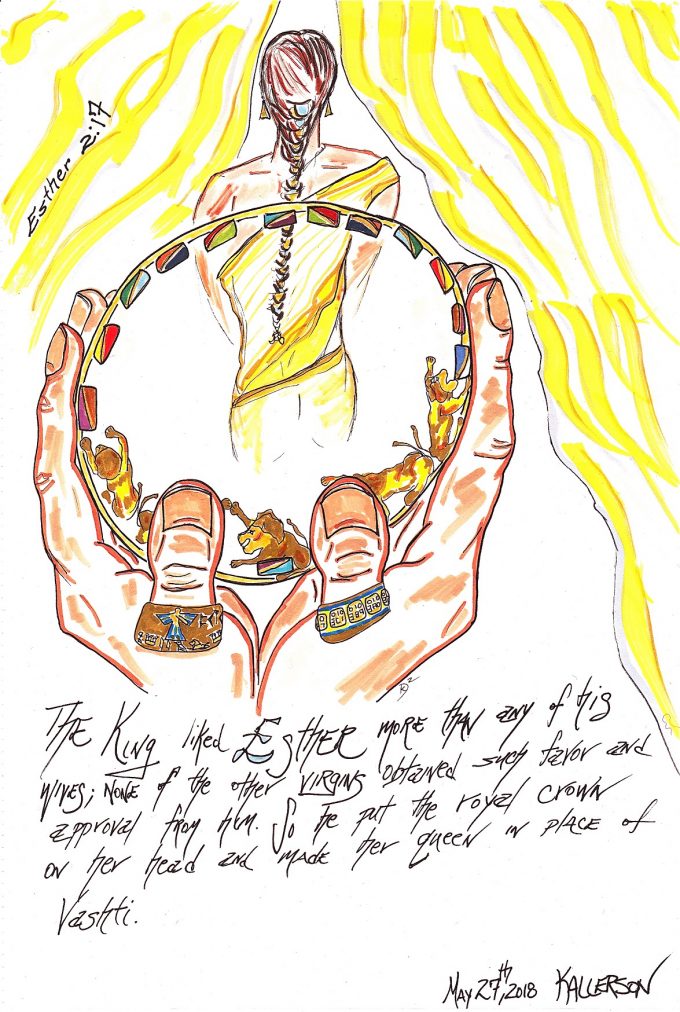
Esther 2:12-23
A Night With the King
Where does satisfaction come from? And can we, at any time, say that we are completely satisfied? Abraham Maslow’s pyramid was taught to us when I was in school. He developed it to show that basic needs had to be met before a person could attain a higher level of satisfaction. As I was taught it, each step up would bring us closer to a marvelous high point where we would be truly satisfied.
His levels started with Physiological needs – food, water, warmth, and rest. If you were deprived one of these things, you couldn’t get beyond that point. It kept you down, and you would stay down. After that were Safety needs – security and safety from harm. From there, you progressed to Love and Belonging needs – intimate relationships, friendships, and the like.
After meeting those needs, up the pointy hill you climbed to Esteem needs – you would meet your desire for prestige and feelings of accomplishment and self-worth. Whoo hoo. And finally, yes! After a long trek of meeting all of these other needs, you could finally self-actualize. There you could find your true full potential, including any creative activities that would allow you to express yourself in a complete way.
Unfortunately, you could drop from one point back to a lower point. If you went bankrupt, you might wind up going from self-actualization to physiological needs overnight.
Even as a kid, I questioned the stupidity of this way of looking at life. Almost every moment of our life, we are facing any and all of these needs. Just because you’re hungry and can’t buy lunch, it doesn’t mean that you also don’t want to have close and intimate friendships. Maslow’s pyramid was taught because teacher’s needed something to tell us during the long hours of each school day, and someone came up with a diagram. That was more than they had done, and so people ran with it.
There is no time when we can’t fully actualize, and that actualization is never, no not ever, found in self. The concept of self-actualization is so ridiculous that it has ruined an entire generation of people who were taught it was possible. To find the most neurotic, self-consumed, lives-out-of-control people on the planet, all you need to do is pick up a magazine and read about the latest problems with the Hollywood crowd.
The people who have every one of Maslow’s levels met and exceeded, right up to the pointy top of it, are also the ones who are drunks, adulterers, drug addicts, liars, hate-filled… shall I go on? And we want to emulate them?
Actualization comes from one place, and one place alone. It comes from a personal relationship with the Lord. It comes from standing approved in Him. When we cannot find approval from any other place, including self, we can – and do – find it in Him.
Text Verse: “As the deer pants for the water brooks,
So pants my soul for You, O God.
2 My soul thirsts for God, for the living God.
When shall I come and appear before God?” Psalm 42:1
King Ahasuerus is looking for a queen. Whoo hoo! Let’s hope he finds a good one. Well, we know he did. We read the sermon text for the day. Her name is Esther. But by the end of our verses today, we find that he didn’t delight in the queen completely. In fact, he failed in Maslow’s pyramid there and in other areas.
He is the king. He has all the money and power he could ever want. He could pursue whatever avenue of life he wanted to. Self actualization? He should be the epitome of it. But he failed to find joy in his queen, and he failed to find security in his life. Actualization apart from intimacy with the Lord is impossible. He alone is the Source of all things, and therefore He alone can meet our needs and desires fully and completely. And He can (and will!) do so to the point that we will never drop down a level on that crummy pyramid again. As long as we fix our eyes on Jesus, we have the full and complete actualization to carry us throughout the endless ages of eternity. This is a truth which can only be found in His superior word. And so let’s turn to that precious word once again and… May God speak to us through His word today and may His glorious name ever be praised.
I. Myrrh and Perfumes (verses 12-14)
12 Each young woman’s turn came to go in to King Ahasuerus
Eventually each of the virgin’s selection would finally result in the purpose of their selection, a night with the king and a chance at being made queen. The word tor, or turn, is introduced. It will be seen here and in verse 15, and then twice in the Song of Solomon. It comes from the word tur which signifies to spy something out. That in turn comes from a root meaning to meander about.
In the Song of Solomon, the word is used to describe rows of ornaments, such as jewels on a necklace. Together they are beautiful, and yet they are individual, radiant, jewels. In this then, we can see that it is as if the king here is winding his way through a process, spying out that which will bring him to his final result, the selection of a queen. Thus, each virgin’s turn is a guided process, while the king’s is a meandering one.
Like slavery in the Bible, our modern sensibilities do not always coincide with what occurs in these stories. We may think of what is happening as brutish, sexist, or whatever other label we wish to pin on the event, but this was the standard of the times, and these things were common, accepted, and normative for the age. It is certain that those of this period would look at our lives, such as wearing bikinis at the beach, and find us to be out of proper moral bounds.
12 (con’t) after she had completed twelve months’ preparation, according to the regulations for the women,
There were set laws for the virgin’s preparation. This was not a willy-nilly process of taking beautiful women from the provinces and then sending them arbitrarily to the king for his pleasure, but a refined process which was intended for the safety of the king, the honor of the office, and also for the king’s delight.
An entire year of beauty preparations was called for to ensure that nothing of her old life remained. First, such a period would ensure that she didn’t come pregnant, and thus defiled. That would quickly become noticeable. Further, if she was from a land of garlic, they would want that to be purged from her system so she only smelled delightful for the king.
If she had spent her days outdoors, her skin would be tanned, and not whatever natural color she would be in the royal residence. And moral or physical flaw would have a chance to be revealed before she could either harm, or disgrace, the royal office. For these, or any other reasons, the time of her preparation lasted a full year.
The number twelve in the Bible signifies governmental perfection, and so we could infer that this is stated as well to indicate that any candidate for being queen was properly evaluated to ensure she met the necessary qualifications for holding such a position within the government as well.
12 (con’t) for thus were the days of their preparation apportioned: six months with oil of myrrh,
The word “preparation,” or maruq, here is closely associated with the word tamruq, which has already been seen, and which is also used in this verse. It give the sense of beautifying through rubbing with perfumery for purification. For six months, each virgin would be rubbed down with oil of myrrh.
This first spice, mor, or myrrh, comes from marar, or “bitter.” The name gives the sense of “distilling in drops.” It has only been seen so far in Exodus 30 in the making of the special incense for burning in the tabernacle.
Myrrh comes from a shrub and can be obtained in one of two ways. The first is the purest form where it naturally exudes from the plant. This is the “myrrh of freedom,” or “free flowing myrrh.” Inferior myrrh comes from the bark when incisions are made in it. Myrrh is fragrant to smell, but bitter to the taste. Looking at the uses of myrrh in the Old Testament, the prominent idea which it symbolizes is love, but more especially, love in intimate union, but not necessarily sexual in nature.
Myrrh was presented to Christ at both His birth by the Magi, and at his death when mixed in wine to deaden His pain, something He refused.
12 (con’t) and six months with perfumes and preparations for beautifying women.
The second six-month period is dedicated to rubbing her down with bosem, or balsam. The word signifies fragrance, and can be any of various balsam spices, thus the word in Hebrew is plural. The modern words in English for both of these words have retained their Hebrew origin quite well – mor is myrrh, and bosem is balsam. After twelve months of such rubbing, the woman would be as sweet smelling as she could possibly be, ready for the night of her calling…
13 Thus prepared, each young woman went to the king,
The idea here was that there was only a presentation of the woman after this full treatment had been rendered. Once the time of purification and beautification had been met, she would await her turn for a chance to be elevated to the position of queen, or to become a permanent concubine of him, living out her life among the other concubines. In order to give her the best chances in her own mind of obtaining the former, she was given a special honor…
13 (con’t) and she was given whatever she desired to take with her from the women’s quarters to the king’s palace.
The idea here is that her presentation was whatever she thought would be most pleasing or enticing to the king. If she wanted a certain dress, a particular necklace, a given bit of make up or eye liner, and so on, then it would be provided. This was her one big night, and it was her final chance to change her destiny, possibly going from provincial girl to royal queen. Whatever was kept in the women’s quarters was allotted to her for her special night.
14 In the evening she went, and in the morning she returned to the second house of the women,
The translation here is correct concerning evening and morning. Some translations will incorrectly say, “on the morrow.” The account is written by a Hebrew. The Hebrew day began in the evening, not the morning. Thus it is the same day. To say, “on the morrow,” is a technical error as much as a poor paraphrase. The virgin would go into the king in the evening, and when her night was completed, she would be directed to a new residence called the second house of the women.
It is a house specifically maintained for the king’s concubines. They would never be permitted to lay with any other man, nor could they ever seek marriage. It is said that Darius, who was conquered by Alexander, had three hundred and sixty concubines. In 1 Kings, Solomon is said to have had a similar number –
“And he had seven hundred wives, princesses, and three hundred concubines; and his wives turned away his heart.” 1 Kings 11:3
These women who had gone into Ahasuerus were forever the king’s property. They would remain that way for the rest of their lives. Their time would be filled with the enjoyments of the royal house and food, but there would be no contact for them with the outside world. There, they would have a new custodian to watch over them…
14 (con’t) to the custody of Shaashgaz, the king’s eunuch who kept the concubines.
The king’s eunuch, specially chosen for this particular duty, is Shaashgaz. This is the only time he is mentioned in Scripture. Albert Barnes identifies the name with either sheshkhunj, meaning beardless, or sestgunj, meaning weak of loins. Either Persian word would be a fitting epithet for a eunuch. In essence then, he is named by his state. It would be like someone calling me Beardy, or Mr. Muscle. Either way, the epithet would be fitting of the state in which I exist.
14 (con’t) She would not go in to the king again unless the king delighted in her and called for her by name.
Under the care of Shaashgaz, the now-defiled concubine would never leave the care of the king’s eunuch again, unless the king was enamored with her, and if his memory called her to mind. If so, she would be called for by name, and would again be brought to him. It would not be hard for a woman who loathed her calling to simply make herself displeasing to the king on the first night. After this, she would forever be free from being forced to come to him again, but it would also mean that she would be barren and unloved for the rest of her life as well.
My night with the king; how will it be?
Will he find delight and joy as I to him submit?
Is there possibly royalty awaiting me?
Will he to me the royal crown commit?
How my heart trembles, and my body shakes
To step into his presence, and to him submit
My head it spins; my constitution quakes
Will he to me the royal crown commit?
One night with the king; can it be true?
Will there be many more as queen after I so submit?
I am ready to present myself through and through
Will the king to me the royal crown commit?
II. The Feast of Esther (verses 15-18)
15 Now when the turn came for Esther the daughter of Abihail the uncle of Mordecai,
Here we learn the name of Esther’s father, Abikhayil, or Father of Might. The term “father” is to be taken in the sense of possession, and so he would be the “Possessor of might.” Here he is also noted as the dod, or uncle, of Mordecai. The word dod means uncle, but it also means “beloved.” Here we have Mordecai in a beloved relationship with the Father of Might.
15 (con’t) who had taken her as his daughter, to go in to the king,
It is Mordecai who had taken Esther to be his daughter. Now this same Esther is about to have her chance to attain royal status, like all the other women before her were given. There can be only one, and so she will do as she is instructed, trusting in the word of another instead of her own futile attempt at attaining the kings’ approval…
15 (con’t) she requested nothing but what Hegai the king’s eunuch, the custodian of the women, advised.
Instead of trusting in her own ability to discern what would be most pleasing to the king, she wisely takes the advice of the king’s eunuch. As the king’s eunuch, he would know exactly what was pleasing to him, and he would impart that knowledge to whoever he felt was worthy of receiving that inside information. It shows that he favored her, just as was seen in verse 9.
In this, we could infer a picture of being chosen for the king by grace through faith. The grace is imparted by Hegai, the faith is seen in her acknowledging his instruction. As the appointed trustee of the king, he would bear word from him to the women under his charge. He now exits the narrative and the Bible. Goodbye Hegai.
15 (con’t) And Esther obtained favor in the sight of all who saw her.
The word for “favor” is khen. It means grace, favor, and the like. A literal translation here would be, “…and Esther received grace in the eyes of all seeing her.” She was obviously beautiful to behold, and when adorned with only those things recommended by the bearer of the king’s word to the virgins, she received grace from all eyes which alighted upon her.
16 So Esther was taken to King Ahasuerus, into his royal palace, in the tenth month, which is the month of Tebeth, in the seventh year of his reign.
As it is the seventh year of the reign of Ahasuerus, and as it is the tenth month, the time of this union is placed at either Dec/Jan 479/478 BC. The extended time between the events of chapter 1 and the events now is explained by the king’s absence while waging war against Greece, a time in which he was defeated and suffered disgrace for his losses. Now, in order to redirect his mind away from that sad event, he is working on choosing a queen for the realm. This is the only mention of the month of Tebeth in Scripture. The name corresponds to the tenth month of the Egyptian calendar known as Tubi.
17 The king loved Esther more than all the other women,
The list includes both his lesser wives, and his concubines. In other words, there is a type of hierarchy among the king’s women. There is the chosen queen. After her would be his chosen wives. They would pay respect to the queen, but they were also given certain privileges as wives, such as special quarters, a set revenue from taxes, and the like. And below them would be the concubines. Esther was loved more than all of these. Therefore…
17 (con’t) and she obtained grace and favor in his sight more than all the virgins;
va’tisa khen va’khesed lepanav – And obtained grace and lovingkindness before him. The addition of the words “more than all the virgins” repeats what we have already deduced. None of the secondary wives who were below Vashti were desired by him in making one of them a queen. Instead, virgins were sought out, among whom Esther prevailed, being the fairest virgin of them all.
These words now close out one of our sets of twos. In verse 9, Esther found khesed lepanav, or “lovingkindness before” Hegai. Here, she finds khen va’khesed lepanav – grace and lovingkindness before the king. There it was favor of the keeper of the women, here it concerns the love of the king. They contrast, and yet they confirm that she was pleasing in all ways as a refined and beautiful woman.
In Hegai is seen a parallel to the work of the Spirit who searches out and prepares those circumcised in heart to be pleasing to God. Through Him grace is found, and after that, grace and lovingkindness is displayed towards God’s people.
17 (con’t) so he set the royal crown upon her head and made her queen instead of Vashti.
The setting of the crown is the conferral of the position. In this act, she was raised from concubine to queen, and from unwed to wife. It was now her position to fill in the place of the vanquished Vashti, who is mentioned for the last time in Scripture. We can wave goodbye to her.
18 Then the king made a great feast, the Feast of Esther, for all his officials and servants;
This is, like the other feasts mentioned, a banqueting feast. This one is, however, termed a mishteh gadol, or a great banquet. Whether this was the customary type of feast for a newly appointed queen, or whether it is because of the exceptional beauty and grace found in Esther, either way it would have been a magnificent ordeal. It was one to which all of those in high positions would have been invited, and all would be careful to heap high praises upon his choice for queen.
18 (con’t) and he proclaimed a holiday in the provinces and gave gifts according to the generosity of a king.
Here is a word found only this once in the Bible, hanakhah, translated as “holiday.” The word comes from nuakh, meaning “rest.” And so “holiday” is not a bad guess. However, some translations will say, “a release.” Others say, “remission of taxes.” This would then give the sense of rest from taxes. It could even be that the queen’s gold is what is being referred to.
As I said earlier, a certain portion was collected from various cities which was given as a revenue to the wives of the king. Adam Clarke thinks that in this, Esther may have petitioned the king to give a rest from this particular tax, thus it would make her a very popular queen. The people would be freed from this obligation for a certain amount of time, or even during the entire time of her filling the position. Whatever the case, it is best to not get dogmatic and stick with any one translation, which could be entirely wrong. Along with this release, gifts were extended to those who found favor in the king’s eyes during this happy celebration.
I have found favor before the king
And in his eyes I am highly esteemed
The honor bestowed upon me makes my heart sing
What chance was there? None, so it seemed
But in the eyes of the king, I found grace and favor
And so before him now as his bride I stand
Rejoicing in this moment: one I will forever savor
When the king extended to me his loving hand
And upon my head, the royal crown has been set
As the queen, I shall be near to him, just at his side
But from where I came, I shall never forget
Never shall my heart be filled with pride
Instead, I will be grateful for the position given to me
A queen to the king! Oh, how can it be!
III. A Plot Against the King (verses 19-23)
19 When virgins were gathered together a second time,
This is now the second noted gathering of virgins. The first was in 2:8. The first gathering was to find a queen, the second gathering is after a queen has been selected. The first gathering was for the king to find sufficiency in a queen, the second is to fill a void in the king’s desired harem. One meant a good life for Esther, the second could mean death for her. They contrast, and yet they confirm that the king was always on the lookout for others to find pleasure in.
The translation of the NKJV is correct. Many versions say, “And when the virgins were gathered the second time.” There is no definite article in front of either “virgins” or “second.” Adding in a definite article in either place leads to a false idea of what is being said. These are not the same group of virgins, and there is no subsequent gathering of them. Instead, this is a new group of virgins, and it is a stand-alone occurrence. One must ask, “Why is this mentioned at all?” What difference does it make in placing this statement here, instead of just not mentioning it at all? These questions have plagued scholars for eons.
Some see this as going back to what happened before Esther’s marriage and reliving an event which took place then. That is disproved in the second clause of this verse. Some insert a plot by the royal officials to supplant Esther. Nothing indicates that. It is forced and incorrect. No commentary really gives a suitable reason for the inclusion of these words. But to understand them merely takes looking ahead to what Esther says in chapter 4 –
Then Esther spoke to Hathach, and gave him a command for Mordecai: 11 “All the king’s servants and the people of the king’s provinces know that any man or woman who goes into the inner court to the king, who has not been called, he has but one law: put all to death, except the one to whom the king holds out the golden scepter, that he may live. Yet I myself have not been called to go in to the king these thirty days.”
Chapter 3 shows that this was after the start of the twelfth year of the king’s reign; or five years later. It was apparent that despite Esther finding favor in the king’s eyes, even enough to be made queen, he still was enjoying the privilege of being king by bringing in another group of virgins. After five years of being queen, he was still more interested in what is new and exciting than he was in her. Because he was enjoying this avenue, she had not been called to be with the king. If she were out of his favor because he found a virgin he favored more, entering his presence without permission would mean her death. Though she was queen, it did not permit her to approach his throne without first being called. This is the reason for including this seemingly irrelevant note about a second gathering of virgins.
19 (con’t) Mordecai sat within the king’s gate.
These words show that the previous clause was not referring back to before she was made queen. At that time, he is said to have paced in front of the women’s quarters. Now he sits within the king’s gate. He was then, and is now, where she can be most easily contacted. Due to her occupying the queen’s residence, the nearest place that he could be to obtain news about her was at this spot. Each word and clause is carefully selected to show a logical progression of the story, while at the same time showing that God is in the background directing the events despite the choices and decisions of man.
20 Now Esther had not revealed her family and her people, just as Mordecai had charged her,
Verse 20 is parenthetical between verses 19 and 21. It is providing information necessary to develop the theme which is continuing on in the story. The primary placement of the word “family” here is notable in the Hebrew. As John Lange says of it, “This is here placed first, because the relation of Esther to Mordecai is under consideration.”
The fact that she was Jewish has nothing to do with her hiding the matter, as if she was ashamed of it, or as if it could have, or could still, harm her in the eyes of the king. That is entirely unfounded, and by the end of the story that will be seen wrong. It is Mordecai who has instructed her, and that is all that matters. He is concerned about her and other’s perception of her relation to him. Their nationality is of secondary concern.
This is now the ending of another set of twos. She was shown to have concealed her identity in verse 2:10, and the same is said of her now in this verse. The first was at the command of Mordecai, and the second is in obedience to his command. They contrast, and yet they confirm the obedience of Esther to her adopted father. In this, no faithlessness to the king or anyone else can be noted, but a great faithfulness to Mordecai is seen. This is substantiated by the next words…
20 (con’t) for Esther obeyed the command of Mordecai as when she was brought up by him.
The inclusion of these words shows the faithfulness of Esther to Mordecai. Her royal position, and whatever wealth and honor she possessed was seen as secondary to her faithful allegiance to the one who raised her and nurtured her. This may also show a humility in Mordecai. With her advancement to queen, he also could have risen in the royal court. But by keeping their family unit a secret, Mordecai would retain his particular position without any additional pomp and favor being bestowed to him. The intimate family connection between the two is what is highlighted. In this, the word omnah, or “being brought up,” is given. This is the only time it is found in the Bible, and it gives the sense of training, or tutelage. His raising of her resulted in a faithful, obedient step- daughter.
21 In those days, while Mordecai sat within the king’s gate, two of the king’s eunuchs, Bigthan and Teresh, doorkeepers, became furious and sought to lay hands on King Ahasuerus.
The story now proceeds from verse 19, after the parenthetical insert. It is possible that Bigthan is the same person as Bigtha in verse 1:10. This is not improbable because the name changes a third time in verse 6:2 to Bigthana. If this is the same person, he was high in the king’s court. Teresh may have been elevated to that same rank at some point in the intervening years. Together, they were considered doorkeepers.
The Hebrew word for “door” here is one which is translated also as a bowl, basin, or cup. Thus, this is a door where there is a curved-in threshold, and probably then, the very entrance way to the king’s bedroom. This would have been a position of the highest trust, because of it would also be the position easiest to rush upon and kill the king. Somehow, Mordecai learned that they had evil intent for the king. Any speculation about why they were angry, or how Mordecai found out is irrelevant, and so it goes unstated.
What is rather unusual is that eventually, history records that this same king, Xerxes, would eventually be murdered by Artabanus, the captain of the guard, and Aspamitras, a chamberlain and eunuch. One plot against him was foiled, but another would eventually see his end.
This verse introduces a set of two’s. Here the words of the deeds of Bigthan and Teresh, the doorkeepers of Ahasuerus, are reported by Mordecai. The same words – Mordecai, Bigthan,Teresh, doorkeepers, and Ahasuerus – are all repeated in verse 6:2. The two accounts differ as one is occurring, and one has occurred, but they confirm that what has occurred is crucial to the unfolding events in the lives of all concerned.
22 So the matter became known to Mordecai, who told Queen Esther, and Esther informed the king in Mordecai’s name.
As speculated in the previous sermon, Mordecai was possibly a eunuch or a doorkeeper of some level within the royal compound. This makes it not at all improbable that he could have heard of the plot against the king. However the word came to him, he passed it on to Esther, and from there it was passed on to the king in Mordecai’s name.
This would have two positive results. First, it would vouch for the truthfulness of the information, and secondly, it would hopefully benefit Mordecai in a time of future need. It is a note of wisdom on the part of Esther to thus pass on the information in this manner. It would also directly lead to the salvation of the Jews, as well as the exaltation of Mordecai.
23 And when an inquiry was made into the matter, it was confirmed, and both were hanged on a gallows;
The inquiry was certainly one which involved torture. Anyone who threatened the king would face death, and so a denial would be expected. Eventually, a confession would be gathered concerning the matter, and then the execution would be handed down. In this case, the word is talah, or hanging. However, it doesn’t necessarily mean hanging by a rope. In Deuteronomy 21, it says –
“If a man has committed a sin deserving of death, and he is put to death, and you hang him on a tree, 23 his body shall not remain overnight on the tree, but you shall surely bury him that day, so that you do not defile the land which the Lord your God is giving you as an inheritance; for he who is hanged is accursed of God.” Deuteronomy 21:22, 23
Paul then cites that verse in Galatians 3:13 to indicate crucifixion. This was known to be common in Persia at the time, and so they may have been hung to a tree by crucifixion. The word translated as “gallows” here simply means wood from a tree. However they departed, it would have been an ouchy way to go.
*23 (fin) and it was written in the book of the chronicles in the presence of the king.
We finish with words that would otherwise be unimportant except for the continuance of the narrative. It is these words here which will bring about another chain of events which will lead to Jewish salvation when it seemed they were to be destroyed.
Like other courts of the ancient Middle East, the Persians had scribes who sat before the king and recorded what he did. They would move with him, and keep a constant record of events. For the king, it would be like a careful diary that he could refer to anytime in order to bring back to memory things that he may have let slip during the busy hours of his daily life.
At times during the narrative of these verses, it seems hard to grasp why certain things are mentioned. As I said, a couple verses in particular have left scholars scratching their heads and reaching out for explanations which have failed to sufficiently answer the situation or circumstance.
But because this is the word of God, each word is carefully selected, and even carefully placed within the Hebrew, in order to show us a marvelously unfolding tapestry of God’s wisdom concerning how to resolve a matter which seems out of control, as well as His neverending watch over, and care for, His people.
Nothing is superfluous, nothing is left out, and each detail shows meticulous attention. As we continue on, it will appear that the Jews will be destroyed. This would include those back in the land after return from exile. There would be nothing left of them because of the hatred of one man, soon to be introduced. However, God promised in the Law of Moses that they would always be kept as a people. Esther will show how this promise continued to be kept. But it is the little details now that are getting us to that point.
Again, we can look to these things, and we can insert ourselves right into them as far as God’s faithfulness is concerned. Once He speaks, that word is stronger than iron. When it is recorded, it is to be considered an everlasting surety that we can cling to. Christ Jesus has established His church, and His church is made up of individuals. As carefully as He watched over Mordecai and Esther, He is watching over us. Both Mordecai and Esther are going to face stress and trouble, but both of them – along with their people – will also be delivered.
No matter what we face, the Lord has said that because of our faith in Christ Jesus, we are sealed with a guarantee – the greatest guarantee of all – the Holy Spirit. Our salvation is set. To question it after God has sealed us, is to question God’s integrity. Let us not waiver in our conviction, and let us stand fast on the truth of His word. In the end, we will stand approved not because of our reliability, but because of His.
Closing Verse: “I thank my God always concerning you for the grace of God which was given to you by Christ Jesus, 5 that you were enriched in everything by Him in all utterance and all knowledge, 6even as the testimony of Christ was confirmed in you, 7 so that you come short in no gift, eagerly waiting for the revelation of our Lord Jesus Christ, 8 who will also confirm you to the end, that you may be blameless in the day of our Lord Jesus Christ. 9 God is faithful, by whom you were called into the fellowship of His Son, Jesus Christ our Lord.” 1 Corinthians 1:4-9
Next Week: Esther 3:1-15 Whether Jew under a star, or the church under a steeple… (There is a Certain People) (5th Esther Sermon)
The Lord has you exactly where He wants you. He has a good plan and purpose for you. At times, you might feel as if he has no great design for you in life, but he has brought you to this moment to reveal His glory in and through you. So follow Him and trust Him and He will do marvelous things for you and through you.
A Night With the King
Each young woman’s turn came
To go in to King Ahasuerus, it was when
After she had completed twelve months’ preparation
According to the regulations for the women
For thus were the days of their preparation apportioned:
Six months with oil of myrrh, for a really good smell
And six months with perfumes and preparations
For beautifying women as well
Thus prepared, each young woman went to the king
And she was given whatever she desired
To take with her from the women’s quarters
To the king’s palace; as she was so inspired
In the evening she went, and in the morning she returned
To the second house of the women; her new confines
To the custody of Shaashgaz
The king’s eunuch who kept the concubines
She would not go in to the king again, for sure
Unless the king delighted in her, and by name called for her
Now when the turn came for Esther
The daughter of Abihail the uncle of Mordecai
Who had taken her as his daughter
To go in to the king, by and by
She requested nothing but what Hegai the king’s eunuch
The custodian of the women, advised
And Esther obtained favor in the sight of all who saw her
With her beauty everyone was hypnotized
So Esther was taken to King Ahasuerus
Into his royal palace, in the tenth month, we know
Which is the month of Tebeth
In the seventh year of his reign it was so
The king loved Esther more than all the other women
And she obtained grace and favor in his sight
More than all the virgins
Esther pleased the king on that night
So he set the royal crown upon her head
And made her queen; replacing Vashti instead
Then the king made a great feast, the Feast of Esther
For all his officials and servants he did this thing
And he proclaimed a holiday in the provinces and gave gifts
ccording to the generosity of a king
When virgins were gathered together a second time, on that date
Mordecai sat within the king’s gate
Now Esther had not revealed her family and her people
Just as Mordecai had charged her, so she did
For Esther obeyed the command of Mordecai
As when she was brought up by him, even as a kid
In those days, while Mordecai sat
Within the king’s gate, two of the king’s eunuchs
———- they were treasonous
Bigthan and Teresh, doorkeepers
Became furious and sought to lay hands on King Ahasuerus
So the matter became known to Mordecai
Who told Queen Esther, just the same
And Esther informed the king
Yes, she informed the king in Mordecai’s name
And when an inquiry was made into the matter, it was confirmed
And both were hanged on a gallows; so they were dangling
And it was written in the book of the chronicles
In the presence of the king
Lord God, thank You for Your presence that is with us
Even when we don’t realize that You are there
Because You sent Your own Son Jesus
We can know that You truly do care
And so Lord, be real to us in a wonderful new way
Open our minds and our hearts to seeing You always
Through every step we take, and throughout every day
Be real to us, O God, and to You will shall give all of our praise
Hallelujah and Amen…