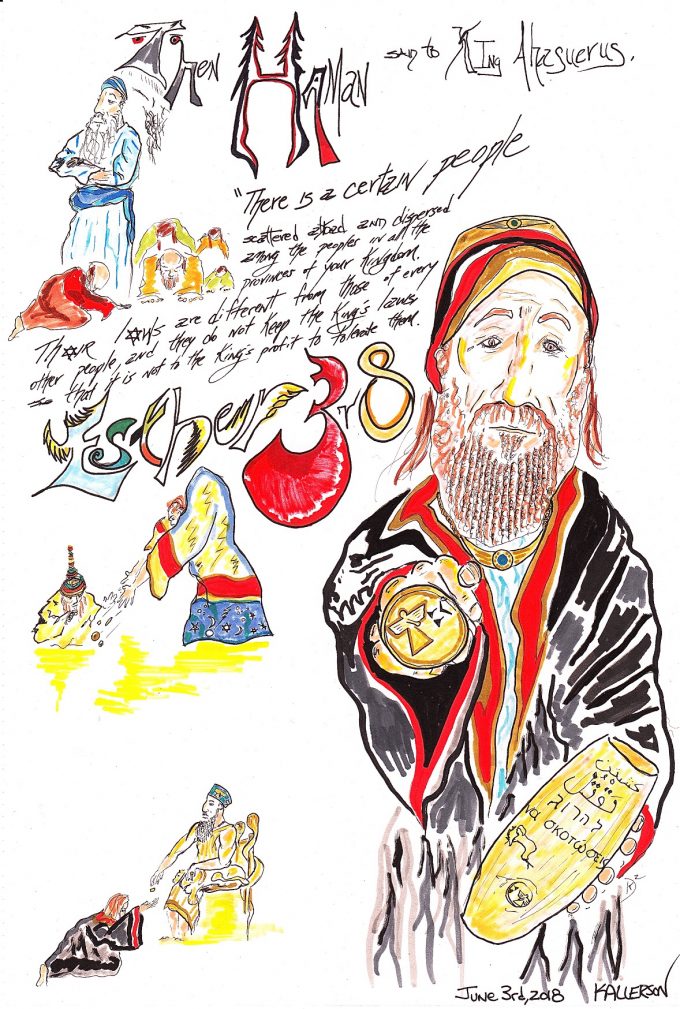
Esther 3:1-15
There Is a Certain People
The Jewish people are facing real trouble in today’s verses. It seems like a truly calamitous affair as to where they are with the verses we just read. And indeed, for anyone who was to stop at this point in the story, it would seem like a sad end for them.
But they were selected by God, and he made great and sure promises to them. What they need now is not a drop into the pit of despair, but a reminder of the covenant promises made to them, and faith that those promises are true.
And this is true with every person now who is one of the redeemed of the Lord. For the person who has called on Christ, there is no situation too hopeless, no disaster too great, and no loss so complete that good will not come out of it. When one thing is lost, another thing is provided. When one door is shut, another one will open up. When a child dies, someone affected by that death calls on Christ and is born again.
What we think of as impossible, God uses as the perfect opportunity. When we can’t see how things will ever be right again, God has already straightened out that which was broken. I’m not saying this to be cliché; it is simply true. Because of Jesus Christ in the believer’s life, the worst possible thing we could imagine is just a step to something better. Got cancer and are dying? Heaven is waiting. Bad cannot outdo good, and joy lies ahead for those who wait on the Lord.
Text Verse: “I will go before you
And make the crooked places straight;
I will break in pieces the gates of bronze
And cut the bars of iron.
3 I will give you the treasures of darkness
And hidden riches of secret places,
That you may know that I, the Lord,
Who call you by your name,
Am the God of Israel.” Isaiah 45:2, 3
Long before Israel was in exile, the Lord had already called Cyrus by name to release Israel from captivity. Everything is already known in the Lord’s mind. There is no thing that can thwart His will, and the disasters of exile for disobedience were overcome by favor and restoration for those who wished to return home.
But some Jews stayed in the land of their exile. One might call this disobedience, but God used it as opportunity. That will be seen in the chapters ahead. Many Jews died in the Holocaust, but that set the stage for their reestablishment as a nation. There are still Jews in the dispersion today, but they are being used to both bless and protect Israel that has returned.
God is using all of these things for a good end for them. Though they are not right with Him at this time, He is looking forward… ahead to when they will be. If you look at the world from a biblical perspective, it doesn’t matter how bad things seem, there is always, always something positive ahead. And so as we look into the verses today, and as we end on an otherwise sad note, let us remember that the book is written, the story is complete, good things are ahead, and we are just in the process of getting there.
It’s all to be found in His superior word. And so let’s turn to that precious word once again and… May God speak to us through His word today and may His glorious name ever be praised.
I. The Agagite (verses 1-7)
After these things
The words are speaking of the events at the end of Chapter 2 where Mordecai uncovered a plot to harm the king. This was subsequently passed on to the king who had the conspirators hung. It is after these things that the story brings in the next relevant events to be detailed. The timing of them is between the seventh and the twelfth year of the reign of Ahasuerus. The seventh year is mentioned in verse 2:16, and the twelfth will be seen in verse 3:7.
1 (con’t) King Ahasuerus promoted Haman,
gidal ha’melekh akhashverosh eth haman – “made large Ahasuerus, Haman.” The words are actually explained in the final clause of the verse, but the promotion is stated here in this abrupt way to form a contrasting parallel in the narrative between the exaltation of Esther in the previous chapter, and that of Haman here. One has found the favor of the king’s heart, and the other has found the favor of his throne.
The actual meaning of the name Haman is debated. Some tie it to various Persian words, but the true meaning appears lost to history. From a Hebrew perspective, it is closely associated with the verb aman, which means to confirm or be truthful. If so, then his name might mean “Certainty,” but we can’t say this with certainty. The name of one of the seven eunuchs in verse 1:10, Mehuman, is derived from the Aramaic version of that same verb. And so some have tied Haman in as the same person who is now promoted above the others.
As noted in the first sermon, Esther is a book which is read annually at the Jewish feast of Purim. As the book is read, every time the name Haman is read, all of the people shout and rattle noise-making toys to drown out his name. He is identified then as the epitome of the enemy of the Jews, a title he is actually given four times in Esther, beginning in verse 3:10.
One can almost taste what lies ahead because of the sudden introduction of this vile person. Understanding biblical history, one could then find a reason for what will come about in the story. That begins to be revealed in the next words…
1 (con’t) the son of Hammedatha the Agagite,
The name Hammedatha is almost ignored by scholars as to any known meaning. The closest attempt at explaining it is that it is tied to the word Mahadata, meaning “given by the moon.” And thus it might be inferred that he would be “The son of the one who works in darkness.” The designation Agagite is also of singular note and importance. The name Agag is connected to the word gag, or roof. It thus signifies that which is the highest. This name is directly connected to the names Gog and Magog. Magog goes back to Genesis 10:2 as a son of Japheth. Gog and Magog are found as the great enemies who will come against Israel as noted in Ezekiel 38 and Revelation 20. Agag is first seen in Numbers 24:7 in an oracle given by Balaam the prophet. In his oracle, he blesses Israel with these words –
“How lovely are your tents, O Jacob!
Your dwellings, O Israel!
6 Like valleys that stretch out,
Like gardens by the riverside,
Like aloes planted by the Lord,
Like cedars beside the waters.
7 He shall pour water from his buckets,
And his seed shall be in many waters.
“His king shall be higher than Agag,
And his kingdom shall be exalted.” Numbers 24:5-7
After this, Agag is mentioned again in 1 Samuel 15. There he is known as Agag, king of the Amalekites. The Amalekites were most notably mentioned in Exodus 17. It is a passage which must be repeated to gain a fuller understanding of the narrative –
Now Amalek came and fought with Israel in Rephidim. 9 And Moses said to Joshua, “Choose us some men and go out, fight with Amalek. Tomorrow I will stand on the top of the hill with the rod of God in my hand.” 10 So Joshua did as Moses said to him, and fought with Amalek. And Moses, Aaron, and Hur went up to the top of the hill. 11 And so it was, when Moses held up his hand, that Israel prevailed; and when he let down his hand, Amalek prevailed. 12 But Moses’ hands became heavy; so they took a stone and put it under him, and he sat on it. And Aaron and Hur supported his hands, one on one side, and the other on the other side; and his hands were steady until the going down of the sun. 13 So Joshua defeated Amalek and his people with the edge of the sword.
14 Then the Lord said to Moses, “Write this for a memorial in the book and recount it in the hearing of Joshua, that I will utterly blot out the remembrance of Amalek from under heaven.” 15 And Moses built an altar and called its name, The-Lord-Is-My-Banner; 16 for he said, “Because the Lord has sworn: the Lord will have war with Amalek from generation to generation.” Exodus 17:8-16
The name Amalek is derived from the word am, or people, and from the word malaq which “means to nip or wring off the head of a bird with or without severing it from the body.” (Abarim) Thus, they are the “The People Who Wring Off.” They are those who are disconnected from the body and strive to disconnect the body. It is a fitting description of Haman and his coming actions.
The Amalekites attempted to wring off the Israelites in Exodus 17 and they were defeated, but the promise was that the Lord would have war with Amalek from generation to generation. There would be an end to this on-going war though. Again, in Balaam’s prophecy in Numbers 24, he pronounced these words –
“Amalek was first among the nations,
But shall be last until he perishes.” Numbers 24:20
This same group came against Israel during the times of the Judges and into the times of the kings. It is in 1 Samuel 15 where the names Amalek and Agag are united, and which become a key to understanding what is going on here in Esther. The entire chapter needs to be read to get this. (Stop and read 1 Samuel 15).
After this story, the Amalekites continued to trouble Israel, including battles with King David. When Saul was injured in battle, he killed himself by falling on his own sword. However, an Amalekite came to David with Saul’s crown and claimed to have been the one to kill him. In this, David had him executed. But the stain of the conflict between Saul and Amalek was deep. It is what is explicitly stated as having cost him his continuing right to the kingship of Israel.
With this understanding, we can now go back and see why the genealogy of Mordecai was so carefully noted in verse 2:5. His ancestors went back to Kish, a Benjamite. King Saul was a son of Kish, meaning that Mordecai and Esther were of the same family within Benjamin as Saul. But they were related to Kish through Saul’s nephew Shimei, who is also listed in Esther 2:5.
As I said then, Shimei is recorded as having cursed King David in 2 Samuel 16:5. Eventually, this same person was executed by Solomon in 1 Kings 2:46.
It is Kish who is the tie between the two genealogies. It is from his house that both King Saul and Mordecai, through Shimei, come. They are both sons of Kish according to ancestry. This Kish is mentioned by Saul, or Paul, in Acts 13:21. The name of Kish is connected to the word qush, a verb meaning to ensnare. Thus it may mean “To Snare.”
And so we can see now that Haman, the Agagite of Amalek is being set in opposition to Mordecai, who descends from Kish, the Benjamite. A double disgrace fell upon this line. First, Saul was ensnared in his failure to destroy Amalek as ordered, and he lost the kingship. Secondly, Shimei was ensnared in his hatred of David who was chosen to replace Saul, cursing this new royal line. Both of these stains rested upon the line of Kish. The story in Esther shows a correction of these failures of the past. As a note, it is assumed that the name Agag is not necessarily the proper name of the person in 1 Samuel 15, but rather a royal title, just as Pharaoh is not a name, but a title. Either way, Haman is described as an Agagite, one who is of Amalek, and who is said to be at war with Israel from generation to generation, and whose name and clan will eventually perish.
1 (con’t) and advanced him and set his seat above all the princes who were with him.
These words explain the first clause which said the king had promoted Haman. However, more is left out of what is said about the promotion than what is stated. We aren’t told why he was promoted, from what position he was promoted, etc. The record simply and succinctly records his promotion above the others.
2 And all the king’s servants who were within the king’s gate bowed and paid homage to Haman,
The term “servants” here gives the sense of those lower than the princes of the court. As they are said to be within the king’s gate, then it would be the same level of servant as Mordecai who was said to sit within the king’s gate in the previous chapter. This lower class of servants bowed and paid homage to Haman. The same word, ebed, servant, is used when speaking of Messiah in Isaiah 52:13.
The word translated as “bowed” comes from a root signifying, “to bend the knee.” It is some sign of obeisance from a curtsy to a bow to even kneeling. The act then explains the second word translated as “paid homage.” The sign of bowing is what then pays the homage. Once can bow without paying homage, and one can pay homage without bowing. But here one is tied to the other.
2 (con’t) for so the king had commanded concerning him.
This was the command of the king, just as it would be the command of the president, who commissions officers within the military, that the enlisted ranks are to salute officers. The salute is the act, and the homage is tied to the act. It is the same thought in a salute then, as is the thought in the bowing. As it is the king’s command, then it is expected to be followed…
2 (con’t) But Mordecai would not bow or pay homage.
It is generally assumed that this is tied in with the fact that he is a Jew, as is explicitly stated in verse 4. From this, it is held by most scholars that because he is a Jew, it would be inappropriate for him to bow in homage to a man, being a type of idolatry. This however, seems unlikely at best. The same word, shakhah, is used many times for a man bowing or prostrating before other men. Abraham did it before the sons of Heth. It is a regular occurrence before kings and others in the books of Samuel and Kings, and elsewhere.
To this day, Jews serve in governments around the world, and they give proper respect to their designated authorities. In the US military, they salute their superiors, and they salute the president and the flag. Further, if this type of salute was required for Haman, then it would certainly be required before the king. If Mordecai refused to honor the king, it would mean execution rather than being someone who sat in the king’s gate.
It appears that as a Jew, Mordecai refused to bow to Haman because he was an Agagite, and thus an Amalekite. This is certainly what is the case. The ancient enmity between these rivals made Mordecai refuse to pay homage to the enemy of the Jews.
3 Then the king’s servants who were within the king’s gate said to Mordecai, “Why do you transgress the king’s command?”
It is the same word for servants as in verse 2. In other words, those of the same rank as Mordecai were willing to pay homage to Haman, but they noticed that he was not. And so their question to him is obvious, “Why do you transgress the king’s command?”
The very nature of the question shows that this has nothing to do with him being a Jew who cannot pay homage based on religious grounds. If so, then they would have asked the same thing when he failed to honor the king in this way. Even more, he never would have become a servant of the king if he failed to pay him homage. They can tell that there is more involved between Mordecai and Haman, and that it caused Mordecai to refuse to bow to him.
4 Now it happened, when they spoke to him daily and he would not listen to them,
There is the sense of frustration among the servants, as would be right under any normal circumstances. If a person were in the military, and someone refused to salute an officer because he was black, he would probably say to him over a period of days, “You’re not being disobedient to that guy, you’re being disobedient to the rank he possesses. Despite your hatred of him, you need to respect the position.” Eventually, through continued refusal, the matter would have to be elevated. There is nothing wrong in what is happening here. There appears to be a violation of the king’s command, and they are rightly questioning Mordecai’s refusal to obey it. And so…
4 (con’t) that they told it to Haman, to see whether Mordecai’s words would stand;
It is Mordecai’s words, not his actions, which are mentioned. Were his words sufficient to support his actions? They check with Haman. It is the logical and appropriate action to take. Mordecai has stated his reasons for not paying homage to Haman. With no other option, the servants then passed this on to Haman to see whether he would force Mordecai to obey, or whether Mordecai would prevail.
Again, the tenor of this matter isn’t that of a Jew refusing to pay homage because of religion, but because of enmity. If it was religion, it would have been seen in any other person who was so designated to receive the same type of honor, including the king. Rather, it is Haman who Mordecai will not bow to because of his genealogy. This continues to be seen with the words…
4 (con’t) for Mordecai had told them that he was a Jew.
Of this, John Gill, who is in agreement with almost all scholars, says, “He had told them that he was a Jew; and therefore did not deny this reverence to Haman out of pride, or any personal grudge against him, much less out of a rebellious mind and contempt of the king’s authority and command; but merely out of conscience, because he was a Jew, who was obliged to give this honour to none but to God only.” This is exactly the opposite of what is happening.
If this thought was correct, Haman’s response would have been much different. Rather, because Mordecai was a Jew, he refused Haman any sort of obeisance at all. The matter is personal, and its roots go back to the very Exodus of Israel from Egypt. The Amalekites were Israel’s sworn enemies, and it would be loathsome to give homage to one of the enemies of the people of the Lord. This is clearly seen in Haman’s response…
5 When Haman saw that Mordecai did not bow or pay him homage, Haman was filled with wrath.
The words and actions are taken personally. It is not the king’s command which Haman is concerned about. Otherwise, it would have said that he was angry that he didn’t obey the king’s command. Instead, it is because Mordecai refused him homage.
The ancient enmity is herein brought to remembrance. “Those Jews who almost exterminated my people refuse to give me homage now that I am ruler over them.” The entire thought is that of ancient rivalry, rising to the surface, and then foaming from the heat boiling within. This is exactly what the word khemah, or wrath, signifies – heat boiling over in fury.
6 But he disdained to lay hands on Mordecai alone,
For Haman, it would not suffice to simply eradicate the offender. It would be too easy, too quickly forgotten, and it would not solve the root of the problem at all. There was a far larger issue that he was determined to deal with, and he was in the position which would allow him to do so with ease and finality. Therefore, instead of laying hands on his immediate enemy alone, he would have them grab and destroy all those associated with him…
6 (con’t) for they had told him of the people of Mordecai.
With Mordecai’s nationality revealed as to the source of the enmity, there would have to be a cleansing of that very source in order for the enmity to cease. It is exactly the same thing which has been seen countless times throughout history, among many races, and even many times among the Jews in particular.
Even in the Persian Empire, it was only fifty years earlier that the historian Herodotus says that when Darius Hystaspes ascended to the throne, he massacred all of the Magi in the land. It was an event which was celebrated annually during Haman’s time. With such a precedent still in commemoration, his desires would simply be another event for the empire to commemorate. Yes, rather than just killing just Mordecai…
6 (con’t) Instead, Haman sought to destroy all the Jews who were throughout the whole kingdom of Ahasuerus—the people of Mordecai.
It is common for commentaries to say that the events of Esther occurred during the dispersion of the Jews from their homeland, because the events occur outside of Israel. And it is true, Mordecai and many other Jews were in dispersion throughout the known world at this time. However, it is not true that this was during the period of the exile. The exile had officially ended about 60 years before by the decree of Cyrus in 539BC.
As this is so, and as the land of Israel was now a province of the kingdom, it would mean that Israel would be completely eradicated. The ancient hatred would finally be ended through the annihilation of the Jewish people. Wherever they were, it was within the power of Haman to have them completely exterminated. Any outside of the kingdom itself would be so dispersed, and so few in number that they would never recover from the events he was to plan and execute.
7 In the first month, which is the month of Nisan, in the twelfth year of King Ahasuerus, they cast Pur (that is, the lot), before Haman to determine the day and the month, until it fell on the twelfth month, which is the month of Adar.
Nisan is the first month of the redemptive calendar for the Jews. In Exodus, it is known as Aviv. However, the name Nisan was adopted after the Babylonian exile. The month corresponds to March/April on our calendar. As it is the twelfth year of Ahasuerus, this is the year 474BC. It is on the 14th of Nisan that the Passover is commemorated. The Hebrew reads, “from day to day, and from month to month, twelfth.” In other words, lots were cast for each successive month, and then each successive day within the month. In doing this, they would determine the most propitious time of the year to bring about the plan. The twelfth month, Adar, is selected.
When the wicked are in power
The people mourn and are afraid
Distress comes hour after hour
Sadness in heart and soul is constantly displayed
But God’s people should never bow to them
We are to stand resolutely before our foes
Though they may threaten, haw, and hem
Let us stand unconcerned that this is how it goes
Because the Lord has a plan, good and upright
For those who are His; it shall in time be revealed
The wicked will perish forever from His people’s sight
Great is the plan that is at this time concealed
II. If it Pleases the King (verses 8-15)
8 Then Haman said to King Ahasuerus, “There is a certain people scattered and dispersed among the people in all the provinces of your kingdom;
The numbers of those who chose to return to the land with Zerubbabel are recorded in the book of Ezra. They numbered 42,360. Therefore, the majority of the Jews remained scattered throughout the empire. But he uses two words here to describe their scattering. First is a new word in Scripture, pazar, or scattered. It then says parad, or separated. Not only were they scattered throughout the empire, but they kept separated and aloof from the other peoples. Surely other groups were disobedient to the king, but with such a wide scattering, and with such an arrogance of attitude, great trouble was sure to arise in every place because…
8 (con’t) their laws are different from all other people’s, and they do not keep the king’s laws.
It is true that the customs of the Jews were different, and that they had not assimilated into the surrounding peoples. Further, the laws stemming from Moses were also different for many aspects of life, but those laws dealt with religion rather than a conflict with the set laws of other lands. Further, the Jews are always known for obedience to the laws of the lands they live in to the highest degree possible. This was explicitly one of the words from the Lord through Jeremiah. They were to seek the peace of the city where they dwelt. In doing so, they too would have peace. Haman, however, has found one act of disobedience to the king’s laws to be reason to accuse all Jews of total disobedience. And so…
8 (con’t) Therefore it is not fitting for the king to let them remain.
It is a statement of supposed piety. “I’m not doing this for my sake, but for your sake… in order to protect your kingdom.”
9 If it pleases the king, let a decree be written that they be destroyed,
In having a royal edict, the matter would become official kingdom policy. Through this, any stink of the offense would be lifted off of himself, and it would be placed on the king and on his court. Regardless of who suggested the law, the king was demonstrating agreement with it, and full sanction for its execution. Haman would be completely off the hook when the matter was decreed.
9 (con’t) and I will pay ten thousand talents of silver into the hands of those who do the work, to bring it into the king’s treasuries.”
This is an immense amount of money being offered by Haman to accomplish the task. In essence, he has already said that keeping the Jews alive would be costly to the empire, but in destroying them, it would also be costly to the empire. And so to rectify the situation, he would pay for it himself. Some scholars question the accuracy of the amount because of its enormous size. But historical records show that other individuals had offered even greater amounts to kings for such purposes. One new word in Scripture here is genez or “treasuries.” It is from a root meaning “to store” and thus it is a chest or coffer. It will be seen twice in Esther, and once in Ezekiel.
10 So the king took his signet ring from his hand and gave it to Haman, the son of Hammedatha the Agagite, the enemy of the Jews.
This is the first of another set of two’s. Here the king takes off his signet ring and gives it to Haman so that he will possess the king’s authority, including the issuance and authentication of an edict in the king’s name. This will be done again for Mordecai in verse 8:2. This first time, it is given to a Gentile, Haman the Amalekite. The next time it will be given to a Jew, Mordecai. This time it will be for the destruction of the Jews; next it will be for their salvation. They contrast, but they confirm that God sets up rulers and he deposes rulers in order to accomplish His purposes.
The tabaath, or signet ring, comes from taba, meaning “down,” or “to sink.” Thus, it is a ring which is used to press down into wax or clay in order to impress a seal. It is that which speaks of authority. Haman is given the full authority to act on behalf of the king. The ring would act as a signet. When pressed into a wax seal, it would be equivalent to an issuance directly from the king. Thus, the king has agreed to the deed, and now the full authority of the Persian empire is to be directed against the Jews by the hereditary enemy of the Jews. The full name and lineage are given here to show the momentous nature of the event.
11 And the king said to Haman, “The money and the people are given to you, to do with them as seems good to you.”
There are two varied explanations for these words. The first is a refusal of the money offered by Haman. The decree is allowed, and no expectation of payment is needed. The second is that the money being given to him is that of the plunder received from the killing of the Jews. Confiscation of property was always the result of capital punishment, and thus that would be received by the royal coffers. Either way, the king would benefit, and it would either cost Haman nothing, or he would also benefit monetarily.
12 Then the king’s scribes were called on the thirteenth day of the first month,
This seems purposeful and calculated by Haman. This is the day prior to the Passover. Even if all the Jews of the empire would not hear of the edict at this time, those in Shushan would. Mordecai’s Passover remembrance of the Jew’s deliverance would be a mournful taste of future Jewish destruction.
It should be noted that an almost exact recurrence of this event happened just under 500 years later, when at this same time, the gospels record that the Jews themselves conspired together with the Gentiles and the powers of darkness to destroy the true Passover Lamb, Christ Jesus. But just as the Jews of this time were to be delivered by God who is working behind the scenes on their behalf, so Christ would be delivered from death by God who destroyed Satan’s power through the resurrection. In this, the Jews cut themselves off from His favor. Those who were friends became His enemies, and those who were far off, were brought near.
12 (con’t) and a decree was written according to all that Haman commanded—to the king’s satraps, to the governors who were over each province, to the officials of all people, to every province according to its script, and to every people in their language. In the name of King Ahasuerus it was written, and sealed with the king’s signet ring.
The decree went out to all officials throughout the empire 11 months prior to its execution. It would take some time for the messages to be received, but even it it was a couple weeks, there would still be many months of terror for the Jews. Those who could get up and flee very well might do so. For those who stayed, they only did so in anticipation of certain death. One new and rare word is used here, akharshdarpan, or satrap. It is a Persian loan word which will only be seen four times in Esther.
This now also introduces another set of two’s. It is the actual issuance of a royal edict for the destruction of the Jews. This will be overwritten in chapter 8. One is for the Jew’s destruction; one is for their salvation. They contrast, but they confirm God’s overarching protection of the Jews despite the wicked plots against them. Man enacts, but God rules over man as absolute Sovereign.
13 And the letters were sent by couriers into all the king’s provinces, to destroy, to kill, and to annihilate all the Jews, both young and old, little children and women, in one day, on the thirteenth day of the twelfth month, which is the month of Adar, and to plunder their possessions.
The courier system of the empire is described by Xenophon. It was highly efficient, modeling our Pony Express. The verse here, citing the content of the letter, uses as many surplus words as a Dicken’s novel – destroy, kill, annihilate; and young and old, little children, and women. The cruel passion of the overuse is to ensure that complete destruction of all Jews, without exception, is the ultimate goal. The timing of the mandate is for exactly 11 months from the date of issuance, or the 13th of the 12th month. Plundering of the possessions is mandated, and it would be assumed that the royal coffers would receive at least a portion of what was taken.
EW Bullinger defines the number thirteen as the number connected to rebellion, apostasy, defection, corruption, disintegration, revolution, or some kindred idea. Very fitting indeed.
14 A copy of the document was to be issued as law in every province, being published for all people, that they should be ready for that day.
It was not sufficient for a letter to be sent to the governors with the instructions of what they were to do. Instead, a pathshegen, or an exact copy of the edict was to be made in the language of the people. The word is also Persian, showing the careful nature of the author to ensure that the details are exacting concerning the transcript to be made. It was to be posted so that all could see it, and to understand what the king had ordered. Thus, all people would be aware of, and ready for, the events of the chosen day.
15 The couriers went out, hastened by the king’s command; and the decree was proclaimed in Shushan the citadel.
As it is a royal edict, the message would impel the couriers to ensure it was transmitted as quickly as possible. The post would travel by day and by night until it reached its intended destination. Further, an immediately available copy was posted in Shushan itself. The joyous day of Passover would be turned to mourning and lamentation for the Jews of Shushan.
*15 (fin)So the king and Haman sat down to drink, but the city of Shushan was perplexed.
Here is the first of another set of two’s. In this verse, the city of Shusan is said to be perplexed. In verse 8:15, it will rejoice and be glad. They contrast certainly, but they confirm the wise proverb of Solomon –
“When the righteous are in authority, the people rejoice;
But when a wicked man rules, the people groan.” Proverbs 29:2
The contrasts are evident. The king and Haman sat down with purpose – to eat and drink, but the people of the city were buk, or perplexed. The word is used but three times in Scripture, and its meaning is “confusion,” but it gives the sense of wandering aimlessly. One could think of the guy who is fired, and who walks without purpose out of the building with the pink slip hanging in his limp hand and muttering, “What will I do? What will I do?”
So while they sat; the people wandered. While they ate and drank, the people’s stomachs were turning. While they laughed; the people moaned in horror. While they were being filled; the people had been drained. While the destruction of the Jews was Haman’s delight; sadness for them was the people’s plight. The chapter ends on this troubling note. The enemies of God’s people always rejoice when such things occur. Jesus Himself said this before His crucifixion –
“Most assuredly, I say to you that you will weep and lament, but the world will rejoice; and you will be sorrowful, but your sorrow will be turned into joy.” John 16:20
Mordecai here, representative of the Jewish people, is being used as a type of Christ to come. They were, for all intents and purposes, as good as dead. And yet, they would be restored to life, plus. And so it is with Christ. He truly was crucified and died, but He rose with all authority and power in heaven and earth granted to Him. The Bible says in Proverbs that the lot is cast into the lap, but it’s every decision is from the Lord (16:33). In His control of even the purim, or lots, used by Haman, the Lord orchestrated it so that there would be almost 11 months for the decision to be overturned, and for the events to take a new and wonderful path.
This is true with every moment of our life. We are stuck in time, and we can’t see a moment ahead, but God is already at the very end of it all. He is working out our good, even during times which seem horribly bad. The Jews of Mordecai’s day found this out, and we find it out each time the future unfolds in a positive way for us.
“I need a place to stay. I’m losing where I am.” Guess what, the Lord will provide. “I lost my job.” Don’t worry, something better will come up. He may not provide for every want, but the Lord provides for every need. We keep getting proofs of this, and we keep forgetting it as soon as a new day begins.
Don’t fret, don’t be anxious, don’t be disheartened. Destruction has been determined by man, but glorification has been decreed by God. For those in Christ Jesus, even death itself cannot destroy our hope. While Haman smugly thinks he’s had the final say, the Lord is laughing louder, saying “No way.”
But all of the words of comfort about a good and final end are only true for those who are in Christ. You can only be assured of the Lord’s blessings by being a child of the Lord. And there is only one way that can happen, and that is through receiving Jesus Christ and being one of His redeemed.
Closing Verse: “Remember the former things of old,
For I am God, and there is no other;
I am God, and there is none like Me,
10 Declaring the end from the beginning,
And from ancient times things that are not yet done,
Saying, ‘My counsel shall stand,
And I will do all My pleasure,’” Isaiah 46:9, 10
Next Week: Esther 4:1-17 In the omnipresence of the Lord we need to be schooled and colleged… (Unseen and Unacknowledged) (6th Esther Sermon)
The Lord has you exactly where He wants you. He has a good plan and purpose for you. At times, you might feel as if he has no great design for you in life, but he has brought you to this moment to reveal His glory in and through you. So follow Him and trust Him and He will do marvelous things for you and through you.
There Is a Certain People
After these things King Ahasuerus promoted Haman
The son of Hammedatha the Agagite
And advanced him and set his seat
Above all the princes who were with him, as he deemed right
And all the king’s servants
Who were within the king’s gate
Bowed and paid homage to Haman
For so the king had commanded concerning him
———-so that they would get this straight
But Mordecai would not bow or pay homage
Then the king’s servants who were within the king’s gate
Said to Mordecai, “Why do you transgress the king’s command?”
Why can’t you get this thing straight?
Now it happened, when they spoke to him daily
And he would not listen to them as planned
That they told it to Haman
To see whether Mordecai’s words would stand
For Mordecai had told them that he was a Jew
This is why this thing he wouldn’t do
When Haman saw that Mordecai
Did not bow or pay him homage; this thing he wouldn’t do
Haman was filled with wrath
And he was determined to do in this Jew
But he disdained to lay hands on Mordecai alone
For they had told him of the people of Mordecai
———-to him this thing was shown
Instead, Haman sought to destroy all the Jews
Who throughout the whole kingdom of Ahasuerus were
The people of Mordecai
He wanted them all done in for sure
In the first month, which is the month of Nisan
In the twelfth year of Ahasuerus the king
They cast Pur (that is, the lot)
Before Haman to determine the day and the month of this thing
Until it fell on the twelfth month of the calendar
Which is the month of Adar
Then Haman said to King Ahasuerus
|“There is a certain people scattered and dispersed
Among the people in all the provinces of your kingdom
Their laws are different from all other people’s
———-I think they are accursed
And they do not keep the king’s laws; it’s crazy and insane
Therefore it is not fitting for the king to let them remain
If it pleases the king, let a decree be written that they be destroyed
And I will pay ten thousand talents of silver, so I shall do
Into the hands of those who do the work
To bring it into the king’s treasuries, if approved by you
So the king took his signet ring from his hand
And gave it to Haman, the son of Hammedatha the Agagite
The enemy of the Jews
Believing that what he was doing was good and right
And the king said to Haman
“The money and the people are given to you
To do with them as seems good to you
So this thing you are instructed to do
Then the king’s scribes were called on the thirteenth day
Of the first month, when the year was new
And a decree was written
According to all that Haman commanded to do
To the king’s satraps
To the governors who were over each province
———-so they were equipped
To the officials of all people
To every province according to its script
And to every people in their language
In the name of King Ahasuerus it was written out
And sealed with the king’s signet ring
So that there would be no doubt
And the letters were sent by couriers
Into all the king’s provinces
———-to destroy, to kill, and to annihilate all the Jews
Both young and old, little children and women
In one day was to be accomplished this terrible news
On the thirteenth day of the twelfth month, if you did wonder
Which is the month of Adar, and to their possessions plunder
A copy of the document was to be issued
As law in every province, as the law did say
Being published for all people
That they should be ready for that day
The couriers went out, hastened by the king’s command
And the decree was proclaimed in Shushan the citadel
So the king and Haman sat down to drink
But the city of Shushan was perplexed at this bombshell
Lord God, thank You for Your presence that is with us
Even when we don’t realize that You are there
Because You sent Your own Son Jesus
We can know that You truly do care
And so Lord, be real to us in a wonderful new way
Open our minds and our hearts to seeing You always
Through every step we take, and throughout every day
Be real to us, O God, and to You will shall give all of our praise
Hallelujah and Amen…