Numbers 4:21-49
Service of the Tent of Meeting
While reading commentaries on our verses today, I had to laugh at one which was such a contrast to what we see recorded here in Scripture. Moses is given methodical instructions about how to break down the Tent of Meeting, which he then passes on to the people. In verse 32, for some particularly heavy tasks which are being described, we are told that each man was to be assigned the items of his burden.
There are several reasons for the specificity, as we will see when we get there, but EH Palmer, in The Desert of Exodus, says the following about the Arabs who dwelt in tents while he was visiting the land –
“The task of apportioning the loads is always a difficult one. The Arabs scream and struggle as though about to engage in a sanguinary fight; and each one, as he gets the opportunity, will seize upon the lightest things which he can find, and, if not immediately repressed, will hasten off to his camel with about a quarter of his proper load, leaving his comrades to fight over the heavier burdens.”
That sounds about right for a majority of the people of the world. Maybe the Arabs were more so in this regard. I’m not sure, but I’ll check with my Arab friend Rhoda the next time I see her. If I come back with a black eye, you’ll know that she didn’t find my question worth answering. But then, that might just validate the person’s observations anyway about Arabs engaging in sanguinary fights.
Text Verse: “Let the word of Christ dwell in you richly in all wisdom, teaching and admonishing one another in psalms and hymns and spiritual songs, singing with grace in your hearts to the Lord. 17 And whatever you do in word or deed, do all in the name of the Lord Jesus, giving thanks to God the Father through Him.” Colossians 3:16, 17
Paul says to “let the word of God dwell in you richly in all wisdom.” The only way we can do this is to read and study the word of God. When he wrote that, all there was of Scripture was the Old Testament. But it is that same body of Scripture that he says to have dwelling in us richly in all wisdom.
He said that because he knew and understood that those same Scriptures talk about one over-arching subject, Jesus Christ. His letters were written to explain that. He probably had no idea that what he was writing would become a part of that same marvelous body known as the Holy Bible.
Because this is so, everything that we are seeing is either directly pointing to Christ and His redemptive work, or it is typical of it. Such is the case with today’s seemingly unimportant passage. I won’t deny that reading it is difficult, and it is often overwhelming. But it reveals both the nature and the ways of God. Who would have thought that the stories of Jacob and Joseph and others would have so perfectly fit the redemptive workings of God, but they do. Even mentioning Leah’s weak eyes had a reason.
So it is with today’s continuation of Chapter 4. It all fits into patterns of other things. The meticulous care of every detail of the tent of meeting points directly to the meticulous care of God’s promises concerning our salvation and future glorification. Not a single detail is overlooked in one, because not a single detail is overlooked in the other.
On the other hand, John Lange says, “…in tracing this typical import, one must avoid attaching special significance to each minor detail.” He notes that a variety of details is at times necessary to express one simple truth. I will grant that, but I will still state that each minor detail is necessary, and not without significance. If it isn’t, then it would not be included in the word of God.
And so we need to be careful about spiritualizing things in Scripture. Context needs to be maintained, and if we do spiritualize a passage, we need to do it in a way which reveals what God is doing or has done, not what we want the word to say. It is a fine line, because by spiritualizing things, we are making the assumption that we have figured out what God intends for us to see. If we are wrong, that isn’t the happiest place to be. And so when we follow this path, we need to make sure we give the caveat that we really aren’t sure, unless we feel we really are sure.
For now, we’ll get into the verses, and then we will try to figure out what they may be telling us. Great things are to be found in His superior word. And so let’s turn to that precious word once again and… May God speak to us through His word today and may His glorious name ever be praised.
I. The Duties of Gershon and Merari (verses 21-33)
21 Then the Lord spoke to Moses, saying:
Unlike verse 4:1, the Lord only speaks to Moses now instead of Moses and Aaron. This is a continuation of what was introduced in 4:1, but it deals with the sons of Gershon, rather than the sons of Kohath. This section will continue on through the details concerning the sons of Merari as well. Verses 22-28 first deal with Gershon…
22 “Also take a census of the sons of Gershon, by their fathers’ house, by their families.
Gershon is the oldest son of Levi, but he is listed second in this census because the Kohathites are more closely associated with the priestly line of Aaron, and to them belonged the most sacred duties, especially the details concerning the service of the sanctuary, meaning the most holy implements. Gershon’s responsibilities will be for more exterior parts of the sanctuary. However, the same formula for the census is used again now…
23 From thirty years old and above, even to fifty years old, you shall number them, all who enter to perform the service, to do the work in the tabernacle of meeting.
It is the same designation for Gershon as was for Kohath. A twenty-year period of service is designated for work in the tent of meeting. And again, the words translated as “perform service” are litsvo tsava. It in essence says, all who “wage the war” for working the work. Thus, like Kohath, they are considered the hosts of the Lord, performing the warfare of God as His sacred military force.
24 This is the service of the families of the Gershonites, in serving and carrying:
A more literal translation of this would be, “The is the labor of the families of the Gershonites for working and for burden.” There is a call to physical labors, and that call includes working and the bearing of burden…
25 They shall carry the curtains of the tabernacle and the tabernacle of meeting with its covering,
This is not a well translated verse. First, unlike the most holy objects, these items now mentioned will not be carried. They will be placed on carts for transport. Secondly, two separate words and ideas are both sadly translated as “tabernacle” here. It should read, “And they shall lift up the curtains of the tabernacle and the tent of meeting.” Three things are specified. First the “curtains of the tabernacle” are the actual tabernacle as is noted in Exodus 26:6, and the boards of support which will be taken down later are subsidiary to the curtains. The curtains of the tent of meeting are of goat’s hair as is seen in Exodus 26:7. And “its covering” consists of the ram skins which go over that. After that comes…
25 (con’t) the covering of badger skins that is on it,
This is the outermost covering which is the hide of sea animals, not badger skins. Along with that, they are to take up…
25 (con’t) the screen for the door of the tabernacle of meeting
This is the outer screen for entrance into the tent of meeting described in Exodus 26:36. It, like all other things mentioned, forms a beautiful picture of Christ. Specifically, it looks to Jesus in John 10:7 when He says, “I am the door.”
26 the screen for the door of the gate of the court, the hangings of the court which are around the tabernacle and altar,
For some bizarre reason, the NKJV changes the order of the words. It should read, “And the hangings of the court, and the screen for the door of the gate of the court.” The hangings are the white curtain which encompasses the entire sanctuary. The screen is the actual entrance into the courtyard of the sanctuary detailed in Exodus 27:16. The screen looks to Christ in John 14:6 when He said, “I am the way, the truth, and the life. No one comes to the Father except through Me.”
26 (con’t) and their cords, all the furnishings for their service and all that is made for these things: so shall they serve.
This is everything used in association with the things just mentioned except for those things which will be designated for Merari to carry. All of these related items are the responsibility of Gershon.
27 “Aaron and his sons shall assign all the service of the sons of the Gershonites, all their tasks and all their service. And you shall appoint to them all their tasks as their duty.
The Hebrew reads, “At the mouth of Aaron and his sons.” They are the overseers of what work is to be performed, and from the direction of their mouths the Gershonites are to receive the instruction and perform their tasks. Aaron and his sons have been given the watch, or charge, of the Lord. They in turn pass on the charge for the conduct of that watch.
28 This is the service of the families of the sons of Gershon in the tabernacle of meeting. And their duties shall be under the authority of Ithamar the son of Aaron the priest.
Ithamar is the youngest son of Aaron. The charge of the Gershonites is b’yad, or “in the hand” of him. The hand thus signifies authority. It is Ithamar who was given the task of superintending the original inventory of the tabernacle in Exodus 28:31. There it was also noted as b’yad, or “in the hand” of him.
29 “As for the sons of Merari, you shall number them by their families and by their fathers’ house.
The attention is now directed to Merari, the youngest son of Levi. However, this is still under the same main section which began in verse 21.
30 From thirty years old and above, even to fifty years old, you shall number them, everyone who enters the service to do the work of the tabernacle of meeting.
The formula is repeated from verse 23 with a few minor differences in the Hebrew. But again, the word “service” is literally “for warfare.” Like his two other brothers Merari is given to performing the warfare of the Lord as a sacred military force.
31 And this is what they must carry as all their service for the tabernacle of meeting: the boards of the tabernacle, its bars, its pillars, its sockets,
Again, there is confusion in the translation. They are given assignments for all their service for the tent of meeting, not the tabernacle of meeting. It then says, “the boards of the tabernacle.” Two different things are being described here. The boards are the support structure of the curtain of the tabernacle. It’s hard to figure how people can rightly picture what is being described when translators don’t convey what is being said in the Hebrew.
The boards, bars, pillars, and sockets were all described in Exodus 26 & 36. Cumulatively, theirs are the heaviest of the items, and thus the greatest burden. However, like those items mentioned for Gershon, these will be transported on wagons, not on the shoulders of men. And further, Merari is the largest family of Levi.
32 and the pillars around the court with their sockets, pegs, and cords, with all their furnishings and all their service; and you shall assign to each man by name the items he must carry.
The items given to Merari are assigned by name. The reason is that there is a large number of items, many were small, and there was a great variety of them. Because of this, they were inventoried, and a careful designation was made of who would have responsibility for them. It shows us that the Lord is meticulous in His attention to even the smallest matters, and to the care of even the most trivial of things. Further, it shows that the Lord is directing that the workload be handled fairly. A sluggard could potentially go pick up a few tent pegs and say he did his portion.
As this is so, we can rightly deduce that we are 1) expected to be similarly attentive to those things we are responsible for, and 2) we are to carry a load sufficient for the proper running of the church, not expecting everyone else to bear the heavy burden while we file our fingernails, and 3) nothing we do for the Lord will be overlooked or ignored.
33 This is the service of the families of the sons of Merari, as all their service for the tabernacle of meeting, under the authority of Ithamar the son of Aaron the priest.”
This is similar to the words of verse 28, showing that all stated for Merari has been appointed to them, and they are under the authority of Ithamar, Aaron’s youngest son.
Work to be done in the service of our Lord
We will respond when He makes the call
We shall be obedient to His every word
And not a word that He speaks shall be allowed to fall
We are His servants, and to our duties we shall attend
And so we will respond when He makes the call
We shall work throughout our years, until we come to the end
And not a word that He speaks shall be allowed to fall
And we shall be faithful to do our fair share
Yes, we shall carefully tend to our duties when He makes the call
Tending to our tasks with faithfulness and care
And, No! Not a word that He speaks shall be allowed to fall
II. Everyone Who Entered the Service for Work (verses 34-49)
34 And Moses, Aaron, and the leaders of the congregation numbered the sons of the Kohathites by their families and by their fathers’ house,
There has been an orderly movement of concepts since Chapter 1. There was the record of the genealogies of each tribe as a census of the men able to go to war. Then there was the arranging of those tribes by standards around the sanctuary. After that came the genealogies of Aaron, starting with him and his sons. Then came the calling of the Levites and their presentation to Aaron and his sons, taking them in the place of the firstborn of Israel. Then a census of the Levites by family was taken. After this came the dedication of the Levites in place of the firstborn sons of Israel. Then came the duties of each individual family. Now, there will be another counting of Levites who are capable of the actual warfare and labor of the Lord.
The chapters have been long, detailed, and repetitive, causing many to lose focus on how orderly things actually are in them. Everything so far has been perfectly arranged for that which is necessary to meet every need which exists. In this special census, Moses, Aaron, and the congregational leaders were there to number the men, starting with the Kohathites who were…
35 from thirty years old and above, even to fifty years old, everyone who entered the service for work in the tabernacle of meeting;
It is a census of those already expected to serve from Kohath as specified in verse 3. The words of this verse and verse 3 are exceedingly similar.
36 and those who were numbered by their families were two thousand seven hundred and fifty.
Kohath was the largest family overall with 8600 males. However, it is the second largest in available workers at 2750. Proportionally, they have the least available of all though at 32%.
37 These were the ones who were numbered of the families of the Kohathites, all who might serve in the tabernacle of meeting, whom Moses and Aaron numbered according to the commandment of the Lord by the hand of Moses.
The duties laid out in verses 4:4 – 4:15 are designated to be accomplished by these 2750 men.
38 And those who were numbered of the sons of Gershon, by their families and by their fathers’ house,
The numbering of Gershon was mandated in verse 21. That census is now conducted of those…
39 from thirty years old and above, even to fifty years old, everyone who entered the service for work in the tabernacle of meeting—
To the last letter, the words are identical to verse 35.
40 those who were numbered by their families, by their fathers’ house, were two thousand six hundred and thirty.
Gershon was the second largest family overall with 7500 males. However, it is the third largest in available workers at 2630 at 35%.
41 These are the ones who were numbered of the families of the sons of Gershon, of all who might serve in the tabernacle of meeting, whom Moses and Aaron numbered according to the commandment of the Lord.
The duties laid out in verses 4:24-26 are designated to be accomplished by these 2630 men.
42 Those of the families of the sons of Merari who were numbered, by their families, by their fathers’ house,
The numbering of Merari was mandated in verse 29. That census is now conducted of those…
43 from thirty years old and above, even to fifty years old, everyone who entered the service for work in the tabernacle of meeting—
To the last letter, the words are again identical to verse 35.
44 those who were numbered by their families were three thousand two hundred.
Merari was the smallest family overall with 6200 males. However, it is the largest in available workers at 3200. Proportionally, they have the greatest number available of all. More than one half of their number are acceptable for service. Though they have the greatest burdens in overall weight, their jobs will be more evenly spread out through their great number of available men, and the loads will be borne in wagons. Thus, there is an interesting equaling of the overall burden between the three families.
45 These are the ones who were numbered of the families of the sons of Merari, whom Moses and Aaron numbered according to the word of the Lord by the hand of Moses.
The duties laid out in verses 4:31, 32 are designated to be accomplished by these 3200 men. This means that Merari stands at 52% of males who were readily available for service.
46 All who were numbered of the Levites, whom Moses, Aaron, and the leaders of Israel numbered, by their families and by their fathers’ houses,
The verse sets the stage for the next verse to come, a counting of the Levites has been made by Moses, Aaron, and the twelve leaders of the other tribes. It has been conducted, like the previous census of Levites, by their families and by their father’s houses. But with the important difference is that those numbered are…
47 from thirty years old and above, even to fifty years old,
It is of those who are of the proper age to serve the Lord. A twenty-year span of their lives is so dedicated to this holy service. It comprises…
47 (con’t) everyone who came to do the work of service and the work of bearing burdens in the tabernacle of meeting—
The words of this clause refrain from including the term tsava, or warfare. Instead, the focus is heavily upon the labors of service. It reads kal haba la’avod avodat avodah, v’avodat masa b’ohel moed – “all that came for the laboring of the labor of labor and the labor of burden in the tent of meeting.” The repetition is a stress all its own of the magnitude of what must be accomplished. But it is a task which will be readily handled because of the suitable number of qualified men to attend to it, which consists of…
48 those who were numbered were eight thousand five hundred and eighty.
Out of 22,273 Levites from a month old and up, 8580 are qualified to serve based on their age. This reflects 38.5% of the total males, and it is a number wholly sufficient to have the tasks they are responsible for tended to quickly and without undue burden on any.
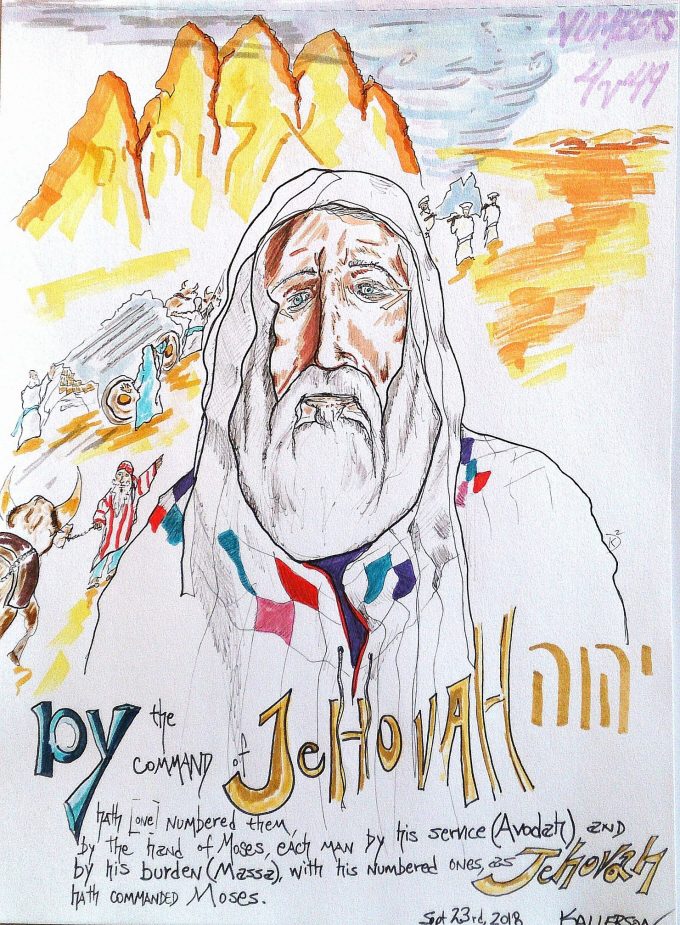
49 According to the commandment of the Lord they were numbered by the hand of Moses, each according to his service and according to his task; thus were they numbered by him,
The words here are words of obedience. The Hebrew says, “According to the mouth of Yehovah.” The Lord spoke out the word, and under Moses’ authority, the census was taken, the duties were explained, and the people were numbered for those duties accordingly. As has been seen time and again, Moses faithfully performs the duties required of him, both personally, and through those under his authority, just…
*49 (fin) as the Lord commanded Moses.
The Lord gave the tsavah, or command, and His words were carried out exactly as the command was given.
There is a time to serve, and a time for that to end
During our time of service, we shall faithfully heed the call
We shall not be slack, nor the rules shall we bend
Not a single duty shall be allowed to fall
Our faithfulness is being judged; so the Lord does see
And so in our time of service, we shall faithfully heed the call
All things we will do well, tending to them carefully
Not a single duty shall be allowed to fall
For great is our God, and to Him we put forth our work
So that in our time of service, we shall faithfully heed the call
No duty that is required shall we set aside or shirk
No! Not a single duty shall be allowed to fall
III. Carrying Away the Sanctuary
The tent of meeting was a temporary edifice where the Lord dwelt. It was a structure with various parts. As we have seen, all of them point to the Person of Christ. It was assembled for His dwelling, it was broken down and carried to a new location, and it was then reassembled for Him to dwell in. That looked forward to Christ’s coming and dwelling in a human body. We saw this so clearly in the Exodus sermons.
For Israel, the tent of meeting itself looked forward to a permanent temple once they arrived in the Land of Promise. Just as Christ put on temporary garments of flesh, so He has put on His eternal body, never to die again after having paid the sin-debt for His people. But the temple in Jerusalem only looks forward further to the true and final temple where the saints will dwell, and which they will be a part of, for all eternity – there in the New Jerusalem. It will be a true and eternal temple, an edifice made by God for man to dwell. It is where, as Revelation says, “Behold, the tabernacle of God is with men, and He will dwell with them, and they shall be His people. God Himself will be with them and be their God” (Revelation 21:3).
As you can see, there is the overlapping of things, one thing leading to the next, and in each, Jesus is the central focus of what is occurring. But the Bible speaks of other, similar tents… those of His people. Peter spoke of his coming death and what that meant in 2 Peter –
“For this reason I will not be negligent to remind you always of these things, though you know and are established in the present truth. 13 Yes, I think it is right, as long as I am in this tent, to stir you up by reminding you, 14 knowing that shortly I must put off my tent, just as our Lord Jesus Christ showed me.” 2 Peter 1:12-14
Likewise, Paul speaks of all believers in this same way –
“For we know that if our earthly house, this tent, is destroyed, we have a building from God, a house not made with hands, eternal in the heavens. 2 For in this we groan, earnestly desiring to be clothed with our habitation which is from heaven, 3 if indeed, having been clothed, we shall not be found naked. 4 For we who are in this tent groan, being burdened, not because we want to be unclothed, but further clothed, that mortality may be swallowed up by life. 5 Now He who has prepared us for this very thing is God, who also has given us the Spirit as a guarantee.” 2 Corinthians 5:1-5
As Christ had a tent similar to ours, we can then equate our tent with His. Though He never saw corruption, the pattern of taking down the Sanctuary by the Levites mirrors what will happen to us. It is an emblem of what Peter endured, and of what we may also endure if the Lord tarries.
First Aaron and his sons went in and covered all of the most holy things. Once they were covered, they were then carried away by those who served under them from Kohath. It is representative of the soul of man, his very existence, being taken by the Lord, covered over as a sacred treasure invested to Him alone. Man is sealed with the Holy Spirit when he calls on Christ. That is, according to Ephesians 1, “the guarantee of our inheritance until the redemption of the purchased possession.” So the believer dies, safely covered over and protected by His Lord.
Next, the coverings of the sanctuary are removed by Gershon. It is no different than what happens to man when he dies. His own covering – first his skin, and then his flesh – is removed as his body begins to deteriorate.
After the coverings are removed, the next stage is for Merari to come and take down the boards, remove the poles and cords, and complete the job of removing all that is left. When they are done, only the earth remains in its place. Likewise, after our skin and flesh is removed, the bones and sinews come apart. Eventually, unless fossilization occurs, nothing but earth is left once again. Job speaks of the formation of man in this temporary tent we possess –
‘Your hands have made me and fashioned me,
An intricate unity;
Yet You would destroy me.
9 Remember, I pray, that You have made me like clay.
And will You turn me into dust again?
10 Did You not pour me out like milk,
And curdle me like cheese,
11 Clothe me with skin and flesh,
And knit me together with bones and sinews?
12 You have granted me life and favor,
And Your care has preserved my spirit.” Job 10:8-12
This is the state of man in Christ when the Lord calls him out of his earthly tent. But the tent of meeting wasn’t taken down and then never built again. Rather, the very purpose of taking it down so carefully and meticulously was to raise it up again. The holy contents are the guarantee of that. The edifice was constructed and erected to contain them, and so our precious holy contents, found in this temporary tent, are intended to have a dwelling and to be in that dwelling.
And so Christ has promised in His word that we too shall be built again, not with hands in a temporary body, but as Paul says, “we have a building from God, a house not made with hands, eternal in the heavens.”
The labors of Levi were exacting, they were meticulously handled, and they were set anytime the Lord called on them to be accomplished. They didn’t know if they would be in one place for a day or a year, and they didn’t know if they would march for 100 paces or for 20 miles. But once they were done marching, they would immediately return to set up the edifice.
We don’t know the span of our lives. God may leave us here for another day, or for 120 long years. But when the Lord calls, we depart this tent. And our contents will be safely conducted through the intervening days or ages until it is time for us to be called again to live in His presence. His servants are attentive to His call, and His people shall be brought back at His word. Be assured of this, and be confident that the guarantee with which you are sealed is just that, a guarantee.
And finally, in a similar way to the reconstruction of the sanctuary, so Israel will also be revitalized in the days to come. The process of their renewal is found in Ezekiel 37, in the Valley of Dry Bones. The Lord told Ezekiel to prophesy to the bones in order for them to come together. And they did, first the bones, then the sinews, and then the flesh, and then the skin. So Israel has been rebuilt. But to this day, there is no breath of God in them. The Bible says that first they will come together, and only then does the Lord say, “I will put My Spirit in you, and you shall live, and I will place you in your own land. Then you shall know that I, the Lord, have spoken it and performed it,’ says the Lord” (Ezekiel 37:14).
The promises of God will never fail, and He uses symbolism of various sorts to show us spiritual truths. And these symbols can and do overlap in how they are expressed because God is consistent in how He deals with man, which is faithfully. He made sure promises to Israel, and Israel will revitalize as a Spirit-filled group of people someday. And He has made sure promises to us as well. Because of His faithfulness to Israel, and indeed – simply because of His faithfulness – we can be assured that His promises to us will likewise be realized. Let us not falter in our faith in His sure promises.
Closing Verse: “Now, therefore, you are no longer strangers and foreigners, but fellow citizens with the saints and members of the household of God, 20 having been built on the foundation of the apostles and prophets, Jesus Christ Himself being the chief cornerstone, 21 in whom the whole building, being fitted together, grows into a holy temple in the Lord, 22 in whom you also are being built together for a dwelling place of God in the Spirit.” Ephesians 2:19-22
Next Week: Numbers 5:1-10 Better than being Rolex’d or Mercedes Benz’d… (A Conscience Cleansed) (9th Numbers Sermon)
The Lord has you exactly where He wants you. He has a good plan and purpose for you. It may seem at times as if you are lost in a desert, wandering aimlessly. But the Lord is there, carefully leading you to the Land of Promise. So follow Him and trust Him and He will do marvelous things for you and through you.
Service of the Tent of Meeting
Then the Lord spoke to Moses, making this to him known
“Also take a census of the sons of Gershon
By their fathers’ house, by their families
From thirty years old and above, even to fifty years old
You shall number them, all who enter to perform the service
To do the work in the tabernacle of meeting, as you are told
This is the service of the families of the Gershonites
In serving and carrying; these are their rites
They shall carry the curtains of the tabernacle
And the tabernacle of meeting with its covering too
The covering of badger skins that is on it
The screen for the door of the tabernacle of meeting
———-so they shall do
The screen for the door of the gate of the court
The hangings of the court which are around
———-the tabernacle and altar
And their cords, all the furnishings for their service
And all that is made for these things:
———-so shall they serve and not falter
“Aaron and his sons shall assign all the service
Of the sons of the Gershonites, so he shall do
All their tasks and all their service
And you shall appoint to them all their tasks as their duty too
This is the service of the families of the sons of Gershon
In the tabernacle of meeting, these duties to them are released
And their duties shall be under the authority
Of Ithamar the son of Aaron the priest
“As for the sons of Merari
This is how things are to be
You shall number them by their families
And by their fathers’ house too
From thirty years old and above, even to fifty years old
———-you shall number them
Everyone who enters the service to do the work
———-of the tabernacle of meeting, so you shall do
And this is what they must carry
As all their service for the tabernacle of meeting, you see
The boards of the tabernacle, its bars, its pillars, its sockets
So shall it be
And the pillars around the court
With their sockets, pegs, and cords, this is the game plan
With all their furnishings and all their service
And you shall assign by name the items he must carry to each man
This is the service of the families of the sons of Merari
As all their service for the tabernacle of meeting
Under the authority of Ithamar the son of Aaron the priest
To them these directions you shall be repeating
And Moses, Aaron, and the leaders of the congregation
Numbered the sons of the Kohathites as they were told
By their families and by their fathers’ house
From thirty years old and above, even to fifty years old
Everyone who entered the service for work
In the tabernacle of meeting; a number quite nifty
And those who were numbered by their families
Were two thousand seven hundred and fifty
These were the ones who were numbered
———-of the families of the Kohathites
All who might serve in the tabernacle of meeting
———-as we now understand
Whom Moses and Aaron numbered
According to the commandment of the Lord by Moses’ hand
And those who were numbered of the sons of Gershon
By their families and by their fathers’ house; so we are told
From thirty years old and above
Even to fifty years old
Everyone who entered the service for work
———-in the tabernacle of meeting
Those who were numbered by their families, in the call
By their fathers’ house
Were two thousand six hundred and thirty in all
These are the ones who were numbered
Of the families of the sons of Gershon, according to the word
Of all who might serve in the tabernacle of meeting
Whom Moses and Aaron numbered
———-according to the commandment of the Lord
Those of the families of the sons of Merari who were numbered
By their families, by their fathers’ house, and by their seating
From thirty years old and above, even to fifty years old
Everyone who entered the service for work
———-in the tabernacle of meeting
Those who were numbered by their families roles
Were three thousand two hundred souls
These are the ones who were numbered
Of the families of the sons of Merari, as we now understand
Whom Moses and Aaron numbered
According to the word of the Lord by Moses’ hand
All who were numbered of the Levites
Whom Moses, Aaron, and the leaders of Israel numbered
———-so we are told
By their families and by their fathers’ houses
From thirty years old and above, even to fifty years old
Everyone who came to do the work of service
And the work of bearing burdens in the tabernacle of meeting
———-a number quite weighty
Those who were numbered
Were eight thousand five hundred and eighty
According to the commandment of the Lord
They were numbered by Moses’ hand
Each according to his service and according to his task
Thus were they numbered by him, as the Lord commanded Moses
———-so we are now made to understand
Lord God, we are even now in a wilderness
And we are wanting to be led by You
Without You to direct, our lives would be a mess
And so be our guide, O God; You who are faithful and true
We long for the water in this barren land
May it flow forth from the Rock, our souls to satisfy
Give us this refreshing, spiritual hand
And may we take it, and to our lives daily it apply
And we shall be content and satisfied in You alone
We will follow You as we sing our songs of praise
Hallelujah to You; to us Your path You have shown
Hallelujah we shall sing to you for all of our days
Hallelujah and Amen…