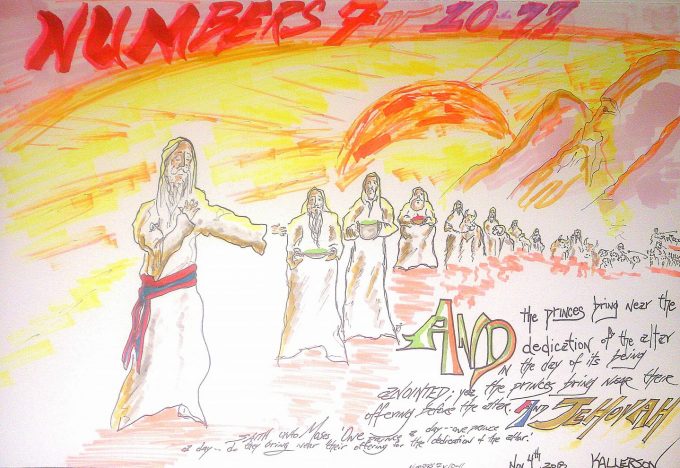
Numbers 7:10-89
The Dedication of the Altar
I’m going to be as honest as I can about today’s verses in two ways. The first is that when I get to this particular set of verses, specifically verses 12-83, I only read the whole set of verses 12-17, and then only the first and last verse of the other eleven sets of verses, just as I have done for you today. Funny thing, my mom said to me that she does the exact same thing when she gets here. The reason we do this is that they are seemingly identical, word for word, all the way through with the exception of the names. I have a tight schedule, and repetition leads to time use, and time use leads to getting backed up in other areas.
Yes, I kind of feel guilty about skipping over the repetition, but repetition leads to time use, and time use leads to getting backed up in other areas. Now that we are sufficiently backed up because of my repetition, I’ll move on by saying that not all repetition is tedious, and I will occasionally have someone say to me that they enjoy repetition in sermons and Bible studies. It helps things to sink in because they are repeated. I don’t disagree with that at all, and things seem to sink in better when they are repeated.
In the case of these repetitive verses in this chapter, they aren’t placed here for that reason. Rather than highlighting their similarities, they are actually given for quite the opposite reason. If you can make it all the way to verse 89, which will be in about 3 hours and 45 minutes, I will finish that verse and then explain the reason for it to you…
Text Verse: “As I urged you when I went into Macedonia—remain in Ephesus that you may charge some that they teach no other doctrine, 4 nor give heed to fables and endless genealogies, which cause disputes rather than godly edification which is in faith.” 1 Timothy 1:3, 4
The second way I need to be honest about today’s sermon is that much of the final analysis of the sermon, after the verses are finished, actually came from the brain of Sergio Voitenko. Had he not looked into these some years ago, I have no idea what my final comments would have been like. Probably, I would have told you that the Bible was giving us a lesson on the beneficial use of repetition. If you need me to say that again, just holler out.
But he did analyze it, and then he went to the Jewish commentaries on this to see what they had to say. I am not a fan of Jewish commentaries in many respects, because they don’t stick to the Bible, and they often devolve into endless genealogies, just as Paul said about them. In the case of their conclusions here, they stuck to Scripture. In fact, they mirror much of what Christians say about Messiah. As Sergio noted in his thoughts, “…what a shame – some rabbis get so close to Jesus but [are] yet so blind. [C]an’t imagine what it would be like when they realize one day what they’ve missed out on for 2000 years.” As far as minute detail of the coming verses, John Lange says the following –
“We have thus a sample of sacred, divine book-keeping, whose separate lesson is that God is careful in all dealings with His people down to details and minutiæ. And this revelation is so comforting that we must not grudge the large space allowed to these entries, and wish that they were replaced by records that would clear up many things in this part of Scripture that are now very obscure.”
On that, he is right in that this is a sample of sacred, divine book-keeping. However, the minutiae actually clear up the seemingly obscure. Stay attentive as we go. And one final way I need to be honest – the sermon won’t take 3 hours and 45 minutes. At best it will be 3 hours and 30 minutes. Great things lie ahead in His superior word. And so let’s turn to that precious word once again and… May God speak to us through His word today and may His glorious name ever be praised.
I. The Offerings of the Dedication (verses 10-89)
10 Now the leaders offered the dedication offering
These words initiate the details of the recording of the dedication of the altar. What follows will be the longest set of repetitions in Scripture. The same words appear to be used twelve times in the same manner, with the exception of the names of the tribe making the offering, and the leader in the tribe who makes the offering. Each day’s offering which follows consists of six verses which almost identically repeat.
The question is, “Why would the Lord repeat the same words twelve times over seventy-two verses? On the surface, it appears to be wholly unnecessary, even to the point of being overly tedious to the mind. Is God simply wasting words that could have been reduced to something like, “The same offering was presented by each tribe over the subsequent eleven days.”?
One thing is for sure, no later writer of the account would have ever thought of compiling it in the matter in which it is written. Thus, it stands as a testimony to the fact that Moses is the author, and he recorded it as it occurred, and exactly as the Lord determined. If we get nothing else out of this today, we should remember that fact. This account fully substantiates that Moses recorded what is presented.
Here, at the start of verse 10, it says, va’yaqrivu ha’nesiim eth khanukat – “and the princes brought near the dedication.” The word for “dedication” is a new one in Scripture which will be seen eight times, but four of them will be in this chapter. It is a word almost all people are familiar with, khanukah. Today it is used when speaking of the festival of Hanukkah which stems from the dedication of the temple by the Maccabees during the intertestamental period. The festival is noted in John 10:22 as something observed even when Jesus came. Now in Numbers, there is a dedication which is brought near…
10 (con’t) for the altar
The Hebrew says, ha’mizbeakh – “the altar.” The altar is dedicated by these offerings. The offerings are brought forth by each tribe for this purpose. Thus, each day is a dedication of the altar by the tribe bringing forth its offering. This will be expressed in verse 84. It is the thing spoken of which is dedicated, not the offering itself. Here, and in 2 Chronicles 7, it is the altar which is spoken of. In Nehemiah 12, it is the wall that is referred to. And Psalm 30 speaks of the dedication of the house of David.
There is a question as to whether the term “for the altar” is speaking of both the brazen altar and the altar of incense. The reason why is because incense is one of the ingredients presented. That doesn’t seem to be a necessary conclusion. Frankincense is presented with offerings on the brazen altar as is noted in Leviticus. Further, the special incense for the golden altar was to be made for, and used only by, the priests. There is no reason to assume that the incense presented here is for anything except the brazen altar. The dedication is speaking only of the brazen altar…
10 (con’t) when it was anointed;
Here it says, b’yom hi-masakh – “in the day it was anointed.” As we have seen before, this doesn’t mean literally on the day of the anointing, but in the time of its anointing. The anointing occurred in Leviticus 8 in a ceremony which lasted seven days. The presentation here is one which takes twelve days. And so the offering of dedication is during the time-frame of the altar’s anointing.
10 (con’t) so the leaders offered their offering before the altar.
The leaders represent the people under them, and they thus represent the individual tribes, twelve of them. The offerings are made for their tribes, and they are offered in exactly the same order as the listing of the tribes around the sanctuary as is detailed in Numbers 2 and again in Numbers 10. As they encamped, and as they will head out in procession, so each also presents an offering.
11 For the Lord said to Moses, “They shall offer their offering, one leader each day, for the dedication of the altar.”
As is often the case, the Hebrew reads much more elegantly – “And said Yehovah unto Moses, ‘One prince a day — one prince a day — are they to bring near their offering for the dedication of the altar.’” The offerings were to be made, but what should be the order? Should they be by birth order? Should they be all in one day? In what manner were they to come near? The Lord determined what was to be done, and then He passed that on to Moses. It is as the tribes are laid out according to the cross, and as the sun lights the sky during the spring of the year, from east to south to west to north, so the offering of each leader is to be made. And they are to be one day at a time. It is a royal procession to bring an offering before the King of the universe.
12 And the one who offered his offering on the first day was Nahshon the son of Amminadab, from the tribe of Judah.
Starting with Judah, the fourth born to Jacob, but from whom would come Messiah, the first offering is made. Other than these three names, Nahshon, Amminadab, and Judah, we won’t repeat the meaning of the three names of each offering as they have been listed already in two previous sermons. Nahshon means “Serpent Person.” Amminadab means “People of the Prince.” Judah means “Praise,” In selecting Judah first, we have a picture for us to always remember, “Praise is to go first before the Lord.”
13 His offering was one silver platter, the weight of which was one hundred and thirty shekels,
The translation is lacking. It says, v’qarebano – “And his offering.” Things like this are placed into the word of God for a reason. To leave them out leaves the studious reader with a lack of understanding concerning what is being relayed. The offering presented is first to be a qaarat keseph, or “dish silver.” The word qearah, or dish, is used 17 times and only in Exodus and Numbers. It comes from a word which means to tear, or cut out. Thus it is something hollowed out like a shallow bowl. Silver pictures redemption. The weight is given as one hundred and thirty shekels. As this is silver, it was not used in the tabernacle, as only gold vessels were used there. This one, in the future, would probably be used at the brazen altar for mixing grain offerings.
13 (con’t) and one silver bowl of seventy shekels,
Next is a mizraq, or bowl. This comes from the word zaraq, meaning “to scatter,” and so it would be a deeper bowl than the first presented. This one is to be a bit more than half the size of the previous dish; seventy shekels. This one would probably have been used in the future for receiving the blood of sacrificial animals and then splashing it upon the sides of the altar. The weight of each of these vessels was to be…
13 (con’t) according to the shekel of the sanctuary,
The shekel of the sanctuary is described five times in the Bible as being the weight of twenty gerahs. A gerah is a set standard, like a grain in our modern weights. Of these bowls…
13 (con’t) both of them full of fine flour mixed with oil as a grain offering;
Both bowls were to be filled with soleth belulah ba’shemen – “fine flour mixed with oil.” The flour, or soleth, comes from an unused root meaning “to strip.” Thus it is fine flour. Into that is mixed oil so that it becomes one mixture. That mixture was brought as a grain offering. These picture Christ as has been seen in previous sermons. As they are in silver, it points to the human aspect of Jesus working out our redemption in His humanity. Next…
14 one gold pan of ten shekels, full of incense;
The word here is kaph. It means “hand.” Thus it is a pan or cup, but being only ten shekels, it would be dinky. In it was to be incense. The gold points to the deity of Christ; the incense to His intercessory role in His divine nature. Also…
15 one young bull, one ram, and one male lamb in its first year,
The par, or “bull” comes from the word parar, to defeat. The ayil, or ram, is from the same as ul, or mighty. And the kebes, or lamb is from an unused root meaning, “to dominate.” The lamb is in its first year indicating innocence. Each of these points to the work of Christ, as has been seen in previous sermons. It is Christ who defeats the devil through His might, and who remained innocent and free of sin, pictured in these animals. These then are offered up…
15 (con’t) as a burnt offering;
The burnt offering is one which is burnt up completely. It pictures a life dedicated wholly to God. The symbolism then is that these are offered on behalf of the people who have dedicated their lives in this way, but the offerings picture Christ who makes that possible.
16 one kid of the goats as a sin offering;
This is a seir izzim, or shaggy goat. The word sayir means hairy. The word izzim means goat, coming from the word azaz, or prevail. It is the same as the two goats presented on the Day of Atonement in Leviticus 16:5. It is presented because hair in the Bible denotes awareness. In this case, it is an awareness of sin. The first time this word, sayir, or “hairy” was used was when speaking of Esau who is called a hairy man. He pictured fallen Adam who became aware of sin through his disobedience of the Lord’s command. Paul says in Romans 8:3 that “Christ came in the likeness of sinful flesh, on account of sin.” In doing this, “he condemned sin in the flesh.” He prevailed over it. This is the purpose of presenting a hairy goat. It pictures Christ who came in this manner. This then acknowledges the sin of the people, but that the animal (picturing Christ) is given to take their place.
17 and for the sacrifice of peace offerings: two oxen, five rams, five male goats, and five male lambs in their first year.
Also is a peace offering which consists of two baqar, or oxen. That comes from a verb signifying “to seek out.” Also, five ayil, or rams, signifying strength. Further, five atud, or male goats. These atudim have never been mentioned before in the sacrificial system. The word comes from athod which signifies “destined” as in “ready to become.” Along with them are to be five kebes, or lambs, of the first year. They again signify “to dominate.”
As these are peace offerings, they picture seeking out peace with God through Christ, resting in His strength, destined to be what God expects of us in Christ, and looking to dominate over the flesh through the power of Christ. To understand the significance of the offerings themselves, meaning the burnt, sin, and peace offerings, took sermon after sermon in Leviticus. Time prohibits repeating all of that here, and so a review of those Leviticus sermons is necessary to grasp all that these short verses now encompass.
17 (con’t) This was the offering of Nahshon the son of Amminadab.
This concludes the offering of the first day as given by Nahshon.
18-23 On the second day Nethanel the son of Zuar, leader of Issachar, presented an offering. … This was the offering of Nethanel the son of Zuar.
The second day sees the offering of the second tribe, which is also the second tribe under Judah’s standard to the east.
24-29 On the third day Eliab the son of Helon, leader of the children of Zebulun, presented an offering. … This was the offering of Eliab the son of Helon.
The third day sees the offering of the third tribe, which is also the third tribe under Judah’s standard to the east.
30-35 On the fourth day Elizur the son of Shedeur, leader of the children of Reuben, presented an offering. … This was the offering of Elizur the son of Shedeur.
The fourth day sees the offering of the fourth tribe, which is also the first tribe under Reuben’s standard to the south.
36-41 On the fifth day Shelumiel the son of Zurishaddai, leader of the children of Simeon, presented an offering. … This was the offering of Shelumiel the son of Zurishaddai.
The fifth day sees the offering of the fifth tribe, which is also the second tribe under Reuben’s standard to the south.
42-47 On the sixth day Eliasaph the son of Deuel, leader of the children of Gad, presented an offering. … This was the offering of Eliasaph the son of Deuel.
The sixth day sees the offering of the sixth tribe, which is also the third tribe under Reuben’s standard to the south.
48-53 On the seventh day Elishama the son of Ammihud, leader of the children of Ephraim, presented an offering. … This was the offering of Elishama the son of Ammihud.
The seventh day sees the offering of the seventh tribe, which is also the first tribe under Ephraim’s standard to the west. As the seventh day is noted here, it should be considered that whether this was a Sabbath or not, eventually there would be at least one, or even two presentations which occurred on a Sabbath. If so, it may be considered acceptable as it occurred in conjunction with the established religion. However, it may be that there was no offering at all made on a Sabbath, and the counting of days skips over the Sabbath. Thus, the term “on the XXth day” speaks of the day of the offerings, not the subsequent day in time. As the people were told to rest on the Sabbath, this may be the case, but as we saw in the previous sermon, it very well may not be.
54-59 On the eighth day Gamaliel the son of Pedahzur, leader of the children of Manasseh, presented an offering. … This was the offering of Gamaliel the son of Pedahzur.
The eighth day sees the offering of the eighth tribe, which is also the second tribe under Ephraim’s standard to the west.
60-65 On the ninth day Abidan the son of Gideoni, leader of the children of Benjamin, presented an offering. … This was the offering of Abidan the son of Gideoni.
The ninth day sees the offering of the ninth tribe, which is also the third tribe under Ephraim’s standard to the west.
66-71 On the tenth day Ahiezer the son of Ammishaddai, leader of the children of Dan, presented an offering. … This was the offering of Ahiezer the son of Ammishaddai.
The tenth day sees the offering of the tenth tribe, which is also the first tribe under Dan’s standard to the north.
72-77 On the eleventh day Pagiel the son of Ocran, leader of the children of Asher, presented an offering. … This was the offering of Pagiel the son of Ocran.
The eleventh day sees the offering of the eleventh tribe, which is also the second tribe under Dan’s standard to the north.
78-83 On the twelfth day Ahira the son of Enan, leader of the children of Naphtali, presented an offering. … This was the offering of Ahira the son of Enan.
The twelfth day sees the offering of the twelfth tribe, which is also the third tribe under Dan’s standard to the north.
84 This was the dedication offering for the altar from the leaders of Israel,
The Hebrew says zot khanukat ha’mizbeakh – “this dedication the altar.” The altar is dedicated through the twelve offerings from each tribe, tribe by tribe.
84 (con’t) when it was anointed:
It again reads, “in the day” it was anointed. Thus, this is speaking of the entire period of the offering as being in relation to the day in which the altar was anointed.
84 (con’t) twelve silver platters, twelve silver bowls, and twelve gold pans.
The dedication spoken of in the first clause is now explained by this and the following verses. What was presented is what brings about the dedication of the altar. One of each item here was presented by each tribe.
85 Each silver platter weighed one hundred and thirty shekels and each bowl seventy shekels.
The combined weight of the silver platters is 1560 shekels. The combined weight of the silver bowls is 840 shekels.
85 (con’t) All the silver of the vessels weighed two thousand four hundred shekels, according to the shekel of the sanctuary.
The combined weight of the silver is given. This according to the sanctuary shekel which is twenty gerahs to the shekel.
86 The twelve gold pans full of incense weighed ten shekels apiece, according to the shekel of the sanctuary; all the gold of the pans weighed one hundred and twenty shekels.
Interestingly, the weight of the gold in gerahs, which is twenty gerahs to the shekel, is the same number as shekels of silver. There are 2400 shekels of silver and 120 shekels of gold which equals 2400 gerahs. 2400 is 12 x 200. Not to read too much into that, but the number 12 is that of governmental perfection, and the number 200 is the number of insufficiency. As this is for the dedication of the altar, it appears to point to the insufficiency of this Old Testament sacrificial system to accomplish what it is designed for. Thus, it is an implicit reference to the need for a New Covenant led by Christ and structured around His twelve apostles.
87 All the oxen for the burnt offering were twelve young bulls, the rams twelve, the male lambs in their first year twelve, with their grain offering, and the kids of the goats as a sin offering twelve.
The totals for the burnt and sin offerings are given, one of each animal for each tribe. The grain offerings are only now mentioned, but it is understood from the laws given in Leviticus that these would accompany the sacrifices. All of these together, the burnt, grain, and sin offerings were given in anticipation of Christ to come. In themselves, they could accomplish nothing except to picture what He would do. This is explicitly stated in the book of Hebrews.
88 And all the oxen for the sacrifice of peace offerings were twenty-four bulls, the rams sixty, the male goats sixty, and the lambs in their first year sixty.
The combined totals of each animal for the peace offerings are given here. Those combined then total 204 animals. And then combining these with the burnt and sin offerings equals a total number of animals offered at 252 over a period of 12 days, 36 as whole burnt offerings, and 216 were partially burned and the rest eaten according to the laws given for the sin and peace offerings.
88 (con’t) This was the dedication offering for the altar after it was anointed.
The word akhar, or after, confirms what has already been deduced. The term b’yom, or “in the day” of the anointing of the altar, which has already been used, is speaking of the entire duration of the dedication. The entire process of the dedication is counted as the day of the altar’s anointing. With this, the altar is now dedicated to serve in the capacity for which it was built.
Through the offering presented by each leader, the people have, tribe by tribe, symbolically offered themselves to God through Christ; they have had their sins symbolically atoned for through Christ; and they have symbolically partaken of the body of Christ. Now, everything in Leviticus concerning the sacrifices to be conducted at this altar, and all of which point to the coming Messiah, can now be performed and accepted because of this time of dedication.
89 Now when Moses went into the tabernacle of meeting to speak with Him,
To close out this long and very complicated chapter, we have a verse that seemingly has nothing to do with anything, but actually, this isn’t so. The first verse of Chapter 7 said, “Now it came to pass, when Moses had finished setting up the tabernacle, that he anointed it and consecrated it and all its furnishings, and the altar and all its utensils; so he anointed them and consecrated them.” That took us all the way back to Exodus 40:17 when the tabernacle was said to have been set up.
Since then, the entire sacrificial system has been outlined, and numerous laws have been given. Also, the priests have been consecrated and the Levites were then set apart for service to the priests. Here in this chapter the people have consecrated the altar and offered themselves, tribe by tribe, in anticipation of the coming Christ. Now, to close out all of that, we come to this verse.
We understand in this how Moses received his word from the Lord. It says that he would go into the tent of meeting to speak with Him. What is understood is that “Him” is Yehovah who has been speaking out His word to Moses. This is confirmed back in Exodus 25 at the giving of the directions for the construction of the Ark –
“You shall put the mercy seat on top of the ark, and in the ark you shall put the Testimony that I will give you. 22 And there I will meet with you, and I will speak with you from above the mercy seat, from between the two cherubim which are on the ark of the Testimony, about everything which I will give you in commandment to the children of Israel.” Exodus 25:21, 22
That is now revealed to actually be the case. When Moses went in, it says…
89 (con’t) he heard the voice of One speaking to him
The verb here is in a particular form where it expresses the reflexive voice where the subject of the verb is both performing and receiving the verbal action. Maybe better stated, this should say, “…he heard the voice conversing with him” (Pulpit). It is debated if Moses stood outside of the veil, or if he alone was allowed inside the veil, apart from the special Day of Atonement allowances. In Exodus 33:11, it says that “the Lord spoke to Moses face to face, as a man speaks to his friend.” This means that they had open and free discussion, not literally necessarily seeing one another’s face. However, in Numbers 12:8, it also says that Moses “sees the form of the Lord.” That implies a physical manifestation of the Lord, presumably the eternal Christ in His incarnate form. Either way, the voice was audible. And it both spoke to and responded to Moses. As God doesn’t have parts, and as a voice requires something to make the voice resonate, it is at least a foreshadowing of the incarnation where God would literally speak with a mouth through the Person of Jesus. For now, though, the mouth of the Lord would speak…
*89 (fin) from above the mercy seat that was on the ark of the Testimony, from between the two cherubim; thus He spoke to him.
The eternal Word of God, Yehovah, who is the Lord Jesus, would converse with Moses from above the mercy seat that was on the Ark. As the mercy seat points to the place of Christ’s atoning death, and as the ark of the Testimony points to Christ, the fulfillment and thus embodiment, of the law, it is appropriate that this verse is placed here. It is after the offering of the tribes for the dedication of the altar, which points to the sacrificial work of Christ which Christ would accomplish, that we are told how He spoke to Moses.
The name Moses means, “He who draws out.” Moses went in to draw out from the Lord, that which needed to be expressed to the people and the Lord would be there, conversing with him. From the spot which pictures His fulfillment of the covenant, He would speak out the words of the covenant which anticipated His coming in order to fulfill it. It is a rather remarkable thing to consider.
An offering to God; an offering for peace
One which signifies fellowship so sweet
It stems from our daily trod, and in Christ it shall never cease
Because in Him our fellowship is complete
Cleanse us in our inward parts; lead us in Your peace
May we join together with You, O precious Lord
Purify our minds and hearts; may this joy never cease
Through Christ, may we always be in one accord
Thank You for the cross from whence atonement came
Upon that offering, we can now add an offering of peace
Together they point to the same great Name
Both look to Jesus where joyous fellowship will never, never cease
II. Why So Many Repetitive Verses?
It has always been a curiosity why the Lord didn’t just say what the offerings were for the first day, and then say that the leader of each subsequent tribe made similar offerings over the next eleven days. The tally at the end would have clarified that well enough. But He didn’t do this. And so being curious as to why, our friend Sergio put these verses into the computer and looked for any differences. There actually are some.
First, the only tribe that doesn’t use the term nasiy, or “prince,” is that of Judah. All the others say, “On the XXth day XX the son of XX, leader (nasiy) of the children of XX, presented an offering. In verse 12, however, it says of Judah, “And the one who offered his offering on the first day was Nahshon the son of Amminadab, from the tribe of Judah.”
Secondly, verse 13 is identical to all the other eleven corresponding verses, but with one exception. It contains the letter vav at the beginning of the verse, translated as “And,” – “And His offering…” The other eleven simply begin with, “His offering was…” It would make more sense to say “And” at the beginning of the last eleven, not only say it during the first, but this is how it is.
And then thirdly, the exact same offerings are used, letter for letter, in all of the other verses, with two exceptions. In verse 17, and in verse 23, the word atudim, or “male goats” is spelled ayin-tav-vav-dalet-yod-mem. However, in the other ten, it is spelled without the letter vav. Those are the only differences in all 72 verses – the word nasiy, and three vav’s.
The reason for the exacting repetition of these 72 verses is clear. The Lord had these variations which needed to be highlighted. The way to accomplish this was to write every section, verse, word, and letter identically, with those changes as well. In doing this, the changes would then be seen as purposeful.
The first change, the leaving off of the term nasiy, or “prince,” is though Nahshon is the prince of Judah, he was not named specifically as prince because from this tribe would come its true nasiy, or Prince. This is actually referred to in 1 Chronicles 5 –
“For Judah prevailed above his brethren, and of him came he that is the prince…” JPS Tanakh 1977
Though that was speaking immediately about David, it is referring prophetically to Messiah, the seed of David. Hence, the term nasiy, or prince, is left off here in anticipation of Christ.
The second variation, that of the vav, or “And,” beginning verse 13 is explained by the lack of the term “prince” in verse 12. The “and” there acknowledges that an offering was made by Nahshon, who though the leader, was not acknowledged as such. The vav is the sixth number of the aleph-bet. Six is the number of man. Nahshon made his offering, but the title being left off looked forward to the greater Man who would lead the tribe and the congregation.
Even the ancient rabbis understood the vav points to Messiah. Although their commentaries are not the Bible, in this case, they are, like any other scholars’ comments, based on the Bible. In the Midrash Rabbah of Numbers, they looked at the vav as an anticipation of six righteous men who would come from Judah. Nahshon is the grandfather of Boaz, and Boaz is the grandfather of David. Thus David, who anticipates the coming Messiah, is sixth from Nahshon. Along with him, the sages list the four other righteous men listed in the Bible – Daniel, Hananiah, Mishael, and Azariah. They say the sixth to come would be Messiah. It is he who is the greater David. The way that they determine this is the same way we determine that Christ is the Lord; from Isaiah 11. There, the seven spirits of the Lord are named, but the first is the Spirit of the Lord. After that, six spirits would rest upon the Man, Messiah the Lord –
“There shall come forth a Rod from the stem of Jesse,
And a Branch shall grow out of his roots.
2 The Spirit of the Lord shall rest upon Him,
The Spirit of wisdom and understanding,
The Spirit of counsel and might,
The Spirit of knowledge and of the fear of the Lord.?Isaiah 11:1, 2
The third variation, that of the two vav’s in the atudim, or male goats, of Judah and Issachar point to the Person of Messiah as well. As I said, the word comes from athod which signifies “destined” as in ready to become. The first of the two uses is in the male goat offering of Judah, which means Praise. The vav signifies Messiah destined to be the Praise of God for and among His people.
This explains the extra vav of the offering of Judah, which seems obvious because Messiah comes from Judah. But, it doesn’t explain the extra vav of Issachar’s offering. In this, we need to look at the meaning of the name of Issachar. It means, “He is wages.” Thus, unlike the other ten tribes that have no vav, we see here that the Messiah was giving us a clue as to His mission. He is destined to be the payment which brings us peace with God, as seen in this peace offering which is made upon this very altar being dedicated.
There is no need for the vav in any other tribe’s offering, because these two sum up the role of Messiah as is intended here. He is the Praise of God which brings peace to man, and He is the payment which brings peace with God, represented by the altar where these sacrifices are made. It looks to the cross of Calvary. It was a long set of verses to go through to make the point, but the point is made.
If nothing else from this very long passage, which we even cut short in both its reading and its analysis because of the repetition, I would hope that you have learned that nothing is superfluous in God’s word. That which seems to make no sense, makes all kinds of sense when it is studied. Reading isn’t study, but it is what you should do every day with this precious word. The study is what you should do with those who have the time to prepare the study. Here, that’s my job. And in our time together, you can combine what you know from reading, with that which you learned from the study. In putting them together, you have a much fuller and more beautifully laid out picture of Christ. In the end, it is all about Him.
Closing Verse: “Blessed be the God and Father of our Lord Jesus Christ, who has blessed us with every spiritual blessing in the heavenly places in Christ, 4 just as He chose us in Him before the foundation of the world, that we should be holy and without blame before Him in love, 5 having predestined us to adoption as sons by Jesus Christ to Himself, according to the good pleasure of His will, 6 to the praise of the glory of His grace, by which He made us accepted in the Beloved.” Ephesians 1:3-6
Next Week: Numbers 8:1-26 Don’t be anxious. Don’t lose your nerve… (Acceptable to Serve) (15th Numbers Sermon)
The Lord has you exactly where He wants you. He has a good plan and purpose for you. It may seem at times as if you are lost in a desert, wandering aimlessly. But the Lord is there, carefully leading you to the Land of Promise. So follow Him and trust Him and He will do marvelous things for you and through you.
An Offering for the Altar
Now the leaders offered the dedication offering
For the altar when it was anointed
So the leaders offered their offering before the altar
They did this as they were so appointed
For the Lord said to Moses, “They shall offer their offering
One leader each day, for the dedication of the altar
———-such shall be their proffering
And the one who offered his offering on the first day
Was Nahshon the son of Amminadab, from the tribe of Judah
———-as the record does say
His offering was one silver platter
The weight of which was shekels one hundred and thirty
And one silver bowl of seventy shekels
According to the shekel of the sanctuary
Both of them full of fine flour mixed with oil as a grain offering
One gold pan of ten shekels, full of incense as well
One young bull, one ram, and one male lamb in its first year
———-as a burnt offering
One kid of the goats as a sin offering, as the account does tell
And for the sacrifice of peace offerings
Two oxen, five rams, five male goats, not grown in a lab
And five male lambs in their first year
This was the offering of Nahshon the son of Amminadab
On the second day Nethanel the son of Zuar
Leader of Issachar
Presented an offering the same as before
This was the offering of Nethanel the son of Zuar
On the third day Eliab the son of Helon
Leader of the children of Zebulun
Presented an offering the same as before
This was the offering of Eliab the son of Helon
On the fourth day Elizur the son of Shedeur
Leader of the children of Reuben, for sure
Presented an offering the same as before
This was the offering of Elizur the son of Shedeur
On the fifth day Shelumiel the son of Zurishaddai
Leader of the children of Simeon, by and by
Presented an offering the same as before
This was the offering of Shelumiel the son of Zurishaddai
On the sixth day Eliasaph the son of Deuel
Leader of the children of Gad, as the account does tell
Presented an offering the same as before
This was the offering of Eliasaph the son of Deuel
On the seventh day Elishama the son of Ammihud
Leader of the children of Ephraim, so it is understood
Presented an offering the same as before
This was the offering of Elishama the son of Ammihud
On the eighth day Gamaliel the son of Pedahzur
Leader of the children of Manasseh, for sure
Presented an offering the same as before
This was the offering of Gamaliel the son of Pedahzur
On the ninth day Abidan the son of Gideoni
Leader of the children of Benjamin, as we see
Presented an offering the same as before
This was the offering of Abidan the son of Gideoni
On the tenth day Ahiezer the son of Ammishaddai
Leader of the children of Dan, by and by
Presented an offering the same as before
This was the offering of Ahiezer the son of Ammishaddai
On the eleventh day Pagiel the son of Ocran
Leader of the children of Asher, as stated hereon
Presented an offering the same as before
This was the offering of Pagiel the son of Ocran
On the twelfth day Ahira the son of Enan
Leader of the children of Naphtali
———-by the Lord his name was drawn
Presented an offering the same as before
This was the offering of Ahira the son of Enan
This was the dedication offering
For the altar from the leaders of Israel
When it was anointed
Twelve silver platters, twelve silver bowls
———-and twelve gold pans as the record does tell
Each silver platter weighed one hundred and thirty shekels
And each bowl shekels seventy
All the silver of the vessels weighed
———-two thousand four hundred shekels
According to the shekel of the sanctuary
The twelve gold pans full of incense weighed ten shekels apiece
According to the shekel of the sanctuary
All the gold of the pans weighed
Shekels one hundred and twenty
All the oxen for the burnt offering were twelve young bulls
The rams twelve, the male lambs in their first year twelve, as well
With their grain offering
And the kids of the goats as a sin offering twelve
———-as the record does tell
And all the oxen for the sacrifice of peace offerings
were twenty-four bulls, the rams sixty, the male goats sixty
———-all as duly appointed
And the lambs in their first year sixty
This was the dedication offering for the altar after it was anointed
Now when Moses went into the tabernacle of meeting
To speak with Him, the voice of One speaking to him he heard
From above the mercy seat that was on the ark of the Testimony
From between the two cherubim; thus He spoke to him
———-thus He conveyed His word
Lord God, we are even now in a wilderness
And we are wanting to be led by You
Without You to direct, our lives would be a mess
And so be our guide, O God; You who are faithful and true
We long for the water in this barren land
May it flow forth from the Rock, our souls to satisfy
Give us this refreshing, spiritual hand
And may we take it, and to our lives daily it apply
And we shall be content and satisfied in You alone
We will follow You as we sing our songs of praise
Hallelujah to You; to us Your path You have shown
Hallelujah we shall sing to you for all of our days
Hallelujah and Amen…