Numbers 16:16-35
Korah Meets His Maker
Well, if nothing else, today’s passage is simply cool for the mental imagines it provides. It’s like watching Raiders of the Lost Ark when the ark itself is opened and the main bad guys are melted and the rest of the offenders are burnt up with fire.
We can try to imagine what the actual events of the earth opening up looked like, and we can insert the faces of folks who we may not be so fond of on the offenders standing at their tents, and then what it must be like to watch them drop right out of sight once and for all.
Moses promised something new from the Lord, and the Lord delivered. Although the act of creation itself was a one-time thing, and nothing new is physically created since then, the Lord still creates new things out of what has been created. This is to demonstrate His character, His glory, and to continue to reveal His plan of redemption for mankind. One step at a time, the Lord brings out new things as He carefully unfolds His beautifully prepared tapestry of wonder…
Text Verse: “I form the light and create darkness,
I make peace and create calamity;
I, the Lord, do all these things.” Isaiah 45:7
As I said, while reading this passage, we can try to imagine what it must have been like to actually see. Although he is to be taken with a grain of salt on many matters, Flavius Josephus also has many insights into things which the Bible, and which later history, speaks of. As far as the passage today, he wrote about what the event looked like, adding in what is left unstated in Scripture. As I said, he is to be taken with a grain of salt, but I thought I’d share his words with you –
When Moses had said this, with tears in his eyes, the ground was moved on a sudden; and the agitation that set it in motion was like that which the wind produces in waves of the sea. The people were all affrighted; and the ground that was about their tents sunk down at the great noise, with a terrible sound, and carried whatsoever was dear to the seditious into itself, who so entirely perished, that there was not the least appearance that any man had ever been seen there, the earth that had opened itself about them, closing again, and becoming entire as it was before, insomuch that such as saw it afterward did not perceive that any such accident had happened to it. Thus did these men perish, and become a demonstration of the power of God.” Flavius Josephus, Antiquities, Book IV. Chapter 3:3
And so, if you ever decide to make a movie about Korah, that would be a nice additional help in describing the scene for your certain blockbuster adventure. Whether what Josephus handed down is actually accurate or not, the story is a marvelous part of the life and times of Moses, and the people of Israel, as they lived out the punishment of rejecting the Lord’s offer of Canaan.
Instead of going in and taking over the land, they spent their lives in the wilderness, meeting their end there as well. With the noted exceptions of Joshua and Caleb, all twenty and over met their end. Some just met it in a more memorable and dramatic way, but none more dramatic than that of those in here in Numbers 16. It really is an unforgettable part of His superior word. And so let’s turn to that precious word once again and… May God speak to us through His word today and may His glorious name ever be praised.
I. The Glory of the Lord Appeared (verses 16-22)
16 And Moses said to Korah, “Tomorrow, you and all your company be present before the Lord—you and they, as well as Aaron.
Moses now gives a repetition of the instruction that he has already directed, mirroring what he said in verses 6 and 7. His words are directly to Korah which clearly set him apart as the leader of the insurrection. He initiated it, and therefore, he is instructed to lead the men by informing them of the time – tomorrow – and the place – before the Lord – that they are to have their challenge settled. He also reminds him of who is being challenged, Aaron.
As a refresher, Moses means, “He who draws out.” He is in the process of drawing out the will of the Lord concerning the priesthood. And, as was explained in the last sermon, Korah, or Korakh, probably means, “Baldy.” The idea of baldness is the opposite of hair. In Scripture, hair signifies an awareness. Being bald then would signify being either naive, or even empty headed. The thought fits Korah rather well.
Korah has no awareness of the danger he is in, and he is naive about the will and purposes of the Lord. Moses is not, and he is not only drawing out the Lord’s will, but he is drawing out the Lord’s judgment upon the rather empty-headed Korah.
17 Let each take his censer and put incense in it, and each of you bring his censer before the Lord, two hundred and fifty censers; both you and Aaron, each with his censer.”
Again, the words continue to follow closely to verses 6 & 7. Moses is directing that the challengers be ready for the challenge. There are two hundred and fifty men, thus there is expected to be two hundred and fifty censers brought forward. That is then set in contrast to Aaron’s single censer. Will the smoke of the two hundred and fifty be found more pleasing than that of the one? This is what is to be decided.
Because Moses already knows the outcome of what is going to happen, his appeal for every challenger to ensure he brings his own incense is a pre-appointed death sentence. As a review from last week, it is appropriate that the errors which these men will commit before the Lord be restated.
First, they are not priests. Only Aaron and his sons could function as priests. Presenting incense before the Lord is considered a priestly function. Death is the anticipated outcome for such a violation of the law. If something less is received, such as will later be the case at the time of King Uzziah, that is an act of mercy.
Secondly, because they were not of the line of Aaron, these men are not consecrated to conduct priestly duties. Both the lineage and the consecration were necessary. A person who was otherwise acceptable, but not consecrated, could still expect the Lord’s wrath for their violation.
Next, each took a censer. These were censers not fashioned for use in the sanctuary, and which had not been part of the consecration process. The word for censer is makhtah. It comes from a root which means terror, ruin, or destruction. It is a fitting concept in regards to what can be expected for such a violation.
Fourth, they are instructed to come together to offer incense. Offering incense was a duty which was only to be conducted by one attending priest at a time. Aaron is a priest, he is consecrated to offer, and thus there will be two hundred and fifty superfluous offerers who will need to be taught a lesson concerning presumption.
Fifth, incense offered in a censer is only specified as being done by the high priest. In the law, it is never noted as an offering made by anyone but him. The incense offered by the other priests was burnt in the golden altar in the holy place, or along with offerings on the brazen altar, but never in censers. Again, these men have not been consecrated for high priestly duties, and they should expect that their actions will be found inappropriate.
Sixth, they are bringing their own incense which is not according to what the Lord has prescribed to be burnt before Him. The incense for the Lord was forbidden to anyone else. Should they make it, they were to be cut off from their people. Whatever incense they offered, then, was considered profane. Therefore, no matter how sweet the smell of the incense to man’s nose, to the Lord, it would be considered an abomination.
As Aaron pictures Christ in performing mediatorial duties, and as incense pictures prayers to God, then the symbolism is that of profane prayers being offered to the Lord through unqualified mediators. What is presented will not be pleasing, but odious.
Seventh, if they brought their own censer, then they also brought their own fire. Thus, their fire is also profane. The law shows that the high priest was to take the fire for the incense from the brazen altar which had been sanctified by the Lord’s fire. It is the same fire which had been ignited by the Lord at the time of the ordination offering. This is the fire that was to never be extinguished from that first time it was lit. It is a celestial fire, having been sanctified by Yehovah himself.
Instead of using this fire, sanctified by the Lord, they will bring their own, profane, fire. The law was written, every infraction is to receive its just punishment, and high handed sins were considered as capital crimes. As stated last week, Moses knows all of this. There can only be one outcome if the word of the Lord is a reflection of the will of the Lord.
Bad times lay ahead for these dudes, and as if to avoid any unnecessary delay in getting to the point, the account next jumps from one day to the next day without any further commentary. Whether there were excited, sleepless nights, or a party to celebrate the victory ahead, or sacrifices to false gods in hopes of gaining a favorable advantage over the situation, nothing is stated. One day has become the next and…
18 So every man took his censer,
One in accord with the law, two hundred and fifty violations of the law, if presented as anticipated.
18 (con’t) put fire in it,
One in accord with the law, two hundred and fifty violations of the law, if presented as anticipated.
18 (con’t) laid incense on it,
One in accord with the law, two hundred and fifty violations of the law, if presented as anticipated. Like two hundred and fifty sheep being led to the slaughter, the account goes through each step that was taken in disobedience to the law to show that these men truly deserved what was coming to them. Up until this point, they have done nothing wrong in their actions. People own censers, people had incense, people made fires. And, people combined the three into delightful times of enjoyment in their own dwellings. However, these men now take what they have prepared, stepped out of their comfortable dwellings, and have carried their arrogant offerings to the midst of the camp…
18 (con’t) and stood at the door of the tabernacle of meeting with Moses and Aaron.
Once their feet arrived at this place, with the offerings that are in their hands, there can be only one outcome which will glorify the Lord, establish the authority of Moses, and the priesthood of Aaron, and properly punish the offenders. They have, by stepping before the Lord, signed their own death sentence.
However, not realizing the danger of the situation, and certainly hopeful of his soon-to-be exalted position, Mr. Baldy even more arrogantly calls together an audience to witness the spectacle which will exalt him to the office of the priesthood…
19 And Korah gathered all the congregation against them at the door of the tabernacle of meeting.
Korah is so naive about what lies ahead that he let out a general notice to the congregation that they should all come and watch the spectacle unfold. Obviously, the entire congregation couldn’t fit in the area outside of the tent of meeting, but the leaders would be close enough to peer in and see what transpired.
Any other curious onlookers could have the word passed on to them. And if there were any hills near to the camp, people could climb up on them and watch. It was going to be spectacle, and Mr. Baldy wanted everyone to see him rise up and prevail over Moses and Aaron.
It is reminiscent of the crowd who gathered on Mount Carmel many years later as is recorded in 1 Kings 18. A challenge was made, the people were gathered, and the question was asked, “How long will you falter between two opinions? If the Lord is God, follow Him; but if Baal, follow him.”
Now, the question is, “If Moses and Aaron are the leaders, follow them. If Mr. Baldy is leader, follow him.” The anticipation was high at both times, and in both, the true man of the Lord was vindicated through the action of the Lord. In this encounter, before the Lord acts, He first makes His presence known…
19 (con’t) Then the glory of the Lord appeared to all the congregation.
It is similar to what happened in Numbers 14. There it said, “Now the glory of the Lord appeared in the tabernacle of meeting before all the children of Israel.” That meant bad news for the congregation, especially for the spies who brought back a bad report. The appearance of the Lord this time will be no less so for those who have come against Him. This is because those who come against His chosen leaders actually oppose Him. The words, “all the congregation,” give an advanced hint of what the Lord means when we get to verse 21.
20 And the Lord spoke to Moses and Aaron, saying,
The matter is all but resolved with these words. It is to Moses and to Aaron that the Lord speaks. Whether the voice is audible and addressed to them for all to hear, or whether the voice is only heard by them, any doubt about the Lord’s intent for the continuance of these two in their positions is settled with His speaking directly to them. And the words are ominous…
21 “Separate yourselves from among this congregation, that I may consume them in a moment.”
In Leviticus 9, at the time when the priestly ministry of Aaron began, it says that all the congregation drew near before the Lord (v. 5) for the presentation of offerings. Later, Aaron lifted his hands and blessed the people (v. 22), at which time the glory of the Lord appeared to all the people (v. 23). At that time, fire came out from before the Lord and consumed the burnt offering and the fat on the altar (v.24). The Lord had approved Aaron’s ministry, and He had accepted the people’s offering as presented through him. Thus, he approved of the people because of the mediator.
That was representative of God’s acceptance of us because of Christ’s mediation on our behalf. However, the people have rejected Aaron and his mediation, and in type, they have thus rejected Christ. In this, the Lord’s anger is highly aroused, and His words reflect exactly what He intended to do. Instead of consuming an offering mediated through His high priest, He intended to consume the people who presumed to back another priest, not chosen by Him. People who think they have access to God apart from Jesus, God’s chosen Mediator, are wholly deluded.
22 Then they fell on their faces,
In Leviticus 9, after the fire came out from the Lord and consumed the offering of the people, the chapter ended with, “When all the people saw it, they shouted and fell on their faces.” It is as if that passage and this were written with one thought in mind – the acceptance of Aaron means the acceptance of the people, and thus the rejection of Aaron means the rejection of the people.
Now, instead of the people shouting and falling on their faces in acknowledgment of Aaron’s ordination and the establishment of the priesthood, it is Moses and Aaron falling on their faces and petitioning the Lord for the people who have rejected Aaron’s mediation. And yet, they still determine to intercede and mediate for them…
22 (con’t) and said, “O God, the God of the spirits of all flesh, shall one man sin, and You be angry with all the congregation?”
It is obvious that more than one man sinned, but there is one main instigator of that sin, who then encouraged it in others and in various levels. Moses and Aaron, understanding that the masses are easily swayed by a few, petition for leniency from the Lord. Though under different circumstances, specifically sin by the leader of Israel, the petition here is reflective of the words of David towards the Lord when His judgment came upon the people –
“Then David spoke to the Lord when he saw the angel who was striking the people, and said, ‘Surely I have sinned, and I have done wickedly; but these sheep, what have they done? Let Your hand, I pray, be against me and against my father’s house.’” 2 Samuel 24:17
In both instances, the men understood that the Lord is the Creator of man, and the one who endows men with a spirit and with life. To destroy the people is to destroy His own work. Matthew Henry says of this incident –
“See how dangerous it is to have fellowship with sinners, and to partake with them. Though the people had treacherously deserted them, yet Moses and Aaron approved themselves faithful shepherds of Israel. If others fail in their duty to us, that does not take away the obligations we are under to seek their welfare. Their prayer was a pleading prayer, and it proved a prevailing one.”
I will dwell in them and walk among them too
I will be their God, and My people they shall be
This is the thing that I promise I will do
Together we shall fellowship in the eternal sanctuary
Therefore, come out from among them, I say
And be separate, says the Lord your God
Do not touch what is unclean, from such you shall stay
And be holy as I am holy in this walk that you trod
And I will receive you, and give you eternal waters
I will be a Father to you, now and always
And you shall be My sons and you shall be My daughters
Says the Lord Almighty; says the Ancient of Days
II. If the Lord Creates a New Thing (verses 23-35)
23 So the Lord spoke to Moses, saying,
In verse 20, the Lord spoke to both Moses and Aaron. It was with the intent of destroying the people. The fact that He now only speaks to Moses shows us that this is no longer the case. The people are safe from destruction. Well, most of them…
24 “Speak to the congregation, saying, ‘Get away from the tents of Korah, Dathan, and Abiram.’”
In verse 21, the Lord told Moses and Aaron to separate themselves from among the congregation. Now, having accepted Moses’ petition, He pronounces His judgment. Instead of consuming them all, there is an implicit warning for them to not be consumed. If there are perpetrators who led them astray, then only they will be punished. And so by name, He identifies them.
In doing so, a rather remarkable term, mishkan, or tabernacle, is used, and it is in the singular. The words literally read that the congregation is to, “Get away from the tabernacle of Korah, Dathan, and Abiram.” This will be repeated in verse 27, again in the singular. However, it will also mention their ahole, or tents, in the plural in verses 26 & 27.
To this point, the term mishkan has only been used when speaking of the tabernacle of the Lord which is inside of the tent of meeting. It literally means a dwelling place. And so what is probably being relayed here is that the three, despite one being a Levite and the other two being from Reuben, had set apart a space for themselves as one dwelling place with their three individual tents.
The Lord is thus contrasting their tabernacle with His. They have set themselves in their own tabernacle with their own hoped-for high priest. Last week, the name Dathan was explained to indicate “Their law,” and Abiram as “My Father is Exalted.” In this, one can see these men naively or stupidly (Korah) following their own law (Dathan) and thus serving their father, the devil (Abiram).
It certainly appears this is what the Lord is indicating in His words to Moses. And, it is born out by the words of Jesus from John 8 –
“You are of your father the devil, and the desires of your father you want to do. He was a murderer from the beginning, and does not stand in the truth, because there is no truth in him. When he speaks a lie, he speaks from his own resources, for he is a liar and the father of it.” John 8:44
If this is so, and it certainly appears that way, I would say this then is picturing the synagogue of the Jews which set their own laws, rules, and customs in the Talmud in contrast to the revelation of God found in Christ. Thus, it is called by Jesus in Revelation, a synagogue of Satan. They are the tabernacle of rebellion.
This verse also seems to imply that the word of the Lord to Moses is probably not audible, but rather is an internal word directed to him alone. This is because Korah is not next mentioned…
25 Then Moses rose and went to Dathan and Abiram, and the elders of Israel followed him.
If the Lord’s words to Moses were audible, Korah probably would have started running, and he would still be running today, in order to get away from the Lord. However, we are told that Moses went to Dathan and Abiram, and elders followed him. These may or may not be the seventy elders who received the Spirit which was on Moses. There is no definite article in the Hebrew saying, “the elders.” It simply says, “… and elders of Israel followed him.”
From this point on, the account does not specifically say what happens to Korah, whether he is destroyed with these two, or if he dies with the 250. However, in Numbers 26:10, it does say that Korah was, in fact, swallowed up with Dathan and Abiram. What probably happened then, is that Moses had the elders grab Korah and bring him along with them. However, this is again debated by other verses which will be stated later.
26 And he spoke to the congregation, saying, “Depart now from the tents of these wicked men!
Here the word tents is used when speaking of their individual tents as property. The congregation is told to remove themselves from them, indicating that they are now unclean and thus devoted to destruction. This is made explicit with the words…
26 (con’t) Touch nothing of theirs, lest you be consumed in all their sins.”
In being rendered unclean and thus set for destruction, nobody was to touch anything that belonged to them. This is what occurred in Joshua 7 at the destruction of Jericho. The city was declared kherem, or under a curse, and was to be completely destroyed. However, Achan took what was under the ban and thus brought himself, his family, and his possessions under the ban. They were subsequently burned with fire after they were stoned to death.
The men were condemned because of idolatry, the idolatry of self. They set themselves in opposition to the Lord’s chosen leaders, and thus in opposition to the Lord. In this, the Lord uses a different word than verse 21 which is also translated as “consumed” here. It means to be swept away. In touching their unclean possessions, any others would be swept away together with the offenders.
In 2 Corinthians, Paul’s words concerning keeping away from idols practically mirror what is occurring in this account –
“Therefore
‘Come out from among them
And be separate, says the Lord.
Do not touch what is unclean,
And I will receive you.’
18 ‘I will be a Father to you,
And you shall be My sons and daughters,
Says the Lord Almighty.’” 2 Corinthians 6:17, 18
Dathan and Abiram were said in verse 1 to be sons of Eliab. That name means “My God is Father.” for these two, this was not the case. The Lord says that if we depart from such things, He will be our Father. Lesson: Do not touch what is unclean, and the Lord will, in fact, receive you.
27 So they got away from around the tents of Korah, Dathan, and Abiram; and Dathan and Abiram came out and stood at the door of their tents, with their wives, their sons, and their little children.
Here, in one verse, both words, mishkan, or tabernacle and ahole, or tents, are used and are, unfortunately, both translated as “tents.” What is being said is that the tents of these three was one dwelling place of iniquity set in opposition to the dwelling place of the Lord. Everything in the Lord’s tabernacle was most holy; everything here is wholly unclean.
When it says that Dathan and Abriam came out, this doesn’t mean Korah isn’t there, he is already outside of his tent, probably having been brought with Moses. The commotion of Moses arrival and his warning to those around them has obviously brought those inside the tents outside to see the events surrounding them unfold. This includes everyone, even to the little children. Such is the curse upon them for what has transpired.
However, it is noted in verse 26:11 that the sons of Korah did not die in this event. All that tells us is that they were old enough to have their own tents and lived their own lives apart from their wayward father. Despite being one of the infamous scoundrels of Israel, the prophet Samuel, and Heman the singer, both descended from him. Further, “the sons of Korah,” meaning old Baldy here, are mentioned in the titles of eleven psalms. Despite having success in later generations, Korah himself did not end well…
28 And Moses said: “By this you shall know that the Lord has sent me to do all these works, for I have not done them of my own will.
The words here are often extended beyond what the context of the passage is speaking of. When Moses says “all these works,” most scholars include everything from the Exodus to the receiving of the law, to the establishment of the priesthood, and so on, in what is said here. The disputed matter is that of the selection of Aaron and his sons to the priesthood, the authority of the priesthood, the relegation of the Levites to service of the priesthood, and the like.
It is obvious the Lord led Israel out of Egypt, and that He spoke out the Ten Commandments from Sinai, and so on. What is supposedly not obvious to the people are the laws which Moses kept bringing out of the tent of meeting concerning all of the other things.
But this is faulty thinking on several levels. First, the people asked that the Lord not speak to them again as He did from Sinai, lest they die. Then, on several occasions, they agreed to do whatever the Lord said through Moses. And finally, the Lord showed His approval of the priesthood of Aaron when He consumed the offerings made through him upon his consecration as high priest.
In reality, the only ones to blame for the situation they were in, are the people themselves. Moses has no true need to defend himself again, except in the sight of the forgetful people whom he led. And so, once again, he will demonstrate that it is the Lord, and not he himself, who set Moses in the position of authority. And he will do so at the expense of the lives of those who have challenged him…
29 If these men die naturally like all men, or if they are visited by the common fate of all men, then the Lord has not sent me.
Moses gives two possibilities concerning the death of these men. The first is that of a natural death, like any man could expect. It might be by having a heart attack, or maybe by choking on a durian seed, or maybe by simply dying in one’s sleep.
The second is that of a visitation by which men are visited. That might be by a stray arrow running through them, or contracting the plague, or maybe by being run over by a donkey. In these, nobody would say, “Well, that it was really out of the ordinary.” The circumstance may be unusual, but not really beyond what one would expect in normal life.
In either case, if such was to happen to these guys, then Moses says, you can be sure that the Lord hasn’t sent me. What is certain is that these men are going to die, but the way in which it happens will either leave a doubt about Moses, or it will leave no doubt at all. And so, in order to make it absolutely sure that there is no doubt about it, he not only says they are going to die in a completely unique way, but he tells how it will come about, and he tells it in advance of it happening…
30 But if the Lord creates a new thing,
v’im beriah yivra Yehovah – “and if creation creates Yehovah.” Here is a most astounding statement. The word beriah, or “creation,” is only found here in the Bible. It is a created thing, and thus something novel or new. It is something that never existed before. The word bara, or “to create,” is also rather rare. It was used in the early Genesis account, and then once in Exodus 34:10 –
“And He said: ‘Behold, I make a covenant. Before all your people I will do marvels such as have not been done in all the earth, nor in any nation; and all the people among whom you are shall see the work of the Lord. For it is an awesome thing that I will do with you.’”
The Lord created and then He finished His creation, but He promised Moses while on the mountain that He would create new things in and among Israel. Moses now promises one of those new things is coming in the destruction of these men. This is the type of marvel that the Lord said He would create. The people’s eyes would behold marvels never before conceived of, such as…
30 (con’t) and the earth opens its mouth and swallows them up with all that belongs to them, and they go down alive into the pit,
The idea here is as if the earth itself comes alive. First, there is the word patsah; open. That was only seen in Genesis 4 when the earth opened its mouth to receive the blood of Abel. Next, is the word peh, or mouth. It is as if the earth is alive and opening to devour. And then is the word bala, or swallow down. This is what is said to have happened to Pharaoh and his armies in the Red Sea.
Moses combines these thoughts into one graphic statement of their anticipated fate. They and all that they possessed would go down alive into Sheol, the place of the dead, sometimes translated as the pit, hell, or the grave, depending on the context. And there was a purpose for this…
30 (con’t) then you will understand that these men have rejected the Lord.”
Moses doesn’t say, “that these men have rejected me.” He says, “that these men have rejected the Lord.” Again, as has been evident with each calamity that has befallen them, the rejection of Moses is a rejection of the Lord.
Taking that to its logical conclusion, the rejection of the law, which came through Moses, is a rejection of the Lord. The wonders which have been seen in and through Israel, both positive and negative, have come about because of the promise of the Lord, made to Moses, on Mount Sinai. What is seen in the swallowing up of these men, directly into hell, and with their possessions and families accompanying them, is simply a warning to all of Israel.
And as Moses spoke of One to come who would usher in a New Covenant, then to reject Him and His greater covenant is to reject His Messiah. The wounds of Israel, even since Moses until today, are self-inflicted. Such is certainly the case with what now occurs…
31 Now it came to pass, as he finished speaking all these words, that the ground split apart under them,
The words indicate that Moses had spoken, and at that very moment the ground beneath them split open. It wasn’t something anyone could predict apart from the Lord, and yet it was prophesied in advance. Thus, it must have been of the Lord. There was no time for apology or appeal, there was no time for shouting out a word of rebellion or a word of remorse. And there were no extended goodbyes. The matter was spoken, the sentence pronounced, and justice was served…
32 and the earth opened its mouth and swallowed them up, with their households and all the men with Korah, with all their goods.
There is, again, confusion as to whether Korah is included here or not. In Deuteronomy 11 and Psalm 106, only Dathan and Abiram are mentioned as being swallowed up. It appears to be purposeful that there is this mystery surrounding how he died. Was it directly into the pit, or was it by the fire which will be seen in a few verses?
It could be that the Lord left this ambiguous for a reason. The fate of Korah is the fate of both of the camps aligned with Korah. In this one, it includes “all the men with Korah.” This would include any alliances that were not at the sanctuary swinging their censers, trying to please the Lord through fire. For this first half, their final fate is given marvelous detail…
33 So they and all those with them went down alive into the pit; the earth closed over them, and they perished from among the assembly.
The earth opened, the earth gulped, and the pit of the earth received. Everything and every person associated with them was kherem, and was thus destroyed, forever to languish in the darkest of darkness, and in the pit of corruption.
34 Then all Israel who were around them fled at their cry, for they said, “Lest the earth swallow us up also!”
Depending on how deep the esophagus of the earth was before they arrived at the pit, and depending on the acoustics on the way down, this could have been a rather terrifying thing to hear. No matter the details, the text itself says that the voices of the people as they went down were enough to cause those within earshot to get up and flee. So horrifying was it that they did not want to share in their fate if the ground under them started to give way as well. Moses had promised a new thing, and the people saw something new. Meanwhile, back at the sanctuary…
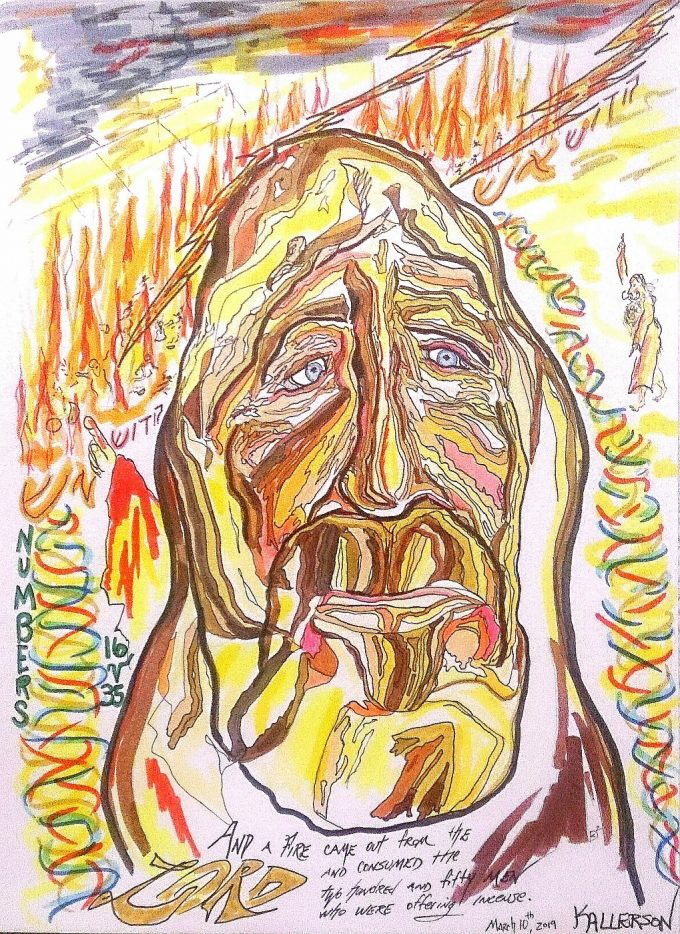
*35 And a fire came out from the Lord and consumed the two hundred and fifty men who were offering incense.
The power of the Lord is not constrained to one event at a time. Rather, He opened the earth to swallow the rebels in the camp, and He sent forth fire to destroy the rebels at the sanctuary. In one there is the sending of a heavenly fire to destroy those who came against the priesthood, a mediatorial duty between earth and heaven. And, in the other, he opened the earth to swallow the rebels who stood against the Lord’s earthly ruler, swallowing them up alive. In each, there is a just punishment from the Judge of all mankind, proportionate to the offense brought against Him.
And at the same time, there was mercy on those who were merely led astray by the offenders. In this double judgment, and as I have said already, the actual fate of Korah is not mentioned. Only inferences which seem to support both judgments can be made from other parts of Scripture. And so, as I said a minute ago, it could be that the Lord left this uncertain for a reason.
The fate of Korah is the fate of both of the camps aligned with Korah. And that fate then comprises both fire and of being cast alive into condemnation simultaneously. There is only one place in Scripture where this is actually seen to occur. Towards the end of the book of Revelation, and at the end of the tribulation period, which is coming soon to a terrifying calamity on earth near you, we read this from Revelation 19 –
“Then the beast was captured, and with him the false prophet who worked signs in his presence, by which he deceived those who received the mark of the beast and those who worshiped his image. These two were cast alive into the lake of fire burning with brimstone. 21 And the rest were killed with the sword which proceeded from the mouth of Him who sat on the horse. And all the birds were filled with their flesh.” Revelation 19:20, 21
Korah stood against Moses and Aaron. Jesus is the fulfillment of both of their positions under the New Covenant. He is the Son over the house, and He is the High Priest mediating for His people. The beast and the false prophet will both come against Christ Jesus, and they will receive the just penalty for their offense when they are cast alive into the lake of fire. Those with them will be destroyed as well, and the Lord will usher in a glorious time on earth where such things will be but past memories.
For now, the fantastic details of today’s passage are not a story of fiction made up as a lesson to scare us into obedience. Rather, the events are said to actually have occurred, and then the fact that they did are repeated, even during the life of Moses to the generation who would enter Canaan. If the story wasn’t true, that generation would have known it to be false and would have spoken against it.
The reliability of the word is seen in its internal confirmations, and it is seen in innumerable extra-biblical confirmations as well. Of all of the events of Scripture though, the surest of them all is that of the life, death, and resurrection of Jesus Christ. He is testified to in so many ways within the Bible, both before and after His coming, that from a Scriptural standpoint, no other option than the story of Him being true is possible.
He is further testified to extra-biblically as well, sometimes by hostile witnesses. Such testimony then is all the more reliable, because nobody would testify negatively about someone that wasn’t actually real. And so, as stories such as today’s point us to the Person and work of Jesus Christ, it is incumbent upon us to respond to the call to receive Him. This is what I would implore you to do today. Don’t let the day go by without making the decision to follow Christ. The Bible does not promise us tomorrow. Instead, the word is given –
“‘In an acceptable time I have heard you,
And in the day of salvation I have helped you.’
Behold, now is the accepted time; behold, now is the day of salvation.” 2 Corinthians 6:2
Closing Verse: “When they envied Moses in the camp,
And Aaron the saint of the Lord,
17 The earth opened up and swallowed Dathan,
And covered the faction of Abiram.
18 A fire was kindled in their company;
The flame burned up the wicked.” Psalm 106:16-18
Next Week: Numbers 16:36-50 There is only One; just one I say again… (The Mediator Between God and Men) (32nd Numbers Sermon)
The Lord has you exactly where He wants you. He has a good plan and purpose for you. It may seem at times as if you are lost in a desert, wandering aimlessly. But the Lord is there, carefully leading you to the Land of Promise. So follow Him and trust Him and He will do marvelous things for you and through you.
Korah Meets His Maker
And Moses said to Korah
“Tomorrow, you and all your company
Be present before the Lord—
You and they, as well as Aaron… then we shall see
Let each take his censer and put incense in it
And each of you bring his censer before the Lord
Two hundred and fifty censers
Both you and Aaron, each with his censer, according to this word
So every man took his censer, put fire in it
Laid incense on it, and stood at the door
Of the tabernacle of meeting with Moses and Aaron
To see what would be the score
And Korah gathered all the congregation
Against them at the door, of the tabernacle of meeting
Then the glory of the Lord appeared to all the congregation
Expecting a warm and gracious greeting
And the Lord spoke to Moses and Aaron, saying
“Separate yourselves from among this congregation
That I may consume them in a moment
Yes! This entire disobedient nation
Then they fell on their faces, and said
“O God, the God of the spirits of all flesh, including this nation
Shall one man sin
And You be angry with all the congregation?”
So the Lord spoke to Moses, saying
“Speak to the congregation, saying
‘Get away from the tents of Korah, Dathan, and Abiram
Ominous words He was then relaying
Then Moses rose and went to Dathan and Abiram
And the elders of Israel followed him, there and then
And he spoke to the congregation, saying
“Depart now from the tents of these wicked men!
Touch nothing of theirs, surely to you I say
Lest you be consumed in all their sins this very day
So they got away from around the tents
Of Korah, Dathan, and Abiram; these wicked men
And Dathan and Abiram came out and stood
———-at the door of their tents
With their wives, their sons, and their little children
And Moses said: “By this you shall know
That the Lord has sent me to do all these works
For I have not done them of my own will
You’re acting like spoiled little… next rhyme please
If these men die naturally like all men
Or if they are visited by all men’s common fate
Then the Lord has not sent me
Then the record will be made straight
But if the Lord creates a new thing
And the earth opens its mouth and swallows them up
———-with all that belongs to them according to this word
And they go down alive into the pit
Then you will understand that these men have rejected the Lord
Now it came to pass, as he finished speaking
All these words, that the ground split apart under them
———-time to bid these folks adieu
And the earth opened its mouth and swallowed them up
With their households and all the men with Korah
———-with all their goods too
So they and all those with them
Went down alive into the pit; screaming in anguish certainly
The earth closed over them
And they perished from among the assembly
Then all Israel who were around them
Fled at their cry
For they said
“Lest the earth swallow us up also! Lest we also die!”
And a fire came out from the Lord, for a little more recompense
And consumed the two hundred and fifty men
———-who were offering incense
Lord God, we are even now in a wilderness
And we are wanting to be led by You
Without You to direct, our lives would be a mess
And so be our guide, O God; You who are faithful and true
We long for the water in this barren land
May it flow forth from the Rock, our souls to satisfy
Give us this refreshing, spiritual hand
And may we take it, and to our lives daily it apply
And we shall be content and satisfied in You alone
We will follow You as we sing our songs of praise
Hallelujah to You; to us Your path You have shown
Hallelujah we shall sing to you for all of our days
Hallelujah and Amen…