Numbers 19:11-22
The Water of Purification
When considered, as we will do today, the verses here are highly confusing and hard to grasp. And so, to start us out, I’ll give an example for us to think about. It is somewhat analogous to what we will look at.
Suppose we have to give someone a bath. He is really dirty, and he also can’t bathe himself. Let’s even suppose he is so dirty that if we don’t wash him, he will die. Something on him really has to go. And so we get some soap, we fill a tub, we put him in, and rubadubdub. Are you with me so far?
Now, the bath is complete. What is clean? You just cleaned the person, so he must be clean? Right? What about the soap you used. Is that still clean? It was clean when you started, but not now? Would you separate it from the water and use it again? How about the water, is that clean? Would you use that again? Maybe for tea at noon? Why did you pull the plug? All that water down the drain. And that was a brand new tub and drain – never used before, but now they aren’t clean anymore, are they?
What about you, are you clean? I mean, you just washed a person that was so dirty he would die if you didn’t wash him. Now, you’ve given him a bath. Would you go have a meal before washing your hands again? Why not? Aren’t they clean?
And is he really clean? Whatever you have on your hands is still on him, isn’t it? Is his skin impervious to whatever you have on your hands that you need to go wash off? And what about the tub? What is that ring that’s visible there on the tub?
Text Verse: And so it is written, “The first man Adam became a living being.”The last Adam became a life-giving spirit. 46 However, the spiritual is not first, but the natural, and afterward the spiritual. 47 The first man was of the earth, made of dust; the second Man is the Lord from heaven. 48 As was the man of dust, so also are those who are made of dust; and as is the heavenly Man, so also are those who are heavenly. 49 And as we have borne the image of the man of dust, we shall also bear the image of the heavenly Man.” 1 Corinthians 15:45-49
Christ bore the image of Adam, but he wasn’t in Adam as we are. However, under the law, He was considered a man. What does that have to do with taking a bath? Well, how is it that someone is so dirty that he must have a bath, he is then given the bath to make him clean, and yet afterward when he is considered “clean,” everything – including him – is actually still kind of unclean.
This is not a perfect analogy, but it conveys the point that needs to be conveyed for the passage. There is defilement, the defilement is removed, and yet there remains a state of uncleanness not only in the one who was cleansed, but in the person who did the cleansing, and in everything associated with that cleansing.
I bet $50.00 that nobody here would go to that drain which was used only one time, take it apart, and use it for a straw to prove that I was wrong. In this passage, everything in the process of cleansing brings about its own stain. And yet, in the evening, meaning at the beginning of a new day, everything is declared “clean.”
Confused? Hold on to your seats and bear with my occasional stutters and other linguistic foibles and we will find out that it all has to do with the Person and work of Jesus Christ. Certainly, great things are to be found in His superior word. And so let’s turn to that precious word once again and… May God speak to us through His word today and may His glorious name ever be praised.
I. The Law of Death (verses 11-16)
11 ‘He who touches the dead body of anyone shall be unclean seven days.
The first ten verses of the chapter dealt with the obtaining of, and preparation of, the red heifer to be used for cleansing. Now, the specific details concerning what to do with the ashes of the red heifer are given in regards to purification of the people. As can be seen, the details concern defilement through death.
Death is the result of sin in one’s life. Contact with the dead then brings one into contact with the final result of sin, and thus it makes him unclean. There must be purification from this in order to be restored to a right relationship with God. Without it, the person remains defiled, and must be separated from the people of God, among whom is the sanctuary of God.
As the sanctuary is symbolic of the place of restored access to paradise and fellowship with God, we can then see that death – which results from sin – is something that will keep us separated from God. What is implicit here, because these things point to Christ’s purification, is that any person who dies apart from Christ is separated eternally from God. Sin is the problem, death is the result, and separation is the consequence. But Jesus is the cure.
Keeping this in mind, we are told in this verse that one who touches the dead body of anyone else, is deemed unclean for seven days. The Hebrew says, b’met l’kal nephesh adam – “the dead of all body adam,” signifying “man.” What is important to grasp is that there is no distinction made between a man or a woman, an adult or a stillborn baby. The corruption exists in all, and it thus – once again – reveals the biblical truth of “inherited sin.”
Sin comes through man, and all are born of man. The human is conceived, and the sin is transferred in that conception. David wrote of that in the 51st Psalm, certainly understanding the truth from this very passage. Christ came to correct that state of corruption. Right here, one can look forward to the words of 1 Corinthians 15:42, “So also is the resurrection of the dead. The body is sown in corruption, it is raised in incorruption.” Like our text verse, these words deal with humanity in its corrupt state, and what Christ would come to do about it. The adam in us – meaning the man Adam, our humanity, is corrupt. Death is the result of that. But the cleansing power of Christ, as prefigured in the red heifer described in the last Numbers sermon, is given to correct that.
In Leviticus 11:24, and elsewhere, touching the carcass of an unclean animal only made a person unclean until evening. Here, however, touching a dead human brought about uncleanness for seven days. Thus, he is wholly unclean. Seven signifying “spiritual perfection,” indicates this to us.
To not be cleansed during this period would then indicate being perfectly defiled. In comparing a human corpse to that of even a vile, unclean animal, shows our utter corruption because of sin, and the vile nature of that before God. The wages of sin is death. One must get that corrected, or he is to be cut off, as will be seen…
12 He shall purify himself with the water on the third day and on the seventh day; then he will be clean. But if he does not purify himself on the third day and on the seventh day, he will not be clean.
This is how the Greek and the Latin Vulgate translates it, and it is also how verse 19 states it. However…
He shall purify himself with it on the third day, and on the seventh day he shall be clean; but if he purify not himself the third day, then the seventh day he shall not be clean. (Darby)
This is how many translations state it. And so there is either one sprinkling on the third day which leads to cleansing on the seventh, or there are two sprinklings – on the third and seventh – which then fully cleanse. As the process is typical of Christ’s work, the correct answer must be found in an evaluation of that.
What becomes obvious here, either way, is that because the red heifer anticipates the purification found in Christ, the law could neither conquer death, nor purify from it. These are external rituals only, and they have no true power to cleanse. Were it so, one sprinkling would suffice for all time. Rather, as Hebrews says it –
“For the law, having a shadow of the good things to come, and not the very image of the things, can never with these same sacrifices, which they offer continually year by year, make those who approach perfect. 2 For then would they not have ceased to be offered? For the worshipers, once purified, would have had no more consciousness of sins. 3 But in those sacrifices there is a reminder of sins every year. 4 For it is not possible that the blood of bulls and goats could take away sins.” Hebrews 10:1-4
Every time that death occurred, the people who touched that death became unclean. It was a constant reminder to them of the failure of the law to bring them to a state of holiness acceptable to God. Thus, the veil in the temple remained until Christ came to tear it open and restore us to God, purifying us from every trace of sin. This is seen in the next words…
13 Whoever touches the body of anyone who has died, and does not purify himself, defiles the tabernacle of the Lord.
Here, an article is placed before the word adam. It says b’nephesh ha’adam asher yamut, or “the body of the man which has died.” This is an obvious reference to “the Adam,” meaning “the man” who died in Genesis 3. Again, it looks to the transfer of original sin from Adam to all men. It is what Paul writes of in Romans 5 –
“Therefore, just as through one man sin entered the world, and death through sin, and thus death spread to all men, because all sinned.” Romans 5:12
As all are in Adam, all have touched the body of the man who has died. What man now needs is the touch of the Man who did not come through Adam’s transfer of sin, and in whom is life.
Here, it is specifically said that the reason for the purification is because, to not be so purified, it then defiles mishkan Yehovah, or the “tabernacle of the Lord.” The tabernacle of the Lord was seen to have pictured, in every single detail, the Person and work of the Lord. It is He who that edifice anticipated. In Revelation 21, the mishkan elohim, or tabernacle of God, is said to be among men –
“Behold, the tabernacle of God is with men, and He will dwell with them, and they shall be His people. God Himself will be with them and be their God.” Revelation 21:3
It is Christ who provides the purification necessary to return to the presence of God. Without His purification, the tabernacle of the Lord is defiled by the presence of one who is unclean. Such cannot be in a restored paradise, and thus…
13 (con’t) That person shall be cut off from Israel.
A person purified is acceptable and does not defile the tabernacle of the Lord. This state of uncleanness, however, for one who fails to be cleansed excludes that person from the rights and privileges of Israel. That is then seen in Revelation 21:7, 8 –
“He who overcomes shall inherit all things, and I will be his God and he shall be My son. 8 But the cowardly, unbelieving, abominable, murderers, sexually immoral, sorcerers, idolaters, and all liars shall have their part in the lake which burns with fire and brimstone, which is the second death.”
13 (con’t) He shall be unclean, because the water of purification was not sprinkled on him; his uncleanness is still on him.
There are only two states of man before God – unclean or clean. There is only one way to go from the first to the second, which is through the cleansing of Christ. That is it. Without this me niddah, or water of purification, which looks to the cleansing of Christ, the defilement of the death of Adam, meaning sin, remains. The word used here is not the normal word for sprinkling that is used four other times in this passage. Rather, the word is zaraq, a scattering. It is the scattering which is caused by a sprinkling. Further, the word is passive, not active. If translated more literally, it would say something like “…because the water of purification was not received as a scattering on him.”
In this, it then looks directly to man’s responsibility to receive what Christ has done. Christ does the work, but it is received by us. Christ does the purification; we receive what He does. It is His work alone which accomplished the cleansing.
As it is passive, this doesn’t mean we don’t call on Christ. The man had to walk up to the one who would sprinkle. However, he stood there and received the sprinkling. We come to Christ, but we do nothing in the purification process. Rather, we receive what He did.
14 ‘This is the law when a man dies in a tent: All who come into the tent and all who are in the tent shall be unclean seven days;
This settles the matter concerning when the instructions were received. It says b’ohel, or “in a tent.” A later writer would have certainly said b’beit, or “in a house.” However, the Israelites are now in tents in the wilderness. What is certain is that this would transfer to a house in the future.
Anyone who was in a tent, or entered a tent, where there was a dead body would be unclean for seven days. As touching a corpse has already been defined, this means that simply being in the tent, even without having touched the corpse, rendered a person unclean. Simply being in the presence of a corpse in an enclosed area brought defilement. Further…
15 and every open vessel, which has no cover fastened on it, is unclean.
In this verse, there are actually two nouns, bracelet and cord. Most translations call the bracelet a cover, and then “cord” is used as a verb, such as “no cover fastened on it.” That is more of a paraphrase. The two are probably used in apposition, one identifying the other.
In this, it then would say, “and every open vessel, which has no covering, a cord on it, is unclean.” The idea is that of being sealed off from the very smell of death which would transmit to the inside of the container. In this is seen the reason for the question to the priests in Haggai 2 –
“Thus says the Lord of hosts: ‘Now, ask the priests concerning the law, saying, 12 “If one carries holy meat in the fold of his garment, and with the edge he touches bread or stew, wine or oil, or any food, will it become holy?”’”
Then the priests answered and said, “No.”
13 And Haggai said, “If one who is unclean because of a dead body touches any of these, will it be unclean?”
So the priests answered and said, “It shall be unclean.”
14 Then Haggai answered and said, “‘So is this people, and so is this nation before Me,’ says the Lord, ‘and so is every work of their hands; and what they offer there is unclean.” Haggai 2:11-14
Holiness does not transfer to the common, making it holy. But the uncleanness of death does transfer to anything else, even that which is holy. If the contents of the vessel were exposed, the defilement transferred.
16 Whoever in the open field touches one who is slain by a sword or who has died,
The touching of a corpse is not limited to someone who dies naturally, meaning they died of something which corrupted them and finally took their life – be it age, disease, and so on. Nor was it limited to enclosed areas. Instead, it extended to anyone dead in an open field, and who was even killed in battle or died naturally. The effects remained the same. Of this, the Pulpit Commentary says –
“This would apply especially, it would seem, to the field of battle; but the law must certainly have been relaxed in the case of soldiers.”
In other words, they are stating that the cleanup crew in a battle would be defiled when gathering and burying the dead, but the soldiers who did the killing, were probably exempt. Is this correct? We don’t even need to leave the book of Numbers to find out –
“And as for you, remain outside the camp seven days; whoever has killed any person, and whoever has touched any slain, purify yourselves and your captives on the third day and on the seventh day. 20 Purify every garment, everything made of leather, everything woven of goats’ hair, and everything made of wood.” Numbers 31:19, 20
The act of killing another, even while the life is leaving the body, brought about defilement. Death, in all its associated forms, and including during battle, brings about uncleanness. Also…
16 (con’t) or a bone of a man,
A dead man’s bone itself brought about defilement. This is alluded to in Ezekiel 39, after a whopping battle which is coming soon to a world near you –
“They will set apart men regularly employed, with the help of a search party, to pass through the land and bury those bodies remaining on the ground, in order to cleanse it. At the end of seven months they will make a search. 15 The search party will pass through the land; and when anyone sees a man’s bone, he shall set up a marker by it, till the buriers have buried it in the Valley of Hamon Gog. 16 The name of the city will also be Hamonah. Thus they shall cleanse the land.”’ Ezekiel 39:14-16
But it must be remembered that bones eventually degrade, just as the rest of the body, even to the dust itself. Therefore, if thought through logically, the very dust of the earth which is picked up by the wind and blows about man must carry defilement. One could truly never know when they had come into contact with such a source of defilement, and thus the state of being unclean permeated everything about the people. If this is the standard, and it is, then a state of total uncleanliness exists in man. Apart from Christ, there is nowhere we can go to be truly free from it.
16 (con’t) or a grave,
There are marked graves, and there are unmarked graves. The law makes no distinction between the two. To tread on the grave of a man brought defilement. One could never know when they were actually in violation of this. And it is exactly this that Jesus was referring to in words found in Matthew and Luke –
“Woe to you, scribes and Pharisees, hypocrites! For you are like whitewashed tombs which indeed appear beautiful outwardly, but inside are full of dead men’s bones and all uncleanness. 28 Even so you also outwardly appear righteous to men, but inside you are full of hypocrisy and lawlessness.” Matthew 23:27, 28
“Woe to you, scribes and Pharisees, hypocrites! For you are like graves which are not seen, and the men who walk over them are not aware of them.” Luke 11:44
The Pharisees looked to their own righteousness, and as examples to others of the way to obtaining righteousness. And yet, Jesus told them that they were both defiled, and the source of defilement. It was to be considered the highest insult of all to these self-righteous, arrogant men who shunned God and boasted in self. Unfortunately, because of this, they were in a perpetual state of defilement. However, for the law, such transgressions meant they…
16 (con’t) shall be unclean seven days.
Whether one was aware of his state because of defilement or not, he was defiled, but for those who knew they were, they were to be in a state of separation, and considered defiled, for seven days.
The first man Adam became a living being
He was made alive by God on that day
The last Adam became a life-giving spirit, from death He is freeing
In Him is life, and the path to lead our way
However, the spiritual is not first, as we know
But the natural, and afterward the spiritual, so we understand
The first man was of the earth, out of dust He was made to grow
The second Man is the Lord from heaven, He is God’s right hand
As was the man of dust, so also are those who are made of dust
And as is the heavenly Man, so also are those who are heavenly
And as we have borne the image of the man of dust, so we trust
That we shall also bear the image of the heavenly Man, so shall it be
II. The Water of Purification (verses 17-22)
17 ‘And for an unclean person they shall take some of the ashes of the heifer burnt for purification from sin,
When a person was defiled through death in any of these ways, set procedures were to be followed by first getting some of the ashes. Here the word “heifer” is inserted. The Hebrew says, seraphat ha’khatath, or “of the burning of the sin.” As in other areas, the word “sin,” is used to describe its purpose.
We do this when we say that we skin an animal. We don’t add skin, we remove it. The same is true here. The ashes of the burning of the sin means, “The ashes of that which was burned for purification from sin.” As long as one keeps thinking about Jesus, and how He fits into the terminology, the words are understandable, and the pictures become obvious. This is true with the next words…
17 (con’t) and running water shall be put on them in a vessel.
mayim khayim – “waters living,” or as we would say it, “living water.” As we saw last week, the ashes of the burning pictured Christ in every way. It was He who gave His life for us, but His death is not the end of the story. In Him is found the true living water which He spoke of in John 4 with the Samaritan woman at the well. And it is He, who in an obvious reference to this passage, said this to Israel –
“On the last day, that great day of the feast, Jesus stood and cried out, saying, “If anyone thirsts, let him come to Me and drink. 38 He who believes in Me, as the Scripture has said, out of his heart will flow rivers of living water.” 39 But this He spoke concerning the Spirit, whom those believing in Him would receive; for the Holy Spirit was not yet given, because Jesus was not yet glorified.” John 7:37-39
He reached back to the Old Testament symbolism in order to show us truths about Himself, and what He would do for those who came to Him. Christ had to die for our sins, be glorified through the resurrection and ascension, and then the living water has its effect. One can only drink from Christ if he is purified by Christ. In Him is found the true Living Water. What pictures that continues to be seen in the next verse…
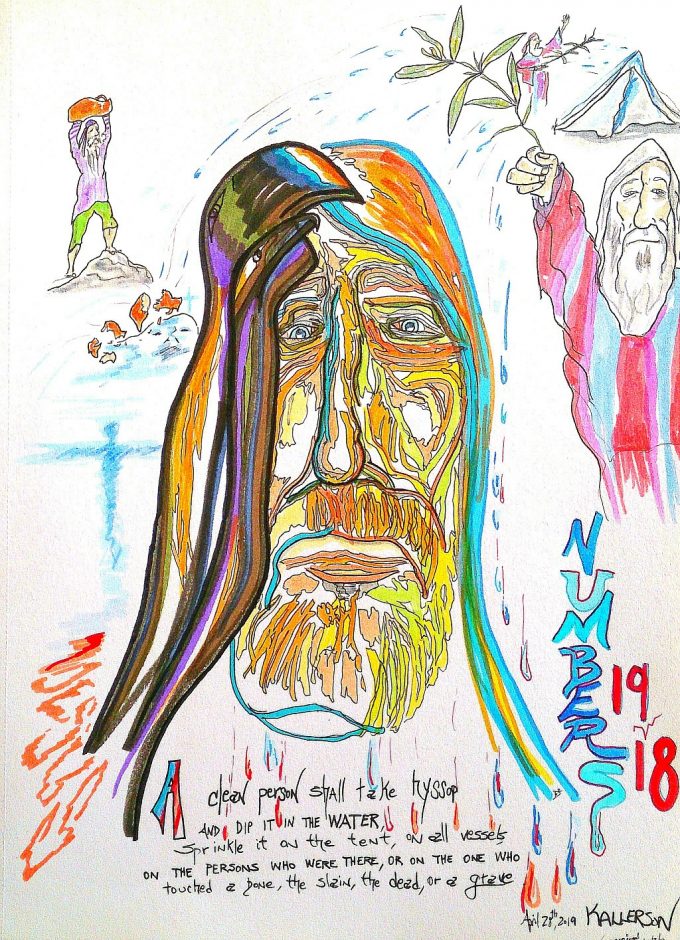
18 A clean person shall take hyssop and dip it in the water, sprinkle it on the tent, on all the vessels, on the persons who were there, or on the one who touched a bone, the slain, the dead, or a grave.
Here it notes “a clean person.” A priest is not specified, but someone who is clean. Though seemingly a priestly duty, the rite of purification could be accomplished by whoever was clean. As this is looking to the application of Living Water, meaning the Holy Spirit, mixed with the Person and work of Christ, it is a beautiful picture concerning the priestly duty of sharing of the gospel. It can actually be accomplished by anyone who is cleansed by Christ.
As in verse 6, hyssop is specified. It, in picture, looks to the humbled humanity of Christ. As quoted in the previous sermon –
“Let this mind be in you which was also in Christ Jesus, 6 who, being in the form of God, did not consider it robbery to be equal with God, 7 but made Himself of no reputation, taking the form of a bondservant, and coming in the likeness of men. 8 And being found in appearance as a man, He humbled Himself and became obedient to the point of death, even the death of the cross.” Philippines 2:5-8
That is the heart of the gospel message, and it is what is being pictured here. Only hyssop is allowed, because only hyssop fits the typology necessary to see the humility displayed in Christ, and to transmit Christ to the unclean soul. Thus, the hyssop, ashes, and living water, are united to form a complete picture of Christ’s work, death, resurrection, and the Spirit which proceeds from Him. It is sufficient to cleanse all things, just as the water of purification was used to cleanse all of what is again named in this verse, but previously described.
19 The clean person shall sprinkle the unclean on the third day and on the seventh day;
This verse clarifies the ambiguous Hebrew of verse 12. The person is to be sprinkled on both the third and the seventh day. As I said earlier, because the process is typical of Christ’s work, the reason for two sprinklings must be found in an evaluation of that.
For Israel, if the sprinkling actually cleansed, then one sprinkling would suffice. And if it actually cleansed on the second sprinkling, there would be no need for another ever again. But it only cleansed until again defiled. Thus, the law anticipated Christ, and the law is insufficient without the coming of Christ.
In Christ, we are cleansed from all sin and unrighteousness by His work. But if that cleansing took effect in actuality upon our acceptance of Him, we would be immediately glorified. But such is not the case. We remain here, and we are still in defiled, corruptible bodies. Therefore, the two sprinklings look to what is actual but not realized, and that which is actual and realized.
Right now, any who are in Christ are actually forgiven, justified, sanctified, and glorified in God’s sight. But until that is actual and realized, we are still awaiting the consummation of what we possess. Thus, one sprinkling is given as the assurance of cleansing, the second is given for realization of it. That is seen in the next words…
19 (con’t) and on the seventh day he shall purify himself, wash his clothes, and bathe in water; and at evening he shall be clean.
The question here is, “who is to wash his clothes and bathe in water?” The clean person who does the sprinkling becomes unclean in that act, as is seen in verse 21. And so it could be either person who is being spoken of. But probably it is the one being sprinkled because, unlike verse 21, it mentions both washing the clothes and bathing. Thus, we have an allusion to Hebrews 10:22 –
“…let us draw near with a true heart in full assurance of faith, having our hearts sprinkled from an evil conscience and our bodies washed with pure water.” Hebrews 10:22
There is the sprinkling, and there is the washing. A clean person sprinkles another with the gospel, and the person who hears it responds in receiving the gospel; acting upon it through faith. We are not to rigidly look at the third and seventh days as specific time frames, but rather as specific events.
If a person hears the gospel and responds to it just one minute prior to the rapture, he has everything here occur in that one minute. He is sprinkled for salvation, sprinkled unto salvation, and washed clean, all in a moment. The evening in the Bible is the start of a new day. In this, it is the eighth day, the day of “new beginnings.” In Christ, we shall enter the new Day, that of “new beginnings,” cleansed and purified in reality.
20 ‘But the man who is unclean and does not purify himself, that person shall be cut off from among the assembly,
The words of this verse are reflective of what is said in Revelation 22:11 – “…he who is filthy, let him be filthy still.” Purification with the water was mandatory in that one must do it to be in right standing within Israel and with God. But it was still a choice one voluntarily made.
The very fact that it says, “But the man who is unclean and does not purify himself,” signifies that free-will is involved. The people didn’t tackle him and force the purification on him. Instead, he willfully rejected what was offered. In this, he was to be cut off…
20 (con’t) because he has defiled the sanctuary of the Lord.
Here it says miqdash Yehovah – “the sanctuary of Yehovah.” The tabernacle noted in verse 13 resides within the sanctuary. In defiling the tabernacle, the entire sanctuary is, by extension, defiled by the presence of such a person. And this is because…
20 (con’t) The water of purification has not been sprinkled on him; he is unclean.
Again, as in verse 13, the verb is passive. It reads “The water of purification was not received as a scattering on him.” The individual was offered Christ, and he refused Christ. Christ’s purification was not imparted to him, and he remains unclean.
21 It shall be a perpetual statute for them.
l’khuqat olam – “for ordinance forever.” The word olam, or forever, signifies “to the vanishing point.” In this case, when the covenant is fulfilled in Christ, the shadows of these rituals are ended in Christ. The law has reached its vanishing point. However, the precept is forever as it is fulfilled in Christ. What the shadows prefigured is now realized in Him, forever. Included in this is…
21 (con’t) He who sprinkles the water of purification shall wash his clothes; and he who touches the water of purification shall be unclean until evening.
Here in this verse, we see that the person who was clean and who sprinkled the person who was unclean in order to cleanse him has garments which have been rendered unclean. And the person who touched the water of purification – certainly he who prepared it, and he who sprinkled it – was rendered unclean until evening, even though that same water was used to purify the person who was unclean. But there is yet more…
*22(fin) Whatever the unclean person touches shall be unclean; and the person who touches it shall be unclean until evening.’”
At this point, all involved with the process are unclean. The person who was clean and made the mixture became unclean by touching it while making it. The person who sprinkled the mixture must wash his clothes, implying he is unclean.
The person who had the water of purification sprinkled on him remains unclean until evening – both for his initial defilement and certainly because of the water of purification which makes everything it touches unclean.
As all are unclean, anything they touch becomes unclean. And then anyone who touches that which is unclean through their touch becomes unclean until evening.
Again, as in the first half of the passage, it needs to be asked, “How can something that cleanses make those who touch it unclean? And how can cleansing come out of that which renders those who touch it unclean, meaning that it must be unclean?”
Countless explanations have been put forth to answer this, but none goes far enough. What is it that purifies us? Christ. But how did that come about? Through His death. The entire passage is dealing with touching a dead body. If His body was dead, then according to the law, touching His body would defile.
But as He had no human father, sin did not transmit to Him. Thus He was sinless. The sin He bore, was for the people of the world. Every time that someone comes to Christ, it is through His death. That death defiles because sin was connected with it. But not His own sin. When we take the Lord’s Supper, we remember His death until He comes.
When I tell someone about Christ and he receives that, I, in essence, sprinkle that person with Christ. In that, I am participating in the death of Christ. Thus, I am ceremonially unclean because of the sin which is transferred to Christ because of my witness. The person also is purified, but he remains unclean in reality, until he is actually glorified in Christ.
It appears that Paul had this rite of purification on his mind when he wrote his words found in 2 Corinthians 4. There he wrote about the sufferings of the apostles for the sake of sharing the message of Christ, something that those who share the gospel continue with to this day. Think of the water of purification when I read this. He said they were –
“…always carrying about in the body the dying of the Lord Jesus, that the life of Jesus also may be manifested in our body. 11 For we who live are always delivered to death for Jesus’ sake, that the life of Jesus also may be manifested in our mortal flesh. 12 So then death is working in us, but life in you.” 2 Corinthians 4:10-12
We carry about in the body the dying of the Lord Jesus. Death brings uncleanliness, and yet, we (meaning believers) are already clean because of Christ. But we carry this body of death in order to continue to bring life to others. So even though we are alive, death is working in us, but it is working life in those who come to Christ.
The clean person who did the sprinkling must have thought, “I am making this guy clean, but I am making myself unclean in the process.” Unless you understood the whole picture, you would say, “What a jip!” But in understanding that what he is doing is necessary for the life of the other, then it doesn’t appear jippish at all.
It is Christ who cleanses from all unrighteousness, but uncleanness had to come from His dead body in order for that to come about. That is why there is no sprinkling with blood. That is accomplished in Christ’s death. It is the death and the body of death which is dealt with here. It is that which defiles. If you remember from the previous sermon, this is the only sacrifice which is burnt and which includes the fact that the blood is burnt with the body.
That is why the living water mixed with the death, meaning the ashes, is used. It furthers the picture. Christ didn’t die and stay dead, He rose to provide living waters, but that can only be appropriated through His death, even though His dead body brought defilement under the law.
One cannot get to the Living Water until he is first cleansed by the blood, even though the death associated with that blood defiles. And so that confusing, but infinitely important message must be shared. Are you willing to carry about in your body the dying of Jesus so that the life of Jesus may be manifest in you? That is the lesson of the red heifer and the sin water. Without Christ becoming sin we could not become the righteousness of God in Him. It is an amazing thing that God has done in Jesus Christ.
Closing Verse: “If then you were raised with Christ, seek those things which are above, where Christ is, sitting at the right hand of God. 2 Set your mind on things above, not on things on the earth. 3 For you died, and your life is hidden with Christ in God. 4 When Christ who is our life appears, then you also will appear with Him in glory.” Colossians 3:1-4
Next Week: Numbers 20:1-13 Waters will come out of the Rock – and all the people said ooh and ahh… (The Waters of Meribah) (38th Numbers Sermon)
The Lord has you exactly where He wants you. He has a good plan and purpose for you. It may seem at times as if you are lost in a desert, wandering aimlessly. But the Lord is there, carefully leading you to the Land of Promise. So follow Him and trust Him and He will do marvelous things for you and through you.
The Water of Purification
‘He who touches the dead body of anyone
Shall be unclean seven days, this is what I mean
He shall purify himself with the water on the third day
And on the seventh day; then he will be clean
But if he does not purify himself on the third day
And on the seventh day, he will not be clean, so to you I say
Whoever touches the body of anyone who has died
And does not purify himself, defiles the tabernacle of the Lord
That person shall be cut off from Israel
According to this word
He shall be unclean
Because the water of purification was not
Sprinkled on him
His uncleanness is still on him, like a defiling spot
‘This is the law when a man dies in a tent:
All who come into the tent, as the Lord relays
And all who are in the tent
Shall be unclean seven days
And every open vessel, so I mean
Which has no cover fastened on it, is unclean
Whoever in the open field touches
One who is slain by a sword
Or who has died, or a bone of a man, or a grave
Shall be unclean seven days according to this word
‘And for an unclean person
They shall take some of the ashes; the ashes like soot
Of the heifer burnt for purification from sin
And running water shall on them in a vessel be put
A clean person shall take hyssop and dip it in the water
Sprinkle it on the tent, on all the vessels too
On the persons who were there, or on the one who touched a bone
The slain, the dead, or a grave, so he shall do
The clean person shall sprinkle the unclean
On the third day and on the seventh day; so do I mean
And on the seventh day he shall purify himself
Wash his clothes, and bathe in water
———-and at evening he shall be clean
‘But the man who is unclean and does not purify himself
That person shall be cut off from, according to this word
Among the assembly
Because he has defiled the sanctuary of the Lord
The water of purification has not been sprinkled on him
He is unclean
It shall be a perpetual statute for them
This is what I mean
He who sprinkles the water of purification shall wash his clothes
And he who touches the water of purification
———-shall until evening be unclean
Whatever the unclean person touches shall be unclean
And the person who touches it shall be unclean until evening
———-at the sanctuary of the Lord, he shall not be seen
Lord God, we are even now in a wilderness
And we are wanting to be led by You
Without You to direct, our lives would be a mess
And so be our guide, O God; You who are faithful and true
We long for the water in this barren land
May it flow forth from the Rock, our souls to satisfy
Give us this refreshing, spiritual hand
And may we take it, and to our lives daily it apply
And we shall be content and satisfied in You alone
We will follow You as we sing our songs of praise
Hallelujah to You; to us Your path You have shown
Hallelujah we shall sing to you for all of our days
Hallelujah and Amen