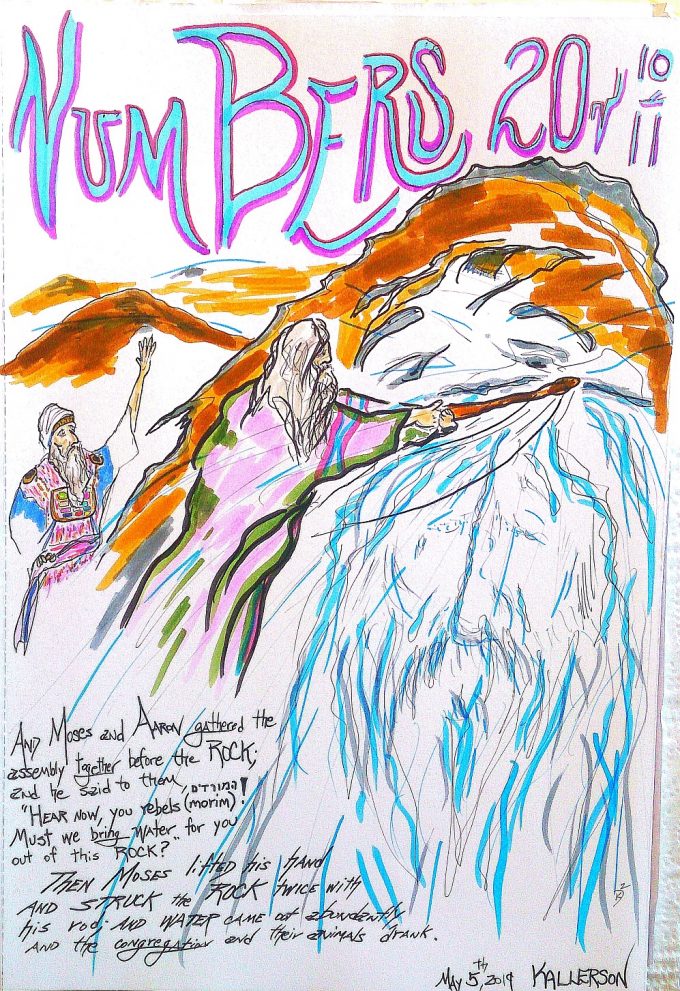
Numbers 20:1-13
The Waters of Meribah
Biblical theology is constantly argued over. There are countless doctrines which people cling to. Replacement theology says the church replaced Israel. Dispensationalism says this is incorrect and that Israel remains Israel, and the church is merely grafted into the commonwealth of Israel.
However, among dispensationalists, there are varying views as well. Hyper dispensationalism attempts to divide the church and Israel even further by saying that mysteries belong to the church, but prophecy belongs to Israel. As stupid as that sounds, people actually hold to that. They then go so far as to say that none of the letters to the churches in Revelation are for the church, baptism isn’t mandated for Gentiles within the church, and etc.
How can one tell if replacement theology is correct, or if dispensationalism is? How can a traditional dispensationalist tell if hyper-dispensationalism is wrong or not? I mean, it is the same set of verses from the New Testament which are being argued over.
Admittedly, most people that argue their personal view actually have no idea what the New Testament says. Rather, they have read a book (meaning a book on the subject), they listened to the sermon, or they simply trust the pastor who tells them what is correct. But they really don’t know the Bible all that well. And, surprisingly, many pastors don’t either.
They are like the people that watch CNN and think they are getting the straight scoop, and so they go with it. But let’s suppose two people are pretty well versed in the New Testament, and they still disagree on these basic doctrines. How can you tell which is correct? They both have decent sounding arguments.
Text Verse: “Moreover, brethren, I do not want you to be unaware that all our fathers were under the cloud, all passed through the sea, 2 all were baptized into Moses in the cloud and in the sea, 3 all ate the same spiritual food, 4 and all drank the same spiritual drink. For they drank of that spiritual Rock that followed them, and that Rock was Christ. 5 But with most of them God was not well pleased, for their bodies were scattered in the wilderness.” 1 Corinthians 10:1-4
Today’s passage deals with exactly what Paul is speaking about here. In fact, unless you read the Old Testament, you wouldn’t have any idea about what Paul is saying. You’d just nod your head and say, “OK.” You’d have to agree with his words without having all the information. Fortunately, Paul’s words are inspired by God, so we know what he says is correct.
The answer to the questions that I gave is… to study the Old Testament. If you disagree with someone on New Testament theology, guess what? The Old speaks of the things in the New in type and picture. But even then, one needs to be careful, or he may come up with an incorrect picture of what God is showing us.
One commentary I read on the parallel accounts of Exodus 17 and Numbers 20, both of which speak of water coming from the rock when it is struck by Moses, says that the two accounts picture Christ’s first and second advents. This is incorrect. Surprisingly, they took the information and made an incorrect assumption about what is presented in the New Testament.
And so, in order to understand proper theology in the Old, you need to be properly versed in the New. But to understand proper theology in the New, you need to be properly versed in the Old. Together, they form one seamless message about what God is doing in Christ Jesus and for the people of the world.
If someone runs ahead in one Testament or the other, error will result. This is as sure as the nose on your face. As far as replacement theology, that is incorrect. The church has not replaced Israel. Though not a heresy, it is really crummy doctrine. As far as hyper-dispensationalism, that is incorrect as well, and it is actually worse theology than replacement theology. It can border heresy. Or, depending on how it is taught, it actually spews out heresy.
Know the Old to understand the New. And know the New to grasp the Old. Anything else will lead you down very strange paths of poor doctrine. But, guess what! You can be on the sound path if you simply follow the truths as they are laid out in His superior word. And so let’s turn to that precious word once again and… May God speak to us through His word today and may His glorious name ever be praised.
I. No Water for the Congregation (verses 1-13)
Chapter 20 now introduces the fourth major section of the book of Numbers. Verses 1:1-10:10 were a wilderness section in Sinai. The next section was a road trip, a time of travel which went from 10:11 until 12:16. That went from Sinai to the next wilderness section which was in the area of Paran. That was from 13:1 until 19:22. Now comes another road trip which comprises 20:1 until 21:35. After this second road trip will be a final wilderness section in Moab which will go from verses 22:1 through 36:13. For now, the road trip commences with the words of verse 1 …
Then the children of Israel,
The Hebrew simply reads, “And the children of Israel.” Without careful study, there seems to be no sure way of determining where or when their last stop was, and so the word “and” should be translated exactly that way. But the point that is being focused on here is that of the collective group of people known as Israel. This is completely certain because of the next words…
1 (con’t) the whole congregation,
This is stated emphatically in the Hebrew, and it will be repeated in verse 22. It shows that the same group, in their entirety, who are condemned to endure a generation in the wilderness were together as one, from beginning to end. It resolves a rather difficult problem concerning the timing of events. For now, the entire congregation…
1 (con’t) came into the Wilderness of Zin
The Wilderness of Zin was named in Numbers 13:21. It said, “So they went up and spied out the land from the Wilderness of Zin as far as Rehob, near the entrance of Hamath.” At that time, it said Israel was camped in the Wilderness of Paran and the spies went from the Wilderness of Zin as far as Rehob. That makes it seem like the Wilderness of Paran and the Wilderness of Zin are different locations. Now, it says that the whole congregation has come to the Wilderness of Zin again, and a date is given…
1 (con’t) in the first month,
No year is given, and so scholars debate whether this is the first month of the 3rd year, or the first month of the 40th year. It could be the 3rd, because the last noted date was in Numbers 10:11&12 –
“Now it came to pass on the twentieth day of the second month, in the second year, that the cloud was taken up from above the tabernacle of the Testimony. 12 And the children of Israel set out from the Wilderness of Sinai on their journeys; then the cloud settled down in the Wilderness of Paran.”
However, one might think (as most scholars do) that it is the 40th year. Aaron’s death is recorded at the end of this chapter. That is said, in Numbers 33, to have occurred in the 40th year –
“Then Aaron the priest went up to Mount Hor at the command of the Lord, and died there in the fortieth year after the children of Israel had come out of the land of Egypt, on the first day of the fifth month.” Numbers 33:38
It is complicated, and it gets more so, because while Israel was in the Wilderness of Paran, and after disobeying the Lord, they were told in 14:25 to “turn and move out into the wilderness by the Way of the Red Sea.” It seems to indicate that they did not enter into the Wilderness of Zin. But, a complexity arises with the next words…
1 (con’t) and the people stayed in Kadesh;
The reason why this is complicated, is because Kadesh was said in verse 13:26 to be in the Wilderness of Paran. Here, it is said to be in the Wilderness of Zin. And so, there are either two places named Kadesh in two different wildernesses, or the two names, “the Wilderness of Paran,” and “the Wilderness of Zin,” are synonymous, but are being used by the Lord to fit the typology and pictures of Christ to come. Is your head hurting yet?
It should be noted that the Numbers accounts so far, and those to come, are not specifically chronological, but are placed according to a pattern in order to develop a theme. And it appears that all of the complexity found in this first verse centers on the next words…
1 (con’t) and Miriam died there and was buried there.
The question to be asked then is, “Did Miriam die at the beginning of the time of the wilderness wandering, or towards the end of it?” Nothing explicit is stated, but the account today answers the question. It is prior to the sentencing of punishment upon them. In this, she dies many long years before her brothers. What is apparently important is that of the deaths of Miriam and Aaron bracket the chapter now set before us, one is at the beginning of the chapter, the other is at the end…
2 Now there was no water for the congregation;
The name “Miriam” comes from two separate words – marar meaning “bitter” or “strong,” and yam which means “sea.” And so her name may mean “Bitter Waters,” or “Waters of Strength.” That, in itself, ties in with the account now presented, and is the reason for mentioning her death just prior to what is now stated.
Here, it is specifically noted that “there was no water for the congregation.” This then is an internal clue that the account is in the third, not the fortieth year. If this were in the fortieth year, it would be their second time in the area, and they would have known – in advance – that there was no water there. However, if this was the second stay, nothing was said of a lack of water in the first stay. Only if this is during the time of the spies would this make sense.
2 (con’t) so they gathered together against Moses and Aaron.
It is another internal clue concerning an early dating of the narrative. In Chapter 17:5, it said, “And it shall be that the rod of the man whom I choose will blossom; thus I will rid Myself of the complaints of the children of Israel, which they make against you.” However, the people are now gathering together against Moses and Aaron to contend with them.
Thus, it is the first generation who came out of Egypt, and who were faithful at being unfaithful. At this time, they have gathered together against their leader.
3 And the people contended with Moses and spoke,
Here the word is riv. It means to contend or strive with another. It is the same word used in Exodus 17 in the parallel account –
“Then all the congregation of the children of Israel set out on their journey from the Wilderness of Sin, according to the commandment of the Lord, and camped in Rephidim; but there was no water for the people to drink. 2 Therefore the people contended with Moses, and said, ‘Give us water, that we may drink.,” Exodus 17:1, 2
One can see that the two accounts are being tied together with the use of the particular words and concepts. Something is being instructed to us for our learning.
3 (con’t) saying: “If only we had died when our brethren died before the Lord!
Here are still more clues that this is at the beginning of the time of punishment and wilderness wanderings. Instead of saying, “our fathers,” it says, “our brothers.” After the many years of wandering, they would have spoken of the deaths of their parents.
Further, they use the word gava, or perish. It gives the sense of breathing one’s last. It was what the people were afraid of after the budding of Aaron’s rod, something that will actually occur later even though it has already been recorded, and it is the word used of Aaron’s death in verse 29 of this chapter.
Only the first generation would have spoken of the perishing of their brothers, meaning those who had perished at places like Taberah and Kibroth Hattaavah. The choice of wording here seems to exclude even Korah’s rebellion which had not happened yet in the chronology of events.
4 Why have you brought up the assembly of the Lord into this wilderness,
The same thought, again, continues with these words. Why would a generation of people who had been brought into the wilderness almost forty years earlier ask this? After refusing to enter Canaan, this is exactly what the Lord said would happen –
“And your sons shall be shepherds in the wilderness forty years, and bear the brunt of your infidelity, until your carcasses are consumed in the wilderness.” Numbers 14:33
After refusing to enter Canaan, the people were under punishment of death in the wilderness. Such a question makes no sense after the ending of those long years. This is especially so because if this is the end of the time in the wilderness, it would be their second trip to this same location and the surroundings would have been known to Moses and the people. The question is unnecessary for a group that had already been made aware of the geography. Further, in their question, there is a special focus on the animals…
4 (con’t) that we and our animals should die here?
Here the beir, or beasts, are noted. It is a rather rare word, being used just six times in the Bible, but three of them are in this passage – verses 4, 8, & 11. The word comes from ba’ar, meaning to burn away or consume. They are animals that consume the land as they go. The question of their grazing animals is similar to the same type of question in Exodus 17:3 where they are called miqneh, or “livestock.”
Paul noted, in our text verse from 1 Corinthians 10, that the rock followed them, meaning that from the time of this account on, the water was present with them. Only after the water came does he then say, “But with most of them God was not well pleased, for their bodies were scattered in the wilderness.”
The water came before, not after, the sentence, and the concern for the animals occurred at that time, not after. It is the exact same pattern revealed in the New Testament where Christ came, Israel was offered salvation through Him, but which also included the Gentiles, and then Israel received its punishment and exile. This is stated by the people explicitly in the next verse…
5 And why have you made us come up out of Egypt, to bring us to this evil place?
Here Egypt is mentioned. It is the place from which they have been redeemed. Egypt pictures a life of bondage to sin. The Lord redeemed them from that and brought them to Sinai. One thing is for sure, which is that they have already received the law.
Despite being redeemed, they are under the yoke of the law, which is its own bondage according to Paul as stated several times in Galatians, and it is noted elsewhere in the New Testament. Though they are freed from Egypt, the people complain that they have been brought to an evil place. They now describe what that means…
5 (con’t) It is not a place of grain or figs or vines or pomegranates;
There are five aspects of this place that are lacking. Five is the number of grace, and it is lacking. Further, each indicates this. The first is zera, or seed. Seed is where life generates from. Christ is noted as the Seed of the woman in Genesis 3:15. At this point, they are under law. The law doesn’t bring life, but death, as Paul says –
“I was alive once without the law, but when the commandment came, sin revived and I died.” Romans 7:9
The next is the te-enah, or fig. Its significance is one of a connection to God, or a disconnect from Him. They note that there is no fig, and thus no connection to God. Jesus gave a foreshadowing of this when He cursed the fig tree in Mark 11 –
“Now the next day, when they had come out from Bethany, He was hungry. 13 And seeing from afar a fig tree having leaves, He went to see if perhaps He would find something on it. When He came to it, He found nothing but leaves, for it was not the season for figs. 14 In response Jesus said to it, ‘Let no one eat fruit from you ever again.’” Mark 11:12-14
He was making a living parable of the cutting off of the spiritual connection to God through the ineffective temple worship. No fruit was borne through it, and it was to be terminated.
After this is the gephen, or vine. The vine signifies the Lord’s favor through the impartation of spiritual blessing. Israel is equated to a vine, but the vine became corrupt. They remained under the law and failed to produce. Jesus is called the true Vine in John 15:1. He is the true Source of spiritual blessing. He fulfilled the law and He produces abundance.
The fourth thing which is lacking is the rimmon, or pomegranate. It is associated with the word rum – “to be high,” or “exalted.” It carries the connotation of mental maturity and calling to remembrance. Paul says those under the law are under a tutor; they are not mature. On the contrary, he says in Galatians 3:25 that for those in Christ Jesus, “…after faith has come, we are no longer under a tutor.” Finally, the people exclaim…
5 (con’t) nor is there any water to drink.”
Water carries many meanings in the Bible, but the obvious connection here is to life. In this case, we have already seen that the Rock is Christ, and from the Rock issues water. Thus, water is life not under law, but life in Christ; the giving of the Spirit.
The people have been given law, but the law has brought them death, not life. It has not established a suitable connection to God. It has not produced spiritual blessing. It has not brought them to spiritual maturity. And it has not brought them the Spirit and life. It is Moses and Aaron who fill the positions as lawgiver and high priest under this covenant. Therefore, they go to seek the Lord…
6 So Moses and Aaron went from the presence of the assembly to the door of the tabernacle of meeting, and they fell on their faces.
It is important to note here that both Moses and Aaron left the assembly and went to the door of the tent of meeting. What will occur affects them both because both are types of Christ in regards to their positions under the law. The door of the tent of meeting means “at the brazen altar.” The altar and the door are united in one thought again and again in the books of Exodus, Leviticus, and Numbers. There, they fall on their faces. One can get the image of the law before the Lord at the place of sacrifice. It looks to the law being humbled as it was nailed to the cross, as Paul says in Colossians 2:14. In that picture, and at that spot it says…
6 (con’t) And the glory of the Lord appeared to them.
The glory of the Lord is revealed to the lawgiver and the high priest. What they are to be presented with, then, is to be seen as typical of something coming in the greater work of Messiah. His glory now is given to anticipate the glory which lies ahead. The people are not satisfied with life under the law. It has not given what they desire, nor what they need. Moses and Aaron are there to obtain what the people need.
7 Then the Lord spoke to Moses, saying,
The Lord speaks solely to the lawgiver. The high priest’s duties come from the introduction and giving forth of the law. At this time, the instructions are for Moses to…
8 “Take the rod;
This is not Aaron’s rod which budded. That actually happens later in the chronology of events. Rather it is the same rod used many times previously. It was called, “the rod of God” in Exodus 4:20. It was used before Pharaoh in Egypt in the performance of many miracles and wonders, including the parting of the Red Sea. It was also used to strike the rock in Exodus 17:6, and it was lifted during the battle with Amalek. It was clearly used as a picture of Christ in each of those passages.
8 (con’t) you and your brother Aaron gather the congregation together.
Unlike the account in Exodus 17, where only the elders were taken to see the rock struck by Moses, now the congregation is to be gathered together.
8 (con’t) Speak to the rock before their eyes,
The verb is plural, v’dibartem, “And speak you (plural).” Both Moses and Aaron are to speak to the rock.
8 (con’t) and it will yield its water;
By merely the spoken word of the lawgiver and the high priest, in the presence of the rod, the rock will yield its water. In typology – Lawgiver = Christ; High Priest = Christ; Rock = Christ; Rod = Christ; Water = Spirit of Christ. Everything is typologically given to prefigure Christ.
8 (con’t) thus you shall bring water for them out of the rock, and give drink to the congregation and their animals.”
In the account in Exodus 17, it said –
“Go on before the people, and take with you some of the elders of Israel. Also take in your hand your rod with which you struck the river, and go. 6 Behold, I will stand before you there on the rock in Horeb; and you shall strike the rock, and water will come out of it, that the people may drink.” Exodus 17:5, 6
There is a change in what is to be done. Moses is told to speak to ha’sela, or “the rock.” Moses doesn’t question which rock. He knows where to go and what should be done. The Rock is Christ. Of this, there is no doubt because Paul explains it as such in 1 Corinthians 10, our text verse in this sermon.
The Lord’s word goes otherwise unexplained as to the reason, but it is the word of the Lord, and thus it is to be obeyed. Both Moses and Aaron are expected to comply.
Some of the differences between the two accounts: 1) There, only the elders went; here, the congregation goes. 2) There, it says ha’tsur, “the rock;” here it says, ha’sela, “the rock.” tsur comes from a root meaning to confine, bind, or besiege; sela comes from an unused root meaning “lofty.” Why the difference? 3) The Lord said He would stand before Moses on the rock in Exodus; here, that is left unstated. 4) There, Moses struck the rock; here, Moses and Aaron are to speak to it. 5) There, the people may drink; here, the congregation and the animals will drink.
9 So Moses took the rod from before the Lord as He commanded him.
The rod is said to have been miliphne Yehovah, or “before the Lord.” Thus, it was kept in the Most Holy Place of the tabernacle. It is to be brought out for the bringing forth of the water, but only by its presence, not through its action.
10 And Moses and Aaron gathered the assembly together before the rock;
The assembly, implying any or all the people, are brought el pene ha’sala, or “to the face of the rock,” meaning “before the rock.”
10 (con’t) and he said to them, “Hear now, you rebels!
The object is a verb, not a noun. He says, shimu na ha’morim – “Hear, I pray, the rebelling.” Moses was not told to reproach the people for their rebellion, but rather he was to speak to the rock and it was to issue forth water for their thirst. What they needed, was to be supplied solely as grace from the Lord. However, Moses sees the people as being in a state of rebellion and that is to be corrected. But who will do that?
10 (con’t) Must we bring water for you out of this rock?”
The words are not what the Lord directed. Although it would be fine to speak out what will happen, Moses acts as if it is not of the Lord’s doing, but that of Moses and Aaron. It is a plural verb indicating that he and Aaron will bring the water out of the rock as if by their effort.
11 Then Moses lifted his hand and struck the rock twice with his rod;
This is in complete disobedience to the Lord. Nothing was said for them to strike the rock, and certainly not twice. But he did. Despite his disobedience, the grace to the people is imparted anyway…
11 (con’t) and water came out abundantly, and the congregation and their animals drank.
The water flowed forth, and it was sufficient for all. As in verse 8, the animals are, once again, noted as being provided the same water as the congregation.
12 Then the Lord spoke to Moses and Aaron,
Both are addressed. The lawgiver first, and the high priest who represents the sacrificial system of the law. They are combined into one judgment by the next words of the Lord…
12 (con’t) “Because you did not believe Me, to hallow Me in the eyes of the children of Israel, therefore you shall not bring this assembly into the land which I have given them.”
Here is another clue that the events precede the punishment levied upon the people to wander in the wilderness, and thus Miriam’s death – along with the entire account – is in the first month of the third year. In Numbers 14:30, the Lord said this to Moses –
“Except for Caleb the son of Jephunneh and Joshua the son of Nun, you shall by no means enter the land which I swore I would make you dwell in.”
It was already understood, at that time, that Moses and Aaron would also not enter Canaan. And so, it is certain that this account fits into the time frame that the twelve spies were gone to Canaan. And this is actually then seen in the otherwise incomprehensible words of Deuteronomy 1:34-40 –
“And the Lord heard the sound of your words, and was angry, and took an oath, saying, 35 ‘Surely not one of these men of this evil generation shall see that good land of which I swore to give to your fathers, 36 except Caleb the son of Jephunneh; he shall see it, and to him and his children I am giving the land on which he walked, because he wholly followed the Lord.’ 37 The Lord was also angry with me for your sakes, saying, ‘Even you shall not go in there. 38 Joshua the son of Nun, who stands before you, he shall go in there. Encourage him, for he shall cause Israel to inherit it.’”
39 ‘Moreover your little ones and your children, who you say will be victims, who today have no knowledge of good and evil, they shall go in there; to them I will give it, and they shall possess it. 40 But as for you, turn and take your journey into the wilderness by the Way of the Red Sea.”
Moses notes that his punishment came before or at the same time as the punishment of the people, and only after that does the Lord then go on to tell him to turn with the people away from Canaan and toward the Red Sea. Why is this important? It is because it then fits the typology of everything we previously saw in those sermons. Our verses today fit chronologically between Numbers 13:21 and 13:25.
In this account, Moses was told to speak to the rock, not strike it. To understand what occurred in Exodus 17, I’m sorry but you will have to go back and watch that sermon. But, in short, it pictured Christ being struck in His fulfillment of the law. It used the same word, nakah, or “strike,” there as was used of Christ in Isaiah 53 –
“Surely He has borne our griefs
And carried our sorrows;
Yet we esteemed Him stricken,
Smitten by God, and afflicted.” Isaiah 53:4
Moses was told now to speak to the rock because it was to not picture Christ’s sufferings leading to the giving of the Spirit, but the giving of the Spirit through the speaking of the word faith. This is seen in Paul’s words to the Galatians –
But that no one is justified by the law in the sight of God is evident, for “the just shall live by faith.” 12 Yet the law is not of faith, but “the man who does them shall live by them.”
13 Christ has redeemed us from the curse of the law, having become a curse for us (for it is written, “Cursed is everyone who hangs on a tree”), 14 that the blessing of Abraham might come upon the Gentiles in Christ Jesus, that we might receive the promise of the Spirit through faith. Galatians 4:11-14
Moses and Aaron, representing the law, are incapable of speaking the word of faith.
13 This was the water of Meribah, because the children of Israel contended with the Lord,
Again, as in verse 20:3, the word riv is used. It means to contend or strive. Thus, the place is named Meribah, meaning Quarreling or Place of Quarreling. As is commonly the case, the place is named because of the surrounding circumstances. The children of Israel quarreled and the Lord resolved the matter. In the process, He was hallowed among His people.
*13 (fin) and He was hallowed among them.
The verb here, and in the previous verse, qadash, is of the same root as that of the name Kadesh. Thus, the place also gets its name from the events which surrounded the circumstances. This then explains why the name of the place, Kadesh, was not used before the spies went out in Numbers 13, but it was used upon their return.
The events here occurred during the time the spies were in Canaan. However, the name was used, as we saw in that sermon, for a specific reason of showing us other hints of the future. In order to maintain the typology of various stories, the Lord introduces events at intervals which are not chronological, and yet which show us marvelous hints of redemptive history as they are placed into the sacred writings.
Where will we find water to drink to quench our thirst?
This is a parched and barren land
If only the waters through this Rock would burst
We could drink until filled; wouldn’t it be grand!
We know the waters are there, but what can we do?
We have given all of our effort, but not a drop have we obtained
But we believe the waters will burst through
And then from them true life we will have gained
What is the secret? How can we obtain a drink?
Who will open the Rock and bring it out for us?
Is it really so simple that faith is the link?
Just believe and receive from the Lord Jesus?
Surely He has done the work, and so He can the waters give
If we but trust in Him, by the Water of Life, surely we will live
II. Pictures of Christ
The account began in the Wilderness of Zin, meaning the thorn. It is a picture – as it has been before – of the cross of Christ. Miriam is said to have died at this time. In the Numbers 12 sermon, she was seen to represent the prophetic witness of Israel. That ended at the time of Christ. There is no longer a prophetic witness for the time of the Law of Moses.
Any future prophecy falls under the New Covenant. Here, she dies prior to the time of punishment upon Israel. Only after that, then will Israel be sentenced to perish in the wilderness, just as Israel was sentenced to perish among the nations, after rejecting Christ.
In this area, there is no water for the people. They have been brought out of the bondage of Egypt, but to an evil place. It is the time of the law which only highlights their sin. It cannot take it from them, except through a fulfillment of the law.
They noted five aspects of life that were lacking – seed, figs, vines, pomegranates, and water. As we saw, the lack of these pictured life under the law. It brought them death, not life. It did not establish a suitable connection to God. It did not produce spiritual blessing. It could not bring them to spiritual maturity. And it did not bring them the Spirit and life.
At this time, Moses and Aaron – the law and its sacrificial system – go before the Lord and fall on their faces and He appears to them in glory. It pictures the radiance of Christ before which the law is brought to its place of humility. They are told to take the rod.
The rod, which has not been mentioned since Exodus 17, is suddenly reintroduced for this parallel passage. It is said to have been miliphne Yehovah, or “before the Lord.” It is a picture of Christ, after completing His work, returning to His position of authority before God in heaven.
It is brought out in order to bring forth the Spirit, not through action, but through presence alone. It is a note of the deity of Christ; His omnipresence. Wherever the word of faith in Christ is spoken, the Spirit will issue forth, but not by deeds of the law. Rather by faith alone.
By merely the spoken word of the lawgiver and the high priest, in the presence of the rod, the rock is expected to yield its water. As we saw, Lawgiver = Christ; High Priest = Christ; Rock = Christ; Rod = Christ; Water = Spirit of Christ. Everything looks to prefigure Christ and the grace which comes from Him.
This is how it is. The giving of the New Covenant and the sacrificial work of the High Priest yields forth the Spirit. The Lord told Moses and Aaron – the lawgiver and high priest of the law – to speak to the rock and bring forth water. Both were to speak. As noted, these are some of the differences between Exodus 17 and here –
1) There, only the elders went; here, the congregation goes. The elders pictured the apostles who were witnesses of Christ’s work. Here, and because of their word, all can see the work of Christ.
2) There, it says ha’tsur, “the rock.” Here, it says, ha’sela, “the rock.” tsur comes from a root meaning to confine, bind, or besiege. sela comes from an unused root meaning “lofty.” In Exodus 17, it pictured Christ’s sufferings; here, it pictures Christ’s exaltation. In both, He is the Rock.
3) The Lord said He would stand before Moses on the rock in Exodus. Here, that is left unstated. There, the Lord stood before the law – in fulfillment of it. Here, the Lord is unseen. The water comes from an act of faith.
4) There Moses was to strike the rock; here Moses and Aaron are to speak to it. Christ was struck for our sins before the law. After that, Christ is received by the word of faith. The law has no part in the issuance of the Spirit, except as it was previously fulfilled in Christ.
5) There, the people may drink; here, the congregation and the animals will drink. How do you show that all are included in the spiritual blessings of Christ when it is simply a single nation of people in the wilderness? You use typology. The animals in the wilderness, though not Israel, shared in the commonwealth and blessings of Israel. It is a picture of Gentiles being given the same water of life as Israel –
“Therefore remember that you, once Gentiles in the flesh—who are called Uncircumcision by what is called the Circumcision made in the flesh by hands— 12 that at that time you were without Christ, being aliens from the commonwealth of Israel and strangers from the covenants of promise, having no hope and without God in the world. 13 But now in Christ Jesus you who once were far off have been brought near by the blood of Christ.” Ephesians 2:11-13
However, Moses and Aaron violated what the Lord spoke, they destroyed the symbolism, and they were consigned to die in the wilderness with the people. It is an obvious picture of the ending of the Law of Moses before the people are restored to God.
As we have seen from the chronology, Moses and Aaron are actually assigned their punishment before the congregation received theirs, not after. It points to the death of the law coming prior to the punishment and exile of Israel in AD70. This is exactly how the New Testament reveals the chronology.
However, Moses and Aaron live up until the fortieth year of wanderings. Likewise, Israel remains under the law until just prior to the end of their time of punishment. That is the purpose of the tribulation period and the last seven years of the law. Only those who live by faith, pictured by Joshua and Caleb, would enter into God’s promised rest.
Verse 12 said, “Because you did not believe Me, to hallow Me in the eyes of the children of Israel, therefore you shall not bring this assembly into the land which I have given them.” The law is not of faith, but of works. It is also incapable of bringing man to heaven. Only Christ Jesus can do that.
Under the law, there is only quarreling and strife. Until the waters of the Spirit come forth, there cannot be contentment. This is why Miriam’s death is so important to the account, and why it occurred now, prior to the coming of the water and the sentence of punishment upon the people.
Her life was used as symbolic of the prophetic witness to Israel. Her death ends that time of prophetic witness, just as John the Baptist was the last to prophesy before the coming of Christ. In his death, that prophesy of the law ended.
Further, her name – Bitter Waters, or Waters of Strength – is used in type to show what occurred both to those who remain under the law, and how they would fare after the giving of the Spirit.
As you can see, the teaching mentioned at the beginning of the sermon concerning the two accounts of the giving of the water from the rock in Exodus 17 and then again here – which said that it reflected Christ’s first and second advents – is entirely wrong. It doesn’t fit the typology. Rather, it is the same account revealed with two different truths – all occurring in His first advent.
The first account in Exodus 17 pictured Christ, under the law, struck for our sins in order for the Spirit to be given. This second account is Israel’s rejection of Christ and holding to the law instead. Thus, they struck Him twice through that act. In this, and for Israel, it can be said, “Three strikes and you are out.”
This is why it is important to go methodically, verse by verse, through the Old Testament. To simply make a conclusion based on such a passage alone, will inevitably result in a faulty conclusion, based on a presupposition of what the account supposedly tells us.
For now, this is the lesson of this marvelous passage of Scripture. The Lord is, as He does consistently, revealing to us pictures of the immensely glorious workings of God in Christ. Let us pay attention to the words, and let us respond by living by faith, and by faith alone, in what He has done for us through His Son, Our Lord Jesus.
Closing Verse: “He split the rocks in the wilderness,
And gave them drink in abundance like the depths.
16 He also brought streams out of the rock,
And caused waters to run down like rivers.” Psalm 78:15
Next Week: Numbers 20:14-29 Wandering under punishment must be a bummer, for shor… (From Kadesh to Mount Hor) (39th Numbers Sermon)
The Lord has you exactly where He wants you. He has a good plan and purpose for you. It may seem at times as if you are lost in a desert, wandering aimlessly. But the Lord is there, carefully leading you to the Land of Promise. So follow Him and trust Him and He will do marvelous things for you and through you.
The Waters of Meribah
Then the children of Israel, the whole congregation
Came into the Wilderness of Zin in the first month
———-as we are made aware
And the people stayed in Kadesh
And Miriam died there and was buried there
Now, there was no water for the congregation
So they gathered together against Moses and Aaron
———-as an angry horde
And the people contended with Moses and spoke, saying
“If only we had died when our brethren died before the Lord!”
Why have you brought up the assembly of the Lord
Into this wilderness
That we and our animals should die here?
This is a real pickle and a giant mess
And why have you made us come up out of Egypt
To bring us to this evil place?
It is not a place of grain or figs or vines or pomegranates
Nor is there any water to drink, not even a trace
So Moses and Aaron went from the presence
Of the assembly to the door of the tabernacle of meeting
And they fell on their faces
And the glory of the Lord appeared to them, such was the greeting
Then the Lord spoke to Moses, saying
These words to him He was then relaying
Take the rod; you and your brother Aaron
Gather the congregation together as well
Speak to the rock before their eyes
And it will yield its water, as to you I tell
Thus you shall bring water for them out of the rock
And give drink to the congregation and their animals
———-both the herd and the flock
So Moses took the rod from before the Lord
As He commanded him; according to His word
And Moses and Aaron gathered the assembly together
Before the rock; and he said to them in a stern talk
“Hear now, you rebels!
Must we bring water for you out of this rock?”
Then Moses lifted his hand
And struck the rock with his rod twice
And water came out abundantly
And the congregation and their animals drank
———-water, refreshing and nice
Then the Lord spoke to Moses and Aaron
“Because you did not believe Me, to hallow Me
In the eyes of the children of Israel
Therefore you shall not into the land which I have given them
———-bring this assembly
This was the water of Meribah
Because the children of Israel contended with the Lord
And He was hallowed among them
Among that disobedient horde
Lord God, we are even now in a wilderness
And we are wanting to be led by You
Without You to direct, our lives would be a mess
And so be our guide, O God; You who are faithful and true
We long for the water in this barren land
May it flow forth from the Rock, our souls to satisfy
Give us this refreshing, spiritual hand
And may we take it, and to our lives daily it apply
And we shall be content and satisfied in You alone
We will follow You as we sing our songs of praise
Hallelujah to You; to us Your path You have shown
Hallelujah we shall sing to you for all of our days
Hallelujah and Amen…