Numbers 20:14-29
From Kadesh to Mount Hor
Taking these Old Testament stories, and then combining them with truths found in the New Testament, one can see pattern after pattern jump off the Bible’s pages. Concerning Aaron and his office, this is no surer than when one reads the books of Romans and Hebrews. But hints of such things are found all through the epistles.
In Romans, Paul explains the doctrinal truths which tell us of the weakness of the law and of the strength of being in Christ. Hebrews tells of the weakness of those who administered the law, and the strength of Christ who administers the New Covenant.
In understanding the content of both books, one gets a full picture of the Person and work of Christ in relation to those who come to Him, and the difference between those who only looked to Him in type and shadow.
In the end, when those truths are understood, the completely ineffective, temporary, and futile system which is the Law of Moses comes shining forth. And remember, these books of the New Testament weren’t written by biased Gentiles who had some type of ax to grind against the Jews.
Rather, they were written by Jews who had lived under the law, grasped what God had done through Christ, and had moved wholeheartedly to cling to the One who had become the focal point of their lives and faith. In Paul’s case, there were very few in all of Israel who stood on a more sure footing under the law, and yet he realized how unsure that footing actually was.
Text Verse: “Also there were many priests, because they were prevented by death from continuing. 24 But He, because He continues forever, has an unchangeable priesthood. 25 Therefore He is also able to save to the uttermost those who come to God through Him, since He always lives to make intercession for them.” Hebrews 7:23-25
Whether Paul was the author of Hebrews or not, the author understood the fallible nature of the Aaronic priesthood, which administered the Law of Moses, simply by noting the deaths of the priests, particularly meaning the high priests.
The first of those deaths is recorded in our verses today. Aaron, from whom the line of the Aaronic priesthood is derived – a priesthood that lasted almost 1500 years – died and was buried. He could no longer make intercession for the people of Israel. Instead, one of his sons had to take his place. And then another son came, and another, and another.
They kept on dying, like dominoes in time, one dropping after the next. If you were looking for permanency under the law, you weren’t going to find it. And more, consider what the ultimate cause of their deaths was from.
If you can remember what that is, then you can figure out much more about the weak, ineffective, and sad state of affairs of that priesthood, and of the hopeless state of those who were ministered to under that priesthood. Only in the hope of Messiah was there any true hope at all. These truths are once again to be found in His superior word. And so let’s turn to that precious word once again and… May God speak to us through His word today and may His glorious name ever be praised.
I. Edom’s Refusal (verses 14-21)
The timing of the events of this account is hard to pin down. As we saw, the first thirteen verses of this chapter referred to the incident at Meribah which occurred before the time of punishment for not entering Canaan. The verses now come towards the end of their time of wandering in punishment.
Both Numbers 20:1 and Numbers 20:14 indicate that the events are in Kadesh, and so the entire time of punishment is overlooked in the narrative. They were in Kadesh at the beginning of their punishment, and they ended up in Kadesh as their punishment was ending. Other than that, it is hard to be dogmatic about timing. Especially because dogs don’t use calendars.
14 Now Moses sent messengers
The word for “messengers” here is malak. It is the same word translated as “angels,” including when speaking of the Angel of the Lord, and so on. It simply means an envoy, messenger, etc. Therefore, it can refer to divinely appointed messengers, or simply men who are designated as envoys. In this, Moses sent malakim…
14 (con’t) from Kadesh to the king of Edom.
Kadesh means, “Sacred,” or “Holy.” It received its name from the words of verses 12 & 13 of this chapter which occurred about 38 years earlier. That name continues on now at the close of this lengthy period. Edom means, “Red.” It is the name given to Esau who sold his birthright for a bowl of red soup. The events of this sending of messengers is referred to, many years later, by Jephthah in Judges 11:17 –
“Then Israel sent messengers to the king of Edom, saying, ‘Please let me pass through your land.’ But the king of Edom would not heed. And in like manner they sent to the king of Moab, but he would not consent. So Israel remained in Kadesh.”
Edom’s territory is to the south of the area of the Dead Sea, on the westward side of the sea. It extended southward to the Red Sea. It comprises the southern area of the land of Jordan today. The intent, then, is that Israel wants to pass along their territory, on their westernmost border, and to travel toward Canaan arriving and entering there from the east. Moses now makes this petition to melekh edom, or the king of Edom, based on their family ties…
14 (con’t) “Thus says your brother Israel:
Jacob, who is Israel, and Esau, who is Edom, are brothers. Though they had a great dispute when they were seventy-seven years old, and which brought about death threats from Esau towards his brother, they later reconciled and put aside their enmity. Both were present at the burial of their father Isaac. With their reconciliation, Moses appeals to this king, Esau’s descendant and representative of Edom, as his brother. He now calls their history to mind…
14 (con’t) ‘You know all the hardship that has befallen us,
Moses uses a rare word, telaah, or distress, to describe their situation. It was used once in Exodus 18 concerning their hardships while Moses spoke to Jethro. It will only be seen two more times, in Nehemiah and Lamentations. It comes from a word signifying weariness. The travails of Israel have been many, and they have worn them out. Moses next details those hardships…
15 how our fathers went down to Egypt,
This is referring to the move of Jacob and his family 254 years earlier, and which is recorded in Genesis 46.
15 (con’t) and we dwelt in Egypt a long time,
This comprises everything from Genesis 46 until the exodus of Israel in Exodus 12. Israel dwelt in Egypt for 215 years.
15 (con’t) and the Egyptians afflicted us and our fathers.
This was first described in Exodus 1 with the words –
“So the Egyptians made the children of Israel serve with rigor. 14 And they made their lives bitter with hard bondage—in mortar, in brick, and in all manner of service in the field. All their service in which they made them serve was with rigor.” Exodus 1:13, 14
That affliction continued on, but then there was relief…
16 When we cried out to the Lord,
That is recorded in Exodus 2 saying,
“So God heard their groaning, and God remembered His covenant with Abraham, with Isaac, and with Jacob. 25 And God looked upon the children of Israel, and God acknowledged them.” Exodus 2:24, 25
16 (con’t) He heard our voice and sent the Angel and brought us up out of Egypt;
It is the same word, malakh, used in verse 14 and translated as “messengers.” In this verse, it simply says “angel,” without the article. Edom would probably not be aware of the Lord as the Angel of the Lord, and so no article is used. However, here it is speaking of the Messenger of the Lord, the Angel of God, who was sent to deliver Israel. It speaks of the eternal Christ, Jesus.
The first mention of the Angel of the Lord that Moses is referring to was in Exodus 3:2 when He appeared to Moses in the burning bush. From there, He was mentioned in Exodus 14 when He, the Angel of God, went before Israel and then moved behind them, standing between them and the Egyptians. He continued to be mentioned in Exodus, but this is the first reference to Him in Numbers. The words of Moses are recounting the events for the king of Edom to consider…
16 (con’t) now here we are in Kadesh, a city on the edge of your border.
As I noted earlier, they were in Kadesh at the beginning of their time of punishment wanderings, and now they are there again, standing in anticipation of finally entering the land of promise. However, instead of going up through the south, as had been rejected 38 years earlier, they intend to go through the east. The shortest route to achieve this would be up the western border of Edom, and so he petitions now for that to be allowed…
17 Please let us pass through your country.
The wording of the verse is formal and dignified. He first notes that the land is the country belonging to the king. He is the ultimate authority, and so it is only by first obtaining his permission that they would consider passing through.
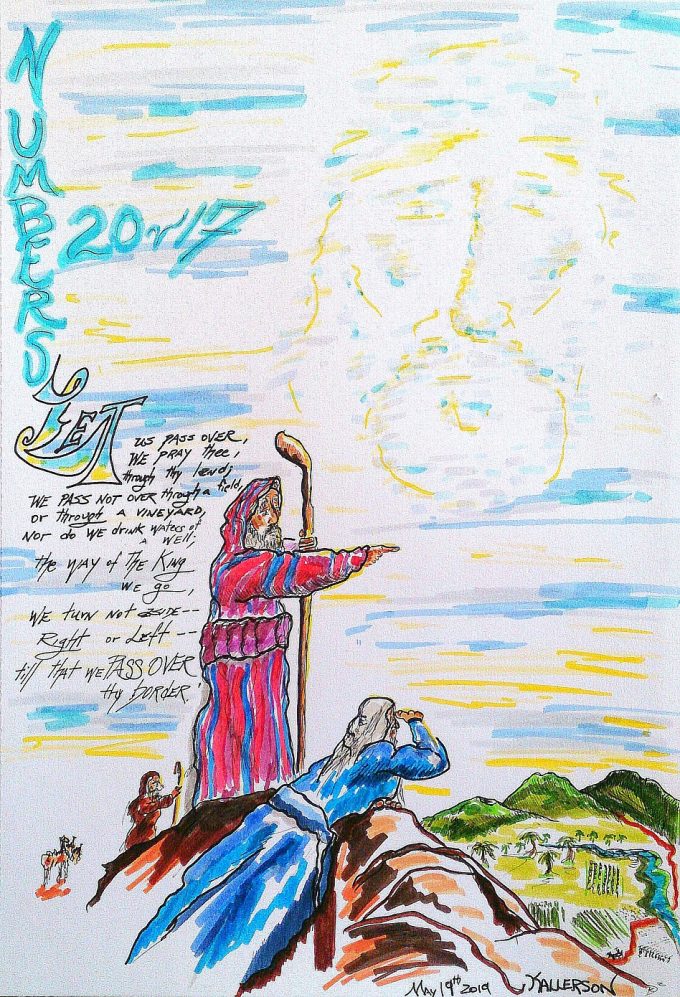
17 (con’t) We will not pass through fields or vineyards,
Though the king of Edom probably doesn’t know it, there is no need for Israel to wander out of their direct path. Fields and vineyards would be needed for such a large group, except… that they are Israel. They have manna to sustain them on the trek through Edom.
17 (con’t) nor will we drink water from wells;
Again, the king would not know it, but there would be no need for Israel to drink from the wells of the land. They are Israel, and they had the rock which followed them –
“For they drank of that spiritual Rock that followed them, and that Rock was Christ.” 1 Corinthians 10:4
17 (con’t) we will go along the King’s Highway; we will not turn aside to the right hand or to the left until we have passed through your territory.’”
The term derek ha’melekh, or “Way of the King,” is first used here. It would be a public road paid for at the cost of the king’s treasury, and would be kept in proper order at all times for the king and his army to set out on in times of either offensive or defensive battles. It would pass through the heart of the land, and so Moses says that they will not depart from this set path at any time, but would pass directly through the land on it.
However, the words must have seemed incredulous to Edom’s king. Would they carry enough food and water for several million people and their animals to trek from one end of his land to the other? He surely must have thought that the impossible nature of their claim meant that they planned more than a peaceful journey through Edom, and thus…
18 Then Edom said to him, “You shall not pass through my land, lest I come out against you with the sword.”
The refusal shows the doubting nature of the king. There is no reason to assume this is from the ancient enmity between the two. That was resolved before the brothers’ deaths. He is concerned about his land and his revenue. So much so that he promises a battle will ensue if they attempt to pass through.
Despite how things turn out here, it is obviously the plan of the Lord for Israel to have to take the longer route around. He knows the end from the beginning, and the benefits of land acquisition which lie ahead in the book of Numbers comes directly from the refusal which now occurs.
As we saw earlier, in Judges, Jephthah says that both Edom and Moab refused Israel passage through their land. It is obvious that emissaries were sent to both countries at the same time, because it would do no good to get through Edom, only to be refused further travel by Moab. However, there is no need to mention that now.
If Edom refuses, then Moab’s refusal is irrelevant to mention. Further, only mentioning Edom now is needed to set the typology for the pictures of redemptive history now being made. The Lord is directing the events now in order to establish the many patterns and types of Christ, and also to make the land acquisitions which lie ahead prior to, and at the time of, Israel’s entry into Canaan. We are looking back on what we know, but Israel is looking ahead on an unknown, therefore…
19 So the children of Israel said to him, “We will go by the Highway,
This now has to be a second petition to the king. Here is a new word in Scripture, mesillah, or “highway.” It comes from salal, meaning to mount up, lift, up, cast up, etc. Thus, it is a true highway. This explains, “the way of the king,” in verse 17.
19 (con’t) and if I or my livestock drink any of your water, then I will pay for it; let me only pass through on foot, nothing more.”
In this second appeal, it appears that they clued into the doubting nature of the king. How could a gathering of this immense size pass through the land without needing food or water? Surely, this must be a subterfuge, and the true intent is to catch Edom unaware.
They must have understood this now and they qualify this second appeal by stating that if any water is drunk by the people, they would be willing to pay for it. It further says, raq ayin daber b’raglay eeborah, “only (it is nothing) on my foot I will pass over.” They note that the matter is as inconsequential as allowing people to simply walk through without any chance of harm. But it is too late. The king is determined that they will not pass through the heart of the country with such a large contingent of people…
20 Then he said, “You shall not pass through.” So Edom came out against them with many men and with a strong hand.
Edom was so convinced of the state of things not being right with allowing Israel to pass, that the king mustered a large army and a great show of force as a warning that Israel was absolutely not to pass through their land.
What seems likely from the narrative is that Israel didn’t expect a negative reply and actually began its trek through Edom on the king’s highway before being told they could proceed no further through the mountains. This verse and the next are stated now to complete the narrative before entering into the next subject, that of the death of Aaron, but this verse and the next probably belong after verse 22 chronologically.
21 Thus Edom refused to give Israel passage through his territory; so Israel turned away from him.
With this statement, the issue of whether Israel can pass through Edom or not is complete. Instead of passing through the midst of Edom, Israel will skirt its borders as is relayed in Deuteronomy 2.
The span of your years has come to an end
And your time has now run out
Your death is quickly approaching, friend
And of that fact, there can be no doubt
When your years have ended, Another shall take your place
And in your demise, a new path will be revealed
Through your administration, none could see God’s face
Through you, the veil remained, and He was concealed
But Another is coming to make the way plain
And through Him there will be access forevermore
Where there was sadness and loss, there will now be joy and gain
When the new High Priest opens the Door
II. The Death of Aaron (verses 22-29)
22 Now the children of Israel, the whole congregation,
Here again we have the same emphatic statement that was made in verse 1, “the whole congregation.” That was first stated at the beginning of the wilderness wanderings when Miriam died. Now it is once again stated at the end of the wilderness wanderings. During the whole 38-year period, the entire congregation of Israel remained united. Despite being under condemnation, and a death sentence in the wilderness, they remained a united people.
The connection to modern Israel, and the continuing picture which is made, is not to be missed. The whole congregation went under an extended period of exile, even for the fullness of the time allotted for their punishment, and yet they have remained “the whole congregation.” Israel of today is the same group who began their punishment 2000 years ago.
22 (con’t) journeyed from Kadesh and came to Mount Hor.
The meaning of Hor is simply “Mountain.” Thus, Israel traveled from Kadesh to hor ha’ har, or “mount of the mountain.” The mountain, as recorded even to antiquity, is what is now known as Mount Harun (Mount Aaron), which is located close to Petra in Jordan. It is a double-peaked mountain with a tomb on it which is said to be where Aaron was buried.
23 And the Lord spoke to Moses and Aaron in Mount Hor by the border of the land of Edom, saying:
This is the last time that the words, “And the Lord spoke to Moses and Aaron,” are recorded. There is a finality about them that we quickly read over without thinking of the sadness that must have filled Moses’ heart at what will be relayed to them next.
Again, as in the previous verse, the Hebrew reads b’hor ha’har, or “in mount of the mountain.” This is specifically noted as being “by the border of Edom.” It is here, without Israel yet entering into the land of promise, that Moses and Aaron are scheduled for a trip up the mountain. The reason for this is…
24 “Aaron shall be gathered to his people,
It is a standard statement indicating death. It is simply what happens to a person. He is gathered to those who have gone before him. There is nothing here to indicate the location of the interment, as if there was a spot waiting for him. Rather, it is an all-encompassing statement that they are interred, and he is going to join them. Aaron is set to die prior to achieving the goal which had been set out for almost 40 full years earlier…
24 (con’t) for he shall not enter the land which I have given to the children of Israel,
The land is Canaan. It is the land of promise, and it is that which represents, in its most idyllic sense, heaven. It is the place where rest was promised, though Israel did not attain that rest. Rather, their true rest lies yet ahead of them in the day when they come to receive their Messiah. However, Aaron, the high priest of the law, and the mediator between Israel and God, would not see that land which so closely mirrors the hope of mankind – the land where God will dwell with men. The reason for this is next explained…
24 (con’t) because you rebelled against My word at the water of Meribah.
What occurred in this same chapter, but which was actually many years earlier, was sufficient to bar Moses and Aaron from entry into the Land of Promise. Together, they were to speak to the rock and water was to issue forth. But instead of speaking, Moses struck the rock twice.
The symbolism of Christ was destroyed, and the penalty was spoken – “Because you did not believe Me, to hallow Me in the eyes of the children of Israel, therefore you shall not bring this assembly into the land which I have given them” (Numbers 20:12). Because of this, Moses is now told to…
25 Take Aaron and Eleazar his son, and bring them up to Mount Hor;
Moses means, “He who draws out.” Aaron means, “Very High.” Eleazar means, “Whom God Helps.” Moses is asked to bring his older brother and his nephew, Aaron’s oldest surviving son, to perform a particular ritual which was hinted at all the way back in Exodus 29 at the top of hor ha’har or “mount of the mountain…
26 and strip Aaron of his garments and put them on Eleazar his son; for Aaron shall be gathered to his people and die there.”
The details for the consecration of Aaron and his sons are found in Exodus 29. There, this was recorded –
“And the holy garments of Aaron shall be his sons’ after him, to be anointed in them and to be consecrated in them. 30 That son who becomes priest in his place shall put them on for seven days, when he enters the tabernacle of meeting to minister in the holy place.” Exodus 29:29, 30
It was anticipated, even at the time of their consecration, that the high priest would die, and that he would be replaced with another high priest. The time for a son of Aaron to minister in place of him has arrived. As directed, so he obeys…
27 So Moses did just as the Lord commanded,
Moses disobeyed the Lord, and it brought about a death sentence for himself and his brother, outside of Canaan. Now, he obeys the Lord in order for that death sentence to be executed upon Aaron.
27 (con’t) and they went up to Mount Hor in the sight of all the congregation.
Whether the congregation was informed that Aaron was going to die or not, this is stated so that there would be no uncertainty that the transfer of the priesthood was completed according to the law, and that the transfer was specifically to Eleazar. There was to be no doubt about the succession of priests, and thus there was to be no challenge to the priesthood, as had occurred in Korah’s rebellion.
28 Moses stripped Aaron of his garments and put them on Eleazar his son;
It was Moses’ joyous honor to dress Aaron in these priestly garments a bit over 38 years earlier, and it was now his mournful duty to strip him of them and pass them to Eleazar. There was probably no more difficult moment in the life of Moses than this. Despite all of the trials and frustrations, an age was ending, and it was an age which departed with the life of his sole remaining sibling.
At the same time, it was probably a very proud moment for Aaron, seeing his son receive the sacred garments of the priesthood. To avoid defilement, the transfer is made before Aaron’s death. But again, sorrow must have filled the heart of Eleazar. Despite the honor placed upon him, and which meant that he could not mourn the death of his own father, his heart must have been overwhelmed with grief. Further, he would have to remove himself from Aaron before he actually died. This was seen in Leviticus –
“He who is the high priest among his brethren, on whose head the anointing oil was poured and who is consecrated to wear the garments, shall not uncover his head nor tear his clothes; 11 nor shall he go near any dead body, nor defile himself for his father or his mother.” Leviticus 21:10, 11
Such was the burden of the newly established high priest.
28 (con’t) and Aaron died there on the top of the mountain.
Here, it is simply called ha’har, or the mountain. The transfer was complete, the garments were placed upon Eleazar, and Aaron breathed his last. What is probable is that along with Moses and Eleazar, some attendants went with them who would bury Aaron and then required purification with the ashes of the red heifer.
If this were not the case, then either Moses went down defiled, which is highly improbable, or Aaron was left to die and the Lord determined how his body would find its final mode and place of deterioration. Concerning his death, Numbers 33:38, 39 says –
“Then Aaron the priest went up to Mount Hor at the command of the Lord, and died there in the fortieth year after the children of Israel had come out of the land of Egypt, on the first day of the fifth month. 39 Aaron was one hundred and twenty-three years old when he died on Mount Hor.”
This is in exacting agreement with Exodus 7:7 which says. “Moses was eighty years old and Aaron eighty-three when they spoke to Pharaoh.” That then agrees with Deuteronomy 34:7, which says, “Moses was one hundred and twenty years old when he died.” This then is the year 2554 Anno Mundi, or from the creation of the world. It is also in the 39th year of Aaron’s ministry.
28 (con’t) Then Moses and Eleazar came down from the mountain.
As I said, it is highly improbable that Moses touched Aaron’s body after he died. If so, there could be no contact between him and Eleazar. He who wore the sacred garments was to remain away from anyone who was unclean. This would, according to law, include Moses. The weight of the law, and the burden of ensuring it was met, now fell upon him.
*29 Now when all the congregation saw that Aaron was dead, all the house of Israel mourned for Aaron thirty days.
Thirty days is, according to Deuteronomy 34:8, the standard time given for such an event. That passage details the same thirty-day period of mourning for Moses. And, so closes out the record of Aaron’s life. Moses’ own demise is coming only a short time later. It will be mere months, and the time for that sad event will be experienced by the people of Israel.
A greater priesthood lies yet ahead
But it cannot come when the old remains alive
Not until the first one is finished and dead
Can the new come in and begin to thrive
But the first cannot end until all is complete
Only when that happens can the new one come in
When the law is fulfilled, and the devil suffers defeat
Then! Joyfully then, will the New Covenant begin
Let us put our trust in the One who has done it
Let us look to He who died on Calvary’s tree
To Him alone shall we our souls commit
Because He alone has set us free!
III. A Greater Priesthood
The passage we just looked over shows, very clearly, the temporary nature of the Law of Moses. The instructions given at the time of the consecration of Aaron which said that upon his death the garments were to transfer to his son, and the noting of that act now, in the 39th year of Aaron’s priesthood shows that nothing was made perfect through the Aaronic priesthood.
Aaron was the representative of the law before the Lord, and yet he died. This shows that his sinful state remained. Further, if the designated representative before the Lord died, then those on whose behalf he ministered for were also not perfected. This is explained in Hebrews 10 –
“For the law, having a shadow of the good things to come, and not the very image of the things, can never with these same sacrifices, which they offer continually year by year, make those who approach perfect. 2 For then would they not have ceased to be offered? For the worshipers, once purified, would have had no more consciousness of sins. 3 But in those sacrifices there is a reminder of sins every year. 4 For it is not possible that the blood of bulls and goats could take away sins.” Hebrews 10:1-4
However, at the time of the establishment of the priesthood, these things weren’t expected to be thought through. Only now as we look at the whole counsel of God can we clearly see the temporary nature of the law, and the limitations that went along with the associated offices and rites connected to it. Only in Christ is that which is perfect and eternal realized.
The death of Aaron in the 39th year of his priesthood is surely a subtle hint to the ending of the priesthood in the coming of Christ. There are 39 books of the Old Testament, from Genesis to Malachi. In that final book, the Messenger of the covenant is promised who is called the Sun of Righteousness.
The darkness of the law would be overshadowed by the brilliancy of the arrival of Messiah who would come with healing in His wings. Where Aaron ministered under a law of death, leading to death, Messiah would come with a covenant of life, leading to life.
What we have seen here today is the time when Israel is ready to be brought into the New Covenant. Their time of punishment is almost over. It notes that they are in Kadesh, or Holy, and want to go through Edom in order to advance towards the Land of Promise.
As we saw in Numbers 13, Kadesh signified access to the kingdom of God through Christ. That is their starting point, but how will it come about? In Genesis, Edom was given as a picture of Adam, the natural man. Israel, the spiritual man, wants to go through Edom, the natural man, in order to get to their promised inheritance. It is a picture of attempting to enter heaven through works of the law, meaning through the natural man. But it doesn’t work that way. Edom refuses. Even when promising to take the King’s Highway and pay for their food and water, the refusal is made.
One does not buy what God offers freely, as Simon the sorcerer found out in Acts 8, and as Isaiah proclaims –
“Ho! Everyone who thirsts,
Come to the waters;
And you who have no money,
Come, buy and eat.
Yes, come, buy wine and milk
Without money and without price.” Isaiah 55:1
One cannot go through the natural man in order to receive or enter the promise. Israel had the Rock with them all along, just as Israel has had Christ with them all along. But as Paul says, “But with most of them God was not well pleased, for their bodies were scattered in the wilderness.”
Israel’s attempts to enter the promise though Adam, meaning the flesh, are so strongly rejected that it says that Edom came out against them with many men and a strong hand. So much for such an attempt! And so it says they turned away from him. Israel will turn away from Adam at some point.
That point is then introduced in the next words which state that they journeyed from Kadesh, or Holy, to Mount Hor, or “Mount of the mountain.” What would that be picturing? The last named mountain that they were at was Mount Sinai, which is called the mountain of the Lord, and which they departed from in Numbers 10. If Sinai, which represents the law is the mountain of the Lord, and if Christ is the fulfillment of the law, then Mount Hor, the “Mount of the mountain” would be a picture of Christ.
It is at this location that Aaron is set to die. Two truths are seen in Aaron. The Aaronic priesthood is typical of Christ, the greater High Priest. But Aaron is also, literally, the high priest of the law. He is in the 39th year of his priesthood; the Old Testament ends with the 39th book of the Bible. And by Providence, we are in our 39th Numbers sermon today. Kind of fun!
The transfer of the priesthood from Aaron, meaning Very High, and typical of Christ, but who is also the line of the high priest of the law, to the son Eleazar, or Whom God Helps, represents the change of the priesthood from that which pictures Christ in his work, “Very High,” to that who pictures Christ in His person, “Whom God helps.” He fulfilled the law and established the New Covenant, becoming God’s true, and final, High Priest. Being fully God, it is He who helps those who come to Him in faith.
Aaron, representative of the Law of Moses, had to die outside of the Land of Promise, because it is not by works of the law that one can enter, but through faith in Christ. The typology is set because the typology points to Christ. Remember the poignant lesson from our sermon last week.
The law can perfect nothing. This is seen in the death of the law’s high priest. If he wasn’t perfected by the law, then nobody could be perfected by it. Only One born perfect under the law, and who then perfectly fulfilled the law, could bring the law to its end. Aaron died on the “Mount of the mountain.” The law died in Christ –
“And you, being dead in your trespasses and the uncircumcision of your flesh, He has made alive together with Him, having forgiven you all trespasses, 14 having wiped out the handwriting of requirements that was against us, which was contrary to us. And He has taken it out of the way, having nailed it to the cross. 15 Having disarmed principalities and powers, He made a public spectacle of them, triumphing over them in it.” Colossians 2:13, 14
The message of these Old Testament stories keeps telling us, time and again, that only in the coming of Messiah will things truly be as they should be. The Aaronic priesthood will continue on after Aaron, and there will be oodles of pictures of Christ there as well, but the thing to remember is that the folks just kept dying – priests, kings, prophets, and common folk – they just kept dying.
The law itself says that the man who does the things of the law will live, but the people just kept on dying. What futile, pointless existence if the law of Moses is where you have put your hope – except when it is in the One who fulfilled that law. If that is where your hope is placed, it is well placed indeed.
Come to Christ, rest in Christ, and trust in Christ. Put away your arrogant deeds of the law, and be saved by Jesus Christ our Lord. May it be so, and may it be today.
Closing Verse: “It is finished!” John 19:30
Next Week: Numbers 21:1-9 Exciting stuff… You won’t be bored… (The Standard of the Lord) (40th Numbers Sermon)
The Lord has you exactly where He wants you. He has a good plan and purpose for you. It may seem at times as if you are lost in a desert, wandering aimlessly. But the Lord is there, carefully leading you to the Land of Promise. So follow Him and trust Him and He will do marvelous things for you and through you.
From Kadesh to Mount Hor
Now Moses sent messengers from Kadesh
To the king of Edom, words to discuss
“Thus says your brother Israel
‘You know all the hardship that has befallen us
How our fathers went down to Egypt
Jacob and his family, so they did do
And we dwelt in Egypt a long time
And the Egyptians afflicted us and our fathers too
When we cried out to the Lord
He heard our voice and sent the Angel, by divine order
And brought us up out of Egypt
Now here we are in Kadesh, a city on the edge of your border
Please let us pass through your country
We will not pass through fields or vineyards, as I say
Nor will we drink water from wells
We will go along the King’s Highway
We will not turn aside to the right hand or to the left
———-so shall it be
Until we have passed through your territory
Then Edom said to him
“You shall not pass through my land
Lest I come out against you with the sword
This you best understand
So the children of Israel said to him, “We will go by the Highway
And if I or my livestock drink any of your water, for sure
Then I will pay for it
Let me only pass through on foot, nothing more
Then he said, “You shall not pass through
So Edom came out against them with many men
———-and with a strong hand
Thus Edom refused to give Israel passage through his territory
So Israel turned away from him, as we now understand
Now the children of Israel, the whole congregation, so we know
Journeyed from Kadesh and came to Mount Hor
———-to Mount Hor they did go
And the Lord spoke to Moses and Aaron in Mount Hor
———-to them He was relaying
By the border of the land of Edom, saying
“Aaron shall be gathered to his people
For he shall not enter the land, such is this spoken law
Which I have given to the children of Israel
Because you rebelled against My word at the water of Meribah
Take Aaron and Eleazar his son
And bring them up to Mount Hor; that is where
And strip Aaron of his garments and put them on Eleazar his son
For Aaron shall be gathered to his people and die there
So Moses did just as the Lord commanded, as was fitting and right
And they went up to Mount Hor in all the congregation’s sight
Moses stripped Aaron of his garments
And put them on Eleazar his son
And there on the top of the mountain Aaron died
Then Moses and Eleazar came down from the mountain
Now when all the congregation saw that Aaron was dead
All the house of Israel mourned for Aaron thirty days
———–for him their tears were shed
Lord God, we are even now in a wilderness
And we are wanting to be led by You
Without You to direct, our lives would be a mess
And so be our guide, O God; You who are faithful and true
We long for the water in this barren land
May it flow forth from the Rock, our souls to satisfy
Give us this refreshing, spiritual hand
And may we take it, and to our lives daily it apply
And we shall be content and satisfied in You alone
We will follow You as we sing our songs of praise
Hallelujah to You; to us Your path You have shown
Hallelujah we shall sing to you for all of our days
Hallelujah and Amen…