
Numbers 25:1-18
The Zeal of Phinehas
There are a lot of confusing subjects in Scripture, but one of the most confusing of all comes from the book of James, which, by the way, we are currently going through in our daily verse by verse analysis of Scripture. You might learn something if you follow along *hint hint.*
In James 2, he speaks about faith verses works, and justification in relation to that. It is such a difficult subject to understand that there are still giant differences in theology among scholars concerning his words two thousand years after they were penned.
Paul says in Romans 3, “Therefore we conclude that a man is justified by faith apart from the deeds of the law.” But James says in James 2, “You see then that a man is justified by works, and not by faith only.” That sounds like a contradiction, doesn’t it?
Some say it is, and that Scripture isn’t reliable. The Roman Catholics grab on to James’ words and beat congregants over the head with them in order to justify the unjustifiable. In fact, they say in Canon 10 from the Council of Trent that –
“If any one saith, that by faith alone the impious is justified; in such wise as to mean, that nothing else is required to co-operate in order to the obtaining the grace of Justification, and that it is not in any way necessary, that he be prepared and disposed by the movement of his own will; let him be anathema.”
In other words, they mean that a person isn’t saved by grace through faith alone. Rather, we need to do stuff in order to be justified before God. However, the reformers came out and said, “No, we are saved by grace through faith alone.” So how did they handle the words of James? They said, and they still say today, that works stem naturally from saving faith and they are the fruit of that faith. If we don’t have works, we probably aren’t saved.
That begs a lot of questions, first and foremost, “Just what works are you implying?” Regardless of that though, the RCC came back against that with Canon 24 at the Council of Trent –
“If any one saith, that the justice received is not preserved and also increased before God through good works; but that the said works are merely the fruits and signs of Justification obtained, but not a cause of the increase thereof; let him be anathema.”
So we have some faulty logic from the reformers, but we also have some heretical teachings from the RCC. Where do we go to get an answer to these things?
Text Verse: “They joined themselves also to Baal of Peor,
And ate sacrifices made to the dead.
29 Thus they provoked Him to anger with their deeds,
And the plague broke out among them.
30 Then Phinehas stood up and intervened,
And the plague was stopped.
31 And that was accounted to him for righteousness
To all generations forevermore.” Psalm 106:28-31
It says here that the Phinehas stood up and intervened. Because of that, it “was accounted to him for righteousness.” In other words, he was justified before God. That sounds a lot like the Roman Catholic position, doesn’t it? He did something and he was reckoned as righteous.
Is that what Numbers 25 teaches? If so, should we take Paul’s words and chuck them out of the Bible? Where do we go to get a proper answer? It is, “To the word of God.” Yes, every such answer is to be found in His superior word. And so let’s turn to that precious word once again and… May God speak to us through His word today and may His glorious name ever be praised.
I. A Deed Done in Faith (verses 1-9)
Now Israel remained in Acacia Grove,
v’yeshev yisrael ba-shitim – “And sat Israel in the Shittim.” The name Shittim is first seen here, but the last place that they were noted at was recorded in Numbers 22 –
“Then the children of Israel moved, and camped in the plains of Moab on the side of the Jordan across from Jericho.” Numbers 22:1
This is further defined by Numbers 33 –
“They camped by the Jordan, from Beth Jesimoth as far as the Abel Acacia Grove in the plains of Moab.” Numbers 33:9
Israel is spread out over this large grassy area. The name Shittim means Acacias. That, in turn, comes from a word signifying “a scourge.” This is because of its scourging thorns which cover the tree and are hard and sharp. It is in this place that another event occurs which will be remembered throughout the pages of the Bible, even to the book of Revelation.
This is the last stop for Israel before entering into Canaan, and yet, it is here that Israel succumbs to great temptation and the violate the very laws which they had been given to keep them from such things. This is evidenced with the words…
1 (con’t) and the people
The words, “and the people,” are general in nature. It doesn’t mean “all the people,” but rather it is referring to Israel as a whole regardless as to the number who actually fell into transgression.
1 (con’t) began to commit harlotry
The word here has a two-fold meaning. First, it signifies that the people engaged in actual physical fornication. However, the word also signifies harlotry against God. When one worships other gods, it is harlotry against the true God. Both are occurring as can be seen from the context of the passage.
What certainly happened is that the enticements of the women of Moab in a physical manner led the men to also succumb to the spiritual harlotry against the Lord. This is a pattern which any and all need to be aware of. The natural will lead to the spiritual. It is found, for example, in Solomon many years later –
“But King Solomon loved many foreign women, as well as the daughter of Pharaoh: women of the Moabites, Ammonites, Edomites, Sidonians, and Hittites— 2 from the nations of whom the Lord had said to the children of Israel, “You shall not intermarry with them, nor they with you. Surely they will turn away your hearts after their gods.” Solomon clung to these in love. 3 And he had seven hundred wives, princesses, and three hundred concubines; and his wives turned away his heart. 4 For it was so, when Solomon was old, that his wives turned his heart after other gods; and his heart was not loyal to the Lord his God, as was the heart of his father David. 5 For Solomon went after Ashtoreth the goddess of the Sidonians, and after Milcom the abomination of the Ammonites. 6 Solomon did evil in the sight of the Lord, and did not fully follow the Lord, as did his father David. 7 Then Solomon built a high place for Chemosh the abomination of Moab, on the hill that is east of Jerusalem, and for Molech the abomination of the people of Ammon. 8 And he did likewise for all his foreign wives, who burned incense and sacrificed to their gods.” 1 Kings 11:1-8
For Israel, they were first enticed…
1 (con’t) with the women of Moab.
el benot moav – “with the daughters of Moab.” Here we have a great source of falling away from God. Balaam was unsuccessful in his attempts to curse Israel. Instead, his words blessed them. He had subsequently advised Moab that the only way they were going to overcome Israel would be through seduction. This is certain based on the words of Numbers 31 (and elsewhere) where it is noted that Balaam was killed along with the Midianites for recommending this course of action.
By enticing the men with women, they were able to draw them away from their allegiances. This same pattern is seen throughout history in espionage rings which set honey traps for unsuspecting fools. For Israel…
2 They invited the people to the sacrifices of their gods,
The carnal led directly to the spiritual. This was warned against by the Lord in Exodus 34 –
“Take heed to yourself, lest you make a covenant with the inhabitants of the land where you are going, lest it be a snare in your midst. 13 But you shall destroy their altars, break their sacred pillars, and cut down their wooden images 14 (for you shall worship no other god, for the Lord, whose name is Jealous, is a jealous God), 15 lest you make a covenant with the inhabitants of the land, and they play the harlot with their gods and make sacrifice to their gods, and one of them invites you and you eat of his sacrifice, 16 and you take of his daughters for your sons, and his daughters play the harlot with their gods and make your sons play the harlot with their gods.” Exodus 34:12-16
He told them that when they came into Canaan, they were to be watchful and not fall into such temptation. They are not even in the land yet, and it has happened. They failed to heed…
2 (con’t) and the people ate and bowed down to their gods.
Exactly as the Lord had said would occur with those in Canaan has come about even before entering it. It specifically notes that the people ate. The reason for this inclusion is two-fold. First, when a sacrifice is made to a god, it is customary to participate in the eating of that sacrifice. Thus, one joins himself to that god.
But secondly, it is to be remembered that Israel had the manna each morning. They had complained against that on several occasions, but the manna pictures Christ’s sustaining influence. They found Christ tasteless and insufficient, and so they went after other gods. What started with sexual enticement took the people in a completely unholy direction.
Through sexual enticement, the hearts of the people were drawn to spiritual harlotry. Does anyone here today think they are immune from this? Watch and pay heed.
3 So Israel was joined to Baal of Peor,
In the previous verse, the word “gods” was used twice. It is the standard word for “god” which is elohim. The plural here stands for the singular. Israel joined himself to Baal of Peor, which is believed to be a different name for their god Chemosh, the god of war.
The word Baal simply means “master” or “lord,” and it can be used to speak of a person or even the Lord, but in the context, it is referring to the lord of Peor. Peor comes from the verb paar meaning “to open wide.” Thus, it means “The Opening.” Abarim says of this word –
“It’s used to apply to the mouth but suggests to allude to other bodily cavities. This verb yields no nouns, which suggests that it describes doings out of a kind of hunger or desire rather than merely the mechanics of opening. In that sense it means to desire, to yearn and obviously also to lust.”
The name fits the account. The people are drawn to the “master of lusts.” Also in this verse, the word tsamad, or joined, is introduced. It is a rare word, and three of its five uses will be in connection with this occurrence now. It signifies to join or fasten. Israel had bound itself to a false god, coming under its yoke and rule through this event. Because of this…
3 (con’t) and the anger of the Lord was aroused against Israel.
v’yikhar aph Yehovah b’yisrael – “and burned the nostril of Yehovah in Israel.” As has happened before, the anger of the Lord was so hot, it was as if flames shot out of His nostril. There could be no excuse for what occurred and no leniency upon the offenders.
What is implied here is that the plague, which will be mentioned later, began immediately because of the anger of the Lord. The only way to stop what had begun would be to take the actions next directed by the Lord. This is the same in thought, then, that was seen in Numbers 16:46 –
“So Moses said to Aaron, ‘Take a censer and put fire in it from the altar, put incense on it, and take it quickly to the congregation and make atonement for them; for wrath has gone out from the Lord. The plague has begun.’”
The necessary remedial action is next described…
4 Then the Lord said to Moses, “Take all the leaders of the people and hang the offenders before the Lord,
Though debated, this probably doesn’t mean that the leaders would be hung, but that the leaders would be those to testify to the names of the people below them who had gone astray. From there, the leaders would execute punishment upon them.
What occurs here is hard to determine. The word is yaqa, and it has only been used so far to describe Jacob’s thigh which was dislocated. The word means “to alienate” or “dislocate.” Thus, translations will say “hang.”
However, the next verse leads to the thought that they were first executed and then hung. Either way, the thought is that they will be publicly and openly exposed, just as they had publicly and openly disgraced the name of the Lord through their actions. In saying, l’Yehovah, or “for the Lord,” the idea is that their being exposed was as means of appeasing His wrath.
4 (con’t) out in the sun, that the fierce anger of the Lord may turn away from Israel.”
The Hebrew reads neged ha’shemesh, or “against the sun.” The idea is that they would be on display in the open sun, and then their bodies would be taken down at the setting of the sun. Their being exposed was to humiliate them for their actions, just as their actions had humiliated the Lord’s name among the people.
5 So Moses said to the judges of Israel, “Every one of you kill his men who were joined to Baal of Peor.”
In the last verse, the rashe, or heads were mentioned. Here the shofete, or judges, are mentioned. They are probably the same people, first designated by their status, and now by their function. As heads of the people, they were to be judges of their actions. And more, they were then to be the executioners of the offenders. Anyone who had transgressed and joined to the Baal of Peor was to be called out, judged, and executed.
6 And indeed, one of the children of Israel came and presented to his brethren a Midianite woman
It is certain that the anger of the Lord and the plague upon the people had begun. Further, the command to execute the offenders has been given, but this person was probably unaware of it and was simply on his way to enjoy himself.
The Hebrew says, “the Midianite woman,” not “a Midianite woman.” She is singled out here first because of her status, which will be explained later, and which means this event was not by chance, but was rather planned.
Secondly, it is seen that the Midianites are actually the force behind what is occurring, even though they are first mentioned here. And thirdly, calling her “the Midianite” sets her apart for all future references to this event in the memory of Israel.
6 (con’t) in the sight of Moses and in the sight of all the congregation of the children of Israel, who were weeping at the door of the tabernacle of meeting.
The transgression of this person is aggravated by the fact that this individual not only brought a foreign woman into the camp, but he brought her directly before the tent of meeting. Moses’ tent was stationed directly east of the sanctuary.
This is a willful act of defiance against the Lord, against Moses, and in a spiteful jab at the people who gathered at the tent of meeting to mourn the events which had taken place, including the plague of the Lord’s anger. With the authorization of the Lord for action to be taken already given, a hero arises to do just that…
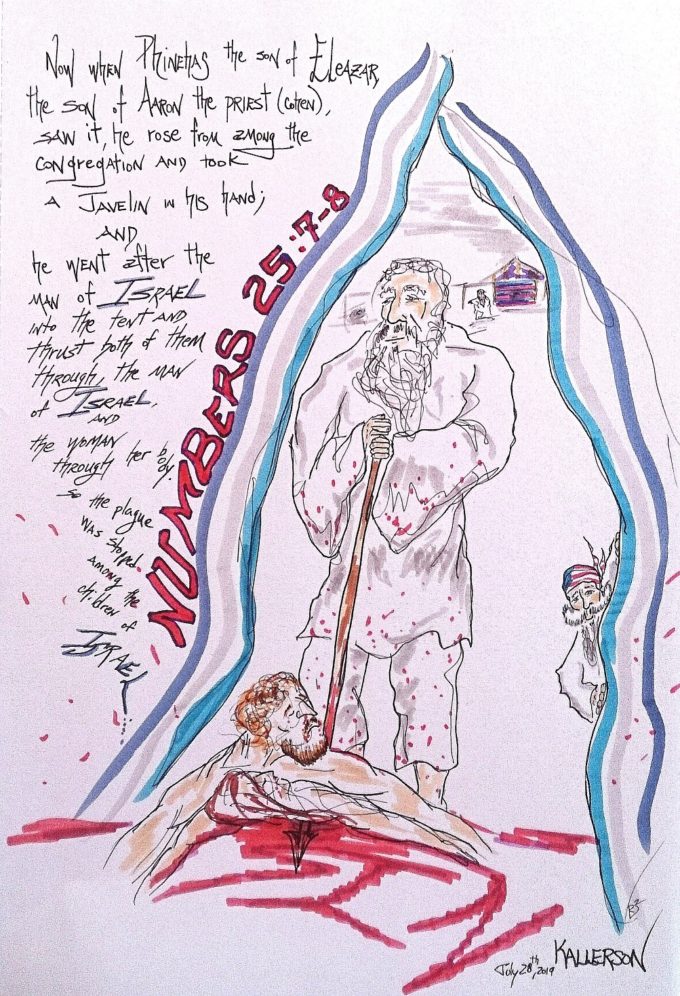
7 Now when Phinehas the son of Eleazar, the son of Aaron the priest, saw it, he rose from among the congregation and took a javelin in his hand;
The name phinekhash, or Phinehas, comes from the words mouth and brass or mouth and serpent. Thus, the name means “Mouth of Brass,” meaning “Mouth of Judgment,” because brass signifies judgment, or “Mouth of a Serpent.”
It is apparent that he was one of the congregation weeping at the tent of meeting. He was distraught by the events which had occurred, and at the anger of the Lord which had arisen because of the actions of the people.
In his anger, he got up and grabbed a romakh or javelin. It is a new word which comes from an unused root meaning to hurl. Thus it is a weapon, like a spear or javelin, one would hurl at an enemy.
8 and he went after the man of Israel into the tent and thrust both of them through, the man of Israel, and the woman through her body.
Here is a word found only here in Scripture, ha’quvah, or “the tent.” It signifies an arched area. It is the inner or rear part of the tent where privacy would be sought. The privacy they sought was ended with the coming of Phinehas.
The context clearly implies that the two were one above the other, and thus in the act of having sex. In his anger at the events, Phinehas took the javelin and plunged it through them both.
In this is another word found only here in the Bible, qovah, or belly. Both words – quvah, or tent, and qovah, or belly, are derived from the word qavav, or curse, which was used eight times in the Balaam passages. That word signifies “to scoop out.” Thus, it almost appears as if the words are selected to show a connection to the attempted curses of Balaam on Israel and to what occurs here.
Regardless of that, the action of Phinehas was enough to satisfy the Lord that the honor of His name had been defended…
8 (con’t) So the plague was stopped among the children of Israel.
Just as in Numbers 16 when Aaron went among the congregation with the incense to atone for the sins of the people, thus stopping the plague, so the actions of Phinehas also stopped the plague. The Lord looked on his deeds with approval and relented from any further slaughter of the people, but by then, many had died…
9 And those who died in the plague were twenty-four thousand.
Here is an interesting dilemma between the Old and New Testaments, which liberals will often use to say that the Bible has contradictions in it. In 1 Corinthians 10:8, Paul says, “Nor let us commit sexual immorality, as some of them did, and in one day twenty-three thousand fell.” The Old says 24,000 while Paul says 23,000. However, Paul does say, “in one day.”
What appears to be the case is that one thousand died separately from the others. This would then be those tried and executed by Moses which would be in addition to the 23,000 who died in the plague. As always, there is an individual punishment for offense, and there is collective punishment as well. There is no reason to assume that there is any contradiction between what Paul wrote and what is recorded in Numbers.
Lord God, wickedness is everywhere and it tears me up
If I could I would end it all now
I would give the wicked their overflowing cup
And I would put it all to an end for sure somehow
But I am not in the judgment seat
And I can only do what I can do
And so I speak of Jesus, my Lord, so sweet
Look on my heart, O God; my intentions are true
Reward me according to my righteousness
Reward me according to the cleanness of my hands
Though this world is in a dreadful mess
You are the One who sees my heart, and in seeing understands
II. Harass the Midianites (verses 10-18)
10 Then the Lord spoke to Moses, saying:
With these words, a new section is introduced, even though it bears directly on what has just been recorded.
11 “Phinehas the son of Eleazar, the son of Aaron the priest, has turned back My wrath from the children of Israel, because he was zealous with My zeal among them, so that I did not consume the children of Israel in My zeal.
Again, as in verse 7, the lineage of Phinehas is given. This is to show that he was of the priests and one who bore authority. It is how he has used that authority which is commendable. At other times in Scripture, such people in authority will act in a vastly different manner.
Here the Lord speaks of His khemah, or wrath. That word was used in Leviticus to describe the fury of the Lord when Israel disobeys. Even though they have not yet entered into the land of Israel, they have already now partaken of that fury through their vile conduct.
However, His fury was stayed by the zeal of Phinehas. The word here signifies jealousy. It has been seen so far seven times in Numbers 5 concerning the jealousy of a husband in regards to his possibly unfaithful wife.
The Lord is treating Israel as His bride in a covenant relationship. When she strays, His jealousy is aroused. But because of Phinehas’ jealousy for the sake of the Lord, he has accepted his actions as an atoning offering and the relationship is restored, and…
12 Therefore say, ‘Behold, I give to him My covenant of peace;
The covenant of the Lord’s peace signifies divine favor and protection. It does not mean that all will be well at all times, but that the Lord will not forget, and that peace between the two shall never end. This is alluded to between the Lord and the people in Isaiah 54 where the term, “covenant of My peace” is used.
Paul uses that passage from Isaiah, and he equates it to the church in Galatians 4. Phinehas is used here as a type of Christ who is zealous for the name and honor of the Lord. Thus, the covenant of peace anticipates that greater covenant to come in Christ.
13 and it shall be to him and his descendants after him a covenant of an everlasting priesthood,
This needs to be taken in its proper light. The word here is olam. It comes from a word which signifies to conceal. Thus, it speaks of time out of mind. It can mean forever, but the Mosaic covenant is not a forever covenant. It was a covenant which anticipated a New Covenant. Thus, the priesthood of Phinehas would last until it was superseded by the greater priesthood of Christ.
The line of Phinehas continued on until the coming of Christ with only one short interruption which went from the time of Eli until David. The promise of this enduring priesthood was fulfilled by the Lord as spoken here.
13 (con’t) because he was zealous for his God, and made atonement for the children of Israel.’”
The words here look to the greater work of Christ in two ways. First, the zeal of Christ was seen in His defense of the Lord and the temple in John 2 when He cleared the temple which had been defiled by the people.
Secondly, Christ is the one who made the full and final atonement for the children of Israel. Phinehas’ actions atoned for Israel so that the plague of wrath was stopped, but Christ’s cross atoned for Israel, and – indeed – all the world so that the plague of death is forever ceased in Him.
14 Now the name of the Israelite who was killed, who was killed with the Midianite woman, was Zimri the son of Salu, a leader of a father’s house among the Simeonites.
The name Zimri probably deals with music and thus it would be My Musician, My Praise, My Song, or Song of the Lord. He is specifically noted as a leader of his father’s house, and thus he was all the more responsible for his actions.
But not only that, this shows the bravery of Phinehas’ action because Zimri’s status would mean that there would be many who could claim the status of the avenger of blood and thus come against Phinehas. It is certainly only through the Lord’s strong approval of his actions that this did not come about.
It appears from Numbers 26, that the main group of those who died in the plague were probably from Simeon. During the second census of the people which is recorded there, Simeon is the tribe with the smallest total number. As they were to the far south of the encampment, they were probably closest to the town which seduced Israel through the Baal of Peor.
Further, noting his position shows that Phinehas did not regard the position, but rather the actions of the man. In his failure to meet the call to his office, and the honor of the Lord, he forfeited his life.
15 And the name of the Midianite woman who was killed was Cozbi the daughter of Zur; he was head of the people of a father’s house in Midian.
The name Cozbi comes from the word kazav, meaning to lie, or to be a liar. Thus, her name either means “Lying,” or “My Lie.” Her father’s name, Tsur, means, “Rock.” He is said to have been a head of the people of a father’s house in Midian, just as Zimri was in Simeon. He is named as one of the five kings of Midian in Numbers 31.
The arrangement appears to be a purposeful attempt to subvert the people’s authority through such arrangements.
16 Then the Lord spoke to Moses, saying:
Once again, a new thought is introduced. Each step, the narrative is slowly unfolding to lead to a climax in the events. The words here come later in the chronology of events, and they are directly connected to Chapter 31 where the command now to be stated is actually carried out. And for that command, Moses is told to…
17 “Harass the Midianites, and attack them;
tsaror eth ha’midyanim – “Treat like enemies the Midianites.” From this, it is apparent that Midian was behind the seduction of Israel, even if it was in Moabite territory. It was seen at the beginning of the Balaam passage that it is probable that Midian ruled over Moab at this time. That seems to be borne out by the command now.
The Lord tells Moses that they are to treat Midian as enemies and to attack them. This will be carried out in Chapter 31. In this attack, the righteous anger of Phinehas is to be transferred to the whole nation. They are being instructed to learn to detest what God hates, and to destroy that which God has determined is to be destroyed.
Phinehas has set the example, and the people are to learn from it and follow suit.
The same word from the previous verse is used again. “Treat them as enemies because they treated you as enemies.” There was no enmity between the two until Midian determined to subvert the people’s devotion to the Lord and pull them away from Him…
18 (con’t) with their schemes by which they seduced you
Here, the same word in noun and verb form is used. In essence, it says, “with the beguilings by which they beguiled you.” They came to Israel with a set purpose and intention. It was to draw the people away from the Lord which was…
18 (con’t) in the matter of Peor and in the matter of Cozbi,
There is an emphasis in these words. The matter of Peor was exacerbated by the matter of Cozbi. The foes had attempted to seduce Israel through their leadership and by their leadership. This was because Cozbi was…
18 (con’t) the daughter of a leader of Midian, their sister,
The focus is on Cozbi and her position within the community. She was both the daughter of one of their leaders, elevating the matter, and she was also their sister, meaning that it was a commonly known matter. It could not be that it was a secretly conducted affair, but one which was planned at the top and known by all.
*18 (fin) who was killed in the day of the plague because of Peor.”
The inclusion of these words, the substance of which is already known, is certainly to indicate that as she was killed, so are all of Midian to be killed. In other words, what is said here is given to justify what will be recorded in Chapter 31 –
“And Moses said to them: ‘Have you kept all the women alive? 16 Look, these women caused the children of Israel, through the counsel of Balaam, to trespass against the Lord in the incident of Peor, and there was a plague among the congregation of the Lord. 17 Now therefore, kill every male among the little ones, and kill every woman who has known a man intimately. 18 But keep alive for yourselves all the young girls who have not known a man intimately.’” Numbers 31:15-18
Cozbi’s actions were known and condoned by the leadership and the people. Therefore, their attitude was approving of what she did, and it was a part of their moral makeup. For them, destruction was the only remedy.
I have a zeal for You in my heart, O God
It consumes me throughout the day and into the night
It burns in me with every step I trod
I wish to honor Your name, Your power, and Your might
When I see the wicked, I am distressed indeed
And I loathe what they do, they mock Your glory
They follow hard after their father, they are Satan’s seed
It is a sad, maddening truth to life’s story
But some I can tell about Jesus and His cross
And some will turn away and mock Your glory still
For those who listen, there will be gain, not loss
But for the others, may be done in them, O God, Your will
III. Phinehas
What we have here is a picture of the battle God’s people have faced, and Christ’s victory over it. Man is caught in the trap of the devil’s lies, stuck in a system of works-based righteousness.
Israel, God’s people, are said to be in Shittim, meaning “Scourges.” The root of that word, shotet, is used only once in the Bible. In Joshua 23:13, it said –
“…know for certain that the Lord your God will no longer drive out these nations from before you. But they shall be snares and traps to you, and scourges on your sides and thorns in your eyes, until you perish from this good land which the Lord your God has given you.” Joshua 23:13
The people of Canaan are equated to scourges who would afflict Israel. Thus, the scourges are that which draw the people away from faith in the Lord and to that which is false. In this place of scourges, the people are beguiled and drawn away from the Lord through the beguilings of Midian – meaning “Place of Judgment.”
But in this place of scourges, along comes a hero, Phinehas, or “Mouth of Judgment.” He is the son of Eleazar, or Whom God Helps. He pictures Christ, who bears the mouth of judgment. He entered into the very spot where man is harassed and beguiled.
In order to restore God’s people to Him, Phinehas went into the tent and pierced Zimri and Cozbi through the belly. The words quvah, or tent, and qovah, or belly, are both derived from qavav, meaning a curse.
Here, Phinehas pictures Christ, entering the quvah, or place of the curse, meaning our world where death reigns. He destroys the curse, pictured by piercing the qovah (the belly – the curse), with the spear. He is victorious over the curse, and the plague of death upon the people is stopped.
Cozbi, or “Liar,” pictures the lies of the devil. He is called, the “father of lies” by Jesus. She is the daughter of Tsur or “Rock.” Tsur represents the rock of works-based righteousness who is contrasted to the true Tsur, or rock, which is the faith of Abraham. That is seen in Isaiah 51:1 –
“Listen to Me, you who follow after righteousness,
You who seek the Lord:
Look to the rock from which you were hewn,
And to the hole of the pit from which you were dug.
2 Look to Abraham your father,
And to Sarah who bore you;
For I called him alone,
And blessed him and increased him.” Isaiah 51:1
The man Zimri, or “My Song,” or “My Praise,” is man who is drawn away from the Lord, enticed by the lies of the devil, into works-based righteousness. The “song” here is emblematic of following one’s own course, or song, and uniting with the lie. This is what is destroyed by Christ, represented by the actions of Phinehas.
In his act, Phinehas is granted a covenant of peace with the Lord and an everlasting priesthood, just as Christ was granted through His work. As it says in Hebrews 5, when speaking of Christ –
“So also Christ did not glorify Himself to become High Priest, but it was He who said to Him:
‘You are My Son,
Today I have begotten You.’
6 As He also says in another place:
‘You are a priest forever
According to the order of Melchizedek.’” Hebrews 5:5, 6
This, in short, is the pictorial meaning of the passage we have before us today. Christ is the Victor over the devil through His noble actions. From there, we can also see in this passage what it means to be people of faith who live out lives of faith, and how that relates to our deeds before the Lord.
In our text verse, it was said of what Phinehas did that it “was accounted to him for righteousness.” These are the same words, and it is the same sentiment that was spoken of Abraham in what Paul uses as his declaration of justification by faith alone.
And more, the exact same words in the Greek translation of the Old Testament which speak of Phinehas in Psalm 106, are spoken of Abraham in James 2:24, where James then says, “a man is justified by works, and not by faith only.”
The question is, “Why would the Lord inspire James to use a passage from Abraham, many years after he had been declared righteous, instead of just citing this account concerning Phinehas whose deeds coincided with his declaration?” It’s a good question. Does anyone want to answer it?
The answer is that Phinehas’ deeds didn’t justify him. His zeal for the Lord did. The Lord looks at intent as action complete. If I have it in my mind to commit adultery, my intent has caused me to sin. That is why there is a tenth commandment which requires no action at all. Coveting is intent.
If Phinehas had jumped up and grabbed the spear and then was restrained by someone, it would make no difference in God’s eyes. His intent was to defend the zeal of the Lord. He simply had nothing to obstruct his following through with that intent.
It was God’s intent, from the foundation of the world, that Christ would go to the cross of Calvary. That is stated explicitly in Revelation 13:8. The difference between the Lord’s will and ours is that ours does not always get carried through to its fulfillment.
We may not commit adultery actually, but we do so when we lust after another in our hearts. We may not be able to defend the Lord’s honor in some manner, but our intent to do so is seen and known. Phinehas may not have been able to carry through with his intent, but his zeal showed that he would have.
These things do not mean that if we “say” we intended to do something, that we are credited for that action. Rather, the intent has to be real and in our hearts where God will read it. We cannot pay lip service to God with our hearts. He reads every motive behind every action – intended or completed.
Phinehas may be the person most emblematic of the Lord above every other person in the Bible simply because everything said about him in this passage reflects Christ.
Phinehas, or Mouth of Judgment, rose from the congregation – as did Christ. He had a zeal for the honor of the Lord, as did Christ. He had a desire to defend that honor, as did Christ, whose mouth speaks judgment. And, he was able to follow through with that in action, as was Christ. In doing so, it says he provided atonement for the children of Israel, as did Christ. In turn, he was promised a covenant of an everlasting priesthood, as was Christ.
In saying that Christ defended the honor of the Lord, it means that He did for the people what they could not do. In the incident here, many people were executed. The executioners were told what to do, and they did it. There was no righteousness imputed to them for what they did. They simply obeyed and acted.
Phinehas, however, did what he did for the Lord’s name, not out of command. Likewise, Christ voluntarily gave Himself. As it says in the book of Jonah, “Salvation is of the Lord.” Jesus, or Yeshua, is Salvation, and He is of the Lord. The Lord Himself worked out salvation, defending His honor, because it is not by works, but by faith that one is saved.
Phinehas’ actions did not save him. His faith in, and zeal for, the Lord did. His desire was simply worked out in action.
Let’s get this right so that we understand what James is saying, and what we are to learn from Phinehas. James says, “faith by itself, if it does not have works, is dead.” What is he talking about? He is talking about intent. Faith is what saves. If we don’t have faithful intent in our action, our faith is dead.
Likewise, when he says that “a man is justified by works, and not by faith only,” how do you explain that to a quadriplegic who loves Christ and yet can’t do anything at all for Him? You tell him that his intent, his heart, is what God is evaluating.
In the end, our salvation is solely and entirely of grace through faith. And our rewards will be given to us, or taken from us, based on our true and heartfelt intent, even if we do not, or cannot, act on our intent. When we lust after another, rewards will be lost. When we honestly desire to do, but cannot, rewards will be gained. And when we desire to do and are able to, it will be commendable indeed.
When we cannot follow through, it does not mean we are being un-Christlike. It simply means that we have been inhibited by God from being able to do that thing that we desire to do for Him because He has another plan in store for us.
Christ went through with His mission because He was preordained to do so. When God says, “I will do,” it is done. We are not always in such a position, but He knows that already. David desired to build a temple for the Lord his God, but Solomon explains how that went –
“Now it was in the heart of my father David to build a temple for the name of the Lord God of Israel. 18 But the Lord said to my father David, ‘Whereas it was in your heart to build a temple for My name, you did well that it was in your heart.’” 1 Kings 8:17, 18
Let us be like these heroes of the faith and be like Christ in the process, because they were like Christ. God will look upon your heart and know if you are truly sincere in your desire, or if you are just blowing smoke. So, don’t blow smoke. Live for Christ, pursue Christ, and honor Christ with all your heart and in your actions when you can – to the glory of God.
Closing Verse: “But to him who does not work but believes on Him who justifies the ungodly, his faith is accounted for righteousness, 6 just as David also describes the blessedness of the man to whom God imputes righteousness apart from works:
7 ‘Blessed are those whose lawless deeds are forgiven,
And whose sins are covered;
8 Blessed is the man to whom the Lord shall not impute sin.’” Romans 4:5-8
Next Week: Numbers 26:1-51 We are going to keep counting until the thing is done… (The Second Census, Part I) (50th Numbers Sermon)
The Lord has you exactly where He wants you. He has a good plan and purpose for you. It may seem at times as if you are lost in a desert, wandering aimlessly. But the Lord is there, carefully leading you to the Land of Promise. So follow Him and trust Him and He will do marvelous things for you and through you.
The Zeal of Phinehas
Now Israel remained in Acacia Grove there and then
And the people began to commit harlotry with Moab’s women
They invited the people to the sacrifices of their gods
And the people ate and bowed down to their gods for a spell
So Israel was joined to Baal of Peor
And the anger of the Lord was aroused against Israel
Then the Lord said to Moses
“Take all the leaders of the people
———-And hang the offenders before the Lord
Out in the sun, that the fierce anger of the Lord
———-may turn away from Israel, and you be restored
So Moses said to the judges of Israel for sure
“Every one of you kill his men who were joined to Baal of Peor
And indeed, one of the children of Israel
Came and presented to his brethren, a despicable greeting
A Midianite woman in the sight of Moses and in the sight of all
———-the congregation of the children of Israel
Who were weeping at the door of the tabernacle of meeting
Now when Phinehas the son of Eleazar
The son of Aaron the priest, saw it
He rose from among the congregation
And took a javelin in his hand, for some violence to commit
And he went after the man of Israel
Into the tent and thrust both of them through, so the word does tell
The man of Israel, and the woman through her body
So the plague was stopped among the children of Israel
And those who died in the plague that day
Were twenty-four thousand, yes twenty-four thousand passed away
Then the Lord spoke to Moses, saying:
These words to him He was relaying
“Phinehas the son of Eleazar
The son of Aaron the priest, has turned back My wrath
———-from the children of Israel
Because he was zealous with My zeal among them
So that I did not consume the children of Israel in My zeal as well
Therefore say, ‘Behold, I give to him
My covenant of peace; let it be understood
And it shall be to him and his descendants after him
A covenant of an everlasting priesthood
Because he was zealous for his God, yes he did well
And made atonement for the children of Israel
Now the name of the Israelite who was killed
Who was killed with the woman of the Midianites
Was Zimri the son of Salu
A leader of a father’s house among the Simeonites
And the name of the Midianite woman
Who was killed was Cozbi the daughter of Zur
He was head of the people of a father’s house in Midian
But he didn’t get to see his daughter anymore, for sure
Then the Lord spoke to Moses, saying:
These words He was to him relaying
“Harass the Midianites, and attack them
For they harassed you with their schemes
By which they seduced you in the matter of Peor
And in the matter of Cozbi; bad news for them, so it seems
The daughter of a leader of Midian
———-who got ran through there on the floor
Their sister, who was killed in the day of the plague
———-because of Peor
Lord God, we are even now in a wilderness
And we are wanting to be led by You
Without You to direct, our lives would be a mess
And so be our guide, O God; You who are faithful and true
We long for the water in this barren land
May it flow forth from the Rock, our souls to satisfy
Give us this refreshing, spiritual hand
And may we take it, and to our lives daily it apply
And we shall be content and satisfied in You alone
We will follow You as we sing our songs of praise
Hallelujah to You; to us Your path You have shown
Hallelujah we shall sing to You for all of our days
Hallelujah and Amen…