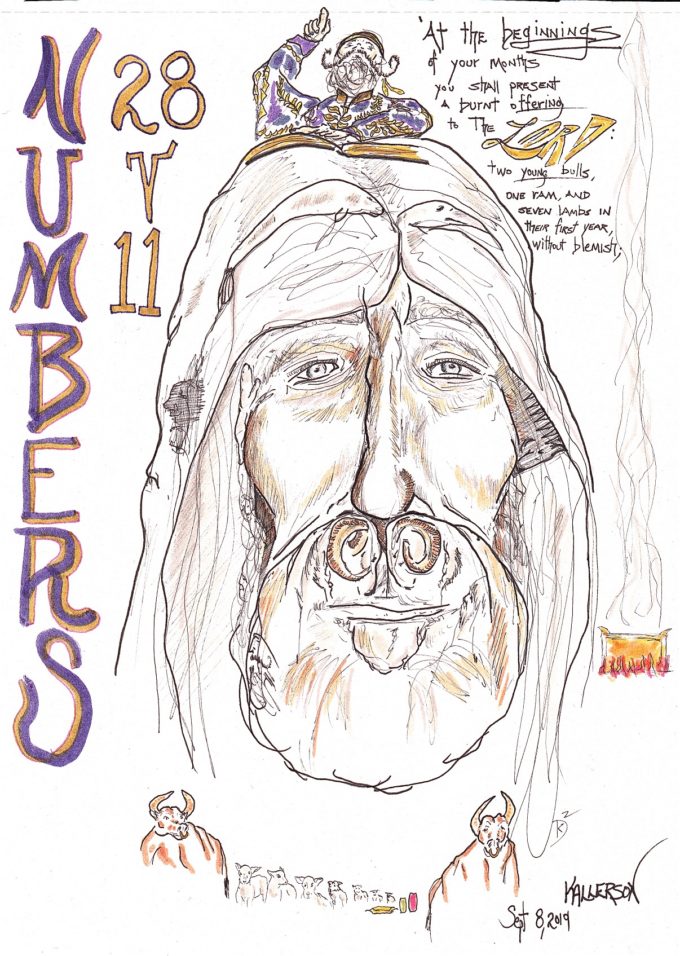
Numbers 28:11-15
The New Moon Offerings
When speaking of a right relationship with God, idolatry is one of the biggest problems that man faces. Man has found every possible thing in heaven and on earth to worship. We worship mountains, we worship forests, we worship stars, and we worship women or men. Some people worship their pets. The list is long and sad.
Paul writes about this in Romans 1, there is the creation, and there is the Creator. Because we can’t see the Creator, we may steer away from worshiping lest we look silly at worshiping something we can’t see, even if the evidences for His existence are plain and obvious.
As a species, we don’t tend to think clearly. Much of the reason for that is because we are infected with sin. That clouds our understanding. But we also just don’t want to expend the energy to think about things. Thinking, contemplating, and studying can be hard work, and it can drain us.
It is a lot easier to just do other, less challenging things. But, ironically, some people actually spend more energy trying to challenge what is obvious than they ever would in coming to a full understanding of those obvious things.
For example, evolutionists spend all kinds of time and energy attempting to disprove the very evidences that God has left of His hand in creation. Bible scholars have been known to spend countless hours attempting to tear apart the Bible instead of studying it as it is intended. Oh my.
Text Verse: “Sing aloud to God our strength;
Make a joyful shout to the God of Jacob.
2 Raise a song and strike the timbrel,
The pleasant harp with the lute.
3 Blow the trumpet at the time of the New Moon,
At the full moon, on our solemn feast day.
4 For this is a statute for Israel,
A law of the God of Jacob.” Psalm 81:1-4
Why is there a New Moon? Why is there a full moon? And how do we know exactly when they will be? Why is there an equinox or a solstice that can be easily determined, year by year, even hundreds or thousands of years into the future? Why is it that men who sleep with men cannot bear children?
Why is it that a person was able to identify the makeup and properties of elements which had not yet been discovered, so that when they were discovered, the properties and makeup of them matched what the person had already figured out?
The answer to these things, and to an almost infinite number of related questions, is that it is because there is order and harmony in the creation. If the universe started in chaos, the universe would still be in chaos. No matter how long the chaotic continues, it will never become organized.
Reading about the offerings to the Lord which were required of Israel is a study in order. There is harmony in them, there is wisdom in them, and there is structure in them.
When we read passages such as the one today, we should try to look beyond the simple words themselves and attempt to figure out why the Creator placed them here, and what He is attempting to show us through them. That is where real treasure can be found. We have come across so much in the past, and we will come across more today. This is certain, because great things are to be found in His superior word. And so let’s turn to that precious word once again and… May God speak to us through His word today and may His glorious name ever be praised.
I. The Monthly Offerings (verses 11-15)
11 ‘At the beginnings of your months
u-b’rashe khadeshekem – “and in heads your months.” Here the word rosh, or head, signifies the first or beginning. The word now turns to the third mandated offering which is given for a specific time, that of the beginning of the month.
Thus, the required offerings have gone from the daily in verses 1-8, to the weekly, meaning that of the Sabbath, in verses 9 & 10, and now they go to monthly offerings. This monthly event is something which has only been mentioned in an incidental way so far. In Numbers 10:10, it said –
“Also in the day of your gladness, in your appointed feasts, and at the beginning of your months, you shall blow the trumpets over your burnt offerings and over the sacrifices of your peace offerings; and they shall be a memorial for you before your God: I am the Lord your God.”
Nothing else has been said of this to explain why the beginning of the month is singled out. The reason for it being later called the “New Moon” is because the Hebrew Calendar was based on the cycle of the moon. It is a 30-day calendar, commencing each month at the time of the New Moon.
As the beginning of the month is the time of the New Moon, that means that the 15th of the month is the time of the full moon. Thus, the Passover occurring on the 14th of the month – as stated in Exodus 12 – means that the Exodus of the people occurring on the 15th of the month was the most propitious time for them to depart.
Moses and Aaron were called for by night, and they were ready when the moon was full. The departure would have allowed them the most light possible for their escape. The fifteenth also corresponds to the beginning of the Feast of Unleavened Bread which is mandated in Leviticus 23 –
“And on the fifteenth day of the same month is the Feast of Unleavened Bread to the Lord; seven days you must eat unleavened bread. 7 On the first day you shall have a holy convocation; you shall do no customary work on it. 8 But you shall offer an offering made by fire to the Lord for seven days. The seventh day shall be a holy convocation; you shall do no customary work on it.” Leviticus 23:6-8
The exact offerings which are mentioned there to be made by fire for that feast will be outlined later in this same chapter, in verses 17-25. This beginning of the month, also known as the time of the New Moon, is now noted as having a mandated offering which is to be associated with it. That begins with the words…
11 (con’t) you shall present a burnt offering to the Lord:
Here, an offering is to be made l’Yehovah, or “to the Lord.” As nothing has yet been specified concerning the New Moon, such as was specified, for example, in the giving of the Sabbath, it begs the question, “What is the significance of this time of the month?”
There must be a reason why the beginning of the month, or the “New Moon,” requires a mandatory offering. Oddly, the Bible never explicitly says. Thus, an explanation can only be inferred. The fact that the day was to be announced by the blowing of the silver trumpets certainly elevated the respect the day received. Four basic reasons for blowing of the silver trumpets were given –
1) For the gathering of the people;
2) For the advancement of the people from their camps;
3) For remembrance in battle; and
4) As a memorial before God at various times.
The only one which applies here would be “as a memorial before God.” The silver of the trumpets pictured redemption. That there were two of them pictured the proclamation of God’s word, given in two testaments. Thus, blowing these trumpets at the time of the New Moon was to be as a memorial before God at a particular time of life which points to Christ.
As the blowing of the trumpets was to coincide with the offerings to be presented, then they are calling forth a remembrance of what the offerings represent in typology as they anticipated Christ.
But not all offerings were to be called out in order to be remembered. For example, the sin offerings, which pictured Christ’s life as a sin offering, did not have the trumpets blown over them. It would be as if calling sin to remembrance.
Rather, sin is expiated and gone. The trumpets, according to Numbers 10, show they were only to be blown over the burnt offering mentioned here. Those burnt offerings consisted of…
11 (con’t) two young bulls,
parim bene baqar shenayim – “bulls sons of ox two.” The par, or bull, comes from the word parar which carries the meaning of defeat, or make void, although it can be variously translated. In this is a type of Christ who defeated the devil, making void that which the devil had wrought.
Baqar comes from a word meaning to inquire or seek out. Being a son of such an ox looks to Christ who seeks out those He would redeem, just as the Lord is said to seek out His sheep in Ezekiel 34.
This is the first time that two bulls, instead of just one, are offered. No explanation is given for it. And so we must think it through. The number two signifies that there is a difference. In one, there is no difference, but in two there is a difference; there is another.
Bullinger notes that in two things, the second may be included for help and deliverance. Such would make sense for the reason of having two bulls. The first looks to the work of Christ accomplished for the people. The second anticipates help and deliverance in the month ahead.
As the first day of the month stands as representative of the entire month, the one bull looks to Christ’s accomplished work, and the second looks to the work Christ continues to accomplish. In other words, he has defeated the devil and the one is a remembrance of that, but we still look to Him to deliver us from the devil, of which the second is given in anticipation of that.
11 (con’t) one ram,
v’ayil ekhad – “and ram one.” The word ayil comes from a word denoting strength. The ram reflects the total commitment of Christ who offered all of His natural strength to His Father. He is fully sufficient to redeem all.
11 (con’t) and seven lambs in their first year,
kebasim bene shanah shivah – “lambs son of year seven.” The lamb, or kebes, signifies “to dominate.” The type of animal looks to Christ who dominated over sin. Seven of them pictures Christ. Seven is the number of spiritual perfection, emblematic of His spiritually perfect work.
The first year signifies innocence, just as Christ was innocent. Through His innocence, He prevailed over the law, dominated over sin, and destroyed it. This is what we are to see in these seven lambs of the first year. And in them, as with the other animals, they were all to be…
11 (con’t) without blemish;
temimim – “perfect.” As with all animals presented as burnt offerings to the Lord, they were to be without spot, without blemish, and perfect. Again, the quality looks to Christ who bore no sin before God. As seen last week, Peter provides exactly this explanation –
“…knowing that you were not redeemed with corruptible things, like silver or gold, from your aimless conduct received by tradition from your fathers, 19 but with the precious blood of Christ, as of a lamb without blemish and without spot.” 1 Peter 1:18, 19
12 three-tenths of an ephah of fine flour as a grain offering,
As seen in the previous sermon, the number ten in Scripture signifies the perfection of divine order. It implies that nothing is wanting and that the number and order are perfect, and the whole cycle is complete.
The tenth part is given as representative of the whole. In this case, it is three-tenths of an ephah. The reason this specific amount will be mentioned is in this same verse. The grain offering is to be of solet, or fine flour.
As seen last week, solet is from an unused root meaning to strip; flour, as chipped off; and thus fine. It is generally considered, even when not specifically stated, that wheat was the flour used in such an offering. It would be the best of things offered to the greatest of Beings, meaning the Creator. In this, it is a picture of Christ.
First, is that it is a division of a tenth, it represents the whole, showing that nothing is wanting and that His offering is perfect, and through His work, the whole cycle is complete. He is the perfection of divine order.
That it is solet, or the finest flour of wheat, looks to His purity. It is a fitting emblem of Christ who is the Bread of Life, and the One who provides everlasting life to those who partake of Him. Thus the offering is an acknowledgment of this to God. It is to be…
12 (con’t) mixed with oil,
The shemen, or oil, is said to be balal, or mixed, into the grain. The oil pictures the Spirit of God. Though Christ is a Man, He is fully endowed with the Holy Spirit. It looks to Christ, the God/Man.
12 (con’t) for each bull;
The amount, three-tenths, is given based on the size of the animal. This was seen in Numbers 15, and the amounts mentioned here are consistent with what is presented there. As this is the largest animal offered, the grain offering is sized accordingly. For the next offering, it is less…
12 (con’t) two-tenths of an ephah of fine flour as a grain offering, mixed with oil, for the one ram;
A tenth division is again made, representing divine perfection, but this time it is smaller to correspond with a smaller animal. And then once again, the amount decreases with the third animal offering…
13 and one-tenth of an ephah of fine flour, mixed with oil, as a grain offering for each lamb,
The same grain offering, mixed in the same manner, and carrying the same symbolism, is again repeated, but this time, the amount is one-tenth in order to correspond with the size of the animal. All of these together are to be…
13 (con’t) as a burnt offering of sweet aroma, an offering made by fire to the Lord.
Again as with the daily and weekly offerings, we look to these words and find the same symbolism of Christ. In the offering of His life – His works, His perfection, and His sacrifice in fulfillment of the law, He was considered as a sweet aroma, pleasing to God the Father. This is explicitly stated by Paul in Ephesians 5 –
“Therefore be imitators of God as dear children. 2 And walk in love, as Christ also has loved us and given Himself for us, an offering and a sacrifice to God for a sweet-smelling aroma.” Ephesians 5:1, 2
Everything points to Christ and what He would do for us. The people of Israel were required to give these monthly offerings as a sort of parable in anticipation of what was to come in Him.
These went on, month by month, as a memorial before God that His covenant stood firm until the time Christ would come, fulfill it, and initiate a New Covenant through His perfect work and life. It is His life alone which is truly the offering and sacrifice to God for a sweet-smelling aroma.
As with the daily and weekly offerings, along with these monthly burnt offerings, with their grain offerings, there were also to be drink offerings presented…
14 Their drink offering shall be half a hin of wine for a bull, one-third of a hin for a ram, and one-fourth of a hin for a lamb;
The drink offering amounts are the same as were recorded for the same type of offerings in Numbers 15. However, unlike the daily drink offerings we looked at last week which were said to be shekar, or strong drink, here these are to be yayin, or wine.
First, the nesek, or drink offering, comes from a word meaning “cover.” The idea is that when the drink offering is poured out, it will cover that onto which it is poured.
The drink offering of yayin, or wine, looks to the merging together of cultural expressions into a result. The thing that ought to happen can happen, symbolized by wine. In the drink offering, it signifies rest and celebration. Such a drink offering is only offered after entry into the Land of Promise, which is a land of defeated enemies. It is a land of rest. Only when rest is seen, would the Lord accept the wine libations.
And more, a drink offering is poured out in its entirety to the Lord. No part of it was drunk by the priests or people. It signifies that they were partially excluded from the Lord’s full blessings while under the Law of Moses. Jesus referred to this in Matthew –
“Nor do they put new wine into old wineskins, or else the wineskins break, the wine is spilled, and the wineskins are ruined. But they put new wine into new wineskins, and both are preserved.” Matthew 9:17
He was speaking of the law and grace. The new wine is the new dispensation of grace to come. The old wine was the dispensation of the law. Introducing the new concept into the old would not work because they are incompatible.
Only when putting the new wine into the new wineskins is the mind changed. Only in Christ does man truly enter into God’s victory and rest. This is what is seen in the wine drink offering, and it is why Paul could say in Philippians 2 –
“Yes, and if I am being poured out as a drink offering on the sacrifice and service of your faith, I am glad and rejoice with you all. 18 For the same reason you also be glad and rejoice with me.” Philippians 2:17, 18
Paul’s labors in the vineyard anticipated his victory and rest in Christ. It is confirmed in his words to Timothy –
“For I am already being poured out as a drink offering, and the time of my departure is at hand. 7 I have fought the good fight, I have finished the race, I have kept the faith. 8 Finally, there is laid up for me the crown of righteousness, which the Lord, the righteous Judge, will give to me on that Day, and not to me only but also to all who have loved His appearing.” 2 Timothy 4:6-8
14 (con’t) this is the burnt offering for each month throughout the months of the year.
The three types of animals, along with the grain and drink offerings that accompanied them, unite to form a unit which is the burnt offering for each month, on the first of each month, each year. As it says, b’khadesho l’khadeshe ha’shanah, or “in the month, for the months the year.”
Each burnt offering represented the month, and together they united to form the required monthly burnt offerings. Over these burnt offerings would be blown the silver trumpets, thus making them a memorial before God concerning the promise of the coming of Messiah and what He would do in fulfillment of these mere types and shadows. Along with the burnt offerings there is…
15 Also one kid of the goats as a sin offering to the Lord shall be offered,
It is notable that this sin offering is mentioned only after the burnt offering. As with the Day of Atonement, and at various other times, it is a sayir izzim, or a hairy goat. Hair in Scripture signifies awareness. In this case, it is awareness of sin. This is a monthly reminder of the sinful state of the people.
Despite having other sin offerings when sin is committed and recognized as such, or which were to cover the sins of the people for the year, meaning on the Day of Atonement, this sin offering is given as a reminder that the people were not free of sin, and that they needed continual atonement for it.
It was to be for their constant awareness of that fact, and that they were wholly dependent on the Lord for His mercy, not just annually, but from month to month. They were to be aware of their sin and seek its atonement.
This monthly hairy goat sin offering was given to represent the human life of Jesus, taking on our nature, but without sin, and yet then taking on our sin in His crucifixion. It is seen in Paul’s words to the Corinthians –
“For He made Him who knew no sin to be sin for us, that we might become the righteousness of God in Him.” 2 Corinthians 5:21
*15 (fin) besides the regular burnt offering and its drink offering.
What is probable, although unstated, is that the sin offering would be the first offering to the Lord. The precedent of following this order has been seen numerous times already. Sin must be first dealt with, and then – when the sin of life is atoned for – the offender is considered acceptable before God once again.
Though these offerings look to Christ and His work, they are offerings of the people in acknowledgment of their state before God. The regular daily and Sabbath offerings were sufficient to make the picture of a people living in a holy manner before the Lord.
However, the addition of this monthly sin offering reminded the people that they were never truly detached from sin, and that they required an offering for that state.
Unlike the daily and Sabbath day offerings which did not mandate any sin offering, the monthly offerings did. The idea seems to be that the people were to daily offer themselves to the Lord, and they were to do so in anticipation of the coming rest of the Lord each week. But beyond these very short intervals, more was needed.
Although most people realize that their life on any given day was not perfect, and for others, they could reflect on the Sabbath that they certainly had offended God in the week gone by, there are some who probably felt that they were acceptable to God even beyond their daily and weekly lives.
But the mandating of this sin offering was certainly intended to quash any such thoughts in their heads. The Lord is telling the people, month by month, of the impossibility of being right before God without atonement.
Though less formal than the annual Day of Atonement rituals, this monthly sin offering was to carry the same mental idea for the people to consider. It is certainly because of this sin offering being included as a part of the monthly requirements, that this first day of each month observance became so prominent in Israel.
Though it is not given any great detail in the Law of Moses, the beginning of months, or New Moon observance, is seen quite a few times in both the Old and even in the New Testament. We will look over some of those noted times after a short poetic break…
The New Moon has come at last
From waning to waxing goes the light
A new month has started, the old has passed
From here on out, things will be getting bright
But on this day, we will observe a rest
And we need to contemplate our state before God
In the past month, we have failed to be our very best
And our walk at times has been quite flawed
And so, a sin offering to the Lord we will make
To cover over the misdeeds that we have done
He shows mercy to us for His name’s sake
For the Lord our God is the great and merciful One
Yes, the silver trumpets blow forth their customary tune
They now blow forth for the burnt offering of the New Moon
II. The New Moon
The term, “the beginnings of your months,” is seen twice in the Bible, in Numbers 10:10 and in Numbers 28:11. After this, the simple term khodesh, or “month,” will be used to speak of this day.
As the word khodesh can mean a month, or a day during the month when singled out – such as “the tenth of the month” – many translations, will use the term New Moon when it is clearly referring to the first of the month. In the NKJV, there are 22 times in the Old Testament and 1 in the New where the term is used. Of this day, the Jamieson-Fausset-Brown commentary, says –
“The beginning of the month was known, not by astronomical calculations, but, according to Jewish writers, by the testimony of messengers appointed to watch the first visible appearance of the new moon; and then the fact was announced through the whole country by signal-fires kindled on the mountain tops.” Jamieson-Fausset-Brown
This is still taught today in rabbinic circles, and among Christians who follow that thinking, and it is completely unscriptural. This is a problem with reading and accepting Jewish commentaries at face value. They often dismiss what is clearly taught in Scripture. For example, a verse from 1 Samuel 20 shows that this is not the biblical way of determining it –
“And David said to Jonathan, ‘Indeed tomorrow is the New Moon, and I should not fail to sit with the king to eat. But let me go, that I may hide in the field until the third day at evening.’” 1 Samuel 20:5
If the Jewish tradition were true, then David would have had to wait until the evening of the next day to see if the New Moon had arrived or not. This same thought is expressed in 2 Kings 4 as well.
Secondly, to rely on this type of calculation would mean that it was up to man to determine when the month began. If there was cloud cover or a heavy haze over the land due to a dust storm, one could not be obedient to Scripture concerning these offerings on the actual New Moon because the people had not sighted it.
These types of commentaries are both unreliable, and they lack the logic and order which the Bible both reveals and demands.
There are two types of moon cycles. The first is known as the sidereal month. That is measured by how long it takes for the moon to complete one full orbit around the earth. That takes 27 days, 7 hours, and 43 minutes. That is measured by the moon’s position relative to distant fixed stars. This is not what the Bible refers to.
The second period is that of the moon’s cycle phases, meaning from New Moon to New Moon. That takes about 29.5 days. Anybody who knows this, and it would be anyone who lived during those times – and who needed to comply with the Law of Moses – could simply count on their fingers, as David probably did, and come up with the date of the New Moon observance.
As far as the New Moon observances, other than what is given in Numbers 10 and here in Numbers 28, nothing else is mandated. And yet, other things are seen as being observed later in Scripture.
Jamieson-Fausset-Brown does note this which appears likely –
“The new-moon festivals having been common among the heathen, it is probable that an important design of their institution in Israel was to give the minds of that people a better direction; and assuming this to have been one of the objects contemplated, it will account for one of the kids being offered unto the Lord (Nu 28:15), not unto the moon, as the Egyptians and Syrians did. The Sabbath and the new moon are frequently mentioned together.”
More directly, the Pulpit Commentary says –
“There can be no doubt that this (unlike the sabbath) was a nature-festival, observed more or less by all nations. As such it did not require to be instituted, but only to be regulated and sanctified in order that it might not lend itself to idolatry, as it did among the heathen.”
That is certainly the case. Just as the solstices and equinoxes were known to the ancients, which then became nature festivals, so the monthly moon cycles would too. This could become problematic if not properly dealt with. In Deuteronomy 4, in a warning against idolatry, it says –
“And take heed, lest you lift your eyes to heaven, and when you see the sun, the moon, and the stars, all the host of heaven, you feel driven to worship them and serve them, which the Lord your God has given to all the peoples under the whole heaven as a heritage.” Deuteronomy 4:19
Having a New Moon observance mandated by the Lord would help the people from making the moon into an idol, simply because the observance was when the moon was at its least strength. Instead of worshiping a full moon, the people would be observing a New Moon to the Lord. It would be as a reminder that He had set the lights in the heavenlies, and that He was the one who regulated the timing of their appearances, and that He did so with precision.
Unfortunately, the people didn’t heed, and worshiping the heavenly bodies became a customary occurrence in Israel. Jeremiah speaks the word of the Lord concerning this –
“‘At that time,’ says the Lord, ‘they shall bring out the bones of the kings of Judah, and the bones of its princes, and the bones of the priests, and the bones of the prophets, and the bones of the inhabitants of Jerusalem, out of their graves. 2 They shall spread them before the sun and the moon and all the host of heaven, which they have loved and which they have served and after which they have walked, which they have sought and which they have worshiped. They shall not be gathered nor buried; they shall be like refuse on the face of the earth.’” Jeremiah 8:1, 2
That is just one of the many such instances noting the people’s idolatry in worshiping the heavenly bodies. However, as seen in 1 Samuel 20, the time of the New Moon was considered a day of particular social gathering. David was expected to sit at a meal with the king. That continues on in 1 Samuel 20:24-26 –
“And when the New Moon had come, the king sat down to eat the feast. 25 Now the king sat on his seat, as at other times, on a seat by the wall. And Jonathan arose, and Abner sat by Saul’s side, but David’s place was empty. 26 Nevertheless Saul did not say anything that day, for he thought, ‘Something has happened to him; he is unclean, surely he is unclean.’”
In 1 Samuel 4, the New Moon is brought to a level commensurate with that of the Sabbath in regards to visiting a prophet of God. It implies that such a thing was most commonly done on one of those two special days. Later in Isaiah, it becomes evident that the New Moon wasn’t just something that was only observed at the sanctuary by the priests, or by the king. Rather, what Isaiah says, shows that it was something observed by all people –
“Bring no more futile sacrifices;
Incense is an abomination to Me.
The New Moons, the Sabbaths, and the calling of assemblies—
I cannot endure iniquity and the sacred meeting.
14 Your New Moons and your appointed feasts
My soul hates;
They are a trouble to Me,
I am weary of bearing them.” Isaiah 1:13, 14
The New Moons are elevated here to the same level as the Sabbaths, calling of assemblies, and appointed feasts. Each of these involved the common people as well as the leaders. And even more, in Amos, the New Moon can be seen to be not only a day of observation to the Lord, but a day of rest among the people –
“When will the New Moon be past,
That we may sell grain?
And the Sabbath,
That we may trade wheat?
Making the ephah small and the shekel large,
Falsifying the scales by deceit,
6 That we may buy the poor for silver,
And the needy for a pair of sandals—
Even sell the bad wheat?” Amos 8:5, 6
The implication here is that the New Moon was a day, like the Sabbath, when selling was not allowed. Despite not being mandated by the Lord directly, it was considered a day set apart in a unique way, just as the Sabbath was. But, because of the people’s attitude toward the Lord, and because of the abuse of their relationship with Him, including their defilement of these sacred days, the Lord told the people of Israel this through Hosea –
“I will also cause all her mirth to cease,
Her feast days,
Her New Moons,
Her Sabbaths—
All her appointed feasts.” Hosea 2:11
Paul then uses this same thought in the book of Colossians to show that all of these things are now obsolete in Christ –
“So let no one judge you in food or in drink, or regarding a festival or a new moon or sabbaths, 17 which are a shadow of things to come, but the substance is of Christ.” Colossians 2:16, 17
It is a part of Paul’s standard warning. Israel failed to properly observe their own Lord-directed observances. They failed to honor Him and to obey the precepts of the law. They fulfilled the imagery that Paul lays out in Galatians.
The law was not an end in and of itself, but a means of showing Israel how desperately they needed something else, something far better. It was merely a tutor to take them by the hand and to lead them directly to the foot of the cross. They could not fulfill the law, but Christ Jesus could. And in His fulfilling, he brought to an end the Law of Moses.
Paul’s words in Colossians are a warning against anyone attempting to bring you back under the same failed system that they themselves cannot live by. The New Moon, along with the dietary laws, the feast days, and the sabbaths were simply shadows of what would come in Christ. He is the Substance, and He is to be our constant reminder of God’s love for us.
By following the Bible through the various times the New Moon is mentioned, we can see that it was a day which was set apart to the Lord. There are twelve months in a Hebrew calendar, and thus there were twelve New Moon observances each year. Twelve, is the number of perfection of government.
It is the monthly sin offering which makes this picture come alive. Three signifies the divine, heavenly number. Four signifies that of creation. Multiplied, they speak of organization. The government of the Lord comes together for man through these monthly reminders of man’s sin, and of what Christ would do to atone for it.
Christ died for our sins only once, but the monthly reminders come together in an organized way to show what that one sacrifice would accomplish – a government not based on the effects of sin, as is the Law of Moses, but a government based on freedom from sin, as is the New Covenant of grace.
The heavenly unites with the earthly in a restored, eternal kingdom because of His perfect offering for sin. For those who have put their faith in Christ, we have received this in the church. Someday Israel will understand this as well. In the book of Ezekiel, we read this –
“Thus says the Lord God: ‘The gateway of the inner court that faces toward the east shall be shut the six working days; but on the Sabbath it shall be opened, and on the day of the New Moon it shall be opened.’” Ezekiel 46:1
Someday Israel will observe these things not as a means of being right with God because of self, nor as anticipatory of Messiah. Rather, they will be observed as commemorative of what Christ has done, and of an imputed righteousness because of His work. Both the Sabbath and the New Moon, and indeed all of these now-fulfilled aspects of the Law of Moses will find their proper place in the realization that Christ has done it all, and it is all done in Him.
Closing Verse: “‘For as the new heavens and the new earth
Which I will make shall remain before Me,’ says the Lord,
‘So shall your descendants and your name remain.
23 And it shall come to pass
That from one New Moon to another,
And from one Sabbath to another,
All flesh shall come to worship before Me,’ says the Lord.” Isaiah 66:23
Next Week: Numbers 28:16-31 Here come more profferings… (Passover, and the Unleavened Bread and Weeks Offerings) (56th Numbers Sermon)
The Lord has you exactly where He wants you. He has a good plan and purpose for you. It may seem at times as if you are lost in a desert, wandering aimlessly. But the Lord is there, carefully leading you to the Land of Promise. So follow Him and trust Him and He will do marvelous things for you and through you.
The New Moon Offerings
‘At the beginnings of your months you shall present
———-a burnt offering to the Lord:
Two young bulls, one ram, and seven lambs without blemish
———-in their first year
Three-tenths of an ephah of fine flour as a grain offering
Mixed with oil, for each bull, please listen and hear
Two-tenths of an ephah of fine flour as a grain offering
Mixed with oil, for the one ram according to this word
And one-tenth of an ephah of fine flour, mixed with oil
———-as a grain offering for each lamb
As a burnt offering of sweet aroma, an offering
———-made by fire to the Lord
Their drink offering shall be half a hin of wine for a bull
One-third of a hin for a ram, and for a lamb one-fourth of a hin
This is the burnt offering for each month
Throughout the months of the year. As each month does begin
Also one kid of the goats as a sin offering to the Lord
Shall be offered, besides the regular burnt offering and its drink
————offering according to this word
Lord God, we are even now in a wilderness
And we are wanting to be led by You
Without You to direct, our lives would be a mess
And so be our guide, O God; You who are faithful and true
We long for the water in this barren land
May it flow forth from the Rock, our souls to satisfy
Give us this refreshing, spiritual hand
And may we take it, and to our lives daily it apply
And we shall be content and satisfied in You alone
We will follow You as we sing our songs of praise
Hallelujah to You; to us Your path You have shown
Hallelujah we shall sing to You for all of our days
Hallelujah and Amen…