Numbers 28:16-31
Passover, and the Unleavened Bread and Weeks Offerings
Today, we continue on with the offerings of the timed redemptive events found in the annual Hebrew calendar. As we have seen some of these events numerous times before, it might seem dull or even tedious to revisit them.
Passover has been mentioned again and again since it was first introduced in Exodus. This is true with Unleavened Bread as well. Even Weeks has been seen several times, and it will be seen again before we leave the books of Moses.
You might say, “Why doesn’t the Lord just give us all of the information on these things once and move on?” Like the Sabbath, however, we find that the Lord is progressively revealing His intent through these repetitions.
This is because they are not merely rote repetitions, but they are concepts which are repeated, and yet they are also being built upon. In each step we take under one of these subjects, we see a beautiful order and harmony develop.
By the time we get through with them, we – if we are willing to study them as the are given – find that everything makes complete sense. To have compiled all of the information at one time would have been to rob us of the incredible tapestry which the Lord has woven together.
Text Verse: “The end of a thing is better than its beginning;
The patient in spirit is better than the proud in spirit.” Ecclesiastes 7:8
As soon as I finished the sermon work for these verses, this verse came to mind. The introduction is generally the last thing I type before being finished, and the verse seemed to fit very well.
As usual, there was a lot of study and mulling things over during the verses, but nothing that seemed overly complicated – just more mentally laborious than anything else. However, upon arriving at the last verse, things changed.
The matter went from mentally laborious to mentally challenging. If I had known in advance that the last verse would take as much time to consider as many of the other verses combined, I would have quoted the text verse to myself at the beginning of typing. Yes, the end of a thing is better than its beginning.
Translations vary into one of two major ways the verse is translated, and they both then will result in a different way of perceiving other things that are found in the rest of the verses. Would I have to go back and edit what I had typed? Were my initial thoughts correct?
When faced with a problem like this, what should I do? Do I lick my finger and hold it up to see which way the wind is blowing. Do I cast lots in hopes of resolving the matter? Should I just pick one and go with it?
Rather, I called Sergio. That’s always a good way of resolving things. Two minds work better than one. When he first looked at the verse, he tended towards the opposite conclusion that I had come up with. That’s when I showed him all the study I had already done in Chapter 28 and 29 in hopes of finding an answer.
After that, he agreed that my initial thoughts were probably correct. Whew. Now I don’t have to fudge anything, I don’t have to correct anything, and I have material for the sermon introduction. Yes! It’s good to have a friend to sort difficulties out with. I recommend you find one in whatever your life needs are, and learn to lean on one another. It sure makes things go more smoothly.
For now, let’s get into the sermon. Great things are to be found in His superior word. And so let’s turn to that precious word once again and… May God speak to us through His word today and may His glorious name ever be praised.
I. Offerings for the Feast of Unleavened Bread (verses 16-25)
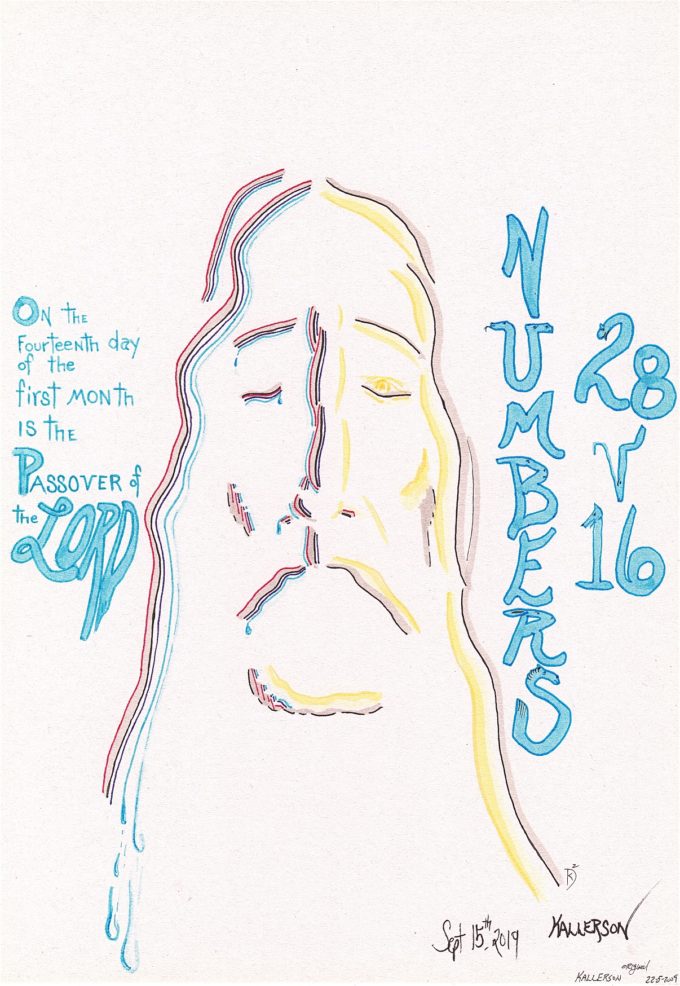
16 ‘On the fourteenth day of the first month is the Passover of the Lord.
The offerings of Chapter 28 have gone from the daily, to the weekly (meaning the Sabbath) to the monthly (meaning the beginning of the months, or the New Moon), and now they go to the annual offerings.
The progression has been logical and orderly. Of the annual offerings, the Passover is mentioned first because it is the first annual feast of the first month, and it is said to be pesakh l’Yehovah, or “Passover to Yehovah.”
It is a commemorative celebration which is not properly translated as “of the Lord,” but rather “to the Lord.” At the original Passover, the Lord struck all the firstborn of Egypt, but all who participated in the Passover lamb were spared. The lamb died so that its blood could be applied, saving those who participated in that act.
The killing of the Passover Lamb anticipated the death of Christ. Thus, it is the Passover “to the Lord.” This was first instituted in Exodus 12:1-21. Before that, the first month of the year was what later became the seventh month of the year in the redemptive calendar. That is spoken right at the beginning of Exodus 12 –
“Now the Lord spoke to Moses and Aaron in the land of Egypt, saying, 2 ‘This month shall be your beginning of months; it shall be the first month of the year to you.’” Exodus 12:1, 2
In reality, Israel would use two different calendars throughout their years. The first is the creation or civil calendar, and the second is this one instituted by the Lord which would be the “redemptive calendar.” This is because it details the timing of the redemptive events associated with the work of the Lord, the first being Passover. This was to be on the fourteenth day of the first month.
The fourteenth day is the day just before the full moon which would occur on the fifteenth day. As the biblical day goes from evening to evening, as soon as the fourteenth day ended, and the fifteenth started, the full moon would be expected to arise. It was at this time that…
17 And on the fifteenth day of this month is the feast; unleavened bread shall be eaten for seven days.
This now details what is considered a separate feast, the Feast of Unleavened Bread. It is one of the three pilgrim feasts, meaning a feast where all males were required to appear before the Lord at the place of His dwelling. This is stated in Exodus 23, 34 and also in Deuteronomy 16 –
“Three times a year all your males shall appear before the Lord your God in the place which He chooses: at the Feast of Unleavened Bread, at the Feast of Weeks, and at the Feast of Tabernacles; and they shall not appear before the Lord empty-handed.” Deuteronomy 16:16
Though a pilgrim feast, it is joined to the Passover. The two are separate appointments, but they unite because they follow one after the other. Unleavened Bread was first stated in Exodus 12 as well –
“In the first month, on the fourteenth day of the month at evening, you shall eat unleavened bread, until the twenty-first day of the month at evening. 19 For seven days no leaven shall be found in your houses, since whoever eats what is leavened, that same person shall be cut off from the congregation of Israel, whether he is a stranger or a native of the land. 20 You shall eat nothing leavened; in all your dwellings you shall eat unleavened bread.” Exodus 12:18-20
In that set of verses, it says, “on the fourteenth day of the month at evening.” This means “the beginning of the fifteenth day.” Hence, Unleavened Bread is a seven-day feast affixed to the Passover. It began on the 15th day, and it continued through the 21st day.
It should be noted that the first day of Unleavened Bread is not a Sabbath. Rather, it is a holy convocation. Meals could be prepared on it, but no regular work was to be done. On a Sabbath, not even meals could be prepared. Understanding this will help to avoid confusion concerning the actual crucifixion date of Christ Jesus.
Eventually, the two feasts, Passover and Unleavened Bread, became united in terminology. This is seen in Luke 22:1 –
“Now the Feast of Unleavened Bread drew near, which is called Passover.”
Luke says that the Feast of Unleavened Bread is called the Passover. This is not saying that they are one feast according to the model laid out in the books of Moses. What it is saying is that it is one feast according to the common language of the people.
To understand this, we can think of what we might call the Christmas Holiday. Although there are two actual holidays during the school break, Christmas and New Years, we will call them both by the one name. This is common terminology, just as Luke was using. Thus, this cannot be considered an error in the Bible. It is a misunderstanding in Luke’s intention, which is to describe the Feast time which the Jews were gathering to celebrate.
In this verse, the word “feast” is not the same as that used elsewhere concerning the Passover. One word is moed, which signifies an appointed time, or meeting. The other is khag.
The word khag comes from khagag, which in turn, indicates “to move in a circle” or specifically “to march in a sacred procession.” From there you have the implication of being giddy; to celebrate, dance, and feast. It is to be a time of worship, celebration, and sacrifice. It is a pilgrim feast.
Unfortunately, translations normally use one word to describe the two thoughts. All eight feasts listed in Leviticus 23 are moed, or appointed times, but only three are khag, or actual feasts – Unleavened Bread, Weeks, and Tabernacles. That is why the verse we are looking at right now specifically calls it a feast. It is a feast in the truest sense. It is a time of celebration.
As I noted a minute ago, and which is now explicitly stated…
18 On the first day you shall have a holy convocation.
This is the fifteenth day of the month, and the mandate was first noted with these words in Exodus 12 –
“On the first day there shall be a holy convocation, and on the seventh day there shall be a holy convocation for you. No manner of work shall be done on them; but that which everyone must eat—that only may be prepared by you. 17 So you shall observe the Feast of Unleavened Bread, for on this same day I will have brought your armies out of the land of Egypt. Therefore you shall observe this day throughout your generations as an everlasting ordinance.” Exodus 12:16, 17
The holy convocations are two. One as noted here and one will be noted in verse 25. Both are mentioned together in Exodus 12. As it says in Exodus, “No manner of work shall be done on them; but that which everyone must eat—that only may be prepared by you.” This is further defined as…
18 (con’t) You shall do no customary work.
The scholar Keil, along with others, says “that on the first and seventh day there was to be a Sabbath rest and holy meeting.” This is incorrect, and it has led to faulty conclusions over the years concerning what day the Lord was crucified. Some say it was a Thursday, or even a Wednesday.
These are incorrect. As just noted, food could be prepared on these holy convocations. But, on the Sabbath, the instructions are clear –
“Remember the Sabbath day, to keep it holy. 9 Six days you shall labor and do all your work, 10 but the seventh day is the Sabbath of the Lord your God. In it you shall do no work: you, nor your son, nor your daughter, nor your male servant, nor your female servant, nor your cattle, nor your stranger who is within your gates. 11 For in six days the Lord made the heavens and the earth, the sea, and all that is in them, and rested the seventh day. Therefore the Lord blessed the Sabbath day and hallowed it.” Exodus 20:8-11
This builds upon Exodus 16 where the preparing of meals was strictly forbidden on the Sabbath. Thus, these holy convocations cannot be equated to a Sabbath.
19 And you shall present an offering made by fire as a burnt offering to the Lord:
In Leviticus 23, in the instructions for this feast, it said, “On the first day you shall have a holy convocation; you shall do no customary work on it. 8 But you shall offer an offering made by fire to the Lord for seven days. The seventh day shall be a holy convocation; you shall do no customary work on it.”
At that time, the “offering made by fire to the Lord” was not specified. Only now, just prior to entering Canaan, is that given. It is argued that the Passover was not observed during the time in the wilderness under punishment because only now are these required offerings mandated.
That is faulty logic. The Sabbath was certainly observed during the entire time they were in the wilderness, but the Sabbath offerings are also only mandated here in this chapter. Whether those who had been circumcised before the time of punishment continued to observe the Passover or not is unknown, but it is known that those born in the wilderness did not.
According to Exodus 12, one must be circumcised in order to observe the Passover. However, in Joshua it says –
“For all the people who came out had been circumcised, but all the people born in the wilderness, on the way as they came out of Egypt, had not been circumcised.” Joshua 5:5
It seems hard to imagine that Moses, Aaron, Joshua, and etc. would fail to observe the Passover. However, the matter is left unstated. All that matters is that now the offerings for all of these appointed times are being given.
It is an indication that they will, in fact, enter Canaan, and that they will be a society with sufficient grain, wine, and animals to make the required offerings, something that could not be done while in the wilderness. From this point on, and for the daily offerings during this feast, they are to offer…
19 (con’t) two young bulls, one ram, and seven lambs in their first year.
This is the exact same animal offerings as were required for the New Moon celebration. First were parim bene baqar shenayim – “bulls sons of ox two.” As we have seen, the par, or bull, comes from the word parar which carries the meaning of defeat, or make void. In this is a type of Christ who defeated the devil, making void that which he had wrought.
Baqar comes from a word meaning to inquire or seek out. Being a son of such an ox looks to Christ who seeks out those He would redeem, just as the Lord is said to seek out His sheep in Ezekiel 34.
In offering two bulls, the first looks to the work of Christ accomplished for the people. The second anticipates help and deliverance in the year which lies ahead.
The one bull looks to Christ’s accomplished work, and the second looks to the work Christ continues to accomplish. In other words, He has defeated the devil and the one is a remembrance of that, but we still look to Him to deliver us from the devil, of which the second is given in anticipation of that.
The reason for offering one each day of the feast is what this seven-day period signifies. As a feast, it follows directly after Passover, and it signifies the life of the believer who is in Christ. The unleavened bread signifies a life without sin.
In the instructions for the people they were given a positive command to eat unleavened bread during the entire feast. This goes in picture to what Paul says in 1 Corinthians 5:8, “let us keep the feast, not with old leaven, nor with the leaven of malice and wickedness, but with the unleavened bread of sincerity and truth.”
Not only are we to not partake of sin, but we are to actively live our lives in “sincerity and truth.” It is not that we can abstain from the whole if we abstain from one; it is that we are to abstain from one while partaking in the other. Thus, the offering of the second bull anticipates our relying on Christ to keep free from sin even though we have been freed from sin.
Next, the offering included one ayil, or ram. That comes from a word denoting strength. The ram reflects the total commitment of Christ who offered all of His natural strength to His Father. He is fully sufficient to redeem all.
And thirdly, the people were to offer seven lambs of the first year. The lamb, or kebes, signifies “to dominate.” The type of animal looks to Christ who dominated over sin. Seven of them pictures Christ. It being the number of spiritual perfection, emblematic of His spiritually perfect work.
Being of the first year signifies innocence, just as Christ was innocent. Through His innocence He prevailed over the law, dominated over sin, and destroyed it. And in all of these animals, it then says…
19 (con’t) Be sure they are without blemish.
temimim yihyu lakem – “perfect to be them.” It is a stern note expecting compliance. As with all animals presented as burnt offerings to the Lord, they were to be without spot, without blemish, and perfect.
The reason for the stress is that these animals were presented in anticipation of Christ who would have no sin before God. As seen already, Peter provides exactly this explanation –
“…knowing that you were not redeemed with corruptible things, like silver or gold, from your aimless conduct received by tradition from your fathers, 19 but with the precious blood of Christ, as of a lamb without blemish and without spot.” 1 Peter 1:18, 19
The typology was expected to be maintained because every offering to the Lord was in anticipation of the perfect Christ who was coming. To offer a defiled or blemished animal was to disgrace the notion of the glory which lay ahead in Him.
20 Their grain offering shall be of fine flour mixed with oil: three-tenths of an ephah you shall offer for a bull, and two-tenths for a ram;
This is the same grain offerings as for the bulls and the ram of the monthly offering. The same symbolism is seen here as was seen there. If you forgot from last week, you can go brush up. The size of the grain offering corresponds to the size of the animal.
21 you shall offer one-tenth of an ephah for each of the seven lambs;
And again, it is the same grain offering, mixed in the same manner, and carrying the same symbolism, but this time, the amount is smaller in order to correspond with the size of the animal.
In the instructions here, there is no drink offering mentioned. This will be the same as for the Feast of Weeks, the Feast of Trumpets, the Day of Atonement, and the first day of the Feast of Tabernacles. It is assumed by some that a drink offering was made along with each of these animals, but unless the text says so, it is better not to jump to such conclusions.
Why it fails to mention them in these places is rather curious. The instructions are so precise that not mentioning them seems intentional, but is otherwise unexplained. Despite that, along with these burnt offerings, there was…
22 also one goat as a sin offering,
A goat was also required for the New Moon offering. Like there, it is a sayir, or a hairy goat. As we have seen, hair signifies awareness. As it is a sin offering, it is awareness of sin. This sayir is a reminder of the sinful state of the people.
In picture for us, despite Unleavened Bread looking to our being in Christ and living as unleavened, or sinless, this tells us that we actually are not so. We still need Christ’s covering to free us from the sin which we do commit. Is it not that we do not sin in Christ. Rather, it is that we do sin, but sin is not imputed to us. That is recorded in 2 Corinthians 5 where Paul says, “that God was reconciling the world to himself in Christ, not counting people’s sins against them” (NIV).
Christ is our offering for sin, but he is also our continued offering for sin through the non-imputation of sin once in Him. This is what is now pictured in this sayir. As the verse continues to say, it is…
22 (con’t) to make atonement for you.
l’kapper alekhem – “to make atonement for you.” The word kapher signifies “to cover over.” This is what Christ does for us when we are in Him. And so, before going on, let us think it through logically. If we are in Christ, then our past sins have been atoned for. They are covered over. Thus, they are no longer counted against us. This is salvation.
But in 2 Corinthians 5, it says that in Christ, God is not counting our sins against us – meaning the sins we commit after coming to Christ. Those sins are also covered over. Can someone please explain to me how a person can lose his salvation if it is sin that separates us from God, and yet our sins are covered over and continue to be covered over? Anyone?
The Old Covenant sacrifices point to New Covenant truths. If anything, our walk with Christ, and our confidence in what Christ has done – and is doing – for us should only be strengthened by studying these otherwise ignored, or at least overlooked, verses.
23 You shall offer these besides the burnt offering of the morning, which is for a regular burnt offering.
This refers to the morning offering mentioned in verses 3-8 of this chapter. There it spoke of both a morning and an evening offering which were to be offered each day.
What it is then implying is that these offerings of the Feast of Unleavened Bread were to be offered separately from the morning offering, and also after the morning offering. All offerings were cumulative. One did not replace another.
These different offerings were not to be mingled together, because each bears its own picture of the Person and work of Christ. The symbolism of Christ’s marvelous work was always to be maintained. Understanding this, we can take an example directly from the gospels to see what would have occurred on a particular day. In John 19:31, it says –
“Therefore, because it was the Preparation Day, that the bodies should not remain on the cross on the Sabbath (for that Sabbath was a high day), the Jews asked Pilate that their legs might be broken, and that they might be taken away.” John 19:31
On the day after the cross, meaning the day after Passover, or as John here calls it “Preparation Day,” it was a Sabbath that year. Thus, the day of the cross, being Passover, was a Friday on the 14th of the first month. The next day, the 15th (a Sabbath day), would have had the following sacrifices:
First, the regular morning offering. Next, the regular Sabbath-day offering. After those, it would have then had the offering for the first day of Unleavened Bread which we are looking at right now. Finally, the day would be complete with the evening offering which included the second Sabbath offering as well. Each and every offering was being conducted at the same time that Christ, who is the fulfillment of all of them, was lying in the grave. After His marvelous work, He rested, and in Him we now rest.
John calls that particular Sabbath a “high-day.” It is not because it was a special day which was set apart as a Sabbath. Rather, it was a regular Sabbath that coincided with the holy convocation which is the first day of Unleavened Bread. That special offering on the first day was to be continued throughout the feast. As it next says…
24 In this manner you shall offer the food of the offering made by fire daily for seven days,
In other words, what has been detailed since verse 18 is to be conducted on each and every day of the Feast of Unleavened Bread. From the 15th day of the month, until the 21st day of the month, these same offerings were to be made…
24 (con’t) as a sweet aroma to the Lord;
As Unleavened Bread pictures our time in Christ, and as all of the offerings picture Christ, we can go to Ephesians 5 to see how we should conduct ourselves and why that is so –
“Therefore be imitators of God as dear children. 2 And walk in love, as Christ also has loved us and given Himself for us, an offering and a sacrifice to God for a sweet-smelling aroma.” Ephesians 5:1, 2
We are to imitate God, and we are to walk as Christ walked because He is our offering and sacrifice, fulfilling these pictures from the Old Covenant. Paul’s words are a great summary of what this feast pictures.
24 (con’t) it shall be offered besides the regular burnt offering and its drink offering.
These words tell us explicitly that the offerings of the feast are made in addition to the other daily offerings. One did not replace the other, but they were cumulatively added according to the day or particular feast. The mentioning of the drink offering here, but not at any point during the offerings for the Unleavened Bread offerings, is a clue that there were no drink offerings presented with those Unleavened Bread offerings. It seems to be an error to assume that the offerings included a drink offering. The words are too precise to make such an assumption.
25 And on the seventh day you shall have a holy convocation. You shall do no customary work.
As with the first day of Unleavened Bread, so is the final day. Both are to be holy convocations. They are not Sabbaths, but days on which customary work was forbidden.
Israel was to not merely abstain from work, but they were to actively celebrate the work of the Lord. The entire week was to be a feast, but the seventh day was to be a feast unto itself as a festive termination to the entire feast.
The two holy convocations bracket the feast. They stand as representative of the entire period of it. And the feast itself is a picture of our time in Christ in this earthly life, from the day of our adoption as sons of God until the day we go home to glory. The offerings on each day of the feast were to be markers pointing to Christ and what He would accomplish for His people.
Holy and pure is how you are to conduct your life
Abstaining from all malice and from wicked ways
Keeping yourselves from backbiting and from strife
Instead, living out your lives properly all your days
Because you truly are unleavened in My eyes
Having called on Jesus, you are free from your sin debt
You reached out in your need and took hold of the Prize
Receiving Jesus as your Savior, all My conditions met
Therefore, walk holy just as you are already reckoned
Walk in a manner worthy of your heavenly call
For you responded when My Spirit beckoned
Because My Son Jesus has broken down the wall
II. Offerings for the Feast of Weeks (verses 26-31)
26 ‘Also on the day of the firstfruits,
In the Feasts of the Lord, there are two times firstfruits are mentioned, the first is the appointed time of Firstfruits. That is seen in Leviticus 23:9-15. That pictured Christ’s resurrection. It is not what this is speaking of here.
Rather, this is what is mentioned in the Feast of Weeks which comes fifty days later. The first firstfruits was on Sunday, the day Christ arose. The next firstfruits was fifty days later, again on a Sunday. One firstfruits leads directly to the next and is seven weeks later. That is explicitly stated next…
26 (con’t) when you bring a new grain offering to the Lord at your Feast of Weeks,
The Hebrew reads, “in your weeks.” It is at this time, seven weeks later, on the fiftieth day, that this new grain offering is brought. That is recorded in Leviticus 23:16, 17 –
“Count fifty days to the day after the seventh Sabbath; then you shall offer a new grain offering to the Lord. 17 You shall bring from your dwellings two wave loaves of two-tenths of an ephah. They shall be of fine flour; they shall be baked with leaven. They are the firstfruits to the Lord.”
This is one of only two times in the Bible that leaven was to be offered to the Lord. If you don’t remember, those two loaves signified the presentation of Jew and Gentile to the Lord, both with sin, but both accepted because of the work of the Lord.
This feast in the New Testament is known as Pentecost, and it pictures the giving of the Holy Spirit to those who come to Christ. The feast was, like Unleavened Bread, one of the three pilgrim feasts where all of the males were required to meet before the Lord. On this day, it says…
26 (con’t) you shall have a holy convocation. You shall do no customary work.
Again, as with the holy convocations which bracket Unleavened Bread, this particular day was a day to refrain from work and to actively celebrate with the Lord. However, it is not considered a Sabbath Day. On this special day of gathering and celebration…
27 You shall present a burnt offering as a sweet aroma to the Lord:
This is the special offering for the day. It is another cumulative offering, not intended to replace other mandated offerings. That special offering is now stated as…
27 (con’t) two young bulls, one ram, and seven lambs in their first year,
Here again is the same type and number of animals as with the New Moon and Unleavened Bread offerings. They carry the same meaning and picture concerning Christ’s work as before. As you just heard the symbolism a few minutes ago, I won’t repeat it now. If you were napping when I gave it, shame on you. Go home and watch this sermon again.
28 with their grain offering of fine flour mixed with oil: three-tenths of an ephah for each bull, two-tenths for the one ram,
It is the same grain offering mentioned in verse 20 which we just reviewed, and it carries exactly the same symbolism. Further…
29 and one-tenth for each of the seven lambs;
And again, it is the same offering with the same symbolism for the grain offering for the lambs. Each grain offering is based on the size of the animal. This is what the Lord expects for this holy convocation offering. However, this then seems to contradict Leviticus 23. There, it says a different number of animals –
“And you shall offer with the bread seven lambs of the first year, without blemish, one young bull, and two rams. They shall be as a burnt offering to the Lord, with their grain offering and their drink offerings, an offering made by fire for a sweet aroma to the Lord.” Leviticus 23:18
First, there is only one bull mandated in Leviticus 23. Here it says two bulls. There, it says two rams, and here it says only one ram. And both say seven lambs. Further, in Leviticus 23 it mentions a drink offering is to be made with each. However, none is mentioned here in Numbers.
Because of this, some scholars see that error has crept into the text. That is not correct. The difference is plain and obvious to the reader, and it would be more so to those who conducted the rituals. Especially when this feast was celebrated year by year.
There is no contradiction. Rather, these offerings are distinct from those in Leviticus. The ones there belong to the loaves. The ones here in Numbers are for the day of the feast itself. In other words, as has already been seen, these are cumulative offerings.
There would first be made the daily offerings. Then would follow the offerings for the feast itself as outlined here. And only then would the offerings for the two loaves be made. This will be confirmed beyond a shadow of a doubt when we arrive at the Day of Atonement offerings of Chapter 29 which are completely different from those of Leviticus 23.
The only reason to erringly assume a contradiction is because of the seeming similarity between the offerings peculiar to the festival and the additional offerings mandated here now. That is shown false by those Day of Atonement offerings coming up in the next chapter. Rather than having error, these passages are so meticulously arranged that they are shown to be incredibly intricate and which demonstrate marvelous order and harmony.
This is all the more evident because here in Numbers, no drink offering is mentioned along with the animal offerings, but those of Leviticus 23 do mention the drink offerings. One should not lightly assume that drink offerings are implied when not explicitly stated.
30 also one kid of the goats, to make atonement for you.
In Leviticus 23, after the other festival offerings, it says this –
“Then you shall sacrifice one kid of the goats as a sin offering, and two male lambs of the first year as a sacrifice of a peace offering.” Leviticus 23:19
Once again, this very clearly shows there is no contradiction. There is a separate goat offering for the festival, and then also two male lambs for it as well. Here in Numbers, there is an additional goat offered for atonement. Why would the Lord do this?
It is the same reason as before. Every offering and every occasion is to be kept separate in order to maintain the typology of what Christ would do. In one way He fulfills this, and in one way He fulfills that. Everything is to be kept separate and distinct so that the fullness of what Christ has done is revealed in individual passages.
This particular goat offering again looks to the same symbolism as was seen in the corresponding goat offering of Unleavened Bread. And then finally…
*31 (fin) Be sure they are without blemish. You shall present them with their drink offerings, besides the regular burnt offering with its grain offering.
The verses and the chapter end on an extremely complicated set of words. The Hebrew is so difficult that I called Sergio in Israel and we talked about it for some period. The NKJV, along with some other versions, changes the entire structure of the Hebrew to show what the Hebrew would grammatically say under a best guess.
However, from a contextual reading of all of the other feasts mentioned in Chapter 28 and 29, it appears that their translation is completely wrong.
The NKJV makes the drink offering appear to apply to the festival offerings, not the daily burnt offerings. However, at the end of every other section in these two chapters, the drink offering is explicitly said to be offered to the daily burnt offerings. In the Hebrew, there are three individual clauses –
1) Besides the burnt offering, the regular, and with its grain offering, you shall present them.
2) You shall present without blemish to them.
3) And with their drink offerings.
The question is, does the third clause apply to the first, meaning the burnt offerings, or to the other offerings already named in earlier verses? Based on the context of all of the other major passages of these two chapters, it must be speaking of the daily burnt offering.
But then why add “You shall present them without blemish” in the middle? No matter how it is translated, it calls out for the emphasis to be on the thought of everything offered is to be without blemish.
When reading the Hebrew, anyone who was concerned about being accurate in their offerings would have to admit that the unusual structure of the verse is calling out for that to be perfectly understood. The reason for this takes us to the last book of the old Testament. In Malachi 1, the Lord severely rebukes the people for profaning His name by offering animals that were stolen, lame, and sick. He repeats it at the end of the chapter by saying –
“‘But cursed be the deceiver
Who has in his flock a male,
And takes a vow,
But sacrifices to the Lord what is blemished—
For I am a great King,’
Says the Lord of hosts,
‘And My name is to be feared among the nations.’” Malachi 1:17
The Lord expected the very best of His people because He is the best of all beings. And in His asking for the best, it was because His incarnation in Christ, the greatest and best of all beings, was being pictured in these offerings.
Regardless of anything else, this is what Israel was expected to know. When Christ came, they were to recognize Him for who He is, and they were to submit to Him. But, just like the defiled offerings they brought to the Lord, they treated their Messiah with the same reviling contempt. And they have suffered because of it.
We dare not make the same mistake, and yet we do. A thousand times a day and in ten thousand different ways, we treat the honor of the Lord carelessly. We do it in our lives, we do it in our churches, and we do it in the deep recesses of our hearts.
But God is a great God, and the giving of His Son was the greatest of His acts. Let us reflect on this, take it to heart, and treat Him with the highest honor and the greatest respect. We will fail, and that is to be expected as symbolized by the goat offering of atonement.
But when we fail, let us be grateful for our continued salvation, despite what we have done. And then, let us brush ourselves off, and go forward in the grace which has already been given, which is the eternal salvation found in Christ Jesus our Lord.
Closing Verse: “In Him you also trusted, after you heard the word of truth, the gospel of your salvation; in whom also, having believed, you were sealed with the Holy Spirit of promise, 14 who is the guarantee of our inheritance until the redemption of the purchased possession, to the praise of His glory.” Ephesians 1:13, 14 (Saved, in Christ, and sealed – Passover, Unleavened Bread, Pentecost)
Next Week: Numbers 29:1-40 It is a big title for the sermon concerning these profferings… (The Day of Acclamation, Day of Atonement, and Tabernacles Offerings) (57th Numbers Sermon)
The Lord has you exactly where He wants you. He has a good plan and purpose for you. It may seem at times as if you are lost in a desert, wandering aimlessly. But the Lord is there, carefully leading you to the Land of Promise. So follow Him and trust Him and He will do marvelous things for you and through you.
Passover, and the Unleavened Bread and Weeks Offerings
‘On the fourteenth day of the first month
———-is the Passover of the Lord
And on the fifteenth day of this month is the feast
Unleavened bread shall be eaten for seven days
On the first day you shall have a holy convocation
———-from the greatest to the least
You shall do no customary work
And you shall present an offering made by fire
As a burnt offering to the Lord: two young bulls, one ram
———-and seven lambs in their first year
Be sure they are without blemish as I require
Their grain offering shall be of fine flour mixed with oil:
Three-tenths of an ephah you shall offer for a bull
———-and two-tenths for a ram, so you shall do
You shall offer one-tenth of an ephah for each of the seven lambs
Also one goat as a sin offering, to make atonement for you
You shall offer these besides the burnt offering of the morning
So this you shall do
Which is for a regular burnt offering
As I am now instructing you
In this manner you shall offer the food of the offering
Made by fire daily for seven days, so shall be this proffering
As a sweet aroma to the Lord
It shall be offered besides the regular burnt offering
———-and its drink offering
And on the seventh day you shall have a holy convocation
You shall do no customary work throughout the whole nation
‘Also on the day of the firstfruits
When you bring a new grain offering to the Lord
At your Feast of Weeks, you shall have a holy convocation
You shall do no customary work, according to this word
You shall present a burnt offering as an aroma to the Lord
———-so sweet
Be sure that the offering is complete
Two young bulls, one ram, and seven lambs in their first year
With their grain offering of fine flour mixed with oil
———-(so you shall do)
Three-tenths of an ephah for each bull, two-tenths for the one ram
———–and one-tenth for each of the seven lambs
Also one kid of the goats, to make atonement for you
Be sure they are without blemish
You shall present them with their drink offerings as I say
Besides the regular burnt offering with its grain offering
They shall be offered in this way
Lord God, we are even now in a wilderness
And we are wanting to be led by You
Without You to direct, our lives would be a mess
And so be our guide, O God; You who are faithful and true
We long for the water in this barren land
May it flow forth from the Rock, our souls to satisfy
Give us this refreshing, spiritual hand
And may we take it, and to our lives daily it apply
And we shall be content and satisfied in You alone
We will follow You as we sing our songs of praise
Hallelujah to You; to us Your path You have shown
Hallelujah we shall sing to You for all of our days
Hallelujah and Amen…