Numbers 32:1-19
Do Not Take Us Over the Jordan
In the verses today, it is readily apparent that Moses becomes almost enraged at the words brought to his ears. He was eighty years old when he last stood this close to entering Canaan. Now he is one hundred and twenty, and except for Joshua and Caleb, he has seen the death of every adult around him since that time.
And even though he will not enter into Canaan, he wants the assurance in his heart that his beloved people will. His appeals to God over these many years have constantly been on their behalf. He has led them like a shepherd and petitioned the Lord for them on his face many times.
But now a possible obstacle has arisen once again that puts their entrance into the promise in jeopardy. It is apparent that he is ready to go to battle to ensure this will not be the case. What will be the outcome? And what is it that has him so upset that he would immediately scold those who have come before him?
Text Verse: “Where is boasting then? It is excluded. By what law? Of works? No, but by the law of faith. 28 Therefore we conclude that a man is justified by faith apart from the deeds of the law. 29 Or is He the God of the Jews only? Is He not also the God of the Gentiles? Yes, of the Gentiles also, 30 since there is one God who will justify the circumcised by faith and the uncircumcised through faith. 31 Do we then make void the law through faith? Certainly not! On the contrary, we establish the law.” Romans 3:27-31
Moses is Israel’s lawgiver, and yet he saw the very thing which kept Israel from entrance into the land of promise forty years earlier. It wasn’t an infraction of the law at all. It was a lack of faith in the promises of the Lord.
Moses came to understand that the law had a particular purpose, but it was not that which got the people into Canaan. Rather, their faith in the Lord is what got them in or kept them out. Moses discovered this, and he added it onto what has already been said about his predecessors.
This is a certain truth which is revealed in His superior word. And so, let’s turn to that precious word once again and… May God speak to us through His word today and may His glorious name ever be praised.
I. A Brood of Sinful Men (verses 1-15)
Now the children of Reuben and the children of Gad had a very great multitude of livestock; and when they saw the land of Jazer and the land of Gilead, that indeed the region was a place for livestock,
The Hebrew of this first verse of the chapter sets the tone for what is coming. The way it is laid out, there is an emphasis on the word “livestock” which begins and ends the verse. It says, “And livestock many (rav) had sons Reuben and sons Gad mighty very (atsum meod). And when they saw land Jazer and land Gilead – and behold – the place a place for livestock.”
Because of the great amount of livestock, which is especially highlighted by the use of the two descriptions – many and mighty very – and because of the nature of the land being especially suited for livestock, the stage is set for what lies ahead.
It is to be noted that according to Numbers 2, both Reuben and Gad were situated on the south of the camp, along with Simeon. Thus, for almost 40 years these people had grown up together, lived together, and probably shared a very close bond through marriage and the like.
Simeon is probably not included in this joining because they had the largest reduction of men in the second census. They were at this time a small clan and thus their destiny is tied in with the majority of Israel, not a group who desires to branch out from the whole.
Jazer means Helpful, or He Shall Help. In Numbers 21:32, it was seen to be a city of the Amorites which was taken by Israel. Gilead means Perpetual Fountain. When Gilead is referred to, it is more of a great area which extends to both the north and south of the Jabbok River. Here it is identified with the area south of the river.
The area was said to have been taken from Sihon, king of the Amorites in Numbers 21. From there, it said that Israel took possession of the land and dwelt in the cities. It is possibly during those wars that the greatness of the livestock was obtained by Reuben and Gad.
As far as the terrain, scholars noted that even during the time of the desolation of the land for the past 2000 years, it was always an area that remained rich and fertile. During that time, it was known as the Belka, and Arabs had a saying, “You cannot find a country like the Belka.” It was such an enticing place to Reuben and Gad that…
2 the children of Gad and the children of Reuben came and spoke to Moses, to Eleazar the priest, and to the leaders of the congregation, saying,
Reuben is both the firstborn and the larger of the two tribes. He is also the main tribe of the southern divisions, and yet Gad is placed first in this verse. It indicates that it was probably they who were the chief instigators of what follows. This appears to be borne out in verses we will see next week.
Gad means both “Troop,” meaning a large group, and “Fortune.” It could be that using Gad as the main tribe being referred to is to show that these people are seeking their fortune, represented by Gad, instead of seeking the Lord’s will. Reuben means, “See A Son.” Together, they come forward to the leadership of all of the congregation with words to consider…
3 “Ataroth, Dibon, Jazer, Nimrah, Heshbon, Elealeh, Shebam, Nebo, and Beon,
They are the names of nine cities. In the Bible, nine is the number of finality or judgment. The names don’t appear to form any pattern, and this is especially so because the meaning of several of them are almost impossible to determine. They are listed again later in this chapter, with some being named slightly differently.
For a best guess – Ataroth – Crowns; Dibon – Pining; Jazer – Helpful; Nimrah – Place of Leopard or Clear Water; Heshbon – Intelligence; Elealeh – God ascends; Shebam should read Sebam – Spice (?); Nebo – Interpreter or Foreteller (?); Beon – May be a contraction of Baal Meon – Master of the House (?).
4 the country which the Lord defeated before the congregation of Israel,
ha’arets asher hikah Yehovah – “The land which struck Yehovah.” After naming the towns, they note that it is the Lord who struck the country. This is true, and it is probably intended to show that they expect all such conquests to end in the same manner, but what is also true is that it is Israel who is the Lord’s arm for striking the nations in warfare.
The Lord didn’t just strike them with a plague or send hailstones down on the Amorites. Rather, the battles which defeated Sihon and Og were waged by Israel. This is again attested to in Deuteronomy 2:33 where it says, “And the Lord our God delivered him over to us; so we defeated him, his sons, and all his people.”
4 (con’t) is a land for livestock, and your servants have livestock.”
It is apparent already that their proposal is based on the fact that they desire this land as their own. The Lord defeated it, and now it is at the disposal of the leaders of Israel to do with it as they best determined. How far their desire goes is what is next stated…
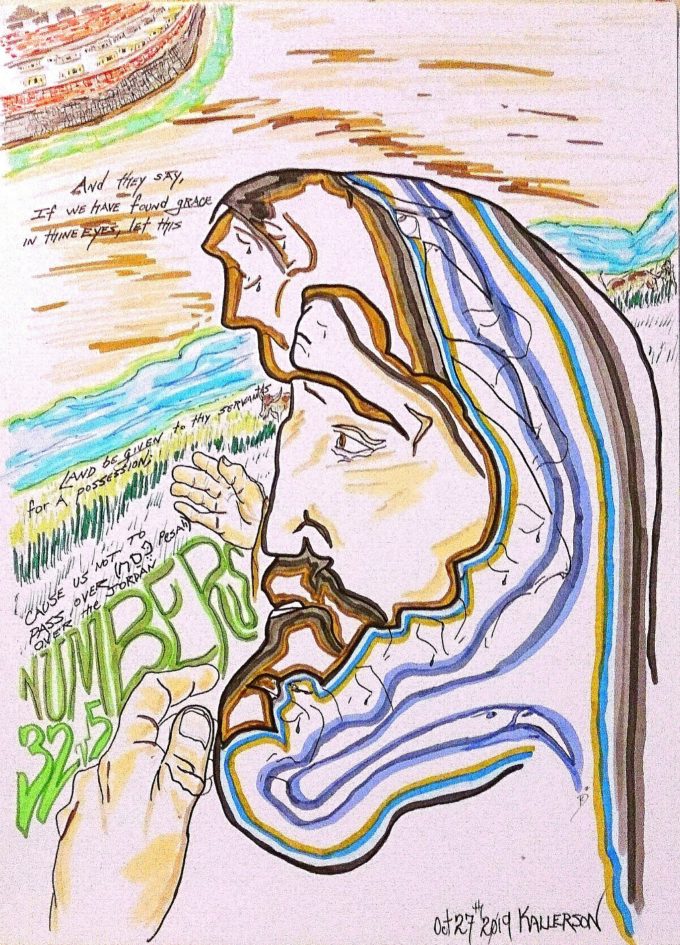
5 Therefore they said, “If we have found favor in your sight, let this land be given to your servants as a possession.
The words are in the singular, and thus the address is to Moses alone. They have noted that the Lord gave the land to Israel, and Moses is the one to speak on behalf of the Lord. And so they say, “If we have found grace in your eyes.”
It is a common expression first introduced when Abraham spoke to the Lord in Genesis 18. Its meaning is obvious. “We have a request, and we look to you for approval if it is your will to favor us in the matter.” In this case, it is for their own possession east of the Jordan instead of in the land of Canaan.
5 (con’t) Do not take us over the Jordan.”
ha’yarden, or the Jordan, meaning the Descender, is the dividing line between the hope of the promise and the realization of it. It gets its name from the great descent it makes. It goes from the top of Mount Hermon all the way down to the lowest elevation on earth, the Dead Sea.
In typology, the Jordan pictures Christ who descended from the heights of heaven to come to earth, and who even descended to death itself. Passing over the Jordan means to pass over to what God has promised.
To Israel, it is an earthly inheritance. To those whom Israel look to in type, it is restoration and fellowship with God. Moses probably had no idea about the typology, but he certainly had an idea about rejecting the promise, and doing so at the expense of others…
6 And Moses said to the children of Gad and to the children of Reuben:
As occurred in verse 2, and as will continue throughout the chapter, Gad is again placed first. The text appears to be showing that it is Gad who is the main tribe behind the plan, and thus the main tribe to be addressed first in the incident. For them, there is the seeking of a fortune east of the Jordan to which Moses now responds…
6 (con’t) “Shall your brethren go to war while you sit here?
There is a rather sharp dividing line between what scholars see as the intent behind this request by Gad and Reuben. Some see it in the negative. They are cowardly and self-seeking, or at best uncaring about the plight of the other tribes who must go in and subdue Canaan.
Others see it as a trust in the fact that the Lord won all of the battles so far for them, and thus the conquest of Canaan is a foregone conclusion, of which they need not even be present in order for it to come about.
We can only speculate on which is correct, and we can’t even know if what transpires later in the passage was already considered by them and is something they would have voluntarily acted upon. It is certain, however, that they are content with what they possess.
We have seen how profitable it is to have men of war win in battle. The amount of plunder that came to the soldiers as it was divided would have been an enormous enticement to join all of Israel in each battle. If they did not intend to assist in the battles, it means that they felt what they had was sufficient for them.
But two things are for sure to Moses. The first is that Israel is a collective whole, and secondly, Moses takes their words in the most negative light possible. Rightly or wrongly, he sees this as an act of cowardice and/or uncaring greed.
Because what they have said so far is at best vague as to any other intentions, he takes their request as basically asking for land that has been subdued by the entire congregation of fighting men while they can sit and enjoy the spoils of others’ efforts.
At the same time, the rest of Israel still has to fight its way through its inheritance. And there is good reason for his attitude. And so he begins with…
7 Now why will you discourage the heart of the children of Israel from going over into the land which the Lord has given them?
Here Moses uses a word, nu, seen only four times in Numbers 30. That was concerning a father or a husband forbidding a vow which was made by a woman under his authority. It would appear that it should be taken in a similar way.
It is as if these two tribes have the authority to forbid the hearts of the children of Israel from going over the Jordan. It isn’t just that they would merely discourage the hearts of the people, but that they would be the force behind them being incapable of going over.
Moses even says that it is “the land which the Lord has given them.” It is their possession, but he acts as if these two tribes are actively forbidding Israel to enter. To support this, he says…
8 Thus your fathers did when I sent them away from Kadesh Barnea to see the land.
This goes back to the last time that Israel was at the door of Canaan. They had arrived at the Wilderness of Paran, and Moses had sent men to spy out the land. Here, he calls them “your fathers.”
He is directly tying Gad and Reuben into the family that transgressed against the Lord, showing that they are of the same seed that brought about great woe to the people. Upon their return, they brought back a bad report, thus causing the people to turn their hearts away from advancing into Canaan.
Here, the spot is called Kadesh Barnea for the first time. Before, it was called simply Kadesh, or Holy, and the reason for that was that while in that spot Moses had failed to hallow the Lord before the people’s eyes. Now it is called Kadesh Barnea which means either “Sacred Desert of Wandering,” or maybe in the active sense, “Holy Purifying Wanderings.”
The reason for using the term Kadesh Barnea now for the first time seems to be an indictment on the attitude of the people which caused them to become fugitives, wandering in the desert for thirty-eight years. Moses is reminding them that this was the result of Israel’s previous disobedience while standing right at the door of entrance into Canaan.
His words are intended to wake them up to the severity of the situation and to remind them of the consequences of the actions of the people. With this in mind, he continues with…
9 For when they went up to the Valley of Eshcol and saw the land,
Moses could have chosen any point among the journeys of the twelve spies, but his words single out the Valley of Eshcol. And so it needs to be re-explained what nakhal eshkol, or the Valley of Eshcol, means.
The word nakhal signifies a wadi where water would flow through during the seasons of rain. That word comes from nakhal meaning, “to take possession,” or “inherit.” Eshcol means “cluster.” But that comes from the word eshek, meaning testicle.
As we learned, this pictured Christ’s work. Once having been accepted, He took possession of that which proceeds from the spot where man is generated from. In other words, it is a picture of the overriding of original sin in man.
Sin transfers from father to child. The semen, which is generated in man, is what transfers that sin. Christ has, through His work, taken possession of that in all who move from Adam to Him. It is the realization of the kingdom for His people through this act.
This, however, was rejected by Israel, just as the spies who went into the Valley of Eshcol had rejected the promises of the Lord. The Lord, through Moses’ words to these men, is giving us a recounting of what brought them to the disaster that followed – both for that generation, and for the generation who would come and reject the work of Christ. For the wilderness generation…
9 (con’t) they discouraged the heart of the children of Israel,
Moses again uses the word nu, to forbid, which he used in verse 7. This is its last use in the books of Moses, and he is essentially saying, “…they forbid the heart of the children of Israel.” The word “heart” is in the singular. The people are a collective whole with one undivided heart.
The spies had discouraged that heart, forbidding it to have faith in the promises of the Lord, and causing them to instead disbelieve. One can clearly see the parallel which caused Israel to disbelieve in the work of Christ which is found in Matthew 28 –
“‘“Now while they were going, behold, some of the guard came into the city and reported to the chief priests all the things that had happened. 12 When they had assembled with the elders and consulted together, they gave a large sum of money to the soldiers, 13 saying, “Tell them, ‘His disciples came at night and stole Him away while we slept.’ 14 And if this comes to the governor’s ears, we will appease him and make you secure.” 15 So they took the money and did as they were instructed; and this saying is commonly reported among the Jews until this day.”’” Matthew 28:11-15
The spies in the wilderness, leaders among the people, forbid the people to trust in the Lord through their negative report, and the leaders of Israel at the time of Jesus did the same. They spread a bad report which caused their own extended punishment.
Moses’ final two uses of this word nu here, after its introduction just two short chapters ago, is intended to show us this. It isn’t just that the collective heart of the people was discouraged, but that it was forbidden from faith by the actions of the leaders. This is also exactly repeated by the author of Hebrews.
In Hebrews 4, which is a book directed to the end times Jews, those who are exactly being pictured in these Numbers sermons, we read this in Hebrews 4:1-13 (Please read these verses). Because of this, Moses continues with…
9 (con’t) so that they did not go into the land which the Lord had given them.
The word that Moses uses here, though not uncommon, is one which is stronger than simply not doing something. It is a failure to do something. One might paraphrase this as, “so that they failed to go into the land.”
Moses is recounting what occurred before directly speaking what is on his mind concerning the request of Gad and Reuben in order to set the stage for why it is on his mind at all. The spies forbid the hearts of Israel, and therefore Israel failed to obtain the promise.
This is what Paul speaks of concerning Israel in Romans 11, where he calls Israel’s rejection of Christ – meaning the promise – a failure, which in turn meant riches for the Gentiles.
The pattern is obvious. Israel’s earthly rejection of Canaan here in Numbers is a direct picture of Israel’s rejection of Christ and thus a spiritual rejection of restoration with God. Canaan the land is representative of restored paradise and fellowship with God. This is seen in the next words…
10 So the Lord’s anger was aroused on that day,
v’yikhar aph Yehovah ba’yom – “And burned nostril Yehovah that day.” The imagery is that of Yehovah’s nostrils flaring with anger and shooting forth flames.
Imagine the anger of the Lord at the faithless people who had seen all of His great wonders cowering at the report and rejecting the Lord and His promises there in Kadesh Barnea. It was a faithless act which brought them punishment, exile, and rejection.
Now imagine the anger of the Lord at the faithless people who had seen all of the miracles and wonders of Christ the Lord, and then rejected Him and His promises. And so…
10 (con’t) and He swore an oath, saying,
The word of the Lord is an oath in and of itself. He does not need to say, “I swear,” for His word to be confirmed. But when He does, it is a sign to the people that what He says will come about.
In Numbers 14, He added an extra confirmation to what he will next say in verse 11 with the words, “‘As I live,’ says the Lord.” It was His way of saying that what He was to utter would be performed. The substance of what He then said in Numbers 14 is repeated by Moses now…
11 ‘Surely none of the men who came up from Egypt,
Here Moses speaks to them concerning those who “came up from Egypt.” They were redeemed from Egypt. Egypt pictures bondage to sin. The Lord, in fact, redeemed Israel from their sin through His work. But there is a difference between being redeemed potentially and being redeemed actually.
Jesus redeemed Israel potentially, but they had to accept His redemption to be redeemed actually. In this, Moses calls them ha’anashim ha’olim. The word olim is a verb. Thus it reads, “the men, the ‘coming uppers’ from Egypt.” They were brought up, but they would not continue on the trek into Canaan…
11 (con’t) from twenty years old and above,
Twenty is the number of expectancy. Those who expect have not yet attained. In this case, they never would. Theirs was to be an expectancy which will end in futility.
It is a curse upon the people which was then executed, day by day and step by step through the wildness. For thirty-eight years, they suffered under the curse, leaving none of that generation left to enter into the inheritance.
11 (con’t) shall see the land
Here Moses uses the term ha’adamah, or the land, when speaking of the land the Lord promised to Abraham, Isaac, and Jacob. However, in Genesis 12, 13, and 15, and elsewhere when the promises were spoken to Abraham, the Lord used the term ha’aretz, the land. It is also used by Isaac, Jacob, Joseph, and etc.
This is not without purpose. ha’aretz, or “the land,” speaks of the area. ha’adamah, or “the land,” speaks of the soil; the ground. However, the word comes from the same source as “Adam.” This is an obvious picture of the coming Christ. Paul calls Jesus “the last Adam” in 1 Corinthians 15:45.
Moses’ use of the word ha’adamah here is a picture of Christ, the last Adam. He was the hope of Abraham, Isaac, and Jacob. The Messiah to come was their anticipation. The Lord, through the inspiration of these words spoken by Moses, is prophetically looking forward to the generation who would reject Jesus and He is saying that “none of these shall see the Messiah.”
This doesn’t mean they wouldn’t see Jesus. They saw Him, rejected Him, and crucified Him. It is saying that they wouldn’t see what He offered them – meaning Himself. They rejected Jesus and they did not see the last Adam.
It is then reminiscent of what the Lord promised to Israel if they rejected His coming Messiah in Malachi 4. At the end of that chapter, as the Old Testament closes out, He told the people –
“Remember the Law of Moses, My servant,
Which I commanded him in Horeb for all Israel,
With the statutes and judgments.
5 Behold, I will send you Elijah the prophet
Before the coming of the great and dreadful day of the Lord.
6 And he will turn
The hearts of the fathers to the children,
And the hearts of the children to their fathers,
Lest I come and strike the earth with a curse.” Malachi 4:4-6
The people turned away from the Lord and He sentenced them to die in the wilderness over the next thirty-eight years. The people rejected Christ, and the Lord struck their land with a curse, exiling them for the next two thousand years. Their expectancy would end in futility.
11 (con’t) of which I swore to Abraham, Isaac, and Jacob, because they have not wholly followed Me,
This is the only time in the book of Numbers that Abraham or Isaac is mentioned. It is also the only time that Jacob is mentioned as the man, Jacob. Seven other times Jacob is mentioned, but in those instances, it is speaking of Jacob the people who are Israel. There is an important reason for naming Abraham, Isaac, and Jacob here.
The question that must be asked is, “When did the Lord swear the land to Abraham, Isaac, and Jacob? Was it before the giving of the law, or after?” It was not after, but before. Therefore, the promise is not of the law, but of grace. Abraham, Isaac, and Jacob wholly followed the Lord, because they believed the Lord. They demonstrated faith.
The law is not of faith, but of works. However, those under law can still demonstrate faith. It is by faith, and by faith alone that the promise is obtained. That is why Paul said this in Galatians 3 –
“And this I say, that the law, which was four hundred and thirty years later, cannot annul the covenant that was confirmed before by God in Christ, that it should make the promise of no effect. 18 For if the inheritance is of the law, it is no longer of promise; but God gave it to Abraham by promise.” Galatians 3:17, 18
Abraham was given the promise. He believed. Isaac received the promise. He believed. Jacob received the promise. He believed. Israel received the promised, and they failed to have faith in the promise.
This is why Abraham, Isaac, and Jacob are mentioned here, and only here, in the book of Numbers. Moses is reminding the people of their responsibility as they stand at the very borders of Canaan. Nobody of that faithless generation was to enter the promise…
12 except Caleb the son of Jephunneh, the Kenizzite, and Joshua the son of Nun,
The Lord uses the same word as in verse 9 where it said they did not go into the land. They failed to do so. Here, he uses the same word with an attached preposition, translated as “except.” Where Israel failed, they are the exception.
Here, Caleb, or “Dog,” is named first. He is identified by his father’s name Yephunneh, or “He will be beheld.” He is also identified here as a Kenizzite, a descendant of Canaan, or a son of Kenaz, which is an Edomite name. Later in Joshua, his brother Othniel is identified as a son of Kenaz.
Thus, it is likely that he was of foreign birth and brought into the people of Israel and the tribe of Judah. The emphasis on him being a Kenizzite is to show his Gentile heritage.
Next Joshua, or “The Lord is Salvation,” is named. He is identified as the son of Nun, or “To propagate” or “Increase.” These two then, as was seen in Numbers 14, picture both Gentiles and faithful Jews who would receive the inheritance in Christ, even while collective Israel was in their time of punishment.
This is not to say that Caleb himself was a Gentile, but the identification of him as a Kenizzite is given to show this in typology. Where Jews regarded Gentiles as dogs, seen in Caleb, the Lord accepted them because of Christ. His father’s name further shows this, “He will be beheld.”
For those faithful Jews who have come to Christ, they are represented by Joshua, or “the Lord is Salvation.” Naming his father, Nun, shows that the Lord, would propagate, or increase His offspring through these faithful Jews. As always, the typology is given to show Christ and His redemptive plans for His people. This is because His people are represented by them. As He says…
12 (con’t) for they have wholly followed the Lord.’
Moses now takes the words he just cited from the Lord in the previous verse and turns them. Quoting the Lord, he said, ki lo milu aharai – “for no fully followed after Me.” But of Caleb and Joshua, he says, ki milu ahare Yehovah – “for they fully followed after Yehovah.”
The question is, “How did they fully follow after the Lord?” The answer is simple – They believed in Him, and they believed Him. They demonstrated faith in the promise of the Lord, just as Abraham, Isaac, and Jacob did. They were men of faith, and it is by their faith that they would receive the promise. Those of the law are shown to be excluded from the promise because the law is not of faith, but of works.
13 So the Lord’s anger was aroused against Israel,
Moses repeats the same thought as in verse 10. There he said, “And burned nostril Yehovah that day.” Now he says, “And burned nostril Yehovah in Israel.” The spies discouraged the heart of the people which caused the people to not wholly follow Him. The one action led to the other, and the Lord’s anger was aroused…
13 (con’t) and He made them wander in the wilderness forty years,
The number forty in Scripture points to a period of probation, trial, and chastisement. Israel failed to believe, and they were judged for that, receiving the Lord’s chastisement for their unbelief. The pattern follows through with Israel’s rejection of the Lord.
Though Israel could be considered to have been punished, they were not destroyed. God had promised to never forsake His covenant with them, and He has kept that promise. Though chastised, they were not destroyed. Instead, they died off…
13 (con’t) until all the generation that had done evil in the sight of the Lord was gone.
The question must be asked, “What evil did they do which brought about their state?” The fact is that Israel did a lot of evil, but the specific evil that the Lord, and now Moses, imputes to them is the evil of unbelief. Whereas Caleb and Joshua demonstrated faith, Israel was faithless. It is that simple. One is deemed right through belief, or he is deemed as out of the Lord’s favor through unbelief.
And it is not enough to simply believe in God. That is something most people do. One must also believe God. When He speaks, His word is to be accepted. Israel failed with the exception of Caleb and Joshua.
14 And look! You have risen in your fathers’ place,
v’hinneh qamtem takhat abotekhem – “And behold! You have risen up under your fathers.” Moses’ words in verse 14 are direct, specific, and powerful. The meaning of this clause is that they have now risen up in the same way as their fathers did who came before them. The God’s Word Translation paraphrases this as, “You’re just like your parents!” Or, as John Gill says, “Like fathers, like sons.”
14 (con’t) a brood of sinful men,
tarbut anashim khataim – “an increase of men – sinners.” God’s Word Translation again gives a resounding paraphrase – “You’re a bunch of sinners…”
The idea here is that just as their fathers were sinners, so they have risen up in place of their fathers and are simply adding more sinners to that heap of sinners who came before them. It is evident that Moses is severely upset with these people. He is even beside himself. And so he goes on…
14 (con’t) to increase still more the fierce anger of the Lord against Israel.
lispot od al kharon aph Yehovah el Yisrael – “to scrape up still more upon the burning nostril of Yehovah towards Israel.” The words must have been like arrows coming off of Moses’ lips.
The word he uses, and which is translated as “increase,” is saphah. It comes from a root meaning to scrape or to shave. Thus, there is an increase of what is scraped, or there is a removal of what is scraped. In this case, it is combined with the word od, or “again,” and so it is an increase.
Moses has already twice mentioned the burning nostril of Yehovah. Now, his words show that the anger has not gone away. It is still alive from the actions of the faithless men almost forty years earlier. And now, the action of Gad and Reuben is adding fuel to that fire, which has been – and will be – directed towards Israel. This is so certain that Moses continues with…
15 For if you turn away from following Him, He will once again leave them in the wilderness, and you will destroy all these people.”
The words take them back to the time when the spies returned from Canaan. The people awaited word about the land, and the spies gave a bad report. In this, they caused the people to turn away from following the Lord.
Moses is saying that exactly the same thing will happen. The people will get disheartened by the display of cowardice on Gad and Reuben’s part, and they will turn from following the Lord. In this, He will again consign them to their fate in the wilderness, and the people will again wander until they are destroyed. Moses speaks out the general substance of Ecclesiastes 1:9 –
That which has been is what will be,
That which is done is what will be done,
And there is nothing new under the sun.
Moses hopes to avoid that through his rebuke of what has come before him.
The Lord desires to show His favor to you
He will open the Door and lead you to glory
This is what He is set to do
If you will but believe the gospel story
In fact, the door is open if you will just but believe
And through that Door, you can enter into glory
All He asks is that His Son you will receive
Yes, He asks you to accept the truth of the gospel story
And when you do, the Door will never again be shut
Your access through Him is a guarantee of glory
This is His promise without an “if,” “and,” or “but”
It is yours forever because you trusted the gospel story
II. The Proposal and Promise (verses 16-19)
16 Then they came near to him and said:
It says, “And they came near him.” It seems to be that they may have shrunk back from Moses at his rebuke, or they retired from him to talk the matter over, or something such as this.
Whatever the intent is, they had either already determined to take this course of action and had not been given the chance to speak, or they decided on the course of action they will present, and they now bring it forward as a proposal for Moses to hear.
16 (con’t) “We will build sheepfolds here for our livestock, and cities for our little ones,
The Hebrew term translated as “sheepfolds” is gidrot tson. It means, “walls livestock,” and thus an enclosure of stones which livestock would be led into when they were not grazing.
It is interesting that they mention building the sheepfolds even before mentioning cities for their families. The chapter began with the thought of the tribes possessing much livestock, and that the land was a region for livestock. It seems that these people are almost possessed by their possessions.
In his response to them in verse 24, Moses will place the little ones first before the livestock. After that, in verse 34, it will confirm that they built the cities, along with the sheepfolds following the order of Moses’ words.
Here, the term taph, or “little ones,” normally speaks of children, but in this case it extends out to any who are weak or defenseless.
And finally, the word translated as “build,” signifies the process of building. It can be from scratch, or to fortify. In this case, it is probably the latter. They had gone into a land already occupied and subdued it. They would simply need to repair that which was broken down. It is a process that would not take a great deal of time if so. Once the task was complete, or as it was ongoing…
17 but we ourselves will be armed,
In contrast to the families who are secured in cities with their livestock, the males promise to instead stand withdrawn from them, implying armed for battle. And to show their determination in the matter, they then say…
17 (con’t) ready to go before the children of Israel
Here is a new word, khush which is certainly an onomatopoetic expression. It means to make haste. Figuratively, it means to be eager with excitement.
To prove they had no intent on cowardice, they show that they are, in fact, eager to go forward with Israel. And so, they will hasten to be set so that there will be no delay for Israel because of them.
They further state that they are ready to go liphne, or “before” them. The word can mean “before,” “in the presence of,” and so on, but it surely indicates “before,” as “in front of.” They have been accused of cowardice, and their response is to indicate that they are exactly the opposite. They will set the pace of the battles for all others to emulate. And this will last…
17 (con’t) until we have brought them to their place;
This means they will be with them during the entire campaign. They will not break ranks with their brothers until the land is subdued. But they must first put up fortifications in the land…
17 (con’t) and our little ones will dwell in the fortified cities because of the inhabitants of the land.
With the cities being fortified, they could be defended. It is certain that a large portion of the fighting men stayed for that purpose, and neither Moses, nor anyone else, found that unreasonable. The census of the tribes showed that Reuben had 43,730 fighting-aged men. Gad had 40,500, and Manasseh had 52,700. Half of Manasseh would be about 26,350 men. In total, they then had about 110,580 men of battle age, and yet we read this in Joshua 4 –
“And the men of Reuben, the men of Gad, and half the tribe of Manasseh crossed over armed before the children of Israel, as Moses had spoken to them. 13 About forty thousand prepared for war crossed over before the Lord for battle, to the plains of Jericho.” Joshua 4:12, 13
Therefore, almost two thirds of the fighting aged men stayed behind, continued to build, defended the people, and so on. These probably rotated in and out of the battles during the campaign to conquer Canaan.
The same would be true for the families of the other tribes west of the Jordan, and it is almost to be understood without being mentioned to or by Moses now.
18 We will not return to our homes until every one of the children of Israel has received his inheritance.
Again, like the previous verse, these words mean the tribe as a whole. It cannot mean that individuals would not return home for a vacation, a family death, or the like. The campaign to subdue Canaan is to last seven years.
Gad and Reuben as tribes of fighting men will remain until all the tribes also have what they are now about to possess. This is their word of assurance to Moses now because of their hope of what the future will provide…
*19 (fin) For we will not inherit with them on the other side of the Jordan and beyond, because our inheritance has fallen to us on this eastern side of the Jordan.”
The words here are given a precision that actually confuses some scholars. The men now speaking state that they will not take an inheritance me’ever, or on the side of the Jordan. It does not mean specifically, “on the other side.” The term simply means, “on the side,” and it can mean, “on this side,” or, “on the other side.”
In this case, the verse itself twice explains the meaning when they say, “on the side of the Jordan and beyond.” This indicates that the land on the side of Canaan may be extended beyond the original boundaries, towards Lebanon perhaps.
They then say – using the same expression – that their inheritance will fall me’ever ha’yarden mizrakhah, or “on side the Jordan, eastward.” The land of Canaan is the reference point in both. It makes no difference which side is being referred to as long as the point of reference is understood.
However, in an astonishingly inept comment, the normally sound Pulpit Commentary says of this –
“All we can say is, that the awkward use of the phrase in two opposite meanings, with words of clearer definition added, points more or less strongly towards a probability that the passage as it stands was written or revised at a later date.” Pulpit Commentary
The entire point of revision is to fix that which is broken, not to further muddy the waters. The commentator must have slipped in his bathtub and then passed out under the water too long, depriving him of oxygen, to make such a statement. Comparing the term me’ever elsewhere makes the meaning here plain and obvious.
They state that the inheritance of Israel is in Canaan, but their inheritance shall be east of the Jordan. Whether their words are presumptuous, or whether they are in the form of a petition for approval, they (and thus we) will now wait for Moses’ response.
The important point to understand in our verses today is that of what was seen earlier. It is the exemplary note of the Bible concerning a relationship with God, which is that we are to come before Him without adding anything to our request for restoration apart from what He has done in Jesus Christ.
We cannot come to Him saying, “I received Jesus and continued to obey the law to make sure that You would accept me.” Such a presentation does not give God the glory. Rather, it robs it from Him by saying that what He did is insufficient for our restoration.
We also cannot come to Him and say, “I waited for you to regenerate me before receiving Christ.” That puts an onus on God not found in Scripture. The Bible says that God is not willing that any should perish, but that all should come to repentance.
However, if God regenerating man first is true, then it means that He must make a second move beyond the giving of His Son, a concept not taught in Scripture. Rather, He has given His Son, and He expects us to receive Him. Israel failed at that; we must not fail unless we too are set to perish.
God has opened the doors of restoration, and He has paved the way to paradise. Be wise and discerning and receive what He has done. Come to Christ and be reconciled to God through Christ’s precious shed blood.
Closing Verse: “We who are Jews by nature, and not sinners of the Gentiles, 16 knowing that a man is not justified by the works of the law but by faith in Jesus Christ, even we have believed in Christ Jesus, that we might be justified by faith in Christ and not by the works of the law; for by the works of the law no flesh shall be justified.” Galatians 2:15, 16
Next Week: Numbers 32:20-42 This is the land they will for themselves be a’gainin’… (A Possession East of Canaan) (63rd Numbers Sermon)
The Lord has you exactly where He wants you. He has a good plan and purpose for you. It may seem at times as if you are lost in a desert, wandering aimlessly. But the Lord is there, carefully leading you to the Land of Promise. So follow Him and trust Him and He will do marvelous things for you and through you.
Do Not Take Us Over the Jordan
Now the children of Reuben and the children of Gad
Had a very great multitude of livestock
And when they saw the land of Jazer and the land of Gilead
That indeed the region was a place for livestock
———-of the herd and the flock
The children of Gad and the children of Reuben
Came and spoke to Moses, with words to be conveying
To Eleazar the priest
And to the leaders of the congregation, saying
“Ataroth, Dibon, Jazer, Nimrah, Heshbon
Elealeh, Shebam, Nebo, and Beon – nine cities in which to walk
The country which the Lord defeated
———-before the congregation of Israel
Is a land for livestock, and your servants have livestock
Therefore they said
“If we have found favor in your sight
Let this land be given to your servants as a possession
Do not take us over the Jordan; we think this is right
And Moses said to the children of Gad
———-and to the children of Reuben: Let me get this clear…
“Shall your brethren go to war while you sit here?
Now why will you discourage the heart
Of the children of Israel
From going over into the land
Which the Lord has given them? Please do tell!
Thus your fathers did when I sent them away
From Kadesh Barnea to see the land; listen now, I pray
For when they went up to the Valley of Eshcol and saw the land
They discouraged the heart of the children of Israel
So that they did not go into the land
Which the Lord had given them. That didn’t go so well
So the Lord’s anger was aroused on that day
And He swore an oath. Here’s what He did say…
‘Surely none of the men who came up from Egypt
From twenty years old and above, yes from twenty
Shall see the land of which I swore to Abraham, Isaac, and Jacob
Because they have not wholly followed Me
Except Caleb the son of Jephunneh, the Kenizzite
———-and Joshua the son of Nun, according to His word
For they have wholly followed the Lord
So the Lord’s anger was aroused against Israel
And He made them wander in the wilderness forty years
Until all the generation that had done evil
In the sight of the Lord was gone, wandering on a trail of tears
And look! You have risen in your fathers’ place
A brood of sinful men
To increase still more the fierce anger of the Lord
Against Israel once again
For if you turn away from following Him
He will once again leave them in the wilderness
And you will destroy all these people
We’re talking here one giant mess
Then they came near to him and said:
“We will build sheepfolds here for our livestock
———-as to you we now tell
And cities for our little ones
But we ourselves will be armed, ready to go
———-before the children of Israel
Until we have brought them to their place
And our little ones will dwell, please now understand
In the fortified cities
Because of the inhabitants of the land
We will not return to our homes, no not even by chance
Until every one of the children of Israel
———-has received his inheritance
For we will not inherit with them
On the other side of the Jordan and beyond
Because our inheritance has fallen to us
On this eastern side of the Jordan of which we are fond
Lord God, we are even now in a wilderness
And we are wanting to be led by You
Without You to direct, our lives would be a mess
And so, be our guide, O God; You who are faithful and true
We long for the water in this barren land
May it flow forth from the Rock, our souls to satisfy
Give us this refreshing, spiritual hand
And may we take it, and to our lives daily it apply
And we shall be content and satisfied in You alone
We will follow You as we sing our songs of praise
Hallelujah to You; to us Your path You have shown
Hallelujah we shall sing to You for all of our days
Hallelujah and Amen…