Numbers 31:25-54
The Spoils of Midian
In the doctrinal and ethical portion of his commentary on this passage, John Lange equates what we see in Numbers 31 with what the Christian should be involved in at all times, meaning a battle against the foe. He says –
“As Jehovah is Israel’s God, who has bound Himself with them, so every attack upon Israel is an attack upon God. The analogy which holds between the war of Israel against the Midianites and the Christian warfare of all the people of God against His foes and theirs, is suggestive and instructive.”
It is certain that he is not referring to a war against non-believers, such as the crusades. What we see in Israel is an earthly nation selected to be the people of God, and who are to be obedient to Him in all ways. As He directs, they are to comply.
At times, what the Lord directs in the Old Testament may hurt our modern sensibilities, but the Lord is God and His judgments are His alone. Our possible dislike of what He has commanded does not negate that what He commanded is right, and that what His people did in the execution of His commands was also right.
Last week we saw that Midian was to face vengeance for what they did, and they indeed received the full measure of it. This week, we will see the rewards for Israel’s obedience to the call. And, along with their rewards, they display something quite often neglected by the Lord’s people – both in the Bible and in our daily life.
Text Verse: “I will remember the works of the Lord;
Surely I will remember Your wonders of old.
12 I will also meditate on all Your work,
And talk of Your deeds.” Psalm 77:11, 12
The psalmist said that he would remember the works and wonders of the Lord, and that he would also mediate on them and… talk of them. It is a note of gratitude for the Lord’s hand upon his life. It is the sin of ingratitude which must most fill the hearts of Christians in general. Maybe not at first, but as the years go by, we forget that the debt we were forgiven, and the mercies we were shown, were not just small things, but that they bear infinite weight.
Of ingratitude, Benjamin Franklin said, “Most people return small favors, acknowledge medium ones and repay greater ones – with ingratitude.” That is certainly true with the Christian.
When we pray about our sick dog, we are grateful when it gets better and we decide to do something good to return to the Lord the favor. Maybe by praying for another person’s sick dog. That seems fair. When we have something pretty big happen in our life, we will generally acknowledge it. “The Lord sure pulled me out of that fire. I could have died, but the cancer was cured. Maybe I’ll go to church on Sunday. Well, just one Sunday.”
But of the greatest favor of all, that of being forgiven of all of our sin and granted new life in Christ, it is sadly true that most Christians repay the Lord with a state of complete ingratitude. Really think about the lives of those believers we know and see if how they conduct themselves is as if they are truly, truly grateful.
I think that for the most part, you will see that we really don’t demonstrate a level of gratitude commensurate with the size of the favor that was bestowed upon us. Obviously, we can never repay an infinite, but at least we have an infinite amount of time to try. The problem is, that it’s easier to put it off until sometime later. And later is, after all, an infinite all by itself.
Israel demonstrates gratitude in today’s verses, and when they do, Moses and Eleazar take the sign of that gratitude and lay it up before the Lord as a memorial. The word there is zikaron. That comes from zakar, or “remember,” which is the exact word the psalmist used in our text verse, saying that he would remember the works of the Lord.
Let us remember the works of the Lord, and let His works be as a memorial to us so that we never forget, and never fail to be grateful for what He has done for us. Let the eternal “later” not be found on our lips or in our actions.
Instead, may we be grateful right now and forever, and let us do so through the holy war that we engage in. Not an earthly, fleshly battle, but a spiritual one that we have been charged to fight. And, in the conduct of our war, then our deeds of faith in that battle can be stored up as their own memorial before God of our faithfulness to His kind hand upon us.
This is a precept which has been given to us in His superior word. And so, let’s turn to that precious word once again and… May God speak to us through His word today and may His glorious name ever be praised.
I. Much Plunder (verses 25-47)
25 Now the Lord spoke to Moses, saying:
The translation is incorrect. In fact, very few translations caught the change. Such an introductory phrase normally says, “And the Lord spoke to Moses, saying…” Here it says the much rarer, “And the Lord said to Moses, saying.”
The Hebrew words for “spoke” and “said” carry essentially the same idea, that of conveying a message, but “said” is more concise. It usually means the task is complex and it requires a partnership and people working together.” This is what will be seen…
26 “Count up the plunder that was taken—of man and beast—
sa eth rosh malqoakh ha’shevi – “Lift up the head of the plunder of the captive.” It is a way of saying that each head is to be counted of the living prey. That is further defined as ba’adam u-ba’behemah, or “of man and of beast.” All that was taken as a living prey is what is spoken of here.
26 (con’t) you and Eleazar the priest and the chief fathers of the congregation;
These are certainly required so that no one could later say that an unfair counting was made. The leader, the high priest, and all of the rashe, or heads, of the congregation would be included in the counting. Thus, it would be a fair and unbiased counting.
27 and divide the plunder into two parts, between those who took part in the war, who went out to battle, and all the congregation.
The idea here is that all of the living spoil was gathered in one whole, and then it was divided equally into two parts. The division would be without partiality so that no one could say, “They got the better half.” From there, one half would go to those who went to battle, a small portion of the whole number of Israel.
As there were over 600,000 counted as ready for battle in the recent census, and as only 12,000 of those were selected, the division seems hugely one-sided and unfair, but it is not. By dividing it this way, it would spur those who were battle capable in the future to willingly go out to fight.
These 12,000 represented the whole, and they had earned what was won in battle. But the congregation was still entitled to a half because they were represented by their fighting men who had gone to war. For any who died in battle, a portion would naturally be set aside for the tribe as an honor of their fallen hero. What comes later in this passage does not negate this division. Rather, it highlights it.
28 And levy a tribute for the Lord on the men of war who went out to battle:
v’haremota mekes l’Yehovah – “And raise a computation to Yehovah.” The verb is rum, it signifies to lift up or raise. It is the basis for the word terumah, or heave offering. This is what is being conveyed. It is to be as a heave offering to the Lord.
The word translated as “tribute” is a new word, mekes. It signifies a computation or a tax. It will be seen six times in this passage and nowhere else. This first mekes is to be taken from the half set apart for those who went out to the battle.
28 (con’t) one of every five hundred of the persons, the cattle, the donkeys, and the sheep;
Here it says, ekhad nephesh, or “one soul.” It defines the beings as living. Of the living beings, one of every five hundred of each category is to be raised up to the Lord.
29 take it from their half, and give it to Eleazar the priest as a heave offering to the Lord.
The idea here is that this 1/5th of a percent would be the Lord’s portion as acknowledgment that the victory was ultimately His. This was to be given to Eleazar who represented the Lord and who stood as representative of all of the priests who would be included in the reception of the offering.
30 And from the children of Israel’s half you shall take one of every fifty, drawn from the persons, the cattle, the donkeys, and the sheep, from all the livestock,
Instead of 1/5th of a percent which was drawn out from the warrior’s half, here 2 percent is drawn from the people’s half. There is the obvious reason that because their risks were less, their taxed portion should be greater. Secondly, it is because of who receives what is drawn off in this 2 percent portion…
30 (con’t) and give them to the Levites who keep charge of the tabernacle of the Lord.”
Whereas there are few priests, there are many Levites. Therefore, as a suitable offering to them for their service between the priests and the people, they were given a larger percent from the people’s half.
One can see here how the troops who went to battle were reckoned as the Lord’s army. Phinehas the priest went with them, thus they represented the Lord in battle. The people who remained at camp, remained under the service of the Levites. Thus, the portions which have been levied from the two halves reflect these divisions.
As it says, the Levites are those who “keep the charge of the tabernacle of the Lord.” This is the fifth of nine times that the term mishkan Yehovah, or “tabernacle of the Lord” is used. When the term is used, it anticipates the Person of Christ because every part of the tabernacle reflects Him and His work.
The Levites are those who minister, standing in place of the firstborn of the congregation, and thus they represent Christ, the Firstborn of God. Each thing we are seeing anticipates Christ in one way or another. The offerings made anticipate offerings made to God in Christ.
31 So Moses and Eleazar the priest did as the Lord commanded Moses.
It is the standard note of compliance. The Lord has commanded, and the command is attended to according to His word.
32 The booty remaining from the plunder, which the men of war had taken,
What these words mean is not clear. It could mean that what is going to be detailed here is besides the other plunder not included in the living beings, some of which will be detailed in verse 50. Or, it could be the plunder that was left after the women and boys had been killed, and any animals eaten by the army during the campaign. Either way, after whatever is being referred to, the following amounts of plunder to be divided are given…
32 (con’t) was six hundred and seventy-five thousand sheep,
With a total of sheep at 675,000, this would mean 337,500 for the soldiers, and 675 from that to the Lord, meaning to the priests. It would mean that each soldier got 28 sheep as well. The people’s half would also be 337,500, and the Levites would receive 6,750 from that.
33 seventy-two thousand cattle,
A total of 72,000 cattle means 36,000 for the soldiers, and 72 from that to the Lord, meaning to the priests. It would mean that each soldier got 3 cattle as well. The people’s half would also be 36,000, and the Levites would receive 720 from that.
34 sixty-one thousand donkeys,
A total of 61,000 donkeys means 30,500 for the soldiers, and 61 to the Lord, meaning to the priests. It would mean that each soldier got 2 donkeys, but there would be 6,500 extra that would need to be divided in some fair way between them. The people’s half would be 30,500, and the Levites would receive 610 from that.
35 and thirty-two thousand persons in all, of women who had not known a man intimately.
A total of 32,000 young virgins means 16,000 for the soldiers, and 32 to the Lord, meaning to the priests. There would be one virgin for each soldier, but there would be about 4,000 extra that would need to be divided in some fair way between them. The people’s half would be 16,000, and the Levites would receive 320 from that.
36 And the half, the portion for those who had gone out to war, was in number three hundred and thirty-seven thousand five hundred sheep;
This is the warrior’s half. As noted, it would mean that each soldier got 28 sheep. Also…
37 and the Lord’s tribute of the sheep was six hundred and seventy-five.
The priests, being small in number, fared very well.
38 The cattle were thirty-six thousand, of which the Lord’s tribute was seventy-two.
This is the warrior’s half. As noted, it would mean that each soldier received right at 3 cattle, with the priest’s 72 being taken out first.
39 The donkeys were thirty thousand five hundred, of which the Lord’s tribute was sixty-one.
This was the warrior’s half. As noted, it would mean that each soldier got 2 donkeys, but there would be about 6,500 extra that would need to be divided in some fair way between them, but the Lord’s tribute of 61 would be taken out first.
40 The persons were sixteen thousand, of which the Lord’s tribute was thirty-two persons.
This is the warrior’s half. As noted, it would mean that each soldier got one virgin, but there would be about 4,000 extra that would need to be divided in some fair way between them, but the Lord’s tribute of 32 would be taken out first.
In all, each soldier who went to war came out with a bit more than 28 sheep, 3 cows, 2 donkeys, and one virgin. And that was only of the living beings. The other plunder is not even reckoned in the total. Thus, being a soldier was a very profitable deal, and the great amount they received would be a huge impetus for all able fighting men to volunteer for such battles.
41 So Moses gave the tribute which was the Lord’s heave offering to Eleazar the priest, as the Lord commanded Moses.
The priest’s portion totaled 675 sheep, 72 cows, 61 donkeys, and 32 virgins. This was considered the Lord’s heave offering, and it was accepted on His behalf by Eleazar the priest. As a side note to keep you interested, the word mekes or “tribute” was introduced in verse 28. It was seen five more times since then. This being the last time it will be seen in the Bible. Hello and goodbye to mekes.
42 And from the children of Israel’s half, which Moses separated from the men who fought—
The numbers for those who did not go out to battle – meaning all of the rest of Israel – is detailed as follows…
43 now the half belonging to the congregation was three hundred and thirty-seven thousand five hundred sheep,
Of this, the Levites would receive 6,750 from that.
44 thirty-six thousand cattle,
Of this, the Levites would receive 720 from that.
45 thirty thousand five hundred donkeys,
Of this, the Levites would receive 610 from that.
46 and sixteen thousand persons—
Of this, the Levites would receive 320 from that.
47 and from the children of Israel’s half Moses took one of every fifty, drawn from man and beast, and gave them to the Levites, who kept charge of the tabernacle of the Lord, as the Lord commanded Moses.
In all, the Levites received 6750 sheep, 720 cows, 610 donkeys, and 320 virgins.
We bear the shield and by faith head in
We gird ourselves with truth as we seek the reward
We have a helmet of salvation for the battle to win
And in our hand, we carry the Spirit’s sword
Yes, the word of God is the instrument by which we fight
And prayer is the line to our side’s Head
Upon our feet is the gospel of peace, as is right
And we have prevailed in the battle; the enemy lies dead
The spoil is piled high from the battle of which we fought
There is great reward for those who entered the fight
On behalf of the Lord, the battle was wrought
And the rewards piled high are a beautiful sight
II. Not a Man is Missing (verses 48-54)
48 Then the officers who were over thousands of the army, the captains of thousands and captains of hundreds, came near to Moses;
This would be 12 captains of thousands and 120 captains of hundreds. Coming as a united whole, and after the division of living beings having gone so favorably in their direction, this would not be to submit a grievance at their unfair treatment. Rather, they must be amassing for something positive, gratitude perhaps. Or, maybe something even more wonderful…
49 and they said to Moses, “Your servants have taken a count of the men of war who are under our command, and not a man of us is missing.
It is a rather astonishing statement, which – of course – some in history have called out as a fabrication of the truth. However, the very fact that they will make the offering they are about to make stands as a testimony to the truth of the account. Stalin once said that “If only one man dies of hunger, that is a tragedy. If millions die, that’s only statistics.”
This is, unfortunately, a true way of looking at death. If a single soldier had died, the entire army would have come together to mourn that one loss – especially standing so close to entry into Canaan. Each and every living soldier would have taken that single loss as a personal failure.
But, if many had died, they would have taken it as a loss expected in a battle, written a warrior’s song of remembrance, and gone back to prepare for the next battle. There would have been personal mourning for friends, but overall, it would be a time of celebration for the victory.
However, neither occurred. Instead, they have come forward in acknowledgment of what is a true miracle. It doesn’t matter if they attacked before sunrise, or if it was a special Midianite holiday to sleep in all day, the expectation is that there would be losses.
Based on the number of virgins and animals that were taken as plunder, the scholar Keil estimates that the number of Midianites would have been about 130,000 to 150,000 people, of whom there would have been about 35,000 fighting-capable men.
That would make the odds about 3 to 1. Even with the advantage of surprise, the battle would have been an uphill one with many expected casualties. Instead, however, there was not only a rout of the enemy, it was a complete rout and an absolute victory. Only this can explain the next words…
50 Therefore we have brought an offering for the Lord, what every man found of ornaments of gold: armlets and bracelets and signet rings and earrings and necklaces,
Five types of gold ornaments are named here, the identification of which is difficult for some. The bracelets and signet rings are pretty certainly identified, but the other three are debated due to the rarity of the words used. Five is the number of grace, and this offering is based on the grace granted to the warriors.
All are rare, and two are new words. The first is the etsadah. It will only be seen twice. It comes from tseadah, or “a marching,” and thus it is a type of chain, translated here as “armlets.”
Another new and rare word is agil, or ring. This comes from agol, meaning round, and thus it is believed to be a hoop-style earring. It too will be seen just twice – here and in Ezekiel 16:12.
And finally, this verse contains the second and last use of the word kumaz, translated here as “necklace.” It is some type of gold ornament, though the identity is not certain.
These five types of gold ornaments are brought forward. It is debated whether only the captains brought them forward from their own booty, or whether all of the soldiers gave of what they had to the captains who then brought it all forward. Either way, they state that they are bringing this offering forward…
50 (con’t) to make atonement for ourselves before the Lord.”
The word kaphar, or atonement, simply means “to cover over.” In this, it extends to the idea of appeasing, or covering over for wrongdoing, and thus to make atonement. Scholars suggest that this was brought forward to make atonement for not having killed the women and male children, but that is not what they are tying the offering to.
Rather, they are connecting the giving of the offering to the fact that no loss of life occurred. It can be assumed, then, that if there was a loss of life, they would not have felt impelled to bring this offering forward. Therefore, the covering, or appeasement, seems to be proactive, not reactive.
They are gratefully acknowledging the Lord’s care over them. If they failed to do this, then they would be sinning against the Lord. Ingratitude is one of the greatest offenses man is guilty of. How much more in a situation as rare as this!
51 So Moses and Eleazar the priest received the gold from them, all the fashioned ornaments.
The words of the previous verse, along with these words, shows that all of what is presented is of gold. And further, it is gold which is maaseh, or worked. It is not merely gold, which was kept as money, but gold which was fashioned through works, or deeds, of effort. Of this gold, the record then says…
52 And all the gold of the offering that they offered to the Lord, from the captains of thousands and captains of hundreds, was sixteen thousand seven hundred and fifty shekels.
Scholars vary in what they believe the weight of a shekel was. The Pulpit Commentary assumes that a shekel equals 66 of an ounce. If that is so, then the total amount of gold presented as an offering to the Lord would have been about 11,000 ounces. As of 19 August, the day I typed this, that would equal at current gold prices about $16,613,850.
Some scholars say that the five kings of Midian alone would be expected to possess that much gold. If so, then it is not an outlandish amount which would make the account implausible, but rather it would confirm the account is accurate and reliable.
Further, in Judges 8, Gideon asked the men of Israel to give him a gift of the earrings alone which had been plundered from the battle against Midian at that time. These were only men who fell in battle, meaning soldiers, and so they would not bear all the gold of the family with them.
The weight of only the earrings given by each man in his army came out to 1700 shekels. Therefore, the amount here is not at all outlandish. It included all of the wealth of the houses and people, and that of the kings as well.
53 (The men of war had taken spoil, every man for himself.)
Although debated, as is usual, this seems to indicate that all of the men of war had gone about taking spoil, and that each of them gave from his spoil for this offering to the Lord. Others argue that it is telling exactly the opposite, and that only the officers gave of their spoil and everyone else gathered for himself without adding to the offering. The verses, as written, don’t really answer the matter well enough for a fixed stand one way or the other.
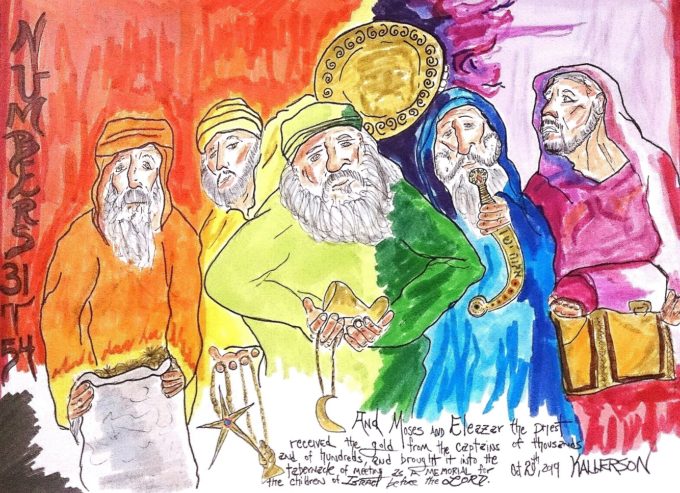
*54 (fin) And Moses and Eleazar the priest received the gold from the captains of thousands and of hundreds, and brought it into the tabernacle of meeting as a memorial for the children of Israel before the Lord.
This final verse of the chapter says that the gift that was offered up to the Lord was then brought into the tent (not tabernacle) of meeting to be a memorial before the Lord. The idea here is that of the faithfulness of the people to show appreciation for the great deliverance He had wrought.
It is certain that thanks and appreciation wax and wane through time and circumstance, and so this memorial was to be a reminder that at one time, the people were grateful, and that the Lord would hopefully remember this and be merciful during those times when appreciation was lacking.
It would also bear the remembrance that Israel had complied with the word of the Lord to take vengeance on Midian. They had mustered men and sent them out in faith that they would be victorious, despite the small force which had been selected to carry out the task.
And further, it is probable that some of the gold had even come from some of the women who had been brought as captives to the outskirts of the camp, and yet who were then sentenced to die without being assimilated into the people of Israel.
It could be that as many as 50,000 women were ordered to be executed, and it could be argued that if there were 32,000 virgins who were spared, there may have been as many as 32,000 young boys who weren’t. That would be over 80,000 destroyed.
Supposing those numbers were high, what number could we reduce it to and still have the soldiers not care about what they needed to do? If the total number was an impossibly low 24,000, that would still mean that each soldier would have to execute two non-combatants.
The offering of the gold was gratitude for the sparing of their souls, but it would also be as a memorial to the Lord that their souls were spared in order to complete the duties they were assigned, and of which they certainly accomplished.
The military force of Israel was the Lord’s arm of judgment for an attack against His people. This meant that it was an attack against Him. If the Lord wished to send a plague among the people, they would have been no less dead, but He chose this time to use Israel to defend the honor of Israel and the honor of His name.
The gold presented to Him had no more intrinsic value to Him than anything else that could have been presented. But it carried the value of a sign of both obedience and of gratitude to Him. King Saul would later fail to show either to the Lord, and it would cost him his kingship.
Saul may have looked back on what occurred here at Midian and thought he was justified to have killed every Amalekite human and to have spared the animals as Israel did here with the Midianites. But that was a different time and his were different orders.
Maybe he thought that the gold of Midian still stood as a memorial which would atone for his failure to obey, but he was mistaken. Instead, Samuel spoke out his words of rebuke to Saul –
“Has the Lord as great delight in burnt offerings and sacrifices,
As in obeying the voice of the Lord?
Behold, to obey is better than sacrifice,
And to heed than the fat of rams.
23 For rebellion is as the sin of witchcraft,
And stubbornness is as iniquity and idolatry.
Because you have rejected the word of the Lord,
He also has rejected you from being king.” 1 Samuel 15:22, 23
The obligation of God’s people, at any time in history, is to be obedient to the Lord in accord with His word as it applies to that point in history. We cannot go back to the Law of Moses, for example, and attempt to be righteous before God by adhering to it.
That is to demean the work of Christ who lived out the law and who then offers to us His righteousness as demonstrated in His fulfillment of the law. We cannot use the examples of either war against Midian or war against Amalek as examples of how we are to engage in holy war. Those were earthly battles of Israel, by Israel, and for the honor of Israel’s God.
Today, we may engage in earthly battles as citizens of the nation we are born into, but those are not holy wars. The holy war of the Christian is one which is outlined by Paul in the New Testament. Paul is explicit that our holy war is not against flesh and blood. Rather, it is a spiritual battle.
There is no longer a need for earthly holy wars because Israel’s ultimate battle, that against sin, was won by Christ. We now follow suit in that same battle. And its rules for conduct are not optional. Just as Israel obeyed the Lord and destroyed the women and male children of Midian, we are to obey the precepts of the Lord as He has outlined them to us.
If you are not actively participating in the war we have been charged to conduct, you are not being faithful to the Lord who has so charged you. Church on Sunday morning is only meant to be a place of preparation for you to be ready to conduct your warfare throughout the week. Although Paul’s words in Ephesians 6 are not the total of our obligations in this battle we are to conduct, they do give us a good summary statement of what we are to do –
“Finally, my brethren, be strong in the Lord and in the power of His might. 11 Put on the whole armor of God, that you may be able to stand against the wiles of the devil. 12 For we do not wrestle against flesh and blood, but against principalities, against powers, against the rulers of the darkness of this age, against spiritual hosts of wickedness in the heavenly places. 13 Therefore take up the whole armor of God, that you may be able to withstand in the evil day, and having done all, to stand.
14 Stand therefore, having girded your waist with truth, having put on the breastplate of righteousness, 15 and having shod your feet with the preparation of the gospel of peace; 16 above all, taking the shield of faith with which you will be able to quench all the fiery darts of the wicked one. 17 And take the helmet of salvation, and the sword of the Spirit, which is the word of God; 18 praying always with all prayer and supplication in the Spirit, being watchful to this end with all perseverance and supplication for all the saints— 19 and for me, that utterance may be given to me, that I may open my mouth boldly to make known the mystery of the gospel, 20 for which I am an ambassador in chains; that in it I may speak boldly, as I ought to speak.” Ephesians 6:10-20
Let us be prepared, let us be willing, and let us be obedient to the calling. Israel was told to take vengeance on Midian and a force of men went forward to do so. Their rewards were felt among all of the people of Israel.
Likewise, when we are obedient to the charge set before us, our rewards will be great, and the entire body will prosper because of it. But, just as those young virgins were brought into the nation of Israel as an act of grace and mercy, so we must come into the body of believers in the same way.
We must come with nothing in our hands, but the simple petition to be granted life. The physical purity of these Midianite women is to be likened unto our spiritual purity in order to be accepted. And the only way that can come about is through a new birth. And that can only come about by coming to God through Christ Jesus.
So, today you are admonished to first get right with the Lord through faith in Jesus, and then to prepare yourself daily to be right with the Lord through adherence and obedience to His word. May it be so for each one of us who desires to have our maaseh, or deeds of faith, brought before the Lord as a memorial.
Closing Verse: “Now if anyone builds on this foundation with gold, silver, precious stones, wood, hay, straw, 13 each one’s work will become clear; for the Day will declare it, because it will be revealed by fire; and the fire will test each one’s work, of what sort it is. 14 If anyone’s work which he has built on it endures, he will receive a reward. 15 If anyone’s work is burned, he will suffer loss; but he himself will be saved, yet so as through fire.” 1 Corinthians 3:12-15
Next Week: Numbers 32:1-19 Are they acting as if it is a prison and Moses is the Warden? … (Do Not Take Us Over the Jordan) (62nd Numbers Sermon)
The Lord has you exactly where He wants you. He has a good plan and purpose for you. It may seem at times as if you are lost in a desert, wandering aimlessly. But the Lord is there, carefully leading you to the Land of Promise. So, follow Him and trust Him and He will do marvelous things for you and through you.
The Spoils of Midian
Now the Lord spoke to Moses, saying:
These words to him He was then relaying
“Count up the plunder that was taken—of man and beast
———-hear now my oration
You and Eleazar the priest and the chief fathers of the congregation
And divide the plunder into two parts
Between those who took part in the war, where my fury was spent
Who went out to battle, and all the congregation
And levy a tribute for the Lord on the men of war
———-who out to battle went
One of every five hundred of the persons
The cattle, the donkeys, and the sheep; according to this word
Take it from their half, and give it to Eleazar the priest
As a heave offering to the Lord
And from the children of Israel’s half
You shall take one of every fifty, drawn from the persons
The cattle, the donkeys, and the sheep
From all the livestock and give them to the Levites who the charge
———-of the tabernacle of the Lord keep
So Moses and Eleazar the priest, as was demanded
Did as the Lord to Moses commanded
The booty remaining from the plunder
Which the men of war had taken, in the war
Was six hundred and seventy-five thousand sheep
Seventy-two thousand cattle. But wait! There’s more
Sixty-one thousand donkeys
And thirty-two thousand persons in all
Of women who had not known a man intimately
Thus by the sword they did not fall
And the half, the portion for those who had gone out to war
Was in number three hundred and thirty-seven thousand
———-five hundred sheep
And the Lord’s tribute of the sheep
Was six hundred and seventy-five; that’s a whole heap
The cattle were thirty-six thousand
Of which the Lord’s tribute was seventy-two
The donkeys were thirty thousand five hundred
Of which the Lord’s tribute was sixty-one, whoo-hooo!
The persons were sixteen thousand, there in plain view
Of which the Lord’s tribute was persons thirty-two
So Moses gave the tribute
Which was the Lord’s heave offering, according to His word
To Eleazar the priest
As had commanded Moses the Lord
And from the children of Israel’s half, as was brought
Which Moses separated from the men who fought
Now the half belonging to the congregation
Was three hundred and thirty-seven thousand five hundred sheep
Thirty-six thousand cattle, thirty thousand five hundred donkeys
And sixteen thousand persons. Once again, that’s a whole heap
And from the children of Israel’s half
Moses took one of every fifty, drawn from man and beast
And gave them to the Levites, who kept charge
———-of the tabernacle of the Lord
As the Lord commanded Moses, then the dividing ceased
Then the officers who were over thousands of the army
The captains of thousands and captains of hundreds too
Came near to Moses
And they said to Moses – their words to Moses did ensue
“Your servants have taken a count
Of the men of war who are under our command; hear our word
And not a man of us is missing
Therefore we have brought an offering for the Lord
What every man found of ornaments of gold
Armlets and bracelets and signet rings. (So much we have scored!)
And earrings and necklaces
To make atonement for ourselves before the Lord
So Moses and Eleazar the priest, those two fine gents
Received the gold from them, all the fashioned ornaments
And all the gold of the offering that they offered to the Lord
From the captains of thousands and captains of hundreds too
Was sixteen thousand seven hundred and fifty shekels
That’s a whole heap, I’m telling you
The men of war had taken spoil, every man for himself
And Moses and Eleazar the priest received the gold
———-according to their word
From the captains of thousands and of hundreds
And brought it into the tabernacle of meeting as a memorial
———-for the children of Israel before the Lord
Lord God, we are even now in a wilderness
And we are wanting to be led by You
Without You to direct, our lives would be a mess
And so be our guide, O God; You who are faithful and true
We long for the water in this barren land
May it flow forth from the Rock, our souls to satisfy
Give us this refreshing, spiritual hand
And may we take it, and to our lives daily it apply
And we shall be content and satisfied in You alone
We will follow You as we sing our songs of praise
Hallelujah to You; to us Your path You have shown
Hallelujah we shall sing to You for all of our days
Hallelujah and Amen…