Numbers 33:16-49
The Journeys of Israel, Part II
From Sinai to the Plains of Moab
In the record here in Numbers 33, from the departure from Egypt to where Israel finally ends, right at the doorstep to Canaan, there are 42 movements of the people. One can then say that there are 43 locations, but one is leaving Egypt.
If one includes entry into Canaan, that would make a final movement and a final stop, thus equaling 44 locations in 43 movements. But the record of Numbers 33 specifically refers only to these 42 movements, and thus it is certainly intended for us to look at where the number 42 may be seen elsewhere in Scripture.
And, indeed, there are a few. Two notable ones are found first in 2 Kings 2 where two bears killed forty-two rascally youths, and in 2 Kings 10, forty-two brothers of Ahaziah got whacked. EW Bullinger says of the Number 42 –
“FORTY-TWO is a number connected with Antichrist. An important part of his career is to last for 42 months (Rev 11:2, 13:5), and thus this number is fixed upon him. … Its factors are six and seven (6×7=42), and this shows a connection between man and the Spirit of God, and between Christ and Antichrist: … Being a multiple of seven, it might be supposed that it would be connected with spiritual perfection. But it is the product of six x seven. Six, therefore, being the number of Man, and man’s opposition to God, forty-two becomes significant of the working out of man’s opposition to God.”
That actually fits perfectly with the stops of Israel along the way to glory. It seems that at almost every stop, Israel was working in opposition to God, or they were in extended punishment for being in opposition to God. As Israel is a snapshot of the redemption of man from leaving Egypt, picturing life in bondage to sin, to entering Canaan, picturing coming to the place of rest promised by God through Christ, we can see how we stand in opposition to God even after having been redeemed by Him. That shows us of the wonderful marvel which is found in the grace of God in Christ.
For Israel, the last forty-two months of the tribulation period are reflective of this as well. It will take that period to finally break down their opposition and come to the point where they call out to Christ. But it will happen. Though there is opposition, there is still God’s powerful hand working through it. There is also one other interesting use of the number forty-two worth looking at today…
Text Verse: “So all the generations from Abraham to David are fourteen generations, from David until the captivity in Babylon are fourteen generations, and from the captivity in Babylon until the Christ are fourteen generations.” Matthew 1:17
The three sets of fourteen generations listed in Matthew 1 come to a total of forty-two generations. A promise was made, and from that time, all the way through until it was fulfilled, man stood in opposition to God.
But God worked all the way through that period to bring man back to Himself. God gives us these patterns so that we can know that He is in control, and despite our opposition to Him – either intentionally or unintentionally, He will bring us to His kingdom.
What He expects from us in the process is faith. Israel has proven that relying on the deeds of the law doesn’t work. They continue to prove it through their stubborn reliance on personal deeds of merit, and they will continue to do so right up until the point where the world is at its final stage of destruction. But they will give up on it someday, and they will call out, in faith, for relief.
That is what the Lord asks us to do now… have faith. He has made the promise. He has done the work. And now, He asks us to simply trust that His word is true and that He has made access to heaven open for us by His own work. We just need to do the believing. This is a lesson which is repeatedly found in His superior word. And so, let’s turn to that precious word once again and… May God speak to us through His word today and may His glorious name ever be praised.
From Sinai to the Plains of Moab
16 They moved from the Wilderness of Sinai and camped at Kibroth Hattaavah.
This is now the thirteenth movement of the people. The move now described is that which occurred after the extended stay at Sinai. They arrived in this area in Exodus 19:1 and the departure is recorded in Numbers 10 –
“Now it came to pass on the twentieth day of the second month, in the second year, that the cloud was taken up from above the tabernacle of the Testimony. 12 And the children of Israel set out from the Wilderness of Sinai on their journeys; then the cloud settled down in the Wilderness of Paran. 13 So they started out for the first time according to the command of the Lord by the hand of Moses.” Numbers 10:11-13
This chapter is a record of the places of encampment, and very little information about those places is given. But it is still surprising that not a single word is spoken of all that occurred between Exodus 19 and Numbers 10. It does show, however, how purposeful the record is.
The name Kibroth Hattaavah essentially means, Graves of the Lusting. It is the location where the people lusted after meat, the Lord gave them quail, and – as it says – “there they buried the people who had yielded to craving.” Without attempting to over-symbolize the passage, there is another passage which matches what occurs here.
If the time at Sinai is given as symbolic of the time of Christ’s cross, then what occurred with Ananias and Sapphira in Acts 5 makes a good parallel to what occurred here. Instead of being satisfied with life in Christ, they lusted after the things of the world, died because of it, and were buried in the Graves of Lusting.
As a note, Taberah was mentioned as a stopping place in Numbers 11, but it is not the name of a place of encampment. Here in Numbers 33, no such place is named. Therefore, and as we noted at that time, Taberah is surely a location within the confines of Kibroth Hattaavah, not specifically a separate location.
17 They departed from Kibroth Hattaavah and camped at Hazeroth.
The fourteenth movement of the people is from Kibroth Hattaavah, or Graves of the Lusting, to Hazeroth. Khazeroth is the plural of khatser, or village. Therefore, it means “Villages.” As we saw in a Numbers 12 sermon, Hazeroth implies a place of many villages, and thus many people. It made a fitting description of the dispersion of Israel around the world among many settlements and a wide range of peoples. Next…
18 They departed from Hazeroth and camped at Rithmah.
The fifteenth movement of the people is from Hazeroth, or “Villages,” to Rithmah. Rithmah comes from rethem, meaning a type of broom, or juniper tree. That, in turn, comes from ratham, meaning “to bind” or “attach.”
From this point, Charles Ellicott explains many of the difficulties of the stops as recorded earlier, as are recorded now, and as will be recorded later in Deuteronomy. In the end, if you want to know an explanation for many of these difficulties, you can refer to his writings. For now, he notes that –
“…according to Numbers 12:16, the next encampment after Hazeroth was in the wilderness of Paran, from whence Moses, in obedience to the Divine command, sent the spies to search out the land of Canaan (Numbers 13:3). If, then, we compare these two accounts, and take into further consideration the fact that the Wady Abu Retemat is not far distant from Kadesh, and that, according to Robinson (I., p. 279), it abounds with the retem, or broom, and that near it there is a copious spring of water called Ain el Kudeirât, it seems reasonable to infer that the encampment at Rithmah which is recorded in this chapter is the same as that at Kadesh, “in the wilderness of Paran,” as recorded in Numbers 12:16.” Charles Ellicott
In other words, and as we have seen at other times, there are places with names already given that are also given names based on what occurs at those places. As this is the location where in Numbers 14 the people accepted the words of the spies, and rejected the word of the Lord, it may be what the psalmist speaks of in Psalm 120 –
“What shall be given to you,
Or what shall be done to you,
You false tongue?
4 Sharp arrows of the warrior,
With coals of the broom tree!” Psalm 120:3, 4
Here, we can see a picture. The root, ratham, meaning to “bind” or “attach” as with a yoke, pictures the people attaching themselves to a yoke, meaning the law, having rejected Christ. Paul calls the law a yoke in Galatians 5:1, 2 –
“Stand fast therefore in the liberty by which Christ has made us free, and do not be entangled again with a yoke of bondage. 2 Indeed I, Paul, say to you that if you become circumcised, Christ will profit you nothing.”
Because of this yoke, a truth is seen in the next words…
19 They departed from Rithmah and camped at Rimmon Perez.
The sixteenth movement is from Rithmah, or “Place of the Broom” to Rimmon Perez. Rimmon is a pomegranate, perets signifies a breach. Therefore, it is “Pomegranate of the Breach.” The word rimmon is associated with the word rum – “to be high,” or “exalted.” Thus, the pomegranate carries the connotation of mental maturity and calling to remembrance. Paul says those under the law are under a tutor; they are not mature. On the contrary, he says in Galatians 3:25 that for those in Christ Jesus, “…after faith has come, we are no longer under a tutor.”
Based on Charles Ellicott’s words cited in the previous verse, he makes a logical assumption –
“If this inference be admitted, it is reasonable to conclude further that the seventeen places of encampment which are mentioned in Numbers 33:19-36 between Rithmah and Kadesh are those at which the Israelites pitched their camps during the thirty-eight years of wandering in the wilderness.”
And this is exactly what is seen in the naming of this next stop, Rimmon Perez. There was a breach between the coming of Christ and them going on to mental maturity. They instead clung to the yoke of the law. They chose the law and went into exile, perfectly pictured – as we saw in the earlier Numbers sermons – in the thirty-eight years of wandering. The account fits exactingly. Next…
20 They departed from Rimmon Perez and camped at Libnah.
The seventeenth movement is from Rimmon Perez, or “Pomegranate of the Breach,” to Livnah, or “Whiteness.” On the surface, that doesn’t seem to indicate anything connected to what we would expect of exile, however, Livnah comes from lavan, a verb meaning to make whiter, or make bricks because bricks whiten when they are made.
For those who have followed the use of this word since the early Genesis account where the people made lavan, or bricks, to build the tower of Babel, it has consistently been used to picture works-based salvation. Thus, this location follows the rejection of Christ, the breach in the people’s mental maturity, and their attempts at being justified by works, and not by faith in Christ.
This isn’t an arbitrary made up possibility, it is what lavan, or bricks, have consistently pictured, and it is exactly what occurred among Israel since they departed from Christ.
Admittedly, from this point on, the pictorial imagery for each stop, at times, is difficult to determine. Some of my analyses concerning the meanings for them are, therefore, my best guess. For the next stop…
21 They moved from Libnah and camped at Rissah.
The eighteenth movement is from Livnah, or “Whiteness,” to Rissah. The word comes from rasas, signifying to moisten. That, in turn, comes from rasiys which is used in Amos 6:11 –
“For behold, the Lord gives a command:
He will break the great house into bits,
And the little house into pieces.” Amos 6:11
Rissah thus means Dew, or a Ruin. Thus, one can see the ruin promised upon Israel in the day of the Lord’s wrath.
22 They journeyed from Rissah and camped at Kehelathah.
The nineteenth movement is from Rissah, or “A Ruin,” to Qehelathah, or Assembly. It comes from qahal, meaning a convocation or assembly. What appears to be the case for this name, is that despite being under punishment, and also being brought to ruin, the Lord kept Israel as a united people; an assembly. Thus, they move from Ruin to Assembly. It is a note of grace, hope, and promise.
23 They went from Kehelathah and camped at Mount Shepher.
The twentieth movement is from Qehelathah, or Assembly, to Mount Shepher, or Beautiful Mount. As complete speculation, I would guess that this could follow along with the previous stop as a note of hope and promise. Despite their wanderings in exile, they are given the hope of possessing the beautiful mountain, meaning that of God with Messiah, someday.
It could be the exact opposite though. Israel under exile finds a Beautiful Mount to reside, and yet they are quickly plucked up and moved again. It is speculation.
24 They moved from Mount Shepher and camped at Haradah.
The twenty-first movement is from Mount Shepher, or Beautiful Mount, to Kharadah. This comes from kharad, meaning Terror, or Trembling. It can be good trembling, such as in Hosea 11:11, or it can be terrified trembling. It is either a continued promise of restoration, or a picture of the state of the people in exile. If the former…
25 They moved from Haradah and camped at Makheloth.
The twenty-second movement is from Kharadah, or Terror, to Makheloth, Place of Assembly(ies). Hosea 11 says the following about the exiles of Israel using the same word, kharad, that is the basis for Haradah –
“They shall walk after the Lord.
He will roar like a lion.
When He roars,
Then His sons shall come trembling from the west;
11 They shall come trembling like a bird from Egypt,
Like a dove from the land of Assyria.
And I will let them dwell in their houses,”
Says the Lord.” Hosea 11:10,11
If the imagery follows concerning hope of future restoration, it is a note that, even in a time of exile and punishment, those who tremble will return to their place of assembly. However, the name could mean that in their place of assemblies they will face terror until their time of exile is over. This was certainly the case for the Jewish people over the past two thousand years. That actually seems likely based on the next two stops…
26 They moved from Makheloth and camped at Tahath.
The twenty-third movement is from Makehloth, or Place of Assembly, to Takhath. The name comes from takhath which means under or beneath, but it can also signify “in place of” because something that comes from under can replace, such as when Seth is said to have come in place of his murdered brother Abel.
Israel moves to Takhath, or In Place of, from the Place of Assemblies. This was certainly the case for Israel. They were taken out of their Place of Assembly, and they continued to be removed from each place they assembled, wandering from place to place throughout the generations. This is seen in the next move…
27 They departed from Tahath and camped at Terah.
The twenty-fourth movement is from Takhath, or “In Place Of,” to Terakh. The name Terakh is the same as that of the father of Abraham. Its meaning is a best guess, but it appears to come from two words, tur, which gives the sense of a broad sweeping motion, and ravakh which is to be wide, spacious, unconfined, and so on. Thus, it could signify Wanderer.
It makes complete sense that they were given wandering in place of a home and a place of assembly. Thus, the names suit the pattern of Israel’s exile. From there…
28 They moved from Terah and camped at Mithkah.
The twenty-fifth movement is from Terah or Wanderer, to Mithkah. The word comes from mathoq – to become sweet or pleasant. Thus, it means Sweetness. Though seemingly unlike something experienced in exile, it may be exactly the opposite.
When in exile, Israel found wonderful, pleasant places to dwell. However, in time, they were uprooted again and forced to move on. That is the case with the move here and then away from here…
29 They went from Mithkah and camped at Hashmonah.
The twenty-sixth movement is from Mithkah, or Sweetness, to Khasmonah. It comes from khashman which is some type of envoy. That comes from a root signifying wealthy. Thus, it may mean Fertile. Being uprooted from a pleasant place, they find themselves in a new location, a fertile one. But for people under punishment, there is nothing permanent or lasting, and thus…
30 They departed from Hashmonah and camped at Moseroth.
The twenty-seventh movement is from Khashmonah, or Fertile, to Moseroth. It is the plural of the same place, Moserah, which is seen in Deuteronomy 10:6 –
“(Now the children of Israel journeyed from the wells of Bene Jaakan to Moserah, where Aaron died, and where he was buried; and Eleazar his son ministered as priest in his stead.” Deuteronomy 10:6
As it says elsewhere that Aaron died on Mount Hor, it follows that the names Moserah, Moseroth, and Hor are the same place, or that Mount Hor is located near a place called Moserah. Moserah means Bond or Bonds, as in those used on prisoners.
The picture of exile in bonds is obvious, and it is how the people often found themselves. They chose the yoke of the law, bound themselves to it, and in turn they were bound and imprisoned in the lands of their exile.
31 They departed from Moseroth and camped at Bene Jaakan.
The twenty-eighth movement is from Moseroth, or Bonds, to Bene Yaaqan. Bene means sons. Yaaqan comes from a root, aqal, meaning to twist. It is used in Habakkuk 1:4 –
“Therefore the law is powerless,
And justice never goes forth.
For the wicked surround the righteous;
Therefore perverse judgment proceeds.” Habakkuk 1:4
Thus, Bene Jaaqan signifies Sons of Twisting, meaning perverting. The picture is obvious. It speaks of a people who twist that which is right and proper and follow a contrary path. This continues to be seen, especially in the liberal Jews of the world, to this day. However, it speaks of any who would forsake the truth of God in Christ, which Israel famously did and continues to do.
32 They moved from Bene Jaakan and camped at Hor Hagidgad.
The twenty-ninth movement is from Bene-Yaaqan, or Sons of Twisting, to Khor Hagidgad. Khor signifies a cavern. Hagidgad is a tough word to be dogmatic about. It is derived from gadad, meaning to assemble or to gash. Maybe it means Cavern of the Gatherers.
At this point in the narrative, Israel is still under exile. They are still a united people, but they are exiles from their land. Despite having no home, they remain gathered as a people.
33 They went from Hor Hagidgad and camped at Jotbathah.
The thirtieth movement is from Khor Hagidgad, or Cavern of the Gatherers, to Yotbathah, meaning “Pleasantness.” In Deuteronomy 10:7, Yotbathah is said to be a land of rivers of waters. However, the word for “rivers” there is one signifying a wadi. It receives water at intermittent intervals. That word comes from a verb signifying to take possession or inherit.
Yotbathah is a land of inheritance, but it is not the land of inheritance. There is nothing permanent there for Israel, and so they move on. Israel is united, and they are being led, outside of their land of inheritance, to their future meeting with destiny…
34 They moved from Jotbathah and camped at Abronah.
The thirty-first movement is from Yotbathah, or Pleasantness, to Avronah, or Passage. It comes from avar, meaning to pass. The nah at the end is an imperative feminine plural. Thus, it would signify something like “Do Pass Over!”
If someone camps in a place that means “Do Pass Over!”, it means that they will not be staying in the place they have camped. The stops of Israel during their time of exile are temporary stops, as time urges them to continue on…
35 They departed from Abronah and camped at Ezion Geber.
The thirty-second movement is from Avronah, or Do Pass Over, to Ezion Geber. The word Etsyon comes from atseh, the backbone. Geber speaks of a man. Thus, it is literally “Backbone of a Man.” As the backbone is the foundation of man, one could logically assume that this means, “Foundation of a Man.”
The location is at the very south of where Israel ends at Elath, just at the Red Sea. It is where the ships of Solomon went out from, and it is where the ships of Jehoshaphat were destroyed without ever leaving. Being this close to the land of Canaan, it is almost begging Israel to consider the Creator and how He has revealed Himself.
The foundation of a man is what he was created from and for. When man gets away from contemplating those things, the Lord works to redirect him so that there will be reconciliation. This was the purpose of Israel’s exile. Even though those in exile were destroyed along the way, the purpose of the exile was to bring the body of people back to Him in a restored relationship. He did this through the cross of Christ, and Israel will come to know that…
36 They moved from Ezion Geber and camped in the Wilderness of Zin, which is Kadesh.
The thirty-third movement is from Etsyon Geber, or Backbone of Man, to the Wilderness of Zin, which is at Kadesh. The name Tsin, signifies a thorn or a barb. It was seen several times already, when picturing the cross of Christ. The name Kadesh means “Holy.”
Israel has been confronted with the cross throughout their time of wandering, signified by the Wilderness of Zin. However, the name Kadesh or Holy was given not because the people were holy, but because of Moses’ failure to sanctify the Lord in the people’s eyes. That was seen in Numbers 27 –
“For in the Wilderness of Zin, during the strife of the congregation, you rebelled against My command to hallow Me at the waters before their eyes.” (These are the waters of Meribah, at Kadesh in the Wilderness of Zin.) Numbers 27:14.
Israel is brought back to this location to remind them that the law is what brought about their exile. Moses struck the rock rather than speaking to it. In this, the sentence was pronounced –
“Then the Lord spoke to Moses and Aaron, ‘Because you did not believe Me, to hallow Me in the eyes of the children of Israel, therefore you shall not bring this assembly into the land which I have given them.’” Numbers 20:12
They were sentenced to die in the wilderness with Israel. The Law cannot obtain the inheritance. Israel rejected the Lord’s promise and was exiled. The Law fails to honor the Lord, pictured by Moses, and the law could not bring entry into the inheritance. Thus, all were exiled…
37 They moved from Kadesh and camped at Mount Hor, on the boundary of the land of Edom.
The thirty-fourth movement is from Kadesh, or Holy, to Mount Hor, or “Mount of the Mountain.” In a previous sermon from Numbers 20, it was seen that Mount Hor pictured Christ who is the fulfillment of the law. Here Mount Hor is said to be “on the boundary of the land of Edom.”
Edom is given as a picture of Adam, the man who was made from the red soil of the earth. Israel has arrived at this spot, traveling from Holy to the Mount of the Mountain, bordering the land of Edom. It is here at this time…
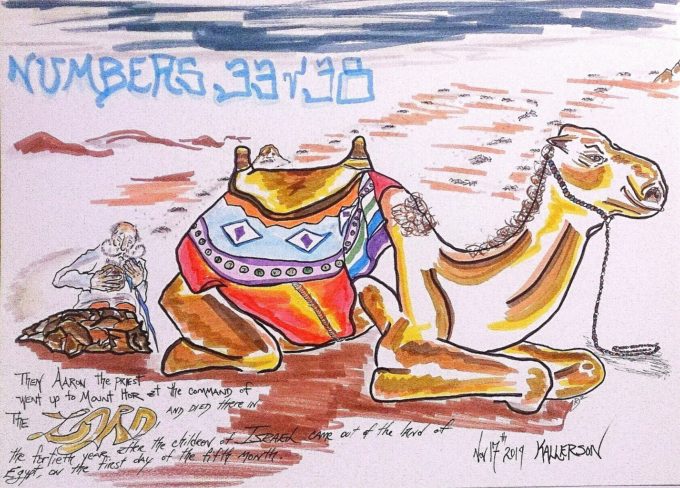
38 Then Aaron the priest went up to Mount Hor at the command of the Lord, and died there in the fortieth year after the children of Israel had come out of the land of Egypt, on the first day of the fifth month.
As we saw in a sermon from Numbers 20, Aaron’s death signified the ending of the law in Christ’s greater priesthood. It was in the 39th year of the wanderings of Israel, just as the Old Testament ends with 39 books. With the Aaronic priesthood ended, the time of the law was also ending. The pictures which followed this in the Numbers narrative clearly reflected this. With the death of Aaron recorded here, it now says…
39 Aaron was one hundred and twenty-three years old when he died on Mount Hor.
This statement is in exacting agreement with Exodus 7:7 which says. “Moses was eighty years old and Aaron eighty-three when they spoke to Pharaoh.” That then agrees with Deuteronomy 34:7, which says, “Moses was one hundred and twenty years old when he died.”
The year of Aaron’s death, then, is the year 2554 Anno Mundi, or from the creation of the world. The dates given show the reliability of the entire account concerning the lines of Adam until this point. The Aaronic priesthood has and will find its end in Christ. It is done, but there is still another seven years left for Israel to figure this out before they call on Christ…
40 Now the king of Arad, the Canaanite, who dwelt in the South in the land of Canaan, heard of the coming of the children of Israel.
This is in agreement with Numbers 21:1 which said –
“The king of Arad, the Canaanite, who dwelt in the South, heard that Israel was coming on the road to Atharim. Then he fought against Israel and took some of them prisoners.” Numbers 21:1
All of the details of why this king is mentioned were given minutely in Chapter 21. If you missed that, it is a marvelous passage to go back and get updated on. In short, it was given to show that Israel will, at some point, go from personal works of the law to faith in Christ in order to enter into the promise. It speaks of the age in which we are now, and which will soon come to pass.
Though there have been some difficulties up to this point in the names of the locations, between accounts in Numbers and Deuteronomy, these are only difficulties because different names are used for the same places. Also, the account here is specifically chronological whereas, at times, this has not been the case.
41 So they departed from Mount Hor and camped at Zalmonah.
The thirty-fifth movement is from Mount Hor, or Mount of the Mountain, to Zalmonah. The name Tsalmonah comes from tselem, which means image, or a likeness. When God created man, He did so in His tselem, or image. Tselem comes from a root meaning to shade and thus figuratively to make a resemblance. And so, it means Shady or Image.
This name, and because it is mentioned here in the narrative, may indicate the place where the Bronze Serpent was fashioned. It being an image of the serpents which had bit them. That is only conjecture though. For Israel in exile, it is a note that they too will go from the image of the earthy man to that of the heavenly Man, as Paul says in 1 Corinthians 15 –
“The first man was of the earth, made of dust; the second Man is the Lord from heaven. 48 As was the man of dust, so also are those who are made of dust; and as is the heavenly Man, so also are those who are heavenly. 49 And as we have borne the image of the man of dust, we shall also bear the image of the heavenly Man.” 1 Corinthians 15:47-49
Next, it says…
42 They departed from Zalmonah and camped at Punon.
The thirty-sixth movement is from Tsalmonah, or Image, to Punon. This comes from pun, meaning “to be distraught.” That is only found in Psalm 88 –
“I have been afflicted and ready to die from my youth;
I suffer Your terrors;
I am distraught.” Psalm 88:15
Therefore, Punon means something like “Perplexity.” Despite being prepared for entry into the land, step by step, the people of Israel are, and will remain, in perplexity until they have come to God through Christ…
43 They departed from Punon and camped at Oboth.
The thirty-seventy movement is from Punon, or Perplexity, to Oboth, or Wineskins. This place was seen in Numbers 21:10. The oboth, or wineskins pictured the people of Israel. This is based on what Jesus said in the synoptic gospels –
“And no one puts new wine into old wineskins; or else the new wine will burst the wineskins and be spilled, and the wineskins will be ruined. 38 But new wine must be put into new wineskins, and both are preserved. 39 And no one, having drunk old wine, immediately desires new; for he says, ‘The old is better.’” Luke 5:37-39
Jesus was speaking of the law and grace. If one tries to put the grace the Lord provides into the law, the skins couldn’t handle it. They were incompatible and both are ruined in the attempt. The people are the wineskins, ready to be filled with the New Covenant grace found in Christ. From there…
44 They departed from Oboth and camped at Ije Abarim, at the border of Moab.
The thirty-eighth movement is from Oboth, or Wineskins, to Ije Abarim. This is recorded in Numbers 21:11. Iye comes from iy, meaning “a ruin.” Avarim comes from avar, meaning “to pass through.” Thus, iye ha’avarim means something like “Ruins of the Passers,” or “Ruins of the Crossing-over.”
There were some rather magnificent pictures of redemptive history which were recorded in the surrounding verses of Numbers 21. In short, Iye of the Abarim, or Ruins of the Passers, speaks of that which is past. In order to get to glory, one must pass through the ruins of his past life. Nobody starts in glory, and this is what is being seen here. The wineskin of grace means passing through that which is ruined. From there…
45 They departed from Ijim and camped at Dibon Gad.
The thirty-ninth movement is from Iyim, or “Heaps,” to Dibon Gad. Iyim is a shortened form of Iye Abarim. Dibon means “Pining.” Gad means “Troop” or “Fortune.” Thus, it may mean Pining of the Troop.
Coming to this place appears to be foreshadowing what it says in Zechariah 12. The pining, or mourning, of Israel will be great when they realize what they had missed –
“And I will pour on the house of David and on the inhabitants of Jerusalem the Spirit of grace and supplication; then they will look on Me whom they pierced. Yes, they will mourn for Him as one mourns for his only son, and grieve for Him as one grieves for a firstborn. 11 In that day there shall be a great mourning in Jerusalem, like the mourning at Hadad Rimmon in the plain of Megiddo.” Zechariah 12:10, 11
Next…
46 They moved from Dibon Gad and camped at Almon Diblathaim.
The fortieth movement is from Dibon Gad, or Pining of the Troop, to – as the Hebrew reads – Almon Diblathaimah. Almon comes from alam, meaning to conceal. Diblathaimah is a plural word coming from debelah, or fig cakes. Thus, it is something like “Hidden Cakes of Figs.”
The debelah, or fig cakes, are mentioned six times in the Old Testament. They are given to signify nourishment and healing. In the case of healing King Hezekiah, it was actually for the restoration of life itself. What is hidden in Christ is to be revealed to the people of Israel for their nourishment and their healing unto life. Next…
47 They moved from Almon Diblathaim and camped in the mountains of Abarim, before Nebo.
The forty-first movement is from Almon Diblathaim, or Hidden Fig Cakes, to the mountains of Abarim, before Nebo. ha’avarim, or the Abarim, means the Regions Beyond, or the Crossings. But, remembering from a previous sermon, Abarim is spelled the same as both ivrim, or Hebrews, and oberim, or transgressions. Both of those bear the sense of crossing over. Nebo means Interpreter or Foreteller.
The mountains of Abarim do not speak of being in the promise, but they are the regions outside of the promise. This is where Moses will die. Those Hebrews who come to Christ must cross over. And only in this will their crossings over of the law, or transgressions, be forgiven.
The law was given to be interpreted as something which foretells the coming Christ. It is not a means to an end. This stop anticipates crossing over from the law to the grace of Christ and into the land of promise.
48 They departed from the mountains of Abarim and camped in the plains of Moab by the Jordan, across from Jericho.
The forty-second movement is from the mountains of the Abarim, or the Regions Beyond to the plains of Moab, by the Jordan, across from Jericho. Moav means, “From Father.” Jordan means Descender. It is a picture of Christ who descended from the heavens, even to the lowest parts. Jericho means “Place of Fragrance,” or “Place of the Moon.”
Each of these anticipates Christ. It is He who is From Father. He is the Descender, and He leads His people into the Place of Fragrance, the heavenly kingdom. This last movement of Israel, which was recorded in Numbers 22:1, brings the Israelites to their last stop before entering into Canaan. This location is now further explained with the words…
*49 (fin) They camped by the Jordan, from Beth Jesimoth as far as the Abel Acacia Grove in the plains of Moab.
The NKJV incorrectly says here Beth Jesimoth. It is Beth Jeshimoth. Beth means “House.” ha’yeshimoth means, “The Desolations.” Thus, it is “House of the Desolations.” Abel means “Meadow,” and ha’shittim means “the Acacias.” Thus, it is “Meadow of the Acacias.”
However, shittim comes from a word, shotet, signifying a “scourge.” That root is used only once in the Bible. In Joshua 23:13, it says –
“…know for certain that the Lord your God will no longer drive out these nations from before you. But they shall be snares and traps to you, and scourges on your sides and thorns in your eyes, until you perish from this good land which the Lord your God has given you.” Joshua 23:13
Thus, the scourges are that which draw the people away from faith in the Lord and to that which is false. Everything outside of the land of promise is a House of Desolations, and it is a place which will draw people away from the Lord.
It is at this spot that the Lord will give the people advice concerning their inheritance, in the verses and chapters to come, and it is also here that the Lord will speak out the words of Deuteronomy. After that, Moses will be taken up to the top of Nebo, see the land of promise, and there die.
The travels of Israel have been carefully documented to show us what Israel would do in her exile, and how the Lord would work slowly and methodically throughout the span of years to both punish them, and to also lead them back to Himself.
I will be as honest as I can, and tell you that the pictorial meaning for many of these stops are a best guess on my part, but as we saw with many that are certain beyond a shadow of a doubt, they are all given for the specific purpose of showing us snapshots of Israel’s history, including its future. This is absolutely assured.
The patterns we had seen in chapters 14-21 have been relived and expanded on, and yet the names and places carefully follow that same pattern of God’s tender care for Israel due to His covenant faithfulness, despite Israel’s deserved punishment for their covenant unfaithfulness.
In the end, and as I have shown you many times in the past, we can look to God’s covenant faithfulness to Israel under the Law of Moses, and compare it to us under the New Covenant in Christ’s blood. Though He punished them for their misdeeds, He never rejected them as His people.
How good that is to know when we fail to honor Him as we should. He has promised in the book of Hebrews that He will never leave us nor forsake us, and He has promised that any punishment we receive is because He loves us as His sons. What a glorious God we serve. What a faithful, wonderful Father we have.
When we come to this list of stops from Sinai to Canaan, we know this and cherish the thought as we read through the otherwise difficult and even obscure names of places that Israel really traveled through on their way back to the loving arms of their Lord and Father.
Closing Verse: “’And you have forgotten the exhortation which speaks to you as to sons:
“My son, do not despise the chastening of the Lord,
Nor be discouraged when you are rebuked by Him;
6 For whom the Lord loves He chastens,
And scourges every son whom He receives.’
7 If you endure chastening, God deals with you as with sons; for what son is there whom a father does not chasten?” Hebrews 12:5-7
Next Week: Numbers 33:50-56 For this, Israel will forever the Lord bless… (I Have Given You the Land to Possess) (66th Numbers Sermon)
The Lord has you exactly where He wants you. He has a good plan and purpose for you. It may seem at times as if you are lost in a desert, wandering aimlessly. But the Lord is there, carefully leading you to the Land of Promise. So, follow Him and trust Him and He will do marvelous things for you and through you.
The Journeys of Israel, From Sinai to the Plains of Moab
They moved from the Wilderness of Sinai
And camped at Kibroth Hattaavah, by and by
They departed from Kibroth Hattaavah and camped at Hazeroth
They departed from Hazeroth and camped at Rithmah
They departed from Rithmah and camped at Rimmon Perez
They departed from Rimmon Perez and camped at Libnah
They moved from Libnah and camped at Rissah
They journeyed from Rissah and camped at Kehelathah
They went from Kehelathah and camped at Mount Shepher
They moved from Mount Shepher and camped at Haradah
They moved from Haradah and camped at Makheloth
They moved from Makheloth and camped at Tahath
They departed from Tahath and camped at Terah
They moved from Terah and camped at Mithkah
———-at Mithkah they temporarily did squat
They went from Mithkah and camped at Hashmonah
They departed from Hashmonah and camped at Moseroth
They departed from Moseroth and camped at Bene Jaakan
They moved from Bene Jaakan and camped at Hor Hagidgad
———-a place worthy of note
They went from Hor Hagidgad and camped at Jotbathah
They moved from Jotbathah and camped at Abronah
———-maybe at Abronah the flowers were fresh
They departed from Abronah and camped at Ezion Geber
They moved from Ezion Geber and camped
———-in the Wilderness of Zin, which is Kadesh
They moved from Kadesh and camped at Mount Hor
On the boundary of the land of Edom, so says the word
Then Aaron the priest went up to Mount Hor
At the command of the Lord
And died there in the fortieth year
After the children of Israel
Had come out of the land of Egypt
On the first day of the fifth month as the record does tell
Aaron was one hundred and twenty-three years old
When he died on Mount Hor. He lived a good long spell
Now the king of Arad, the Canaanite, who dwelt in the South
———-in the land of Canaan
Heard of the coming of the children of Israel
So they departed from Mount Hor and camped at Zalmonah
They departed from Zalmonah and camped at Punon
———-according to the order
They departed from Punon and camped at Oboth
They departed from Oboth and camped at Ije Abarim
———-at Moab’s border
They departed from Ijim and camped at Dibon Gad
They moved from Dibon Gad and camped at Almon Diblathaim
They moved from Almon Diblathaim
And camped before Nebo in the mountains of Abarim
They departed from the mountains of Abarim
And camped in the plains of Moab by the Jordan
———- across from Jericho
They camped by the Jordan, from Beth Jesimoth as far as
———-the Abel Acacia Grove
In the plains of Moab, as we now know
Lord God, we are even now in a wilderness
And we are wanting to be led by You
Without You to direct, our lives would be a mess
And so be our guide, O God; You who are faithful and true
We long for the water in this barren land
May it flow forth from the Rock, our souls to satisfy
Give us this refreshing, spiritual hand
And may we take it, and to our lives daily it apply
And we shall be content and satisfied in You alone
We will follow You as we sing our songs of praise
Hallelujah to You; to us Your path You have shown
Hallelujah we shall sing to You for all of our days
Hallelujah and Amen…