Numbers 35:1-8
The Levitical Cities – A Prophecy Fulfilled
The passage today is another step toward that final step where Israel will cross over Jordan and into their long-awaited inheritance. For the tribe of Levi, the inheritance is different than for that of the other tribes, and yet, it is uniquely tied to the inheritance of the tribe of Simeon in one way.
But it was vastly different from that of Simeon in all other ways. The Levites had a special charge laid upon them which has been seen in great detail in the book of Leviticus and even more so in the book of Numbers. Leviticus dealt mostly with one portion of the tribe, that of the Aaronic priesthood.
Numbers has shown a remarkable amount of detail concerning the rest of Levi such as why they were chosen, what that choosing meant to them and to all of Israel, and the special nature of Levi in the presence of the Lord. Of this passage, the scholar Keil says –
“Called out of the whole nation to be the peculiar possession of Jehovah, to watch over His covenant, and teach Israel His rights and His law … the Levites were to form and set forth among all the tribes the ἐκλογή of the nation of Jehovah’s possession, and by their walk as well as by their calling to remind the Israelites continually of their own divine calling; to foster and preserve the law and testimony of the Lord in Israel, and to awaken and spread the fear of God and piety among all the tribes.”
Levi’s selection out of Israel for this was for one reason, but the results of that selection actually fulfill another prophecy which was pronounced upon Levi several centuries earlier. That prophecy, which was spoken out by Jacob on his deathbed, and which will be our closing verse today, was spoken out based on what had happened many years earlier in the life of Jacob and his sons…
Text Verse: “Now it came to pass on the third day, when they were in pain, that two of the sons of Jacob, Simeon and Levi, Dinah’s brothers, each took his sword and came boldly upon the city and killed all the males.” Genesis 34:25
Simeon and Levi killed an entire city of men because one of them had defiled their sister Dinah. That story provides a marvelous picture of things which would occur much later in history during the church age, and it corresponds well to the tasks and duties of Levi under the law.
However, the law is the law, and grace is grace, and the two do not mix. Unfortunately for so many in the church, they cannot figure this out. They bear in them the same defect that man under law always bears – pride in self.
Jesus Christ has come. He has fulfilled the law. And, that law is now set aside in Him. Those who continue to hold to the law of Moses are not pious, though they act that way. They are full of pride, and they mar the glory of what God has done in Jesus Christ.
To them, what He did was insufficient to save them, and they can do better. This is a truth which is revealed time and again in Scripture. But to understand this, one must understand the law itself, and its purpose in redemptive history. Without that base of knowledge, our walk with God is not one of felicity, but of enmity.
Let us learn this by learning the law. We will continue to do so right now. It’s all to be found in His superior word. And so, let’s turn to that precious word once again and… May God speak to us through His word today and may His glorious name ever be praised.
Dispersed in Israel (verses 1-8)
And the Lord spoke to Moses in the plains of Moab by the Jordan across from Jericho, saying:
This is the exact same opening formula for a passage, word for word and letter for letter, as was seen in Numbers 33:50. That was immediately after the detailed record of the travels of Israel from Egypt to this spot. With that record complete, the Lord gave the instructions for what to do when entering Canaan, including the division of the land by inheritance.
After that, in Chapter 34, the boundaries of the land were detailed, and that was then followed with the names of the leaders who were chosen to oversee that land division.
Now, and in accord with that, the instructions for the Levitical cities are to be provided. It is the same order as for the counting of the divisions of Israel in the census. The main tribes were counted, and only then were those of the tribe of Levi counted.
What is already understood, is that the Levites were to receive no inheritance, meaning a division of land of their own within Israel. That goes back to Numbers 18, where this was said –
“Then the Lord said to Aaron: ‘You shall have no inheritance in their land, nor shall you have any portion among them; I am your portion and your inheritance among the children of Israel.
21 “Behold, I have given the children of Levi all the tithes in Israel as [i]an inheritance in return for the work which they perform, the work of the tabernacle of meeting. 22 Hereafter the children of Israel shall not come near the tabernacle of meeting, lest they bear sin and die. 23 But the Levites shall perform the work of the tabernacle of meeting, and they shall bear their iniquity; it shall be a statute forever, throughout your generations, that among the children of Israel they shall have no inheritance. 24 For the tithes of the children of Israel, which they offer up as a heave offering to the Lord, I have given to the Levites as an inheritance; therefore I have said to them, ‘Among the children of Israel they shall have no inheritance.’” Numbers 18:20-24
This note, that Levi would receive no inheritance, was repeated once again during the second census as is recorded in Numbers 26:62. There is a stress on this to show that Levi was dedicated to the Lord.
There is the priestly class which descended from Aaron, and then there are the other Levites who were given to act in a role which extended in two directions – to the priests for their assistance, and to the people for their instruction in the things of the law.
Understanding this, there is still a need for the Levites to have land set apart for them to live in. It would be unreasonable for them to live in tents around the sanctuary.
With the people spread all over Israel, this would make their job of tending to the people impossible. For a person who needed instruction in a particular matter, it would mean stopping work and traveling on a long journey to simply get a resolution to a matter.
There would be an immediate and ongoing void in the spiritual lives of the people, and that would result in an almost immediate turning of the people from the Lord. The wisdom of separating Levi from the other tribes has already been seen.
The wisdom of incorporating them among those same tribes from whom they have been separated is then seen. Levi is separate from Israel and divided as a tribe, and yet they are uniquely joined to Israel, but they remain united as Levites.
If government service were a permanent occupation (God forbid), then it would be comparable to this. Suppose that all federal employees were designated as such, forever throughout their generations.
It would be impossible to run the government solely from Washington DC. And so, this group of people would be spread out among the states. They would receive their living from the taxes of the people, they would reside among them, they would accomplish their duties both for the government, and on behalf of the people.
And so, they would be government workers, separate from other Americans and divided as a group among the states, and yet they would be carefully joined to the Americans of given states, but they would remain united as government employees.
Yes, that sounds like a complete disaster, and it shows how things could very quickly get out of hand. Despite being ingenious in its makeup for Israel, and the best possible way of administering the law, it is a part of the law, nonetheless.
It will not be long before this system’s failings are revealed. The account of the Levite who became a priest to the family of Micah in Judges 17 is a perfect example of how such a system could be easily abused. As the Law is intended to point us to our need for Christ, that is inclusive of the failed actions of both priest and Levite, along with all other parts of the law.
But make no mistake, it is not that the law is defective. It is that man is defective. Paul explains that in Romans 7 –
“What shall we say then? Is the law sin? Certainly not! On the contrary, I would not have known sin except through the law. For I would not have known covetousness unless the law had said, ‘You shall not covet.’ 8 But sin, taking opportunity by the commandment, produced in me all manner of evil desire. For apart from the law sin was dead. 9 I was alive once without the law, but when the commandment came, sin revived and I died. 10 And the commandment, which was to bring life, I found to bring death. 11 For sin, taking occasion by the commandment, deceived me, and by it killed me. 12 Therefore the law is holy, and the commandment holy and just and good.” Romans 7:7-12
As I have said, there is immense wisdom in how this law is structured and how it is purposed. It is not the fault of the law, but the fault of man’s inability to adhere to the law which brings about sin. By the law is the knowledge of sin. The account of Micah and the Levite in Judges 17 is one example of this in relation to what we will now be instructed on here in Numbers 35.
If man were not sinful, the idea of a permanent class of government employees might be a great idea, but – as we have seen in the US – anytime someone is too long in a government position, it simply doesn’t work out. For some, 10 seconds in such a position is too long. Remember what happened the moment Obama was inaugurated president concerning the White House website. Fallen man, especially fallen man without Christ, cannot be trusted with power and governmental authority.
For now, Israel is on the verge of entering into their inheritance, and the situation of the Levites must be detailed next. And so, still in the plains of Moab across from Jericho, Moses is instructed by the Lord to…
2 “Command the children of Israel that they give the Levites cities to dwell in
This is not a request, but a command. The children of Israel are given this command before entering Canaan with very specific detail because it is the twelve warring tribes that will go in to subdue the land. Levi is not a tribe of war, and so – knowing in advance the wickedness of the human heart – the Lord anticipates what may otherwise occur, and He commands what is to be done for Levi.
Otherwise, the tribes could say, “We fought for and earned the right to this land, and then it was divided by lot to us for our inheritance. Levi can go find their own land to dwell in.” Only then would the matter have to be brought to the Lord and resolved.
Further, if this was the case, it would not have been a specifically directed portion of the law received by Moses and it would bear less weight in the minds of the people. The Lord knows this and is providing law, in advance, to ensure such wicked things will not arise in the hearts of the people.
It is to be noted that the priests, at this point, are considered under the umbrella of Levi. In other words, both priest and the more common Levite are included in this command. Later in 1 Samuel 22, there is a city, Nob, which is called the city of the priests, but that was a determination not specifically addressed under the law.
For now, the Levites are to be given cities, despite not being a tribe of war. And further, these cities are to be…
2 (con’t) from the inheritance of their possession,
This is specific, and it is explicit. The land for the Levites is to be taken out of the individual inheritance of whatever tribe is designated. The Levites have no inheritance because their inheritance is the Lord, as has already been stated.
Thus, these cities, taken out of the individual inheritances must logically be thought of as the Lord’s cities, and reserved for His own tribe to live out their lives. They stand as the Lord’s representatives among the people, and therefore, these cities are the Lord’s cities among the tribes.
Like the tithes of Israel, so is the land. It is what comes from the inheritance of the people. As the ground of their land was won through their effort in battle, so the tithe from that ground was won by the efforts of their labor. A portion of each is granted for the Levites.
Not to take the comparison too far, it is not unlike what is mandated by the Lord, through Paul, for the workers of the gospel. As Paul said to those at Galatia, “Let him who is taught the word share in all good things with him who teaches” (Galatians 6:6), and also to those in Corinth –
“For it is written in the law of Moses, ‘You shall not muzzle an ox while it treads out the grain.’ Is it oxen God is concerned about? 10 Or does He say it altogether for our sakes? For our sakes, no doubt, this is written, that he who plows should plow in hope, and he who threshes in hope should be partaker of his hope. 11 If we have sown spiritual things for you, is it a great thing if we reap your material things?” 1 Corinthians 9:9-11
The things of the Lord are to be tended to by the people who serve the Lord, and, in turn, those who serve the Lord are to be tended to by the labors of those who receive instruction and guidance from them. For the people of Israel, this included…
2 (con’t) and you shall also give the Levites common-land around the cities.
Here, for only the second time, the word migrash, or common land, is seen. It comes from garash, meaning to drive out or cast away. The meaning then is lands that are outside of their cities. It is land reserved for the use of the Levites. From here, it will become a common word in Scripture.
Older translations use the word “suburb” to describe this land. A suburb is an outlying district of a city, but one which is designated for residential use. This is not what is being relayed here. The Levites were to dwell in Levitical cities. As the Levites had no land inheritance, they were not workers of the fields. Rather, they were workers of the law and possibly other professional jobs which may have arisen over time.
But how did the Levites survive? It was by receiving what was provided to them by the law. This included the tithes of Israel according to the laws of the tithe which have been given already, and which will be further defined in Deuteronomy.
Included in the tithes were animals. These animals would need to have a place to forage and roam, and so these common lands were necessary for the livelihood of the Levites. It would make no sense to set apart one-tenth of the livestock every third year and give it to the Levites if they had no land on which to keep that livestock.
This is then what is being referred to. It is common land for the use of the Levites who dwelt within the cities that they had been given. The Lord is preparing, in advance, for the care of the Levites. And He is doing it very meticulously and specifically so that no argument could arise against their claims later. The explanation for this common land continues with…
3 They shall have the cities to dwell in;
This now specifically states what you have already heard. The cities are to be where the Levites were to live. This is how people lived in these times. There were homes built together inside of walls. This was to be protection for the people within from wild animals, invasions, and robbers.
The cities had gates which would be closed at night, and guards would normally be stationed at them. During the day, the gates are where the leaders and judges would gather. Often, there would be recesses in the walls of the gates where people would sit in the shade. This is where legal matters of all sorts were normally decided.
It should be noted that these cities were right within the confines of the land of whatever tribe they were assigned to. Further, there are times where a city is known as a Levitical city, and yet it is also a city of the tribe itself.
We will see in Joshua 14 that Hebron was given to Caleb for his faithfulness, and yet, Hebron was also designated as a city of refuge in Joshua 20, and it was designated as a Levitical city under Aaron the priest in Joshua 21. The way this is reconciled is by what it says in Joshua 21:12 concerning the Levitical cities –
“And they gave them Kirjath Arba (Arba was the father of Anak), which is Hebron, in the mountains of Judah, with the common-land surrounding it. 12 But the fields of the city and its villages they gave to Caleb the son of Jephunneh as his possession.”
Therefore, Hebron itself was designated as a Levitical city, including the land termed common land as directed by the Lord. But that which extended beyond the common land of the city itself was the property of Caleb.
As the Levites dwelt right in and among the Israelites, and as they both had families and possessions, it is easy to see that there was no such thing as a class of ascetics who lived by themselves from society, remained celibate, and shunned the normal life of comfort, wealth, and the like. Such an idea is foreign to the Law of Moses.
It shows that those who lived this type of life in Old Testament times, such as the Essenes and other sects were not in any way mainstream. Rather, they deviated from the normal sense of life outlined by the Lord through Moses.
And the same is true with those who have gone off to live such lives in New Testament times as well. There is nothing in Scripture which teaches this type of life, and it is actually foreign to the notion of people living normal lives as described by Paul and the other writers of the epistles.
Further, living such a monastic existence is actually opposed to the concept of the gospel, where we are to live in the world and allow ourselves to be used as examples and guides to others who also need to hear the good news.
The Levites lived in their own cities, but that was because of the precept that they had no inheritance, meaning no land to work. This was the appropriate way of keeping them as a part of Israel, but a unique and separate part at the same time.
Unfortunately, this mandated separation was taken to unintended extremes as is clearly evidenced by the parable of Jesus concerning the man who was waylaid on his trek from Jerusalem to Jericho –
“A certain man went down from Jerusalem to Jericho, and fell among thieves, who stripped him of his clothing, wounded him, and departed, leaving him half dead. 31 Now by chance a certain priest came down that road. And when he saw him, he passed by on the other side. 32 Likewise a Levite, when he arrived at the place, came and looked, and passed by on the other side. 33 But a certain Samaritan, as he journeyed, came where he was. And when he saw him, he had compassion.” Luke 10:30-33
It was never the intent for the separation of the tribe of Levi to include a perceived holiness that they were above the other commands of the law concerning such things.
Again, the law itself is good and holy, but it is the heart of man which is unable to properly work within the confines of the law in order to bring about the expected result which the law calls for. Only Christ was able to meet the law’s demands and then to set us free from those impossible confines. Thank God for Jesus.
3 (con’t) and their common-land shall be for their cattle, for their herds, and for all their animals.
u-migreshehem yihyu livhemtam v’lirkusham u-lekol khayatam – “And their common land shall be for their cattle and their possessions and for all their life.” Here it speaks of the common land that we previously looked into. The reason for it is now stated. It seems like an easy set of words, but the meaning is actually highly debated.
The idea of common land is set. It is said to be used here for three things. The first is their behemah. This is simply a beast in general, like cattle. The second word is unusual if it is to be translated as “herds.” It is rekush, and it means property or goods. It comes from a verb meaning to collect or gather.
It very well could be speaking of other types of animals, but what is more likely is that it refers to the things of any possession which might be left for the fields which would not be brought into a city, such as wagons and other movable possessions, stalls and pens for the livestock, and etc.
The third thing described is literally “and for all their life.” It could be referring to any other animals, but it also could be a phrase which speaks of whatever is needed to sustain them. As they received the tithes from Israel every third year, maybe the phrase includes silos for grain. Or it might include places for the children to go and play and so on.
4 The common-land of the cities which you will give the Levites shall extend from the wall of the city outward a thousand cubits all around.
As one could expect, there are various views on this. Some consider that the city would be deemed as square, and the measure would go out from the walls from that perspective.
However, cities were more often than not irregular in shape. To not follow the shape of the city would fail to meet the expectations outlined here and lead to obvious disputes at some point.
The distance, being one-thousand cubits, is about one-third of a mile. If a cubit is 18 inches, that would make it .284/mile. This is the area, all the way around the city, which would be considered common land. However, another problem, which is even more debated, results from the next words…
5 And you shall measure outside the city
This is clear. The word is madad and it means to measure – “And you shall measure from outside the city.” The sticky problem is what does it mean “from outside?” Several suggestions have been made which will be considered. However, by doing that, the next words have to be looked at…
5 (con’t) on the east side two thousand cubits, on the south side two thousand cubits, on the west side two thousand cubits, and on the north side two thousand cubits.
This is understandable no matter which view is correct concerning the term “outside the city.” On each of the four directions, a measure of two thousand cubits will be measured. Based on this measurement, whatever it may be, it then says…
5 (con’t) The city shall be in the middle.
Again, there is nothing difficult here. The city is situated in the middle of the final measurement which is taken from outside the city. But what is that measurement? We cannot be dogmatic about this, because all dogs care about is where they can go play, not specifically how big the land that they can play in is. So, here are several suggested possibilities.
The first is that there is an error in the Hebrew. The Greek of both verses 4 and 5 say “two thousand cubits.” It seems more likely that the Greek is in error in that, and it is a cheap way of resolving the matter.
The second option is that if one measures out to the north one thousand, and then measures out to the south one thousand, there is a line that is two thousand cubits long, plus the length of the city on the east and west. Likewise, the same is true for the other two sides.
And so, a city that is one thousand cubits long would have a line that is three thousand on that side. If the other wall is five hundred feet long, then the measurement would be two thousand five hundred feet. But the words say to measure two thousand feet on the side. It doesn’t say one thousand plus the city, plus one thousand.
The third option is that because the term madad, or measure, is first used here, it is speaking of two different measurements. The first one is that of verse 4 which speaks of the common land of the city being one thousand cubits out from the walls of the city.
Now, verse 5 is saying to measure from that common land out another two thousand cubits, making a total of three thousand cubits. The logic is that the common land is the first one thousand, and that the fields of the city are beyond that. However, that view has its own problem which is seen in the next words…
5 (con’t) This shall belong to them as common-land for the cities.
The problem with the third view is that the same term, migrash, is used in verses 2, 3, 4, 5, & 7. Why would the same term be used to describe land with two different purposes?
I would suggest that the distance from the walls is one thousand cubits. Regardless of the shape of the city, the surveyors were to go directly out from the wall situated at each of the four points on the compass, one thousand cubits from the wall.
From that point, they were to measure two thousand cubits, meaning one thousand in each direction. You now have four lines of two thousand cubits in length which are not yet touching because the city takes up some amount of space, be it narrow or wide on each side.
Once those lines are made, the gaps are simply filled in according to either the shortest route, or following a discernible trek along the ground. This makes sense because there is no fudging in the Hebrew, there is no addition or lesser ground that could reasonably be fought over, and also because the land in Israel is all over the place.
To measure exact lines, based on both the irregular nature of the city walls and the irregular nature of the landscape, in most cases, would be unreasonable. The four points of the compass have been explicitly stated to avoid any further complications of an otherwise difficult task for surveyors to easily, and without bias, portion out the land.
Again, I’m not one to argue over this. It is complicated and each view presents its own difficulties. However, this view appears most aligned with the intent of the mandate to use the four cardinal points on the compass to measure out the land.
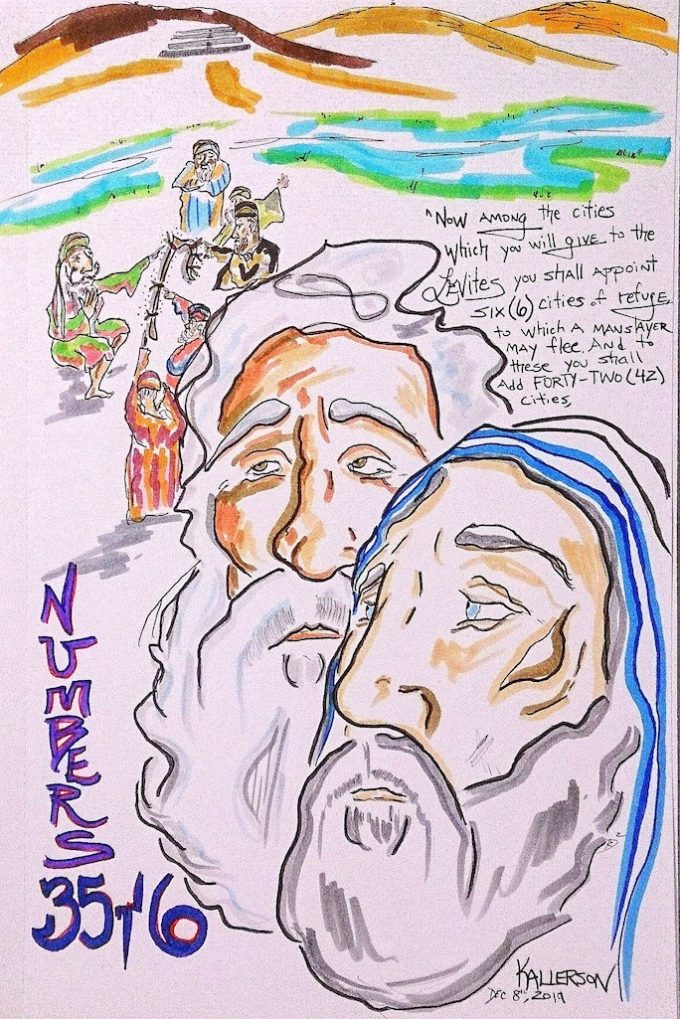
6 “Now among the cities which you will give to the Levites you shall appoint six cities of refuge,
The words of this verse are very widely translated, and yet they convey the same basic meaning for the most part. It literally reads, “And the cities which you will give to the Levities – six cities, the refuge.”
By adding in the word “among,” like the NKJV does here, it assumes that the total number of Levitical cities is the main focus of the verse. It is not. These six cities of refuge are. This concept was first referred to in Exodus 21 –
“He who strikes a man so that he dies shall surely be put to death. 13 However, if he did not lie in wait, but God delivered him into his hand, then I will appoint for you a place where he may flee.” Exodus 21:12, 13
This verse now is the lead-in to the next very important and very detailed section which encompasses verses 9-34. If your KJV or other Bible includes the word “among,” you might make a note that it is incorrect.
Here, the miqlat, or refuge is introduced. It is a word which will be seen twenty times, but only two of them are outside of Numbers 35 and Joshua 20&21. The other two are in 1 Chronicles 6 which simply repeats the granting of the cities.
The word miqlat comes from the word qalat, which is found only in Leviticus 22:23 and which, surprisingly, means “stunted.” In Leviticus, it was speaking of not offering anything that was stunted to the Lord for the fulfilling of a vow.
The connection between the words is the idea that when one is in a place of refuge, or asylum, they are taken in. Their lives are thus stunted from going out.
The number six in Scripture speaks of man. Specifically, it speaks of the imperfection of man. Often it speaks of man as destitute of God, without God, and thus meaning without Christ. The number here is purposeful, and the meaning of these cities of refuge will be carefully explained, revealing why six is the chosen number. It is one of these six cities…
6 (con’t) to which a manslayer may flee.
lanus shamah ha’roseakh – “for fleeing there the manslayer.” Here, the word ratsakh is used. It is the same word found in the sixth commandment and is normally translated as murder. It is not the same word, harag, for example, which is found in Numbers 31 when Moses said for the soldiers to kill all the women and boys of Midian.
Surprisingly, it is not even the same word used when Cain killed Abel. The first time it was used was there in the giving of the Ten Commandments. Thus, it is a word defined by the law itself. As will be seen next week, twenty of its forty-seven uses are in this chapter.
Of these twenty times, it is alternatingly translated in English as “manslayer” or “murderer” based on the guilt or innocence of the offender. However, because the same word is used for both, it carries an underlying thought that whether guilty or innocent, it was a form of unsanctioned taking of human life.
The one who commits such an act has a place to flee to which is designated right here, even before the allotting of the full number of Levitical cities. The placement of these six cities will be seen in Joshua 20. Three each will be in land on both sides of the Jordan, but all six were well-situated to allow a place of escape to all people.
This is the exact same pattern that will be seen when the actual cities are appointed in Joshua. First will be named the cities of refuge in Chapter 20, and only then will the cities of the Levites be named in Chapter 21. A high importance is given to this concept.
The reason for this is that even though these will be Levitical cities, they actually belong to the Lord for all the people in the sense that any Israelite could go there to live if the unfortunate circumstances which necessitated it were to occur. After appointing these six cities, Israel is next instructed…
6 (con’t) And to these you shall add forty-two cities.
This thought is secondary to the highly important designation of six cities of refuge. The Levitical cities are six plus forty-two first and foremost. One could say that the United States was first 13 plus 37 added since then. Although all are equal, there is a special note of honor held among those first thirteen.
7 So all the cities you will give to the Levites shall be forty-eight; these you shall give with their common-land.
In common math, 6 + 42 = 48. That would make four per tribe if they were evenly spaced that way, which they are not. Size of land grant varied, and the Levites would be dispersed in a way which would ensure they were properly placed throughout the land of Israel.
However, the obvious immediate division of 48 by 12 is not to be missed. Twelve signifies the perfection of government. Four represents the number of material completeness. It is the world number, and especially the “city” number.
Thus, in these cities, one can see a representation of the kingdom of God in the world, with a special focus on man which is represented by the six cities of refuge. It is a rather marvelous picture of God, working through Christ, and forming a universal government, highlighted by those who come to take refuge in Him.
As far as the census of Chapter 26, it showed a total number of Levite males from one month old and up being 23,000. Thus, the number of males per city would average at 479. Add in females, and the number would still be about 1000 per city to start with.
Joshua 21 will detail the names of these forty-eight Levitical cities. The Kohathites will be given ten cities in Ephraim, Dan, and the western half of Manasseh. The Gershonites will have thirteen cities in Issachar, Asher, Naphtali and the eastern half of Manasseh. And the Merarites will have twelve cities in Reuben, Gad and Zebulun. And finally, the priests will have thirteen cities in Judah, Simeon, and Benjamin.
What is interesting, and which seems logical, is that the thirteen priestly cities are divided among the tribes which were nearest to where the sanctuary would eventually be in Jerusalem, rather than where the tabernacle was originally kept in Shiloh. One can see the hand of the Lord working things out ever-so meticulously, even in advance of the need for things to be the way they were.
8 And the cities which you will give shall be from the possession of the children of Israel; from the larger tribe you shall give many, from the smaller you shall give few.
This was a directive which actually didn’t come to pass as laid out, if it speaks of actual numbers of cities. They were all very closely dispersed in this manner.
Judah and Simeon will be collocated within the same large area. They will provide nine Levitical cities. All of the rest of the tribes will each have four Levitical cities in their territory, except the last to be named, Naphtali, which will only have three. So, all of them give approximately the same number.
However, even if all gave the same basic number of cities, it could be that more Levites went to the more populated tribal inheritances. Although the Hebrew does not indicate this as an option. Otherwise, this would have to be considered a precept which was not carefully adhered to by Israel. This is then repeated with the final words of the day…
*8 (fin) Each shall give some of its cities to the Levites, in proportion to the inheritance that each receives.”
Again, it refers to the number of cities in relation to the inheritance received. As the inheritances were based on lots first, and then by family size within the land allotted, the final division of the Levitical cities does not follow this precept as one would read it.
However, the overall dispersion of the Levites was satisfactory to ensure that the job they were called to accomplish could, in fact, be accomplished if they handled their duties in the solemn manner which reflected the office.
The eight verses today have provided great insights into the expectations for Levitical living in Israel, and what the tribes of Israel were to do to ensure the Lord’s intentions worked as they should for the people.
If everything was conducted according to expectation, Israel would operate smoothly and in a state of high moral living. Unfortunately, the problem does not rest with the law and how it is laid out in order to serve the people. Rather, the problem with the precepts here lies in the heart of man who is constantly at war with what is morally proper.
This is true with the commoner in Israel, all the way up to Israel’s high priest. The failings of the people, in opposition to the meticulously flawless nature of the law, is what is highlighted. Something better was needed, because the human under law simply cannot bear up.
We have seen a few interesting patterns today, and a few points of how things anticipate Christ, but there is a point which must be made before we finish, and it is a point which anticipates what we will look at next week.
The cities of refuge are given for the one who has committed ratsakh, or murder. No distinction between accidental or intentional murder is made in the use of this word, except as it is qualified by other words.
If one murders, he will either be put to death, or he will be granted asylum. How does that point us to Christ? It is what James says in his epistle –
“For whoever shall keep the whole law, and yet stumble in one point, he is guilty of all. 11 For He who said, ‘Do not commit adultery,’ also said, ‘Do not murder.’ Now if you do not commit adultery, but you do murder, you have become a transgressor of the law.” James 2:10-11
The fact is that by any sin, we have broken the entire law, including murder. But more directly, our sin necessitated the death of Christ. It is we who, by our actions, caused His death. Where can we flee to in such an instance? And what can be done about the terrible price we must pay for our actions? The next two sermons will answer this for us.
In short, this is the reason for Christ’s coming. He is the Israelite without sin. He is the perfect Firstborn. He is the great and sinless Priest who conducts His duties flawlessly. And He is the embodiment and completion of the law which stood so proudly in opposition to man because of the sin it highlights in him.
Christ alone was able to bear that burden, and in Him is a new and gentle yoke. In Him, the toil and labor are ended, and the rest which God promised His people is found.
Closing Verse: “Simeon and Levi are brothers;
Instruments of cruelty are in their dwelling place.
6 Let not my soul enter their council;
Let not my honor be united to their assembly;
For in their anger they slew a man,
And in their self-will they hamstrung an ox.
7 Cursed be their anger, for it is fierce;
And their wrath, for it is cruel!
I will divide them in Jacob
And scatter them in Israel.” Genesis 49:5-7
Next Week: Numbers 35:9-21 The implications for this are huge… (A Place of Refuge) (69th Numbers Sermon)
The Lord has you exactly where He wants you. He has a good plan and purpose for you. It may seem at times as if you are lost in a desert, wandering aimlessly. But the Lord is there, carefully leading you to the Land of Promise. So, follow Him and trust Him and He will do marvelous things for you and through you.
The Levitical Cities – A Prophecy Fulfilled
And the LORD spoke to Moses, words He was relaying
In the plains of Moab by the Jordan across from Jericho, saying:
“Command the children of Israel
That they give the Levites cities to dwell in, please understand
From the inheritance of their possession
And you shall also give the Levites around the cities common-land
They shall have the cities to dwell in
And their common-land shall be
For their cattle, for their herds, and for all their animals
Pay heed to these words from Me
The common-land of the cities
Which you will give the Levites; their common ground
Shall extend from the wall of the city
Outward a thousand cubits all around
And you shall measure outside the city
On the east side two thousand cubits, so you shall do
On the south side two thousand cubits, on the west side
———-two thousand cubits
And on the north side two thousand cubits too
The city shall be in the middle, so it shall be planned
This shall belong to them for the cities as common-land
“Now among the cities which you will give to the Levites
You shall appoint six cities of refuge; so to you I tell
To which a manslayer may flee
And to these you shall add forty-two cities as well
So all the cities you will give to the Levites, please understand
Shall be forty-eight; these you shall give with their common-land
And the cities which you will give
Shall be from the possession of the children of Israel
From the larger tribe you shall give many
From the smaller you shall give few; follow the instructions well
Each shall give some of its cities to the Levites
———-as if handing out sheaves
In proportion to the inheritance that each receives
Lord God, we are even now in a wilderness
And we are wanting to be led by You
Without You to direct, our lives would be a mess
And so, be our guide, O God; You who are faithful and true
We long for the water in this barren land
May it flow forth from the Rock, our souls to satisfy
Give us this refreshing, spiritual hand
And may we take it, and to our lives daily it apply
And we shall be content and satisfied in You alone
We will follow You as we sing our songs of praise
Hallelujah to You; to us Your path You have shown
Hallelujah we shall sing to You for all of our days
Hallelujah and Amen…