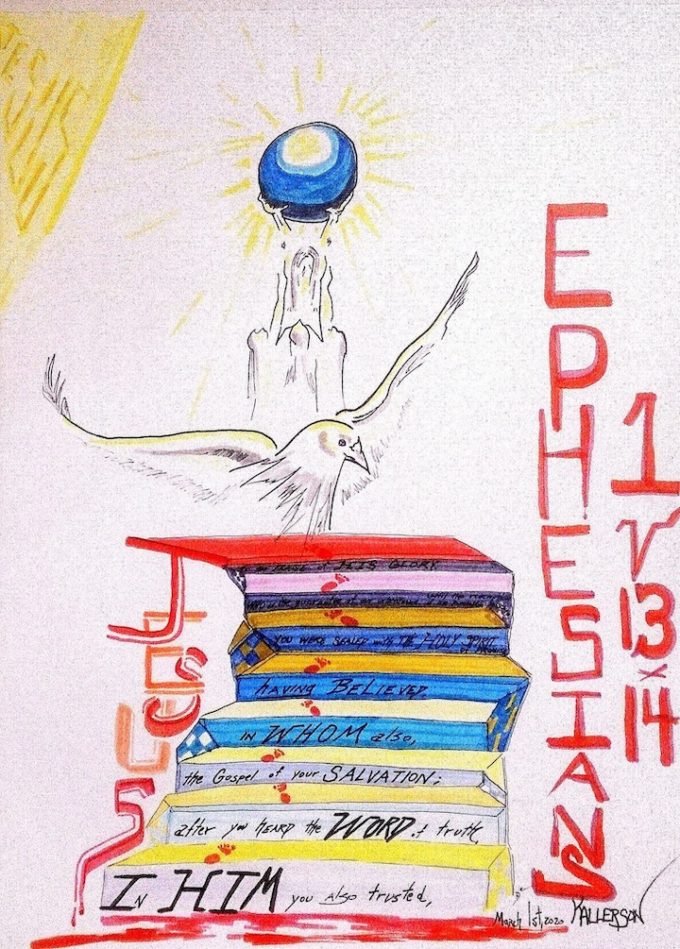
“Once Saved Always Saved?” Or, “Not So!”
“But I will hope continually,
And will praise You yet more and more.
15 My mouth shall tell of Your righteousness
And Your salvation all the day,
For I do not know their limits.
16 I will go in the strength of the Lord God;
I will make mention of Your righteousness, of Yours only.” Psalm 71:14-16
Each day begins for me by getting up and typing a commentary on a verse of the Bible. Right now, I am going through 2 Peter for the second time, refining the commentary I wrote many years ago. The day I typed this sermon, after typing the commentary, and before starting here, I went to emails to see if there was anything pressing, or if there was anything simple and which could be responded to in less than a minute or so.
There were a few quick emails to answer. The rest will have to wait. I’m sorry, but brevity is the key to getting a response from me. Type a long email, and you go to the back of the line for a response. What was propitious is that one of the short emails I responded to, and also the closing comments of the Bible commentary I typed, both fit into the content of today’s doctrine sermon. First, the email –
“Have you ever produced a salvation message geared to children? Or do you know of any?”
That was the entire email. May the Lord bless such brevity! My answer to him was –
“Not that I can remember. A reason why it shouldn’t really be necessary is something I mentioned in the sermon we did at the church yesterday. The gospel is the epitome of simplicity – it tells what God did in Christ to restore us as is detailed in 1 Cor 15:3, 4 –
“For I delivered to you first of all that which I also received: that Christ died for our sins according to the Scriptures, 4 and that He was buried, and that He rose again the third day according to the Scriptures.” 1 Corinthians 15:3, 4
That is the gospel message. So, just simply explain what it means – to the youngest child, or to the wisest professor. Christ died for our sins. “Have you ever disobeyed mom, or told a lie?” Any and all must acknowledge, “Yes” if truthful. “Jesus died for that. He was buried, proving He was dead, and He was raised – proving He had no sin. The sin He died for was yours, not His. As only God is without sin, then Jesus is God.”
That simple message is all that is needed. In fact, anything beyond that isn’t the gospel. Then you simply ask, “Do you believe that God did this for you? If “Yes,” then thank God for sending His Son and accept it as the full payment for what you have done wrong.”
That is all that is needed according to Scripture. Upon belief, the person is sealed with God’s Spirit as a guarantee of His salvation (Ephesians 1:13, 14).
And from my commentary on 2 Peter 1:15, in the “Life Application” section of the commentary, I said –
There are still thousands of unique languages without a copy of the Bible. Christian churches spend a great deal of money sending missionaries overseas to evangelize the lost. This is most noteworthy, but without a strong follow-up, only the people who originally hear the word will benefit. Therefore, it is important to not only tell of Jesus, but also to put in place safeguards so that the message will continue to be told. One way of doing this is schooling, raising up elders, and establishing churches. However, without a copy of the Bible, bad doctrine can easily creep in.
Likewise, missionaries from non-conforming sects such as the Mormons and Jehovah’s Witnesses can come in and steal away the truth. To provide copies of the Bible in English is arrogant and presumptuous when it isn’t the native language of the people. Therefore, it has been the practice of faithful Christians throughout the ages to translate the Bible into the language of the natives.
What do these two thoughts – a question about salvation and an impetus to have both trained people and a copy of Scripture available to those who receive the gospel – have to do with one another?
Text Verse: “But also for this very reason, giving all diligence, add to your faith virtue, to virtue knowledge, 6 to knowledge self-control, to self-control perseverance, to perseverance godliness, 7 to godliness brotherly kindness, and to brotherly kindness love. 8 For if these things are yours and abound, you will be neither barren nor unfruitful in the knowledge of our Lord Jesus Christ. 9 For he who lacks these things is shortsighted, even to blindness, and has forgotten that he was cleansed from his old sins.” 2 Peter 1:5-9
If the person who emailed me was wondering about a gospel message for children because he was wanting to evangelize his own child, then he was wanting to ensure that his child would call on Jesus and be saved. My answer, that the simple gospel is the only gospel, is true.
We don’t need an elaborate presentation. We just present what the Bible presents and accept that what God has presented is reliable and effective. But what if this person told his child the gospel, then the child – we’ll say one that is six years old – accepts the message, and then the person dies the next day. Without this Christian influence in the child’s life, that child may go off on many unhealthy paths. He is a human, after all.
And what about the folks in the jungle of Papua New Guinea. A missionary comes into a village, tells the gospel, and the whole village gladly receives the good news of God in Christ. They all believe and are baptized – grateful for the salvation God has granted.
But, a week later, the missionary is eaten by a saltwater crocodile. After a year, a group of Mormons comes in, establishes a church based on Mormon doctrine, and everyone starts attending there. They had no discipleship beyond their conversion, and they had no copy of Scripture left in their native language. They have even, as Peter says, forgotten they were cleansed from their old sins.
What will happen to that child who received Christ by faith? What will happen to that village who gladly came to Christ? The answer you give will show just how much you understand, or fail to understand, several key words which the Bible uses, especially the meaning of the words “gift,” and “grace.” It will also reveal your understanding concerning several key concepts, such as the nature of God and the weight of His decrees.
The issue of whether one can lose his salvation or not is one of the most important issues that can be addressed in Scripture. It calls into question the truth of God in Christ, the surety possessed by any person who has been saved, and also the efficacy of what Jesus did – was it sufficient or not? This is not a minor issue, but it is the heart of the matter in salvation.
It must be addressed, and it must be faithfully answered. And it can be, right from the word of God. And so, let’s turn to that precious word once again, and may God speak to us through His word today, and may His glorious name ever be praised.
I. Scriptural and Logical Reasons for Eternal Salvation
The gospel was stated in our opening comments. It is what Paul said in 1 Corinthians 15:3, 4 – “For I delivered to you first of all that which I also received: that Christ died for our sins according to the Scriptures, 4 and that He was buried, and that He rose again the third day according to the Scriptures.”
Paul tells how to appropriate that in Romans 10:9, 10 – “…if you confess with your mouth the Lord Jesus and believe in your heart that God has raised Him from the dead, you will be saved. 10 For with the heart one believes unto righteousness, and with the mouth confession is made unto salvation.”
That is the gospel and the means of receiving it in order to be saved. Paul also gives these words to show that there is nothing beyond that gospel which man must do, or indeed can do, in order to be saved –
“For by grace you have been saved through faith, and that not of yourselves; it is the gift of God, 9 not of works, lest anyone should boast.” Ephesians 2:8, 9
Grace is unmerited favor. Anything – anything at all – which is added to grace negates grace. A gift is something that cannot be earned. It is something given without any strings attached, and it is something that once given away now belongs – wholly and entirely – to the recipient. A “gift” which is, or can be, recalled, is not a gift.
Paul then tells what the effects of salvation – of this gift – are in Ephesians 1:13, 14 –
“In Him you also trusted, after you heard the word of truth, the gospel of your salvation; in whom also, having believed, you were sealed with the Holy Spirit of promise, 14 who is the guarantee of our inheritance until the redemption of the purchased possession, to the praise of His glory.” Ephesians 1:13, 14
Paul says that upon belief a person is saved. When this happens, he is sealed with the Holy Spirit. The word for “sealed” is sphragizó. It “signifies ownership and the full security carried by the backing (full authority) of the owner. ‘Sealing’ in the ancient world served as a ‘legal signature’ which guaranteed the promise (contents) of what was sealed” (HELPS Word Studies).
This seal then is as sure as a signature of ownership by God. No higher seal than this can be found in heaven or on earth. And no power can reclaim from God what God has sealed. Further, it is something that is given and will never be taken back. If it were to be taken back, then it means that God has made a mistake in His sealing; something impossible. The logical progression of what Paul says is –
1) A person hears the word of truth (the gospel of his salvation).
2) He believes the message.
3) He is sealed with the Holy Spirit of promise.
4) He is now entitled to all of the benefits that the Jews, as an inheritance, also received by that same process of faith – there being one gospel alone for both Jew and Gentile.
Next, the word for “guarantee” is arrabón. It is a rare word, found only three times in the New Testament. It means “properly, an installment; a deposit (‘down-payment’) which guarantees the balance (the full purchase-price) … [It] is the regular term in NT times for ‘earnest-money,’ i.e. advance-payment that guarantees the rest will be given…[it] then represents full security backed by the purchaser who supplies sufficient proof they will fulfill the entire pledge (promise)” (HELPS Word Studies).
Understanding the meaning of this word, it is impossible that there could later be a loss of salvation for a person who has – at any time in his life – believed in Him and been saved. If God seals us with His Holy Spirit as a guarantee, and if we can lose that, then –
1) The gift was not a gift at all. As it can be taken back, the term “gift” is then a lie.
2) It was not a very good guarantee. In fact, it was no guarantee at all. God’s decree has failed.
3) It is, by default, of our effort and not of God that we are saved. (If we can lose our salvation at any time after having it granted, then it was never of grace in the first place. By default, it must be of works.)
4) God made a mistake in sealing us with His “guarantee.” As God cannot make a mistake, because He knows the end from the beginning, a person who believes salvation can be lost is now following a false god.
5) It would diminish the value of Christ’s atoning shed blood which was used for the purchase of the possession. His cross is, by default, unable to procure and secure that for which it was intended.
As noted, the word arrabón is found only three times in the New Testament. The other two times are in 2 Corinthians 1:22 and in 2 Corinthians 5:5. In all three uses, it is referring to the pledge of the Holy Spirit. He is our surety and our guarantee. As this is the sealing of God in us, it represents the highest of all authorities.
It further represents an eternal decree of God. It can never be undone without violating the initial decree. As we learned in a previous doctrine sermon, God’s decrees are unconditional, and they are eternal. Therefore, the believer is one hundred percent secure as he awaits “the redemption of the purchased possession.”
What is being referred to here is, as Charles Ellicott says, “the complete and final salvation from sin and death.” This indicates the result of the action, and not the action itself. In other words, we have already been purchased by and through the work of Christ. This is evidenced by the sealing of the Holy Spirit.
God cannot lie. The salvation of the one who has believed the gospel is secure. And all of this is, as Paul says, “to the praise of His glory.” Vincent’s Word Studies notes that this final clause is to be taken together with the words “you were sealed.” Our sealing is to the praise of God’s glory because it conforms to “God’s purpose as it respects Himself.”
Those who teach one can lose his salvation state the following –
1) What Christ did is ineffectual for the purpose it was intended.
2) God’s gift of salvation, meaning Christ Jesus, must be earned; it is not a gift.
3) Salvation is not of grace, but of works.
4) God’s sealing of the Holy Spirit has no value beyond human ability.
5) God’s guarantee is conditional upon human action, which is fallible, forgetful, and futile.
Further, to teach that one can lose his salvation demonstrates a complete misunderstanding, or a total rejection, of what Christ did in regard to the law and its effects for the people of the world. The Law of Moses was given to Israel, and only to Israel, but it is the standard which God has set for judgment. This is true, because Jesus Christ came under the Law of Moses. Therefore, in man’s judgment – whether Jew or Gentile – the comparison is to Christ, who came under the law. It is His perfection which is the standard by which all will be judged.
Paul shows us in Romans 6:14, 15 that for those in Christ, they are not under law but under grace. He further explains in Romans 10:4 that “Christ is the end of the law for righteousness to everyone who believes.” In other words, for the one who has placed his faith in Christ, He is their righteousness. In Him, the requirements of the law have been met, and the law is dead to them.
Paul says in Romans 3:20 that by law is the knowledge of sin. In Romans 6:23, he then says that the wages of sin is death. Death is the payment for sin, which comes through law. But Paul then says that, “the gift of God is eternal life in Christ Jesus our Lord.”
God’s gift is given, the demands of the law are satisfied in Him, and therefore, the believer is not under law. Without law, there can be no imputation of sin. And this is what Paul says is the case for those in Christ. He says that God is “reconciling the world to Himself, not imputing their trespasses to them, and has committed to us the word of reconciliation” (2 Corinthians 5:19).
This then is the fundamental misunderstanding of those who believe one can lose his salvation. Sin is the problem which leads to death and separation from God. Sin comes through law. Those not under law are not imputed sin. Therefore, they cannot lose their salvation.
If God did count sin against the man in Christ, then it would mean that God has not accepted Christ’s fulfillment of the law for that man, or any man – ever – in human history. The entire point of Christ’s coming is wasted if even one person who has been saved by Christ is lost. And if one person is lost, then none will be saved. The efficacy of what Christ has done is obliterated by those who teach salvation can be lost.
As stated already, God’s decrees are unconditional. Those who believe that the decree of salvation is conditional have no understanding of the nature of God, or of the eternal nature of His spoken word.
To understand salvation on a basic level, all one needs to do is to look to Israel. God made a promise to Israel that He would never reject them, even when they rejected Him. His word is His guarantee, and His honor is what is at stake. It is “to the praise of His glory.”
This was not for their sake, but for His name’s sake. The salvation or rejection of Israel by God is the template for the salvation or rejection of each individual in Christ. As He said to Israel –
“Thus says the Lord God: ‘I do not do this for your sake, O house of Israel, but for My holy name’s sake, which you have profaned among the nations wherever you went.’” Ezekiel 36:22 (and substantially repeated in Ezekiel 36:32)
Though individuals were cut off, it was not to individuals that the covenant was made, it was made with the people of Israel collectively. In the New Covenant, God promises salvation through His covenant of grace not only to the house of Israel and to the house of Judah collectively, but it applies to individuals.
If God were to reject Israel, He could not be trusted. His word is given, and it must come to pass. The same is true with each person in Christ, of which Israel is the template. His word is given, and that person’s salvation must come to pass – or God cannot be trusted.
Despite Israel’s failings, they remain collectively saved. And thus, despite our failings, we remain individually saved. We can ask, “What sin would separate us from God’s salvation in Christ?” The answer comes back in several ways. First in 1 Corinthians 5, a man is noted as committing an offense “not even named among the Gentiles.”
So perverse were his actions that Paul instructed the congregation to expel him from the fellowship. They were to, “deliver such a one to Satan for the destruction of the flesh, that his spirit may be saved in the day of the Lord Jesus” (verse 5).
He may die in the process of his sinful life, but he remains saved. Secondly, can walking away from the faith result in a loss of salvation? The answer is, again, “No.” From 1 Timothy 1 –
“This charge I commit to you, son Timothy, according to the prophecies previously made concerning you, that by them you may wage the good warfare, 19 having faith and a good conscience, which some having rejected, concerning the faith have suffered shipwreck, 20 of whom are Hymenaeus and Alexander, whom I delivered to Satan that they may learn not to blaspheme.” 1 Timothy 1:18-20
These two rejects, Hymenaeus and Alexander, had shipwrecked their faith, they had left the proper path, and Paul gave them the exact same treatment that he instructed the Corinthians to give to their offender – handing them over to Satan. The implication is that they remain saved but will suffer affliction in this life and loss in the next.
There is no incident in Scripture where a person is said to lose his salvation, and there is no verse in Scripture which supports a loss of salvation, as we will see next…
Who can find the end of God’s grace?
Who can say, “It goes this far, but no further does it go!”?
Can you, this attribute of God erase?
The answer comes back from the heavens with a resounding “No!”
What God has done is because of who He is
When He grants salvation, it is a gift – handed out to you
He will never take back a gift; He is not in that biz
Rather, His word stands firm because He is ever Faithful and True
Praise be to God who does not forget His word
But sends it forth as a testimony of His mercy and grace
And to the ends of the earth, His message will be heard
To those who come to Jesus, upon them will forever shine His face
II. Proper Context and Right Division
In biblical interpretation, context is king. It is the primary point of consideration – before any other is necessary – to determine the applicability of a passage or verse. For the doctrine of salvation, including whether it can be lost or not, the context is that of post-resurrection.
Generally, verses or precepts, prior to Christ’s work in the fulfillment of the law which includes Christ’s death as a part of that fulfillment, are not acceptable to be considered in the context of salvation. The law was not fulfilled, Christ had not died for our offenses, and He had not been raised for our justification.
Therefore, if someone cites a verse from the synoptic gospels as proof that one can lose his salvation, that can be tossed out immediately. The words are spoken to Israel, under the law. The context is wrong, and therefore the analysis is also wrong. There is no need to go further.
The book of Acts is a descriptive account of the establishment of the church. It prescribes almost nothing. With very few exceptions, if someone uses the book of Acts in a prescriptive manner, that analysis is to be tossed out. The context is wrong, and therefore the analysis is also wrong.
The epistles are where church age doctrine comes from. If one is to also include Revelation 1-3 in this analysis, which is not unacceptable, the context still needs to be maintained. Who is being addressed? Under what circumstances are the words being written? Are the words speaking about individuals or a group of people? Does the verse stand alone, or is it a part of a greater whole? What brought about the issue? And so on. All of this must be considered. An example of this is the often-misused verse of Revelation 2:5 –
“Remember therefore from where you have fallen; repent and do the first works, or else I will come to you quickly and remove your lampstand from its place—unless you repent.” Revelation 2:5
This verse has nothing to do with individual salvation. Jesus is speaking to a church, not to individuals. This is even explicitly explained in Chapter 1 where he says that the lampstand represents the church. To have a lampstand removed, then, is to no longer be recognized as an acceptable church. That verse can be tossed out.
This idea of a corporate addressee resolves several of the most often misunderstood verses concerning loss of salvation in Scripture – Hebrews 6:4-6 and Hebrews 10:26-29. Who is being spoken to? The answer is, “The Hebrews.” Hebrews 6:4-6 says –
“For it is impossible for those who were once enlightened, and have tasted the heavenly gift, and have become partakers of the Holy Spirit, 5 and have tasted the good word of God and the powers of the age to come, 6 if they fall away, to renew them again to repentance, since they crucify again for themselves the Son of God, and put Him to an open shame.” Hebrews 6:4-6
This set of verses has nothing to do with individual salvation. It has to do with the corporate group known as Israel. Everything the author says is in the plural. But to settle this, we will spend the next several minutes, or more, going through these verses individually, maintaining that context, and see what they are saying –
6:4 – “For it is impossible for those who were once enlightened, and have tasted the heavenly gift, and have become partakers of the Holy Spirit,”
The letter is written to Hebrew Christians. The temple was standing at the time of the letter to the Hebrews as can be determined from other verses within the letter.
The content of Hebrews is pertinent to today’s church as well, but the specific addressees are the Hebrew people. With this understanding, the words of this verse are not directed to the Gentile-led church age, nor to individual salvation.
“For it is impossible.” The words themselves call to mind the words of Jesus in Matthew 19:26, “With men this is impossible, but with God all things are possible.” However, some things are, in fact, impossible with God. He cannot violate one of His own attributes. He is righteous and He cannot, therefore, commit unrighteousness.
Such is the case with all of His attributes. What Jesus was referring to were things which are not logically or morally impossible for God. Such is the case with spiritual matters like salvation. Man cannot save himself through his own merits, but man can be saved through the merits of Christ.
“…for those.” The words are not in the singular, but are rather in the plural, “those.” This will continue throughout all three verses. It is speaking about a collective whole.
“…who were once enlightened.” This is a metaphor which is used in Hebrews 10:32 where it is again in the plural. There it applies in a general manner to all who are addressed. Here it is speaking of a certain group who have been enlightened. From this, the words will explain what that enlightenment means.
“…and having tasted.” To “taste” something in Scripture is to experience or understand that thing. In Hebrews 2:9, Jesus “tasted” death for everyone. He experienced death, but it was also something that was, at least in the case of believers, something that could be tasted vicariously. Some will never taste death because He died on our behalf (see 1 Thessalonians 4:17).
“…the heavenly gift.” There is a parallelism with the words here, and the words of chapter 2. In verse 3, it speaks of salvation (tasted); and in verse 4, it speaks of gifts of the Holy Spirit (the heavenly gift). The heavenly gifts, those of the Holy Spirit, are the proof of salvation. These were imparted to the Jews of Acts 2.
In Acts 2:38, Peter, while speaking to the Jews of Israel (not the Gentile-led church), promised that they would likewise receive the gift of the Holy Spirit by repenting and being baptized in the name of Jesus.
This is something that occurred differently (in order and in requirement) in Acts 8 with the Samaritans, and again in Acts 10 with the Gentiles in Caesarea. The author of Hebrews is writing to this same group of people, the Hebrews, to instruct them in how to properly understand what reception of this gift then means to them as a collective group.
“…and have become partakers of the Holy Spirit.” They (the collective whole, but not necessarily every one of them) tasted of the gifts of the Spirit because they had partaken of the Holy Spirit. Those who so tasted can only mean true believers. When we partake of something, we participate in that thing. The Holy Spirit is the Gift, and the Gift itself is what bears the heavenly quality.
This is the state of things so far in the first of these three rather complicated verses. “Those who have tasted the heavenly gift” are those who have understood the message which they heard – whether they collectively accepted it or not.
They have, in their mind, all the knowledge sufficient to be saved through the work of Jesus Christ. Theirs is no longer a problem with comprehending the message, but the collective heart hasn’t been touched – something which must occur.
Those “who have shared in the Holy Spirit” are those who have seen the effective power of God displayed in the lives of the converted among them. They may have personally witnessed the miracles and power of Jesus and/or the apostles, or they may have seen the power of the Holy Spirit demonstrated in the conversion of another – they “have shared in” this experience. This does not necessarily mean that all of those in this collective have received the Holy Spirit personally.
6:5 – “…and have tasted the good word of God and the powers of the age to come,”
“…and have tasted the good word of God.” Again, to taste is to experience. The good word of God is the gospel message of Jesus, the Messiah of the Hebrews (who are the recipients of this epistle), and all of the sound doctrine which pertains to this word. It is an acceptance of the truth of Jesus the Messiah as Scripture testifies to.
Faith comes by hearing, and hearing by the word of God. The language here speaks of the Hebrew people collectively having tasted this good word of God. First, while the temple was still standing, the Jews had this taste and yet, as a people, they adamantly remained under the sacrificial system of temple worship.
In the first century, these people had both the Old Testament and any word which was then in circulation – either orally or written – which confirmed Jesus’ ministry and spoke of how the Old was fulfilled in the New.
By hearing and understanding this word, they could taste and understand its goodness. Adding in the demonstrable proofs of the apostles which testified to the fulfillment of their Scriptures in Jesus, they had surely tasted the good word of God.
“…and the powers of the age to come.” The wording here is different than in Hebrews 2:5, though some translations make them the same in the English by saying “the world to come.” Hebrews 2:5 speaks of the inhabited world; here it is speaking of a cycle of time, and thus an age.
In the end, they both look forward to the same thing: a taste of which was given to the Hebrews at Pentecost, and which will also be the case after the rapture of the church, and during and after the tribulation period. There will be notable gifts of the Spirit then as there was at the beginning.
Charles Ellicott states, they “were as truly anticipations of a future age of glory as was the ‘heavenly gift’ an anticipation of the ‘heavenly fatherland.’” These Hebrews had experienced these “powers of the age to come.” These powers most especially indicate the promised time when Jesus will return to rule the nations and “He will rule them with an iron scepter…” (Revelation 2:27).
The Jewish people had seen or heard of this power demonstrated in the resurrection – the very proof that Jesus is God. These points would have been made known to those who received this letter – that Jesus both fulfilled the role of Messiah and would return again in that capacity at some point in the future.
To have an understanding of these wonderful tenets and then to reject them for an inferior system (meaning temple sacrifices) would not only make no sense, but it would also show a complete lack of faith in God’s provision which was provided in the Person and work of Jesus.
6:6 – “…if they fall away, to renew them again to repentance, since they crucify again for themselves the Son of God, and put Him to an open shame.”
The author now begins with, “if they fall away.” There is actually no “if” in the Greek. This insert is based on a presupposition that the entire thought is hypothetical, but one which could not be expected to occur in reality. The words say, “and (then, or having) fallen away.” The verb is in the aorist tense. However, though “if” is not included in the thought, it is still, in a sense, a hypothetical postulation.
From verse 6:4 until this point, the author has not said that such a thing has occurred, but he is proposing that it could and then stating what the results would be. In this case, and understanding that, at a specific time, there was a falling away in this proposal being submitted.
Despite having tasted and participated in what was offered through the Holy Spirit they fell away. It is a warning that in the rejection of the Lord, after they had tasted the heavenly gift, and after they had tasted the good word of God, they would be considered as having fallen away.
It is the same collective type of thought which was mentioned earlier in Hebrews where the people failed to believe, and they collectively did not enter into God’s rest. That was referring to the time of the people’s rejection of the Lord in the book of Numbers.
If it were to occur that this group of people fell away, it would be impossible “to renew them again to repentance.” The “repentance” speaks of turning the mind of the people once again to what they had already turned their minds to.
Many in the collective had believed, but eventually, the people as a whole turned from this belief in (or about) Christ. They had been enlightened, tasted the heavenly gift, etc. To be renewed, in fact, implies that they had once been endowed with this tasting of Christ; some were followers of the Messiah.
The verb here for “renew” is now in the active voice. What this is telling us is that it is impossible for men. However, as seen from Jesus’ words of Matthew 19:26, what is impossible with men is not impossible for God. There can be no contradiction in Scripture, and so this must be considered.
Nothing that a man does to renew this group will be possible. But the truth is that nothing any person does can bring a person to salvation in the first place. Apart from God’s specific revelation of Himself, salvation is not possible. God has brought man to salvation through Christ. A man cannot save himself. The same is true with this verse here concerning Israel.
Scripture never shuts the door on forgiveness to anyone who repents concerning Christ, nor does it shut the door on Israel as a collective (see Romans 9-11). Therefore, when such a falling away occurs, as long as the condition lasts, a renewal is impossible.
The words in no way mean that such a renewal is impossible, but that it cannot occur while the person (or the group) is living under an old economy which has found its fulfillment in Christ (through the New Covenant).
As Cambridge notes, “There can, he implies, be no second ‘Second Birth.’ The sternness of the passage is in exact accordance with Hebrews 10:26-29 (comp. 2 Peter 2:20-21); but ‘the impossibility lies merely within the limits of the hypothesis itself.’”
“…since they crucify again.” The Greek, as is translated by the Berean Study Bible, more closely reads, “and then having fallen away– to restore them again to repentance, crucifying in themselves the Son of God and subjecting Him to open shame.”
It does not say, “again,” twice. Rather, it is only used once in relation to “repentance.” As far as the word, “crucify,” the verb is a present participle; and thus, the Berean Study Bible is correct in saying “crucifying.”
It has the intent of “crucifying as they are doing.” It does not imply an absolute apostasy, but one which is continuous. The tense of the verbs went from past to present. Such is the case with Israel today. They are “crucifying” the Lord through their rejection of Him.
The temple was standing; a future temple will stand. To observe temple rites, to then come to Jesus who is the fulfillment of all of those types and shadows; and then to return to the same temple rites which only prefigured Him, would be to reject what God has done in Christ. He died for the sins of the world. Therefore, the cross of Christ is no longer available to them because it no longer has the meaning they once assigned to it.
The author then continues with, “…for themselves.” This is a reflexive pronoun, dative, third person, plural. It should read, “in themselves,” or, “to themselves.” As Cambridge notes, “This is what is called ‘the dative of disadvantage’ – ‘to their own destruction.’”
There is no human remedy for sin forgiveness, and the temple rites which looked forward to Christ are now, in fact, a human remedy to Israel. Only God can forgive, and that through Christ, who is “… the Son of God.” To take this course of action would then lead to the final words of the verses, “…and put Him to open shame.”
What is the purpose of Christ’s cross if Israel retreats to what only looked forward to that cross – meaning observing the Law of Moses? It is a shameful act which would, in turn, bring discredit upon the Lord who voluntarily took on the very sin which the temple rites could not expiate. This is what Israel did. After tasting His goodness, they shunned Him and returned fully to temple worship. To this day, they are looking to re-establish that temple worship once again.
What is seen here is merely A theoretical possibility concerning the salvation of God’s people, Israel, collectively. It is not speaking of what God has done in saving and sealing individuals under the New Covenant. This is the same for Hebrews 10:26-29 which we will not bother analyzing due to time constraints.
For Israel, there is no finality revealed in these three verses. Everything in Scripture testifies to the forgiveness of God in Jesus Christ which is by grace through faith. The author’s warning is that for Israel to assume that going back to the temple rites will make them holy (or more holy), or bring them nearer to God, is completely contradictory to the work of Christ itself.
Further, the words of the author later in verse 9 actually presuppose that this is, in fact, a hypothetical situation which is being spoken of, and thus it is a doctrinal treatise for the church to read and learn from, and for the nation of Israel, as a whole, to do the same. Until they, as a collective whole, come to Christ, they can find no way of being restored to God. Those things of the Old merely looked forward to the New.
As I noted, the other set of verses which are often used to justify that one can lose his salvation are Hebrews 10:26-29. Like the previous verses, a proper evaluation of them will likewise reveal that these words have nothing to do with the loss of individual salvation. This is true with other difficult verses like John 15:6.
Time does not allow for a full evaluation of these verses, or for any others which are brought into this false teaching by the theologically confused. For anyone who feels differently, my commentaries are available to them for their doctrinal correction.
This is true for any other verse or verses that are incorrectly and haphazardly pulled out of their intended context. If you feel you have the verse which you believe clinches your claim concerning this matter, I have two points for you –
1) You are wrong, and
2) Email me for the correction of your faulty analysis.
Stand approved, obtain right doctrine, and don’t continue to spout off the false doctrine which says that one can lose what God has given, sealed, and guaranteed. Your stubborn attitude in this diminishes the work of Christ, and thus the glory that God is due through the giving of His Son.
In the end, simple logic concerning the nature of God refutes the idea of a loss of salvation. The written word, combined with understanding His nature, confirms this. And finally, taking all verses in their intended context dispels any misunderstanding or misapplication of what is being conveyed.
Saved once and for ever through Christ’s shed blood
Safe within Him for now and for all eternity
Come and be rescued through the cleansing flood
His grace is a gift of love, poured out abundantly
We praise You, O God, for what you have done
We thank You for the grace of Jesus Christ our Lord
How glorious, O God, is the Gift of Your Son
For through Him, on us, Your salvation You have poured
Now and forever, we give You thanks and praise
Yes, we shall hail Your goodness and glory, even for eternal days
III. Rewards and Losses
Paul says in Romans 8:30, “Moreover whom He predestined, these He also called; whom He called, these He also justified; and whom He justified, these He also glorified.”
God’s decrees are unconditional. What He has stated is done. Though we are still in this mortal body, in God’s mind, we were predestined, we were called, we are justified, and we are glorified. That is His decree, and it is immutable. Thank God that this process is once and forever behind us.
However, because we are still in this body, there are consequences for not living as we should while still here. Those consequences will not affect our salvation, but they can affect us in several profound ways –
1) In our earthly walk in physical or mental ways.
2) In the confidence of our walk with the Lord. And,
3) In our future rewards when we stand before the Lord.
The first was alluded to by Paul concerning the sexually immoral man at Corinth. He instructed the church to hand him over to Satan for the destruction of the flesh. What that meant is, “To the consequences of his sin.” He may suffer or die from a sexually transmitted disease, he may get shot by a jealous lover, and so on.
Any sin is destructive. A drunk may die from alcohol-related problems, a person taking drugs may contract a communicable disease, die of the effects of the drugs, and so on. This is what Paul meant.
The second way our life can be negatively affected is through an uncertain walk with the Lord. When we are not living for the Lord, it hinders our prayer life. Peter says this explicitly when husbands fail to honor their wives as they should.
If prayers are hindered for that, then it is logical to assume that they will be hindered for other failings as well. Further, when one fails to live for the Lord, his personal testimony is harmed in the eyes of others. How can one be confident in the Lord, especially before others, when he isn’t living as he should?
And thirdly, all that we do from the time we come to Christ is being evaluated for the day when we receive our judgment before Him. Paul speaks of this day and what it means for the believer, explicitly, in both 1 Corinthians 3 and in 2 Corinthians 5. In his words are further confirmations of the doctrine of eternal salvation –
For we are God’s fellow workers; you are God’s field, you are God’s building. 10 According to the grace of God which was given to me, as a wise master builder I have laid the foundation, and another builds on it. But let each one take heed how he builds on it. 11 For no other foundation can anyone lay than that which is laid, which is Jesus Christ. 12 Now if anyone builds on this foundation with gold, silver, precious stones, wood, hay, straw, 13 each one’s work will become clear; for the Day will declare it, because it will be revealed by fire; and the fire will test each one’s work, of what sort it is. 14 If anyone’s work which he has built on it endures, he will receive a reward. 15 If anyone’s work is burned, he will suffer loss; but he himself will be saved, yet so as through fire.” 1 Corinthians 3:9-15
&
“Therefore we make it our aim, whether present or absent, to be well pleasing to Him. 10 For we must all appear before the judgment seat of Christ, that each one may receive the things done in the body, according to what he has done, whether good or bad. 11 Knowing, therefore, the terror of the Lord, we persuade men; but we are well known to God, and I also trust are well known in your consciences.” 2 Corinthians 5:9-11
We are not saved in order to then continue working to keep our salvation – something which both denies the grace of God and which excludes faith in His provision. Rather, we are saved in order to live faithful lives and lives of faith. Those things we do, in faith, for the Lord will receive rewards. Those things we do that are not in faith will receive none.
And I would suggest to you that for those who started in faith, believing the gospel, and who then later turned to the false teaching which says salvation can be lost, will receive no rewards for their conduct. Having started in grace, they have returned to works, setting aside that grace.
And having started in faith, they no longer trust that the grace is sufficient. Therefore, and by default, they are no longer walking in faith. Thus, rewards are excluded. Such a person is ever striving to somehow earn the grace he has set aside.
In such a walk, there is no room for failure, and there is no true joy in one’s salvation. The doom of banishment is one slipup away. And worse, there is nothing in Scripture to say what that one failure might be. Therefore, any failure at all is one of possible, but uncertain condemnation. What a sad, vapid existence in Christ.
At the beginning of this sermon, I mentioned the scenario where a child was led to Christ and then he was no longer discipled. And also, of the village that was led to Christ and then their mentoring ended. For the villagers, an aberrant cult came in and reeducated them with a lie.
What are the consequences of such things? Those people will remain saved because salvation is eternal. God has spoken and sealed and the deal is done. However, sadly, the next generation of those villagers will never come to the same saving knowledge of Jesus Christ. This is why it is incumbent on us to not only lead people to Christ, but to lead them to sound doctrine in Christ.
Some years ago, I was friended on Facebook by a person who watched the prophecy updates. He was all excited about them and sent a gift to me, a painting. However, many months later when he – in his confused theology – found out that I teach the doctrine of eternal salvation, he emailed me and demanded the gift back.
That is a marvelous object lesson for each of you. Think about it. Think about the nature of what was supposed to be a “gift.” And think about the depravity of the giver who would do such a thing. Now think about the nature of God, the goodness of God in sending His Son, and what God has said in His word concerning this issue.
Are you going to ascribe such a perverse nature to the Giver of all good things? Israel’s failings actually bring glory to God because He has stood by them despite their conduct. And your failings, tragic as though they may be, will not be imputed to you as sin who are in Christ. Such is the nature of God’s grace.
If you are one of the uninformed or willfully uneducated people who actually believes that you have to help God along in order to stay saved, you are to be pitied. Your walk has become a walk of works, and if of works, it is not of Christ.
Such is not the case for those who have trusted and continue to trust in God’s provision of unmerited favor in Christ. There are no loopholes in God’s promise that a person is justified, sanctified, and glorified. It is a done deal. So, rest in that blessed assurance. And then, go forth in faith and receive your rewards for the conduct of your life on that great Day when you stand before the Lord who saved you, once and forever.
Closing Verse: “The grace of our Lord Jesus Christ be with you all. Amen.” Revelation 22:21