Deuteronomy 3:21-29
Speak No More to Me of This Matter
Last week, we saw a short chiasm which helped us determine what was going on in the passage that was set before us. In today’s passage, another chiasm starts, and it will continue about halfway through Chapter 4. We’ll lay it out now and then you can contemplate it as we go through the verses.
Deuteronomy 3:25-4:22 – Call upon Him.
Israel’s Instruction (11/07)
a 3:25 Moses wants to cross Jordan
b 3:26 Lord angry with Moses
c 3:27 “Lift your eyes toward the west, the north, the south, and the east.”
d 4:3, 4 Example of apostasy (idolatry)
e 4:5 Taught statutes and judgments
f 4:6 Be careful to observe them (judgments)
g 4:7 Great nation
x 4:7 Call upon Him
g 4:8 Great nation
f 4:9 Diligently keep yourself (judgments)
e 4:10-14 Taught statutes and judgments.
d 4:15-18 Warning of apostasy (idolatry)
c 4:19 “Lift your eyes to heaven.”
b 4:21 Lord angry with Moses
a 4:22 Moses must not cross over the Jordan
Chiasms are not only interesting curiosities, but they serve various purposes as well. They can help us to more fully understand a passage. They can reveal a central point which the Lord wants us to focus on. They demonstrate that a wisdom and purpose is behind what is written, and that the passage isn’t merely a hodge-podge of disconnected ideas. And so on.
Another thing they do is to demonstrate that what is written came from a single source, not from varying authors at varying times. This is especially important to remember when reading commentaries by supposed scholars who say things like, “This verse was added many years later,” or “This was definitely not written by Moses.” Humbug.
The reason for this is that most of these chiasms have only been found in recent years. Thus, it demonstrates that what is there was original all along. We have a sure word in the Word of God.
Text Verse: “The law of the Lord is perfect, converting the soul;
The testimony of the Lord is sure, making wise the simple;
8 The statutes of the Lord are right, rejoicing the heart;
The commandment of the Lord is pure, enlightening the eyes;
9 The fear of the Lord is clean, enduring forever;
The judgments of the Lord are true and righteous altogether.” Psalm 19:7-9
The psalmist said that the testimony of the Lord is sure, making wise the simple. A lot of supposedly wise scholars are actually very simple. And a lot of people who read the law are as well, because they don’t read it as it was intended to be read – meaning as an anticipatory step on the way to Christ.
An online member of the church, Paul Steiner, posted one time, “Cure your lobotomy with Deuteronomy.”
Even the simple can be made wise through understanding the law, and even someone who is dull enough to seemingly have been lobotomized – like many Bible scholars – will benefit from what the law presents, if… if it is taken in regard to the whole body of Scripture.
As I have said to you, many times, the law is not an end in and of itself. Rather, it is a steppingstone on the path to God’s final, full, and finished revelation of Himself in the Person and work of Jesus Christ.
The Lord asks us to look to the law as a way of learning of our need for Jesus. If we can do that, we will be in the sweet spot. And so, that is what we will do again today. You see, He is the embodiment of this law, and He is what this law anticipates.
We shall see this for sure as we open and contemplate the verses set before us. We can cure our lobotomy as we continue through Deuteronomy. Yes, great hints of Christ are to be found in His superior word. And so, let’s turn to that precious word once again and… May God speak to us through His word today and may His glorious name ever be praised.
I. From Kings to Kingdoms (verses 21 & 22)
21 “And I commanded Joshua at that time, saying,
In the previous passages, Moses recounted the defeat of Sihon, king of Heshbon and Og, king of Bashan. After that, we were presented last week with a recounting of the division of the lands east of the Jordan, and the instructions to the people concerning their responsibilities in helping subdue the lands west of Jordan.
Only in the completion of that campaign, could they truly be considered as acceptably possessing the lands to the east of the Jordan. As Moses finished his words to them, he said, “Then each of you may return to his possession which I have given you.”
With that understood, Moses now turns his direction to what lies ahead, across the Jordan. He knows already that he will not cross Jordan. He will repeat, in just a couple of verses, the substance of that. But before he does, he introduces Joshua into the narrative.
Joshua has been mentioned only once so far in Deuteronomy. In Chapter 1, it said –
Joshua the son of Nun, who stands before you, he shall go in there. Encourage him, for he shall cause Israel to inherit it.
39 ‘Moreover your little ones and your children, who you say will be victims, who today have no knowledge of good and evil, they shall go in there; to them I will give it, and they shall possess it. 40 But as for you, turn and take your journey into the wilderness by the Way of the Red Sea.’ Deuteronomy 1:38-40
A word of encouragement and a fuller explanation of the details concerning Moses not crossing the Jordan are now given. This is necessary for several reasons. First, it is to again confirm that Joshua is the chosen person designated to lead Israel, and it is to provide typology concerning the law in relation to the work of Christ.
Concerning his words to Joshua, he now recounts them…
21 (con’t) ‘Your eyes have seen all that the Lord your God has done to these two kings;
enekha ha’root – “your eyes, the seeing.” It is not past tense, but rather present. We would say, “your eyes that are seeing.” Of this, Charles Ellicott says, it “may also serve to remind us of the fact, that though the Law was given by Moses, no eye saw its full breadth and grasp until it came into the hand of Jesus, the antitype of Joshua.”
The redemptive plan is set, it is unfolding, and those under the law were participants in that plan. So, it is true with us today. Our eyes are seeing the passing of redemptive history as it winds towards the next dispensation in time, and which will ultimately lead us to whatever eternal state the Lord has prepared for His people.
The words here have not been recorded before, and so they must be inserted into the narrative that has previously been given in Numbers 27. Because there is an active sense to the words in the Hebrew, what occurred in the battle which is now past is only a part of the ongoing narrative of the life and times of Israel.
What happened to Sihon and Og was a part of that narrative, and the land that they once possessed is a part of it as well. But more, Joshua’s eyes will continue seeing the effects of what has happened in relation to what will continue to happen. It is as if time is a movie that can be beheld until it reaches its end.
For Joshua at that time, his eyes were seeing what the Lord was doing through the defeat of Sihon and Og. Thus, surely…
21 (con’t) so will the Lord do to all the kingdoms through which you pass.
The Lord’s past performance is the principal indicator of the surety of what will come about in the future. Just as He defeated these two great kings, so He will do to any and all of the kingdoms which were yet to be engaged in battle.
The boundaries of the land had already been detailed in Numbers 34. If the boundaries were specified, even before they crossed the Jordan and into the land, then it means that the Lord had already gone before them to determine what would be theirs.
As there were kings and kingdoms within those borders, it means the Lord had already granted them into Israel’s hands. If someone bought a piece of property with specific borders, say a lot for selling cars, it would make no sense to say, “This land is yours, but all of the cars on the lot have to remain where they are. You have no right to them or to remove them.”
Rather, with the grant of the land comes full right to the land and to that which is on the land. Because the borders of the promised inheritance have been named, then what is in that inheritance has also been granted – fully and completely – to Israel. Joshua is being encouraged by this thought.
Moses will repeat this to Israel shortly before he closes out the book of Deuteronomy. In Chapter 31, it says –
“The Lord your God Himself crosses over before you; He will destroy these nations from before you, and you shall dispossess them. Joshua himself crosses over before you, just as the Lord has said. 4 And the Lord will do to them as He did to Sihon and Og, the kings of the Amorites and their land, when He destroyed them. 5 The Lord will give them over to you, that you may do to them according to every commandment which I have commanded you. 6 Be strong and of good courage, do not fear nor be afraid of them; for the Lord your God, He is the One who goes with you. He will not leave you nor forsake you.” Deuteronomy 31:3-6
The ongoing and unfolding plan which God has set in motion will come to pass. The foes are already defeated as far as the Lord is concerned. As Moses understood this, so Joshua was to understand it as well. Therefore, he continues…
22 You must not fear them,
lo tiraum – “You (all) must not fear them.” The previous verse was spoken to Joshua alone, but now the words are in the plural, and it is thus an address to all who will be under Joshua. Israel, though having a leader, is a collective whole. Where Joshua leads, Israel must follow, and they must do so without fear…
22 (con’t) for the Lord your God Himself fights for you.’
The words are in an emphatic form, “For the Lord your God, HE, fights for you.” Again, the words are second person, plural. They are directed to the entire congregation under Joshua, but who is himself under the Lord.
Though Israel will, in fact, be in the battles, it is the Lord who would be the unseen Force behind the victories. But it is also true that He would stand against them if they failed to obediently follow Him. This will be seen just after the battle of Jericho.
As long as Israel was properly aligned with the Lord, the Lord would be with Joshua, and thus with Israel. This will be repeated again by Moses later in Deuteronomy –
“Then He inaugurated Joshua the son of Nun, and said, ‘Be strong and of good courage; for you shall bring the children of Israel into the land of which I swore to them, and I will be with you.’” Deuteronomy 31:23
It can be seen that Israel and the Lord, and what happens between them, are completely interconnected. The Lord has a plan which is set, and which will come to pass, but that plan includes all of the obedience and victory which Israel displays, and it also includes all of the disobedience and defeat that Israel receives.
The connection between the two is based on the covenant which exists between the two. They are inseparable because the word of the Lord, and the promises of the Lord, reflect who He is. Even if Israel violates her side of the covenant, that in no way negates the Lord’s faithfulness to it.
For those who fail to understand this, they become enmeshed in a world of irresponsible theology which claims the rights to the covenant promises of God even at the exclusion of Israel – the very group to whom the covenant promises were made.
Until those covenant promises are fulfilled, and until Israel enters the New Covenant in Christ, the Lord will continue to work in and through this otherwise disobedient nation. In the end, His plans and purposes for them as a collective whole will be realized.
You are great, and mighty are your deeds
You have done things more marvelous than we can tell
Out of You comes beauty, and from You wisdom proceeds
Trusting in You will keep us from the very pit of hell
You have made everything beautiful in its own way
You have blessed the earth with abundance for us
You bring forth the sun, day unto day
And You brought forth for us Your Son, Jesus
Great are You, O God, and greatly are You to be praised
And we shall forever seek after You
With arms stretched out and with our voices raised
We love You, our God – You are ever Faithful and True
II. The Prayer of Moses (verses 23-29)
23 “Then I pleaded with the Lord
va’eth-khanan el Yehovah. The word is khanan, and it signifies to be gracious or show favor. Correctly, it would be translated, “And I entreated for grace unto Yehovah.” Grace is getting what you do not deserve, and Moses did not deserve the favor he was asking for, having disobeyed the Lord at the waters of Meribah at Kadesh.
However, it is worded as it is for a specific theological purpose as well. Moses pictures the law. The law and grace are mutually exclusive. If one is under law, he is not under grace. And if one is under grace, he is not under law. The law, petitioning for grace, is a petition which cannot be granted.
23 (con’t) at that time,
This exchange most probably fits between Numbers 27:14 and 15, where it says –
Now the Lord said to Moses: “Go up into this Mount Abarim, and see the land which I have given to the children of Israel. 13 And when you have seen it, you also shall be gathered to your people, as Aaron your brother was gathered. 14 For in the Wilderness of Zin, during the strife of the congregation, you rebelled against My command to hallow Me at the waters before their eyes.” (These are the waters of Meribah, at Kadesh in the Wilderness of Zin.)
Insert Moses prayer into the chronology here.
15 Then Moses spoke to the Lord, saying: 16 “Let the Lord, the God of the spirits of all flesh, set a man over the congregation, 17 who may go out before them and go in before them, who may lead them out and bring them in, that the congregation of the Lord may not be like sheep which have no shepherd.”
What seems likely is that the Lord told Moses that he was to see the land and then be gathered to his people. Moses, hoping for the grace of being allowed to cross over, and seeing to the end that which he had begun, petitions the Lord. The Lord denied his request, and so Moses knowing the decision was set and fixed, petitions for a competent leader to replace him…
23 (con’t) saying:
Here is contained the second of only two times Moses petitions something specifically for himself from the Lord. There are many times he begged for the people, and there are times when he asked for relief from the burdens laid upon him. However, this is a petition for something additional to be granted, rather than being taken away.
The first was in Exodus 33, and it is tied into this request in a slightly hidden way. In Exodus 33, we saw this –
And he said, “Please, show me Your glory.”
19 Then He said, “I will make all My goodness pass before you, and I will proclaim the name of the Lord before you. I will be gracious to whom I will be gracious, and I will have compassion on whom I will have compassion.” 20 But He said, “You cannot see My face; for no man shall see Me, and live.” Exodus 33:18-20
The same word Moses used in this verse, khanan, was used twice by the Lord in that exchange in Exodus. “I will be gracious to whom I will be gracious.” Moses, remembering that now, petitions the Lord based on His own acknowledgment of His graciousness, hoping that he will receive it from Him.
However, to maintain the typology, the request must be refused. Moses, the man of Law, anticipates all who are under law. If that is where they choose to hang their hat, then they are excluded from what Moses will now petition the Lord for. This is exactly what John penned in the very first chapter of his gospel –
“And of His fullness we have all received, and grace for grace. 17 For the law was given through Moses, but grace and truth came through Jesus Christ. 18 No one has seen God at any time. The only begotten Son, who is in the bosom of the Father, He has declared Him.” John 1:16-18
Just a moment before writing those words, John had written –
“And the Word became flesh and dwelt among us, and we beheld His glory, the glory as of the only begotten of the Father, full of grace and truth.” John 1:14
The glory that Moses asked to see, he was denied, and the grace that he now petitions for will also be denied. The law and those under the law have no part or portion with those who receive the gift of God found in the grace of Jesus Christ.
Moses, not seeing the end from the beginning, and not understanding the typology which he was fulfilling for God’s unfolding story of redemption, now makes his petition for grace…
24 ‘O Lord God,
Moses says, Adonai Yehovah – “My Lord Yehovah.” It is the first time the expression has been used since Genesis 15, during the time of Abraham. It is a personal, but formal touch to carefully introduce the petition. It also, quite clearly, dispels the myth that the Hebrews of old never pronounced the divine name. They did, and they did so because it is His name.
24 (con’t) You have begun to show Your servant Your greatness and Your mighty hand,
The words now are not limited to the conquering of the two kings east of the Jordan, but they are inclusive of everything that has occurred since he first stood before the burning bush and the divine name was revealed to him. The Lord at that time said –
“I have surely seen the oppression of My people who are in Egypt, and have heard their cry because of their taskmasters, for I know their sorrows. 8 So I have come down to deliver them out of the hand of the Egyptians, and to bring them up from that land to a good and large land, to a land flowing with milk and honey, to the place of the Canaanites and the Hittites and the Amorites and the Perizzites and the Hivites and the Jebusites.” Exodus 3:7, 8
The Lord had promised two things: 1) to bring them out from Egypt, and 2) to bring them into Canaan. Thus, the Lord had only begun to show Moses His greatness and His mighty hand. Only when they had been given rest would the process be considered complete. But Moses knew that it would, in fact, be completed…
24 (con’t) for what god is there in heaven or on earth who can do anything like Your works and Your mighty deeds?
Moses’ mind reaches back almost forty full years to what he had written after being brought through the waters of the Red Sea –
“Who is like You, O Lord, among the gods?
Who is like You, glorious in holiness,
Fearful in praises, doing wonders?” Exodus 15:11
He is not acknowledging the actual existence of any other gods, but that the nations of the world simply believed there are other gods, worshipping false gods as such. The question is rhetorical, and it demands a negative response – “Though there are other gods to the mind of man, truly there is no other god.”
The sentiment is found elsewhere in the Old Testament –
“Among the gods there is none like You, O Lord;
Nor are there any works like Your works.
9 All nations whom You have made
Shall come and worship before You, O Lord,
And shall glorify Your name.
10 For You are great, and do wondrous things;
You alone are God.” Psalm 86:8-10
It is also found in the New –
“Therefore concerning the eating of things offered to idols, we know that an idol is nothing in the world, and that there is no other God but one. 5 For even if there are so-called gods, whether in heaven or on earth (as there are many gods and many lords), 6 yet for us there is one God, the Father, of whom are all things, and we for Him; and one Lord Jesus Christ, through whom are all things, and through whom we live.” 1 Corinthians 8:4-6
25 I pray, let me cross over
The chiasm which we noted in our opening comments begins with this verse and it will continue all the way through verse 22 of the next chapter. Moses desires to cross over…
25 (con’t) and see the good land
ha’arets ha’tovah – “the land, the good.” It speaks of the entire land of which the boundaries were delineated in great detail in Numbers 34.
Moses knew as much of the land as any person who had never actually been there. He had received the Genesis account from the Lord and had probably read it through many times in the years of wandering in the wilderness.
Further, he had the account of the spies who had gone forth about 38 years earlier, and that account had likewise been put into writing. It would have been read from time to time as one would pick up a cherished book and read it again and again.
From the descriptions he had received, he knew the land was good indeed, and he desired to see it himself – that beautiful land…
25 (con’t) beyond the Jordan,
b’ever ha’yarden – “in side, the Jordan.” The meaning is to be determined from the context, and the context is the side which he was not currently in. He was on one side of the Descender, and he desired to cross over to the other side.
One can see the yearning of the law to receive the promise in Christ, the true Descender, but the law cannot do so. Only Christ, who embodies the law, can allow for one to cross over. Man, under law and apart from Christ, cannot obtain the inheritance.
25 (con’t) those pleasant mountains,
ha’har ha’tov ha’zeh – “the mountain (it is singular) the good the this.” Moses looked to the land itself as the promise, and he desired to see that which God had promised. He didn’t understand that the land itself only looked forward to a greater Promise. But the words speak of that Promise.
In coming to Christ (symbolized by crossing the Jordan), one comes to the Mount where Christ dwells. Moses goes from the general to the specific first speaking of the good land, and then the good mountain.
The good mount is the place where the ark of the covenant will rest, but that mount represents the city in which it rests, and that – in turn – represents the whole land and its inhabitants. That is seen in the words of Hebrews 12 –
“But you have come to Mount Zion and to the city of the living God, the heavenly Jerusalem, to an innumerable company of angels, 23 to the general assembly and church of the firstborn who are registered in heaven, to God the Judge of all, to the spirits of just men made perfect, 24 to Jesus the Mediator of the new covenant, and to the blood of sprinkling that speaks better things than that of Abel.” Hebrews 12:22-24
Moses is thinking of geographical locations, but the Lord is using his words to connect us to greater spiritual truths. In coming to Christ, one comes to Mount Zion.
25 (con’t) and Lebanon.’
v’ha’levanon – “and the Lebanon.” This is the same phrase used in Deuteronomy 1:7. Lebanon means “Place of Whiteness,” coming from a word which signifies a brick, because bricks whiten as they are fired. Thus, it signifies works.
But as was seen in Chapter 1, this doesn’t picture works for salvation, but works which stem from salvation. One does not work in order to merit God’s favor. Rather one’s works are acceptable only after having received His grace. Paul explains that in Colossians 1 where those who have believed in Christ will then be fruitful in every good work.
Moses desires to see the glory, but as a picture of the Law, it cannot be so…
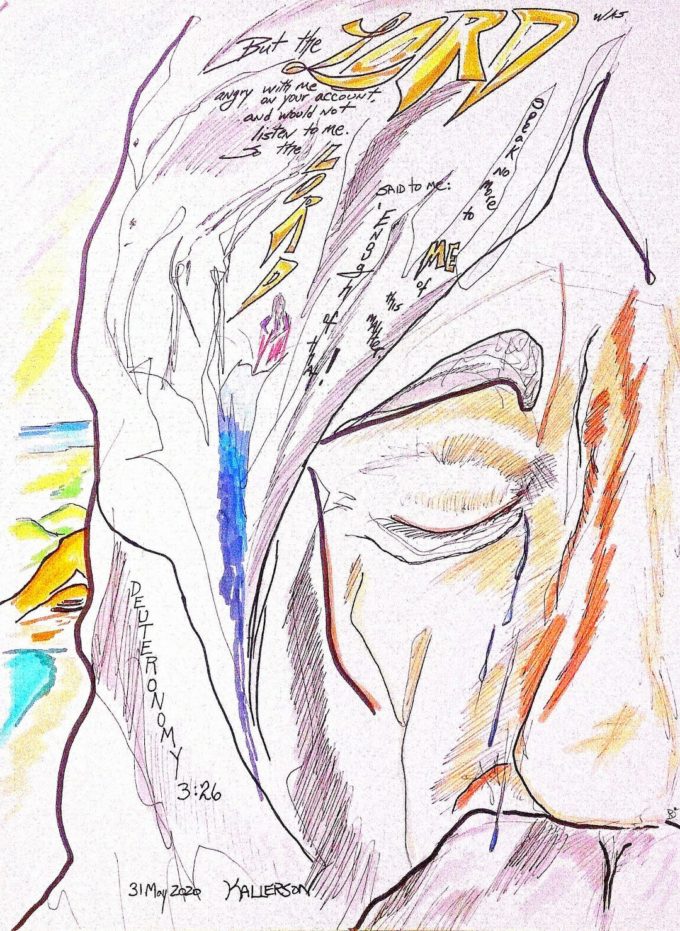
26 “But the Lord was angry with me on your account,
This appears similar to what was said in verse 1:37 –
“The Lord was also angry with me for your sakes.”
However, a completely different word, translated as “angry,” is used. In Chapter 1, the word was anaph. Here it is the same word used in the last verse, translated as “cross over,” avar. It appears to be a play on words, “Let me cross over, over the Jordan, but the Lord crossed over me.”
Also, a different word is used concerning the blame. In Chapter 1, “on your account” came from a word signifying a rolling motion, as if the deeds of the people rolled around and ended up harming Moses. However, here the word is maan, which speaks of purpose or intent.
One cannot help but seeing the work of the Lord here. The law cannot bring one to the inheritance, and so the Lord crossed over the law (pictured by Moses) for the sake of His people.
He was born under the law, He lived out the law, and He died in fulfillment of the law – thus crossing over it for us. As it says, “on your account,” meaning, because of their sins. It was with the purpose or intent of the people that he did this.
26 (con’t) and would not listen to me.
The Lord will not listen to those who live under the law. Rather, He hears the word of faith. This is exactly what Paul speaks of in Romans 10 –
For Moses writes about the righteousness which is of the law, “The man who does those things shall live by them.” 6 But the righteousness of faith speaks in this way, “Do not say in your heart, ‘Who will ascend into heaven?’” (that is, to bring Christ down from above) 7 or, “‘Who will descend into the abyss?’” (that is, to bring Christ up from the dead). 8 But what does it say? “The word is near you, in your mouth and in your heart” (that is, the word of faith which we preach): 9 that if you confess with your mouth the Lord Jesus and believe in your heart that God has raised Him from the dead, you will be saved. Romans 10:5-9
The Lord only hears the law when it is in relation to its fulfillment in Christ Jesus. It is a word of faith, and that alone, which brings one into the Promise of God…
26 (con’t) So the Lord said to me: ‘Enough of that!
The Lord says, rav lakh – “much to.” It is similar to what was said in Numbers 16 when the Levites accused Moses and Aaron of taking too much upon themselves. Moses then repeated the same words back to the Levites, showing that they had gone too far in their grab for power.
The Lord is saying that Moses could only go so far and no further. He had seen enough of what the Lord was doing, and the matter was settled. Again, one can see that the law can only take one to the promise, but it cannot get them into the promise. Only Christ can take one the rest of the way.
26 (con’t) Speak no more to Me of this matter.
It is a perfect picture of what Paul writes concerning the law –
“Now we know that whatever the law says, it says to those who are under the law, that every mouth may be stopped, and all the world may become guilty before God. 20 Therefore by the deeds of the law no flesh will be justified in His sight, for by the law is the knowledge of sin.” Romans 3:19, 20
Those under the law cannot speak of entering the promise. The law only provides a knowledge of sin, but not how to correct that sin.
27 Go up to the top of Pisgah,
aleh rosh ha’pisgah – “Go up to the top of the Pisgah.” Pisgah signifies a cleft. Thus, it is The Cleft. It comes from the word pasag, meaning to pass between. That, in turn, comes from a root signifying to cut up. Thus, pasag figuratively means, “to consider” or “to contemplate.” This is a spot where Moses could pass through to view the land, but only from a distance…
27 (con’t) and lift your eyes toward the west, the north, the south, and the east;
The directions are given based on the layout of the land that he views, not based on the position where he is standing. The directions are:
1) yamah, “westward,” but meaning seaward, and signifying the Mediterranean Sea. The word yam, or sea, comes from a root meaning “to roar.” Thus, it signifies the direction from which the roaring of the Mediterranean waves comes.
2) v’tsaphonah, “and northward,” signifying the hidden, or dark direction, because in the northern hemisphere, the north is the last area to receive the sunlight.
3) v’temanah, “and southward,” signifying to the right, and thus demonstrating that the south is right in relation to one standing in the land looking east. It is from the perspective of where the Lord would dwell in Canaan, not from where Moses stood.
4) u-mizrakhah, “and eastward, signifying the direction from which the sun rises, to which Moses’ back would be facing.
27 (con’t) behold it with your eyes, for you shall not cross over this Jordan.
The thought of this verse is precisely stated by the author of Hebrews. He describes those who lived by faith before the coming of Christ, saying –
“These all died in faith, not having received the promises, but having seen them afar off were assured of them, embraced them and confessed that they were strangers and pilgrims on the earth.” Hebrews 11:13
Moses was the man of law, but he was also one who lived by faith. To maintain the typology of those who came before Christ, even if living in faith, Moses was allowed to see the promise from afar off, but he was not allowed to cross over the Jordan. The law can have no inheritance in the promise. The typology must be maintained. That typology, however, continues after Moses…
28 But command Joshua, and encourage him and strengthen him;
Joshua means “The Lord is Salvation.” In this picture, he is typical of Jesus the Man. The law cannot pass over the Jordan, but a Man must cross over in order to bring the people in. However, Moses is told to encourage and strengthen him.
It is by the fulfillment of the law, including through His death under the law, that man can be brought to the promise. But Christ, in His human nature, needed encouragement and strengthening in His work under the law.
In Luke 9, Jesus was transfigured, and at that time, Moses and Elijah appeared and, as it says, “spoke of His decease which He was about to accomplish at Jerusalem” (Luke 9:31). In the same chapter, it then says, “that He steadfastly set His face to go to Jerusalem” (Luke 9:51). Thus, He was encouraged by the lawgiver (Moses), as well as the prophet of the law (Elijah) fulfilling the typology here.
Later, in Luke 22:43, while Jesus was praying in the Garden of Gethsemane, it says that “an angel appeared to Him from heaven, strengthening Him.” Christ Jesus, under the law, was both encouraged and strengthened in order to continue His work of fulfilling the law…
28 (con’t) for he shall go over before this people,
There is an emphasis here on the word “he.” “He it is that shall go over before this people.” The emphasis is to clearly show that Moses would not be the one to take the people in, but rather “The Lord is Salvation,” which is what “Joshua” means, would do so. He would go before them to bring them in…
28 (con’t) and he shall cause them to inherit the land which you will see.’
Again, the same emphasis is on the word “he.” “And he it is that shall cause them to inherit the land which you will see.” The Lord, not the law, will bring the people in, and the Lord, not the law, shall cause them to inherit. Again, the picture is exactingly fulfilled as seen in the words of Paul –
“Now to Abraham and his Seed were the promises made. He does not say, ‘And to seeds,’ as of many, but as of one, ‘And to your Seed,” who is Christ. 17 And this I say, that the law, which was four hundred and thirty years later, cannot annul the covenant that was confirmed before by God in Christ, that it should make the promise of no effect. 18 For if the inheritance is of the law, it is no longer of promise; but God gave it to Abraham by promise.” Galatians 3:16-18
It is by Christ, and by Christ alone that the promise is received, and the inheritance is obtained…
*29 (fin) “So we stayed in the valley opposite Beth Peor.
Beth Peor means “House of Peor.” Peor comes from the verb paar, meaning “to open.” Thus, it is the House of the Opening. It was a place known for a temple to the Moabite god known as Peor.
The reason for including this final sentence, is that this is the ending of recounting the narrative which brought them to this place. It is from this spot that Moses will finish out the book of Deuteronomy, and then it is in this spot where Moses will be buried, as is seen in Deuteronomy 34:5, 6 –
“So Moses the servant of the Lord died there in the land of Moab, according to the word of the Lord. 6 And He buried him in a valley in the land of Moab, opposite Beth Peor; but no one knows his grave to this day.”
This word, paar, is used in Isaiah 5 when speaking of Sheol, the pit of death, opening its mouth beyond measure to receive those who reject the Lord. When under law – whether trusting in the law for righteousness, or in rejecting the law and satisfying one’s own desires – the inevitable outcome is death.
No matter which way one goes, man under law is condemned and will die outside of the promise. It is only through coming to Christ who fulfilled the law, and who embodies it on our behalf, that we can be made right before God.
In following Him, we will cross over His life, and be brought into the promise. This is – again – the theme set before us in these seven verses today. The Lord keeps giving us the same pictures, again and again and again because we are otherwise slow to learn.
He asks us to wake up from our slumber, our life of ignoring Him, or our supposed life of personal righteousness because of how good we are, and to come to Jesus with our hands empty and our hearts opened wide to Him.
In this, God will be pleased to call us His children and to provide us with a home in the true Land of Promise for all eternity. Think of it! People under the law are doing exactly what Moses did – whether intentional or not.
They are observing the law in an attempt to obtain the inheritance. Why would anyone observe the law if there was nothing to be gained from it? I have a Jewish friend right now who is dying of cancer. The last time I spoke to him, I tried – yet again – to convince him of his need for Christ.
He wrote, please don’t speak to me about Jesus anymore. The funny thing is that I printed out Isaiah 52:13-53:12, removing the verse numbers so that he wouldn’t know it was from the Bible. I said what do you think about this? Who is this referring to?
His answer was, “Jesus.” He knew that. It was obvious. I asked him, “Where did that come from?” His answer, “I have no idea.” I said, it is in your Bible – it is from Isaiah. He acknowledged that his own Scriptures refer to Jesus, and yet he does not want to hear about what his own Scriptures tell him.
And so, his last statement to me will testify against him at the judgment. I want to enter the promise, but I want to do it by my own effort under the law. And the Lord has said to man – “Speak no more to me of this matter.”
There is no inheritance for the soul who desires to merit God’s grace, because grace cannot be merited – it must be received. How stubborn we are to reject the offering of God in Jesus Christ and to say, “I can do better than what You promised, what You accomplished, and what You offer. Speak no more to me about this JESUS.”
It is a sad and self-condemning choice. Be wise, be prepared to meet your God by coming to Christ, and you will be brought near to Him through His precious shed blood today.
Closing Verse: “For as many as are of the works of the law are under the curse; for it is written, ‘Cursed is everyone who does not continue in all things which are written in the book of the law, to do them.’ 11 But that no one is justified by the law in the sight of God is evident, for ‘the just shall live by faith.’ 12 Yet the law is not of faith, but ‘the man who does them shall live by them.’” Galatians 3:10-12
Next Week: Deuteronomy 4:1 Only the evaluation of one verse will I give… (That You May Live) (12th Deuteronomy Sermon)
The Lord has you exactly where He wants you. He has a good plan and purpose for you. But He also has expectations of you as He prepares you for entrance into His Land of Promise. So, follow Him and trust Him and He will do marvelous things for you and through you.
Speak No More to Me of This Matter
“And I commanded Joshua at that time, saying
‘Your eyes have seen; yes, you know it is true
All that the Lord your God has done to these two kings
So will the Lord do to all the kingdoms which you pass through
You must not fear them; this you shall not do
For the Lord your God Himself fights for you
“Then I pleaded with the Lord at that time, saying:
So to Him I was then relaying
‘O Lord God, You have begun to show
Your servant Your greatness and Your mighty hand
———-from You such great power proceeds
For what god is there in heaven or on earth who can
Do anything like Your works and Your mighty deeds?
I pray, let me cross over and see the good land as it stretches on
Beyond the Jordan, those pleasant mountains, and Lebanon
“But the Lord was angry with me on your account
And would not listen to me. So the Lord said to me:
‘Enough of that! Speak no more to Me of this matter
It is decided and that is it. Can’t you see!
Go up to the top of Pisgah, and lift your eyes
Toward the west, the north, the south, and the east
Behold it with your eyes
For you shall not cross over this Jordan
———-only with your eyes shall you on this beauty feast
But command Joshua, and encourage him and strengthen him
For he shall go over before this people, prepared for war
And he shall cause them to inherit the land which you will see
“So we stayed in the valley opposite Beth Peor
Lord God, turn our hearts to be obedient to Your word
Give us wisdom to be ever faithful to You
May we carefully heed each thing we have heard
Yes, Lord God may our hearts be faithful and true
And we shall be content and satisfied in You alone
We will follow You as we sing our songs of praise
Hallelujah to You; to us Your path You have shown
Hallelujah we shall sing to You for all of our days
Hallelujah and Amen…
21 “And I commanded Joshua at that time, saying, ‘Your eyes have seen all that the Lord your God has done to these two kings; so will the Lord do to all the kingdoms through which you pass. 22 You must not fear them, for the Lord your God Himself fights for you.’
23 “Then I pleaded with the Lord at that time, saying: 24 ‘O Lord God, You have begun to show Your servant Your greatness and Your mighty hand, for what god is there in heaven or on earth who can do anything like Your works and Your mighty deeds? 25 I pray, let me cross over and see the good land beyond the Jordan, those pleasant mountains, and Lebanon.’
26 “But the Lord was angry with me on your account, and would not listen to me. So the Lord said to me: ‘Enough of that! Speak no more to Me of this matter. 27 Go up to the top of Pisgah, and lift your eyes toward the west, the north, the south, and the east; behold it with your eyes, for you shall not cross over this Jordan. 28 But command Joshua, and encourage him and strengthen him; for he shall go over before this people, and he shall cause them to inherit the land which you will see.’
29 “So we stayed in the valley opposite Beth Peor.