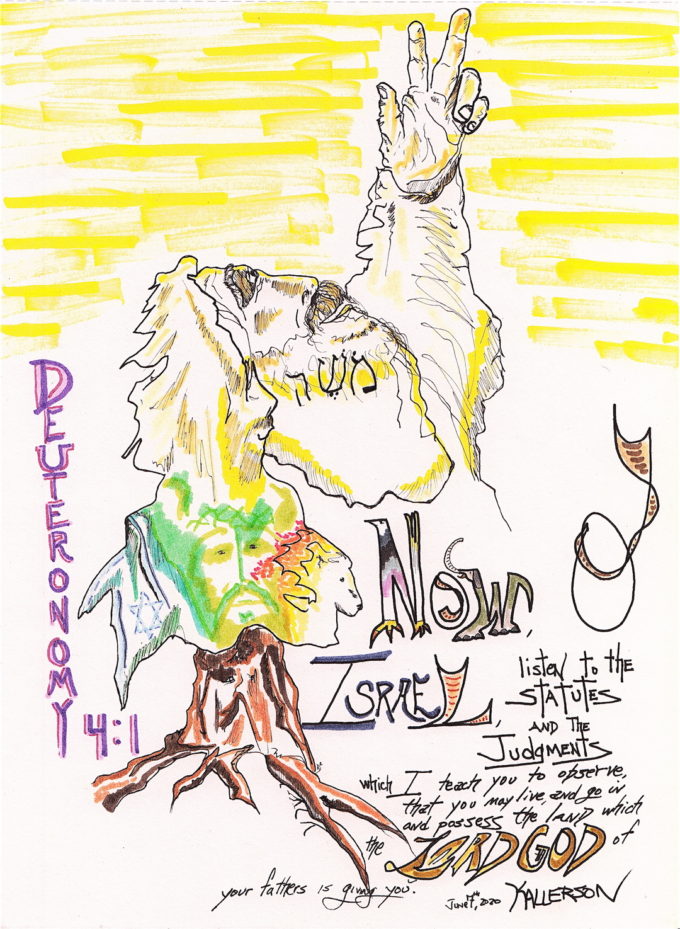
Deuteronomy 4:1
That You May Live
In our sermon last week, which ended Chapter 3, we were shown a chiasm which continues through much of this chapter, even to verse 22. The beginning and ending parts of that chiasm revealed that Moses wanted to cross the Jordan (verse 3:25), but that he must not do so (verse 4:22).
We have seen, and we certainly will see today, that the reason for this is that Moses is a type, or picture of the law, and thus of those under the law. But in our verse today, Moses refers to “the Lord God of your fathers” when speaking to Israel there before him.
That is referring to those who went before them, including their fathers who received the law. But those who received the law did not enter. And those before them did not have the law, and yet, the Lord promised the land to them.
If he did this, before giving them the law, then inheriting the promise cannot be because of the law. As Paul says in Galatians 3:18, “For if the inheritance is of the law, it is no longer of promise; but God gave it to Abraham by promise.”
Further, Paul says in Romans 4:14 that, “…if those who are of the law are heirs, faith is made void and the promise made of no effect.” The promise there in Romans 4 is the same promise to Abraham Paul referred to in Galatians 3. To maintain the typology, Moses (picturing the law and thus those under law) is not to cross the Jordan and enter Canaan.
Well then, if God gave the inheritance to Abraham and his descendants by promise, and yet Israel under law will actually go over Jordan and dwell there, it means that the promise is not really the land of Canaan at all. These people and places are given as types and shadows of something greater.
But this still doesn’t explain why the law was given. What purpose did it serve? Paul answers that in his next words of Galatians after speaking of the inheritance, our text verse for today…
Text Verse: “What purpose then does the law serve? It was added because of transgressions, till the Seed should come to whom the promise was made; and it was appointed through angels by the hand of a mediator. 20 Now a mediator does not mediate for one only, but God is one.” Galatians 3:19, 20
Paul says the law was “added because of transgressions.” What that means is that the statutes and judgments which Moses will begin to refer to today actually multiply Israel’s guilt before the Lord. They don’t bring the people nearer to God, but rather, they were to show the people the perfection of God and how far short of that standard they actually were.
Thus, in the coming of the Seed, meaning Christ, they could also understand the immense grace of God, the infinite mercy of God, and the immeasurable love of God. But those attributes of God can only be realized by faith in God, not in observing the law.
If someone observes the law, it is done to merit favor or to avoid punishment, but it is not done out of faith. You are going to hear this presented to you so many times, and in so many ways, in the next few minutes that your heads may either spin off or explode, but this is necessary to clearly think through what is presented here on several different levels.
The reason we are going to do this, is in hopes that you, or someone else, will finally be able to say, “Aha, I get it.” We may have heard the story of grace a million times, and yet we may still be clinging to our own selfish means of making God happy other than in simply trusting Him and what He has done.
How many of you refrain from certain types of foods because you believe the Bible tells you to? How many of you give a tithe because you believe the Bible tells you to? How many of you think your time at church is part of a Sabbath Day worship?
If you think any of these things, you are both wrong, and you are not pursuing grace, but rather you are pursuing a law, attempting to please God through your efforts. You are setting aside grace in the process of living out some supposed law that you think is bringing you nearer to God. Grace is grace. It cannot be merited.
If you are trying to do so, let’s hope that after the countless repetitions of thought that you are about to hear, you will finally give that up and just… trust. May it be so. By grace, and by faith, meaning faith alone for salvation, is a principle point of Christian theology, and it is clearly laid out in God’s superior word. And so, let’s turn to that precious word once again and… May God speak to us through His word today and may His glorious name ever be praised.
I. The Statutes and Judgments
Moses has spent the first three chapters of the book of Deuteronomy recounting the events which brought Israel to the place where they are now. All of what he has conveyed has been given as typological pictures of future redemptive history, and most especially that of the Person and work of Jesus Christ.
Israel was brought out of Egypt and was set to enter into the land of Canaan, they failed to believe the Lord and His promises, and they were turned into the wilderness to perish there. That pictured Israel’s rejection of Christ, and their exile among the nations for these past two thousand years.
The typology has been exceedingly precise and clear. Now, Israel is once again set to enter into the Land of Promise. But Canaan is not the true Promise. Rather, it is only a typological picture of entering God’s rest which comes by believing in Christ Jesus. As the author of Hebrews says –
“For we who have believed do enter that rest.” Hebrews 4:3
He is referring to faith in Christ which makes that possible.
Chapter 3 closed out with verses 23-29 where Moses petitioned the Lord to allow him to enter the land. To understand the context of what will now be presented, those verses, which we evaluated last week, are again given –
“Then I pleaded with the Lord at that time, saying: 24 ‘O Lord God, You have begun to show Your servant Your greatness and Your mighty hand, for what god is there in heaven or on earth who can do anything like Your works and Your mighty deeds? 25 I pray, let me cross over and see the good land beyond the Jordan, those pleasant mountains, and Lebanon.’
26 “But the Lord was angry with me on your account, and would not listen to me. So the Lord said to me: ‘Enough of that! Speak no more to Me of this matter. 27 Go up to the top of Pisgah, and lift your eyes toward the west, the north, the south, and the east; behold it with your eyes, for you shall not cross over this Jordan. 28 But command Joshua, and encourage him and strengthen him; for he shall go over before this people, and he shall cause them to inherit the land which you will see.’
29 “So we stayed in the valley opposite Beth Peor.” Deuteronomy 3:23-29
Understanding the typology from last week (Moses represents the law, and the law cannot bring people into the promise), the narrative now turns to…the law. It seems almost contradictory. How can it be that Moses, who represents the law and who is forbidden entry into the promise, now issues forth more words of law which he expects the people to be obedient to?
The answer to that question is found in the first verse which introduces the words of law which will span the next twenty-nine chapters, right up until the end of Chapter 32.
“Now, O Israel, listen to the statutes and the judgments
v’atah Yisrael sh’ma el ha’khuqim v’el ha’mishpatim – “And now Israel, hearken unto the statutes and unto the judgments.” The word shama means to hear, but the sense here is to hear and to pay heed to what is heard. And that which is to be hearkened to are the statutes and judgments.
The words are variously translated – decrees and laws, statutes and rules, statutes and ordinances, ordinances and judgments, etc. The first word is khoq, signifying something prescribed or owed.
It comes from khaqaq which is something decreed or even a person or thing which is appointed. That comes from a primitive root meaning to hack, and thus to engrave. These things are appointed and are expected to be obeyed, as any decree would be.
The second word is mishpat. It is a standard or a judgment, coming from shaphat which means to judge or to govern. Moses is now going to relay statutes and judgments for the people to hearken to.
Many of these are going to be repeated from earlier times and will include further recountings of what occurred, and why they were given. In other words, and for example, Moses will repeat the Ten Commandments, which were given to Israel, but He will also recount the many events which surrounded the giving of those commandments.
The end of Moses’ recounting the past is not over, but Moses first recounted the events which led to their punishment before recounting those events that surrounded things which occurred before that time. If this seems out of order, it isn’t.
The Lord, through Moses, is showing Israel in typology what brought them the years of disaster that had happened to them (meaning their rejection of Christ) before showing them again what led them to that point.
So, what led them to it? The law. They had been given the law, and even though they were under law, it is not disobeying the law that brought about their punishment. It was a lack of faith in the Lord that brought it about. That was stated, explicitly and in the most poignant terms, in Deuteronomy 1:32, 33
“Yet, for all that, you did not believe the Lord your God, 33 who went in the way before you to search out a place for you to pitch your tents, to show you the way you should go, in the fire by night and in the cloud by day.”
The people failed to… believe. If you remember, the Hebrew was very marked and specific. Moses had recounted what got them to the door of Canaan, and yet – and despite all of that – they failed to believe. Nothing about the law was even said. They simply failed to trust the Lord.
Moses is now going to heap all of the laws back onto the people again, and he is going to add in other laws as well. And yet, it isn’t their failure of the law that excluded them from the promise, and so it cannot be their observance of the law which will – next time – bring them into the promise.
So why is Moses doing this? Because the Law of Moses, this impossible body of statutes and judgments and penalties – and so much more – is given as a body of instruction to teach Israel one thing… that they need grace. Paul says as much in Galatians 3 –
“Is the law then against the promises of God? Certainly not! For if there had been a law given which could have given life, truly righteousness would have been by the law. 22 But the Scripture has confined all under sin, that the promise by faith in Jesus Christ might be given to those who believe. 23 But before faith came, we were kept under guard by the law, kept for the faith which would afterward be revealed. 24 Therefore the law was our tutor to bring us to Christ, that we might be justified by faith. 25 But after faith has come, we are no longer under a tutor.” Galatians 3:21-25
The first time, Israel was given the law, and while under the law they were presented Christ – the embodiment of the law. They failed to believe, and they were punished. Israel will again be presented the law – for a final seven years known as the tribulation period.
They will have a temple, sacrifices, and all of the trappings that are a part of the Law of Moses, and they will find that it will fail to bring them any closer to the Lord. Eventually, as a people, they will demonstrate faith, they will come to Christ, and they will enter the promise. It is not the law that will save, but Christ’s fulfillment of it.
This is why Deuteronomy is given. It is a second attempt at bringing the people to understand their need for Christ, just as they will have a second attempt after their many years of exile to realize their need for Christ. In the end, it is about Christ. But how contradictory that sounds from Moses’ next words…
1 (con’t) which I teach you to observe,
asher anokhi m’lamed etkhem laasot – “which I train you to do.” Here is a new word, lamad, which means learning, teaching, instructing, and so on. It comes from a primitive root signifying “to goad.” One uses a goad to prod an animal along. Moses will use this word seventeen times in Deuteronomy alone.
Moses is thus, prodding the people through this instruction to do the things that he will expound to them, and it is for a very specific purpose…
Listen to the statutes and the judgments too
Pay heed to the word you are about to hear
I am going to lay out all that you are to do
Keep them with you always, yes – be sure to keep them near
Think on all I am going to tell you
Consider what needs to be done
Will you trust in your own ability, these things to do?
If so, you must accomplish them all – yes, every single one
Think on what I am going to tell you
Consider again what needs to be done
Will you trust in your own ability, these things to do?
Or will you by faith simply trust in My Son?
II. That You May Live
1 (con’t) that you may live,
l’maan tikhyu – “that you may live” is technically correct, but to understand the meaning, one might paraphrase this as, “to the end purpose of your living.” The word maan speaks of a teleological view of things. In other words, “What is the purpose of what is relayed?” In this case, it is that “you may live.”
This is the entire point of the giving of the law – whether it seems like it or not. We can think of the law as a basis for holy living, for moral conduct, for treating others as humans created in the image of God (which is both holy living and right moral conduct), etc.
However, people all over the world do the things of the law, even without having the law, don’t they? All societies, cultures, and nations have codes – written or unwritten – concerning murder, adultery, theft, lying, and so on. But they don’t have life, meaning a right standing with God, through the doing or not doing of those things, do they? No. Paul says as much in Romans –
“For as many as have sinned without law will also perish without law, and as many as have sinned in the law will be judged by the law 13 (for not the hearers of the law are just in the sight of God, but the doers of the law will be justified; 14 for when Gentiles, who do not have the law, by nature do the things in the law, these, although not having the law, are a law to themselves, 15 who show the work of the law written in their hearts, their conscience also bearing witness, and between themselves their thoughts accusing or else excusing them) 16 in the day when God will judge the secrets of men by Jesus Christ, according to my gospel.” Romans 2:12-16
Paul seems to say that people without the law, who have this law on their heart, can live (be right with God) apart from the law by doing these things. But this is not the case. He later says that all have sinned and all fall short of the glory of God. Without Jesus, all stand condemned. Jesus confirms this in John 3:18 –
“He who believes in Him is not condemned; but he who does not believe is condemned already, because he has not believed in the name of the only begotten Son of God.” John 3:18
Moses sums up what he is going to present, saying to Israel that obeying the law has the end purpose of granting life. It is a general repeat of what was said in Leviticus 18 –
“You shall therefore keep My statutes and My judgments, which if a man does, he shall live by them: I am the Lord.” Leviticus 18:5
Moses repeats this now, but even more, the very last thing he says in this major section of Deuteronomy – a section which goes all the way through Deuteronomy 32 – is exactly the same thing he says now in the first verse of this section –
“Moses finished speaking all these words to all Israel, 46 and he said to them: ‘Set your hearts on all the words which I testify among you today, which you shall command your children to be careful to observe—all the words of this law. 47 For it is not a futile thing for you, because it is your life, and by this word you shall prolong your days in the land which you cross over the Jordan to possess.’” Deuteronomy 32:45-47
The only things after this large section of instruction are that Moses will speak out a blessing to the tribes of people in Chapter 33, and then it will record his ascent up Mount Nebo where he dies in Chapter 34. The body of instruction actually ends in Chapter 32.
Think of it! The first words of the actual body of instruction of the book of Deuteronomy say that the end purpose of them is so that the people may live. And the last words of that same body of instruction say that in the observance of these things it is their life.
But more, that is based upon the words of the Lord which explicitly say that the man who does the things of things of the law will live. Those words from Leviticus are a set of words that are so important that they are repeated by Nehemiah (Nehemiah 9:29) after their first exile. They are substantially repeated by Ezekiel several times (Ezekiel 20). And, they are repeated twice by Paul (Romans 10:5 & Galatians 3:12).
And yet, Paul explains something to us concerning these words there in Galatians 3 that is contrary to what we already saw in Deuteronomy 1 –
“For as many as are of the works of the law are under the curse; for it is written, ‘Cursed is everyone who does not continue in all things which are written in the book of the law, to do them.’ 11 But that no one is justified by the law in the sight of God is evident, for ‘the just shall live by faith.’ 12 Yet the law is not of faith, but ‘the man who does them shall live by them.’” Galatians 3:10-12
Paul cites the very law that Moses is about give, right from Deuteronomy 27:26 –
“Cursed is the one who does not confirm all the words of this law by observing them.” Deuteronomy 27:26
He then cites a prophet who lived under the law, and who thus prophesied words of law –
“Behold the proud,
His soul is not upright in him;
But the just shall live by his faith.” Habakkuk 2:4
Habakkuk shows that attempting to be justified before God on one’s own merit, something that the law requires, is prideful, and that the soul of one who is prideful is “not upright in him.”
As this is so, then it is not – nor can it be – that observance of the law will bring life. If it does not bring life, then it – by default – will bring death. Paul says that in Romans 7:7-12 –
“What shall we say then? Is the law sin? Certainly not! On the contrary, I would not have known sin except through the law. For I would not have known covetousness unless the law had said, “You shall not covet.” 8 But sin, taking opportunity by the commandment, produced in me all manner of evil desire. For apart from the law sin was dead. 9 I was alive once without the law, but when the commandment came, sin revived and I died. 10 And the commandment, which was to bring life, I found to bring death. 11 For sin, taking occasion by the commandment, deceived me, and by it killed me. 12 Therefore the law is holy, and the commandment holy and just and good.”
Moses has said, right at the beginning of his giving of the law, and he will then repeat, right at the ending of this giving of the law, what the Lord said in His words of law – that the purpose of the law is for the granting of life. Can anyone disagree with that? No. It is explicit.
And yet, Israel did not enter into the promise. And more, not only did they not enter the promise, it wasn’t at all because of a matter of law. The Lord never commanded the people to go into Canaan, despite the translation of Deuteronomy 1:26. There it said –
“Nevertheless you would not go up, but rebelled against the command of the Lord your God.” Deuteronomy 1:26
Rather, and as we saw at that time, the Hebrew said, va’tamru eth pi Yehovah elohekem – “and rebelled against the mouth of Yehovah your God.”
The “mouth of the Lord” can mean a commandment, but in this case the Lord did not “command” the people to go up. Instead, He promised to go before them. The implication is that they would believe Him and His promises and willingly follow His lead. But they did not.
They failed to have faith that the Lord would lead them and fight their battles for them. In failing to believe, they cut themselves off from the promise. From there, they found death in the wilderness instead of life in Canaan.
But then that brings us to the next thought. Were they under law while in the wilderness? The answer is “Yes.” The entire time that they were wandering there, they were under law. They certainly observed the Sabbath and were bound under the precepts of the law, and yet they could not fulfill the law entirely.
This is because the law included certain observances that can only be fulfilled while in Canaan – such as certain aspects of the Feasts of the Lord. And so, they were under law, but they were so in an imperfect manner.
This is the same as it was for Israel after their rejection of Christ during their dispersion. They were bound to the law, and yet they could not truly be obedient to the law.
When the Lord said that all would die in the wilderness, it isn’t just true for the thirty-eight years after failing to enter Canaan. It was also true for every one of them who was exiled after rejecting Christ. The law that was to bring life, was found to bring death – both while they lived in Canaan, and during their time exiled from Canaan.
But those who were in the wilderness, and who were dying could be spared. Remember the account of the fiery serpents! It says the people spoke against Moses (meaning the law) and so the Lord sent fiery serpents among them. After acknowledging their wrong, Moses prayed for the people. At that time, it said –
“Then the Lord said to Moses, ‘Make a fiery serpent, and set it on a pole; and it shall be that everyone who is bitten, when he looks at it, shall live.’ 9 So Moses made a bronze serpent, and put it on a pole; and so it was, if a serpent had bitten anyone, when he looked at the bronze serpent, he lived.” Numbers 21:8, 9
It says that whoever looked to the bronze serpent lived. He found life. But Moses says here in Deuteronomy 4 that in observing the law, they would live. But these people found life not through the law, but through an act of faith alone.
And who is it that made the serpent and put it on a pole? Moses! It was Moses who – at the direction of the Lord – did so. Moses, the lawgiver, put the serpent on the pole. And it is the law – the penalty of the law – which necessitated Christ being placed on the cross. This is seen first from Jesus’ words –
“And as Moses lifted up the serpent in the wilderness, even so must the Son of Man be lifted up, 15 that whoever believes in Him should not perish but have eternal life. 16 For God so loved the world that He gave His only begotten Son, that whoever believes in Him should not perish but have everlasting life. 17 For God did not send His Son into the world to condemn the world, but that the world through Him might be saved.” John 3:14-17
And then from the words of Paul –
“In Him you were also circumcised with the circumcision made without hands, by putting off the body of the sins of the flesh, by the circumcision of Christ, 12 buried with Him in baptism, in which you also were raised with Him through faith in the working of God, who raised Him from the dead. 13 And you, being dead in your trespasses and the uncircumcision of your flesh, He has made alive together with Him, having forgiven you all trespasses, 14 having wiped out the handwriting of requirements that was against us, which was contrary to us. And He has taken it out of the way, having nailed it to the cross.” Colossians 2:11-14
Jesus says that Moses lifted up the serpent in the wilderness. Moses, the “law,” did so because the Lord told him to do so. Jesus equates what happened there to what will happen to Him – He would be lifted up. As Moses is a type of the law, what Jesus is implying is that it is the law, the word of the Lord through the law, that necessitated that He would be lifted up.
But those who looked to the snake lived, not because of the law, but because of faith in looking to the serpent on the pole. Jesus is implying through the analogy, and explicitly stating through His words, that the world is saved through faith in His being lifted up, not through direct obedience to the law.
Paul then speaks of circumcision, a precept of the law (Leviticus 12:3), as being fulfilled in any who are in Christ, and that in this forgiveness, Christ wipes out the handwriting of the law, meaning He annuls it for that person.
And how is this possible? It is because God has taken the law “out of the way, having nailed it to the cross.” Did any of this – either at Moses’ time, or in the life of a believer now – occur through obedience to the law? Absolutely not. It came by faith in God’s provision.
If you can see it, when Moses put the serpent on the pole and lifted it up, he was – for all intents and purposes – nailing the law he had been given to that pole, crucifying it. Why?
Because first, the Lord said that the man who does the things of the law would live. Moses repeats this, saying that by observing the law you will live. And yet, the people who looked to the serpent on the pole – without doing a single deed of the law – lived.
If people found life without the law, then the law was no longer needed. This is what every Jew – few as they may be – who have come to Christ over the last 2000 years has discovered. The law died to them because they died to the law through Christ.
If Moses was astute, he may have said to himself, “The people have this law (under which they were condemned to die), which is supposed to bring life, and they are all dying around me, except for those who look at this bronze serpent. What on earth do we need the law for then?”
If he were exceedingly astute, he might have then said, “The law, which is supposed to give life to the man who does the things of this law, is summed up in the faith he has in looking to this serpent. This serpent embodies everything that the law was intended to provide. And it came from the Lord by an act of grace.”
If Moses figured that out, which the Bible does not even hint at, then he would have understood one of the main premises of the gospel as explained in detail by Paul –
“But God, who is rich in mercy, because of His great love with which He loved us, 5 even when we were dead in trespasses, made us alive together with Christ (by grace you have been saved), 6 and raised us up together, and made us sit together in the heavenly places in Christ Jesus, 7 that in the ages to come He might show the exceeding riches of His grace in His kindness toward us in Christ Jesus. 8 For by grace you have been saved through faith, and that not of yourselves; it is the gift of God, 9 not of works, lest anyone should boast.” Ephesians 2:4-9
And this is what occurs with every Gentile as well. Paul already said it, as we cited earlier, “And the commandment, which was to bring life, I found to bring death” (Romans 7:10). This is exactly why Leviticus 18:5 is so important. Again –
“You shall therefore keep My statutes and My judgments, which if a man does, he shall live by them: I am the Lord.” Leviticus 18:5
While evaluating that verse, it was noted that there is a definite article before “man.” And further, it used the word adam, instead ish. Both mean “man,” but in using the word adam, it speaks of a human being, the species. It is speaking of a specific man, “if the man does.” Paul explains who the Man is –
“For since by man came death, by Man also came the resurrection of the dead. 22 For as in Adam all die, even so in Christ all shall be made alive.” 1 Corinthians 15.21, 22
Adam died because of the law. God gave him a law, he disobeyed it, and he died. Paul says that through that man, meaning Adam, came death. The Lord says that if the Man does His statutes and judgments, He will live. Christ did the Lord’s statutes and judgments and He lives.
Jesus, and the apostles also, show that faith in Him means that we shall be made alive. If that is said to people who are alive – because only those who are alive can hear it, then it cannot simply be speaking of physical life.
As Paul says, “all in Adam die.” It is a confirmation of the doctrines we call “original sin” and “inherited sin.” Adam sinned, sin entered the world, and we have all inherited his spiritually dead state.
Paul cannot merely be speaking about people who had physically died, because he then says, “even so in Christ all shall be made alive.” But that includes us, who are physically alive right now. And so, it must be speaking of spiritual life, and thus eternal life.
We cannot even begin to speculate on whether Moses realized this or not. All we can know is that Moses repeats the words of the Lord concerning life for the people being found in doing the statutes and judgments set before them, and that some of the people lived, not by doing those, but by looking in faith to a serpent on a pole.
The words are given so that you may live
But you must think on them and consider what to do
These innumerable laws are presented, to you them I give
And in doing them, life shall be granted to you
But consider well what this means to you
Every precept must be exactingly completed and done
The man will live who these things doing he does do
Yes, he will live when he does every single one
Can you pass muster in doing these things you are to do?
Can you accomplish them all – yes, every single one?
There is another option laid out for you…
Trust in the doing of them all by My own precious Son
III. Possess the Land
Having said all that we have said thus far, all of which is true and proper, it must be observed that the words of this verse are in the second person plural. Moses is speaking to Israel. When he said, “the statutes and judgments which I teach you,” the word “you” is plural. The word “you” in “that you may live” is also plural, and so are the words of the next clause…
1 (con’t) and go in and possess the land
Of this verse, Charles Ellicott says, “Life is put before possession. The penalty of the broken law is death.” This depends on what Ellicott is speaking of. If he is referring to physical life, the statement incorrect. Breaking the law depends on what law is broken.
However, if what he says is speaking of the truth of the law itself, then he is correct. In Adam’s breaking of the law, death was the result. Any infraction of God’s law incurs spiritual death, but as we are born in that condition, it hardly matters. It simply means that we will never be made alive by breaking the law.
However, in this, Ellicott would continue to be correct. Life is put before possession. One cannot obtain the inheritance without first being given life. One believes in Christ unto salvation (the granting of life), and then the inheritance is realized. They may actually occur at the same time, but the logical order is life and then possession.
The verb “and go in” is plural as is the verb “and possess.” Moses is speaking to Israel as a collective body. But the fact is that once in the land, the people failed to do the statutes and judgments of the Lord, and yet they – as a people – have continued to live, even though individually they have either 1) trusted in Messiah and been granted eternal life, or 2) they have continued to die physically, and also to remain spiritually dead forever.
After entering Canaan, they lived in the land up until the time of the prophet Jeremiah. At that time, they were exiled to Babylon, as promised. Eventually, they were brought back to the land, also as prophesied.
After the return, Nehemiah went to accomplish a task in Judah, and during his time there, he repeats Leviticus 18:5 in the context of none of the people having done what was expected –
“But after they had rest,
They again did evil before You.
Therefore You left them in the hand of their enemies,
So that they had dominion over them;
Yet when they returned and cried out to You,
You heard from heaven;
And many times You delivered them according to Your mercies,
29 And testified against them,
That You might bring them back to Your law.
Yet they acted proudly,
And did not heed Your commandments,
But sinned against Your judgments,
‘Which if a man does, he shall live by them.’
And they shrugged their shoulders,
Stiffened their necks,
And would not hear.
30 Yet for many years You had patience with them,
And testified against them by Your Spirit in Your prophets.
Yet they would not listen;
Therefore You gave them into the hand of the peoples of the lands.
31 Nevertheless in Your great mercy
You did not utterly consume them nor forsake them;
For You are God, gracious and merciful. Nehemiah 9:18-30
Nehemiah cites Leviticus 18:5, speaking of a singular man, but without the article – “if a man does…” No man had. All had died. The rest of the time, he is speaking of the people collectively – they, them, etc.
And more, not only had a man not done the things of the law, it implied that no man had done the things of the law – meaning that all of Israel had failed to do the things of the law. One plus one equals two. If they had not – meaning none of them – then the promise of Moses in Deuteronomy cannot have been attained.
Further, the people were exiled a second time, but the record shows that a Man (THE Man) had done the things of the law. That is the purpose of the gospels. It is to show that THE Man came, He fulfilled the law, and therefore the promise can be obtained.
However, Israel collectively rejected THE Man, and they were exiled again. Their exile demonstrates that one of two truths must exist: 1) Either no man did the things of the law, and thus Israel did not do the things of the law, or 2) a Man did do the things of the law and they rejected that.
The answer to which is true is obvious based on the gospels, and also on the words of Acts and the epistles. However, because Moses’ words are to Israel collectively, and because they are now back in the land, even though they had not been doing the things of the law, nor are they now doing the things of the law, then there must be a purpose for them being there.
This is evident from our final words of this opening verse of Deuteronomy 4…
*1 (fin) which the Lord God of your fathers is giving you.
The land is given to Israel by the Lord God of their fathers. If the land is given to Israel, which it clearly is stated here, and if they may live (meaning not die), and that they may both go in and also possess the land, then – as was clearly seen in our last of three Leviticus 26 sermons – Israel will someday come to Christ.
They are under the law right now, whether they are observing it or not. They will be under the law during a period of observing it – meaning with a temple, sacrificial rites, and etc., and yet they will continue to be bound by the law which they cannot meet. For a third time, as Paul says, “And the commandment, which was to bring life, I found to bring death” (Romans 7:10).
If they cannot meet the law, and if the law brings death, and yet Moses says that through observing the law they may live, then it must mean through the Man who did the things of the law. Their life, the collective life of Israel, is bound up in the observance of the law. But it is only so in regard to Jesus Christ’s fulfillment of it – nothing more. THE Man has done the things of the law.
It doesn’t matter if it is singular you, or plural you all, the same truth holds for both. By deeds of the law, no man – and no nation – will be justified in God’s sight. For all of the detail of our words today, for all of the carefully and precisely stated words, and for all of the logic that had to be applied to certain points, one truth is inescapable – the law promises life, but it only brings death.
This does not mean that the Lord deceived Israel. It means that they misunderstood what the promises entailed, and that they failed to observe what the very promises of the law speak to – both from Moses and from the later writings. That which it speaks to is the incarnation of God in the Person of Jesus Christ.
Does the law truly bring death? Well, yes. Jesus Christ was born under the law, He lived without violating the law, and thus He could have lived in that capacity forever. But the law even brought death to Christ – not for His violations of it, but for ours –
“I am the good shepherd; and I know My sheep, and am known by My own. 15 As the Father knows Me, even so I know the Father; and I lay down My life for the sheep. 16 And other sheep I have which are not of this fold; them also I must bring, and they will hear My voice; and there will be one flock and one shepherd.
17 “Therefore My Father loves Me, because I lay down My life that I may take it again. 18 No one takes it from Me, but I lay it down of Myself. I have power to lay it down, and I have power to take it again. This command I have received from My Father.” John 10:14-18
Thank God for Jesus Christ who was willing to die under that law so that we could die to the law. My hope and great desire for you is that you will contemplate what this means, and then that you will decide to trust Jesus, by faith alone, for your salvation.
The sin in man must be judged, or man must be judged in sin, but either way, our sin will be judged. Be wise and discerning and ask God for your sin to be judged at the cross of Calvary in the sinless Man who became sin so that we could become the righteousness of God in Him. May it be so, and may it be today – to the glory of God and to the saving of your soul.
Closing Verse: “But now the righteousness of God apart from the law is revealed, being witnessed by the Law and the Prophets, 22 even the righteousness of God, through faith in Jesus Christ, to all and on all who believe. For there is no difference; 23 for all have sinned and fall short of the glory of God, 24 being justified freely by His grace through the redemption that is in Christ Jesus, 25 whom God set forth as a propitiation by His blood, through faith, to demonstrate His righteousness, because in His forbearance God had passed over the sins that were previously committed, 26 to demonstrate at the present time His righteousness, that He might be just and the justifier of the one who has faith in Jesus.” Romans 3:21-26
Next Week: Deuteronomy 4:2-7 It applies to all – be it a Janice or a Jim… (For Whatever Reason We May Call Upon Him) (13th Deuteronomy Sermon)
The Lord has you exactly where He wants you. He has a good plan and purpose for you. But He also has expectations of you as He prepares you for entrance into His Land of Promise. So, follow Him and trust Him and He will do marvelous things for you and through you.
That You May Live
Now, O Israel, listen to the statutes and the judgments
Which I teach you to observe, that you may live
And go in and possess the land
Which the LORD God of your fathers is going to you give
Lord God, turn our hearts to be obedient to Your word
Give us wisdom to be ever faithful to You
May we carefully heed each thing we have heard
Yes, Lord God may our hearts be faithful and true
And we shall be content and satisfied in You alone
We will follow You as we sing our songs of praise
Hallelujah to You; to us Your path You have shown
Hallelujah we shall sing to You for all of our days
Hallelujah and Amen…
“Now, O Israel, listen to the statutes and the judgments which I teach you to observe, that you may live, and go in and possess the land which the Lord God of your fathers is giving you.