Deuteronomy 29:20-29
The Secret Things
In our Leviticus 26:14-39 sermon, entitled Assured Curses, we opened with the words of Mark Twain who confirmed the words of cursing that were laid upon Israel the people and Israel the land. It is right to revisit those words in order to understand and remember the truth of what is now presented in Deuteronomy –
Palestine sits in sackcloth and ashes. Over it broods the spell of a curse that has withered its fields and fettered its energies. Where Sodom and Gomorrah reared their domes and towers, that solemn sea now floods the plain, in whose bitter waters no living thing exists—over whose waveless surface the blistering air hangs motionless and dead—about whose borders nothing grows but weeds, and scattering tufts of cane, and that treacherous fruit that promises refreshment to parching lips, but turns to ashes at the touch. Nazareth is forlorn; about that ford of Jordan where the hosts of Israel entered the Promised Land with songs of rejoicing, one finds only a squalid camp of fantastic Bedouins of the desert; Jericho the accursed, lies a moldering ruin, to-day, even as Joshua’s miracle left it more than three thousand years ago; Bethlehem and Bethany, in their poverty and their humiliation, have nothing about them now to remind one that they once knew the high honor of the Saviour’s presence; the hallowed spot where the shepherds watched their flocks by night, and where the angels sang Peace on earth, good will to men, is untenanted by any living creature, and unblessed by any feature that is pleasant to the eye. Renowned Jerusalem itself, the stateliest name in history, has lost all its ancient grandeur, and is become a pauper village; the riches of Solomon are no longer there to compel the admiration of visiting Oriental queens; the wonderful temple which was the pride and the glory of Israel, is gone, and the Ottoman crescent is lifted above the spot where, on that most memorable day in the annals of the world, they reared the Holy Cross. The noted Sea of Galilee, where Roman fleets once rode at anchor and the disciples of the Saviour sailed in their ships, was long ago deserted by the devotees of war and commerce, and its borders are a silent wilderness; Capernaum is a shapeless ruin; Magdala is the home of beggared Arabs; Bethsaida and Chorazin have vanished from the earth, and the “desert places” round about them where thousands of men once listened to the Saviour’s voice and ate the miraculous bread, sleep in the hush of a solitude that is inhabited only by birds of prey and skulking foxes. Palestine is desolate and unlovely. And why should it be otherwise? Can the curse of the Deity beautify a land? Mark Twain, 1869
Text Verse: “The joy of our heart has ceased;
Our dance has turned into mourning.
16 The crown has fallen from our head.
Woe to us, for we have sinned!
17 Because of this our heart is faint;
Because of these things our eyes grow dim;
18 Because of Mount Zion which is desolate,
With foxes walking about on it.
19 You, O Lord, remain forever;
Your throne from generation to generation.
20 Why do You forget us forever,
And forsake us for so long a time?
21 Turn us back to You, O Lord, and we will be restored;
Renew our days as of old,
22 Unless You have utterly rejected us,
And are very angry with us!” Lamentations 5:15-22
Of our passage today, the Jamieson-Faucet-Brown Commentary states the following, somewhat mirroring the thoughts of Mark Twain –
“The picture of a once rich and flourishing region, blasted and doomed in consequence of the sins of its inhabitants, is very striking, and calculated to awaken awe in every reflecting mind. Such is, and long has been, the desolate state of Palestine; and, in looking at its ruined cities, its blasted coast, its naked mountains, its sterile and parched soil—all the sad and unmistakable evidences of a land lying under a curse—numbers of travellers from Europe, America, and the Indies (‘strangers from a far country,’ De 29:22) in the present day see that the Lord has executed His threatening. Who can resist the conclusion that it has been inflicted ‘because the inhabitants had forsaken the covenant of the Lord God of their fathers. … and the anger of the Lord was kindled against this land, to bring upon it all the curses that are written in this book?’”
The tragedy of Israel’s past, after their years of glory, was clearly prophesied by Moses. Nothing can be more evident from his words of this passage.
But even though the reason for the first exile was understood by them – having been acknowledged in their own writings – the reason for their second exile appears to be some sort of mystery to them, as if it is somehow an aberration that never should have occurred.
However, they were clearly told – before that exile came – by Jesus and by His apostles exactly what was needed to keep them from the disasters they have faced. Their stubborn refusal to acknowledge Christ as Lord has brought, and will continue to bring, upon them many woes.
The word is written. The land was given to Israel. In their disobedience, they were to be exiled and chased throughout the world. This is the word of the Lord, and it is the guiding document concerning the state of Israel in the world at any given time.
Was the second exile of Israel an aberration? Obviously not. But if it was not, there had to be a reason that it came about. And if there is a reason, the word certainly includes what it is. And it does. Because they have not yet acknowledged what brought it about, it means that troubled times are still ahead for them.
They must be brought through the refiner’s fire in order to make them a people once again prepared for the Lord. When that happens, the Lord – their Lord – will return to them. The secret things, indeed, belong to the Lord. But those things the Lord has revealed belong to His people. All they need to do is to search them out, and they will find Jesus. In Him alone is found salvation for every soul, and in Him alone is found the salvation of Israel.
Great things, such as coming to Jesus to be saved are to be found in His superior word. And so, let us turn to that precious word once again and… May God speak to us through His word today and may His glorious name ever be praised.
Every Curse That Is Written in This Book
For context, and because the words to come are based on the words that completed the previous sermon, the last verses from last week need to be reviewed –
“I make this covenant and this oath, not with you alone, 15 but with him who stands here with us today before the Lord our God, as well as with him who is not here with us today 16 (for you know that we dwelt in the land of Egypt and that we came through the nations which you passed by, 17 and you saw their abominations and their idols which were among them—wood and stone and silver and gold); 18 so that there may not be among you man or woman or family or tribe, whose heart turns away today from the Lord our God, to go and serve the gods of these nations, and that there may not be among you a root bearing bitterness or wormwood; 19 and so it may not happen, when he hears the words of this curse, that he blesses himself in his heart, saying, ‘I shall have peace, even though I follow the dictates of my heart’—as though the drunkard could be included with the sober.” Deuteronomy 29:14-19
With this understood as the immediate context, Moses now explains what the consequences for such an unacceptable attitude will be for this person, saying…
20 “The Lord would not spare him;
The words refer to the person who follows the dictates of his own heart, rejecting the words of the covenant and yet saying, “I shall have peace.”
The idea is that of a self-righteous person. In essence, “I am of Israel, God has called us as His people, and therefore I can do as I please and still find peace. In this, Moses says, lo yoveh Yehovah seloakh lo – “no willing Yehovah pardon to him.”
It is the sin of presumption, and it is an intolerable sin. As such, and using the same word as Moses, the Lord asks the question of Israel through Jeremiah –
“‘How shall I pardon you for this?
Your children have forsaken Me
And sworn by those that are not gods.
When I had fed them to the full,
Then they committed adultery
And assembled themselves by troops in the harlots’ houses.
8 They were like well-fed lusty stallions;
Every one neighed after his neighbor’s wife.
9 Shall I not punish them for these things?’ says the Lord.
‘And shall I not avenge Myself on such a nation as this?’” Jeremiah 5:7-9
David committed great sin before the Lord, and yet he was forgiven for what he did. It is the exact same sin that Jeremiah addressed in his words, adultery. And yet, when confronted with his sin, David not only acknowledged it, but he was filled with remorse over his actions –
“Have mercy upon me, O God,
According to Your lovingkindness;
According to the multitude of Your tender mercies,
Blot out my transgressions.
2 Wash me thoroughly from my iniquity,
And cleanse me from my sin.
3 For I acknowledge my transgressions,
And my sin is always before me.
4 Against You, You only, have I sinned,
And done this evil in Your sight—
That You may be found just when You speak,
And blameless when You judge.” Psalm 51:1-4
David not only acknowledged his sin, but he took the time to openly confess it to the world through a psalm. And for 2900 years now, his example has been set forth for all of us to know what is acceptable to the Lord and what is not. The Lord cannot deal graciously with the one who sins presumptuously against Him. Rather, Moses says…
20 (con’t) for then the anger of the Lord and His jealousy would burn against that man,
The Hebrew is active, alive, and emphatic: ki az yeshan aph Yehovah v’qinato ba’ish ha’hu – “for then will smoke nostril Yehovah and his anger in the man the he.” The smoking nostril reminds the hearer of the smoke and terrifying display of fire upon Sinai, the only other time this word has been used –
“Now Mount Sinai was completely in smoke, because the Lord descended upon it in fire. Its smoke ascended like the smoke of a furnace, and the whole mountain quaked greatly.” Exodus 19:18
A violation of the law can be forgiven through the allowances of the law. But there is no allowance that can overcome the presumptuous heart that will not abase itself before the Lord. The Day of Atonement was given for forgiveness, but it called for abasement –
“For any person who is not afflicted in soul on that same day shall be cut off from his people. 30 And any person who does any work on that same day, that person I will destroy from among his people. 31 You shall do no manner of work; it shall be a statute forever throughout your generations in all your dwellings. 32 It shall be to you a sabbath of solemn rest, and you shall afflict your souls; on the ninth day of the month at evening, from evening to evening, you shall celebrate your sabbath.” Leviticus 23:29-32
The word twice translated as “afflict” signifies to bow down or afflict in humility. If this provision of the law cannot be met, there is no remedy for that person. Thus, the Lord’s nostril will smoke…
20 (con’t) and every curse that is written in this book would settle on him,
Again, the words are very poignant, purposeful, and emphatic: v’ravetsah bo kal ha’alah ha’kethuvah ba’sepher ha’zeh – “and will lie in him every the oath the written in the book the this.”
The word ravats, or “lie,” comes from a primitive root signifying “to crouch (on all four legs like a recumbent animal)” (Strong). As such, it is as if the entire weight of every oath of the law has lain upon him.
Rather than the curse itself, it is the oath (alah) referred to in verses 12 and 14 that is sworn and leads to the curse. Again, Jeremiah gives the sense of such a man’s thoughts who is filled with this type of presumption –
“They continually say to those who despise Me,
‘The Lord has said, “You shall have peace’;
And to everyone who walks according to the dictates of his own heart, they say,
‘No evil shall come upon you.’” Jeremiah 23:17
Rather than peace and no evil, there will be terror and the oaths of the law coming upon them. But let us not remove ourselves too far from the One who was willing to take this upon Himself to allow those who are willing to come to God through Him in humility –
“Surely He has borne our griefs
And carried our sorrows;
Yet we esteemed Him stricken,
Smitten by God, and afflicted.
5 But He was wounded for our transgressions,
He was bruised for our iniquities;
The chastisement for our peace was upon Him,
And by His stripes we are healed.
6 All we like sheep have gone astray;
We have turned, every one, to his own way;
And the Lord has laid on Him the iniquity of us all.” Isaiah 53:4-6
The weight of the oaths of the law alighted upon Christ for those who will afflict their souls before the Lord. For those of Israel who rejected this, the Lord – through Moses – has another word…
20 (con’t) and the Lord would blot out his name from under heaven.
Rather than “under heaven,” the Hebrew reads “under the heavens.” It means that there will be no remembrance of that person on the earth. His name will be cut off, and the line that issues from him will end. As such, it will be as if he never existed.
21 And the Lord would separate him from all the tribes of Israel for adversity,
The word translated as “adversity” is “evil.” The Lord will bring evil upon the man who so presumptuously acts against Him. Where he finds peace in himself and his actions, they are – in fact – perverse and contrary to the law.
Such a person would be set apart from all the tribes, meaning cut off from the inheritance and the covenant promises. For such a person, there can be no forgiveness. His doom will hang over his head until he is destroyed. The thought is reflective of the words of Jeremiah towards those who had acted this way before the Lord –
“Behold, I will watch over them for adversity and not for good. And all the men of Judah who are in the land of Egypt shall be consumed by the sword and by famine, until there is an end to them.” Jeremiah 44:27
Again, the promise is explicitly stated that it will be…
21 (con’t) according to all the curses of the covenant that are written in this Book of the Law,
Moses’ words are again focused, firm, fixed, and emphatic: kekol alot ha’berit ha’kethuvah b’sepher ha’torah ha’zeh – “according to all oaths the covenant the written in book the Torah the this.” And again, it says “oaths,” not “curses.”
Not all of the curses will fall upon any particular person, but all of the oaths – leading to the curses – will. That which is written in the book of the Law shall be performed according to the word of the Lord who so inspired it through Moses.
So far, in these past few verses, it has spoken of an individual – he, himself, his, I, my, him, that man, and so on. Now, with the coming verse, that begins to change…
22 so that the coming generation of your children who rise up after you,
It is referring to many years in the future, certainly after the Babylonian exile, and even at the time after the Roman exile. The generation of children who would rise up would see the effect of the presumptuous generation and understand…
22 (con’t) and the foreigner who comes from a far land,
Nothing is more certain in the historical record than this. It may be that Jews saw the land and spoke among one another of its state, but the record of foreigners describing the desolation of the land is abundant. Of these groups, they…
22 (con’t) would say, when they see the plagues of that land
The word is makah, coming from nakah – “to strike.” It is the word used to describe the stripes laid upon the back of a person who is punished according to the law. As such, it is as if the land has been beaten with a massive rod, crushing down buildings, houses, fields, and so on. The sense should be that of welts laid upon the land in anger and fury…
22 (con’t) and the sicknesses which the Lord has laid on it:
v’eth takhalueha asher khilah Yehovah bah – “and diseases which has made sick Yehovah on it.” It is a new word, takhalu. It signifies a malady or disease. It will only be found five times, but the most notable instance that gives the sense of what it signifies is probably that of 2 Chronicles 21, referring to the crummy king Jehoram –
“and it comes to pass, from days to days, and at the time of the going out of the end of two years, his bowels have gone out with his sickness, and he dies of severe diseases, and his people have not made for him a burning like the burning of his fathers.” 2 Chronicles 29:18, 19 (LSV)
Thus, the sicknesses of the land probably refers to the blights and plagues that affected the water, the foliage, and so on. It probably also refers to the sicknesses that became endemic in the land during this period.
And this is true. The land eventually was filled with malaria, trachoma, smallpox, cholera, dysentery, tuberculosis, high infant mortality, and so on. What is noteworthy is that these are attributed to the hand of the Lord. The land became unusable for certainly two reasons.
The first is that Israel was destroyed, and thus the land was too. It became uninhabited by them because they were exiled from it. But the second reason is equally important. The land was given to Israel. While they were in exile, if the land became productive, it would have been – as it is today – coveted after.
As such, there would have been people who settled in and made it productive. This did not happen. Due to its history, as well as its strategic location, it was fought over, but it was never really occupied in the sense that it became productive. The Lord ensured that the land would someday be filled by Israel once again. And this is exactly what both the Bible prophesied of, as well as what has occurred. Of this land of desolation, the people would exclaim…
23 ‘The whole land is brimstone, salt, and burning;
gapherit va’melakh serepha kal artsah – “brimstone and salt, burning all [the] land.” The words give the sense of heat, anguish, and desolation upon the land. Nothing is productive, and nothing apart from the Lord’s favor could make it so. Because of this…
23 (con’t) it is not sown, nor does it bear, nor does any grass grow there,
The words now speak of a lack of rain. No one will sow if there is no rain to cause seed to grow. More than that, nothing hardy will even sprout up on its own. And more, even grass – which needs but a short span of rain to come forth – will fail to grow. The land itself will be left ruined because the rains have ceased. It will be…
23 (con’t) like the overthrow of Sodom and Gomorrah, Admah, and Zeboiim,
The destruction of Sodom and Gomorrah is explicitly stated in Genesis 19, but the destruction of Admah and Zeboiim is implied. They were in the same area and the same fate came upon them.
Here, Moses introduces the word mahpekah. It is a noun used to describe the state of being overthrown. What will occur in the Land of Promise is directly equated to what occurred with these four cities…
23 (con’t) which the Lord overthrew in His anger and His wrath.’
asher haphak Yehovah b’apo u-ba’khamato – “which overthrew Yehovah in nostril and in heated rage.” The words are anthropomorphic, ascribing the actions of a raging man to that of the Lord. The sense is that His nostril is fuming and smoking, His forehead is flushed red with anger, and He lashes down upon the land in His fury.
What is being done in these verses is to equate the entire land to the area around the Dead Sea. In Genesis 13:10, that land was described as idyllic –
“And Lot lifted his eyes and saw all the plain of Jordan, that it was well watered everywhere (before the Lord destroyed Sodom and Gomorrah) like the garden of the Lord, like the land of Egypt as you go toward Zoar.”
That is comparable to the description of Canaan by Moses –
“For the Lord your God is bringing you into a good land, a land of brooks of water, of fountains and springs, that flow out of valleys and hills; 8 a land of wheat and barley, of vines and fig trees and pomegranates, a land of olive oil and honey; 9 a land in which you will eat bread without scarcity, in which you will lack nothing; a land whose stones are iron and out of whose hills you can dig copper.” Deuteronomy 8:7-9
However, just as the Lord destroyed the area of the Dead Sea, turning it into an absolute wasteland, so He will overthrow and ruin the good land of Canaan. In this…
24 All nations would say, ‘Why has the Lord done so to this land?
What is apparent is that what has happened will be ascribed to the Lord, meaning the One true God – even if those who ask this don’t know what His name actually is. This will be perfectly evident simply because the land was fully inhabited, from Dan to Beersheba.
There will be (and there remains to this day) evidences throughout the entire land that it was once filled to the brim with people. When people look at the empty cities and lands that once bustled throughout Asia, South America, and elsewhere, the same question arises. “What tragedy did God bring upon this place?”
We ascribe to God the ruin of such places because we know that the hand of God brings such ruin. In the case of Israel, anyone who went through it would see the devastation and know that God (the Lord) had brought about the disaster. In this, the next question arises…
24 (con’t) What does the heat of this great anger mean?’
meh khori ha’aph ha’gadol ha’zeh – “What heat the nostril the great the this?” In whatever way someone perceives the anger of the Lord, it is usually an anthropomorphic thought. As such, to think of Him raging, with fire and smoke coming out of His nostrils and stomping on the land is not an uncalled-for image. The question for such a mental image is, “What does it mean?”
25 Then people would say: ‘Because they have forsaken the covenant of the Lord God of their fathers, which He made with them when He brought them out of the land of Egypt;
The words in these verses are restated, but still closely repeated by Jeremiah –
“And many nations will pass by this city; and everyone will say to his neighbor, ‘Why has the Lord done so to this great city?’ 9 Then they will answer, ‘Because they have forsaken the covenant of the Lord their God, and worshiped other gods and served them.’” Jeremiah 22:8, 9
Even in Israel’s exile, there have remained people in the land. It has never been completely barren. Little groups of people were left during the Babylonian exile, as is recorded in Scripture. And small pockets of people remained in the land ever since the exile by the Romans as history has shown.
These would be the people who knew the history and passed it down, or who had a Bible handy and knew the recorded history. As such, they could easily explain the events recorded in this verse, thus fulfilling the prophecy of the verse in the process.
A covenant was made, the promises of blessing and abundance are clearly evidenced in the once filled and productive land, and yet, the land is now destroyed. The covenant was violated by the people and the desolation was brought about by the offended Lord.
What is perfectly evident is that these words indicate both a physical as well as a spiritual state of ruin. The land is clearly destroyed, but the destruction of the land is based on the ruination of the people. The covenant is violated, and the resulting curses have fallen upon both the land and the inhabitants.
It is a clear indication that Israel, being cut off from its land, means that Israel has been cut off from the Lord. This should give Israel of today pause. If they have been cut off from the Lord, they are cut off from the Lord.
Their restoration to the land is an act of grace, not an acknowledgment that they are suddenly right with Him. Such is not the case. If they would simply take the blinders off before reading the word of the Lord, they could come to no other conclusion.
But until they are willing to see that the narrative is not about them, this will never happen. This is painfully evident from what got them into the pickle in the first place…
26 for they went and served other gods and worshiped them, gods that they did not know and that He had not given to them.
The covenant forbid Israel to do exactly what they did. There is little in their recorded history that does not include this truth. They rejected the Lord and served every possible god but Him. At times, they worshipped Him by using fashioned gods as well. In both, they were guilty of forsaking the word of the Lord and the precepts of the covenant.
Jeremiah clearly speaks of the fulfillment of Moses’ words –
“And it will be when you say, ‘Why does the Lord our God do all these things to us?’ then you shall answer them, ‘Just as you have forsaken Me and served foreign gods in your land, so you shall serve aliens in a land that is not yours.’” Jeremiah 5:19
All of these things are true and are undeniable. But this doesn’t explain the transition from the singular person in the earlier verses to the plural – you (plural), they, their, them, etc. Why did Moses do this? The answer is found throughout the writings and the prophets, and it can be summed up with an exacting example –
“Manasseh was twelve years old when he became king, and he reigned fifty-five years in Jerusalem. His mother’s name was Hephzibah. 2 And he did evil in the sight of the Lord, according to the abominations of the nations whom the Lord had cast out before the children of Israel.” 2 Kings 21:1, 2
“and I will not make the feet of Israel wander anymore from the land which I gave their fathers—only if they are careful to do according to all that I have commanded them, and according to all the law that My servant Moses commanded them.” 9 But they paid no attention, and Manasseh seduced them to do more evil than the nations whom the Lord had destroyed before the children of Israel.” 2 Kings 21:8, 9
“Nevertheless the Lord did not turn from the fierceness of His great wrath, with which His anger was aroused against Judah, because of all the provocations with which Manasseh had provoked Him. 27 And the Lord said, ‘I will also remove Judah from My sight, as I have removed Israel, and will cast off this city Jerusalem which I have chosen, and the house of which I said, ‘My name shall be there.’” 2 Kings 23:26, 27
The king is the leader of the people. In the departure of the king from the Lord, the people will naturally follow suit. The two are inextricably tied together in a unique way. As such and because of this truth, Moses continues with the words of those who see what has come upon Israel…
27 Then the anger of the Lord was aroused against this land, to bring on it every curse that is written in this book.
Here, the word “curse” is correct. The oath leads to the curse. The turning of the king brings about the turning of the people, and in their turning, “every curse” that is written in the book is brought upon the land and thus the people.
Moses exactingly predicts what will occur as well as what the verbal response from the people will be when they are asked about the matter. But more, he implies that those who convey what has occurred will, in fact, have a copy of the book to confirm what has been stated by the Lord.
It isn’t that they had to guess. The preservation of the word of the Lord is implied in what is stated in this verse, and that same word is being conveyed to those who had asked the question – meaning the children of the future and the foreigner from the far land.
But who is it that will pay heed to the words of predictive prophecy that are so perfectly fulfilled in the people and in the land? It sure wasn’t those in whom the words were fulfilled…
28 And the Lord uprooted them from their land
v’yiteshem Yehovah meal admatam – “And uprooted them Yehovah from their ground.” Here is a new word, nathash. It signifies to pull or pluck up, or to uproot. It will be used frequently by Jeremiah. Instead of “land,” Moses says, “ground,” thus making a play on the words. They were uprooted as a plant is pulled from the ground, and this was…
28 (con’t) in anger, in wrath, and in great indignation,
b’aph u-b’bekhemah u-b’qetseph gadol – “in nostril, and in heated rage, and in indignation great.” The words are exactingly repeated by Jeremiah –
“I Myself will fight against you with an outstretched hand and with a strong arm, even in anger and fury and great wrath.” Jeremiah 21:5
Again, the words are anthropomorphic. It is as if a man is in a garden, raging and tearing up the plants with his nostril fuming and his forehead burning with anger. He pulls up the plants…
28 (con’t) and cast them into another land, as it is this day.’
Here, the word is erets, or land. They are pulled up from their ground and cast, not planted, upon another land. With no roots, they will not prosper and can be moved without any effort to and from the lands around them.
The words ka’yom ha’zeh, or “according to day, the this,” mean that during all of their time in exile, and during all the time that the land is barren and destroyed, the saying will be said. “This is what happened, this is why it happened, and this is the result that you now see, even today.”
The shame of the statement is intended to reach out around the world and explain why Israel is broken up into little pockets of miserable people in the lands of their exile. As such…
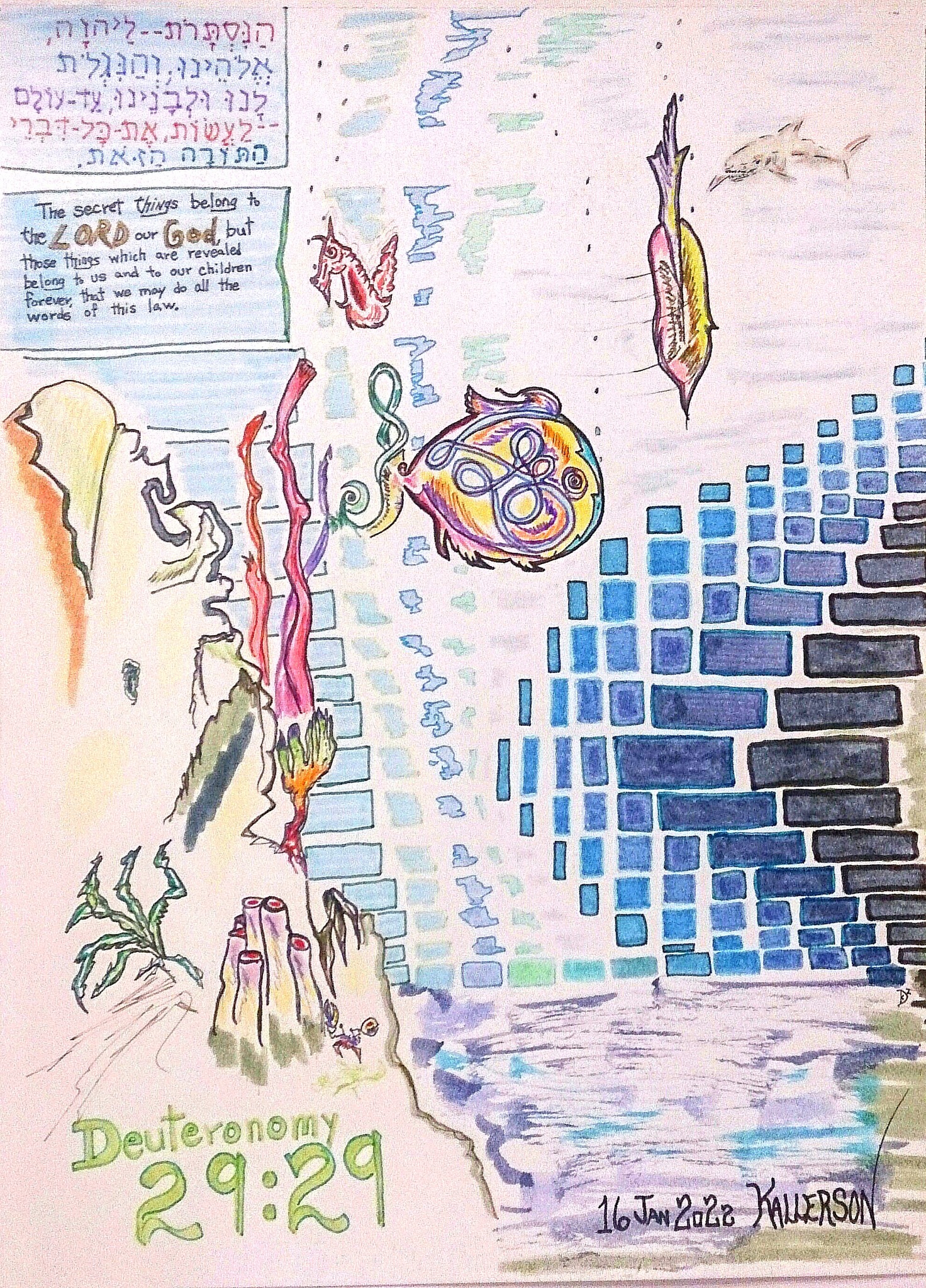
29 “The secret things belong to the Lord our God, but those things which are revealed belong to us and to our children forever, that we may do all the words of this law.
The Hebrew consists of fewer words. Literally, it reads “The hidden to Yehovah our God, and the uncovered (exposed) to us and to our children until forever to do all words, the Torah, the this.”
The number of ideas as to what is being said here is lengthy. Many scholars abuse the text as it is written. One thing seems likely is that the words include the thought of going into captivity. The reason is that the word translated as “uncovered” (or revealed) is used very often elsewhere and is translated as “captive.”
The reason is because when one goes into captivity, he is exposed or uncovered. Jeremiah, who has used Moses’ words time and again today, uses this word in that way numerous times, such as –
“The cities of the South shall be shut up,
And no one shall open them;
Judah shall be carried away captive, all of it;
It shall be wholly carried away captive.” Jeremiah 13:19
Grammatically, the words “to do” could refer to either the Lord or the people. And so, it must be questioned who the subject is –
“The hidden to Yehovah our God (and the uncovered to us and to our children until forever) [for the Lord] to do all words of this Torah.”
Or
“The hidden to Yehovah our God, and the uncovered to us and to our children until forever [for us] to do all words of this Torah.”
Unlike the rest of the entire chapter, this verse has been presented in the first-person plural – “we Israel.” Moses includes himself in the words, a very rare occurrence in Deuteronomy. Without being dogmatic about it, especially because nobody else even considers this, I would suggest this may be a double entendre.
One meaning then would be that the verse is speaking about the intentions of the Lord. The Lord has concealed (hidden) things concerning the future, even in the word. But He has also given explicit instructions in it which are – on the surface – knowable and expected. Hence, he says, laasot eth kal divre ha’torah ha’zot – that [we] may do all the words of this Law.
As the law is revealed, it is expected to be followed, but the law (through the prophets) will continue to reveal more. Eventually, those prophecies will align with their prophetic fulfillment. As such, the words of the law itself will no longer be hidden. For example, Paul’s words in Romans 10:8 show that Deuteronomy 30:14 was a reference to Christ and His work.
The second meaning would then be that the hidden things are the prerogative of the Lord, but the captivity (being exposed) belongs to Israel forever because they are bound to the law of which they cannot “do.” However, at the time of Moses, in the hidden things of the Lord are included all of His “doing” all of the words of the Torah. Eventually, He came, and He did all the words of the Torah.
If this is a correct interpretation, it is summed up in Jesus’ words –
“Do not think that I came to destroy the Law or the Prophets. I did not come to destroy but to fulfill. 18 For assuredly, I say to you, till heaven and earth pass away, one jot or one tittle will by no means pass from the law till all is fulfilled.” Matthew 5:17, 18
As such, the choice belongs to all people, even those not under the law. The reason is that the law is God’s standard. Fulfilling the law is God’s mark of perfection. Whether one is under law or not, perfection is the standard.
None apart from the law have the law to attempt to attain perfection, and none under the law have the ability to attain perfection through the law. What all men need is Christ Jesus’ perfection, who fulfilled the law.
In the Hebrew of this verse, there are special points above the words “to us and to our children.” They are known as puncta extraordinaria, or “extraordinary punctuation.”
It is not known what their meaning is, but we can now speculate that this is exactly what is being referred to, meaning Israel’s permanent inability to meet the demands of the law, and for them to look to the Lord in place of it for their justification and their righteousness.
And this is what all people are to do. Surprisingly, God has made a way available to us to be reconciled to Himself. I say, surprisingly because He was under no obligation to do so, and in order to do so, He would have to do the incredible.
The process would be painful, abasing, and impossible for many to even believe. But He did it. The Lord God Almighty, the Creator of heaven and earth did the unimaginable for His creatures. Let us not turn away from so great a salvation. Let us come to Christ and forever sing praises to the God to whom belong the secret things.
Closing Verse: “I will give you the treasures of darkness
And hidden riches of secret places,
That you may know that I, the Lord,
Who call you by your name,
Am the God of Israel.” Isaiah 45:3
Next Week: Deuteronomy 30:1-10 This is where your point of righteousness will start… (The Lord Your God Will Circumcise Your Heart) (87th Deuteronomy Sermon)
The Lord has you exactly where He wants you. He has a good plan and purpose for you. But He also has expectations of you as He prepares you for entrance into His Land of Promise. So, follow Him and trust Him and He will do marvelous things for you and through you.
The Secret Things
“The LORD would not spare him; for then the anger of the LORD
And His jealousy would burn against that man, even times seven
And every curse that is written in this book would settle on him
And the LORD would blot out his name from under heaven
And the LORD would separate him from
All the tribes of Israel for adversity
According to all the curses of the covenant
That are written in this Book of the Law, so shall it be
So that the coming generation of your children
———-who rise up after you
And the foreigner who comes from a far land, would say
When they see the plagues of that land
And the sicknesses which the LORD has laid on it that day…
‘The whole land is brimstone, salt, and burning
It is not sown, nor does it bear, nor does any grass grow there
Like the overthrow of Sodom and Gomorrah, Admah, and Zeboiim
Which the LORD overthrew in His anger
———-and His wrath He did not spare
All nations would say, ‘Why has the LORD done so to this land?
What does the heat of this great anger mean? We don’t understand
Then people would say: ‘Because they have forsaken the covenant
Of the LORD God of their fathers, and you understand
Which He made with them
When He brought them out of Egypt the land
For they went and served other gods and worshiped them
Gods that they did not know and that He had not given to them
———-and Him they forsook
Then the anger of the LORD was aroused against this land
To bring on it every curse that is written in this book
And the LORD uprooted them
From their land – in anger He did display
In wrath, and in great indignation
And cast them into another land, as it is this day
“The secret things belong to the LORD our God
But those things which are revealed – of which we saw
Belong to us and to our children forever
That we may do all the words of this law
Lord God, turn our hearts to be obedient to Your word
Give us wisdom to be ever faithful to You
May we carefully heed each thing we have heard
Yes, Lord God may our hearts be faithful and true
And we shall be content and satisfied in You alone
We will follow You as we sing our songs of praise
Hallelujah to You; to us Your path You have shown
Hallelujah we shall sing to You for all of our days
Hallelujah and Amen…
20 “The Lord would not spare him; for then the anger of the Lord and His jealousy would burn against that man, and every curse that is written in this book would settle on him, and the Lord would blot out his name from under heaven. 21 And the Lord would separate him from all the tribes of Israel for adversity, according to all the curses of the covenant that are written in this Book of the Law, 22 so that the coming generation of your children who rise up after you, and the foreigner who comes from a far land, would say, when they see the plagues of that land and the sicknesses which the Lord has laid on it:
23 ‘The whole land is brimstone, salt, and burning; it is not sown, nor does it bear, nor does any grass grow there, like the overthrow of Sodom and Gomorrah, Admah, and Zeboiim, which the Lord overthrew in His anger and His wrath.’ 24 All nations would say, ‘Why has the Lord done so to this land? What does the heat of this great anger mean?’ 25 Then people would say: ‘Because they have forsaken the covenant of the Lord God of their fathers, which He made with them when He brought them out of the land of Egypt; 26 for they went and served other gods and worshiped them, gods that they did not know and that He had not given to them. 27 Then the anger of the Lord was aroused against this land, to bring on it every curse that is written in this book. 28 And the Lord uprooted them from their land in anger, in wrath, and in great indignation, and cast them into another land, as it is this day.’
29 “The secret things belong to the Lord our God, but those things which are revealed belong to us and to our children forever, that we may do all the words of this law.