Deuteronomy 30:11-20
For He Is Your Life
The passage set before us today will complete chapter 30 of Deuteronomy, but to understand it completely takes knowing what is written later in Israel’s history, and even knowing what is said in the New Testament concerning both Israel and the work of Jesus.
The Bible starts with something and builds upon it. Nothing is lost in the process, and nothing is discarded. Everything has a place and, together, everything forms one united purpose. Yes, it is hard at times to see how some things written in Scripture have any relevance to anything else. But it all does tie together.
In our passage today, Moses says that the words of law he is presenting to the people equate to life and good or death and evil. He also ties the performance of the words to a love of the Lord and that the Lord is the life of Israel and Israel’s “length of days.”
The two thoughts – that of performance of the law and that of the very being of the Lord Himself are thus inextricably tied together. The performance equates to life and the Lord is Israel’s life. For Israel, the two cannot be separated.
Paul takes the words of Deuteronomy 30, and he then explains what the intent is behind the words in Romans 10 –
Text Verse: “For Moses writes about the righteousness which is of the law, ‘The man who does those things shall live by them.’ 6 But the righteousness of faith speaks in this way, ‘Do not say in your heart, “Who will ascend into heaven?”’ (that is, to bring Christ down from above) 7 or, “Who will descend into the abyss?”’ (that is, to bring Christ up from the dead). 8 But what does it say? ‘The word is near you, in your mouth and in your heart’ (that is, the word of faith which we preach): 9 that if you confess with your mouth the Lord Jesus and believe in your heart that God has raised Him from the dead, you will be saved.” Romans 10:5-9
Moses speaks of the righteousness of the law. Paul speaks of the righteousness of faith. And yet, both cite the same basic words, although Paul does amend them somewhat.
The question for us is then, “Where do the righteousness of the law and the righteousness of faith meet?” Obviously, Paul tells us that the answer is in the Person of Jesus. How is that so? Does this mean we are not bound to the Law of Moses? Let’s hope so. Because if we were, we would have a whole lot of work to do… and we would fail.
The theology behind the message is complicated, but the message itself is simple. Paul’s summing it up for us is a really nice touch – believe and be saved. It is one of those wonderful truths that frees the weary soul from its heavy burden. Thank God for Jesus Christ.
Yes, great things, such as the righteousness of faith are to be found in His superior word. And so, let us turn to that precious word once again and… May God speak to us through His word today and may His glorious name ever be praised.
I. The Word Is Very Near You (verses 11-20)
The chapter so far has dealt with adherence to the law, punishment (including exile) for not doing so, restoration when the law is recalled to mind, and so on. It takes the fact that these things will actually occur as an axiom. The final verses of the previous passage show this is so –
“Also the Lord your God will put all these curses on your enemies and on those who hate you, who persecuted you. 8 And you will again obey the voice of the Lord and do all His commandments which I command you today. 9 The Lord your God will make you abound in all the work of your hand, in the fruit of your body, in the increase of your livestock, and in the produce of your land for good. For the Lord will again rejoice over you for good as He rejoiced over your fathers, 10 if you obey the voice of the Lord your God, to keep His commandments and His statutes which are written in this Book of the Law, and if you turn to the Lord your God with all your heart and with all your soul.” Deuteronomy 30:7-10
As such, Israel will only have themselves to blame for any ills that come upon them, and that true restoration will only be realized when they again turn to Lord through the words of Moses. This is absolutely certain, and it is absolutely pre-confirmed by his words.
As this is so, Moses will show that the ideal he sets forth is perfectly attainable. Thus, the coming words will reconfirm that Israel’s ills are solely a self-inflicted wound. That his words are clear and understandable is now stated.
And yet, what he states bears in it a hint of Messiah. First, the law has already set forth such hints, both implicitly and explicitly. Secondly, the human heart, if it is honest, clearly shows this. For who can meet the demands of the law, even if it is clear and understandable? With that in mind, Moses says…
11 “For this commandment which I command you today
As has been the case repeatedly, the words speak of the entire body of law given forth by Moses. Whether spoken out in one day or in twenty, the word “today” signifies the whole period of instruction.
This is more clearly understood because of his use of the word ha’mitsvah, or “the commandment.” All of the statutes, ordinances, judgments, and commandments combine into one body – “the commandment.” Of this commandment which Moses commands Israel (it is singular – “you Israel”), he says…
11 (con’t) is not too mysterious for you,
lo niphlet hi mimekha – “no wonderful for you.” The word is the verb pala. It is derived from the noun pele (not the soccer player), meaning “a wonder” (and, admittedly, Pelé was somewhat of a wonder). Thus, the word signifies “to be surpassing, or extraordinary.”
As such, the context will determine the exact idea being conveyed – too hard, too difficult, beyond comprehension, mysterious, and so on. The obvious meaning Moses is conveying is that the people will not look at the law once it is fully compiled and say, “this is too hard for us to either understand or to follow.”
As noted, it is truly the case that no one can “do” all the things of this law, and anyone who lives under it for a single day would easily be able to see this, but the law also has provisions for those who fail “to do” if they are willing to admit they have failed. The sacrificial system provided for the failures. The heart would be weighed by the Lord and the heart that was circumcised (verse 30:6) would live. Albert Barnes rightly states this, saying –
“The seeming ease of the commandment, and yet its real impossibility to the natural man, form part of the qualifications of the Law to be our schoolmaster to bring us unto Christ.” Albert Barnes
The law is open, clearly stated, not impossible to do (in the sense that nothing in it cannot be done at any given time), and it tells – in advance – of the blessings for performance and the curses for failing to pay heed.
Again, there is a difference in the idea of possibility/impossibility to “do” the things of the law. To more fully understand this, and as an example, Moses never says something like, “On the 27th day of each month every person must run the entire circuit of the borders of the land, finishing before sundown.
That would be impossible, and thus it would be unfair. Likewise, if Moses said, no person of Israel is ever to drink any liquids, it would be impossible. Rather, everything in the law is possible, in the sense that anyone and everyone can do each and every listed thing within the law.
The impossibility is that of perfect performance at all times. But that is not what Moses is referring to, obviously, because the sacrificial system presupposes failure. It is given for exactly that purpose. Thus, even that makes the law attainable in a sense, but only because the heart is willing to admit the fault that necessitated the sacrifice. Understanding this, Moses next says…
11 (con’t) nor is it far off.
v’lo rekhoqah hi – “and no far off it.” The idea here is that which is unattainable because of distance. The law is given to Israel. It is right there among them, regardless as to where it came from. This is evidenced, for example, in 2 Chronicles –
“Now when they brought out the money that was brought into the house of the Lord, Hilkiah the priest found the Book of the Law of the Lord given by Moses. 15 Then Hilkiah answered and said to Shaphan the scribe, ‘I have found the Book of the Law in the house of the Lord.’ And Hilkiah gave the book to Shaphan. 16 So Shaphan carried the book to the king, bringing the king word, saying, ‘All that was committed to your servants they are doing. 17 And they have gathered the money that was found in the house of the Lord, and have delivered it into the hand of the overseers and the workmen.’ 18 Then Shaphan the scribe told the king, saying, ‘Hilkiah the priest has given me a book.’ And Shaphan read it before the king.
19 Thus it happened, when the king heard the words of the Law, that he tore his clothes. 20 Then the king commanded Hilkiah, Ahikam the son of Shaphan, Abdon the son of Micah, Shaphan the scribe, and Asaiah a servant of the king, saying, 21 ‘Go, inquire of the Lord for me, and for those who are left in Israel and Judah, concerning the words of the book that is found; for great is the wrath of the Lord that is poured out on us, because our fathers have not kept the word of the Lord, to do according to all that is written in this book.’” 2 Chronicles 34:14-21
There it was… the Law of Moses was right there among the people. And yet, they failed to adhere to it. This was so much the case that it was forgotten to even exist. But it did. The guilt was Israel’s.
As for the words, they anticipate the coming of Christ. Knowing that He is the embodiment of what the law states, pictures, and anticipates, the imagery is perfectly clear. The gospel was brought by Jesus to Israel. It wasn’t a long distance away.
Rather, He was born among them in Bethlehem, He was raised in Nazareth. He proclaimed the good news throughout the land, and the New Covenant in His blood was given in Jerusalem. As far as the nearness of the law. it is next more fully expressed by Moses…
12 It is not in heaven, that you should say, ‘Who will ascend into heaven for us and bring it to us, that we may hear it and do it?’
The Hebrew reads, “not in the heavens,” and “ascend into the heavens.” It is plural. The great expanse above their heads is what is being expressed to the people now. One can think of the giving of the law that Moses reminded them of in Chapter 4 –
“Then you came near and stood at the foot of the mountain, and the mountain burned with fire to the midst of heaven, with darkness, cloud, and thick darkness. 12 And the Lord spoke to you out of the midst of the fire. You heard the sound of the words, but saw no form; you only heard a voice. 13 So He declared to you His covenant which He commanded you to perform, the Ten Commandments; and He wrote them on two tablets of stone. 14 And the Lord commanded me at that time to teach you statutes and judgments, that you might observe them in the land which you cross over to possess.” Deuteronomy 4:11-14
In the same chapter, he again said –
“Out of heaven He let you hear His voice, that He might instruct you; on earth He showed you His great fire, and you heard His words out of the midst of the fire.” Deuteronomy 4:36
“Therefore know this day, and consider it in your heart, that the Lord Himself is God in heaven above and on the earth beneath; there is no other.” Deuteronomy 4:39
In each of these verses in Chapter 4, it says, “the heavens” rather than simply “heaven.” Moses is reminding them of where the law came from, but also to whom it was given. The word is not in an unattainable location, as if it was hidden from them. It was not still with God alone and requiring a mediator to go and obtain it.
Though its Source may be in heaven, the law is found among them. There is no need to ascend to attain what has been delivered and mediated from above.
It is these words now, and those in the next verses, that Paul used in our text verse to clearly and precisely show that the law was intended to reveal Christ.
Remembering that Christ is the embodiment of the law and it both pictures and anticipates Him, the words clearly reflect what happened at the incarnation of Christ. He was in heaven, but nobody had to ascend there to retrieve Him. Rather, He came from the heavens, just as the voice of the law came –
“And the Word became flesh and dwelt among us, and we beheld His glory, the glory as of the only begotten of the Father, full of grace and truth.” John 1:14
The patterns are given, and they are unmistakable. Seeing this, Moses continues with…
13 Nor is it beyond the sea,
As great as the heavens above, so was the sea also perceived to be by Israel. They could look up and see only unending sky. And should they look out at the water, they would see no end to it as well.
At this point, Moses is anticipating life in Canaan where the great sea to the west was located. Israel was not a seagoing people and so to journey out for them to an unknown location to find the law would be no different than trying to ascend to the heavens to find it. It is because of such an impassible void…
13 (con’t) that you should say, ‘Who will go over the sea for us and bring it to us, that we may hear it and do it?’
Israel did not need to find a ship and sailors to go out and find the law. There was no great journey from one country to the next, or from one continent to another. Rather, the law came to them, it was maintained among them, and the prophets arose from among them. Everything was available directly to Israel.
Likewise, the message of salvation, the gospel of Christ, was not from some other nation. Rather, as Jesus said, “Salvation is of the Jews” (John 4:22).
When citing these words, Paul makes a change in them, confounding many scholars. He says, “Who will descend into the abyss? (that is, to bring Christ up from the dead).” Moses’ words speak of distance, not depth. Even in the Greek translation of the Old Testament, the words of Paul are not supported.
Be that as it may, Paul is making a point about the coming of Christ, just as Moses is making a point about the availability of the law. The law came to Israel from God. They had it presented to them, and they willingly rejected it and Him. Likewise, John says –
“He came to His own, and His own did not receive Him. 12 But as many as received Him, to them He gave the right to become children of God, to those who believe in His name: 13 who were born, not of blood, nor of the will of the flesh, nor of the will of man, but of God.” John 1:11-13
Israel did not need to pass over the sea to find the law. It was there with them. And Israel did not need to look elsewhere to find their Messiah, He came to them. These verses speak of ascending to the heavens and of going beyond the sea, but there is also a contrasting allusion to the workings of God in Christ.
The heavens are where things are concealed until they are revealed by God. The other side of the sea is where there is no law. As the law is intended to bring life (Leviticus 18:5), then the other side is where there is death. The contrast then, the hiding and revealing, and the life from the death, is seen in the work of Christ –
“and to make all see what is the fellowship of the mystery, which from the beginning of the ages has been hidden in God who created all things through Jesus Christ;” Ephesians 3:9
“There is therefore now no condemnation to those who are in Christ Jesus, who do not walk according to the flesh, but according to the Spirit. 2 For the law of the Spirit of life in Christ Jesus has made me free from the law of sin and death.” Romans 8:1, 2
Israel did not need to ascend or cross over to have the law. It came from God. Likewise, Christ was hidden in God but came to Israel, and the life found in Christ came through His death in fulfillment of the law (that was intended to bring life). It did, in fact do so. What Israel needed, for each step of the process, was provided by God. As Moses says…
14 But the word is very near you, in your mouth and in your heart, that you may do it.
Moses is not speaking of salvation. Israel is the redeemed of the Lord. He is speaking of performance. The word was not concealed from Israel, and it was not unattainable by Israel. Everything has been in the singular here – you, Israel.
The law was in the mouth of Israel as will be shown to be true when the blessings and curses are proclaimed on Mount Ebal and Mount Gerizim as directed in Chapter 27. And they are in the heart of Israel, meaning right there in the sanctuary.
When they failed in performance, they were to then perform – meaning through sacrifice for atonement. Everything comes back to performance for Israel. But the law, clearly and unambiguously, anticipates Christ.
Thus, the idea is of performance in Christ. That is why Paul can then bring forth his words concerning what Moses now speaks of and directly equate them to salvation. Again, from our text verse –
“But what does it say? ‘The word is near you, in your mouth and in your heart” (that is, the word of faith which we preach): 9 that if you confess with your mouth the Lord Jesus and believe in your heart that God has raised Him from the dead, you will be saved. 10 For with the heart one believes unto righteousness, and with the mouth confession is made unto salvation.’” Romans 10:8-10
Someone must perform. Israel did not, and so Christ stepped in to do so. In performance, there is life…
15 “See, I have set before you today life and good, death and evil,
Moses is more precise. Each noun is prefixed by an article – “the life and the good, and the death and the evil.” Therefore, it isn’t just an abstract concept that Moses speaks of, but things that are concrete, fixed, and firm.
As such, these must be based on performance. The law can bring either, and it is totally up to Israel to decide which path they will follow. Immediately, this then speaks of the law, but ultimately, it must speak of Christ.
Israel twice was exiled (the curse, meaning the death and the evil). They still are not following Moses. But more than that, Christ came and fulfilled Moses. Therefore, Israel must now choose Christ to have the life and the good. It is no longer an issue of law. This will become perfectly evident in the verses ahead. For now…
16 in that I command you today to love the Lord your God,
As has been the case, the words continue in the singular – you, Israel. Loving the Lord is the first of the stated commands. Thus, this is a volitional love – an act of the will – intended to set the rest of Israel’s will in alignment with what is expected.
Israel as a nation is to demonstrate love to the Lord. If someone does wrong by committing murder, he is to be punished according to the law. This is obedience and thus a demonstration of love. Israel was not to make up new laws that were not in accord with the Mosaic law. This would demonstrate a disdain for the Lord.
Rather, everything Israel does was to be in accord with that set forth by Moses, which is…
16 (con’t) to walk in His ways, and to keep His commandments, His statutes, and His judgments,
To love the Lord is to do these things. The Lord is merciful, Israel is to show mercy. The Lord is holy, Israel is to be holy. And so on. This is to walk in His ways. Further, obedience demonstrates loving the Lord. This is seen in the keeping of His commandments, His statues, and His judgments.
The life of Israel was to be a demonstration of loving the Lord in these ways. The command to love the Lord is the command to do as Moses now instructs. It is this total national commitment, in which Moses says…
16 (con’t) that you may live and multiply;
You, Israel. The life of Israel is completely tied up in performance. There is no way around this. The law is near them, it is available to them, it is understandable, and it is doable. The conditions are given. To fail is to receive the death and the evil. To perform is to receive the life and the good. Moses is clear. Performance leads to the promise…
16 (con’t) and the Lord your God will bless you in the land which you go to possess.
The words should recall to mind the first verses of Chapter 28. The blessings would come upon Israel, and they would be blessed. Life would be found, and Israel would be secure…
17 But if your heart turns away so that you do not hear, and are drawn away, and worship other gods and serve them,
This is a national turning of the heart. In other words, someone in Dan might serve other gods. When he is found out, Israel takes him out and stones him to death. Then Israel has done what is good and right.
However, if the person was a millionaire and the people said to themselves, “This god has made him prosper, we need to worship it too,” that would be the beginning of turning away.
If the other tribes saw it and came against them to punish them, then Israel would have done what is good. But if they too saw the prosperity that supposedly came from worshipping this false god and started to do so too, it would be that the national heart of Israel had turned as Moses now states. If this is the case…
18 I announce to you today that you shall surely perish;
Moses now carefully selects his words to ensure that the will of the Lord for Israel is clearly and unambiguously stated. He does this by going from the second person singular to the second person plural: higadti lakem ha’yom ki abod tobedun – “I declare to you [all] this day for perishing you [all] shall (surely) perish.”
Moses does not say that Israel will perish, but the people of Israel will perish. This is explained in the words of Leviticus 26:38, saying –
“You shall perish among the nations, and the land of your enemies shall eat you up.”
This does not mean, however, all of the people will utterly perish. That is explicitly stated later in Leviticus 26 –
“Yet for all that, when they are in the land of their enemies, I will not cast them away, nor shall I abhor them, to utterly destroy them and break My covenant with them;
for I am the Lord their God.” Leviticus 26:44
The care taken by Moses to make his pronouncements assures us that the covenant promises of the Lord will never be broken.
18 (con’t) you shall not prolong your days in the land which you cross over the Jordan to go in and possess.
The words are precise, “no you [all] shall [certainly] prolong days upon the ground which you [singular] cross over the Jordan to go there to inherit.”
How careful Moses is to not present a thought that could even possibly be considered by someone to violate that which has already been stated by the Lord! Israel is made up of people, and the people of Israel will suffer the consequences of their failings.
Having said this, Israel faithfully acknowledged that they were exiled for their unfaithfulness after their first exile. What happened to them was justly deserved. That is recorded several times in Scripture. But Israel has not acknowledged in the slightest their failings for the second exile.
A rare voice may have arisen over the millennia, but no voice of Israel – the nation – has so come forth. Further, they have not even bothered to find out why these things have come about. They have hidden the truth so deeply that it will take the hand of God Himself to awaken them from their slumber. But the fact is, to this day, Israel remains because God has spoken, and He will perform.
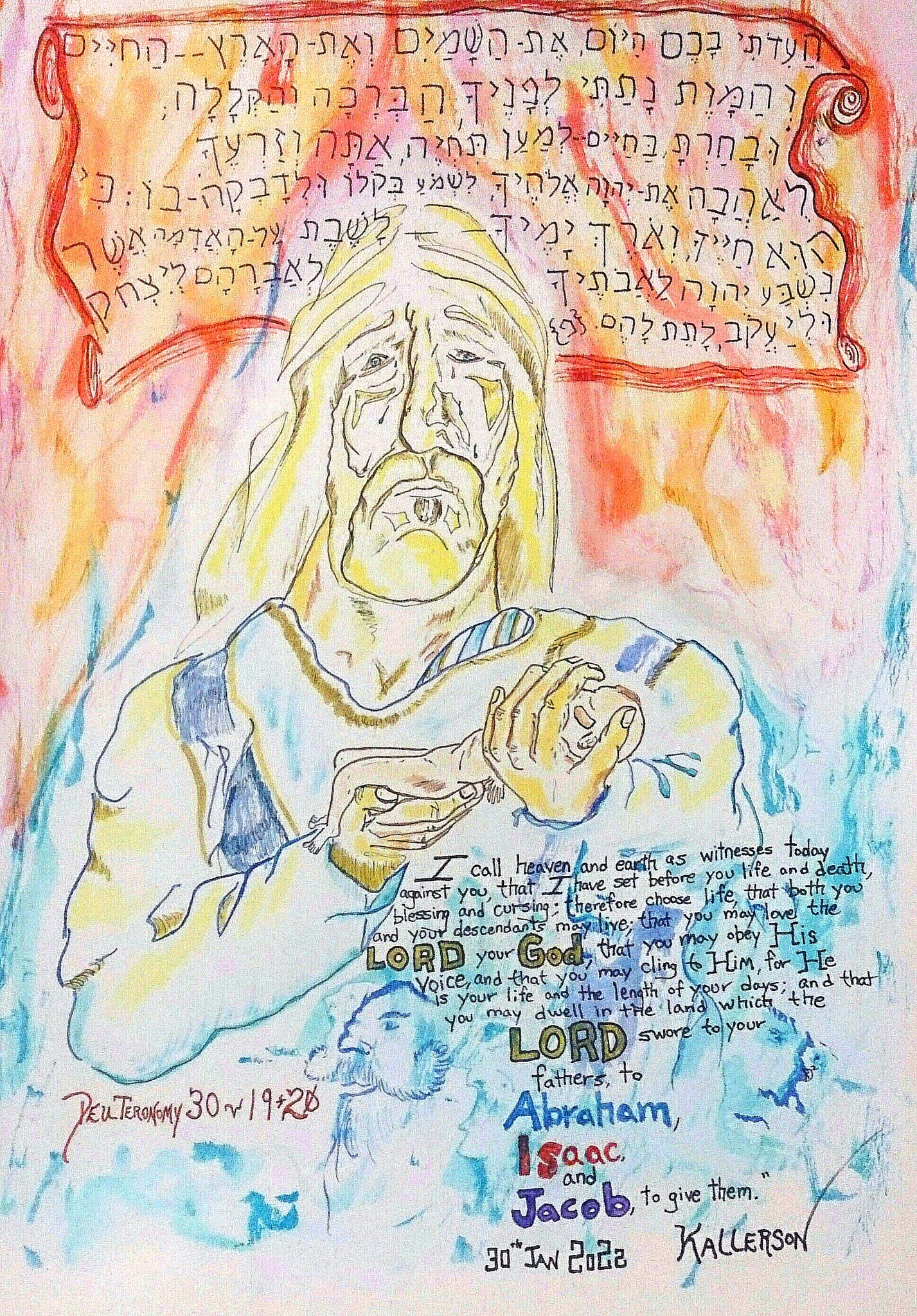
19 I call heaven and earth as witnesses today against you,
It says, “the heavens and the earth.” They are to hear and witness. This can be taken in one of two ways. It could be figuratively speaking of those in heaven and those on the earth to witness. However, it is more likely literal. The heavens and the earth will testify to the people’s (it is plural, you all) disobedience –
“And your heavens which are over your head shall be bronze, and the earth which is under you shall be iron. 24 The Lord will change the rain of your land to powder and dust; from the heaven it shall come down on you until you are destroyed.” Deuteronomy 28:23, 24
19 (con’t) that I have set before you life and death, blessing and cursing;
Now it changes to the singular (you Israel). The changes from the singular to plural and back again are precise and they tell their own story to the people.
As before, it is “the life and the death” and “the blessing and the curse.” These are not abstract concepts, but they are those things explicitly stated by Moses that would come upon Israel. The choice is a national choice. As a nation is directed by its leaders the fate of the people rests in their hands…
19 (con’t) therefore choose life, that both you and your descendants may live;
“Therefore choose the life.” It is an admonition and it is a warning. And the choice is up to the nation because it says “to end purpose you (singular) and your (singular) seed may live.”
Being on this side of the cross, and understanding the significance of what is presented by Moses as it anticipates the coming of Christ, the words of Jesus cannot be missed –
“I am the way, the truth, and the life. No one comes to the Father except through Me.” John 14:6
Without Christ, Israel finds, by default, the death, the curse, and the evil. Until they come to the One who Moses speaks of and anticipates, they will continue to only find disaster.
The current prosperity and abundance in Israel will perish along with that of all other nations in the days ahead. But someday they will choose the Life…
20 that you may love the Lord your God, that you may obey His voice, and that you may cling to Him,
Every pronoun referring to Israel in this final verse is singular – you, Israel. It speaks of the national state of the people. Further, the words of this clause are set not in a conditional way, but in an explanatory manner – “to love, to obey, and to cling.”
In essence, “This is how you may live – to love Him, to obey Him, and to cling to Him.” That is then explained by the words…
20 (con’t) for He is your life
Nothing could point more directly to the coming of Christ than these words. They sum up everything else stated by Moses. How can the Lord be Israel’s life if the people of Israel just keep dying? What kind of an existence is it for a nation to endure, but not its people? The two must come together and meet at some point. Jesus told them as much –
“And the Father Himself, who sent Me, has testified of Me. You have neither heard His voice at any time, nor seen His form. 38 But you do not have His word abiding in you, because whom He sent, Him you do not believe. 39 You search the Scriptures, for in them you think you have eternal life; and these are they which testify of Me. 40 But you are not willing to come to Me that you may have life.” John 5:37-40
It is Jesus who gives life to Israel. As such…
20 (con’t) and the length of your days;
The continuance of Israel is tied up in the life of Israel. Israel will continue when Israel has life. Though these words are to Israel in the singular, speaking to them nationally, a nation is made up of individuals. Hence, the words are parallel to what Jesus said to Martha in John 11 –
“I am the resurrection and the life. He who believes in Me, though he may die, he shall live. 26 And whoever lives and believes in Me shall never die. Do you believe this?” John 11:25, 26
For those who believe, they will have life and length of days. For those of Israel who believe, it will mean that Israel has life and length of days…
*20 (fin) and that you may dwell in the land which the Lord swore to your fathers, to Abraham, Isaac, and Jacob, to give them.”
For Israel, Canaan is the land of promise. To dwell there is the anticipation and expectation. But it will only occur when the law meets in obedience. The implication then, as stated before, is that Israel was not obedient to the law.
But nothing is recorded in Scripture – meaning the Old Testament – to explain their second exile. This means that either Israel was left without explanation – in their own writings – as to why they were exiled, or it means that Sacred Scripture does record the reason, but they have failed to accept that body of Scripture as divinely inspired.
In other words, the Old Testament is an incomplete account of Israel’s history. Only with the New Testament do Moses’ words now have any meaning for the modern nation. Indeed, the Old Testament tells of Israel’s restoration, but it does not tell them why they needed to be restored.
Only with their rejection of Christ do the past two thousand years of their history make any sense. As this is so, and as Canaan is only a type of what God promises in the restoration of all things, the final words of the passage today clearly anticipate the true promise –
“These all died in faith, not having received the promises, but having seen them afar off were assured of them, embraced them and confessed that they were strangers and pilgrims on the earth. 14 For those who say such things declare plainly that they seek a homeland. 15 And truly if they had called to mind that country from which they had come out, they would have had opportunity to return. 16 But now they desire a better, that is, a heavenly country. Therefore God is not ashamed to be called their God, for He has prepared a city for them.” Hebrews 11:13-16
That heavenly city, of which Canaan is only a type and a shadow, it only accessible through the One who made entry possible. Only in Christ, the true Israel, can Israel the nation find its ultimate promise.
There is no need to build a tower to heaven
To bring down the commandment for us to do
And it wouldn’t work anyway, in us there’s too much leaven
The command would only condemn me and you
And there is no need to cross the sea
To bring the commandment back home to us
And even if we did, what a tragedy that would be
What we need is the perfection of Jesus
And yet, the commandment is near to us in its own way
It is very near – in our mouth and in our heart
When it is fulfilled by Another, we can boldly say
“I receive Jesus,” and right then does our life truly start
II. An Explanation of Paul’s Change to Moses’ Words
We saw in verse 13 that Moses said, “Nor is it beyond the sea, that you should say, ‘Who will go over the sea for us and bring it to us, that we may hear it and do it?’”
However, when Paul cites this same verse in Romans 10:7, he says, “or, ‘Who will descend into the abyss?’ (that is, to bring Christ up from the dead).” Why did Paul do that, and how can that be a faithful explanation of what Moses is saying?
It is questions like this that need to be addressed in order to understand what is going on both in the mind of the author, and in the context of what Christ has done.
Otherwise, it would seem that what is presented is not a faithful representation of what Moses was saying. And so, to understand why Paul made the change, we will evaluate this one verse.
First, the word Paul begins with, “Or,” is tying his question to his previous words. He said –
“But the righteousness of faith speaks in this way, ‘Do not say in your heart, “Who will ascend into heaven?”’ (that is, to bring Christ down from above) 7 or, “Who will descend into the abyss?”’ (that is, to bring Christ up from the dead).” Romans 10:6, 7
“Who will ascend into heaven?” That corresponds closely with Deuteronomy 30:12. However, Deuteronomy 30:13 and Romans 10:7 do not follow suit –
“Nor is it beyond the sea.” Deuteronomy 30:13
“Who will descend into the abyss?” Romans 10:7
Paul wasn’t changing Scripture by changing the thought from going over the sea to descending into the abyss. The intent is the same, but the point of reference is different.
The Hebrew people were in the dry wilderness, and they also did not have the knowledge of the risen Lord. Moses was using an example that they could clearly understand in order to speak the language of faith.
On the other hand, Paul is using the resurrection in the same way. The sea to the Hebrews was a great, impassable body. And, as we noted, the death of man is spoken of in this same manner.
As a connecting point between the two, the Greek word abysson is used for “abyss” by Paul. The same word is used in the Greek translation of the Old Testament where the word for “deep,” abysson, is used when speaking about the great sea creature Leviathan in Job where it says –
“He makes the deep boil like a pot;
He makes the sea like a pot of ointment.” Job 41:31
The sea was perceived as the great deep in this way even at Moses’ time. At the giving of the law, the third commandment says, “You shall not make for yourself a carved image—any likeness of anything that is in heaven above, or that is in the earth beneath, or that is in the water under the earth.” Exodus 20:4
There, the “water under the earth” refers to the sea. Passing over the sea then is comparable to descending into the abyss for all intents and purposes.
And so, Paul grasps this Old Testament similarity and uses the imagery to connect it with the work of Christ in the New when speaking of the seemingly impassible void of death. Searching for the commandment by a descent “into the abyss” is then explained “to bring Christ up from the dead.”
We don’t need to conduct such a search to find the knowledge that God provides. Rather, it is obtainable in the work of Christ. He has descended into the abyss.
To search for our faith-righteousness there, after His prevailing over it, would then be a denial of what has been fulfilled in Him. He has triumphed over it for us. As a resounding note of victory in this matter, Paul states this in 1 Corinthians 15:54-56 –
“‘O Death, where is your sting?
O Hades, where is your victory?’
56 The sting of death is sin, and the strength of sin is the law. 57 But thanks be to God, who gives us the victory through our Lord Jesus Christ.”
Moses has spoken of performance of the law in order to have life. The record of the Old Testament, both in Israel as a nation and in Israel the people, shows that life cannot be obtained through performance of the law.
And yet, the law clearly says that if a man does the things of the law, he shall live by them (Leviticus 18:5). Paul cites that same verse in Romans 10:5 in our text verse, calling it the righteousness which is of the law. Only then does he speak of the righteousness of faith.
One must decide where he will hang his hat. Will it be on his own effort under the law, or in Christ’s performance of the law? Moses, almost fifteen hundred years before the coming of Christ, anticipated and spoke of the Christ.
He is the Source of righteousness, and it is in finding Him that one finds life. As big and confusing as the Bible is, and as seemingly irrelevant as the words of Moses might seem, they convey to us a portion of the most important truth of all – the knowledge of the Person and work of Jesus Christ. In Him is our life, and in Him is our length of days – even eternity in the presence of God.
Closing Verse: “For with the heart one believes unto righteousness, and with the mouth confession is made unto salvation. 11 For the Scripture says, ‘Whoever believes on Him will not be put to shame.’ 12 For there is no distinction between Jew and Greek, for the same Lord over all is rich to all who call upon Him. 13 For “whoever calls on the name of the Lord shall be saved.” Romans 10:10-13
Next Week: Deuteronomy 31:1-8 It will not be a call to do the shooby-dooby-doowah (Then Moses Called Joshua) (89th Deuteronomy Sermon)
The Lord has you exactly where He wants you. He has a good plan and purpose for you. But He also has expectations of you as He prepares you for entrance into His Land of Promise. So, follow Him and trust Him and He will do marvelous things for you and through you.
He Is Your Life
“For this commandment which I command you today
Is not too mysterious for you, nor is it far off, you must admit
It is not in heaven, that you should say
‘Who will ascend into heaven for us and bring it to us
———-that we may hear it and do it?
Nor is it beyond the sea, that you should say
“Who will go over the sea for us, who will so commit
And bring it to us
That we may hear it and do it?
But the word is very near you, this holy writ
In your mouth and in your heart, that you may do it
“See, I have set before you today life and good
Death and evil, but the life and good always pays
In that I command you today
To love the LORD your God, to walk in His ways
And to keep His commandments, His statutes, and His judgments
That you may live and multiply, so to you I address
And the LORD your God will bless you
In the land which you go to possess
But if your heart turns away
So that you do not hear, not giving a haw or hem
And are drawn away
And worship other gods and serve them
I announce to you today that you shall surely perish
You shall not prolong your days in the land
Which you cross over the Jordan
To go in and possess; this you must understand
I call heaven and earth as witnesses today against you
That I have set before you life and death, blessing and cursing
———-either of these I give
Therefore choose life
That both you and your descendants may live
That you may love the LORD your God
That you may obey His voice in all ways
And that you may cling to Him
For He is your life and the length of your days
And that you may dwell in the land
Which the LORD to your fathers swore
To Abraham, Isaac, and Jacob
To give them, abundant blessings and more
Lord God, turn our hearts to be obedient to Your word
Give us wisdom to be ever faithful to You
May we carefully heed e ach thing we have heard
Yes, Lord God may our hearts be faithful and true
And we shall be content and satisfied in You alone
We will follow You as we sing our songs of praise
Hallelujah to You; to us Your path You have shown
Hallelujah we shall sing to You for all of our days
Hallelujah and Amen…
11 “For this commandment which I command you today is not too mysterious for you, nor is it far off. 12 It is not in heaven, that you should say, ‘Who will ascend into heaven for us and bring it to us, that we may hear it and do it?’ 13 Nor is it beyond the sea, that you should say, ‘Who will go over the sea for us and bring it to us, that we may hear it and do it?’ 14 But the word is very near you, in your mouth and in your heart, that you may do it.
15 “See, I have set before you today life and good, death and evil, 16 in that I command you today to love the Lord your God, to walk in His ways, and to keep His commandments, His statutes, and His judgments, that you may live and multiply; and the Lord your God will bless you in the land which you go to possess. 17 But if your heart turns away so that you do not hear, and are drawn away, and worship other gods and serve them, 18 I announce to you today that you shall surely perish; you shall not prolong your days in the land which you cross over the Jordan to go in and possess. 19 I call heaven and earth as witnesses today against you, that I have set before you life and death, blessing and cursing; therefore choose life, that both you and your descendants may live; 20 that you may love the Lord your God, that you may obey His voice, and that you may cling to Him, for He is your life and the length of your days; and that you may dwell in the land which the Lord swore to your fathers, to Abraham, Isaac, and Jacob, to give them.”