Deuteronomy 31:1-8
Then Moses Called Joshua
This sermon was typed on 22 November, the Monday prior to Thanksgiving. What are we thankful for? I must admit, I don’t express my thankfulness enough. He gives us rain, He gives us cool breezy days, He gives us marvelous moons that radiate out a soft glow for our evening walks, and He gives us so much more.
Every good and kind blessing we could imagine comes our way, but we often fail to acknowledge them when they do because we get caught up in the trials, miseries, pains, woes, and sadnesses of life. That isn’t unexpected, but wouldn’t it help us if we were able to be grateful at the same time as being miserable?
To varying degrees, some of us are. But life’s troubles have a way of robbing our joy and our ability to be grateful. Paul gives us constant admonitions about how to overcome these things and to remain strong in the Lord and fixed on Him and His hand of grace that provides us with so much.
I don’t know how people can remain positive and not be in the word of God! Without the constant reminders from it, I would probably be the most miserable person on the planet – along with about 8 billion others in the same boat.
But we have this word. Let us take advantage of it, think on it, and apply its precepts to our lives. Jesus overcame this world. In Him, we have overcome it. Let us never lose sight of the bigger picture in Him!
Text Verse: “For this reason we also, since the day we heard it, do not cease to pray for you, and to ask that you may be filled with the knowledge of His will in all wisdom and spiritual understanding; 10 that you may walk worthy of the Lord, fully pleasing Him, being fruitful in every good work and increasing in the knowledge of God; 11 strengthened with all might, according to His glorious power, for all patience and longsuffering with joy; 12 giving thanks to the Father who has qualified us to be partakers of the inheritance of the saints in the light. 13 He has delivered us from the power of darkness and conveyed us into the kingdom of the Son of His love, 14 in whom we have redemption through His blood, the forgiveness of sins.” Colossians 1:9-14
The word of Colossians so closely matches so much of what is presented in our passage today, that when I went looking for a text verse after typing the sermon I had to think, Paul must have just read this passage in Deuteronomy over breakfast.
He really sums up much of what is conveyed to us here. But he does that elsewhere as well. The book of Ephesians must have been written while he was reading Deuteronomy. It is also just filled with hints of our passage today.
There is Israel, and there is faith in Christ. Sometimes one is given to show us things to avoid, and sometimes one is given to show us what to do. But all of it is to reveal to us Jesus, or our life in Him. It all is centered on Him. What a treasure we have in the pages of Scripture.
I hope you will enjoy what is presented today. As is so often the case, I thoroughly enjoyed researching it and typing it up. This word is a never-ending source of delight. That’s for sure. Great things are to be found in His superior word. And so, let us turn to that precious word once again and… May God speak to us through His word today and may His glorious name ever be praised.
I. He Will Be with You (verses 1-8)
Then Moses went and spoke these words to all Israel.
The words are unusual and a bit perplexing. Literally: va’yelek Moshe v’daber eth ha’devarim ha’elleh el kal Yisrael – “And walked Moses and spoke the words the these unto all Israel.” The curiosity hinges on the word halak, or “to walk.”
It is not a common way of referring to Moses’ discourses. Normally, it just says, “And Moses said…” or something like that. The last time Moses was mentioned, meaning the starting of a new discourse, was in Chapter 29 –
“These are the words of the covenant which the Lord commanded Moses to make with the children of Israel in the land of Moab, besides the covenant which He made with them in Horeb.
2 Now Moses called all Israel and said to them: ‘You have seen all that the Lord did before your eyes in the land of Egypt, to Pharaoh and to all his servants and to all his land— 3 the great trials which your eyes have seen, the signs, and those great wonders.’” Deuteronomy 29:1-3
Both times, then and now, it refers to “all Israel.” The Greek translation says, “And Moses completed speaking all these words.” In this, it would signify that two of the letters of the Hebrew were transposed. Instead of va’yelek, it would have said v’kal – as in Deuteronomy 32:45. That is a possibility because a new direction will now be taken.
Another possibility is that the word “walk” here is simply a way of introducing a new thought. Moses has spoken to all Israel, and he continues on his walk, speaking to all of Israel.
Jamieson-Fausset-Brown takes this as a way of summing everything up, saying –
“It is probable that this rehearsal of the law extended over several successive days; and it might be the last and most important day on which the return of Moses to the place of assembly is specially noticed.”
Whatever the actual meaning of the unusual phrase, the discourse from Moses does continue, it continues in a new direction, and his words continue to be spoken to “all Israel.” As such…
2 And he said to them:
Being third person plural, it is an address to all of the people collectively (all Israel) and individually (you all)…
2 (con’t) “I am one hundred and twenty years old today.
The Hebrew bears a common idiom, “Son of hundred and twenty years I am today.” The reason for stating this is debated, and whether it is to be taken as a literal statement is as well. Some find him saying this to be an indication that it is his birthday.
Some connect it to the span of his life literally being one hundred and twenty, some figuratively, as if it is a round number. It seems unlikely it is a rounded number, but rather that a point about his age is being made.
In Acts 7:23, it says of Moses, “Now when he was forty years old, it came into his heart to visit his brethren, the children of Israel.” In Exodus 16:35, it says, “And the children of Israel ate manna forty years, until they came to an inhabited land; they ate manna until they came to the border of the land of Canaan.”
This would then divide his life into three segments of forty years. The first would be until he was grown and fled to Midian. The second would be forty years in Midian. The third would be forty years leading Israel. However, these cannot be exactly forty years to the day, because the manna actually ends after Moses’ death (Joshua 5:12).
But the division of his life is remarkable in that it was based upon three periods of forty years. It is also the same timeframe noted in the unusual words of Genesis 6 –
“And the Lord said, ‘My Spirit shall not strive with man forever, for he is indeed flesh; yet his days shall be one hundred and twenty years.’” Genesis 6:3
The meaning of the words of Genesis 6 is debated. Some see them as the length of time that man would live from that point on. But nothing in Scripture goes on to support this. What seems most likely is that the words are defining the period until the flood. That is how Young’s translates it
“And Jehovah saith, ‘My Spirit doth not strive in man — to the age; in their erring they are flesh:’ and his days have been an hundred and twenty years.”
This seems likely. The Lord sees the wickedness of the world and sets a time for its coming destruction of one hundred and twenty years. As Noah is the focus of the surrounding narrative, it is then accepted that this was the time that he was given to preach to the world (2 Peter 2:5) before its end was accomplished.
If this is so, then there is a reasonable pattern between the two. Noah’s time of preaching and the life of Moses, who represents the law, are both a witness to the world of God’s impending judgment. That would follow well with the signification of the numbers forty and three.
Bullinger defines one hundred and twenty saying it “is made up of three forties (3×40=120). Applied to time therefore it signifies a divinely appointed period of probation.” Hence, the years of Moses are given to define the time of the law itself.
From a human aspect, however, they also bear on the state of the man himself…
2 (con’t) I can no longer go out and come in.
lo ukal od laset v’lavo – “No able again to go forth and to come in.” This takes the reader back to Numbers 27 where the Lord spoke to Moses about his demise. The section was an anticipatory look at the event, and it uses the same terminology there. Whereas Moses could no longer execute his duties, another (Joshua) was to be selected to replace him. –
“Now the Lord said to Moses: ‘Go up into this Mount Abarim, and see the land which I have given to the children of Israel. 13 And when you have seen it, you also shall be gathered to your people, as Aaron your brother was gathered. 14 For in the Wilderness of Zin, during the strife of the congregation, you rebelled against My command to hallow Me at the waters before their eyes.’ (These are the waters of Meribah, at Kadesh in the Wilderness of Zin.)
15 Then Moses spoke to the Lord, saying: 16 ‘Let the Lord, the God of the spirits of all flesh, set a man over the congregation, 17 who may go out before them and go in before them, who may lead them out and bring them in, that the congregation of the Lord may not be like sheep which have no shepherd.’” Numbers 27:12-17
Later in his life, Joshua will repeat this sentiment –
“As yet I am as strong this day as on the day that Moses sent me; just as my strength was then, so now is my strength for war, both for going out and for coming in.” Joshua 14:11
The meaning is that in one’s coming in, there is strength and vitality within the walls of one’s home, and in one’s going out, there will be health and vigor, and there will be strength for the day’s labors. Moses sees that the years are catching up to him, but this doesn’t mean he wasn’t fit, and exactly that is said of him upon his death –
“Moses was one hundred and twenty years old when he died. His eyes were not dim nor his natural vigor diminished.” Deuteronomy 34:7
The word translated as “natural vigor” signifies “moisture” or “freshness.” Some attribute that to his virility and that is a reasonable interpretation of the rare word that is used there. Despite this, his ability to satisfactorily execute his duties had come to its end. And more…
2 (con’t) Also the Lord has said to me, ‘You shall not cross over this Jordan.’
The basis for this statement should be returned to. In Numbers 20:7-9, it said –
“Then the Lord spoke to Moses, saying, 8 ‘Take the rod; you and your brother Aaron gather the congregation together. Speak to the rock before their eyes, and it will yield its water; thus you shall bring water for them out of the rock, and give drink to the congregation and their animals.’ 9 So Moses took the rod from before the Lord as He commanded him.”
The command was given to demonstrate a point concerning the coming of Christ. Water had been brought from the rock once already, in Exodus. At that time, Moses was told to strike the rock, and he did. In that, water issued forth. That was given as a picture of life issuing from the punishment Christ received.
The second time, in Numbers, both Moses and Aaron were to simply speak (the verb was plural) to the rock and water would issue forth. Thus, the water was to come forth not through any work, but through the word of faith.
It was to be a picture of salvation based upon faith in Him alone. Wherever the word of faith in Christ is spoken, the Spirit will issue forth, but not by deeds of the law. Rather by faith alone. Everything about the account anticipated Christ.
By merely the spoken word of the lawgiver and the high priest, in the presence of the rod, the rock was expected to yield its water. Everything at that time was seen to be a type of Christ: The Lawgiver = Christ; the High Priest = Christ; the Rock = Christ; the Rod = Christ; the Water = Spirit of Christ. Everything looked to prefigure Christ and the grace that issues from Him.
And this is how it is. The giving of the New Covenant, based on the fulfillment of the law, along with the sacrificial work of the High Priest, yields forth the Spirit. The typology was set. However, this is not what happened –
“And Moses and Aaron gathered the assembly together before the rock; and he said to them, ‘Hear now, you rebels! Must we bring water for you out of this rock?’ 11 Then Moses lifted his hand and struck the rock twice with his rod; and water came out abundantly, and the congregation and their animals drank.” Numbers 20:10, 11
Because of his disobedience, thus destroying the typology of Christ and His work, the sentence was pronounced –
“Then the Lord spoke to Moses and Aaron, ‘Because you did not believe Me, to hallow Me in the eyes of the children of Israel, therefore you shall not bring this assembly into the land which I have given them.’” Numbers 20:12
But the actions of Moses and Aaron would have been known to the Lord prior to them doing this. And more, the Lord could have pardoned Moses. But another set typology had to be fulfilled as well: the inheritance cannot come through the law.
That is seen in the words, “You shall not cross over this Jordan.” Ha’yarden, or “the Descender” is a type of Christ. It flows from the snow-capped peaks of Mt. Hermon (Sacred), travels along the border of Canaan, and terminates at the Salt Sea. It is a picture of Christ, descending from heaven – the Sacred place – living out His incarnation, and dying.
However, being the Salt Sea, it is a continued picture of His incorruption. From the Salt Sea, the waters evaporate – picturing Christ’s resurrection and ascension (His return to heaven). In this, the Jordan is the dividing line between the world and the land of promise.
One must cross over (through) the Jordan (Christ) in order to enter the promised inheritance. But the law has no part in the inheritance, as Paul says –
“And this I say, that the law, which was four hundred and thirty years later, cannot annul the covenant that was confirmed before by God in Christ, that it should make the promise of no effect. 18 For if the inheritance is of the law, it is no longer of promise; but God gave it to Abraham by promise.” Galatians 3:17, 18
As Moses is the giver of the law, and thus emblematic of the law, he needed to die outside the inheritance in order to maintain that set typology.
John Gill clearly got this several hundred years ago when he said, “this work was reserved for Joshua, a type of Christ; not Moses and his law, or obedience to it, is what introduces any into the heavenly Canaan only Jesus and his righteousness.”
The Lord is working in typology in order to reveal Himself and His work to the world. As the law cannot obtain the inheritance, then someone else must bring the people in. Everything must fit in order to maintain the typology of Christ. That continues to be seen in the next words…
3 The Lord your God Himself crosses over before you;
The words are emphatic: Yehovah elohekha hu over l’phanekha – “Yehovah your God HE crosses over before your face.” And more, the words are now in the singular – “you, Israel.”
The emphasis is given as a complete contrast to Moses. “Moses, you shall not cross over the Jordan. Instead, the Lord – HE – shall cross over.” The words clearly speak of the Lord being the One to bring Israel into the inheritance. The Lord, the true Lawgiver, is the primary cause of what will occur. As such…
3 (con’t) He will destroy these nations from before you,
Again, the words are emphatic: hu yashmid eth ha’goyim ha’elleh milephanekha – “He will destroy the nations the these from before your face.” “The Lord has said to me, ‘Moses, you will not cross over. But the Lord HE will. And it is HE who will destroy those who possess the inheritance. Israel, trust in the Lord.’” The words are set, they are fixed, and they are given as a guarantee…
3 (con’t) and you shall dispossess them.
It is a single word: vi’rishtam – “And you (Israel) shall dispossess them.” The Lord will go over before Israel, He will destroy the enemy, and Israel shall take what they possessed. Everything is a work of the Lord. And yet…
3 (con’t) Joshua himself crosses over before you, just as the Lord has said.
There is no conjunction to separate the thoughts and it is again emphatic: Yehoshua hu over l’phanekha ka’asher diber Yehovah – “Joshua HE crosses over before your face, just as spoke Yehovah.” Charles Ellicott rightly questions the text –
“The Lord thy God, he will go over before thee . . . Joshua, he shall go over before thee.—Can it be accidental that Jehovah and Joshua are spoken of in exactly the same language, and that there is no distinguishing conjunction between them, the ‘and’ of the English Version being supplied? ‘Jehovah, He is going over; Joshua, he is going over.’ Verbally, the two are as much identified as ‘The God who fed me all my life long unto this day, the Angel that redeemed me from all evil’ (Genesis 48:15-16). The prophetical truth of this identification is too remarkable to be missed.”
Said plainly, the same words are used, the same emphasis is provided, and the same thought is conveyed in the two clauses. And yet, one speaks of the Lord God while the other speaks of Joshua. As there is no connecting conjunction, both thoughts are united as one. As this is so, it is making an absolutely clear picture to consider. For now, Moses continues with…
4 And the Lord will do to them as He did to Sihon and Og,
The battles were described in Numbers 21. They occurred east of the Jordan, outside of the promised inheritance. And yet, they allowed Israel experience in battle. But more, they led Israel into a state of conviction in the Lord’s abilities.
As the battles were victorious, it would bolster Israel’s confidence, trust, and even provide full assurance that the Lord was with them, was guiding them, and would work with them to ensure the battles ahead would also end in victory. These two defeated foes were…
4 (con’t) the kings of the Amorites and their land,
It is singular, “kings of the Amorite.” Thus, it speaks of the nation of people that were defeated. As there are more Amorites, there will be more battles against the people of this nation. However, because of the victory over these, there is the surety that any others that are met will also be defeated. Sihon and Og were great foes, but they stood no chance against the Lord…
4 (con’t) when He destroyed them.
Again, the victory is said to be of the Lord. Even though Israel was in the battle, the ultimate credit belongs to the Lord. Without His hand, they could not have prevailed. With Him, they could not be defeated. The same is true with those they would face in Canaan…
5 The Lord will give them over to you,
Moses’ words now go to the plural, “And will give them over Yehovah before your (all) face.” All of those who went into battle would share in the triumph over the foes. The change to the plural would bolster the confidence of even the hesitant. “Yes, Israel will prevail, but I shall be a part of the victory!” And it is in the victory…
5 (con’t) that you may do to them according to every commandment which I have commanded you.
The Hebrew is not a “Because of this, therefore that.” Rather than “that you may do to them,” it reads: va’asitem lahem – “And you shall do to them.” The Lord will give them over. Based on that, Israel is to then obediently follow through according to the law.
The words, and the change from the singular to the plural, become understandable when placed by the corresponding clauses from verse 3 –
3. “He will destroy these nations from before your (singular) face.”
5. “And the Lord will give them over to you (plural).”
3.” And you (singular) shall dispossess them.”
5. “And you (plural) shall do to them.”
The words are meticulously and brilliantly chosen to have the most positive affect on the minds of the people, even if the subtlety of them passed right over their heads. It is like a subliminal message that is mentally apprehended even when it may not be consciously understood. It is with this strategically placed and pronounced message that Moses next says…
6 Be strong and of good courage,
Both words carry the meaning of strength, hardening, and so on: khizqu v’imtsu – “be strong and be strengthened,” or any such general rendering will do. The idea is that of soldiers (the verbs are plural) fortifying themselves for what lay ahead. The same is true with the next words…
6 (con’t) do not fear nor be afraid of them;
al tireu v’al taarsu mi’penehem – “not fear and not be affrighted from their face.” It doesn’t matter how many there are, how big they are, how battle-worn they appear, and so on. The soldiers of Israel were to not allow such things to affect them in the slightest…
6 (con’t) for the Lord your God, He is the One who goes with you.
Right in the middle of the verse, the words now revert to the second person singular. Moses is referring to Israel, the collective.
Further, the words are emphatic, and a verb preceded by an article is used to describe the Lord – “for Yehovah your God HE the Goer with you.” The people don’t need Moses. Rather, they have the One who called Moses, who directed him, and who sustained him.
As such, to rely on Moses’ presence would be to rely on that which is less that the Lord. It is a lesson way too many in the church need to learn. In knowing this is to find surety…
6 (con’t) He will not leave you nor forsake you.”
The words continue in the singular – “you, Israel.” The Lord will never leave them, nor will He ever abandon them. They have the absolute assurance of this. The problem of defeat will not be because the Lord has left Israel, but only if Israel leaves the Lord.
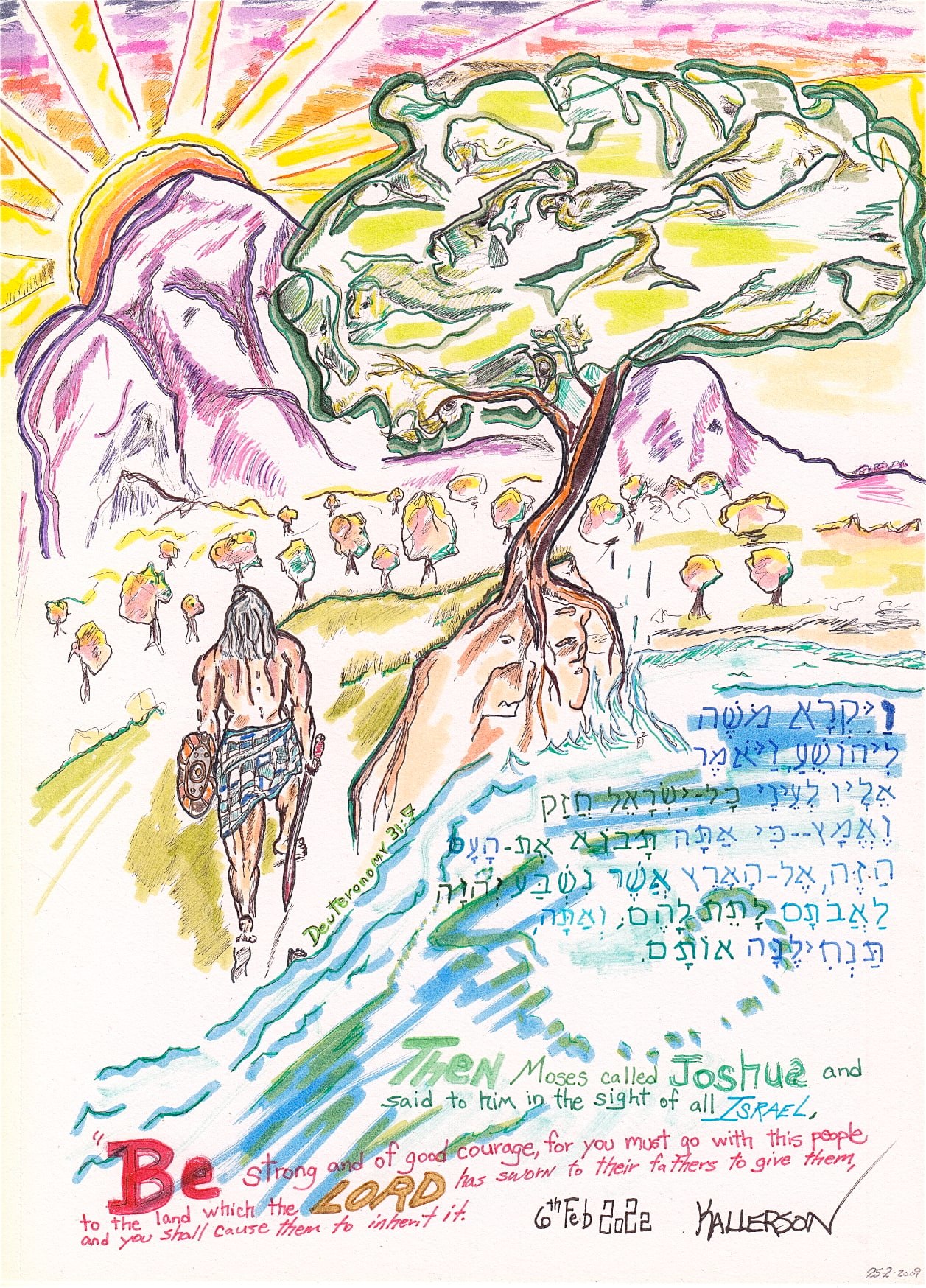
7 Then Moses called Joshua and said to him in the sight of all Israel,
Moses is ensuring that Joshua will be fully recognized as his replacement. There could be no conspiracy theories or attempts at usurping his rightful authority because Moses brings him l’ene kal Yisrael, or “to eyes all Israel.” In his bringing him forth, he says…
7 (con’t) “Be strong and of good courage,
It is the same words just spoken to the people. In order for a congregation to be encouraged, their leader must first demonstrate his own courage – “be strong and be strengthened…”
7 (con’t) for you must go with this people to the land which the Lord has sworn to their fathers to give them,
The words bear an emphasis – “for YOU must go with.” The words “go with” are changed to “bring in” in verse 31:23. Joshua both goes with, and he brings in the people. In other words, he is both one of the people, and he is also to be the leader of the people. There is no bringing in without first going with. But in his going with, Moses says…
7 (con’t) and you shall cause them to inherit it.
Again, it bears an emphasis – “and YOU shall cause to inherit it them.” Moses emphatically states that Joshua personally will go in and Joshua personally will cause them to inherit the land. He, then, is the Lord’s instrument in causing these things to be. With this understood, Moses continues…
8 And the Lord, He is the One who goes before you.
Like in verse 6, there is an emphasis, and the verb is prefixed by an article, “And Yehovah, HE, the Goer before you.” Moses just said that Joshua would cause the people to inherit the land. And yet, the Lord is with Joshua.
In this, we can see the various causes being relayed. Joshua is the material cause. He is the one who makes the thing (like wood in a table) to be. The formal cause, the design, is the destruction of the enemies. The efficient cause, what brings it about, is the Lord’s presence working on behalf of Joshua. And the final cause, the purpose, is the obtaining of the inheritance.
Everything is working towards the goal. Nothing will thwart the goal, and Moses provides the assurance of it…
8 (con’t) He will be with you, He will not leave you nor forsake you;
Again, it is emphatic – “HE will be with you.” There will be no separation between Joshua and the Lord. He will remain with him, and He will not slacken his grip from him. The same words were used in verse 6 and here. The first is rapha. It means to relax or slacken. As such, the Lord will firmly have His hand upon Joshua.
The second is azav. It comes from a root with essentially the same meaning, to loosen. Thus, he will firmly commit Himself to what will come to pass. Therefore, Moses now says…
*8 (fin) do not fear nor be dismayed.”
One of the words is the same as verse 6, while the other bears a close meaning to the other word in verse 6. Like the people, Moses tells Joshua to not fear or be affrighted. He will prevail because the Lord is with him. Nothing can affect the sure outcome that the Lord intends because of it.
Be strong and courageous and trust in Me
You shall not fail because I go with you
Lean not on your own understanding, but trust completely
Having faith in Me is what you are to do
I also had to trust in My God as you are now to do
And so, I was strengthened in order to go in
In My going, it was actually for you
So, fear not. With faith in Me, you are ready to begin
Who is the Goer who goes with you?
He is the same Goer who was there with Me
The Lord our God who is faithful and true
Is the One we can trust forever and wholeheartedly
II. Pictures of Christ
Moses is a picture of the law. We saw that already in verse 2. It is the law that speaks “to all Israel” as was noted in verse 1. The law witnesses to what will happen, how it will happen, and it typologically tells us of the greater fulfillment of these things, if we will accept the typology.
For example, on the Passover, a lamb was killed, and its blood was applied to the doorposts so that the Lord would pass over the people. Paul says that Christ is our Passover Lamb. Do we accept the Antitype in fulfillment of the typology? If so, then we acknowledge what Scripture says. Israel does not yet accept that.
Verse 2 gave us the details of Moses’ age. In that, he said he could no longer go out or come in, implying his strength would no longer allow him to be an effective leader. Rather, it was time for his replacement to take over. The law is unable to enter the promise.
The reason for this is that is not the purpose of the law. Rather, the law is given to highlight sin and to lead us to Christ. As it says in 1 Corinthians 15, “The sting of death is sin, and the strength of sin is the law.” Moses’ coming death is the result of sin. The law, of which he is given as a type of it, finds its strength in sin.
As such, the Lord said to Moses, “You shall not cross over the Jordan.” The law, and thus those under the law, have no part in the inheritance. That was clearly seen in the words of Galatians that we looked at earlier while in verse 2. It is why we so carefully reviewed what led to Moses’ punishment.
With that explained, Moses said emphatically that it would be the Lord who crossed over before Israel. And then, using the same words in the same verse, and without any distinguishing conjunction between them, it emphatically said the same of Joshua.
Here, and elsewhere, Joshua, or “The Lord (Yah) is Salvation,” is clearly presented as a type of Christ. As we saw, the same words were used, the same emphasis was provided, and the same thought was conveyed in the two clauses.
One referred to the Lord God while the other spoke of Joshua. The lack of any conjunction united the two in thought as being one. The picture is clear. Jesus, who is the Antitype, is obviously presented as the incarnate Lord God. The type anticipates its fulfillment in Him.
Verse 4 recalled the two foes of Israel, Sihon and Og, to mind. Just as the Lord (through Israel under Moses) defeated the foes outside of the inheritance, so the Lord (through Israel, under Joshua) will defeat the foes inside of it.
The picture is that the Lord, through the law, will destroy those outside of the inheritance. But that the Lord, through Jesus, will destroy those inside of it. In other words, this presupposes that there are still battles ahead for those who enter the inheritance.
As such, the words clearly reveal that salvation and the promise of heaven are one thing, even if they don’t come at the same time. When one crosses over the Jordan (comes through Christ), the inheritance is obtained. They have entered the promise.
Canaan, the promise, is typical of entry into the state of salvation. Israel is a template for individual salvation; hence it is referred to in the singular.
Stated another way, Israel’s entrance into the promise, having crossed over the Jordan, is a picture of believers going through Christ to receive the inheritance. But there are still foes in Canaan to be destroyed. The picture is clearly seen in Ephesians –
“In Him we have redemption through His blood, the forgiveness of sins, according to the riches of His grace.” Ephesians 1:7
The Lord descended (like the Jordan). The Lord died (as the Jordan ends). It is in crossing through this that one enters. The words “through His blood” don’t just imply death, they explicitly mean it. Therefore, to go through Christ IS to be redeemed. The sins are forgiven, and it is sin (which is strengthened by the law) that has been dealt with.
Joshua, or Yehoshua, comes from two words. The first is the divine name of God YHVH, or Yehovah. The second is yasha, meaning to deliver or save. Hence, the name means, “Yehovah is Salvation.”
Joshua was commissioned under the law. Jesus was born (and commissioned by God) under the law. Joshua will enter the inheritance through the Jordan. Christ enters the inheritance through His own death (pictured by the Jordan) in fulfillment of the law. We enter through Jesus’ death as well. That is also stated in Ephesians –
“In Him you also trusted, after you heard the word of truth, the gospel of your salvation; in whom also, having believed, you were sealed with the Holy Spirit of promise, 14 who is the guarantee of our inheritance until the redemption of the purchased possession, to the praise of His glory.” Ephesians 1:13, 14
The inheritance is obtained. Believers are positionally granted the full inheritance, even if they are still living in this world –
“But God, who is rich in mercy, because of His great love with which He loved us, 5 even when we were dead in trespasses, made us alive together with Christ (by grace you have been saved), 6 and raised us up together, and made us sit together in the heavenly places in Christ Jesus, 7 that in the ages to come He might show the exceeding riches of His grace in His kindness toward us in Christ Jesus.” Ephesians 2:4-7
So, there is the positional until the actual is reached. However, there are still battles ahead in this positional attainment of the inheritance. If anyone doesn’t believe that he is either braindead or just plain dead.
These battles are described quite well, and how to win them is nicely detailed in Ephesians 6. This is what Moses was saying to Israel in verses 5 & 6 and which anticipates our battles today. The changes from the plural to the singular were notable.
There are individual battles, and there are collective battles. Verse 6 told the people in the plural to be strong and of good courage. It is reflective of Paul’s words in Ephesians 6 –
“Finally, my brethren, be strong in the Lord and in the power of His might.” Ephesians 6:10
These, and other such words in the New Testament simply confirm that we are in a battle and that we are to be strong not in ourselves, but in the Lord who goes with us. Again, from Paul –
“Watch, stand fast in the faith, be brave, be strong.” 1 Corinthians 16:13
But all of this is first dependent on the Lord, who goes with us. As it noted to Joshua by Moses, “you must go with this people.” The Lord didn’t just enter into glory and wait for us there. He first went through the Jordan. He went with us in death in order to bring us into the inheritance –
“For Christ also suffered once for sins, the just for the unjust, that He might bring us to God, being put to death in the flesh but made alive by the Spirit.” 1 Peter 3:18
He went before us. Imagine that. But Moses says something to Joshua that also finds its fulfillment in Christ. He said, “Be strong and of good courage,” or “be strong and be strengthened.” The words to Joshua apply to Christ –
“Then an angel appeared to Him from heaven, strengthening Him.” Luke 22:43
The word “angel” simply means “messenger.” That is how Young’s translates this. What was the message brought to strengthen the Lord? My guess, it was the word of the Lord – “Be strong and be strengthened.” In our humanity, we all need the word of the Lord at times.
The wonder of the words of Moses calls out for us to look to Christ who has gone before us. It is the Lord who is with us, it is the Lord who died for us. It is the Lord who we must go through to obtain the inheritance. And it is the Lord we must rely on, even once the inheritance is obtained.
Until we depart and enter the final part of our inheritance, it is a life of promise we live, and yet it is a life of battles we must face. The admonition for Israel was to remember that the Lord is the Goer with us, and He is the Goer before us.
If we can just hold fast to that, how much better will we be as we continue on in this difficult world in which we live. When we take our eyes off of Jesus, and when we allow our thoughts to get diverted from Him, how very ineffective we are! But when we remember that He is with us, we will always be in the sweet spot.
Israel is a group of people. As a group of people, some died in battle, some never obtained the inheritance, some wandered away forgetting the Lord who was among them. We are brought into the commonwealth of Israel by faith in Christ, but nothing promises we won’t suffer or die in the battle.
However, the inheritance will never be denied us. It is obtained. The typology tells us what the New Testament confirms. Thank God for Jesus Christ who has guaranteed our inheritance because He has gone with us into it. Yes, thank God for Jesus Christ.
Closing Verse: “I can do all things through Christ who strengthens me.” Philippians 4:13
Next Week: Deuteronomy 31:9-13 He penned out all the things he heard and saw… (So Moses Wrote This Law) (90th Deuteronomy Sermon)
The Lord has you exactly where He wants you. He has a good plan and purpose for you. But He also has expectations of you as He prepares you for entrance into His Land of Promise. So, follow Him and trust Him and He will do marvelous things for you and through you.
Then Moses Called Joshua
Then Moses went and spoke these words to all Israel
And he said to them, yes, he did begin…
“I am one hundred and twenty years old today
I can no longer go out and come in
Also the LORD has said to me, words of my loss
‘You shall not over this Jordan cross
The LORD your God Himself crosses over before you
He will destroy these nations from before you until they
———-are all dead
And you shall dispossess them
Joshua himself crosses over before you, just as the LORD has said
And the LORD will do to them
As He did to Sihon and Og, without any haw or hem
The kings of the Amorites and their land
When He destroyed them
The LORD will give them over to you
That you may do to them, so you shall do
According to every commandment
Which I have commanded you
Be strong and of good courage, do not fear nor be afraid of them
For the LORD your God is faithful and true
He is the One who goes with you
He will not leave you nor forsake you
Then Moses called Joshua and said to him in the sight of all Israel
“Be strong and of good courage, for you must go with this people
———-so to you I submit
To the land which the LORD has sworn to their fathers
———-to give them
And you shall cause them to inherit it
And the LORD, He is the One who goes before you
He will be with you, this promise He has made
He will not leave you nor forsake you
Do not fear nor be dismayed
Lord God, turn our hearts to be obedient to Your word
Give us wisdom to be ever faithful to You
May we carefully heed each thing we have heard
Yes, Lord God may our hearts be faithful and true
And we shall be content and satisfied in You alone
We will follow You as we sing our songs of praise
Hallelujah to You; to us Your path You have shown
Hallelujah we shall sing to You for all of our days
Hallelujah and Amen…
Then Moses went and spoke these words to all Israel. 2 And he said to them: “I am one hundred and twenty years old today. I can no longer go out and come in. Also the Lord has said to me, ‘You shall not cross over this Jordan.’ 3 The Lord your God Himself crosses over before you; He will destroy these nations from before you, and you shall dispossess them. Joshua himself crosses over before you, just as the Lord has said. 4 And the Lord will do to them as He did to Sihon and Og, the kings of the Amorites and their land, when He destroyed them. 5 The Lord will give them over to you, that you may do to them according to every commandment which I have commanded you. 6 Be strong and of good courage, do not fear nor be afraid of them; for the Lord your God, He is the One who goes with you. He will not leave you nor forsake you.”
7 Then Moses called Joshua and said to him in the sight of all Israel, “Be strong and of good courage, for you must go with this people to the land which the Lord has sworn to their fathers to give them, and you shall cause them to inherit it. 8 And the Lord, He is the One who goes before you. He will be with you, He will not leave you nor forsake you; do not fear nor be dismayed.”