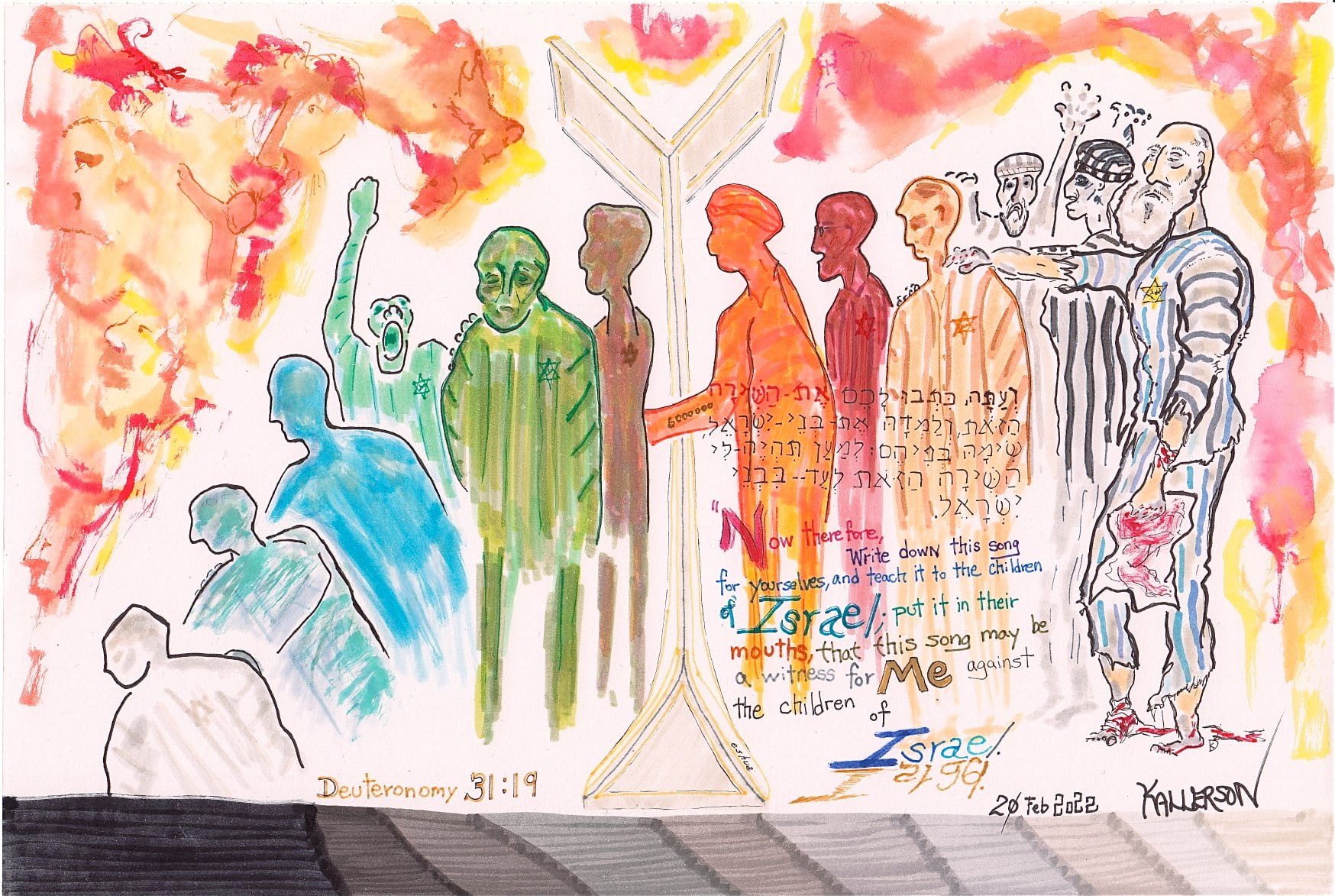
Deuteronomy 31:14-21
A Witness for Me Against the Children of Israel
The passage today is so poorly translated by almost every version of the Bible that it is almost impossible to properly tell what is going on. Even Young’s, the most literal translation of all, and who got most of the subtleties right, failed to get verse 20 right.
As I was typing the sermon, I almost felt I owed you an apology for the amount of time I will have to explain to you all of the inaccuracies that are found in the version I use for sermons, meaning the NKJV. But they simply follow along with the innumerable mistranslations of the KJV.
And pretty much all the others make the same mistakes. However, I shall not apologize for two reasons. First what you will go through is only about 40 or so minutes. I had to go through it for almost 10 hours, just to ensure it was right for you.
As such, how can I feel like you shouldn’t have to go through also! But secondly, once you see why these changes are so important to understanding what is being said, I honestly think you will agree that all of the minutiae we have to go through is actually worth it.
Text Verse: “Now may the God of peace Himself sanctify you completely; and may your whole spirit, soul, and body be preserved blameless at the coming of our Lord Jesus Christ. 24 He who calls you is faithful, who also will do it.” 1 Thessalonians 5:23, 24
I think this is the first time I have ever done a sermon where I used the same verse for the Text Verse as for Closing Verse. I think it’s right to do so because without understanding all of the corrections to the errors in translations in the sermon verses, you might come up with a completely different view of what Paul is saying.
I mean, how many denominations, churches, pastors, preachers, and teachers adamantly state that a person can lose his salvation? We’re reading the same Bible and coming to completely different conclusions concerning a matter of real doctrinal importance.
In the end, only one view is correct. That means that the other is… incorrect. And that means that an enormous number of people believe 100% incorrectly on this issue. That is problematic.
Paul says that God who calls you is faithful. He also says that He will perform (do) what he said in the previous verse, meaning preserving us blameless. Either what he says is true, or it is not. But where do we find out about the faithfulness of God? How can we tell if He is reliable or not?
Well, you can do so right from the history – and continued existence – of Israel. But when you either don’t know that history or when you have a faulty view of it because of faulty translations, as well as faulty teachers of the word concerning it, then you will naturally come to the conclusion that God’s faithfulness is not always something to be relied on.
How tragic. Let us be in the word, let us evaluate it as precisely as we can, and let us never apologize for doing so. I went through it for you, now you just sit still and listen to it from me. Ok? Let’s do it! Great things are to be found in His superior word. And so, let us turn to that precious word once again and… May God speak to us through His word today and may His glorious name ever be praised.
I. I Will Surely Hide My face in That Day (verses 14-18)
14 Then the Lord said to Moses,
va’yomer Yehovah el mosheh – “And said Yehovah unto Moses.” The words are rare for Deuteronomy. Moses has been the speaker throughout the vast majority of the book. But now, after Moses has given these many words and chapters of instruction, it is the Lord who speaks, and it is directly to Moses.
The Lord’s words are words of ending and finality. And yet, they are also words of continuance and a new direction. Moses is “He Who Draws Out.” He has drawn out the will of the Lord for the people of Israel. The time for that is now coming to a close. As such, the Lord says…
14 (con’t) “Behold, the days approach when you must die;
hen qarevu yamekha la’muth – “Behold approach your days to die.” The meaning is obvious. The days, until Moses dies, are coming to a close. Because of this, preparations must be made for things to continue on after his death. Therefore…
14 (con’t) call Joshua,
Joshua has been Moses’ assistant and second in command for the past forty years. His name means, “The Lord (Yah) is Salvation.” It is he who has already been noted as Moses’ successor in Numbers 27. The ongoing narrative since then has now caught up to that account.
In other words, just as Ruth belongs within the book of Judges chronologically, what occurs now belongs within the timeframe of the book of Numbers. Deuteronomy is an account that details Moses’ words within the ongoing narrative. Notice how what is now said in Deuteronomy fits into what is said then –
Now the Lord said to Moses: “Go up into this Mount Abarim, and see the land which I have given to the children of Israel. 13 And when you have seen it, you also shall be gathered to your people, as Aaron your brother was gathered. 14 For in the Wilderness of Zin, during the strife of the congregation, you rebelled against My command to hallow Me at the waters before their eyes.” (These are the waters of Meribah, at Kadesh in the Wilderness of Zin.)
15 Then Moses spoke to the Lord, saying: 16 “Let the Lord, the God of the spirits of all flesh, set a man over the congregation, 17 who may go out before them and go in before them, who may lead them out and bring them in, that the congregation of the Lord may not be like sheep which have no shepherd.”
18 And the Lord said to Moses: “Take Joshua the son of Nun with you, a man in whom is the Spirit, and lay your hand on him; 19 set him before Eleazar the priest and before all the congregation, and inaugurate him in their sight. 20 And you shall give some of your authority to him, that all the congregation of the children of Israel may be obedient. 21 He shall stand before Eleazar the priest, who shall inquire before the Lord for him by the judgment of the Urim. At his word they shall go out, and at his word they shall come in, he and all the children of Israel with him—all the congregation.”
22 So Moses did as the Lord commanded him. He took Joshua and set him before Eleazar the priest and before all the congregation. 23 And he laid his hands on him and inaugurated him, just as the Lord commanded by the hand of Moses. Numbers 27:12-23
Moses doesn’t go up to view the land of promise until Deuteronomy 34, and yet the Lord told him to go up and view it in Numbers 27. The same is true with the commissioning of Joshua now. The narrative is lining up with the unfolding events. It is now, at this specific time before the death of Moses, that he is to call Joshua…
14 (con’t) and present yourselves in the tabernacle of meeting,
The translation is incorrect, or at least faulty: v’hityashevu b’ohel moed – “and present yourselves in tent meeting.” The words here may not be referring to the tabernacle where the ark was at all. This is because it clearly says they would present themselves “in” the tent.
The tabernacle, after its ordination, was only to be accessed by the Levitical priests in the performance of their duties. Therefore, this could be a completely different tent noted in Exodus 33, where Moses would meet with the Lord and where Joshua was also allowed access –
“Now Moses used to take the tent and pitch it outside the camp, a good distance from the camp, and he called it the tent of meeting. And everyone who sought the Lord would go out to the tent of meeting which was outside the camp. 8 And it came about, whenever Moses went out to the tent, that all the people would arise and stand, each at the entrance of his tent, and gaze after Moses until he entered the tent. 9 Whenever Moses entered the tent, the pillar of cloud would descend and stand at the entrance of the tent; and the Lord would speak with Moses. 10 When all the people saw the pillar of cloud standing at the entrance of the tent, all the people would arise and worship, each at the entrance of his tent. 11 Thus the Lord used to speak to Moses face to face, just as a man speaks to his friend. When Moses returned to the camp, his servant Joshua, the son of Nun, a young man, would not depart from the tent.” Exodus 33:7-11 (NASB1995)
However, in Exodus 39, the tabernacle is described by the same words, ohel moed –
“Thus all the work of the tabernacle of the tent of meeting was finished. And the children of Israel did according to all that the Lord had commanded Moses; so they did.” Exodus 39:32
So, this is either the tent noted in Exodus 33, or Joshua – who is not of Levi – is given a special allowance to enter the tabernacle. Either way, it is in the “tent of meeting” that Moses and Aaron were to meet before the Lord, as He says…
14 (con’t) that I may inaugurate him.”
The word is tsavah. It is most often translated as “command.” Here the same meaning can be applied as long as the intent is understood. One might say, “that I may command him,” but it is with the intent of laying a charge upon him. As such…
14 (con’t) So, Moses and Joshua went and presented themselves in the tabernacle of meeting.
Again, it says “in tent of meeting.” Thus, it is either the tent where Moses and Joshua met with the Lord as noted in Exodus 33, or it is a special allowance for Joshua to actually go into the tabernacle, which is the tent of meeting. Either way, it next says…
15 Now the Lord appeared at the tabernacle
The words are wrong again: v’yera Yehovah ba’ohel – “And appeared Yehovah in the tent.” The Lord is visibly manifesting Himself in this manner in order to complete the commissioning of Joshua. The manifestation is…
15 (con’t) in a pillar of cloud,
The pillar of cloud was said to be above the tabernacle (ha’mishkan) throughout all of the journeys of Israel –
“For the cloud of the Lord was above the tabernacle by day, and fire was over it by night, in the sight of all the house of Israel, throughout all their journeys.” Numbers 40:38
But of this pillar of cloud, it next says…
15 (con’t) and the pillar of cloud stood above the door of the tabernacle.
Again, it reads ohel, tent, not mishkan, tabernacle. This is the same terminology used of the tent of meeting noted in Exodus 33:9 (already cited) that was originally outside the camp –
“Whenever Moses entered the tent, the pillar of cloud would descend and stand at the entrance of the tent; and the Lord would speak with Moses.”
Therefore, either the tent and the tabernacle are being spoken of synonymously here and elsewhere (which occurs elsewhere), or it is referring to two separate edifices. If it is the same edifice, then the tabernacle, which is also the tent of meeting, would have replaced the original tent of meeting referred to in Exodus 33.
It wouldn’t be good to be dogmatic about either view as the back-and-forth nature of the words in the books of Moses makes either possible. But wherever the Lord is, that is the “tent of meeting.”
However, why would the pillar need to stand above the door of the tabernacle (if synonymous) when it has already been said that it was always above it during their journeys. But if the pillar moved from the tabernacle to the tent (a separate edifice), then the wording might more logically follow.
I would assume that the “tent of meeting” is also “the tabernacle,” but I just don’t want to present something incorrect, and then find out I was wrong someday. Thus, I am giving a more detailed analysis than may be necessary. The main sticking point is whether Joshua was given a special dispensation to enter the tabernacle or not.
No matter what, the issue at hand is the ordination of Joshua. That will come to pass, but before it does, Moses is told about the future history of his people…
16 And the Lord said to Moses: “Behold, you will rest with your fathers;
The word “rest” is an explanation or a paraphrase. The Hebrew uses the word shakav. It means “to lie down” as in rest. “Behold, you will lie down with your fathers.” It is a metaphorical way of speaking of death.
Some argue that this is not a valid concept to refer to a future resurrection, but I would disagree. The hope of the resurrection already existed, very clearly, at this time. Job, who was contemporary with Abraham, spoke of both –
Why then do You not pardon my transgression,
And take away my iniquity?
For now I will lie down in the dust, (shakav)
And You will seek me diligently,
But I will no longer be.” Job 7:21
“For I know that my Redeemer lives,
And He shall stand at last on the earth;
26 And after my skin is destroyed, this I know,
That in my flesh I shall see God,
27 Whom I shall see for myself,
And my eyes shall behold, and not another.” Job 19:25-27
Sleep, despite being used metaphorically for death, implies that one will awaken. Paul carefully uses the word “sleep” again and again concerning the state of believers. In 1 Thessalonians, he uses both words synonymously to confirm this –
“For this we say to you by the word of the Lord, that we who are alive and remain until the coming of the Lord will by no means precede those who are asleep. 16 For the Lord Himself will descend from heaven with a shout, with the voice of an archangel, and with the trumpet of God. And the dead in Christ will rise first.” 1 Thessalonians 4:15, 16
The words to Moses now are words of comfort and hope of what God had promised from the very fall of man. As for Israel, there is less hope for them, at least in some respects…
16 (con’t) and this people will rise and play the harlot with the gods of the foreigners of the land,
The translation completely misses the intent of what the Lord is conveying: v’qam ha’am hazeh v’zanah akhare elohe nekar ha’aretz – “and will rise the people, the this, and play harlot after gods foreigner the land.”
The word ha’am, or “the people,” is singular, as is the word nekar, or foreigner. The two are being placed in union with one another. Just as an adulterous woman would unite herself with another man. The “gods” are the play toys of the illicit lover with whom Israel commits her adultery.
Israel, as a united whole, will apostatize from the way of the Lord. In turning from Him, who is their Husband by covenant, they will “play the harlot.”
The implication, even before He says it in a coming clause, is that their harlotry is to be considered adultery – a wife cheating on her Husband. The idea of Israel being a spouse to the Lord in relation to this covenant is explicitly stated by Him in Jeremiah 31 –
“Behold, the days are coming, says the Lord, when I will make a new covenant with the house of Israel and with the house of Judah— 32 not according to the covenant that I made with their fathers in the day that I took them by the hand to lead them out of the land of Egypt, My covenant which they broke, though I was a husband to them, says the Lord.” Jeremiah 31:31, 32
Rather than fidelity to the Lord, their Husband, the people will prostitute themselves by worshipping and serving other gods…
16 (con’t) where they go to be among them,
The words are still in the singular: asher hu ba shamah b’qirbo – “which he goes there in his midst.” The entire beauty of the picture being presented is obliterated in the translation. The Lord is very clearly presenting Himself as an offended spouse whose wife is nothing but a cheap harlot.
It calls to mind the book of Hosea many hundreds of years later where the prophet is used to clearly present this truth. But the Lord knows the inclination of the people and thus continues…
16 (con’t) and they will forsake Me and break My covenant which I have made with them.
It is all in the singular: v’azavani v’hepher eth beriti asher karati ito – “and he will forsake Me and he will break My covenant which I have made with him.”
Israel the people, despite the masculine, is the spouse of the Lord by covenant. He will break his part of the bargain. One can see the personal nature of the offense as he says, “forsake Me” and “My covenant.” The Lord is the offended party; Israel is the unfaithful spouse.
The next verse is, again, very poorly translated. As such, the precision of the words of the Lord to Moses is lost. It switches from the singular to the plural, and then it goes back to the singular. This is as the NKJV renders it (following the KJV) –
“Then My anger shall be aroused against them in that day, and I will forsake them, and I will hide My face from them, and they shall be devoured. And many evils and troubles shall befall them, so that they will say in that day, ‘Have not these evils come upon us because our God is not among us?’”
However, the verse more closely reads: “And My anger shall be aroused against him in that day, and I will forsake them, and I will hide my face from them, and he shall be devoured, and many evils and troubles shall befall him, and he will say in that day, ‘Is it not because that my God is not in my midst – these evils have found me?’”
With this understanding, we can now evaluate the verse…
17 Then My anger shall be aroused against them in that day,
The Lord, in advance of what is absolutely sure to come, says: v’kharah api bo ba’yom ha’hu – “And shall burn my nostril in him (singular) in the day the that.” It is as flames shoot out of His nostril at his wayward spouse. “I caught you with another!” The enraged husband has borne the grief of the offense. As such…
17 (con’t) and I will forsake them,
In the last verse, it said, v’azavani – “and he will forsake Me.” Now, it says, v’azavtim – “and I will forsake them.” Notice how carefully the words are chosen. The Lord has promised to never forsake Israel. But He can and will forsake the people who comprise Israel, even while not forsaking the nation itself.
The care and precision of the words are given to show us the Lord’s complete and wholehearted faithfulness to the covenant. He forsakes the individual people who forsake Him, but not the group of people who are His.
17 (con’t) and I will hide My face from them,
v’histarti panay me’hem – “and I will hide My face from them.” One can get the sense of a king not allowing his disobedient subjects to come into His presence. Again, it is unthinkable that the Lord would hide His face from those who were faithful to Him, thus it is unthinkable that He would hide his face from the entire nation itself.
In other words, when Jesus came, there are those who accepted Him and there are those who rejected Him. The nation rejected Him, but even to this day, there has always been a remnant who have come to Him through Christ (Romans 11:5).
If He were to hide His face from the nation as a whole, it would mean that there would be none saved from the nation. But if He hides His face (meaning His favor) from the individuals of the nation, it still leaves room for His favor to extend to any who will turn to Him.
The same is true with the tribulation period. God could say, “I will hide Myself from mankind.” That would mean that none could be saved. Instead, He will hide His face from men, but not all of mankind. Those who turn to Him will receive His salvation.
Wonderful truths can be discerned right from verses such as this in Deuteronomy 31. For now, the Lord continues…
17 (con’t) and they shall be devoured.
v’hayah l’ekol – “and he shall be for eating.” The cutting of a covenant carries with it the idea of a meal. Sometimes, this is made explicit. For example, when Jacob made a covenant with Laban, they had a meal between them.
Likewise, at the cutting of the covenant at Sinai, the leaders of Israel came up the mountain and ate and drank in the presence of the Lord. In the previous verse, it said that Israel would break the covenant.
The meal between the two was disgraced because of Israel’s serving other gods, implying having meals in their presence through fellowship offerings. Because of its ways, Israel would instead become a nation suited for consumption by others for their unfaithfulness to the Lord. This thought is expressed concerning an adulterous wife in the Proverbs –
“This is the way of an adulterous woman:
She eats and wipes her mouth,
And says, “I have done no wickedness.” Proverbs 30:20
In this state, the Lord says…
17 (con’t) And many evils and troubles shall befall them,
u-metsauhu raoth raboth v’tsaroth – “and shall find him evils many, and distresses.” These have already been carefully explained in Chapter 28. The curses that will come upon Israel will be great, severe, consuming, and prolonged. All this will come upon them…
17 (con’t) so that they will say in that day,
v’amar ba’yom ha’hu – “and he will say in the day the that.” The nation – its people – in its synagogues, in its dispersion, in its continued state of being hated by all around them – in that day the nation will say…
17 (con’t) ‘Have not these evils come upon us because our God is not among us?’
Whatever the context for the nation at any given time and in any given place is, it – as a united cry – will acknowledge its rejection, saying, “Is it not because that my God is not in my midst – these evils have found me?’”
It doesn’t matter who among the people says it, how many times it is said, where it is said, and so on. It is a cry which unites the entire nation as a whole – “I am Israel, and God is not with me. Instead, these evils are now my lot.”
Charles Ellicott, who lived in the 1800s noted of these words, that they are “A confession made freely by them at this present day.” Israel forsook its God, and God forsook them, even if He has not forsaken it. And the Lord continues…
18 And I will surely hide My face in that day
The words bear a strong emphasis: v’anokhi haster astir panay ba’yom ha’hu – “and I, hiding, will hide My face in the day the that.” The favorable countenance of the Lord will not rest upon Israel.
They will continue down their evil path, knowing that the Lord is not among them, and yet they will not demonstrate the intelligence of seeking out why. But the answer is perfectly discernible. It is…
18 (con’t) because of all the evil which they have done, in that they have turned to other gods.
There is a pun in the words, and they are in the singular: al kal ha’raah asher asah ki panah el elohim akherim – “above all the evil which he has done for he has turned unto gods other.” The word “face” used in the previous clause is derived from the word “turned” in this clause.
In other words, the hiding of the face of the Lord is a direct consequence of Israel having turned its face away from the Lord and toward other gods. “I will not reveal Myself to them while they are looking to other gods for revelation.”
At this time, there are innumerable gods in Israel. But as a nation, they generally would claim they are the people of the Lord. However, the Lord revealed Himself to them in the face of Christ. Because they rejected Him, one could ask, “Is there then a difference in the Lord (Yehovah) and the Lord (Jesus) for them to still claim to be the people of the Lord?
The answer is, “No.” They are one and the same. But one might then ask, “In rejecting Christ, what does it mean to them when they say they are the people of the Lord? If they are following the Lord (Yehovah) and Jesus is Yehovah, then they are following the same Lord!”
It is a false comparison. Following the Lord doesn’t simply mean following a name. It means being obedient to that name in the manner in which He expects.
They are not following the Lord. They have rejected Christ who is the Lord, and they have attempted to pursue God through their own righteousness, not His. Therefore, they are not following the Lord at all. And, thus, they are not now the Lord’s people (Romans 9:26).
This is the error in thinking of dual covenant theology, such as that proposed by the Roman Catholic Church and John Hagee. They say that the Jews are following the Lord, and therefore they can be saved by adherence to the law which the Lord gave. This is incorrect.
It is also the error of the Hebrew Roots moment, the Seventh Day Adventists, and others who claim they are following the Lord without trusting in the Lord alone. No person can be saved by adherence to the law. It can only come by trusting in His fulfillment of it, because He embodies the law.
Israel is trusting in the god of self before the Lord. Not in the Lord. As such, the face of the Lord is hidden from them. It is a passive hiding; a self-inflicted wound –
“But their minds were blinded. For until this day the same veil remains unlifted in the reading of the Old Testament, because the veil is taken away in Christ. 15 But even to this day, when Moses is read, a veil lies on their heart. 16 Nevertheless when one turns to the Lord, the veil is taken away.” 2 Corinthians 3:14-16
With this understood, the Lord will next give explicit and specific instructions for Moses…
A song to bring to remembrance My word
So that when it comes to pass, you know I knew
You will be able to consider all that you have heard
And if you are wise, you will also know what to do
But you are a nation without understanding
And I know the inclination of your heart
You are like a spoiled child, ever demanding
That I bless you, while you tear us apart
This song will testify against you
It will stand as a witness when your ears have heard
You will know that despite your wickedness, I have remained true
And that I have always been faithful to My word
II. This Song Will Testify (verses 19-21)
19 “Now therefore, write down this song for yourselves,
The verb is plural in this clause. The instructions are for both Moses and Joshua to write down the song “to yourselves” (plural). The song itself is introduced in the last verse of this chapter, and it comprises the majority of the next chapter.
The meaning is that it is for Moses to convey, but it is also for Joshua, who is there with Moses, to write. As it is contained within Deuteronomy, then it was something that was to be conveyed to the people by the leader at any appropriate time in their history…
19 (con’t) and teach it to the children of Israel;
The word so frequently used in Deuteronomy, lamad, is used by the Lord here. It signifies to goad as if prodding an animal along, and thus it means “to teach.” Being in the form of a song, it would be a memory tool for the people.
The verb is singular here. Moses is to teach it to the people, and that is what will be seen when it is presented. Nothing is said of music to accompany it, and when it is presented, it says that Moses will speak the words of the song. Along with teaching it to them, the Lord next says to…
19 (con’t) put it in their mouths,
Moses (the verb is again singular) is not only to read it to them, but to have them repeat it back to them until they have it “in their mouths,” meaning that it is committed to memory and that it can be called back from their mouths at any time.
This is also what Paul later teaches those at Colossae, and thus to us who also have received his words –
“Let the word of Christ dwell in you richly in all wisdom, teaching and admonishing one another in psalms and hymns and spiritual songs, singing with grace in your hearts to the Lord.” Colossians 3:16
This song that Moses instructs is to have a set and enduring purpose…
19 (con’t) that this song may be a witness for Me against the children of Israel.
l’maan tihyeh li ha’sirah hazot l’ed bivne Yisrael – “to end purpose may be to Me the song, the this, to witness in sons Israel.” There is a set reason that the Lord is giving Israel the words of this song. It is to stand as a permanently recorded witness, in advance of their entry into the promise, concerning what is conveyed in it.
Israel can never say that what happened to them was arbitrary, unjustified, without warning, and without a full description of what they would face. There is no excuse for them as a people or as people.
Even if they are unaware of the words, that is a fault of the people as well. They were told to know it and have it in their mouths. It will now be compiled and delivered to them for the time…
20 When I have brought them to the land flowing with milk and honey, of which I swore to their fathers,
The word translated as “land” here signifies the ground. It is a different word than will be seen in the next verse. Also, the words are in the singular – “When I have brought him unto the ground of which I swore to his fathers, flowing with milk and honey.”
Israel the nation, is being brought into the spot of ground that was sworn to the fathers to be given to the people, a land flowing with milk and honey.
This is the sixth and last time that this phrase is mentioned in Deuteronomy. It is more than any other book in the Bible. Every time it is mentioned, a note concerning the fathers is found in the immediate context. It is a good land and one that comes by promise.
As this is the last time the term “milk and honey” is used in this book, and because it is such a commonly used term in Scripture, it would be good to review its meaning once again.
A land flowing with milk and honey implies richness and fertility. Milk comes from cows and so it means abundant pasture lands. Honey comes from bees which pollinate flowers and so it implies all sorts of fruit trees, herbs, and flowers.
And more, for Israel, the term “a land flowing with milk and honey” will also possess a spiritual connotation. For them, it doesn’t just speak of the physical abundance but also of spiritual abundance because of the Lord, and because they are the Lord’s people, through whom the word of God comes.
The word of God is said to be sweeter than honey. It is also equated with milk which nourishes. Thus, this is a reference to that as well. The land would literally flow with milk and honey for sustaining Israel’s physical lives. It would also flow with milk and honey for sustaining their spiritual lives.
All of this was being given to them. They have done nothing to deserve it, but it is simply an act of grace based upon a promise to their fathers. The Lord promised, He has fulfilled, and He will deliver. At some point in the future after it has been obtained…
20 (con’t) and they have eaten and filled themselves and grown fat,
Again, the words are in the singular, “and he has eaten, and filled himself, and he has grown fat.” Israel is being depicted as a single entity, like a big plump cow, benefitting from his plot of ground. He eats and grows into one who is entirely sated. But in this state of obesity and even overindulgence (think of our own nation today…)
20 (con’t) then they will turn to other gods and serve them; and they will provoke Me and break My covenant.
The pronouns change in the middle of the clause – “and he will turn to other gods, and they will serve them, and they will spurn Me and he will break My covenant.” The changes, as before, are precise and exceptionally clear. Israel will turn to other gods. As such, the people will serve those gods and the people will spurn the Lord, and Israel will break the covenant.
The covenant is with the nation of Israel. If someone serves other gods and spurns the Lord, the nation could judge and execute him. The covenant is not broken, except by that person. However, if the nation turns from the Lord and the people serve other gods, the only one left to punish the people – and thus the nation – is the Lord.
Every single word is masterfully issued forth so that we can clearly see what is going on. This same general type of thought is found in the seven letters to the seven churches. The churches are addressed as a whole, but at times individuals are clearly singled out.
Without a proper consideration of these things (which must come from a proper translation of them) it isn’t possible to tell exactly what is going on. But how wonderful it is to see the precision of what is conveyed here to Moses and Joshua by the Lord.
For now, the Lord notes that the covenant is broken by the nation. As such…
21 Then it shall be, when many evils and troubles have come upon them, that this song will testify against them as a witness;
Everything here has spoken of Israel as an individual – “And it shall be when have come upon him evils many and troubles, that will testify this song to him to witness.”
It is Israel upon whom the evils and troubles will alight. But when the nation does, it cannot say that they were unaware of why. The purpose of the song was to be as a witness held in the national memory.
The idea being conveyed is the supernatural preservation of the word. If it were up to man, it may be lost, but the Lord ensured that there would always be a suitable and reliable copy of it available. This is clearly seen in the next words…
21 (con’t) for it will not be forgotten in the mouths of their descendants,
Again, the pronouns are tragically wrong – “for no it will be forgotten from his mouth, his seed.” Individuals may have no idea that the words even existed. But they would never be missing from the mouth of Israel, meaning the availability to have them issue forth, even throughout all of its generations (his seed).
Because it is in the singular, it is a way of implicitly saying that the word will ALWAYS be available to Israel.
And this has borne out to be true through their entire history. At one point, it was locked away in the temple which had been completely shut up.
So far were the people away from the Lord that they didn’t even know the word existed. But it did. It was preserved for the nation. When it was found, it was a witness to it of its guilt, exactly as the Lord promises now in Deuteronomy –
Then Hilkiah the high priest said to Shaphan the scribe, “I have found the Book of the Law in the house of the Lord.” And Hilkiah gave the book to Shaphan, and he read it. 9 So Shaphan the scribe went to the king, bringing the king word, saying, “Your servants have gathered the money that was found in the house, and have delivered it into the hand of those who do the work, who oversee the house of the Lord.” 10 Then Shaphan the scribe showed the king, saying, “Hilkiah the priest has given me a book.” And Shaphan read it before the king.
11 Now it happened, when the king heard the words of the Book of the Law, that he tore his clothes. 12 Then the king commanded Hilkiah the priest, Ahikam the son of Shaphan, Achbor the son of Michaiah, Shaphan the scribe, and Asaiah a servant of the king, saying, 13 “Go, inquire of the Lord for me, for the people and for all Judah, concerning the words of this book that has been found; for great is the wrath of the Lord that is aroused against us, because our fathers have not obeyed the words of this book, to do according to all that is written concerning us.” 2 Kings 22:8-13
The witness stood, and the words of this song – along with the other words of the Book – testified against Israel. It had to be this way. The Lord already understood the nation’s proclivities…
*21 (fin) for I know the inclination of their behavior today, even before I have brought them to the land of which I swore to give them.”
And again, the pronouns must be clarified – “for I know the inclination which he does today in advance I have brought him unto the land which I swore.”
Israel had been a disobedient son from the moment he was called out of Egypt. The people had moaned all the way to Sinai, they rebelled there at the sacred mountain. They moaned and complained on the way to the land of promise. They rebelled against the Lord at its borders, they had been disobedient and moaning throughout all the years of exile in the wilderness.
This was his inclination all along. How much more could this be expected when the people were interspersed throughout the land, filling themselves with food, easily able to hide away their wicked deeds, disobedience, adulteries, and the like.
The Lord knew, and He set forth this song to be a summary of the nation’s existence and a witness to testify to His faithfulness in their continuance before Him despite their faithlessness toward Him.
This is the marvel of God’s covenant keeping. When He speaks, it is an eternal decree. He will never fail to keep His part of a covenant that He enters into. The tragedy for us is that we fail to accept that this is true.
There are those who fail to acknowledge it towards Israel, saying the Lord is through with them or the Lord has replaced them. And there are those who fail to acknowledge it towards saved believers, saying that the Lord may just renege on His part of the deal when He saves us and seals us with a guarantee concerning that salvation.
The more we see this in the Old Testament, the more astonishing it is to consider. It shows the immense failure of scholars, pastors, preachers, and teachers of the church to simply pick up their Bibles, read them, and accept what is stated at face value.
However, if the translation is incorrect, then incorrect ideas will be held in the mind of those who read them. Thus, it is a failure on the part of translators as well.
It is a tragedy, and it is one that is then taught into the minds of congregants, destroying their doctrine, and then weakening their faith in the Lord and their confidence in His word. Let us look to the history, and continued existence, of this disobedient nation. And then, let us exalt the faithfulness of God toward them.
At the same time, let this lesson of Israel give us confidence that when we stumble before the Lord, He is there with us, keeping us from falling altogether. We can have every confidence that His salvation is full, final, and forever. Thank God for His faithfulness to us in Christ Jesus our Lord.
Closing Verse: “Now may the God of peace Himself sanctify you completely; and may your whole spirit, soul, and body be preserved blameless at the coming of our Lord Jesus Christ. 24 He who calls you is faithful, who also will do it.” 1 Thessalonians 5:23, 24
Next Week: Deuteronomy 31:22-30 It will testify against Israel. Yes, it is true… (A Witness Against You) (92nd Deuteronomy Sermon)
The Lord has you exactly where He wants you. He has a good plan and purpose for you. But He also has expectations of you as He prepares you for entrance into His Land of Promise. So, follow Him and trust Him and He will do marvelous things for you and through you.
A Witness for Me Against the Children of Israel
Then the LORD said to Moses
“Behold, the days approach when you must die
Call Joshua, and present yourselves in the tabernacle of meeting
That I may inaugurate him. To this, you must now comply
So Moses and Joshua went and presented themselves
In the tabernacle of meeting, this duty they did tackle
Now the LORD appeared at the tabernacle in a pillar of cloud
And the pillar of cloud stood above the door of the tabernacle
And the LORD said to Moses: “Behold, you will rest
———-with your fathers
And this people will rise and play the harlot with the gods
———-of the foreigners of the land
Where they go to be among them, and they will forsake Me
And break My covenant which I have made with them
———-rebelling against My hand
Then My anger shall be aroused against them in that day
And I will forsake them, and I will hide My face from them
———-yes, hide it away
And they shall be devoured
And many evils and troubles shall befall them
———-so that they will say in that day…
‘Have not these evils come upon us because our God
———-is not among us?
And I will surely hide My face in that day
Because of all the evil which they have done
In that they have turned to other gods; the harlot they will play
“Now therefore, write down this song for yourselves
And teach it to the children of Israel, so to you I tell
Put it in their mouths, that this song may be a witness for Me
Against the children of Israel
When I have brought them to the land flowing
———-with milk and honey
Of which I swore to their fathers, and they have eaten
———-and filled themselves and grown fat
Then they will turn to other gods and serve them
And they will provoke Me and break My covenant, just like that
Then it shall be, when many evils and troubles
———-have come upon them
That this song will testify against them as a witness, so I convey
For it will not be forgotten in the mouths of their descendants
For I know the inclination of their behavior today
Even before I have brought them to the land
Of which I swore to give them, their ways I fully understand
Lord God, turn our hearts to be obedient to Your word
Give us wisdom to be ever faithful to You
May we carefully heed each thing we have heard
Yes, Lord God may our hearts be faithful and true
And we shall be content and satisfied in You alone
We will follow You as we sing our songs of praise
Hallelujah to You; to us Your path You have shown
Hallelujah we shall sing to You for all of our days
Hallelujah and Amen…
14 Then the Lord said to Moses, “Behold, the days approach when you must die; call Joshua, and present yourselves in the tabernacle of meeting, that I may inaugurate him.”
So Moses and Joshua went and presented themselves in the tabernacle of meeting. 15 Now the Lord appeared at the tabernacle in a pillar of cloud, and the pillar of cloud stood above the door of the tabernacle.
16 And the Lord said to Moses: “Behold, you will. rest with your fathers; and this people will rise and play the harlot with the gods of the foreigners of the land, where they go to be among them, and they will forsake Me and break My covenant which I have made with them. 17 Then My anger shall be aroused against them in that day, and I will forsake them, and I will hide My face from them, and they shall be devoured. And many evils and troubles shall befall them, so that they will say in that day, ‘Have not these evils come upon us because our God is not among us?’ 18 And I will surely hide My face in that day because of all the evil which they have done, in that they have turned to other gods.
19 “Now therefore, write down this song for yourselves, and teach it to the children of Israel; put it in their mouths, that this song may be a witness for Me against the children of Israel. 20 When I have brought them to the land flowing with milk and honey, of which I swore to their fathers, and they have eaten and filled themselves and grown fat, then they will turn to other gods and serve them; and they will provoke Me and break My covenant. 21 Then it shall be, when many evils and troubles have come upon them, that this song will testify against them as a witness; for it will not be forgotten in the mouths of their descendants, for I know the inclination of their behavior today, even before I have brought them to the land of which I swore to give them.”