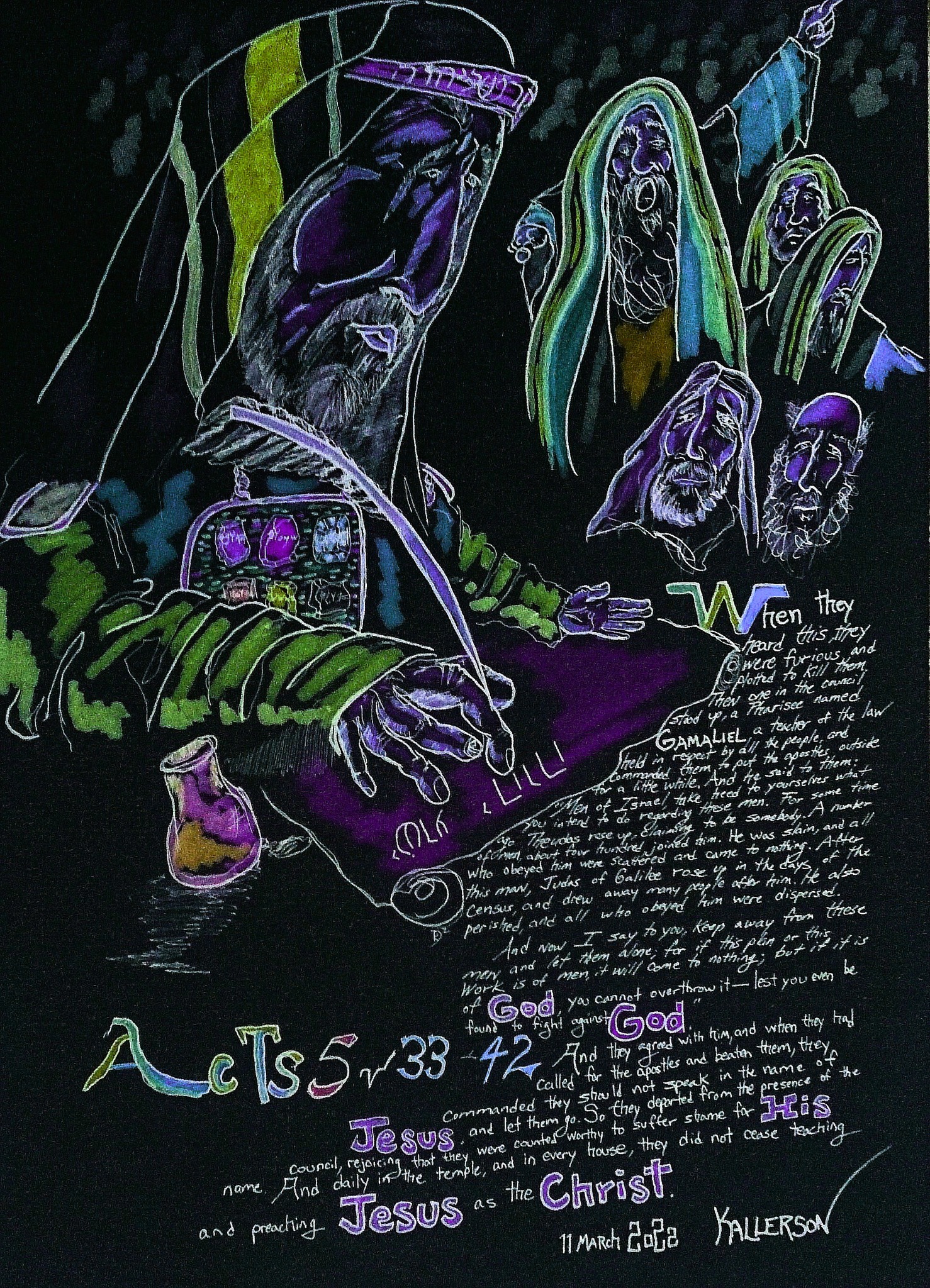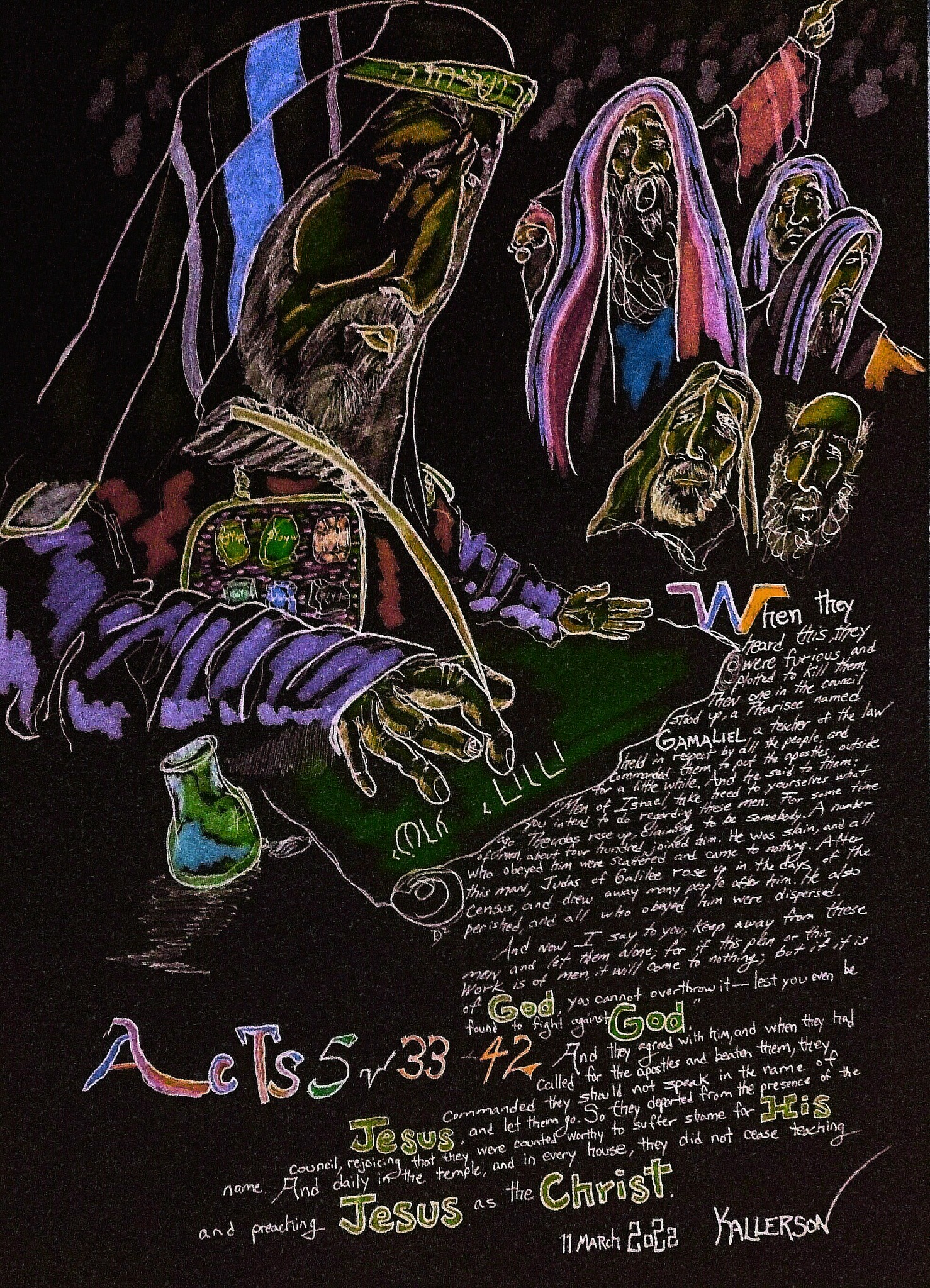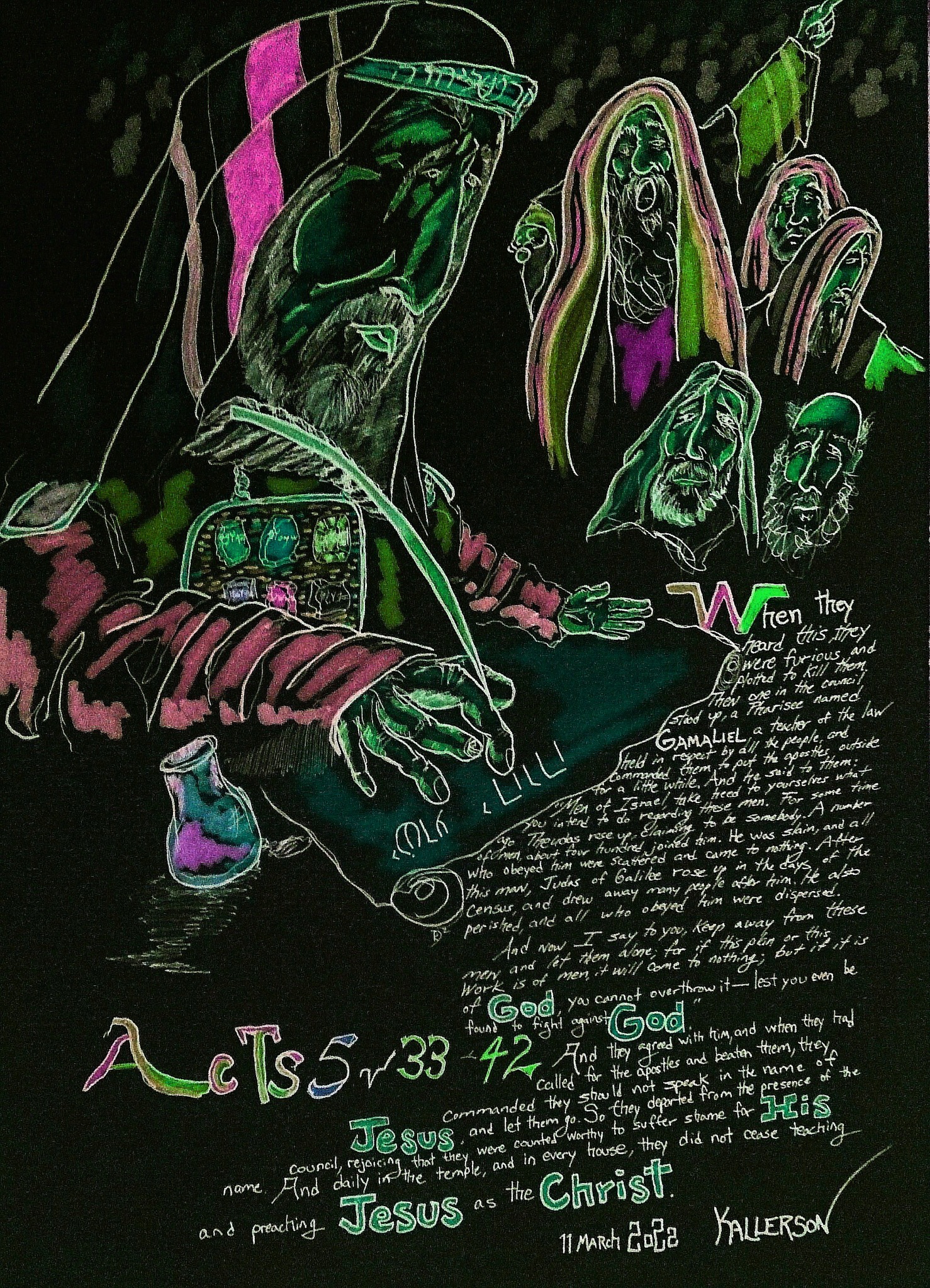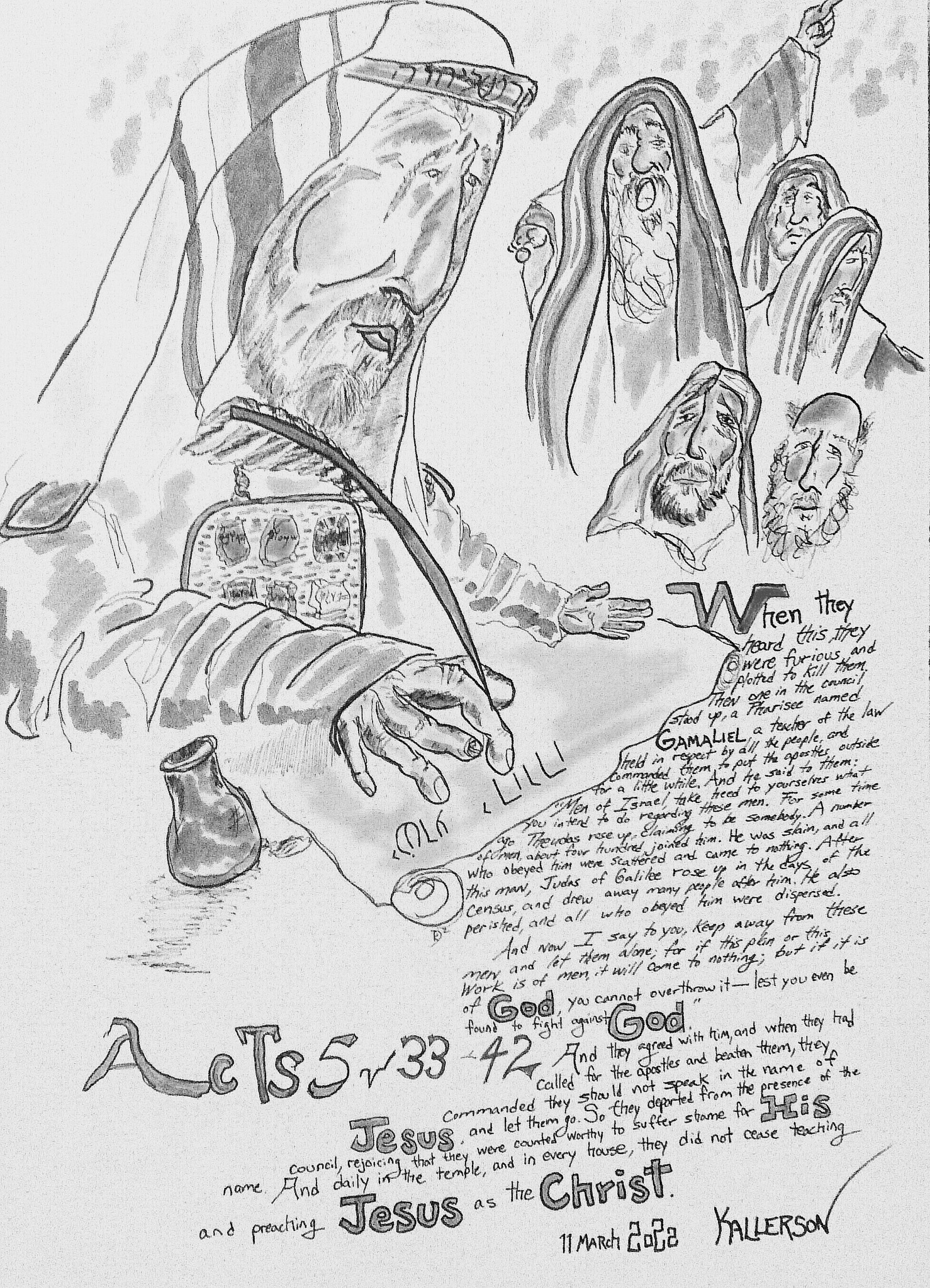
Acts 1:16

Monday, 11 October 2021

“Men and brethren, this Scripture had to be fulfilled, which the Holy Spirit spoke before by the mouth of David concerning Judas, who became a guide to those who arrested Jesus; Acts 1:16

Note: You can listen to today’s introduction courtesy of our friends at “Bible in Ten” podcast. (Click Here to listen)

You can also read this commentary, with music, courtesy of our friends at “Discern the Bible” on YouTube. (Click Here to listen), or at Rumble (Click Here to listen). 

In the previous verse, Peter stood to speak. His words now commence with, “Men and brethren.” It is a single address in the Greek signifying “brother-men.” Simply saying “brothers” would get the point across in our modern speech. In this, he is addressing those with him in a personal, friendly manner. With the tone set, he then says, “this Scripture had to be fulfilled.”

Understanding that there was no New Testament at the time, the only thing the people had to rely on for their knowledge of the workings of God in Christ was the Hebrew Scriptures, now our Old Testament. What Peter is referring to has two parts to it. The first is that of Judas’ betrayal, something he will not cite, but which had already been cited by Jesus in John 13 –

“I do not speak concerning all of you. I know whom I have chosen; but that the Scripture may be fulfilled, ‘He who eats bread with Me has lifted up his heel against Me.’ 19 Now I tell you before it comes, that when it does come to pass, you may believe that I am He.” John 13:18, 19

Jesus’ words are a quote from the 41st Psalm –

“Even my own familiar friend in whom I trusted,
Who ate my bread,
Has lifted up his heel against me.” Psalm 41:9

Though Peter doesn’t cite this, it can be inferred that he is referring to it. Later, he will cite more Scripture to show what must be done in order to replace the traitor. For now, Peter is reminding the brethren that what occurred was a part of the plan of God, even if Judas willingly set out to do what he did. That is evidenced in the next words, saying, “which the Holy Spirit spoke before by the mouth of David.”

David, under inspiration of the Holy Spirit (see 2 Peter 1:19-21), prophesied what would occur concerning Judas’ interactions with the Messiah. This in no way means that the psalm written by David wasn’t something that pertained directly to him as well. David was betrayed, he was disturbed in his heart over his betrayal, and he wrote a psalm to the Lord about what happened. And yet, the words prophetically anticipate what would happen to the Messiah also. Such dual meaning in Scripture occurs constantly –

“And the Lord said to Moses, ‘Go on before the people, and take with you some of the elders of Israel. Also take in your hand your rod with which you struck the river, and go. Behold, I will stand before you there on the rock in Horeb; and you shall strike the rock, and water will come out of it, that the people may drink.’
And Moses did so in the sight of the elders of Israel.” Exodus 1:5, 6

&

“Moreover, brethren, I do not want you to be unaware that all our fathers were under the cloud, all passed through the sea, all were baptized into Moses in the cloud and in the sea, all ate the same spiritual food, and all drank the same spiritual drink. For they drank of that spiritual Rock that followed them, and that Rock was Christ.” 1 Corinthians 10:1-4

Real events of the past, as recorded in Scripture, are given as types and pictures of the coming Messiah, of His work, and of the effects of His work – both for Israel and for the church. These events are often so precise that they can identify the interactions of a single person. As Peter next says, “concerning Judas.”

God, who created time and who is outside of time, knows everything that will ever happen. He knew that Judas would betray Christ Jesus, and He allowed David’s words to become a part of what would be realized in that betrayal. This, however, does not mean that God is responsible for what occurred. Foreknowledge does not, by default, mean “prearranging.” We can know that a clock will ring at a certain time, and it does. And yet, we may have had nothing to do with it happening.

In 1 Samuel 22, David said –

“I knew that day, when Doeg the Edomite was there, that he would surely tell Saul. I have caused the death of all the persons of your father’s house. 23 Stay with me; do not fear. For he who seeks my life seeks your life, but with me you shall be safe.” 1 Samuel 22:22, 23

David understood the character of Doeg and that he would tell Saul what David did. Doeg then killed 85 of the priests of the Lord. If David had killed Doeg, he would have been a murderer. But in not killing him, the priests died. Despite David’s knowledge concerning Doeg, he could not be blamed for the murder of the priests, even if he felt bad about what occurred.

This is a simple example of a man with intuition concerning a matter. Considering God, whose knowledge is infinite, what occurs is known to Him, but it does not mean that He prearranged the good or evil that occurs. He simply knows the logical outcome and uses it in accord with His will to continue His work within the stream of time. Judas is solely to blame for his actions. It is he “who became a guide to those who arrested Jesus.”

The events surrounding what Judas did are recorded in the gospels, specifically in Matthew 26:14 and 47-56, Mark 14:10 and 43-50, Luke 22:3-6 and 47-53, and John 13:18-30 and 18:1-11. Reading these accounts, one can see that the comments of John Gill are correct when he says, “so that he was not only a guide as to the way, but was a director, and conductor, and manager of the whole affair.”

Life application: The events recorded concerning the deeds of Judas are evidence of the state of free will in man. God does not force His will upon man. When it says in Exodus, “I will harden Pharaoh’s heart” (Exodus 7:3), it is perfectly clear from the account that this was done passively, not actively. The Lord arranged events to occur that caused Pharaoh to harden his own heart.

For example, Moses was told to throw down his rod before Pharaoh. In doing so, it became a serpent. However, Pharaoh’s own men did the same. In this, Pharaoh’s heart was hardened towards the power of the Lord. In the next instance, Moses was told to strike the waters of the Nile and they would turn to blood. He did and they did. But it says that Egypt’s magicians did the same with their enchantments. As a result, it specifically says, “and Pharaoh’s heart grew hard” (Exodus 7:22). The hardening was passively accomplished by the Lord. Pharaoh, not the Lord, is to blame for his actions.

The Lord knew the character of the man, He knew what man would do, and He used the circumstances to continue to reveal His glory –

“Now if I had stretched out My hand and struck you and your people with pestilence, then you would have been cut off from the earth. 16 But indeed for this purpose I have raised you up, that I may show My power in you, and that My name may be declared in all the earth.” Exodus 9:15, 16

This doctrine of free will is essential to a right relationship with God. Without it, man would be nothing more than an automaton, doing the bidding of the Lord without any true sense of fellowship, love, fear, awe, admiration, and so on. And this is a key and principal part of salvation as well. One false doctrine espoused within the church, part of the teaching known as Calvinism (after John Calvin), says that man does not have free will to choose God.

Rather, it teaches that man is first regenerated by God (he is “born again”), and then he chooses God and is saved. In other words, he is saved before he is saved. It is a confused theology that has no basis in Scripture. The free will of man is taught from the first pages of the Bible until the last pages of the Bible. Nowhere is it taught that man does not choose Christ. Rather, it is explicitly or implicitly stated throughout Scripture, including John 3:16 –

“For God so loved the world that He gave His only begotten Son, that whoever believes in Him should not perish but have everlasting life.”

God reveals, God offers, and God expects a response. If you disagree, that is your choice. God gave you free will to do so.

Lord God, thank You for the offer of salvation that is found in the giving of Your Son for us. All You ask us to do is to believe the simple message of salvation, the gospel. In accepting that He died for our sins, was buried, and rose again, we are sealed with Your Holy Spirit as a guarantee of our salvation. Thank You for this simple and glorious path to eternity with You. Amen.


Genesis 3, 16-24 (Die Einführung von Donuts – das Ende von Gottes Garten)

Genesis 3, 16-24 (Die Einführung von Donuts – das Ende von Gottes Garten)

Einleitung:

Honig wird in der Bibel 60-mal erwähnt und als Paradebeispiel für Süße im Vergleich zu anderen Dingen verwendet. Im Buch der Sprüche werden wir zum Beispiel vor der Süße einer Verführerin gewarnt –

Denn von den Lippen einer unmoralischen Frau tropft Honig,
und ihr Mund ist glatter als Öl;
Aber am Ende ist sie bitter wie Wermut,
Scharf wie ein zweischneidiges Schwert.
Sprüche 5:3, 4

Und im Hohelied der Liebe macht König Salomo einen ähnlichen Vergleich über die Schönheit der Stimme und der Worte einer rechtschaffenen Frau, seiner Geliebten –

Deine Lippen, oh meine Braut,
tropfen wie die Honigwabe;
Honig und Milch sind unter deiner Zunge;
Und der Duft deiner Gewänder
ist wie der Duft des Libanon.
Hohelied 4,11

Der Honig stammt von der Arbeit der Bienen und die Bienen stammen aus dem Geist Gottes. Die Pracht und Komplexität einer einzelnen Hummel übersteigt bei weitem die Möglichkeit der Evolution und die Arbeit, die sie leisten, erfüllt unsere Lippen mit Freude. Hier sind einige der erstaunlichen Vorteile von Honig –

Er ist der Energie-Booster der Natur, denn er ist eine großartige natürliche Quelle von Kohlenhydraten, die dem Körper Kraft und Energie liefern. Er ist bekannt für seine Wirksamkeit bei der sofortigen Steigerung der Leistung, Ausdauer und er verringert auch die Muskelermüdung.

Er enthält Glukose, die einen sofortigen Energieschub gibt, und Fruktose, die langsamer absorbiert wird, und somit anhaltende Energie liefert. Honig stärkt auch das Immunsystem. Er enthält Antioxidantien und antibakterielle Eigenschaften, die dein Verdauungssystem verbessern und dir helfen können, gesund zu bleiben und Krankheiten zu bekämpfen. Der Verzehr von lokalem Honig kann sogar helfen, Immunität gegen Pollen und Heuschnupfen zu entwickeln, die durch die Sporen der Umgebung hervorgerufen werden. Die Bienen produzieren sozusagen fertige Impfstoffe für die Pollengeplagten.

Honig kann auch bei Schnitt- und Brandwunden, Halsschmerzen, Schlaflosigkeit und vielen anderen Dingen helfen.

Im Gegensatz zum Honig gibt es den Donut (amerikanisches Süßgebäck). Der Honig kommt aus dem Geist Gottes durch Seine Bestäuber – die Bienen. Auf der anderen Seite sind Donuts ein Produkt des menschlichen Einfallsreichtums.

Während Honig für uns von großem Nutzen ist, sind es Donuts offensichtlich weniger. Aber ihre süße Köstlichkeit lässt sich nicht leugnen und ihre absolut verlockende Geschmacksvielfalt testet unsere Geschmacksnerven auf Kosten unseres insgesamt schlanken und trainierten Aussehens.

Was haben also Donuts mit dem Bericht der Genesis zu tun? Sehr wenig für eine Person, die nur Englisch (oder Deutsch) spricht, aber wenn du Hebräisch verstehst, ist vielleicht im Donut eine Moral der Geschichte verborgen…

Hier sind die Zutaten für einen einfachen, glasierten Donut:

* 3/4 Tasse gekochte Milch
* 1/3 Tasse Kristallzucker
* 1/4 Teelöffel Salz
* 1 Beutel mit aktiver Trockenhefe
* 1/4 Tasse warmes Wasser
* 4 Tassen gesiebtes Mehl
* 1 Teelöffel frisch geriebene Muskatnuss (optional)
* 1/3 Tasse Butter
* 2 Eier, verquirlt
* Öl zum Frittieren
* 2 Tassen Puderzucker
* 6 Esslöffel Milch

Text Vers:

Die Furcht des HERRN ist rein, sie bleibt in Ewigkeit;
Die Bestimmungen des HERRN sind wahrhaftig,
Sie sind allesamt gerecht.
Sie sind begehrenswerter als Gold und viel Feingold,
Süßer als Honig und Honigwaben,
Auch dein Knecht wird durch sie ermahnt
Und wer sie befolgt, empfängt reichlich Lohn.
Psalm 19,10-12

Möge Gott heute durch Sein Wort zu uns sprechen, und möge Sein glorreicher Name immer gepriesen werden.

I. Donuts, das zweite Verlangen der Frau

Donuts sind für mich sehr verlockend und ich könnte jeden Tag ein Frühstück daraus machen. Auch Frauen sind von der Sehnsucht nach ihren köstlichen Leckereien nicht ausgenommen, aber es gibt noch etwas anderes, von dem die Bibel sagt, dass eine Frau es begehrt –

16 Und zur Frau sprach er: „Ich will die Mühen deiner Schwangerschaft sehr groß machen; mit Schmerzen sollst du Kinder gebären; und dein Verlangen wird auf deinen Mann gerichtet sein, er aber soll über dich herrschen!“

Die Verurteilung der Frau besteht aus mehreren Teilen und wird in Form von Zweizeilern gegeben. Die ersten beiden beziehen sich auf ihre Rolle als Mutter und die zweiten beiden beziehen sich auf ihre Rolle als Ehefrau. Was wir hier sehen, ist, dass – genau wie bei wie beim Fluch der Schlange – die Frau die Gebärerin von Nachkommen sein wird und dass Nachkommen garantiert kommen werden.

Die Frau, die den Fluch der Schlange miterlebt hatte, war sicherlich aufgeregt über die Aussicht, ein Kind zu bekommen. Der Schlange wurde gesagt, dass der Same der Frau seinen (im Bezug auf Satan) Kopf zertreten würde, und die Frau wartete in Vorfreude darauf, dass es geschehen würde. Wahrscheinlich erwartete sie diese Erfüllung sogar sofort. Das ist keine Spekulation, sondern etwas, das wir in Kapitel 4 sehen werden.

Bis dahin war sie dazu verurteilt, während ihrer Empfängnis und während des gesamten Geburtsvorgangs Schmerzen zu erleiden. Leider muss die Frau feststellen, dass der Fluch der Schlange und die Verheißung eines kommenden Samens, der ihm den Kopf zertreten wird, sie teuer zu stehen kommen wird.

Es ist zu beachten, dass Frauen bei der Geburt mehr Schmerzen erleiden als alle anderen Lebewesen der Erde und das ist sicherlich eine Folge des Fluches, der hier ausgesprochen wurde. Es gibt keinen anderen bekannten Grund dafür.

Während und nach der Geburt eines Kindes haben Frauen seelische Probleme, Kummer, Schmerzen, Übelkeit, Essensstörungen, Schwindel, Kopfschmerzen, Zahnschmerzen, manche haben Ohnmachtsanfälle, und so weiter. Und dann ist da natürlich noch die ständige Sorge um Fehlgeburten, die Gesundheit des Babys, ob sie mit den Dingen zurechtkommt, und so weiter und so fort.

Und all dies führt bis zur Geburt des Babys, während die Geburtswehen immer häufiger und stärker werden. Natürlich gibt es eine Zeit, eine kurze Zeit, in der das vergessen wird, sagte Jesus –

„Wenn eine Frau ein Kind bekommt, macht sie bei der Geburt Schweres durch. Wenn das Kind jedoch geboren ist, hat sie vor Freude, dass ein Mensch zur Welt gekommen ist, alle Schmerzen vergessen.“
Johannes 16,21

Nach der Freude des Augenblicks kehrt jedoch die Realität zurück und die Strapazen der Empfängnis und der Geburt werden durch die Freuden und Mühen des Aufziehens des Kindes ersetzt.

Zusätzlich zu den Strapazen, Schmerzen und der Menge der empfangenen Kinder wird die Frau dazu verurteilt, ihren Mann zu begehren und er wird über sie herrschen. Wenn man die Kommentare zu diesem Thema liest, gehen sie weit auseinander.

Manche sagen, es gehe um das sexuelle Verlangen der Frau nach ihrem Mann und andere leugnen dies völlig. Da der Satz aber in Form eines Zweizeilers geschrieben ist, lässt der Text selbst erkennen, was richtig ist.

Seit dem Sündenfall ist die Frau in fast allen weniger entwickelten Kulturen mehr oder weniger eine Sklavin ihres Mannes. Dort regiert der Egoismus und der Schwächere dient unweigerlich dem Stärkeren. So weit zu gehen, wie Sklaverei, ist von Gott gänzlich nicht gewollt und Kulturen, die diesen Weg beschreiten, weichen von Seiner ursprünglichen Absicht ab.

Andererseits ist die Gleichheit bei ehelichen Entscheidungen von Gott auch nicht gewollt. Kulturen, die diesem Muster folgen, oder solche, die die Ehe völlig ablehnen, um die Herrschaft des Mannes zu vermeiden, weichen ebenfalls von dem ab, was Gott beabsichtigt.

Die Herrschaft des Mannes über die Frau soll vielmehr darin bestehen, dass der Mann die Verantwortung für die Frau und die Familie trägt. Die Frau soll sich den Entscheidungen ihres Mannes fügen, wenn diese mit ihren eigenen Wünschen in Konflikt stehen.

Im Neuen Testament wird die richtige Ordnung dieser Beziehung von den Aposteln sorgfältig festgehalten –

Ihr Frauen, unterstellt euch euren Männern, so wie ihr euch dem Herrn unterstellt. Denn so wie Christus das Oberhaupt der Gemeinde ist – er hat sie ja gerettet und zu seinem Leib gemacht –, so ist der Mann das Oberhaupt der Frau. Und wie die Gemeinde sich Christus unterstellt, so sollen sich auch die Frauen ihren Männern unterstellen, und zwar in allen Dingen. Ihr Männer, liebt eure Frauen, und zwar so, wie Christus die Gemeinde geliebt und sich selbst für sie hingegeben hat.
Epheser 5, 22-25

Das Leben als Ehemann und Ehefrau im christlichen Kontext sollte jedem der beiden ihren Platz wiederherstellen und sie in Einklang bringen mit Gottes Absicht für Ehemann und Ehefrau.

II. Wenn du Donuts willst, musst du für sie arbeiten

Wie wir bereits erwähnt haben, ist Honig ein Geschenk Gottes an den Menschen… nicht aus Werken. Donuts hingegen erfordern Arbeit. Wir müssen die Zutaten besorgen, sie richtig vermengen, den Teig backen und all diese Dinge. Auf dieselbe Weise würde der Mensch vom Honig zu den Donuts; vom Ausruhen im Garten zum Bearbeiten des Bodens übergehen. Das Ende von Gottes Garten für den Menschen war gekommen…

17 Und zu Adam sprach er: „Weil du der Stimme deiner Frau gehorcht und von dem Baum gegessen hast, von dem ich dir gebot und sprach:
»Du sollst nicht davon essen!«,
So sei der Erdboden verflucht um deinetwillen!
Mit Mühe sollst du dich davon nähren
Alle Tage deines Lebens;
18 Dornen und Disteln soll er dir tragen,
Und du sollst das Gewächs des Feldes essen.
19 Im Schweiße deines Angesichts sollst du dein Brot essen,
Bis du wieder zurückkehrst zum Erdboden;
Denn von ihm bist du genommen.
Denn du bist Staub,
Und zum Staub wirst du wieder zurückkehren!“
20 Und der Mensch gab seiner Frau den Namen Eva; denn sie wurde die Mutter aller Lebendigen.

Nachdem Gott, der Herr, die Schlange verflucht und die Frau verurteilt hatte, wendet er nun Seine Aufmerksamkeit und Sein Urteil auf den Mann. Ja, das Ende von Gottes Garten war gekommen. Anstelle von Versorgung im Überfluss, die all ihre Bedürfnisse gestillt und sie mit endloser Freude versorgt hätte, würde es etwas anderes geben.

Der Urteilsspruch der Frau war die Vermehrung der Empfängnis, was in der Bibel als Segen angesehen wird. Im Psalm 127 lesen wir dies –

Wie Pfeile in der Hand eines Helden
sind die Söhne, die man in jungen Jahren bekommt.
Wie glücklich ist der Mann,
der viele solcher Pfeile in seinem Köcher hat…
Psalm 127, 4-5

Mehr Kinder sind ein Teil der Strafe und gleichzeitig ein Teil der von Gott geschenkten Gnade. Die Erde würde weniger geben und mehr nicht verzeihen und so wäre es eine zusätzliche Belastung, mehr Kinder zu ernähren. Zugleich, wenn er die Kinder ernähren könnte, bis sie alt genug wären, würden sie ein Teil der Hilfe des Mannes in seinem Krieg mit der Erde und bei der Pflege für ihn im Alter werden.

Und der Boden ist nicht nur der Schlüsselgedanke bei der Verurteilung des Mannes, sondern einer der Schlüsselgedanken in der gesamten Bibel.

Der Boden ist verflucht und trägt keine Früchte mehr vom Himmel. Stattdessen wird er Früchte vom Thron der Schlange tragen, von dem Ort, an dem er seine Befehle aushaucht. Und sein Thron ist eine harte Herrschaft. Der Mensch müsste sich abmühen, und das tut er auch heute noch, um Nahrung zu bekommen.

“Alle Tage deines Lebens” impliziert, dass es dem gefallenen Menschen immer so gehen wird. Nicht nur während des Lebens von Adam, sondern alle Tage des Menschen. Wasser kommt nun nicht mehr als Nebel aus dem Boden, sondern fließt aus Grundwasserspeichern  und muss dorthin geleitet, getragen oder gepumpt werden, wo es gebraucht wird.

Und der Boden würde nicht nur widerwillig Früchte hervorbringen, sondern im Gegenteil, er würde bereitwillig Dornen und Disteln hervorbringen. Wenn du dich nicht aktiv um deinen Garten oder Rasen kümmerst, was passiert dann als Erstes? Es wächst Unkraut. Wenn sich das Unkraut erst einmal eingenistet hat und den schwächeren Pflanzen das Wasser wegnimmt, sprießen Dornen und Disteln aus dem Boden, weil sie mit trockeneren Bedingungen zurechtkommen.

Die Bibel spricht vom Segen der Ernten, die 30-, 60- oder 100-fache Ernten für essbare Lebensmittel wie Weizen liefern, aber diese Art von Produktivität erfordert Arbeit und Sorgfalt. Auf der anderen Seite gibt es eine Distelart, die als „Acanthum vulgare“ bekannt ist, die mehr als 100 Blütenköpfe hervorbringt und jeder Kopf enthält zwischen 3 und 400 Samen – ohne jegliche Pflege durch den Menschen.

Angenommen, sie produzieren einen Durchschnitt von ca. 80 Kugeln und jede enthält nur 300 Samen, dann würde die erste Ernte 24.000 betragen. Wenn diese ausgesät werden, könnten es potenziell 576 Millionen sein. Ein drittes Mal würde fast 14 Milliarden ergeben. Eine weitere Ernte in dieser Größenordnung würde etwa 332 Quadrillionen betragen. Eine weitere Wiederholung würde genug ergeben, um jeden Planeten im Sonnensystem mit nichts anderem als dieser einen Distelart zu besäen. Oh, wie leicht die Flüche unsere Arbeit beeinträchtigen!

Dieser Fluch führte sogar zu den Sanddisteln, welche die Küsten der ganzen Welt säumen, sogar bis zum Ozean selbst. Der sandigste Boden, der kein Wasser aufnehmen kann, bietet diesen schrecklichen kleinen Monstern dennoch Lebensraum.

In Vers 18 heißt es außerdem: “Du sollst vom Kraut des Feldes essen”. Das heißt, wenn die Ernte ausfällt und die Bäume keine Früchte tragen, werden wir uns wie die Tiere von den Kräutern des Feldes ernähren. Dies ist der Zustand des gefallenen Menschen aufgrund der Auswirkungen einer Sünde, die er in Unwissenheit begangen hatte.

In Seinem letzten Akt der Verurteilung des Mannes sagt der Herr: “Im Schweiße deines Angesichts sollst du Brot essen, bis du zur Erde zurückkehrst, denn von ihr bist du genommen. Denn Staub bist du, und zum Staub wirst du zurückkehren.”

Im Schweiße deines Angesichts oder genauer gesagt “deiner Nase” – das hebräische Wort „beze-et appekha“ weist auf die Arbeitsbedingungen des Arbeiters hin. Unser Kopf schwitzt viel und wenn wir auf dem Feld oder bei anderen Tätigkeiten arbeiten, ist unser Kopf meist nach unten gerichtet.

Deshalb rinnt der Schweiß über den Kopf, ins Gesicht, die Nase hinunter und direkt in den Arbeitsbereich. Mit anderen Worten, wir bewässern symbolisch den Boden, den wir kultivieren. “Im Schweiße deines Angesichts sollst du dein Brot essen.”

Und schließlich kommen wir in Vers 19 zu den traurigen Worten, die den Verlust des Zugangs zum Baum des Lebens offenbaren –

“Denn aus ihm seid ihr genommen; denn Staub seid ihr, und zum Staub werdet ihr zurückkehren.”

Gott, der Herr, hat den Menschen aus Staub geformt und aus diesem Staub bestehen wir. Wenn der Lebensfunke, der uns belebt, unseren Körper verlässt, übernimmt die Entropie und wir kehren unweigerlich zu dem Staub zurück, aus dem wir entstanden sind.

Bevor wir die Verurteilung der Frau und Adams verlassen, müssen wir einen Schritt zurücktreten und ihre zu erwartenden Qualen aus einem höheren Blickwinkel betrachten. Ein Erlöser wurde im Fluch der Schlange versprochen – einer, der der Schlange den Kopf zertreten würde. Auf diesen Erlöser wird auch in ihrer Verurteilung hingewiesen –

Ich werde deinen Schmerz und deine Empfängnis vervielfachen…” Jesus war bekannt als ein Mann der Sorgen und des Leidens und als einer, dessen Seele in den Wehen lag – all das, um Kinder für Gott zu gebären. “Unter Schmerzen sollst du Kinder gebären…” Jesus hat am Kreuz gelitten, um “viele Söhne zur Herrlichkeit” zu bringen. Unter Schmerzen brachte Er Gottes Kinder zur Welt.

Du sollst deinen Mann begehren, und er soll über dich herrschen…” Die Sehnsucht der Braut Christi gilt ihrem Ehemann, und Jesus ist derjenige, der über Seine Braut herrschen wird, die Kirche, die Er mit Seinem eigenen Blut erkauft hat.

Verflucht ist die Erde um deinetwillen…” In Jesaja heißt es, Jesus sei eine Wurzel aus trockenem Boden und später im Galaterbrief heißt es, dass Er zum Fluch für uns wurde (Galater 3,13).

Denn er hat den, der keine Sünde kannte, für uns zur Sünde gemacht, damit wir zur Gerechtigkeit Gottes in ihm werden.“  2. Korinther 5,21

In Mühsal sollst du davon essen, alle Tage deines Lebens.” Bei Jesaja heißt es: “Er wird die Mühsal seiner Seele sehen und zufrieden sein.” (Jesaja 53,11). Jesus mühte sich Sein ganzes Leben lang auf dem Erntefeld der Menschen.

Dornen und Disteln wird es für dich hervorbringen…” Christus wurde eine Krone aus Dornen gegeben. Das selbe Urteil des Mannes für seinen Ungehorsam wurde zur Krone des Herrn, der ihn verurteilt hatte.

Und ihr sollt das Kraut des Feldes essen…” In den Anweisungen für das Passahfest heißt es: “Dann sollen sie das Fleisch in dieser Nacht essen, im Feuer gebraten, mit ungesäuertem Brot und mit bitteren Kräutern sollen sie es essen.” (Exodus 12,8). Jesus nahm nicht nur jedes Jahr am Passahfest teil, sondern Er nahm es auch vorweg, indem Er ein bitteres, schmerzerfülltes Leben vorlebte, um den gefallenen Menschen zu erlösen.

Im Schweiße deines Angesichts sollst du dein Brot essen…” Im Garten von Gethsemane schwitzte Jesus – sozusagen – große Blutstropfen, die auf den Boden fielen und verdiente sich so Sein Brot, das Brot des Leidens, um den gefallenen Menschen zu erlösen.

… bis du zur Erde zurückkehrst, denn aus ihr wurdest du genommen…” Der sterbliche Teil des Herrn Jesus starb am Kreuz von Golgatha und wurde für die Sünden begraben, die von Seiner eigenen Schöpfung begangen wurden. Der Tod kam als Folge der Sünde und die Sünde wurde durch Seinen gehorsamen Tod beseitigt.

Die Strafe des Menschen für seine Rebellion wurde in der Person von Jesus Christus vollzogen. Gott, der Herr, hat dem Menschen nichts zugemutet, was Er nicht selbst zu ertragen bereit war. So ist Er sowohl der Gerechte als auch der Rechtfertiger eines jeden, der Ihn anruft.

Es gibt eine Ausnahme in dem Fluch zwischen Adam und Jesus: “Denn Staub bist du und zum Staub wirst du zurückkehren.” Jesus, weil Er den Teufel besiegt hat, wurde durch die Kraft Gottes auferweckt. Der Fluch wurde aufgehoben und nun wird jeder, der Ihn anruft, ebenfalls von der Endgültigkeit des Todes befreit.

20 Und der Mensch gab seiner Frau den Namen Eva; denn sie wurde die Mutter aller Lebendigen.

Der ins Englische übersetzte Name „Eve“ (Auf Deutsch „Eva“) ist äußerst unglücklich und entbehrt jede Relevanz für das, was hier vermittelt wird. Ihr Name „Khavah“ bedeutet “Leben”. Zuerst sehen wir in diesem Vers, dass Adam ihr einen Namen gab.

Dies bestätigt, was Gott ihr bei ihrer Verurteilung gesagt hat: “…er wird über dich herrschen.” Weil Adam ihr einen Namen gegeben hat, hat er Herrschaft und Autorität über sie, genauso wie Adam die Tiere benannte.

Indem er den Namen Khavah, also Leben, wählt, zeigt er sein Vertrauen in Gottes Versprechen, einen Erlöser bereitzustellen. Er wusste, dass dieser Erlöser ihr geistliches Leben und ihre Gemeinschaft mit Gott wiederherstellen würde. Aber er hatte keine Ahnung, dass es noch 4000 Jahre dauern würde, bis dieser Erlöser kommen würde.

Alles, was er in diesem Moment wusste, war, dass es Einen geben würde, der ihren toten Zustand wiederherstellen würde. Es lässt sich sogar von seiner Namensgebung für seine Frau ableiten, dass er erwartete, dass die erste Person, die von ihnen geboren werden würde, dieser Eine sein würde.

Obwohl sie am Ende von Gottes Garten angekommen waren, hatten sie Hoffnung auf einen besseren, noch kommenden Tag, und sie zeigten den Glauben, dass das eintreten würde, was der Herr versprochen hatte.

III. Mit etwas Süßem bedeckt

Donuts sind nicht nur leckere Brotprodukte. Sie sind oft gefüllt mit Köstlichem und – was häufiger noch reizvoller ist – womit sie überzogen sind. Es gibt alle möglichen Arten von Süßigkeiten und Köstlichkeiten, die einen Donut bedecken. Hier sind ein paar Dinge, über die man nachdenken sollte.

*Donuts machen sich nicht von selbst und sie holen sich nicht selbst aus dem heißen Öl heraus.

*Donuts überziehen sich nicht selbst mit köstlicher Güte. Stattdessen tut das jemand anderes.

*Und Donuts müssen das Ende ihrer Donut-Natur erreichen, wenn sie genossen werden sollen.

Charlie, wovon sprichst du?

21 Dann bekleidete Gott, der Herr, Adam und seine Frau mit Gewändern aus Fell/Leder.

Erst nachdem er seine Frau Khavah genannt hat, kleidet Gott sie ein. Die Symbolik dieses Verses zieht sich durch die ganze Bibel, bis hin zum letzten Buch. Was wäre der Grund dafür, damit zu warten, bis Adam seine Frau benannt hat? Nun, schauen wir uns die Bedeutung des Verses an und dann, warum es erst danach geschah.

Bei der Bekleidung von Adam und Eva geht es um drei Dinge, und sie alle weisen auf das Werk des kommenden Erlösers hin –

Zuerst einmal hat Gott hier die Handlung eingeleitet. Wenn du dich erinnerst, machten sich Adam und die Frau Feigenblätter, um sich zu bedecken, aber Gott lehnte dies ab. Sie wählten das Material, die Art und Weise und alles, was damit zu tun hat. Trotzdem schämten sie sich und versteckten sich, als der Herr sie suchte.

Die Bedeckung konnte ihre Taten nicht verbergen. Auf die gleiche Weise wählen alle falschen Religionen den Modus der Erlösung und sie selbst initiieren die Handlungen, von denen erwartet wird, dass sie Gott gefallen und die Wiederherstellung herbeiführen sollen. Sie sind Menschen-zentriert und arbeiten sich quasi ihren Weg zu Gott zurück. Aber das war, ist und wird immer von Gott abgelehnt.

Stattdessen wählt Gott allein die Vorgehensweise und Er selbst leitet sie auch ein. Er entscheidet über die Bedeckung und alles, was damit zusammenhängt.

Zweitens musste etwas sterben, ein unschuldiges Tier – wahrscheinlich ein Lamm oder ein Widder. Gott tötete weder Adam noch die Frau, sondern wählte ein unschuldiges Tier an ihrer Stelle. Im Grunde übertrug Er ihre Schuld auf das Tier und das Tier litt für ihre Missetaten.

Dies symbolisiert Gottes Wahl des einzigen Opfers, das für Ihn wirklich annehmbar ist, der Tod von Jesus Christus, dem Lamm Gottes. Später in der Bibel sehen wir im Hebräerbrief, dass ein Tier die Sünden nicht wegnehmen, sondern sie nur vorübergehend bedecken kann, bis zum endgültigen Opfer – dem Herrn Jesus, der stellvertretend für den gefallenen Menschen starb.

Und der dritte Punkt in diesem Vers: Gott hat die Handlung vollendet. Er hat sie persönlich bekleidet. Es war Sein Geschenk und es war unverdient. Sein Tier starb, Seine Hände bereiteten die Bedeckung vor, und Seine Hände bekleideten sie. im Buch der Offenbarung lesen wir dies –

„Doch einige bei euch in Sardes haben sich nicht besudelt. Sie werden einmal in weißen Festgewändern neben mir hergehen, denn sie sind es wert. Wer den Kampf besteht, wird mit einem weißen Festgewand bekleidet werden.“
Offenbarung 3, 4-5

Später sehen wir, dass die weißen Kleider für die Rechtschaffenheit der Heiligen stehen. Es ist eine zugerechnete Gerechtigkeit, was bedeutet, dass sie unverdient ist, wird ihnen aber aufgrund des Werkes Christi verliehen.

Die gesamte Art und Weise der Wiederherstellung des gefallenen Menschen vor Gott wird in diesem einen Vers zusammengefasst: “Und Gott, der Herr, machte Adam und seiner Frau Gewänder aus Fell/Leder und bekleidete sie.”

Und das ist das gleiche Muster, welches Gott in der ganzen Bibel immer wieder anwendet. Als die Israeliten in Ägypten in Knechtschaft lebten, sagte Er ihnen nicht, dass sie sich selbst aus dem Schlamassel befreien sollten. Stattdessen führte Er sie heraus, Er leitete sie und als sie vor der Vernichtung durch das Rote Meer standen, sagte Er ihnen nicht, sie sollten sich selbst aus dem Schlamassel befreien, sondern Er sagte: “Habt keine Angst! Stellt euch auf und seht, wie Jahwe euch heute retten wird!” (Exodus 14,13).

Und warum hat Er die Beiden erst bekleidet, nachdem Adam seiner Frau den Namen „Khavah“, „Leben“, gab? Weil dieser Name eine Demonstration des Glaubens war. Sie verloren den Zugang zum Garten, als ihnen der Glaube fehlte, und nur durch den Glauben konnten sie jemals hoffen, wieder in den Garten zu gelangen.

Und nachdem Adam seinen Glauben bewiesen hatte, sorgte Gott für die Kleidung. Auf dieselbe Weise gibt uns Jesus Seine Gewänder der Gerechtigkeit erst, nachdem wir unseren Glauben an Ihn bewiesen haben.

Die Bibel – von der Genesis bis zur Offenbarung – stellt fest, dass die Erlösung der menschlichen Seele auf dem Glauben und auf dem Glauben allein beruht. Wenn Gott spricht, wird von uns erwartet, Sein Wort für bare Münze zu nehmen, und erst nach dem Beweis des Glaubens an Seine Verheißung wird uns Seine Bedeckung gewährt – die Gerechtigkeit Christi.

Und diese Rechtschaffenheit ist so viel süßer als die Glasur eines Donuts. Sie ist vollkommen und weißer und reiner als alles, was wir uns vorstellen können.

IV. Etwas Besseres als Donuts ist auf der anderen Seite

Das hebräische Wort für “Donut” wird “soofganiyah” ausgesprochen und ist eine Kombination aus den drei Wörtern “Ende”, “Garten” und “Gott”.  Donuts sind wörtlich: “Das Ende von Gottes Garten”.  Vielleicht liegt es daran, dass sie so lecker sind, dass jemand dachte: “Wir haben das Paradies verloren, aber das ist die nächstbeste Sache!”

22 Dann sagte Gott, der Herr: “Nun ist der Mensch wie einer von uns geworden. Er erkennt Gut und Böse. Auf keinen Fall darf er jetzt auch noch vom Baum des Lebens essen, um ewig zu leben.”

Der Mensch wurde wie der dreieinige Gott – er kennt jetzt Gut und Böse. Er ist nicht nur für seine Handlungen verantwortlich, sondern er kennt jetzt auch den Unterschied zwischen ihnen und trägt aufgrund dieser Erkenntnis die größere Verantwortung.

Aber es könnte sogar ein Hauch von Sarkasmus in dem Gesagten enthalten sein. Als Adam und Eva gedemütigt in ihren groben Kleidern standen, sagte der Schöpfer, wir sollten darüber nachdenken, was geschehen war. “Seht euch an, was ihr Wissen ihnen gebracht hat. Hoffen wir, dass sie in Zukunft die richtigen Entscheidungen treffen und dem Ruf des Meisters gehorsam sind.”

22 Dann sagte Gott, der Herr: “Nun ist der Mensch wie einer von uns geworden. Er erkennt Gut und Böse. Auf keinen Fall darf er jetzt auch noch vom Baum des Lebens essen, um ewig zu leben.” 23 Deshalb schickte Gott, der Herr, ihn aus dem Garten Eden hinaus. Er sollte den Ackerboden bearbeiten, von dem er genommen war.

Gott wusste, wenn sie auf ewig in dem gefallenen Zustand, in dem sie sich befanden, leben würden, mit Kleidern, die ihre Schande nur symbolisch bedeckten, würden daraus unaufhörlich Bosheit und Übel erwachsen. Und so nahm Er ihnen in einer Demonstration von Barmherzigkeit und Gnade den Zugang zum ewigen Leben weg.

Der Herr trieb sie aus dem Garten, “um den Boden zu bestellen, aus dem der Mensch genommen wurde”. Der Zweck des Lebens im Garten war nicht, ihn zu hegen und zu pflegen, sondern um den Schöpfer anzubeten und Ihm zu dienen. Nun mussten sie den Boden bebauen und pflegen, um zu überleben. Den Schöpfer anzubeten und ihm zu dienen würde eine freiwillige Aufgabe sein, die auf dem Glauben und nicht auf dem Sehen beruht.

Das Leben der Gläubigen ist seither und bis heute darauf ausgerichtet, den Schöpfer anzubeten und Ihm zu dienen, aber unsere Taten sind nicht dazu da, uns zu rechtfertigen. Es sind Taten des Glaubens an einen unsichtbaren Gott und sie beruhen auf Verheißungen, die vor uns liegen, in einer Welt, die uns für unsere Hoffnung verhöhnt und verspottet. Wenn du das nicht glaubst, frag einfach Tim Tebow.

24 Und er trieb den Menschen hinaus und setzte Cherubim an den Osten des Garten Eden und ein flammendes Schwert, das sich nach allen Seiten wandte, um den Weg zum Baum des Lebens zu bewachen.

Der Mensch wurde aus der Gegenwart Gottes und der Schönheit des Gartens vertrieben. Eine himmlische Wache wurde östlich des Gartens aufgestellt, um ihn fernzuhalten, damit er nicht an den Baum des Lebens gelangen konnte. Aber ein Wächter impliziert, dass der Zugang möglich ist. Allein die Tatsache, dass dieser Vers hier steht, beweist, dass eine Rückkehr nach Eden nicht nur möglich ist, sondern erwartet wird.

Der Rest der Bibel beschreibt von diesem Punkt an das lange Abenteuer der Wiederherstellung dessen, was verloren war. Die Stiftshütte in der Wüste deutet den Zugang zu Eden an. Das Allerheiligste, in dem Gott über der Bundeslade wohnte, war von der Außenwelt durch einen Vorhang getrennt, auf den Cherubim aufgenäht waren. Dieser Vorhang zeigte nach Osten, in Richtung der aufgehenden Sonne.

Später war auch der Tempel in Jerusalem nach Westen ausgerichtet, wobei der Vorhang und die Cherubim nach Osten gerichtet waren. An einem Frühlingsmorgen im Jahr 32 n. Chr. starb ein Mann an einem Kreuz in Sichtweite des Tempels. Anders als Adam, der in seiner eigenen Sünde starb, hatte dieser Mann nie gesündigt. Da Er ohne Sünde war, war Er dazu bestimmt, ewig zu leben, Aber Er gab Sein kostbares Leben freiwillig auf, um zu ersetzen, was Adam verloren hatte.

In dem Moment, in dem Er starb, wurde der Vorhang des Tempels – der eine Handbreit dick war – vom Schöpfer von oben bis unten in zwei Teile gerissen. Sein Zorn über die Sünden Adams und seiner Nachkommen wurde durch den Tod Seines eigenen Sohnes befriedigt und erfüllte damit alle Vorbilder und Bilder in den heiligen Schriften.

Der Zugang an den Cherubim vorbei wurde wiederhergestellt und der Baum des Lebens wurde wieder zugänglich gemacht für alle, die durch den Glauben – und allein durch den Glauben – bereit sind, das Werk Gottes in Jesus Christus anzunehmen und sich in Unterordnung vor Ihm zu beugen, indem sie Ihn als Herrn anrufen.

Donuts mögen das Ende von Gottes Garten sein, aber sie erfordern Arbeit und sie verderben, wenn sie nicht schnell gegessen werden. Oh, aber Gott hat unserer Bestreben nach einer süßen und leckeren Existenz gesehen und gesagt: “Ich kann es besser. Ihr seid am Ende von Gottes Garten angelangt, aber ich selbst werde euch wieder hineinbringen. Hört auf die Worte von Jesaja -”

Ich habe große Freude an dem HERRN;
Meine Seele ist fröhlich in meinem Gott.
Denn er hat mich mit Kleidern des Heils bekleidet
Und hat mich mit dem Gewand seiner Gerechtigkeit gekleidet,
Wie ein Bräutigam sein Haupt schmückt, wie ein Priester,
Und wie eine Braut sich mit ihren Juwelen schmückt.
Denn wie die Erde den Keim zum Sprießen bringt
Und ein Garten den Samen zum Wachsen bringt,
So wird der Herr, der souveräne Herrscher,
Gerechtigkeit und Lob vor allen Völkern aufblühen lassen.
Jesaja 61:10, 11

Erfülle mich mit Dir, Herr, ich kann mich selbst mit Donuts füllen… c.g.

Das Ende von Gottes Garten

Dein Urteil ist verkündet, da hilft auch kein Ringen,
Unter Schmerzen wirst du Kinder zur Welt bringen.
Euer Mann wird über euch herrschen, ihr Frauen,
Und er wird die unversöhnliche Erde bebauen.

Deine Schmerzen bei der Geburt werden verstärkt,
Ja, deine Wehen werden am schwersten sein bei diesem Werk.
Doch wenn das Kind aus deinem Schoß entlassen ist,
Die Freude in deinem Herzen dein Baby dann küsst.

Und Adam, weil du auf deine Frau gehört hast
Und von der verbotenen Frucht genascht,
Hast du dir als Konsequenz ein beschwerliches Leben ausgesucht,
Ich habe den Boden unter deinen Füßen verflucht.

Für deine Ernte wirst du den Boden bearbeiten und er wird widerstehen,
Aus ihm werden Dornen und Disteln leicht wachsen, du wirst es sehen.
Aber die Dinge, die ihr zur Ernährung braucht,
Werden sorgfältige Arbeit mit Pflug und Hacke erfordern, das schlaucht.

Eines Tages wirst du zu diesem Boden zurückkehren,
Wie ein in die Erde gepflanzter Same, zum Beispiel die Ähren.
Und wenn du im Glauben dein Leben wirst leben,
Wird es eine Belohnung für deine Zeit der Mühsal geben.

Nun will ich dich mit Kleidern aus Fell und Haut bedecken
Und schicke dich aus diesem Garten der Freude hinaus zu den Zecken.
Cherubim werden treu den Weg zurück bewachen mit feurigem Schwert und Schwingen,
Bis Mein Sohn alle Dinge wird in Ordnung bringen.

Und wenn er das tut, kannst du wiederkommen.
Nicht wegen irgendetwas, das du getan hast oder ersonnen,
Aber Sein Blut allein wird deine Sünde bedecken.
Das ist das wunderbare Werk meines Sohnes, den ich werde auferwecken.

Hallelujah und Amen!


Deuteronomy 26:1-11 (The First of the Fruit)

Deuteronomy 26:1-11
The First of the Fruit

A friend of mine emailed me a few days before typing this sermon and found the words of a Christian author that he normally liked hard to understand. He was sure that the guy taught eternal salvation, but he wasn’t syncing on what the guy was saying in one particular point. The author is AW Tozer and he said –

“We are saved by accepting Christ as our Savior.” “We are sanctified by accepting Christ as our Lord.” “We may do the first without doing the second.” What a tragedy that in our day we often hear the gospel appeal made in this way: “Come to Jesus! You do not have to obey anyone. You do not have to give up anything. Just come to Him and believe in Him as Savior!” The fact that we hear this everywhere does not make it right! To urge men and women to believe in a divided Christ is bad teaching – for no one can receive a half or a third or a quarter of the divine Person of Christ!”

Tozer is right, but it does not negate that some people are saved and are not obedient to Christ. Belief in the gospel saves. Obedience to Christ comes at a different level for every person who has ever been saved. My response was –

1) We are saved by believing the gospel. It is done (1 Cor 15:3, 4 / Eph 1:13, 14 & so on).
2) After salvation we should live as if we are saved because Christ is our Lord. (Eph 4:1 / 1 Thess 2:12 & so on).

I concluded the email with the words, “When we don’t believe the gospel, we have not been saved. When we are saved and don’t live for Christ as Lord, we are not being obedient to the word.”

With that understood, we will talk about confessing Jesus as Lord today. That is a different issue than being obedient to Jesus as Lord. One is referring to His deity – Jesus is the Lord, Jehovah. The other is referring to His position of authority over us. Jesus is the Lord (Master) over us.

It’s an important distinction because people tend both to under and overthink Romans 10:9, 10. As such they misunderstand what Paul is saying, and they can get off on some odd tangents in doing so.

Text Verse: “The Lord has made bare His holy arm
In the eyes of all the nations;
And all the ends of the earth shall see
The salvation of our God.” Isaiah 52:10

The words of Isaiah are relevant to today’s passage as well. The arm of the Lord signifies what the Lord is reaching out to do. In the end, what God does in Christ is what the Lord is reaching out to do. Keep that in mind.

As far as our passage today, one of the verses refers to a confession made about the Israelite’s father. One clause of that verse is quite widely translated, and I thought I would give you a few of the different possibilities as to what is being said –

My father was a wandering Aramean. NIV
My father was a Syrian, about to perish. NKJV
My father was led to Aram. Aramaic
My father abandoned Syria. Brenton Septuagint
My ancestor was homeless, an Aramean. CEV
The Syrian pursued my father. Douay-Rheims
My ancestor was a wandering Aramean. GNT
My ancestors were wandering Arameans. GWT

These, and several other possibilities, have been given for this clause. The Hebrew is just three words, and yet there is this much disagreement on what is being conveyed. If you ever wonder why translations vary so much, it is because the Bible is a big, complicated book.

Not only the words themselves have to be evaluated, but what the words may be referring to do as well. Remember this as you do your studies, and don’t just go with the first translation. And, also, don’t just go with the first commentary. There is a lot involved in what the Bible is telling us

If we can have such a divergence on three seemingly simple words, just imagine how difficult the greater doctrines set forth in the word can be argued over. Hence, we have 8 billion different denominations – all claiming they have the answer. Be careful what you accept and be sure to have the basics right.

We will see the very basic of the basics, the first of the fruit of our life in the Lord, referred to in today’s passage. Great things are to be found in His superior word. And so, let us turn to that precious word once again and… May God speak to us through His word today and may His glorious name ever be praised.

I. I Declare Today to the Lord (verses 1-11)

“And it shall be, when you come into the land which the Lord your God is giving you 

The words of this first verse are not unlike many other verses already seen in Leviticus, Numbers, and Deuteronomy. In Leviticus and Numbers, the Lord repeated the words in the first person again and again –

“Speak to the children of Israel, and say to them: ‘When you have come into the land you are to inhabit, which I am giving to you.’” Numbers 15:2

Moses gives the same general thought in Deuteronomy 18:9, stating it in the third person –

“When you come into the land which the Lord your God is giving you, you shall not learn to follow the abominations of those nations.”

Introducing this expression at the beginning of the chapter sets the tone for everything that follows. Israel is not yet in Canaan, and yet they are promised that they will enter the land, a land being given to them by the Lord.

They were brought out of bondage, they were given the law, they were conducted to the door of Canaan and yet they faithlessly turned away from it, they were sentenced to exile in the wilderness because of their faithlessness, and yet they have been cared for by the Lord through the many years of exile for disobedience.

Now, at the end of their time of exile, right on the banks of the Jordan, they are promised they will – in fact – enter the land. The inheritance was promised to their fathers and to them. They will possess the land, and the Lord will see them through to the satisfactory completion of His promise.

In this, and because it’s been a while since the typology has been considered, all of what occurred has been a picture of Israel’s rejection of Christ. In Numbers 14, Israel refused to enter Canaan. It was a perfectly clear picture of Israel’s rejection of Jesus.

From there, they were led into exile in the wilderness. All of that time in the wilderness has been typical of Israel’s exile over the past two thousand years. And just as He brought Israel through the years of wandering and to the door of Canaan once again, so He has brought Israel back to the land in preparation of their coming to their Messiah.

Through their constant faithlessness towards the Lord, He has remained steadfastly faithful to Israel – both in the historical account recorded in the Pentateuch and in the historical account of their time since the Roman exile.

The words now spoken by Moses are reminding them that entrance into the promise is not because of anything they have done. Rather, it is based on the granting of it by the Lord – “And it shall be, when you come into the land which the LORD your God is giving you.” It will be the land given…

1 (con’t) as an inheritance,

nakhalah – “an inheritance.” One inherits an inheritance. Thus, it is given by another and not earned. This is the state of the land in which the Israelite is to live, and it is in this state – and from this reference point – that the rite to be explained is mandated.

As for Israel as a nation, they have not yet come to Christ who is the anticipated true inheritance. He is what Canaan only anticipates. That life is still ahead of them. Someday they will enter, just as Moses says Israel will enter. It is this time that is being anticipated. Understanding this, Moses says…

1 (con’t) and you possess it and dwell in it,

v’rishtah v’yashavta bah – “and you possess and you dwell in it.” Again, Moses speaks of these things as a certainty. They shall inherit the land, they shall possess it, and they shall dwell in it. For Israel on the banks of the Jordan, the anticipation is Canaan. But for Israel without Christ, the anticipation and the promise is Christ.

As surely as they rejected God’s offer and turned from Canaan, they rejected God’s offer and turned from Christ. And as surely as they will enter Canaan, they will – someday – accept Christ.

The denial of both the Jews who still reject (and many curse) His name, as well as the denial of those in the church who say God is finished with Israel, are both denials that ignore the typology clearly seen in the words of Moses.

But more, they reject the words of the prophets, and they continue to reject the words of the apostles and of Jesus Himself that assure us reconciliation is yet ahead for Israel.

Regardless of that, the typology is set, the promises will come to pass, and Israel will both enter Canaan as stated by Moses, and they will come to Christ as noted in Scripture. As such, Moses has a word for the people when they enter and possess the land. It is…

that you shall take some of the first of all the produce of the ground,

v’laqakhta m’reshit kal peri ha’adamah – “and you shall take from first all fruit the ground.” Because of the use of “from” the words are a bit confusing. This is not referring to the Feast of Firstfruits, but rather of the first of all the produce. In Exodus 23, we read –

“Three times you shall keep a feast to Me in the year: 15 You shall keep the Feast of Unleavened Bread (you shall eat unleavened bread seven days, as I commanded you, at the time appointed in the month of Abib, for in it you came out of Egypt; none shall appear before Me empty); 16 and the Feast of Harvest, the firstfruits of your labors which you have sown in the field; and the Feast of Ingathering at the end of the year, when you have gathered in the fruit of your labors from the field.” Exodus 23:14-16

That is then further defined saying –

“The first of the firstfruits of your land you shall bring into the house of the Lord your God.” Exodus 23:19

The bikkurim, or firstfruits, signifies the first of the harvest cycle, and it is the time when the second pilgrim feast was conducted. Of that harvest of firstfruits, a portion was presented to the Lord. That is the reshit bikure, or “first of the firstfruits.”

It is that, and any other firsts, that are certainly referred to here. In other words, that was one harvest, but there will be harvests of barley, wheat, figs, grapes, olives, pomegranates, and whatever else is grown by the people. Deuteronomy 8:8 gives a good summary of such things. But these “firsts” would also include that of the fleece of the sheep as well. This was stated in Chapter 18 –

“The firstfruits of your grain and your new wine and your oil, and the first of the fleece of your sheep, you shall give him. For the Lord your God has chosen him out of all your tribes to stand to minister in the name of the Lord, him and his sons forever.” Deuteronomy 18:4, 5

The first from each of these, whatever they may be, was to be brought forward…

2 (con’t) which you shall bring from your land that the Lord your God is giving you,

The repetition concerning the land is not unnecessary. It is an added reminder that not only did He give them the land, but he also is the One who gives them what comes from the ground in the land.

Therefore, just as He can give them the land and remove them from it, He can also provide from the ground or withhold what comes from it. They will be explicitly reminded of this, in minute detail, in Chapter 28.

As this is so, they are obligated to give of the first of the fruits that come from the ground. No amount is stated, and thus it is according to the generosity of the heart of the giver to decide. Whatever amount it is, they are to collect it…

2 (con’t) and put it in a basket

Here is a new and rare word, tene. It signifies a basket, coming from a root probably meaning “to weave.” Thus, it is a woven basket of willows or the like. It will be seen four times between now and Deuteronomy 28:7.

2 (con’t) and go to the place where the Lord your God chooses to make His name abide.

In other words, the presentation is to be brought to the place of the tabernacle at the times of the pilgrim feasts. This would probably be something that happened at all three of the feasts, bringing forth whatever crop came ripe at that time.

And you shall go to the one who is priest in those days,

This simply refers to whatever priest is on duty at the time, be it the high priest or whatever priest was in attendance. The number of people coming to the pilgrim feasts would make it impossible for the high priest alone to meet and then accept the offering of every family that came. Thus, they were to come to one of the priests…

3 (con’t) and say to him, ‘I declare today to the Lord your God

The word nagad is used. It is variously translated as declare, profess, acknowledge, testify, show, and so on. It is a general word that gives the sense of “to be conspicuous.” One might say, “I openly proclaim today…”

In saying “today,” it has been passed on that this proclamation would be made only once a year. That does not logically follow. If one is to bring the first of the fruits, it would be much more logical for them to be presented as they became ripe. Hence, one would expect this to be done at each pilgrim feast, despite what Jewish commentators state.

By saying, “l’Yehovah elohekha,” or “to Yehovah your God,” it is demonstrating that the priest is acknowledged as the mediator between the people and the Lord. The profession is to be a constant reminder before the Lord. As such, he is to then say…

3 (con’t) that I have come to the country which the Lord swore to our fathers to give us.’

The Hebrew more specifically says, “swore to our fathers to give to us.” It is not to all of Israel, but that a particular generation would receive the promise. The rest could only anticipate what these people, standing before the priest, would actually receive.

Thus, in saying this, and in providing the fruit at this time, it is a tangible proof that the Lord had fulfilled His oath. The Lord had sworn, and the Lord fulfilled. And more, the presentation of the fruit not only proved they possessed the land, but that the land was productive and fruitful.

Therefore, it is to be understood by them that even the fruit from the land, meaning their continued existence, was from the hand of the Lord. The presentation was to then be considered an offering of both thanks and praise for what it represented in the greater harvest they had received.

Whatever work they did to bring forth the fruit was only possible because they had been given the land, and the land itself was productive enough to bring forth from their labors. This is all tied up in the presentation of the fruit. As such…

“Then the priest shall take the basket out of your hand and set it down before the altar of the Lord your God.

The priest, as the mediator, takes the offering and transfers it to the place before the altar, meaning the altar of sacrifice in the courtyard. Thus, the offering is considered as a sacrifice. In placing it before the altar, it is then representative of having been received by the Lord. As such, an acknowledgment of the Lord’s hand in this is to be proclaimed…

And you shall answer and say before the Lord your God:

The translation is right, “answer and say.” The first statement was made, the basket was taken from the hands and placed before the altar. It is as if the Lord (through the priest) has said, “I accept your offering.” With that accomplished, the person responds to the acceptance of the offering, saying…

5 (con’t) ‘My father was a Syrian, about to perish,

arami oved avi – “Aramean, wandering, my father.” Translating as “Syrian” is for our benefit. Although there are several unique ways of translating these words, the reference is surely to Jacob. He was born in Canaan, but he was not a Canaanite. Abraham was from Ur of the Chaldeans, and thus considered under Syria.

And more, his mother Rebekah was an Aramean. He also lived for twenty years in Paddan-Aram, his wives were from there, and his children were then reckoned as such as well.

Concerning the word avad, it can mean perishing, wandering (as in a lost animal), and so on. If “perishing” is intended, that would indicate the many times in his life when his existence was threatened, such as when Esau was of a mind to kill him, when he toiled under his father-in-law, Laban, when he feared being killed by the Shechemites of Canaan in Genesis 34, and when the great famine came which caused them to go to Egypt.

If “wandering” is intended, it is because he owned none of his own land but remained a nomad and a pilgrim throughout his life. As the word signifies both thoughts, it is probably intended to mean both, as a pun. He was a perishing and wandering Aramean.

The reason for this is because of the proclamation now being made by the presenter of the fruits. He is neither perishing nor wandering. He has both a possession and he has abundance – testified to by the basket. What the Lord promised this Aramean in his humbled state has been realized for his descendants.

5 (con’t) and he went down to Egypt and dwelt there, few in number;

Again, both thoughts, perishing and wandering, fit the narrative here. There was no food in Canaan, and they thus wandered from Canaan to Egypt. There was nothing firm or stable in their existence, and they were a small clan, as Jacob himself acknowledged in Genesis 34:30.

The family number at the time of entering Egypt was 70 souls…

5 (con’t) and there he became a nation, great, mighty, and populous.

That was recorded first in Exodus 1:7 –

“But the children of Israel were fruitful and increased abundantly, multiplied and grew exceedingly mighty; and the land was filled with them.”

But in their massive growth, affliction, not prosperity, resulted…

But the Egyptians mistreated us, afflicted us, and laid hard bondage on us.

Again, it is seen in Exodus 1 –

“Now there arose a new king over Egypt, who did not know Joseph. And he said to his people, “Look, the people of the children of Israel are more and mightier than we; 10 come, let us deal shrewdly with them, lest they multiply, and it happen, in the event of war, that they also join our enemies and fight against us, and so go up out of the land.” 11 Therefore they set taskmasters over them to afflict them with their burdens. And they built for Pharaoh supply cities, Pithom and Raamses. 12 But the more they afflicted them, the more they multiplied and grew. And they were in dread of the children of Israel. 13 So the Egyptians made the children of Israel serve with rigor. 14 And they made their lives bitter with hard bondage—in mortar, in brick, and in all manner of service in the field. All their service in which they made them serve was with rigor.” Exodus 1:8-14

Each thing that is being answered by the presenter of the basket is to remind him of his own state before the Lord. “This is where I have come from, and without the Lord, this is where I – as an Israelite – would still be.” Such is evidenced in the next words…

Then we cried out to the Lord God of our fathers, and the Lord heard our voice and looked on our affliction and our labor and our oppression.

This is referring to the words of Exodus 2 & 3 (and elsewhere) –

“Now it happened in the process of time that the king of Egypt died. Then the children of Israel groaned because of the bondage, and they cried out; and their cry came up to God because of the bondage. 24 So God heard their groaning, and God remembered His covenant with Abraham, with Isaac, and with Jacob. 25 And God looked upon the children of Israel, and God acknowledged them.” Exodus 2:23-25

“And the Lord said: ‘I have surely seen the oppression of My people who are in Egypt, and have heard their cry because of their taskmasters, for I know their sorrows. So I have come down to deliver them out of the hand of the Egyptians, and to bring them up from that land to a good and large land, to a land flowing with milk and honey, to the place of the Canaanites and the Hittites and the Amorites and the Perizzites and the Hivites and the Jebusites. Now therefore, behold, the cry of the children of Israel has come to Me, and I have also seen the oppression with which the Egyptians oppress them. 10 Come now, therefore, and I will send you to Pharaoh that you may bring My people, the children of Israel, out of Egypt.’” Exodus 3:7-10

In their affliction, labor, and oppression, the Lord heard their cry and acted accordingly, demonstrating his power and sovereign authority over Egypt. As Moses says…

So the Lord brought us out of Egypt

v’yosienu Yehovah mimitsrayim – “And brought us out, Yehovah, from Egypt.” Israel was in bondage. Israel cried out to the Lord. And the Lord brought Israel forth from the bondage of Egypt…

8 (con’t) with a mighty hand

b’yad khazaqah – “in hand mighty.” It is the same words spoken to Moses in Exodus 6:1 –

“Now you shall see what I will do to Pharaoh. For with a strong hand he will let them go, and with a strong hand he will drive them out of his land.”

It speaks of the Lord’s effectual power to accomplish what was necessary to bring the mighty nation of Egypt to its knees in order to bring about the release of Israel.

8 (con’t) and with an outstretched arm,

u-bizroa netuyah – “and in arm outstretched.” Again, it is a repeat of Exodus 6:6 –

“I am the Lord; I will bring you out from under the burdens of the Egyptians, I will rescue you from their bondage, and I will redeem you with an outstretched arm and with great judgments.” Exodus 6:6

This speaks of the effectual reach of the Lord to accomplish the delivery. When a man desires to show His strength or to defeat an enemy, he will stretch his arms out. In this one stance, he will both defend some and work against others.

8 (con’t) with great terror

u-b’mora gadol – “and in terror great.” The effects of the Lord’s powerful workings against Egypt can only be described as terrifying.

8 (con’t) and with signs

u-b’othoth – “and in signs.” The othoth, or signs, are things given to represent something else. The Lord gave Moses three signs to give to Israel – the rod which turned into a snake, the leprous hand, and the water which turned to blood. He also gave signs to Pharaoh concerning what would come upon them as the Lord accomplished His work. Also…

8 (con’t) and wonders.

u-b’mophtim – “and in wonders.” The mopheth, or wonder, comes from yaphah, or beautiful. Thus, it speaks of that which is conspicuous and amazing. The word “wonders” gives us the right sense. It speaks of the plagues which came upon the land. And yet, it also speaks of the fact that Israel was spared at the same time. While Egypt was destroyed, Israel survived through the plagues – each time it was a wonder in itself.

The Lord fought the battles, it was His strength that worked against Egypt, it was His reach that devastated them while Israel remained safe, and it was His actions that brought terror upon the foe.

The words of this verse are a general summary of what occurred in the time of the plagues upon Egypt and during the exodus from there. They are a close repeat of Moses’ words of Deuteronomy 4:34 –

“Or did God ever try to go and take for Himself a nation from the midst of another nation, by trials, by signs, by wonders, by war, by a mighty hand and an outstretched arm, and by great terrors, according to all that the Lord your God did for you in Egypt before your eyes?” Deuteronomy 4:34

And in bringing Israel out of Egypt, the Lord safely conducted Israel through the many years of disobedience, right to the shores of the Jordan. As such, he is to next acknowledge…

He has brought us to this place and has given us this land, 

In acknowledging the Lord’s power over Egypt, it is an acknowledgment that their possession of the land was only because of the Lord. There would have been no exodus without the effectual working of the Lord’s power, and there would, thus, be no land for Israel to receive the abundance from what they now possessed. Everything is tied up in what the Lord has done, and what the Lord has given them, it is…

9 (con’t) “a land flowing with milk and honey”;

This is the third of six times this particular phrase is used in Deuteronomy, this time speaking as if he were an Israelite standing before the Lord. The abundance and blessings are realized and confirmed in his words. The word for “land” is eretz. It speaks of the land as a whole, of which he is a partaker of.

Jacob was a wandering (and ready to perish) Aramean, and this Israelite now avows that he is the recipient of a land of fertility – all because of the Lord’s care of him. In acknowledgment of that…

10 and now, behold, I have brought the firstfruits of the land which you, O Lord, have given me.’

v’atah hineh heveti eth reshit peri – “and now, behold, I have brought the first fruit.” As in verse 2, it is not the bikurim or “firstfruits,” but “the first fruit.” Unless the distinction is made, actual points of theology concerning Christ can be easily confused.

This is the first ripe fruit of whatever the land produces. As such, the Israelite is standing before the Lord acknowledging that. For it to not be what is claimed would then be tantamount to lying to the Lord. Also, the word translated as “land” here is the same as in verse 2, ha’adamah. It should be translated as “the ground.” It is what the ground produces that is being referred to.

10 (con’t) “Then you shall set it before the Lord your God, and worship before the Lord your God.

v’hinakhto liphne Yehovah elohekha – “And you shall set it before the Lord your God.” What happens here seems confusing. In verse 4, it said that the priest was to take the basket out of the hand of the offeror, and to then place it before the altar. Since then, nothing has been said of the basket, and yet it says he is to set it before the Lord.

Some take this as the priest setting the basket before the altar, signifying it is a sacrifice to the Lord. From there, it was then returned to the offeror, who would then make his proclamation before the Lord over the sacrifice. After that is done, he then sets the basket before the Lord, meaning it is the priest’s portion who is the representative of the Lord.

Others see this as simply a continuation of verse 4. But that doesn’t seem to fit because the priest is said to have taken the basket. Rather than the word “then” which is used in verse 4 and verse 10, both times it simply says “and.”

What may be the case is that the words, “And you shall set it before the Lord your God,” are speaking of the entire process. One might paraphrase it for understanding as, “This is how you are to set it before the Lord your God.”

While that is being accomplished, he is also bowing and making his proclamation, here called “worship.” The whole process is then summed up in this verse. It is one act of presentation that includes bowing as it is conducted. When this is complete, Moses says…

*11 (fin) So you shall rejoice in every good thing which the Lord your God has given to you and your house, you and the Levite and the stranger who is among you.

This builds upon what has already been said several times in Deuteronomy, such as –

“There you shall bring all that I command you: your burnt offerings, your sacrifices, your tithes, the heave offerings of your hand, and all your choice offerings which you vow to the Lord. 12 And you shall rejoice before the Lord your God, you and your sons and your daughters, your male and female servants, and the Levite who is within your gates, since he has no portion nor inheritance with you.” Deuteronomy 12:11, 12

In other words, this is a part of the same process that is referred to for each of the pilgrim feasts. Though it is mentioned later, this is an integral part of what the people were to do at each such feast.

Once this rite is complete and the first of the fruit has been presented, only then would the people go about eating their tithes and offerings and rejoicing before the Lord. There would be relaxing, eating of meat, and drinking of wine – feasting and celebration.

There would be meeting up with old friends and making new ones. The intent of the pilgrim feasts was for the people to rest in the presence of the Lord, acknowledge His goodness toward them, and to praise Him for each and every blessing they had received.

The annual marking of these pilgrim feasts was a rite that was only failingly observed by the people, and even when they were observed, they were quickly forgotten again. As such, the words of Jeremiah – words that closely mirror much of our passage today – speak of the judgment upon the people for their failings –

“Ah, Lord God! Behold, You have made the heavens and the earth by Your great power and outstretched arm. There is nothing too hard for You. 18 You show lovingkindness to thousands, and repay the iniquity of the fathers into the bosom of their children after them—the Great, the Mighty God, whose name is the Lord of hosts. 19 You are great in counsel and mighty in work, for Your eyes are open to all the ways of the sons of men, to give everyone according to his ways and according to the fruit of his doings. 20 You have set signs and wonders in the land of Egypt, to this day, and in Israel and among other men; and You have made Yourself a name, as it is this day. 21 You have brought Your people Israel out of the land of Egypt with signs and wonders, with a strong hand and an outstretched arm, and with great terror; 22 You have given them this land, of which You swore to their fathers to give them—“a land flowing with milk and honey.” 23 And they came in and took possession of it, but they have not obeyed Your voice or walked in Your law. They have done nothing of all that You commanded them to do; therefore You have caused all this calamity to come upon them. Jeremiah 32:17-23

What will I proclaim, what will I profess?
What will I declare to the Lord my God?
Is there an exalted name, one I can confess?
One that the heavenly host will applaud?

And when I make my solemn profession
Will it be about something I have done?
Or will my mouth’s holy confession
Be about what God had done in Christ, His Son?

It is He who brought about the victory for us
And so, it is His name alone that I will confess
I shall proclaim “The Lord is Jesus!”
Yes. This is what my mouth shall profess

II. Life in Christ

Like the Feasts of the Lord, because this is a part of the conduct of those feasts, the passage today looks to life in Christ. The land the Lord promised is typical of our life in Christ. Israel was given the land; the church is given Christ. Israel was to inherit the land; Christ is our inheritance. Paul speaks of life in Christ as such –

“For if the inheritance is of the law, it is no longer of promise; but God gave it to Abraham by promise.” Galatians 3:18

Paul shows that the inheritance is of God and is not obtained through works of the law. As we noted, one inherits an inheritance. Thus, it is given by another; not earned. Further, Paul expressly states that the inheritance is obtained already by faith in Christ. It is also something promised with a guarantee in Christ –

“In Him also we have obtained an inheritance, being predestined according to the purpose of Him who works all things according to the counsel of His will, 12 that we who first trusted in Christ should be to the praise of His glory.
13 In Him you also trusted, after you heard the word of truth, the gospel of your salvation; in whom also, having believed, you were sealed with the Holy Spirit of promise, 14 who is the guarantee of our inheritance until the redemption of the purchased possession, to the praise of His glory.” Ephesians 1:11-14

It is this guarantee that fulfills the words of our passage today “and you possess it and dwell in it.” We, even now, possess the inheritance and we have obtained the inheritance, even if it is not realized in us yet.

In this state, we see a reflection of Paul’s word of Romans 10 in the next verses. The Israelite is told to take the first of every fruit and put them in a basket and take them to where the Lord is.

Good fruit in the New Testament is that which is pleasing to the Lord. It is the outworking of the faith that is possessed. What is the first of the fruit of the Lord? It is to acknowledge the Lord. As we saw in the passage today, the word nagad was used.

It is variously translated as declare, profess, acknowledge, testify, show, and so on. It is a general word that gives the sense of “to be conspicuous.” One might say, “I openly proclaim today…” The first of the fruit of our salvation is what Paul refers to in Romans –

“that if you confess with your mouth the Lord Jesus and believe in your heart that God has raised Him from the dead, you will be saved. 10 For with the heart one believes unto righteousness, and with the mouth confession is made unto salvation.” Romans 10:9, 10

People try to claim that “confessing” is a work and that Paul has it all wrong. That is nonsense – as is seen right here in Deuteronomy. It is an acknowledgment of the work of the Lord – an open declaration.

Just as Israel was to declare “l’Yehovah elohekha,” or “to Yehovah your God,” the Christian is to profess the Lord Jesus. The priest of Israel was the mediator who only anticipated Christ the Lord, our Mediator.

With the profession made by the Israelite, the priest was to take the basket and set it before the altar of sacrifice. That is typical of our profession of Christ, acknowledging Him as our sacrifice. “I was born of Adam, like him, I am set to perish and to wander until my days are ended. In that state, I was in Egypt, in the bondage of sin, but as the redeemed of the Lord, we called out in our agony, and You looked on our affliction and delivered us.”

This is all implied in 1 Corinthians 15. Christ died for our sins. Christ was buried. Christ rose. He did all of the work with His mighty hand (His effectual power to accomplish what was necessary to redeem us from the devil), and by His outstretched arm (His effectual reach to accomplish the delivery).

He stretched out His arm, He died on the cross, He accomplished the victory! In Him death is defeated. He worked against the powers of darkness, and He worked for His people.

This is what is being pictured in the passage today – a reminder of a person’s first moments in Christ. How can anyone say that to confess the Lord is a work? Who can BUT confess the Lord! He did the work; we are asked to simply acknowledge that.

Confession is more than the audible words which occur with the mouth. To “confess” is almost synonymous with to “profess.” However, one can confess a lie; one only professes the truth.

The audible confession stands because of the inward profession. This is why Paul says in Romans 8 that “the word is near you, in your mouth and in your heart.” It is as close to us as the air which enters and exits our mouth and fills our lungs, and it is both audible in tone and truthful to the heart.

The reason for the audible profession is obvious. No one would hide their true belief in the Lordship of Jesus. If He is, in fact, Lord, then He is alive. If He is alive, then He triumphed over the cross. If He did this, then He was without sin because “the wages of sin is death.” If He is without sin, then He is God because “all have sinned and all fall short of the glory of God.”

As you can see by logically thinking this through, the incarnation of Jesus Christ – being the God/Man – is inextricably tied up in the confession of “the Lord Jesus.” One cannot deny His Lordship, meaning His deity, and be saved. This is the heart of what God has done in the stream of time for the redemption of mankind.

Therefore, confession “with your mouth” is the making of an open profession that Jesus is God, thus denying all other gods. One must make the confession which is a true profession as is seen in the words “and believe in your heart that God has raised Him from the dead.”

Paul directly ties the resurrection to Jesus’ Lordship. One cannot honestly call on a dead savior and so acknowledging His resurrection returns us to the thought that He was sinless in His life and death.

The priest, taking the basket out of the hand of the Israelite is also a picture of Christ’s deity. Just as the first of the fruit of Israel was taken by the priest and placed “before the altar of the Lord your God,” meaning the altar of sacrifice, the first of the fruit of the believer is taken by Christ, our Mediator, who places it before the altar of the Lord, meaning His own sacrifice.

Everything is tied up in what Christ has done – everything. With that understood, the passage ended with the thought of rejoicing in every good thing that the Lord has given to the person, and to his house, and which is to also include “the Levite and the stranger who is among you.” The entire thought is beautifully reflected in the words of our closing verse today.

For now, let each of us be thankful for what God has done. We were wandering through life. We were perishing and destined for a bad end, we were kept in the shackles of sin, and it is Christ who delivered us from those things. By His mighty hand, and by His outstretched arm we have been brought home to God’s heavenly inheritance.

Let us rejoice in this. Let us be grateful to God for this. And let us, now and forever, magnify that great and exalted Name which is above every name. Let us exalt JESUS!

Closing Verse: “Therefore by Him let us continually offer the sacrifice of praise to God, that is, the fruit of our lips, giving thanks to His name. 16 But do not forget to do good and to share, for with such sacrifices God is well pleased.” Hebrews 13:15, 16

Next Week: Deuteronomy 26:12-19 Properly explaining these words will leave many pastors a’writhing… (The Third Year – The Year of Tithing) (74th Deuteronomy Sermon)

The Lord has you exactly where He wants you. He has a good plan and purpose for you. But He also has expectations of you as He prepares you for entrance into His Land of Promise. So, follow Him and trust Him and He will do marvelous things for you and through you.

The First of the Fruit

“And it shall be, when you come into the land
Which the LORD your God is giving you as
———-an inheritance all around
And you possess it and dwell in it
That you shall take some of the first of all the produce
———-of the ground

Which you shall bring from your land
That the LORD your God is giving you, where you will reside
And put it in a basket and go to the place
Where the LORD your God chooses to make His name abide

And you shall go to the one who is priest in those days
And say to him, ‘I declare today to the LORD your God thus
That I have come to the country
Which the LORD swore to our fathers to give us

“Then the priest shall take the basket out of your hand
And set it down before the altar of the LORD your God
And you shall answer and say
Before the LORD your God (with an acknowledging nod):

‘My father was a Syrian, about to perish
And he went down to Egypt and dwelt there
Few in number; and there he became a nation
Great, mighty, and populous – so you shall declare

But the Egyptians mistreated us, afflicted us, and laid
———-hard bondage on us
Then we cried out to the LORD God of our fathers –
———-calling out our confession
And the LORD heard our voice and looked on our affliction
And our labor and our oppression

So the LORD brought us out of Egypt
With a mighty hand, after our Egyptian plunders
And with an outstretched arm
With great terror and with signs and wonders

He has brought us to this place and has given us this land
“A land flowing with milk and honey
And now, behold, I have brought the firstfruits of the land
———-in your hand
Which you, O LORD, have given me

“Then you shall set it the LORD your God before
And worship before the LORD your God
———-worship and praise, and so much more

So you shall rejoice in every good thing
Which the LORD your God has given to you and your house
You and the Levite and the stranger who is among you
And be sure to bring along your spouse

Lord God, turn our hearts to be obedient to Your word
Give us wisdom to be ever faithful to You
May we carefully heed each thing we have heard
Yes, Lord God may our hearts be faithful and true

And we shall be content and satisfied in You alone
We will follow You as we sing our songs of praise
Hallelujah to You; to us Your path You have shown
Hallelujah we shall sing to You for all of our days

Hallelujah and Amen…


“And it shall be, when you come into the land which the Lord your God is giving you as an inheritance, and you possess it and dwell in it, that you shall take some of the first of all the produce of the ground, which you shall bring from your land that the Lord your God is giving you, and put it in a basket and go to the place where the Lord your God chooses to make His name abide. And you shall go to the one who is priest in those days, and say to him, ‘I declare today to the Lord your God that I have come to the country which the Lord swore to our fathers to give us.’

“Then the priest shall take the basket out of your hand and set it down before the altar of the Lord your God. And you shall answer and say before the Lord your God: ‘My father was a Syrian, about to perish, and he went down to Egypt and dwelt there, few in number; and there he became a nation, great, mighty, and populous. But the Egyptians mistreated us, afflicted us, and laid hard bondage on us. Then we cried out to the Lord God of our fathers, and the Lord heard our voice and looked on our affliction and our labor and our oppression. So the Lord brought us out of Egypt with a mighty hand and with an outstretched arm, with great terror and with signs and wonders. He has brought us to this place and has given us this land, “a land flowing with milk and honey”; 10 and now, behold, I have brought the firstfruits of the land which you, O Lord, have given me.’

“Then you shall set it before the Lord your God, and worship before the Lord your God. 11 So you shall rejoice in every good thing which the Lord your God has given to you and your house, you and the Levite and the stranger who is among you.

Acts 1:15

Sunday, 10 October 2021

And in those days Peter stood up in the midst of the disciples (altogether the number of names was about a hundred and twenty), and said, Acts 1:15

Note: You can listen to today’s introduction courtesy of our friends at “Bible in Ten” podcast. (Click Here to listen)

You can also read this commentary, with music, courtesy of our friends at “Discern the Bible” on YouTube. (Click Here to listen), or at Rumble (Click Here to listen). 

It was just noted that all of the apostles, and those who joined them, were in one accord. Understanding there is a lack in the apostleship, it now says, “And in those days.” This defines the period between the ascension and the time when the Promise of the Father would come. It is during this interval that “Peter stood up.”

This is a general way of saying that someone is presenting himself to do something, be it speak, read, or so on. A couple of examples from Luke will show this –

“So He came to Nazareth, where He had been brought up. And as His custom was, He went into the synagogue on the Sabbath day, and stood up to read. 17 And He was handed the book of the prophet Isaiah.” Luke 4:16, 17

“And behold, a certain Lawyer stood up and tested Him, saying, ‘Teacher, what shall I do to inherit eternal life?’” Luke 10:25

In this posture of presenting himself, it next says, “in the midst of the disciples.” Some translations say “brethren” instead of “disciples.” Either way, the words “in the midst” are a way of saying that all attention is directed at him and that he is now the center of focus in the narrative. With that stated by Luke, he then – as he so often does – makes a careful recording of those gathered, saying, “altogether the number of names was about a hundred and twenty.”

There are a variety of ways of translating this –

the company of persons
number of names
multitude of persons
multitude of the names
etc.

It seems unlikely that the word “number” would be used to identify a group just about to be numbered, so “multitude” may be better. The word “name” is used at times to refer to individuals, and so “persons” is also an acceptable translation. The major point is that Luke is being specific in the number, regardless as to whether he is being specific about the individual identification of each person.

It is in this large gathering that Peter will address an issue that he believes needs to be resolved. This is indicated by the words, “and said.” What will be said is to be found in the coming verse.

Life application: The early church started slowly, and it was a small body of believers. But their faith in what they had seen was unshakeable. The bonds of their fellowship were also strong because they had a united purpose based on their faith.

Eventually, disputes and troubles will arise in the book of Acts. However, some of them will be resolved while others have no indication of that being the case. If things don’t work out on an earthly level between people, the main thing is to still be determined in the set goal of promoting faith in Christ and fellowship among one another.

It is rather easy to cut oneself off from the body because of being hurt, but this solves nothing. If a personal disagreement can’t be resolved, it should not be allowed to destroy all other aspects of one’s walk with the Lord. Hold fast to Jesus above all else, and let everything else take second stage to that. In this, everything will find its proper place.

Heavenly Father, we have troubles, and we have trials, even within the church. This can’t be helped at times. But help us to stand strong in our faith despite these things. May our focus be on You and on what You have done through Jesus. If we can do that, then everything else will work out as it should. Help us to keep this perspective. Amen.


Acts 1:14

Saturday, 9 October 2021

These all continued with one accord in prayer and supplication, with the women and Mary the mother of Jesus, and with His brothers. Acts 1:14

Note: You can listen to today’s introduction courtesy of our friends at “Bible in Ten” podcast. (Click Here to listen)

You can also read this commentary, with music, courtesy of our friends at “Discern the Bible” on YouTube. (Click Here to listen), or at Rumble (Click Here to listen).

With the naming of those who were in the upper room of the meeting place complete, Luke continues that thought showing that more people accompanied them, but the highlight is upon those mentioned. It is they, in particular, who are noted as apostles in verse 1:2.

The word “apostle” (Greek: apostolos), signifies a messenger or one sent on a mission. It is the sender of the apostle, then, by whom the apostle is known. If an emperor sent out an apostle, he would be an apostle of the emperor. It is the men named in the previous verse that are considered the apostles of Jesus in its strictest sense. They were personally commissioned by Him.

As this is so, it is inappropriate to use the term “apostle of Jesus” today. There was no commission because the Lord did not personally send that individual. The reason for stating this now is that others may have been on the Mount of Olives with Jesus and the apostles, but it is the apostles who were highlighted upon their return to the upper room. Now, in that same thought, others are mentioned separately, indicating that they were not so commissioned by the Lord.

With this understood, Luke begins this verse with, “These all.” It is referring to the apostles just named. The highlight is on them, and it is they who are set to continue this message as designated apostles. They have a particular task to perform, and that will continue to be highlighted as the narrative progresses. It is they who “continued with one accord.”

The word used is a new one to Scripture, homothumadon. It means “with one mind,” “unanimously,” “with one accord,” and so on. It is a compound word derived from homo (same) and thumos, signifying “passion.” Thus, there is a uniting in purpose. It can be in intent, in wrath, and so on. A fuller study of this word will be included below to make a point about the early church. In the case of these apostles, their united passion was “in prayer and supplication.”

The two Greek words are similar in meaning. Some texts only say, “in prayer.” The main point is that these men were united in intent and purpose in the prayers they set forth, probably praying for wisdom, understanding, and the ability to convey this new message properly. Along with this, there must have been an almost unlimited number of prayers for eyes to be opened concerning Christ to the people.

For such a small group, without their leader physically present, it must have seemed a daunting task. But they had been given the assurance by Jesus that He would not leave them alone He would send the Holy Spirit. Their prayers must have included many words concerning this as well. Next, Luke notes that they were also “with the women.”

These are the women who had accompanied Jesus and who were most highly noted in the gospels by Luke. One of several examples is found in Luke 8 –

“Now it came to pass, afterward, that He went through every city and village, preaching and bringing the glad tidings of the kingdom of God. And the twelve were with Him, and certain women who had been healed of evil spirits and infirmities—Mary called Magdalene, out of whom had come seven demons, and Joanna the wife of Chuza, Herod’s steward, and Susanna, and many others who provided for Him from their substance.” Luke 8:1-3

Only after noting them does Luke next include the words, “and Mary the mother of Jesus.” The inclusion of Jesus’ mother is to demonstrate that she was not neglected by the apostles, even if she had nothing to offer them as the other women did. Although the Gospel of John is written much later, the knowledge that Jesus had appointed His beloved apostle to care for her was already known –

“When Jesus therefore saw His mother, and the disciple whom He loved standing by, He said to His mother, ‘Woman, behold your son!’ 27 Then He said to the disciple, ‘Behold your mother!’ And from that hour that disciple took her to his own home.” John 19:26, 27

The inclusion of Mary in this list is to show that she had been cared for accordingly. This is the last of the few times she is mentioned in Scripture. There is nothing said of note concerning her that would excuse the Roman Catholic teachings and idolatry of her. There is no allowance for prayers to or through her, there is no idolizing of her authorized, and so on. Scripture does not mention the doctrine of Immaculate Conception, and it in fact argues against it. It also does not speak of her “perpetual virginity,” but also clearly argues against it. There is no note of her assumption as well. These are heretical teachings set forth with the sole intent of diminishing the role of Jesus Christ.

Luke completes the thought with, “and with His brothers.” This is certainly included for several reasons. The first is that they came to understand that Jesus is, in fact, the sinless Son of God and the Messiah, something they were previously skeptical about. Further, being listed after the apostles, it shows that they were not considered as such. And thirdly, James (the Lord’s brother) will eventually be the leader of the church as is inferred from the words of Acts 15:13.

As such, it shows that being an apostle has its own purpose, but it does not necessarily confer authority or preeminence in all areas. As such, the idea of “apostolic authority” which is supposedly claimed by various denominations, is another incorrect and inappropriate doctrine. It abuses the intended meaning of the word “apostle,” and it claims an authority that cannot be inferred from Scripture.

As can be seen, this one verse – when considered rightly with other parts of Scripture – refutes a couple points of bad doctrine or even heresy.

Life application: As noted above, the word homothumadon will be looked at a little more closely. These are all of the uses of the word in Scripture –

“These all continued with one accord in prayer and supplication, with the women and Mary the mother of Jesus, and with His brothers.” Acts 1:14

“So continuing daily with one accord in the temple, and breaking bread from house to house, they ate their food with gladness and simplicity of heart,” Acts 2:46

“So when they heard that, they raised their voice to God with one accord and said: ‘Lord, You are God, who made heaven and earth and the sea, and all that is in them,’” Acts 4:24

“And through the hands of the apostles many signs and wonders were done among the people. And they were all with one accord in Solomon’s Porch.” Acts 5:12

“Then they cried out with a loud voice, stopped their ears, and ran at him with one accord;” Acts 7:57

“And the multitudes with one accord heeded the things spoken by Philip, hearing and seeing the miracles which he did.” Acts 8:6

“Now Herod had been very angry with the people of Tyre and Sidon; but they came to him with one accord, and having made Blastus the king’s personal aide their friend, they asked for peace, because their country was supplied with food by the king’s country.”Acts 12:20

“it seemed good to us, being assembled with one accord, to send chosen men to you with our beloved Barnabas and Paul,” Acts 15:25

“When Gallio was proconsul of Achaia, the Jews with one accord rose up against Paul and brought him to the judgment seat,” Acts 18:12

“So the whole city was filled with confusion, and rushed into the theater with one accord, having seized Gaius and Aristarchus, Macedonians, Paul’s travel companions.” Acts 19:29

“that you may with one mind and one mouth glorify the God and Father of our Lord Jesus” Christ. Romans 15:6

A great deal can be learned from the careful placement of this word at the various points in Acts. But only a short evaluation will be made. First, the word is used eleven times total with ten being in Acts. The first seven uses are in the “Peter” chapters of Acts 1-12. One use (Acts 8:6) is among the Samaritans, a people who had their own Pentateuch and are more of an offshoot of what is going on in the religion of the Jews than anything else.

Of the two uses in the “Paul” chapters of Acts (Acts 13-28) the eighth use is in the Council of Jerusalem as led by the Jews. The ninth and final use is seen in the Gentiles coming against the believers of the church.

The eleventh and final use of the word is by Paul, writing to the Romans (and thus by extension to the entire Gentile-led church) to be of one mind in glorifying “the God and Father of our Lord Jesus Christ.”

With only this minimal evaluation of this word, it is plainly evident that unlike the early Jewish-led church, the gentile churches agree on very little. The reason for this is quite apparent. There is a complete breakdown in theology within the church. There is a lack of applying proper context, there is a mixing of dispensations, there is a failure to understand what is prescriptive and what is descriptive for doctrine and practice.

The early church had one body of Scripture that they were well versed in. The early Gentiles had the same body of Scripture, but they were not well versed in it. Therefore, they were easily swayed by external pressures. A perfect example of this is found in the book of Galatians. There was a failure to recognize false teachings, false teachers, and heretical ideas.

To this day, that continues. And the entire reason it does is BECAUSE WE FAIL TO HEED THE WORD. When the word is ignored, diminished, added to (see the Roman Catholic heresies mentioned above), and so on, we can never be in one accord. It is the word of God, in its proper context, that is to be held to and properly evaluated. May it be so in our lives, to the glory of God who has so ordained it. In such a state, the “with one accord” mentioned above will be realized, and there will be harmony among believers –

“Behold, how good and how pleasant it is
For brethren to dwell together in unity!
It is like the precious oil upon the head,
Running down on the beard,
The beard of Aaron,
Running down on the edge of his garments.
It is like the dew of Hermon,
Descending upon the mountains of Zion;
For there the Lord commanded the blessing—
Life forevermore.” Psalm 133

Lord God, help us to rightly divide Your precious word, and then to present it in this manner so that all believers will be built up into one body that has Jesus Christ properly placed in His glorious position before You and before us! Amen.