Acts 26:8
Why Should It Be Thought Incredible?
Last week, I robbed two of our previous sermons – one from Genesis and one from the Doctrine sermons – so that we could revisit some details concerning election and predestination. For today’s sermon, I robbed from Genesis 25:24-34 entitled Heaven’s Riches for a Meal.
Admittedly, doing this saves me a lot of research time, but I have rewritten quite a bit of what was said there while still following the overall message. If you have heard that sermon, this will be a good reminder, and it will be new enough to allow you to enjoy it again.
If you haven’t heard it, then you can decide if the content is exceptional enough for you to say, “I never knew that. Amazing.” If this is your reaction, then I can assure you that its contents are perfectly in accord with all of the Genesis sermons. In other words, you are the one losing out on not taking the time to listen to them. They are all filled with Christ. The sermon today is not an exception; it is the standard.
Text Verse: “For I received from the Lord that which I also delivered to you: that the Lord Jesus on the same night in which He was betrayed took bread; 24 and when He had given thanks, He broke it and said, ‘Take, eat; this is My body which is broken for you; do this in remembrance of Me.’ 25 In the same manner He also took the cup after supper, saying, ‘This cup is the new covenant in My blood. This do, as often as you drink it, in remembrance of Me.’
26 For as often as you eat this bread and drink this cup, you proclaim the Lord’s death till He comes.” 1 Corinthians 11:23-26
What does Paul’s passage about the Lord’s Supper have to do with the verses from Genesis 25 concerning Jacob and Esau? Actually, only in understanding what Christ did for us can we truly appreciate why the Lord placed the story of Jacob and Esau into His word.
The seemingly unimportant details come alive when Christ is seen to be the Subject of the narrative. Otherwise, the story is just a novelty that has no real purpose. For the Jews, it might be a story of why they are so deserving of whatever it is they think they are deserving.
It might be a story that shows why God said he hated Edom to them. From there that can be manipulated into whatever the person’s agenda against one group of people or another may be. But neither of these assumptions is correct.
The details of the story point to God’s work in and through Christ Jesus. To miss this is to miss exactly what the word is conveying to us. It is a story given in pictures and types for us to see His marvelous handiwork in the stream of redemptive history.
It’s all to be found in His superior word. And so, let us turn to that precious word once again and… May God speak to us through His word today and may His glorious name ever be praised.
I. Jacob and Esau
—————
Paul, before lunch, you brought some amazing things to my ears concerning my own heritage, as well as the state of man before God. These are things I had never thought of and you almost – I say – persuade me to be a Christian.
Indeed, now that I have eaten, I am ready to ask more concerning Esau, the father of the Edomites. The story of his birth is curious to me. I am certain that God plans all things and the more I hear about your zeal for Scripture, it alerts me to the fact that everything recorded there is for a reason.
Indeed, you being a Christian, I had assumed that your sect had rejected Scripture and simply thrown your allegiance behind Jesus because of some noteworthy trait of His. But I see that you actually have a greater zeal for the sacred writings than any of the most learned in our society.
Whereas the Pharisees add in the commandments of men, you carefully rely on what is already given in the law and the prophets as the basis for your faith! As this is so, maybe you can shed some light on the story of the births of the twins, Jacob and Esau, that is so meticulously recorded in the word. Can you do this for me?
—————
O King! When lunch was called, I thought my chance to convince you of your need for Jesus was at an end, but how glad I am that there is another chance for me to tell you, and indeed this entire court, of the wonders of God in Christ!
Since becoming a follower of God’s Messiah, King Agrippa, I have considered all of the stories of Scripture that come to my mind in relation to Jesus. And indeed, He alerted the leaders of Israel that we should do so. He said to them, “You search the Scriptures, for in them you think you have eternal life; and these are they which testify of Me. But you are not willing to come to Me that you may have life” (John 5:39, 40).
He made that claim, and I have tested it often, O King. And it is certain that everything keeps pointing me to the surety that it is so. In fact, at the same time He said this, He also said, “For if you believed Moses, you would believe Me; for he wrote about Me. But if you do not believe his writings, how will you believe My words?” (John 5:46, 47).
Because He said this, and because I am fully convinced it is true, I would ask you to believe Moses, and in believing Moses, I know that you too will believe the words of Jesus.
You have asked, O King, about the story of Jacob and Esau. Indeed the details are both exciting and unusual, and for sure, they are words that tell us about Jesus. Before lunch, we talked about the time before they were born. In that, I told you about doctrines that can be understood based on that account. Let me take a minute and remind you about that passage –
“Isaac was forty years old when he took Rebekah as wife, the daughter of Bethuel the Syrian of Padan Aram, the sister of Laban the Syrian. 21 Now Isaac pleaded with the Lord for his wife, because she was barren; and the Lord granted his plea, and Rebekah his wife conceived. 22 But the children struggled together within her; and she said, ‘If all is well, why am I like this?’ So she went to inquire of the Lord.
23 And the Lord said to her:
‘Two nations are in your womb,
Two peoples shall be separated from your body;
One people shall be stronger than the other,
And the older shall serve the younger.’” Genesis 25:20-23
O King, the foreknowledge of God has been relayed to Rebekah, and you know that His plans for the life of these two boys and their posterity will come about just as He has spoken. Our history, King Agrippa, has borne out the prophecy.
As I happen to have a copy of the story of their birth right here in my pocket, O King, I will read the words of that account and explain them to you as I go. Then you will know what is on my mind concerning them, and you will see that Jesus’ words about Scripture being about Him are true. Of this, I am sure. Let me begin…
So when her days were fulfilled for her to give birth, indeed there were twins in her womb.
As we saw, O King, Isaac pleaded with the Lord for Rebekah to have a child. In His grace, the Lord didn’t just bless her with one, but with two. God is abundantly good to His people as He slowly unfolds the future and reveals it in the present.
But more, He has set them in her womb with purpose and intent, as was clearly seen from the prophecy spoken to Rebekah. As for Rebekah, her days were fulfilled. And so, from conception, through the most unusual events occurring in her womb, and now to the time of birth – the moment of delivery has arrived.
Here at this long-awaited moment, Rebekah is ready to meet her boys. As you seem so curious about every detail, King Agrippa, there is an interesting side story concerning the Hebrew word for “twins.” As you know, it is the word thomim, coming from taom, or “twin.” That, in turn, comes from taam, or “to be double.”
If you know the etymology of names, something I always enjoy learning, you may know that the name Thomas, a name of one of Jesus’ disciples, comes from this Hebrew word. He is “Thomas called the Twin” (John 21:2) because he is a twin.
In the Greek, King Agrippa, his friends call him Didymus. As you may know, the word Didymus means the same thing, two-fold or twin. If you play with this word, the way people do, maybe someday there will be a language that shortens it up to say something fun like “ditto.” But that is just how I think, at times, O King. Let me read you more of the story.
And the first came out red.
The Hebrew, King Agrippa, reads v’yetse ha’rishon admoni – “And came out the first ruddy.” It is the word adom, or “red.” This adjective is found only here and in reference to our great king of the past, David. He too was admoni, or ruddy. That was recorded in the book of Samuel the prophet –
“And when the Philistine looked about and saw David, he disdained him; for he was only a youth, ruddy and good-looking” (1 Samuel 17:42).
Esau is born first, O King, and so – without going any further – we know from the prophecy given to Rebekah that he and his line will serve the next to be born. When he came out, he was red. People debate, King Agrippa, whether the red is from the blood of birth adhering to his hair or if his hair was naturally red. Surely, O King, it was his hair. It is normal for a child to be born bloody. But this is specific about the boy himself.
Some see in this red color that he would be a shedder of blood, fierce, and cruel. As you know, this is borne out by his descendants later in the Bible, but that is not all that the Lord wants us to consider, although the same was true of King David. You know that he could not build the temple because the Lord said he was a man of war and had shed blood (1 Chronicles 28:3).
For now, O King, let me continue with the story…
He was like a hairy garment all over;
He, O King, was born with so much hair on his body that he looked kulo k’adereth sear, or “all over as a hairy garment.” This is a genetic anomaly that we have all seen [hypertrichosis] and the story wants us to think on why this is included. But it will help to know that the word adereth, or “garment” comes from adar, meaning to become glorious or honorable.
Also, King Agrippa, when you read Scripture, you will note that hair always carries a special significance. It reflects a state of awareness, especially an awareness of sin. It is because of this condition in which he is born that the words next tell us…
so they called his name Esau.
Because he is born ruddy and with all of that hair, even like a garment, they called his name Esav. The name comes from the word asah, meaning “to make,” or “to do.” And so, it can mean “doer,” or “maker.” Or it can be passively stated as “made.”
What the parents were implying, O King, is that he was made more like a man than a child because of his development in the womb. As is later seen in his life, because of the early development, his youth was more passionate and precocious than others his age.
What it also means for his future is that he would be more earthly than spiritual. This is perfectly evident as the story progresses. All of this will have a purpose as a picture that will be fulfilled in the coming of Jesus. It is certain, O King. Next…
Afterward his brother came out, and his hand took hold of Esau’s heel; so his name was called Jacob.
As is so common in Scripture, King Agrippa, there is a play between the word “heel,” aqev, and the name Jacob, Ya’aqov. The name means “Heel catcher,” or “Supplanter,” because one who catches the heel will trip up the other and supplant him. But the name also carries the idea of “He who follows after.”
As the one who will be served comes out last, it indicates the future of the two boys. This is seen in the holding of Esau’s heel. Because of this, he was given the name Ya’aqov or Jacob. As you can see, there are various ideas that are conveyed by the idiom “takes hold by the heel.”
In grabbing someone by the heel, you will trip him up. But there is also the idea of a deceiver, one who supplants, or one who follows closely behind. All of these fit his life and circumstances as Scripture later reveals. But “supplanting” (“replacing”) and “following after,” are the ideas that point, O King, to Jesus.
There is a meaning and a mystery in the name of Jacob which looks forward to much of his life, both as one who deceives and one who gets deceived. But because he follows after Esau, there is also a wonderful pattern concerning him that I will explain to you later, O King.
As you will see, as the story continues, the account of these boys pictures our first, and fallen, father Adam, and also the sinless, risen Christ. Jacob’s first acts in life were remembered by the prophet Hosea many generations later –
“He took his brother by the heel in the womb,
And in his strength he struggled with God.” Hosea 12:3
For now, the story continues to unfold…
Isaac was sixty years old when she bore them.
—————
Tell me, Paul, why is this always something that Scripture focuses on? Does it really matter how old people are when things happen? And yet, I have heard such records all throughout the stories in the writings.
—————
O King, I can tell you that such things are most important. You see, God is giving us a record of the history of the world. I can just see someone someday saying the earth is tens of thousands of years old, or even millions of years old! Think of it!
Who knows why anyone would want to do that except to claim that the record of God’s word is somehow unreliable! But by Scripture giving these ages of the people, we can tell just how old the world is. In fact, I keep a detailed list of it in my pocket… hmm… O! Here it is, King Agrippa. With these words, we can tell that these events occurred in the year 2169 from the creation of the world.
You see, Isaac was born in the year 2109 and he was married at the age of forty. Now, twenty years later his children are born to them in the year 2169. Curiously, although Abraham’s death has already been recorded by Moses, he will actually be alive for fifteen more years and is probably a happy grandpa at this point. Let us go on…
So the boys grew. And Esau was a skillful hunter, a man of the field; but Jacob was a mild man, dwelling in tents.
In just a few words, O King, we have skipped over enough years to see the boys old enough to live and work alone. God only includes what is necessary to show us His thoughts and to lead us to understanding what He is doing in Christ.
In this first verse about their adulthood, God is showing us two types, or pictures, in the two men. The first picture is Esau. His name, as I said, means “made” just as Adam was made from the dust of the earth. You see, King Agrippa, the word asah, which is the basis for the name Esav, is found in the very beginning of the Genesis account, concerning the “making” of Adam –
“Then God said, ‘Let Us make man in Our image, according to Our likeness; let them have dominion over the fish of the sea, over the birds of the air, and over the cattle, over all the earth and over every creeping thing that creeps on the earth.’” Genesis 1:26
Adam was made as a complete man. This is pictured by Esau in his exceptional birth, having the appearance of a fully developed man. And more, he is described as ish yodea tsayid ish sadeh – “man skillful hunter; man of the field. He is of the ground and one who obtains his living from the ground.
He, King Agrippa, is a picture of Adam who was taken from the ground and who was destined to obtain his sustenance from the ground that he came from. Esau can be summed up in the words of Genesis that the Lord spoke to Adam –
“Then to Adam He said, ‘Because you have heeded the voice of your wife, and have eaten from the tree of which I commanded you, saying, “You shall not eat of it”:
‘Cursed is the ground for your sake;
In toil you shall eat of it
All the days of your life.
18 Both thorns and thistles it shall bring forth for you,
And you shall eat the herb of the field.
19 In the sweat of your face you shall eat bread
Till you return to the ground,
For out of it you were taken;
For dust you are,
And to dust you shall return.’” Genesis 3:17-19
As a hunter, he is like Nimrod and Ishmael who came before him. Both of them, along with him, are given as a picture of fallen man fighting to live off the toil of the earth; they are earthly and unspiritual.
Jacob, on the other hand, O King, looks to the coming Christ. He is described as ish tam yoshev ohalim – “man perfect dwelling tents.” The word tam, as you know, specifically conveys the idea of “complete,” “blameless,” and “perfect.” I tell you, O King, it is just the perfect description of the Lord Jesus.
But more, Jacob is also said to be one dwelling in tents. Again, this looks to Christ, who “tabernacles” among His people. He is the Lord who dwelled in the tabernacle of Moses among the children of Israel. He later dwelt in the temple in Jerusalem. And then, He came into humanity, and He put on a tabernacle of flesh and dwelt among us.
Our brother John has made this connection for us (he really should write out his thoughts for us someday!). I can quote him, even now, saying of Jesus, “And the Word became flesh, and did dwell in a tent among us, and we beheld His glory, glory as of an only begotten from a father, full of grace and truth” (John 1:14) (CG).
—————
Paul, I have heard you and the other apostles say things that make me think you believe Jesus is the Lord God. Now I know you believe this. How can this be?
—————
It is true, King Agrippa. But this is not something new. Our Scriptures speak of this time and again. He will be the Mighty God. He will be the Everlasting Father. He will come from eternity itself. And so on. The truth of who the Messiah will be is found all throughout our sacred writings, O King.
I tell you, O King, that someday the tent of God, our Lord Jesus Christ, will dwell with men for all eternity. He will be with us, and He shall be our God (see Revelation 21:3).
Also, O King, unlike Esau who hunted wild animals, Jacob is a shepherd. It is an exact picture of our Lord. When He was among us, He claimed He is the Good Shepherd. And it is so, it is He who came to guide His flock from this fallen world to a heavenly home, a home of restored perfection.
I tell you, O King, Esau was destructive in hunting game; Jacob is constructive in tending sheep. And, thus, we see Adam and Christ. Let me now continue…
And Isaac loved Esau because he ate of his game, but Rebekah loved Jacob.
The Hebrew here, O King, literally says that Isaac loved Esau because of the venison in his mouth. It is very descriptive and shows his love for the meat as much as the boy. Rebekah, on the other hand, loved Jacob, but no reason is given.
It may be because of the prophecy that she was given before they were born, or it may be because Jacob loved to dwell in tents and so he was always close to mom, unlike Esau who was out hunting all the time. We don’t know for sure, but the words do not say either parent didn’t love the other child.
They merely favored one over the other. Despite many who read these words and find fault in the parents, there is nothing wrong with this. Our Scriptures, O King, simply comment on the facts as they lead us methodically to understand how and why things turned out as they did. Only the relevant details are given.
The words of the prophet Malachi show us that if our thoughts about Isaac and Rebekah are negative, then our thoughts about the Lord’s dealing with these two should be negative as well because the Lord deals much more harshly with Esau.
“Was not Esau Jacob’s brother?” Says the Lord. “Yet Jacob I have loved; 3 But Esau I have hated” (Malachi 1:2).
King Agrippa, we all seem to understand that opposites attract. Isaac wasn’t an adventurer and Esau was. Rebekah made a great adventure, leaving her home and family to go to the land of promise, and Jacob was the type to dwell in tents. The attitude of the parents is completely acceptable when we understand this.
Adam was made from the red soil
And in his rebellion, he was consigned to work from it
His life would be one of pain and toil
Because he would not to the Lord his trust commit
Esau saw Jacob’s red stew
And he longed for it to fill him up
To get it, he did what he should not do
And like Adam, he drank from a sour cup
Let us remember this divine lesson
And follow the Lord’s will as we live out this life
It is there in His word, no need for guessin’
Follow the Lord and there will be no enmity or strife
II. Heaven’s Riches for a Bowl of Stew
—————
Paul, I am thoroughly amazed at the insights you have provided. These stories were always a curiosity to me, but nothing more. Now, you are showing me things I never considered. They are here to show me the future. It is amazing!
—————
So it is, O King! And there is more of that as the story of these two men continues to unfold. As you have just had lunch, I am not worried about making you hungry as I continue with the next lines of Scripture. Let me read them to you…
Now Jacob cooked a stew; and Esau came in from the field, and he was weary.
The words here for “cooked a stew” are yazed nazid. It says to us, King Agrippa, “And boiled Ya’aqov a boiling.” Jacob was in the house making stew. As he is cooking, Esau comes in wearily from the field. But more, the story implicitly tells us that he was unsuccessful in hunting. This is perfectly in line with the curse pronounced upon Adam –
“Cursed is the ground for your sake;
In toil you shall eat of it
All the days of your life” (Genesis 3:17).
Esau was in the field toiling, and he is now hungry and tired. Remember, O King, Esau is a type of Adam in our unfolding story. Jacob pictures Jesus. As such, we can think of Him, in His tent and cooking up the greatest meal in all of history. Let us continue…
And Esau said to Jacob, “Please feed me with that same red stew, for I am weary.”
In my letter to those in Rome, King Agrippa, there are a couple of people in it, Tertius and Quartus (Romans 16:22, 23). You know the significance of their names, don’t you?
—————
Yes, Paul, I do. Without even knowing them, I would guess that they either had a very lazy mother, or they were slaves. Their names mean “third” and “fourth.”
—————
Ha! It is so, O King. We all have names. Sometimes we even have a second name to help define who we are. This is true with Esau. This continuing story tells us about it.
Esau looked at the red stuff in the soup bowl and he may not have even known what it was because he simply says, hal-iteni na min ha’adom ha’adom – “Let me gulp, c’mon, the red the red.” He’s hungry and tired and he simply wants to eat, but because of the description, he gets a nickname…
Therefore his name was called Edom.
It is the name ascribed to your ancestors on your paternal side, O King, the Edomites. The name is from the same verb, adom, as is the adjective adom, red. And more, this verb is the same root from which comes adam, man, and his name, Adam.
Edom is the hairy red man who lives for his stomach. The name sticks because of his exclamation. And here, O King, we see him again as a picture of Adam. Adam was taken from the red clay of the earth and thus received his name.
Both Adam and Edom, with their connected names, are red. Both are earthly. And both are tied to the red, the red – the ground from which they came and also from which their sustenance comes.
—————
It is marvelous, Paul. I have never imagined what I am now hearing with my own ears!
—————
O King, every story of Scripture tells us such wonderful truths. But for now, I shall continue…
But Jacob said, “Sell me your birthright as of this day.”
Jacob, intending to gain from his quick-willed twin, offers him the red, the red if he will sell his birthright. Under the Law of Moses and as you know, O King, a birthright is a double portion of what the other children are to receive.
If there are six children, then the oldest receives 2/7th of the estate. This birthright differs from that. It included being the chief of the clan and the son to receive all authority and all title to the estate. Just as Isaac got everything from Abraham, this same birthright was to pass to Esau. Jacob wanted this.
If obtained, he would be next in the family to follow the father as the chief of the clan. But more, having this birthright would mean that the promises of the inheritance of the land of Canaan would belong to his descendants. And more, it would mean that the Messiah would also come through him.
Ultimately, O King, you see that these things – the position and the status – belong to the Messiah. Jacob cunningly lets Edom know that if there was to be a meal, it would involve a transfer of these rights to him and his posterity.
Jacob is looking for an exchange, from that which is immediately earthly and perishing for that which is ultimately spiritual. Edom like Adam was willing to give up his spiritual inheritance for that which is immediately earthly and perishing.
In the same manner, King Agrippa, Jesus was willing to give up His earthly life to provide that which is heavenly. In what is happening, we can see where Jacob first finds a fulfillment in his name – heel grabber, supplanter, he who comes after.
He is looking to grab the position of the older by obtaining the birthright. This takes us back to the play on words concerning the soup. The word boil is yazed, coming from the word zud, to boil in a literal sense, but it figuratively means to “act proudly or presumptuously.”
Jacob is taking advantage of the situation which has presented itself to obtain the deed to the estate and all that goes along with it. And I tell you, O King, that Jesus took advantage of another situation to obtain fallen man’s title deed and all that goes along with it.
And so, in the story before us, Jacob tells Esau to sell him the birthright “this day.” In other words, in the open and in complete and full terms. If that is agreed on, then Esau gets his soup.
King Agrippa, let me tell you about what we Christians observe called “The Lord’s Supper.” It is a memorial of Christ’s death until He comes. Jesus came to retrieve the promises that would have belonged to Adam. His red blood is the item of transfer.
We humans are all born of Adam. If we accept what Christ’s cup offers, we must give up any attempt at obtaining those things ourselves. We cede our right to Him to be our priest, to having claim on our estate, to all the promises of the Messiah and the rightful ownership of the heavenly land promised to God’s people.
If we accept His offer, His blood, we cede our rights to Him, and the transfer is made. But, O King, what we cede is gained in being granted life. This is seen in the next words of our ongoing story…
And Esau said, “Look, I am about to die; so what is this birthright to me?”
Anokhi holekh lamut – “I am going to die.” It is a truth concerning all men. We are going to die. The words of Esau are given to express a spiritual truth. In this, there is a real occurrence that Esau does, and which is to be condemned.
He gave up his birthright with all that it signified, including the treasures of heaven, for a mere bowl of soup. Because of this, he is remembered as a profane person (Hebrews 12:16).
To Esau, the prospect of his physical life was of more value than the spiritual things he would have received. In his simple and unclear thinking, he may have thought, “Well, if I die, Jacob will get the birthright anyhow.” He lived for his stomach, and he gave up his right to paradise, just like Adam did.
The birthright is as much a spiritual thing as it is an earthly inheritance. As this is true, O King, it would only be of value to someone with faith to understand it. It is like reading our Scriptures. Unless the spiritual aspect of the book is understood it is of little value. It just becomes a book of laws that are impossible to live up to, curious stories, and words of people that claim they know the future.
And yet, King Agrippa, it is the place where all of heaven’s treasures are revealed. I tell you it is so. But our people have ignored what it says, they rejected the One it spoke of, and they crucified Him. The most glorious heavenly treasure has been sold for soup.
But, O King, what I must tell you – please do not miss what I am saying – is that the spiritual aspect of this story is exactly the opposite of the earthly aspect. Esau said, anokhi holekh lamut – “I am going to die.”
King Agrippa, we are all destined to die. We are all Esau, walking in and looking for soup. When we die, none of our treasures, none of our wealth, and none of our high and exalted positions will matter. Like Esau probably figured, someone else will get them anyway. Solomon explained this to us in Ecclesiastes. I think I have that with me… Yes, here it is –
“Then I hated all my labor in which I had toiled under the sun, because I must leave it to the man who will come after me. 19 And who knows whether he will be wise or a fool? Yet he will rule over all my labor in which I toiled and in which I have shown myself wise under the sun. This also is vanity. 20 Therefore I turned my heart and despaired of all the labor in which I had toiled under the sun. 21 For there is a man whose labor is with wisdom, knowledge, and skill; yet he must leave his heritage to a man who has not labored for it. This also is vanity and a great evil” (Ecclesiastes 2:18-21).
The question each must ask, O King, is, “Am I willing to give up everything for one meal?” If that meal will give us life, then isn’t the exchange worthwhile? And there is only one meal that will satisfy. You see, in this meal we move from Esau to Jacob; from the authority of our father Adam to the authority of the One who comes after, the Supplanter, Jesus.
Just as Edom became subservient to Jacob in order to have life, we too, sons of Adam, must cede our present inheritance – meaning this earthly life with all of its rights, honor, and authority – to Jesus. In this, we gain the life that is truly life.
The last time I was with our brother, the apostle John, he spoke to me of Jesus’ words to His disciples. I really hope he will take the time to write all his thoughts down someday! Quoting Jesus, John said these words to me –
“Most assuredly, I say to you, unless you eat the flesh of the Son of Man and drink His blood, you have no life in you. 54 Whoever eats My flesh and drinks My blood has eternal life, and I will raise him up at the last day. 55 For My flesh is food indeed, and My blood is drink indeed” (John 6:53-55).
Jesus has prepared a meal, O King. It is one we must dine on by faith in the promises of God. This is why we take the Lord’s Supper. It is the memory of His death, that we participate in, as we wait upon His return. We have died with Christ in His death and yet we anticipate eternal life through Him.
O King, consider my words and reflect on what I am telling you. The purpose of our Scriptures is to reveal Christ. As an apostle, it is my duty to explain these things so that men may be saved. Now, let us continue to consider the story before us…
Then Jacob said, “Swear to me as of this day.” So he swore to him, and sold his birthright to Jacob.
Think of what Esau did, King Agrippa! He mirrors what happened with our first father, Adam. Adam sold the riches of paradise for a piece of fruit. In just the same manner, this is what Esau did. The Lord chose this story to show what happened at the beginning and how He would correct that terrible mistake.
What Esau sold away, Jacob took possession of. What Adam lost through disobedience, Jesus has obtained through His perfect obedience. He, O King, never sinned. He performed that which the Father sent Him to do, and He has obtained the inheritance which He now offers to any who will come to Him through a simple act of faith. And now, let me take you to the last words of the story we have before us…
And Jacob gave Esau bread and stew of lentils; then he ate and drank, arose, and went his way. Thus Esau despised his birthright.
For nothing more, O King, than a stew that was probably as much water as it was lentils, all of Esau’s treasures were sworn away. And for the same soup, Jacob inherited many glories in the years ahead. And each one of them, O King, is still remembered today. This wasn’t just a short walk of life that ended when he did.
Instead, it was a story that we still read today, and which is now even being read among the Gentiles. The question that should come up in our own minds, O King, is, “What will I most be remembered for?” We put a heavy stress on what others think about us, but what is most important is how God considers us.
King Agrippa, throughout the story, nothing has been said of bread, but now it is suddenly added in. Esau gave up his birthright for bread and the red, the red that would keep him alive for a few more hours. We have been asked to give up our earthly birthright for Bread and the Red that will give eternal life.
You see, at the same time that Jesus spoke to the people concerning His flesh and His blood, He explained to us what that meant. John repeated those words to me as well (he really needs to write all this down!). Jesus said, “I am the bread of life. He who comes to Me shall never hunger, and he who believes in Me shall never thirst” (John 6:25).
Esau ate his bread and his red stew, and he got hungry again. But Jesus offers Himself, His body and His blood, as a spiritual meal. When we partake of it, we will never hunger or thirst again because of what it provides.
In the story of Jacob and Esau, there is a physical aspect and there is a spiritual aspect. Although the two are diametrically opposed in how we handle them, they come from the same account. We can be like Esau and live for our stomachs, trading away that which is of infinite value, or we can live like Jacob and trade away a meal of no value for one that will fill us forever.
I would warn you against the former and ask you to accept the latter. If I may precisely say it to you, O King –
“Pursue peace with all people, and holiness, without which no one will see the Lord: 15 looking carefully lest anyone fall short of the grace of God; lest any root of bitterness springing up cause trouble, and by this many become defiled; 16 lest there be any fornicator or profane person like Esau, who for one morsel of food sold his birthright” (Hebrews 12:14-16).
Esau is like the person I described to my brethren in Philippi –
“Brethren, join in following my example, and note those who so walk, as you have us for a pattern. 18 For many walk, of whom I have told you often, and now tell you even weeping, that they are the enemies of the cross of Christ: 19 whose end is destruction, whose god is their belly, and whose glory is in their shame—who set their mind on earthly things” (Philippians 3:17-19).
On the other hand, O King, in the spiritual aspect of what we see in this story, we actually do have to be willing to sell everything for a single meal – a spiritual meal. In the same letter that I wrote to those at Philippi, I also told them this –
“For our citizenship is in heaven, from which we also eagerly wait for the Savior, the Lord Jesus Christ, 21 who will transform our lowly body that it may be conformed to His glorious body, according to the working by which He is able even to subdue all things to Himself” (Philippians 3:20, 21).
In trading our claim on this world for the offer of Jesus Christ, we who believe now have a new citizenship and a new hope. I mentioned, O King, that being the firstborn granted the birthright. This would make that person chief of the clan and he would receive all authority and all title to the estate.
In this passage, the authority was passed from Esau to Jacob. The transfer is a picture of the transfer from Adam to Christ. As sons of Adam, we have a right to this fallen world – it is our inheritance. Adam had the title to Eden and gave it up for a bite of fruit. Edom did the same thing for a bowl of soup. Both meals were temporary and, ultimately, unsatisfying.
Jacob received the birthright through a vow sworn by Esau. It was irrevocable. Likewise, Jesus asks each of us to give up our inheritance here in the earthly realm under Adam and submit to His rule and authority. Jacob replaced the firstborn Esau, and I, O King, in my first letter to those at Corinth explain that Jesus replaces the first man, Adam –
“However, the spiritual is not first, but the natural, and afterward the spiritual. 47 The first man was of the earth, made of dust; the second Man is the Lord from heaven. 48 As was the man of dust, so also are those who are made of dust; and as is the heavenly Man, so also are those who are heavenly. 49 And as we have borne the image of the man of dust, we shall also bear the image of the heavenly Man” (1 Corinthians 15:46-49).
O King, the question for each of us in Adam is, “Do we want to live an ungodly and profane life like Esau and give up heaven’s riches for what is earthly and temporary, or do we want to sell our earthly riches for a spiritual meal that will grant us eternity in heaven?” O King, remember the prophecy about these two –
“Two nations are in your womb,
Two peoples shall be separated from your body;
One people shall be stronger than the other,
And the older shall serve the younger” (Genesis 25:23).
King Agrippa, there are two people groups on earth right now. One is serving the older and one is serving the younger. Now, remember the words of Malachi –
“Was not Esau Jacob’s brother?” Says the Lord. “Yet Jacob I have loved;
3 But Esau I have hated” (Malachi 1:3).
We are children of wrath by nature (Ephesians 2:3), O King. We are earthly and serving the first man, who is Adam, but we can become heavenly and serve the second, who is Christ. When we make that choice, which is symbolized in the Lord’s Supper, we go from being children of wrath to adopted sons of God and beloved.
Let me tell you how you too can partake of this heavenly meal. Believe this gospel, O King. Jesus Christ died for our sins according to the Scriptures, He was buried, and He rose again the third day according to the Scriptures. Believe, O King, to the saving of Your soul.
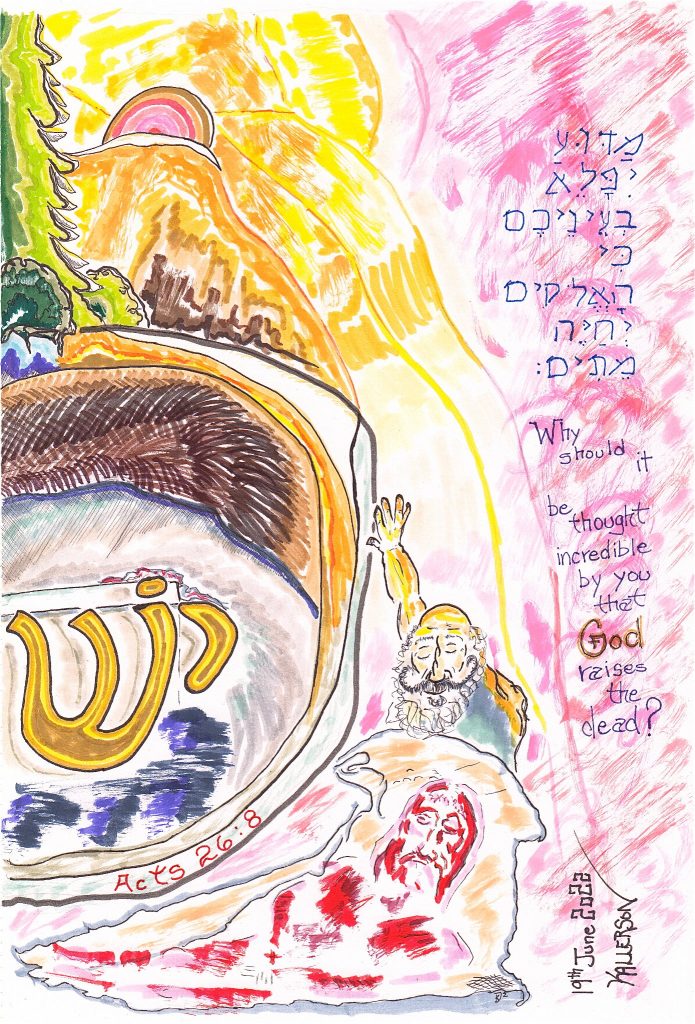
Why should it be thought incredible that God raises the dead? He raised Jesus in His perfection, and He will raise us in the perfection of Jesus. Believe, O King!
Closing Verse: “‘In an acceptable time I have heard you,
And in the day of salvation, I have helped you.’
Behold, now is the accepted time; behold, now is the day of salvation.” 2 Corinthians 6:2 (see Genesis 25:33 – “Swear to me as of this day”).
Next Week: Acts 26:9 Some won’t even utter this Name, even under their breath… (This Jesus of Nazareth)
The Lord has you exactly where He wants you. He has a good plan and purpose for you. But you must first believe by faith in what He has done. Once you do, then that plan can come about in you as it will in all of His redeemed. So, follow Him and trust Him and He will do marvelous things for you and through you.
Heaven’s Riches for a Meal (A Double Entendre)
When Rebekah’s days were fulfilled to give birth
Indeed there were twins in her womb
The first came out red, like the clay of the earth
He was hairy as a garment, like mohair, I presume
So they called his name Esau because like a man he was made
I wonder if those who saw him stood back and were dismayed?
After Esau his younger brother then came out
And his hand took hold of Esau’s heel
So his name was Jacob because with no doubt
He was a heel grabber and supplanting was his deal
When Rebekah bore them, Isaac was sixty years of age
And his life was now turning a brand-new page
So the boys grew and Esau was a skillful hunter
A man of the field was his type of life
But Jacob was a mild man and not a physical grunter
He dwelt in tents; instead of arrows he used a butter knife
And Isaac loved Esau because he ate of his game
But Rebekah loved Jacob and the man he became
Now Jacob cooked a stew
And Esau came in weary from the field
And Esau said to Jacob, “I’m famished through and through
Please feed me some of that red stew before my life I yield
Therefore Edom was called his name
Both his color and the color of the soup were the same
But Jacob said, “Sell me your birthright as of this day
And Esau said, “Look I’m about to die.”
So what is this birthright to me, tell me I pray?
Then Jacob said, Swear as of this day between you and I
So he swore to him and to Jacob he sold his birthright
And Jacob gave Esau bread and some lentil stew
Then he ate and drank, arose, and went out of sight
Thus, Esau despised his birthright; he told it “Adieu!”
Here we are pictured by these boys
And we have choices in this world to make
Will we pursue all the earthly toys?
Or will we give them up for heaven’s sake?
We can sell our birthright for that which perishes
Or we can sell it for the thing that God most cherishes
If we sell it for a bowl of soup that Adam did make
Then it is a sad choice that we have made
But if we sell it for the heavenly cake
Then by God above it was a glorious trade
Eat of the bread and drink of the blood
Of the Lord Jesus provided freely to all
And when you, do it shall be understood
That through this act Christ in you has reversed Adam’s fall
Great and glorious, splendid God above
Let us shout out to You with praises and love
Hallelujah and Amen…