Joshua 4:15-24
Twelve Stones – Part II
We have seen how the Jordan pictures the incarnation of Jesus. It reflects His life, coming from heaven, spending much time in Galilee, zigzagging throughout all of Israel, dying, resurrecting, and ascending again.
The passage today marvelously uses the Jordan, its cutting off, the actions of the priests with the ark, the leadership of Joshua, the stones from the river, and so much more to detail exactly what God is doing in Christ for the people of the world. We will go through the final verses of Chapter 4 and then analyze the entire chapter.
And all of this has a marvelous purpose. When God did what He did to Egypt, using the ten plagues served a special purpose. And then, in the final great act against them, He brought Israel through the Red Sea, luring Egypt in behind them. In His destruction of Egypt, we read this, which is our text verse for today –
Text Verse: “Thus Israel saw the great work which the Lord had done in Egypt; so the people feared the Lord, and believed the Lord and His servant Moses.” Exodus 14:31
As for Moses, his life was used as a steppingstone to bring Israel to another great event. The two crossings, through the Red Sea, and through the Jordan, beautifully reflect what the number two signifies in Scripture. Bullinger says that two “affirms that there is a difference – there is another.”
Moses stands for the law. The people’s passing through the Red Sea reflects the people’s being brought into the law. Joshua stands for the grace of Christ. The people’s passing through the Jordan reflects this occurring in the people.
The law is of works; grace is a gift. The two contrast, but they also confirm the work of God in Christ. Christ did the work of the law, and Christ bestows the gift of grace.
If you follow along carefully with the verses today, you will be able to weed out some real heresies that have arisen in the church. People go running down crazy avenues of theology in the New Testament, simply because they are unwilling to do the hard work and look at what God has already told us in the Old Testament.
If we carefully follow what is said here, so so so much of that can be alleviated. Thank you for sharing in these Old Testament passages with me. May you be blessed as we look into them today. Great things are to be found in His superior word. And so, let us turn to that precious word once again and… May God speak to us through His word today and may His glorious name ever be praised.
I. What Are These Stones? (verses 15-24)
15 Then the Lord spoke to Joshua, saying
It is letter for letter the same as the final clause of verse 4:1, saying, vayomer Yehovah el Yehoshua lemor – “and said Yehovah unto Yehoshua to say.” As noted then, the difference between said and spoke is small, but it carries with it the general sense of working together rather than simply speaking forth a command. Joshua is told to…
16 “Command the priests who bear the ark of the Testimony to come up from the Jordan.”
In the same manner that has already been seen several times in the early Joshua sermons, these words now have already been accomplished in verse 4:11, but the story is now going back to fill in the command that brought about the action there –
“Then it came to pass, when all the people had completely crossed over, that the ark of the Lord and the priests crossed over in the presence of the people.” Joshua 4:11
This then sets off the coming verses as their own independent section. This is the opening verse of that section. The Lord commands, Joshua’s obedience in conveying the command is recorded, and then the action is taken by those to whom the command is directed.
Here, instead of the ark of the Lord or the ark of the covenant, it is called aron ha’eduth, or “ark the testimony.” This is the only time in Joshua that it is called this. The word ed signifies a testimony or witness, coming from ud – to repeat or go around again. It is as a warning, something to be heeded. The symbolism here seems quite obvious; the warning has been heeded by the people. Next, and in immediate obedience to the word of the Lord, it says…
17 Joshua therefore commanded the priests, saying, “Come up from the Jordan.”
With the people fully passed over, the time for the priests to come out of where the water was stopped up has come. In typology, Joshua anticipates Christ, the Leader of His people. The priests are typical of Christ in His mediatorial role. The ark bearing the priests is typical of Christ the fulfillment of the law and the One who then died in fulfillment of it. The Jordan, the Descender, pictures Christ who descended from heaven to earth, and the waters picture the life within Him. With these things in mind…
18 And it came to pass, when the priests who bore the ark of the covenant of the Lord
v’hi ba’alot ha’kohanim nos’e aron berith Yehovah – “And it came to pass in the ascending the priests bearing ark covenant Yehovah.” The name of the ark now returns from the word eduth, or “testimony” to berith, or “covenant.” It is the “covenant of Yehovah.”
The main focus is on the priests who bear the ark. They are a single entity for all intents and purposes. As a whole the focus is on the covenant, meaning the Mosaic covenant. Together they…
18 (con’t) had come from the midst of the Jordan,
mitok ha’yarden – “from midst the Jordan.” The waters had stopped when the feet of the priests had been submerged in the water. The priests stood in that spot until all the people had passed through. Now, the priests have fully crossed and ascended, coming out of the riverbed where the waters had ceased…
18 (con’t) and the soles of the priests’ feet touched the dry land,
It is a heavily pregnant construction: nitequ kapoth ragle ha’kohanim el he’kharavah – “tore up soles feet the priests unto the dry ground.” The word for “tore up” is nathaq. It comes from a primitive root signifying to tear off. Most of its uses in the Old Testament are very forceful, like breaking something off, tearing off fetters, snapping ropes, and so on.
As a side note, and interestingly enough, even though this word in modern Hebrew is much more mellow and conveys the idea of “disconnection,” the three uses of it in the Hebrew NT perfectly match the normal uses of the ancient Hebrew. They are found in Luke 8:29, Acts 16:29, and Acts 27:32.
In this, we can see that in the action of the priests there is as a severing of what was. It is without a doubt that this is recorded history. The soles of the feet of the priests were in the spot where they had placed their feet in the water. The ground remained moist under their soles but dried around them. They had to forcefully pluck up their feet from the ground. In this, it is next seen…
18 (con’t) that the waters of the Jordan returned to their place
va’yashuvu me ha’yarden limqomam – “And returned waters the Jordan to their place.” The text of this verse implies that the waters were there at that moment. As before, the timing of the event wasn’t just “step out and then the waters come later.”
Instead: 1) the waters from very far away, up in Adam, released; 2) the people continued to cross through until the last one crossed; 3) the command from the Lord to Joshua was given; 4) the command from Joshua to the priests was given; 5) the priests tore their feet from the riverbed, and they came out of the Jordan, and (6) the waters were there at that moment.”
The plan of the Lord had started to be worked out with the waters releasing in Adam. It was fully realized the moment the priests stepped out of the bed and onto dry ground. The timing of the event was perfectly executed by the foreseen knowledge of the Lord, as is evidenced with the words…
18 (con’t) and overflowed all its banks as before.
va’yeleku kitmol shilshom al kal gadotav – “And went from yesterday day before yesterday upon all His banks.” The meaning is that just as it had previously flowed, so it returned to just as it was then. In these words, we should note the term “all His banks.”
19 Now the people came up from the Jordan
v’ha’am alu min ha’yarden – “And the people ascended from the Jordan.” The Jordan is the Descender. The words thus give the interesting sense of “The people ascended from the Descender.” This occurred…
19 (con’t) on the tenth day of the first month,
b’asor la’khodesh ha’rishon – “In tenth to the month the first.” This is the tenth day of the year 2555 Anno Mundi. It is a most incredible date, for two reasons. The first is that it is exactly forty years, to the day, from the time the Passover lamb was selected as noted in Exodus 12:3-6.
Secondly, the day is especially notable, based on a discovery that goes back to a study I did over fifteen years ago when looking for something completely different. This date is exactly fourteen thousand days, to the day, from the day the people departed Mount Sinai as is recorded in Numbers 10 –
“Now it came to pass on the twentieth day of the second month, in the second year, that the cloud was taken up from above the tabernacle of the Testimony. 12 And the children of Israel set out from the Wilderness of Sinai on their journeys; then the cloud settled down in the Wilderness of Paran. 13 So they started out for the first time according to the command of the Lord by the hand of Moses.” Numbers 10:11-13
The calculation is simple and uses the standard biblical day of a 360-day year –
Starting: 30 (the first month of second year) + 20 (of second month) + 360 (the first year) = day 410.
Finishing: 10 (of first month of forty first year) + (360×40 = 14400) (forty years) = day 14410.
Subtract: 14410 – 410 = 14000.
The perfection of the dating, unknown until around the year 2005 is telling us something. The number 14 is defined by Bullinger as –
“being a multiple of seven, partakes of its significance; and, being double that number, implies a double measure of spiritual perfection. The number two with which it is combined (2×7) may, however, bring its own significance into its meaning, as in Matthew 1, where the genealogy of Jesus Christ is divided up and given in sets of 14 (2×7) generations, two being the number associated with incarnation.” EW Bullinger
With this astonishingly precise figuring, a dating used even by rabbis in Israel today (now that it has been found), we have a picture of something that God has been carefully planning all along. With that seen, it next says…
19 (con’t) and they camped in Gilgal on the east border of Jericho.
va’yakhanu ba’gilgal biqtseh mizrakh yerikho – “And they camped in the Gilgal in extremity east Jericho.” Gilgal comes from the word gilgal, meaning a wheel. It thus means, A Circle, A Wheel, or, figuratively Liberty (as in a rolling away). The last meaning is derived from Joshua 5 –
“Then the Lord said to Joshua, ‘This day I have rolled away the reproach of Egypt from you.’ Therefore the name of the place is called Gilgal to this day.” Joshua 5:9
It is a marvelous picture that is being conveyed for us to consider…
20 And those twelve stones which they took out of the Jordan,
v’eth shetem esreh ha’avanim ha’eleh asher laqehu min ha’yarden – “and two ten the stones, the these, which they took from the Jordan.” These are the twelve stones the Lord instructed Joshua to have taken from where the priests stood. They are not the same ones set up at the spot where the priests stood. Of these…
20 (con’t) Joshua set up in Gilgal.
heqim Yehoshua ba’gilgal – “raised up Joshua in the Gilgal.” Joshua is said to have accomplished both the setting up of the stones in the midst of the Jordan as well as these now. After this…
21 Then he spoke to the children of Israel, saying:
va’yomer el bene Yisrael l’mor – “And said unto sons Israel to say.” It is Joshua who now speaks, after the setting up of the stones, as he addresses the “sons of Israel,” meaning the twelve tribes descended from Israel…
21 (con’t) “When your children ask their fathers in time to come, saying,
There is a stress in the words: asher yishalun benekhem makhar eth avotam l’mor – “When (certainly) ask your sons tomorrow their fathers to say.” It is with all certainty that the stones, which are to be erected in the Gilgal, will cause the children to ask of their fathers…
21 (con’t) ‘What are these stones?’
mah ha’avanim ha’eleh – “What the stones the these?” As noted in the previous sermon, stone signifies establishment, as in setting up a pillar to establish something. It signifies permanence in that which is established is set to stand firm. It signifies resiliency and strength, as in that which is fixed and unyielding. For the fathers, when asked by their children of these stones…
22 then you shall let your children know, saying, ‘Israel crossed over this Jordan on dry land’;
The stones were to be a perpetual reminder of the event that occurred. The entire nation, as one, passed through the Jordan ba’yabashah, or “in the dry ground.” It is the exact same expression used to describe the event of passing through the Red Sea on dry ground. And the reason for this being possible is…
23 for the Lord your God dried up the waters of the Jordan before you
asher hobish Yehovah elohekhem eth me ha’yarden mipenekhem – “which dried up Yehovah your God waters the Jordan from your presence.” Joshua notes that the waters of the Descender were dried up right before their faces…
23 (con’t) until you had crossed over,
The words are all in the plural as Joshua speaks. The nation as a whole crossed through, but the nation is comprised of all of the people. And all of the people had crossed through in the same manner…
23 (con’t) as the Lord your God did to the Red Sea, which He dried up before us until we had crossed over,
The words are carefully stated as Joshua includes himself in the narrative saying mipanenu, “from our presence,” and av’renu “our crossing through.” Just as had been the case with Israel and the crossing of yam suph, or “Sea the Ending,” so is the case with the people now. Moses led the people in the former, and Joshua now leads them in the latter. This is so…
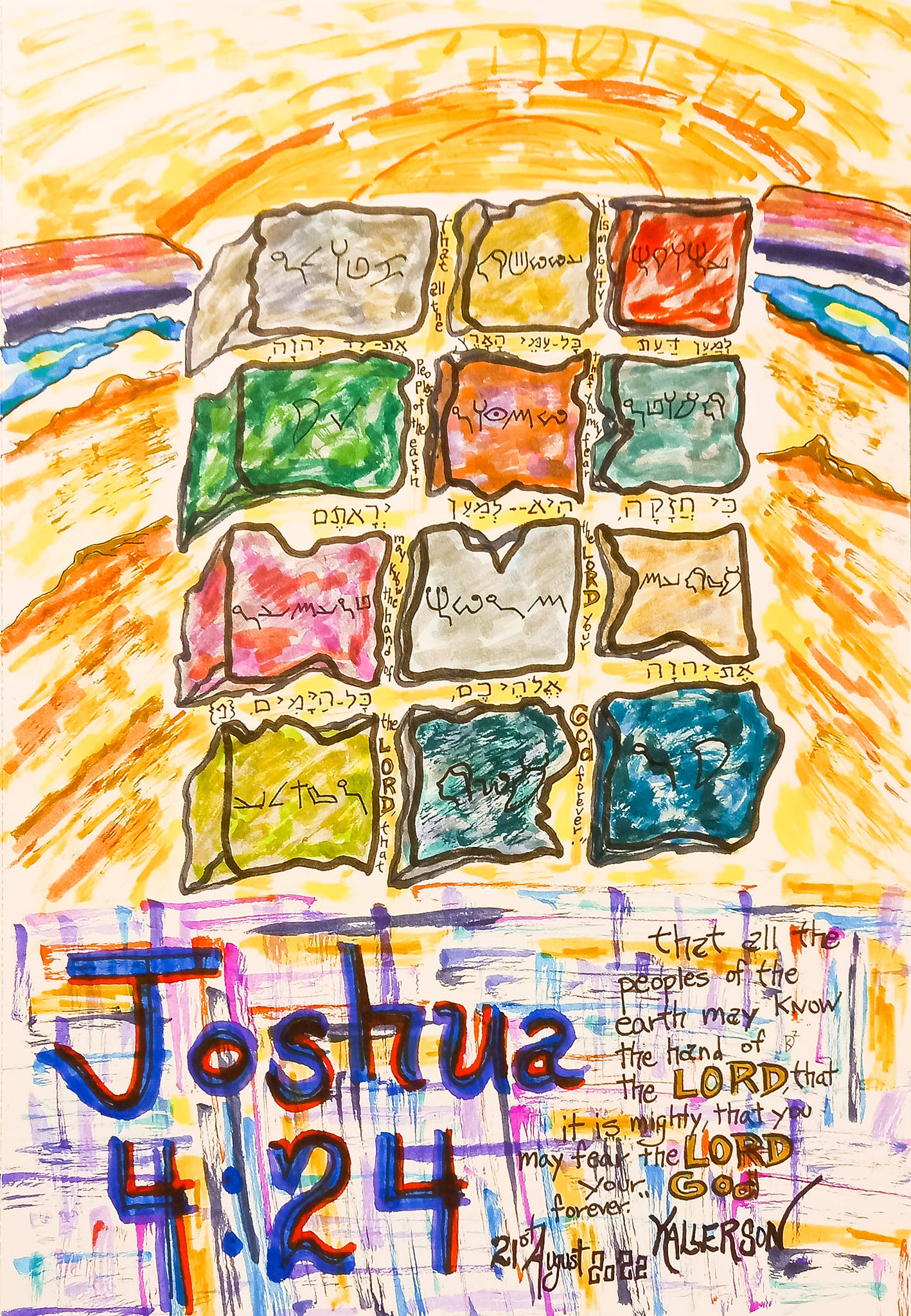
24 that all the peoples of the earth may know the hand of the Lord, that it is mighty,
The words bear an emphasis: l’maan daat kal ame ha’arets eth yad Yehovah ki hazaqah hi – “to end purpose may know all peoples the earth hand Yehovah for mighty IT.” This is the purpose of what took place. The word ha’arets can be translated as “the land,” and for Israel in Canaan, that is probably a better intent.
However, because this is given as typology of Christ, I rendered it “the earth” as in Genesis 1:1 because what is done by the Lord in Christ demonstrates the mighty hand of the Lord to all peoples of the earth. This is the ultimate intent of what is being pictured. And there is a personal purpose for Israel as well…
*24 (fin) that you may fear the Lord your God forever.”
l’maan yeratem eth Yehovah elohekhem kal ha’yamim – “to end purpose you have feared Yehovah your God all the days.” The idea of “fear” here is that of reverenced fear, not of being afraid. For Israel today and for much of the church as well, for example, there is no reverenced fear of the Lord.
But this is the end purpose of setting forth these twelve stones in Gilgal. It is so that they will be a witness to what the Lord has done so that the people will remember His works and reverence Him for all their days, meaning forever.
What are these stones for? Why are they there?
Are they just something someone raised up for fun?
What are they for? Should I care?
Who can I ask about what has been done?
Surely, these rocks were raised up with purpose and intent
They are a witness to what the Lord has done
They were taken from the Descender when the waters were spent
Like when the life ceased in God’s own Son
They have been raised up for all people to see
And those who understand will glory at what God has done
When the waters of the Descender were cut off completely
When the life left the Man from heaven, God’s own Son
II. Pictures of Christ
How does one describe what is going to happen to an entire nation that has been disobedient to the Lord for two thousand years when they finally do what they should have done before being exiled for their rejection of Jesus?
From Numbers 14 until now, the entire panorama of what has been seen has typologically anticipated Israel’s rejection of their Messiah, their exile into the wilderness (meaning, their second exile from the land after rejecting Him), their chance at individual salvation (such as in those who were bitten by snakes and looked to the serpent on the pole), their judgment under the law that Christ had fulfilled, the ending of the law for them as pictured by the death of Moses outside of the land of Canaan, their acceptance of Christ, their entering into the New Covenant, and their state of salvation once that occurs. All of this, and so much more, has been seen since Numbers 14.
This is the last step of that process, but it is not the last event of it. For example, in Joshua 5, the people will be circumcised. That is a part of what happens when the nation comes to Christ. Each account is a part of the greater story, and each conveys truths that will actually occur, in Israel’s future, whether they accept that now or not – which they obviously do not.
What is now being displayed is Israel’s national salvation, while also giving hints of other events that occur in and through the work of Jesus Christ. Joshua 3 already conveyed much of what was then repeated early in Joshua 4. However, in order to fill in more typology of Christ, parts of the account are repeated with different and additional information.
The first thing to remember is the symbolism of the Jordan. We saw this in Chapter 3. In fulfillment of the typology, Jesus Himself expressly tells us that He is what the Jordan pictures –
“For I have come down from heaven, not to do My own will, but the will of Him who sent Me.” John 6:38
Jesus said, “I have come down.” ha’yarden, the Jordan, means “the Descender.” Jesus is the Descender. In their crossing through the Jordan (the Descender, meaning Christ) the Lord tells Joshua, who then tells the people, to take for themselves twelve stones according to the tribes, one man from each tribe is to take a stone.
As noted in Joshua 3, the word “over” used by the NKJV is better translated as “through.” This is to fit the typology repeatedly used of faith in Christ in the New Testament –
“But now the righteousness of God apart from the law is revealed, being witnessed by the Law and the Prophets, 22 even the righteousness of God, through [dia] faith in Jesus Christ, to all and on all who believe.” Romans 3:21-22
As for the number twelve, it signifies “perfection of government, or of governmental perfection.” A governmental order is being represented by these twelve stones. Obviously, because these stones are according to each tribe of Israel, the order is a government set forth for the nation as a whole.
They are taken “from the midst of the Jordan,” meaning Christ Jesus – the Descender. The government is based upon the Person and work of Christ. That is clearly seen, for example, in Matthew –
“So Jesus said to them, ‘Assuredly I say to you, that in the regeneration, when the Son of Man sits on the throne of His glory, you who have followed Me will also sit on twelve thrones, judging the twelve tribes of Israel.’” Matthew 19:28
That is coming, but it is only coming when the nation comes to Christ. This is confirmed throughout both testaments and it is noted innumerable times. It is the finished work of Jesus under the law, and His death in fulfillment of it, symbolizing the cutting off of the waters, that makes this possible.
This is why the death of Moses occurs outside of Canaan. That death is now explained in the Joshua account, one story overlapping and building upon the next. The stones were taken from where the priests holding the ark stood, signifying the priestly duties accomplished by Christ in His death – all carefully explained in the book of Hebrews.
The word describing the cutting off of the waters, karath, is used when a covenant is cut. In this, the death of Jesus in fulfillment of the Law of Moses is seen (Moses dying outside of Israel) and then the cutting of a New Covenant is seen at the same time.
As we saw in verse 7, this explains the difference between “ark Yehovah your God” (Jesus, the embodiment of the law), and “ark covenant Yehovah” (the sacrifice of Christ). Verse 7 also gave us the symbolism saying, “in His crossing through the Jordan were cut off waters the Jordan.”
Jesus, the Man, had His life cut off from Him, symbolized by the cutting off of the waters. And yet, the deity of the Lord stood in the Jordan (the priests with the Ark – the presence of the Lord accepting His priestly work).
As I noted at that time (still verse 7), it doesn’t matter that the stones are lost to history. The written record means that the memorial of the stones still exists. As the stones represent the twelve tribes of Israel, it means that the same group of people who were exiled are the same group of people who are now – two thousand years later – regathered according to Scripture.
In other words, God is showing us that He has faithfully kept this group of people who rejected Jesus, just as He did in the forty years of punishment after they rejected the words of Joshua to enter the land (Numbers 14). That was typical of what we see, even today, with their continued disobedience. Someday, this people will come to Christ, and this typology will be fulfilled!
Of those stones that were selected, in verse 5 it said each was to be taken up on the shoulder of the man carrying it. These twelve tribes, under the authority of Christ, are pictured in this. As we saw, the shoulder signifies the place of bearing a burden, as in a yoke.
As such, it emblematically signifies authority and/or responsibility. It is the authority of their Messiah seen in Isaiah 9 that “the government will be upon His shoulder.” The burden of the government, and thus the responsibility for it, will be His.
The stone signifies 1) establishment, as in setting up a pillar to institute something; 2) permanence in that which is established: it stands firm; 3) resiliency and strength, as in that which is fixed and unyielding. That is also seen in Isaiah –
“Of the increase of His government and peace
There will be no end,
Upon the throne of David and over His kingdom,
To order it and establish it with judgment and justice
From that time forward, even forever.
The zeal of the Lord of hosts will perform this.” Isaiah 9:7
In verse 8, the stones representing the people of the twelve tribes were said to have been carried into Canaan by the twelve men and were laid down (yanakh, rested) at the place where they lodged. It is what was promised by Jesus in Matthew 11 and what is confirmed in Hebrews 4 –
“Come to Me, all you who labor and are heavy laden, and I will give you rest. 29 Take My yoke upon you and learn from Me, for I am gentle and lowly in heart, and you will find rest for your souls. 30 For My yoke is easy and My burden is light.” Matthew 11:28-30
“For we who have believed do enter that rest.” Hebrews 4:3
“For he who has entered His rest has himself also ceased from his works as God did from His.” Hebrews 4:10
In verse 9, something highly unusual occurred, however. It says that Joshua raised up twelve stones in the midst of the Jordan. Why would he do this? The answer is because national Israel is NOT the whole point and focus of Scripture. How many elders are around the throne in Revelation? Twenty-four.
This is another government being set up. It is one that takes another group of people into account. While Israel had rejected Christ, God didn’t just put things on hold; He continued on with the redemption of man. John the Baptist spoke of exactly this –
“Therefore bear fruits worthy of repentance, 9 and do not think to say to yourselves, ‘We have Abraham as our father.’ For I say to you that God is able to raise up children to Abraham from these stones.” Matthew 3:8, 9
He said this while baptizing “in the Jordan” (Matthew 3:6). But more, according to John 1:28, it is in this exact same location –
“These things were done in Bethabara beyond the Jordan, where John was baptizing.” John 1:28
Bethabara means “House of the Crossing.” It would have had this name based on what occurred here in Joshua 4. Whether the twelve stones that Joshua raised up were still visible at the time of John the Baptist or not is irrelevant; the account is recorded in Scripture, and the people would know exactly what he was referring to if they simply thought it through for one second.
An important point to consider is that this second set of stones is credited solely to Joshua having set them up, no one else is mentioned. The church is solely established by Jesus Christ, and it came out of His death in fulfillment of the Old and establishment of the New Covenant. And more it is set up even before Israel finishes crossing through the Jordan.
The second government set forth, and which is included in the twenty-four elders of Revelation, is that which the apostles proclaimed, and which was rejected by national Israel. And yet, it is the same gospel preached to both Jews and Gentiles by them.
As one can see in this, there is one – and only one – gospel. It is preached to Jew and Gentile alike today. But there is also another thing that God is doing. That is the keeping of, restoration of, and exaltation of the nation of Israel according to the promises made to the patriarchs (see Leviticus 26:42-45).
This is not a different gospel, but a different outworking that serves an entirely different purpose in redemptive history. The salvation of Israel the nation will occur in exactly the same way as the individual is saved today – all seen right here in Joshua 4.
The reason for raising up these stones “in the midst of the Jordan” (verse 9) is obvious. When the waters returned, the people who are symbolized by these stones (both Jew and Gentile) would be “in Christ” (the Descender) –
“For as we have many members in one body, but all the members do not have the same function, 5 so we, being many, are one body in Christ, and individually members of one another.” Romans 12:4, 5
Those stones were raised up in the exact spot that the priests and ark were standing (takhat – under, meaning “in place of”). They signify the government of Christ over the church – comprised of both Jews and Gentiles who have come to Him during this dispensation.
This is “in place of” the law of Moses, signified by the ark of the covenant. Christ’s priestly role established the New Covenant and set aside (replaced) the Old –
“For on the one hand there is an annulling of the former commandment because of its weakness and unprofitableness, 19 for the law made nothing perfect; on the other hand, there is the bringing in of a better hope, through which we draw near to God.” Hebrews 7:18, 19 (and etc.)
The words “and they are there to this day” (verse 9) clearly indicate the permanence of what took place. As for where this was, I gave several options in the last sermon. I would argue that it was on the other side of the Jordan, exactly where the priests first placed their feet, not in the middle of the river.
The main reason is that they were clearly visible to the people after the Jordan once again filled. But more, the text says nothing of the priests moving once their feet were planted. Therefore, it seems likely that they were set up on the other shore where the banks overflowed, but not enough to cover them.
Next, verse 10 said that the priests with the ark stood there until all was tamam, or finished. The waters were finished (Christ’s death). The nation finished crossing (salvation of national Israel). And “everything was finished … according to all that Moses has commanded Joshua” (verse 10).
The law of Moses, meaning the command and the charge for Christ Jesus in His earthly life, was finished. The New Covenant was introduced, and only after all of this do the waters return. This is why Hebrews 8:13 says –
“In that He says, ‘A new covenant,’ He has made the first obsolete. Now what is becoming obsolete and growing old is ready to vanish away.”
Christ’s work is complete, the New Covenant is introduced, but national Israel has not yet accepted it. Until they do, the Old is only “ready to vanish away.” Coming soon to a tribulation period and entry into the millennium near you.
Verse 11 noted the alacrity with which Israel crossed through. Once they realize who Jesus is, there will be a national rush to accept Him, and thus “all Israel will be saved.” It is reflective of Paul’s words in 2 Corinthians 6:2 –
“For He says:
‘In an acceptable time I have heard you,
And in the day of salvation I have helped you.’
Behold, now is the accepted time; behold, now is the day of salvation.”
Only after the nation crosses through does the aron Yehovah, the ark of Yehovah, Jesus, the God/Man, then cross through. In type, this reveals that only in the acceptance of Jesus as their Messiah will He finally appear before them –
“O Jerusalem, Jerusalem, the one who kills the prophets and stones those who are sent to her! How often I wanted to gather your children together, as a hen gathers her chicks under her wings, but you were not willing! 38 See! Your house is left to you desolate; 39 for I say to you, you shall see Me no more till you say, ‘Blessed is He who comes in the name of the Lord!’” Mathew 23:37-39
The symbolism of reintroducing Reuben, Gad, and the half tribe of Manasseh is more difficult to pin down, but I would guess that these are typical of those who are of Israel, but who remain outside of the promise – meaning those who are not in the land when Jesus returns, and of those who are born in the land after Israel’s acceptance of their Messiah.
Not all from these three tribes crossed through, and thus they reflect those who must later choose to believe or not, and there are those who will not believe, even in the millennium as several verses reveal, such as Isaiah 65:20.
With the crossing through recorded as complete in verse 14, it said of Joshua that “they feared him, as they had feared Moses.” Understanding that Joshua is typical of Christ, we noted the four causes previously mentioned to reflect this. Here that is again –
The priests bearing the ark are the material cause (Christ’s priestly/sacrificial role in His Person). Their entry into the Jordan (His cross) is what makes the thing (like wood in a table) to be. The formal cause, the design, is the parting of the Jordan (His death). The efficient cause, what brings it about, is the Lord’s presence working on behalf of Jesus. And the final cause, the purpose, is the exaltation of Jesus in the eyes of the people.
With that complete through verse 14 last week, the account then went back in time starting in our verses today where the priests and the ark were still in the Jordan. The Lord told Joshua to command the priests who bore the aron ha’eduth, the ark of the Testimony (the law of Moses) to come up from the Jordan.
It is the command for Christ’s resurrection. He has been found worthy under the law according to Leviticus 18:5, “You shall therefore keep My statutes and My judgments, which if a man does, he shall live by them: I am the Lord.”
The people have realized that Christ is the fulfillment of the law, and they have entered into Him, crossing through Him in His death, burial, and resurrection. Joshua is typical of Christ, the Leader of His people. The priests are typical of Christ in His mediatorial role. The ark borne by the priests is typical of Christ the fulfillment of the law and the One who then died in fulfillment of it. The Jordan, the Descender, pictures Christ who descended from heaven to earth, and the waters picture the life within Him.
As soon as the note about the ark of the testimony was said, it immediately returned to aron berith Yehovah, the ark of the Covenant of Yehovah. Christ is the embodiment and fulfillment of the Old, and He is the Initiator of the New. The use of the forceful word nathaq, tore up, concerning the feet of the priests gives us a marvelous picture of Christ’s work.
He was there, cut off and without life, symbolized by the priests with the ark standing there. His sacrificial death brought about the sudden and abrupt ending of the law. With the sacrificial work complete, the veil was torn, and the law was ended. Israel has accepted this, and they are now included in what Christ has done –
“Those who sat in darkness and in the shadow of death,
Bound in affliction and irons—
11 Because they rebelled against the words of God,
And despised the counsel of the Most High,
12 Therefore He brought down their heart with labor;
They fell down, and there was none to help.
13 Then they cried out to the Lord in their trouble,
And He saved them out of their distresses.
14 He brought them out of darkness and the shadow of death,
And broke their chains in pieces. [nathaq]
15 Oh, that men would give thanks to the Lord for His goodness,
And for His wonderful works to the children of men!
16 For He has broken the gates of bronze,
And cut the bars of iron in two.” Psalm 107:10-16
With this complete, it says “that the waters of the Jordan returned to their place” (verse 18). Israel has been saved through the work of Christ! The promises to the nation have been fulfilled in their acceptance of Jesus, and the Jordan, the Descender, Jesus Christ “overflowed all His banks as before.”
Remember that as long as the priests with the ark stood there, it was as if the waters never stopped, except in Jesus. In other words, the typology is showing us that these people are being baptized into the death of Jesus, just as they once were baptized into Moses. The words of Paul clearly show this –
“Moreover, brethren, I do not want you to be unaware that all our fathers were under the cloud, all passed through the sea, 2 all were baptized into Moses in the cloud and in the sea, 3 all ate the same spiritual food, 4 and all drank the same spiritual drink. For they drank of that spiritual Rock that followed them, and that Rock was Christ. 5 But with most of them God was not well pleased, for their bodies were scattered in the wilderness.” 1 Corinthians 10:1-5
This is exactly what has been seen since Numbers 14. The law could not save them except as it is fulfilled by Christ –
“Or do you not know that as many of us as were baptized into Christ Jesus were baptized into His death? 4 Therefore we were buried with Him through baptism into death, that just as Christ was raised from the dead by the glory of the Father, even so we also should walk in newness of life.” Romans 6:3, 4
With this noted, it next gave the dating of when the events took place. It was exactly, to the day, forty years after the Passover lamb was selected (see 1 Peter 1:19) on the first Passover. On this day, the people “ascended” from the Jordan, meaning they were spiritually raised in Christ (Ephesians 2:6).
Bullinger notes that forty is the number of probation, trial and chastisement of a covenant people. It is the product of 5 and 8, and points to the action of grace (5), leading to and ending in revival and renewal (8).
From the presentation of Jesus as Israel’s true Passover Lamb (1 Corinthians 5:7), until their acceptance of Him, they have gone through the exact process and care by the Lord for them as is defined by Bullinger. But more, it was also 14,000 days, to the day, from their departure from Sinai, signifying life under the law.
Bullinger’s definition of fourteen perfectly describes their state –
“being a multiple of seven, partakes of its significance; and, being double that number, implies a double measure of spiritual perfection. The number two with which it is combined (2×7) may, however, bring its own significance into its meaning, as in Matthew 1, where the genealogy of Jesus Christ is divided up and given in sets of 14 (2×7) generations, two being the number associated with incarnation.” EW Bullinger
In accepting Christ Jesus in His incarnation (the God/Man), they will have a double measure of spiritual perfection. They will be both individually and nationally saved in Christ.
From there, it noted that the people camped in Gilgal (Rolling Away/Liberty) on the east border of Jericho (Place of Fragrance/Paradise Restored). Where were the cherubim placed in the Garden? At the east of the garden of Eden (Genesis 3:24). Because of the work of Christ, the people of Israel will come to that spot of Liberty at the door of Paradise that has been anticipated since the fall of man.
There in Gilgal, Joshua set up the twelve stones, just as he did in the Jordan. Christ is the one to set up the government. This one is for national Israel during the millennium, and which is incorporated with the government of the church to form the heavenly government described by Bullinger –
“Twenty four being a multiple of twelve, expresses in a higher form the same signification. It is the number associated with the heavenly government and worship, of which the earthly form in Israel was only a copy.”
The final verses of the chapter spoke of the reason for the setting up of the stones. They point to Christ in His many roles seen in this passage. They are a memorial of what He would do and now of what He has done. And all of it was said to be so “that all the peoples of the earth may know the hand of the LORD, that it is mighty.”
As our text verse noted, “Israel saw the great work which the LORD had done in Egypt; so the people feared the LORD, and believed the LORD and His servant Moses.” Those deeds included the crossing of the Red Sea and the destruction of Egypt.
With the events of Joshua 3 and 4, the Lord has exalted his new leader, Joshua (verse 3:7). Joshua is a type of Christ, and it is Christ Jesus whom God has exalted to the highest degree because He is the Lord God Almighty.
The twelve stones, times two piles, were to be a witness to Israel concerning the great acts of the Lord. The first ones collected were explicitly stated to be taken, one for each tribe of the nation of Israel. The second ones were actually raised up first by Joshua though. Weren’t they?
Those were then explicitly stated by John the Baptist to reflect something entirely different, and a completely different outworking of the Lord. The one chosen first was set up last, but they were, in fact, set up. God will remember His covenant with Israel, and they will receive the promises made to them in Scripture.
And yet, the process of salvation was identical for both, even if they occur in a separate way. Those of the church (individually and collectively) and those of national Israel (individually and collectively) all have to come through the same single gospel which is the death, burial, and resurrection of Jesus Christ.
This applies to each member of the church, and each member of Israel. And this applies in the same manner collectively to the church (the rapture) and to the nation of Israel (the Second Coming). Joshua 3 and 4, when properly analyzed, clear up a lot (a lotta lot) of bad theology through simple typology.
If you are stuck in replacement theology, the typology clears that up. If you are stuck in a return to the law (such as Hebrew Roots), it clears that up. If you are deceived by hyperdispensationalism, it clears that up too. I could go on with lots of points of really bad doctrine, or even heresy, concerning what this passage clears up, but I will – instead – implore you to keep reviewing our sermons and our weekly Bible studies.
We do our best to cover all such things from time to time. Joshua 3 and 4 just put them all into a simple, easy to swallow, power pack. What a wonderful thing God has done in these precious pages. And it is all centered on one thing: the Person and work of Jesus Christ.
I would ask you to consider the simple gospel today and yield your life to Him. It is beyond comprehension that these patterns simply occurred by chance. The details are too perfect, the pictures are too exacting. Call on Jesus and be a part of what He is doing in human history to redeem the sons of man. Yes, please call on Him today!
Closing Verse: “Therefore God also has highly exalted Him and given Him the name which is above every name, 10 that at the name of Jesus every knee should bow, of those in heaven, and of those on earth, and of those under the earth, 11 and that every tongue should confess that Jesus Christ is Lord, to the glory of God the Father.” Philippians 2:9-11
Next Week: Joshua 5:1-9 Off it will be stripped, yes, it shall be done… (The Reproach of Egypt, Part I) (9th Joshua Sermon)
The Lord has you exactly where He wants you. He has a good plan and purpose for you. It is He who has defeated the enemy and who now offers His people rest. So, follow Him and trust Him and He will do marvelous things for you and through you.
Twelve Stones, Part II
Then the LORD spoke to Joshua, saying
These words to him He was relaying:
“Command the priests who bear the ark of the Testimony
To come up from the Jordan, so I say
Joshua therefore commanded the priests, saying
“Come up from the Jordan, he did relay
And it came to pass
When the priests who bore the ark of the covenant of the LORD
Had come from the midst of the Jordan
And the soles of the priests’ feet touched the dry land
———-according to the word
That the waters of the Jordan returned to their place once more
And overflowed all its banks as before
Now the people came up from the Jordan
On the tenth day of the first month as we now know
And they camped in Gilgal
On the east border of Jericho
And those twelve stones which they out of the Jordan took
Joshua set up in Gilgal as is now recorded in the Joshua book
Then he spoke to the children of Israel, saying
“When your children ask their fathers in time to come, saying
‘What are these stones?
Then you shall let your children know, saying
———-Yes, you shall be conveying…
‘Israel crossed over this Jordan on dry land
For the LORD your God dried up the waters
———-of the Jordan before you
Until you had crossed over
As He promised, So the Lord did do
As the LORD your God did to the Red Sea
Which He dried up before us until we had crossed over
———-(here comes a rhyme so clever)
That all the peoples of the earth may know the hand of the LORD
That it is mighty, that you may fear the LORD your God forever
Lord God, turn our hearts to be obedient to Your word
Give us wisdom to be ever faithful to You
May we carefully heed each thing we have heard
Yes, Lord God may our hearts be faithful and true
And we shall be content and satisfied in You alone
We will follow You as we sing our songs of praise
Hallelujah to You; to us Your path You have shown
Hallelujah we shall sing to You for all of our days
Hallelujah and Amen…
15 Then the Lord spoke to Joshua, saying, 16 “Command the priests who bear the ark of the Testimony to come up from the Jordan.” 17 Joshua therefore commanded the priests, saying, “Come up from the Jordan.” 18 And it came to pass, when the priests who bore the ark of the covenant of the Lord had come from the midst of the Jordan, and the soles of the priests’ feet touched the dry land, that the waters of the Jordan returned to their place and overflowed all its banks as before.
19 Now the people came up from the Jordan on the tenth day of the first month, and they camped in Gilgal on the east border of Jericho. 20 And those twelve stones which they took out of the Jordan, Joshua set up in Gilgal. 21 Then he spoke to the children of Israel, saying: “When your children ask their fathers in time to come, saying, ‘What are these stones?’ 22 then you shall let your children know, saying, ‘Israel crossed over this Jordan on dry land’; 23 for the Lord your God dried up the waters of the Jordan before you until you had crossed over, as the Lord your God did to the Red Sea, which He dried up before us until we had crossed over, 24 that all the peoples of the earth may know the hand of the Lord, that it is mighty, that you may fear the Lord your God forever.”