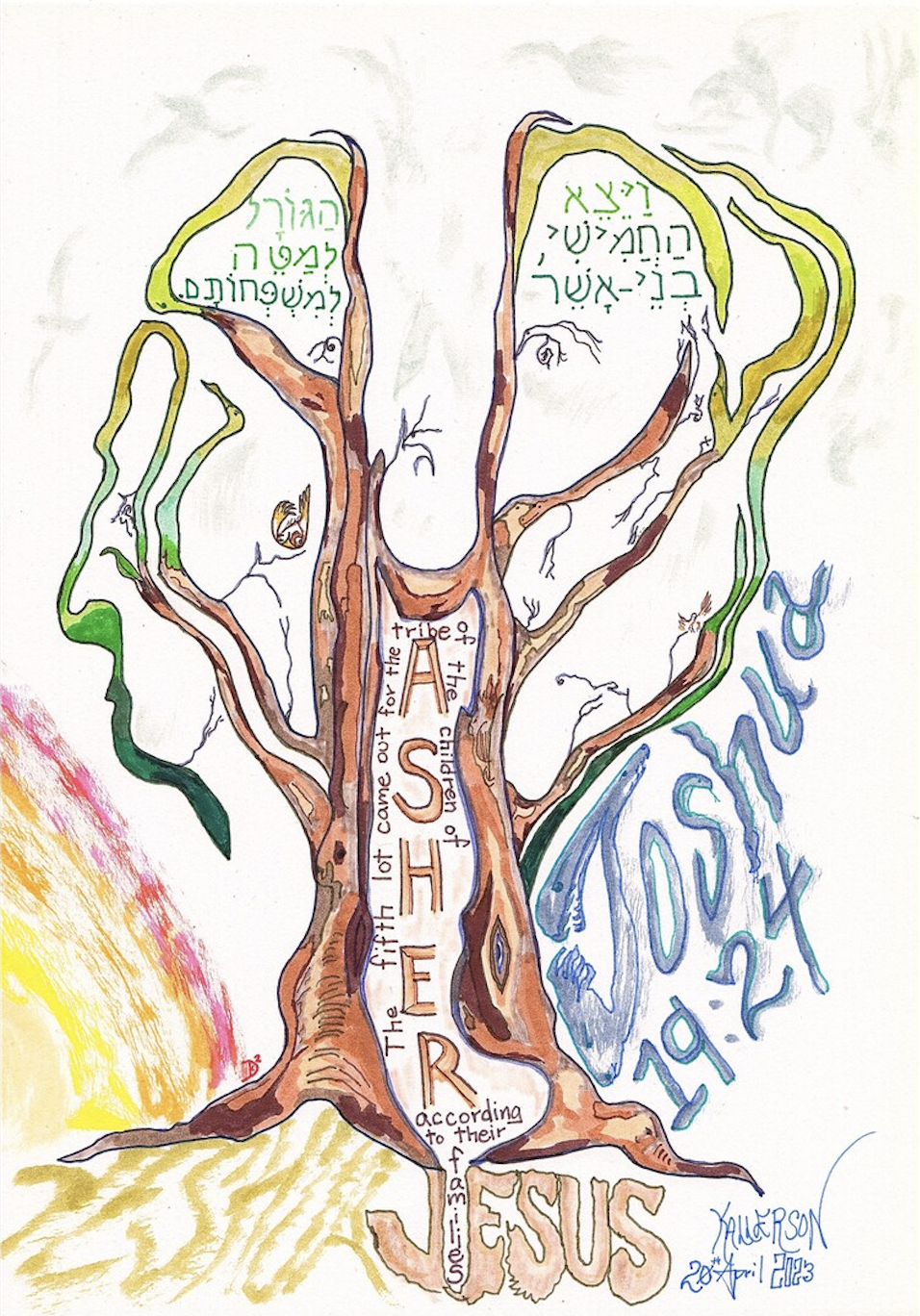
Artwork by Douglas Kallerson
Joshua 19:24-31
The Inheritance of Asher
It’s always exciting for me to have those little events in life crop up that seem coincidental, but which never are. Quite often Jim will open the church and he’ll talk about something that will, without advanced planning, be exactly what is referred to in the sermon.
At times, one of the psalms that is read in church will be referred to in the sermon. That is never planned because the sermons are typed well in advance and I never really know what psalm will be read on Sunday morning, simply because we skip one once in a while, or we forget to read one, or whatever.
And yet, the exact psalm that is there to open the service will read right into the content of the sermon. Similarly, there are many times when I will be doing my morning Bible reading, and I find myself reading exactly what I need for sermon typing that Monday.
That happened on the day I typed this sermon. I read the first few chapters of Micah that morning and then got started. About six hours into sermon typing, I realized that both passages use the name Achzib.
The name is found in Joshua 19:29 and in Micah 1:14. Considering that name is only found four times in the Bible, that was a fun surprise for me. Little God winks like that always make me glad I read the Bible every day. So, how many chapters did you read this morning?
Text Verse: “Kiss the Chosen One, lest He be angry, And ye lose the way, When His anger burneth but a little, O the happiness of all trusting in Him!” Psalm 2:12 (YLT)
The word esher, or happiness comes from ashar, blessed or happy. This is the word used by Leah when Asher was born. What is it that brings happiness? What is it that will bring eternal happiness? Unfortunately, too many in the church wrongly equate the two kinds of happiness. “This makes me happy and so this will be what God will provide for eternal happiness.”
With this kind of thinking, every possible perversion one can name has crept into the church. We take our corrupt view on happiness, such as sexual sin, decide that God accepts this, and then anticipate that for all of eternity we will be able to indulge in sexual sin.
If you think this is crazy, just look at what is taught in almost every mainstream church on the planet. This isn’t happiness. It is moral corruption and wickedness. It will not lead to eternal bliss. For those poor, deluded fools, it will bring eternal condemnation as God’s wrath is poured out on them.
What makes me happy? One thing is driving to church for Bible study or Sunday gathering and the very passage that is playing on the audio Bible as I drive is a part of what is in the material to be presented in the next couple of hours. Man, I get the biggest kick out of that.
Puppies make me happy too.
There are some contrasts set forth for us in today’s passage. First, we will evaluate the content for what it all means, and then we will see how it all fits in typologically with something we all experience in our lives in Christ.
Great things are to be found in His superior word. And so, let us turn to that precious word once again, and… May God speak to us through His word today, and may His glorious name ever be praised.
I. The Fifth Lot (verses 24-31)
The narrative continues as it details the final seven tribal land inheritances that are being assigned according to the lot. The first was to Benjamin. The second was to Simeon. The third went to Zebulun. The fourth went to Issachar. The fifth is now designated and detailed for the tribe of Asher…
24 The fifth lot came out for the tribe of the children of Asher according to their families.
Asher was Jacob’s eighth son and the second son of Leah’s maidservant Zilpah. The lot drawn for him comes after Zebulun and Issachar, despite them being born later. This is because the sons of the maidservants are detailed after those of Jacob’s wives, Leah and Rachel. The record of his birth is found in Genesis 30 –
“When Leah saw that she had stopped bearing, she took Zilpah her maid and gave her to Jacob as wife. 10 And Leah’s maid Zilpah bore Jacob a son. 11 Then Leah said, ‘A troop comes!’ So she called his name Gad. 12 And Leah’s maid Zilpah bore Jacob a second son. 13 Then Leah said, ‘I am happy, for the daughters will call me blessed.’ So she called his name Asher.” Genesis 30:9-13
In her exclamation, Leah makes a pun on the noun osher (happiness) and the verb ashar (blessed), saying, b’asheri ki ish’runi banoth – “I am in happiness for will call me blessed, daughters.” As such the name means Happy but it also means Blessed.
On the march from Sinai to Canaan, Dan, Asher, and Naphtali were stationed north of the tabernacle under the standard of Dan. In the order of marching, this was the final standard to break camp and move.
It is interesting that the youngest son of each handmaid, Asher and Naphtali, are paired next to each other in the most northern area of Canaan in the tribal land grants. Asher will be in the most northwestern area of the land, along the Mediterranean Sea. Cambridge describes it, saying –
“The general position of the tribe was on the slope of the Galilean mountains from Carmel northwards, with Manasseh on the south, Zebulun and Issachar on the south-east, and Naphtali on the north-east, a narrow, but beautiful and fertile region.” Cambridge
With that, the description begins by stating…
25 And their territory included Helkath, Hali, Beten, Achshaph,
As is usual, the NKJV destroys the earlier correct translation of the KJV when such lists are made, leaving out the conjunctions between each name: v’hi gevulam khelqath va’khali, va’veten, v’akhshaph – “And was their border Helkath, and Hali, and Beten, and Achshaph.
What is described begins with the central part of the territory. It goes to the south in verses 26 and 27 and then to the north in verses 28 and 30.
Khelqath comes from the verb khalaq, to divide or share, or from the noun khelqah, a parcel or portion. Hence, it is variously translated as Division, Portion, Field, or Possession. Strong’s, however, takes a figurative meaning of the word khelqah and calls it Smoothness.This is derived from the description of Jacob’s skin in Genesis 27 –
“Then Rebekah took the choice clothes of her elder son Esau, which were with her in the house, and put them on Jacob her younger son. 16 And she put the skins of the kids of the goats on his hands and on the smooth part [khelaqh] of his neck. 17 Then she gave the savory food and the bread, which she had prepared, into the hand of her son Jacob.” Genesis 27:15-17
Using this figurative sense, the word is also used to describe the smooth tongue. Thus, a figurative meaning could be Flattery.
Khali comes from the noun khali, an ornament or jewel. That, however, comes from khalah, which signifies to be rubbed or worn (as when a jewel is polished). Figuratively, that word means weak or sick as well as to stroke, as in flattery. A second root is khalal, to pierce. Thus, it is translated as Jewel, Ornament, Polished, Pierced Thing, Pierced, etc.
Beten comes from beten, the belly or womb. Thus it means Belly or Womb. However, the NAS Concordance looks at it as Depression, taking it as a depression in the terrain that looks like a belly.
Achshaph was seen in Chapter 11. It is possibly from kashaph, meaning to practice sorcery. Hence, it signifies Fascination or Bewitched. Next…
26 Alammelech, Amad, and Mishal;
Alammelech comes from alah, an oak, or from alah, an oath. The second half is from melekh, king. Thus, it is Oak of the/a King or Oath of the/a King.
Amad is said by Strong’s to come from am, people, and ad, time (meaning perpetuity/eternal). Thus it is People of Time.
Mishal is from shaal, to ask or inquire. Strong’s defines it as Request.
26 (con’t) it reached to Mount Carmel westward, along the Brook Shihor Libnath.
u-phaga b’karmel ha’yamah u-b’shikhor livnath – “And impinged in Carmel, the westward (or seaward as in Jeremiah 46:18), and in Shihor Libnath.”
Carmel means Plantation, Orchard, or Fruitful Field (Plentiful Place). Clarke calls it Vineyard of God.
Shikhor Livnath comes from two words obviously intended to avoid any hint of racism (or not) shakhar, to be black, and laven, to be white. Having said that, the noun shakhar means dawn and the verb shakhar means to seek early or diligently.
Thus, the meaning of the city’s name could have an amazing number of possibilities including Black-White, Dark Side of the Moon, or Lunar Eclipse. To throw in another monkey wrench, the thought of laven, or white, has consistently referred to works since early Genesis.
This is because laven also means brick because bricks whiten when they are fired. Bricks imply human labor and thus works. Therefore, for typology, the city could be translated as Blackened Works, Early Works, or Diligently Seeking Works, etc.
27 It turned toward the sunrise to Beth Dagon;
v’shav mizrakh ha’shemesh beith dagon – “And turned rising the sun, Beth Dagon.” Beith means House. Dagon comes from dag, fish, but as much as anything, fish signify abundance.
Hence the word daga means to multiply or increase and dagan refers to cereal crops in general, thus natural abundance. Therefore, Beth Dagon can mean House of Dagon (the god), House of Fish, House of Increase, or House of Cultivation of Natural Abundance.
27 (con’t) and it reached to Zebulun and to the Valley of Jiphthah El,
Zebulun means Glorious Dwelling Place.
The valley, ge, comes from gevah, pride, which in turn comes from gaah, rise up, high, etc. This means the sides of the valley rise up, forming the valley.
Yiphtakh means He Will Open. Taken together with El, or God, the name means God Will Open or God Opens. Ellicott defines it as God’s Opening. They all carry the same general meaning.
27 (con’t) then northward beyond Beth Emek and Neiel, bypassing Cabul which was on the left,
The word “bypassing” is entirely incorrect: tsaphonah beith ha’emeq un’iel v’yatsa el kavul mis’mol – “northward Beth the Emek and Neiel and went out unto Cabul from left.”
As for Beth Emek, beith means House and emeq means Valley, but that comes from amoq, to be deep. Thus, it is House of the Valley or House of the Depth.
Neiel means something like Moved of God or Scattered of God, although some say it is Dwelling Place of God.
Cabul comes from kevel, a fetter. Thus it signifies a limitation. Therefore, Strong’s defines it as Sterile. Others define it as Good for Nothing. The same name, but regarding a different area, is seen again in 1 Kings 9 –
“Then Hiram went from Tyre to see the cities which Solomon had given him, but they did not please him. 13 So he said, ‘What kind of cities are these which you have given me, my brother?’ And he called them the land of Cabul, as they are to this day. 14 Then Hiram sent the king one hundred and twenty talents of gold.” 1 Kings 9:12-14
In this passage from 1 Kings, Keil ties it to the root חבל (khevel), which would give the meaning Pawned or Pledged. Hence he concludes that this strip of territory was merely given to Hiram as a security for the repayment of a loan. That would make sense based on the note about the gold. However, this thought would take us back to the original word, fetter. Hiram may have felt chained to the land based upon the money sent. Thus, it may simply mean Fettered.
28 including Ebron, Rehob, Hammon, and Kanah, as far as Greater Sidon.
Ebron is from the verb avar, to pass over, or the noun ever, the region beyond. Thus it is Beyond, Passing, or Passage. Strong’s defines it as Transitional.
Rekhov means Wide Space or Open Place.
Khamon comes from khamam, to be or become warm. Thus, it is Warmed, Hot, Glowing, or maybe Hot Spring.
Qanah comes from qanah, to get, or acquire. That is the root of qaneh, a reed because a reed is used as a measuring device. Thus, it can mean Reed, Possessed, or Possessor. Church historian Jerome says that this is identified as Cana where Jesus performed his first miracle because this Cana, rather than another one, was in Asher. It is in the upper Galilee rather than the lower Galilee.
Tsidon Rabah (Greater Sidon) means Great Hunting Place or Great Fishery.
29 And the border turned to Ramah and to the fortified city of Tyre;
v’shav ha’gevul ha’ramah v’ad ir mivtsar tsor – “And turned the border the Ramah and until city fortified, Tsor.” This is probably not speaking of Tyre at all. It is generally agreed that it wasn’t until later that Tyre became a noted location. Rather, this could be a fortified city known as Tsor, the same name later given to what we today translate as Tyre.
The Ramah means The Height or The Lofty Place.
Tsor (Tyre) comes from tsor, flint, or tsur, rock. Thus, it is the fortified city, Rock.
29 (con’t) then the border turned to Hosah, and ended at the sea by the region of Achzib.
v’shav ha’gevul khosah v’yihyu tots’otav ha’yamah me’khevel akhzivah – “And turned the border Hosah and were outgoings the sea from cord Achzib.” The meaning of “cord” is that which is marked off, and thus an area or region.
Khosah comes from khasah, to seek refuge. Thus, it means Seeking Refuge or simply Refuge. Strong’s goes with the intent of what the act of seeking refuge is and translates it as Hopeful.
Akhziv comes from akhzav, deceptive or disappointing. That comes from kazav, to be a liar. Thus, it literally means Lying or Liar, but the intent is probably Deceptive or Disappointing.
Micah will use the name in a word play he makes on the names of cites in Israel. There he says, “The houses of Achzib [akhziv] to lie [l’akhsav] to the kings of Israel” (Micah 1:14). The idea is that what appears useful turns out to be completely disappointing.
30 Also Ummah, Aphek, and Rehob were included:
It would be nice if they just translated as it is given: v’umah va’apheq, u-rekhov – “And Ummah, and Aphek, and Rehob.”
Ummah comes from ummah, a word signifying close against, beside, next to, corresponding to, and so on. That comes from im, with. Thus it means Association or Union.
Apheq comes from aphaq, meaning to contain, refrain, or be strong. Hence, it is Fortress.
As before, Rekhov means Wide Space or Open Place.
30 (con’t) twenty-two cities with their villages.
The number obviously doesn’t match the named cities, but there are, as always, various explanations for this. There may be joint border cities, names used as references of where the border goes to, some cities may be collocated and thus be one city with a joint name, and so forth.
What is of note isn’t that, but the meaning of the number itself –
“Twenty-two, being the double of eleven, has the significance of that number in an intensified form,—disorganization and disintegration, especially in connection with the Word of God. For the number two is associated with the second person of the Godhead, the living Word. It is associated with the worst of Israel’s kings,—Jeroboam (1 Kings 14:20), and Ahab (1 Kings 16:29), each reigning 22 years. Eleven, we have seen, derives its significance by being an addition to Divine order (10), and a subtraction from Divine rule (12). These are two of the three ways in which the written Word of God can be corrupted—the third being alteration. ‘The words of the LORD are pure words’—words pertaining to this world and therefore requiring to be purified (see p. 169). But these words have been altered, taken from, and added to by man. Is there anything in this which connects it with the fact that the letters of the alphabet (Hebrew) are twenty-two in number? Does it point to the fact that the revelation of God in being committed to human language and to man’s keeping would thereby be subject to disintegration and corruption?” Bullinger
*31 (fin) This was the inheritance of the tribe of the children of Asher according to their families, these cities with their villages.
zoth nakhalath mateh bene asher l’misp’hotam he’arim v’khatsrehen – “This inheritance tribe Asher to their families, their cities and their villages.” With this, the cities of Asher, along with some of its borders, have been defined. What is the Lord telling us with all these names?
Happy are those who walk in the light of the Lord
Who are content to follow Him all their days
Happy are those who cherish His word
Learning it and applying it to all of their ways
Happy are those who do not stand in the path of sinners
Nor those who sit in the seat of the scornful
Such as these are life’s true winners
Such as are not will be eternally mournful
Follow the Lord and delight in His law always
Meditate on His word with all of your mind
You will stand in His presence for eternal days
This temporary, fallen world will forever be left behind
II. The Typology Explained
As was seen, there are said to be twenty-two cities within Asher. Even though that comes at the end of the verses, it provides the tone for the seemingly confused state of names contained within them.
Bullinger noted that “twenty-two, being the double of eleven, has the significance of that number in an intensified form,—disorganization and disintegration, especially in connection with the Word of God.” It is also “associated with the second person of the Godhead, the living Word.”
Concerning the word, through our actions and conduct, including teaching and instruction, we can add to the word, (legalism), or we can detract from the word (license). We can also alter the word (corruption). Each of these cause disorganization and disintegration of the word.
This is immediately seen in verse 25 with the naming of the cities. Helkath comes from a root meaning to divide or share, or one signifying a parcel or portion. They both give the sense of division.
Hali ultimately comes from a root signifying rubbed or worn. Strong’s notes that it includes the thought of stroking, as in flattery. Beten was then defined as Belly or Womb, and Achshaph as Fascination or Bewitched.
Each of these is a part of how Paul describes what is going on in the church, such as –
“Now I urge you, brethren, note those who cause divisions and offenses, contrary to the doctrine which you learned, and avoid them. 18 For those who are such do not serve our Lord Jesus Christ, but their own belly, and by smooth words and flattering speech deceive the hearts of the simple.” Romans 16:17, 18
“For many walk, of whom I have told you often, and now tell you even weeping, that they are the enemies of the cross of Christ: 19 whose end is destruction, whose god is their belly, and whose glory is in their shame—who set their mind on earthly things.” Philippians 3:18, 19
“O foolish Galatians! Who has bewitched you that you should not obey the truth, before whose eyes Jesus Christ was clearly portrayed among you as crucified? 2 This only I want to learn from you: Did you receive the Spirit by the works of the law, or by the hearing of faith? 3 Are you so foolish? Having begun in the Spirit, are you now being made perfect by the flesh? 4 Have you suffered so many things in vain—if indeed it was in vain?” Galatians 3:1-4
The next names, in verse 26, provide a contrast to those things. Alammelech, Oath of the King, are those who trust the word of God, accepting His word as an unbreakable oath.
Amad, People of Time (meaning eternity) is an obvious explanation of their eternal state in Christ. Mishal, or Request, is the manner in which they live, letting their “requests be made known to God” (Philippians 4:6) instead of fretting away their lives in anxiety.
Carmel, Fruitful Field, (Vineyard of God according to Clarke) is explained by Paul, saying, “you are God’s field” (1 Corinthians 3:9). Shihor Libnath, as I typologically translated it as Diligently Seeking Works, is exactingly explained by Paul –
“Command those who are rich in this present age not to be haughty, nor to trust in uncertain riches but in the living God, who gives us richly all things to enjoy. 18 Let them do good, that they be rich in good works, ready to give, willing to share, 19 storing up for themselves a good foundation for the time to come, that they may lay hold on eternal life.” 1 Timothy 6:17-19
In these names of verses 25 & 26, there is seen this contrast: Two opposing sides within the church, warring against one another. As such, we should take the next locations in verse 27 as describing not one hope but one of two hopes.
The turn is “toward the sunrise to Beth Dagon.” Toward the sunrise would indicate toward the rising light of Christ. Beth Dagon is the House of Increase. One hope is increase in this life, the other is hope in the next. Each is a hope based on what one expects God to provide and how He will provide it.
That takes us back to Paul’s words about those who set their minds on earthly things as opposed to spiritual things. He says –
“For those who live according to the flesh set their minds on the things of the flesh, but those who live according to the Spirit, the things of the Spirit. 6 For to be carnally minded is death, but to be spiritually minded is life and peace. 7 Because the carnal mind is enmity against God; for it is not subject to the law of God, nor indeed can be. 8 So then, those who are in the flesh cannot please God.” Romans 8:5-8
The border reaches to Zebulun, Glorious Dwelling Place. Though the heavenly anticipation is the hope of release from the cares of this world, the spiritually minded want release from the perversion of it, whereas the carnally minded want it to be their eternal state, doing the things they do now without ever facing death.
The next named location is ge yiphtakh el, the Valley of God Opens. The word ge come from gevah, pride or exaltation. There are those who are proud that God will open heaven for them, and there are those who exalt God for opening heaven for them. The perspectives result in either self-pride or humility.
It is Jesus through whom God opens heaven for Man. He is the dividing marker and how we perceive ourselves in relation to Him is the key difference between salvation and condemnation. Is it by faith in His works, or do we exalt ourselves in who we are and what we have done?
From there, the border turned northward, the hidden or darkened direction in Scripture. It went beyond Beth Emek, the House of the Depth. Using the word amoq, the root of emeq, there is a contrast in the two following thoughts –
“O Lord, how great are Your works!
Your thoughts are very deep [amoq].
6 A senseless man does not know,
Nor does a fool understand this.” Psalm 92:5
“They are deeply [amoq] corrupted,
As in the days of Gibeah.
He will remember their iniquity;
He will punish their sins.” Hosea 9:9
The contrast fits those who are in the church. Some are hidden in Christ, and some only claim to be so. There are those who are in the House of the Depth considering the things of God, and there are those who are in the House of the Deep living in corruption, iniquity, and sin. The church is comprised of both. Woe to the latter.
Neiel, Moved of God, is next named. One will either be moved of God in the things of God, or he will be moved away from God as Cain was.
After that came Cabul. The meaning of the name is debated but, based on what was presented from 1 Kings 9 in the interaction between Solomon and Hiram, it does appear to be some sort of binding that occurred between the two of them, be it a pledge or a fetter. With that in mind, one is either bound to the Lord through Christ in salvation, or he is so in condemnation.
Verse 28 began with Ebron which Strong’s translated as Transitional. That is the state of all mankind in relation to Christ while in this body. We are either awaiting heaven or hell. What we have here is not what will be.
Rehob is the Wide Space. There is either a narrow path to the Wide Spaces of heaven, or there is a wide path to the narrow confines of hell. One, the latter, speaks of the earthly minded, the other, the former, of the heavenly minded in this life.
Hammon comes from khamam, to become warm. That is used in Isaiah 57 when referring to allegiances –
“Inflaming [khamam] yourselves with gods under every green tree,
Slaying the children in the valleys,
Under the clefts of the rocks?
6 Among the smooth stones of the stream
Is your portion;
They, they, are your lot!” Isaiah 57:5, 6
There are those who are inflamed with the passions of this world, and there are those who are impassioned by the warmth of God towards them in Christ. The names provide contrast. That continues with Kanah.
Though it comes from the word signifying a reed, the reed is used to indicate obtaining or acquiring and thus Possessed. Those in the visible church are either possessed by Christ, or they are not. If not, they remain possessed by the devil. The Bible gives no other options. Some are so deluded, though, that they think they are the Lord’s when they are not. We all must evaluate what we truly believe.
The next location is Greater Tsidon, the Great Fishery. Everyone is as a fish. When Jesus said to Simon and Andrew that they would be fishers of men, he meant that men are like fish to be caught. That, by necessity, means that some are caught, and some are not. Even within the visible church, there are caught fish, and there are those who are not. Don’t be a not, but rather a caught.
Next is ha’Ramah, or The Lofty Place. It may be stretching this too much, but it is hard to not at least attempt the connection. This is still the northern border, heading west. A passage in the Psalms and one in Isaiah contrast concerning what seems to be speaking of the Lofty Place –
“Great is the Lord, and greatly to be praised
In the city of our God,
In His holy mountain.
2 Beautiful in elevation,
The joy of the whole earth,
Is Mount Zion on the sides of the north,
The city of the great King.
3 God is in her palaces;
He is known as her refuge.” Psalm 48:1-3
“How you are fallen from heaven,
O Lucifer, son of the morning!
How you are cut down to the ground,
You who weakened the nations!
13 For you have said in your heart:
‘I will ascend into heaven,
I will exalt my throne above the stars of God;
I will also sit on the mount of the congregation
On the farthest sides of the north;
14 I will ascend above the heights of the clouds,
I will be like the Most High.’
15 Yet you shall be brought down to Sheol,
To the lowest depths of the Pit.” Isaiah 14:12-15
Though the passage in Isaiah is widely thought to be referring to Satan, this is not the case. The word translated as “Lucifer” is helel meaning “shining one.” By using a Latin word and then incorrectly turning it into a pronoun, all kinds of confusion has arisen over this.
The passage is speaking of the King of Babylon. He was an unregenerate man who thought too highly of himself. This is the state of those who place themselves in the Lofty Place instead of placing the Lord there.
The next location named was ir mivtsar tsor – “city fortified, Rock.” The contrast and explanation is found in the Song of Moses in Deuteronomy 32:32 where it says, “For their rock is not like our Rock.” There are those who are confident in their rock (tsur), and yet their rock is not the Lord who is the Rock (tsur).
From Tsor, the next location is Hosah, translated by Strong’s as Hopeful, but the idea is Refuge. When we seek refuge, that is our hope. The contrast is between who one is seeking. For the true believer, it is explained in Hebrews 6 –
“Thus God, determining to show more abundantly to the heirs of promise the immutability of His counsel, confirmed it by an oath, 18 that by two immutable things, in which it is impossible for God to lie, we might have strong consolation, who have fled for refuge to lay hold of the hope set before us.” Hebrews 6:17, 18
For those who are in Christ, there is no need for fear. Their refuge in Christ is set. On the other hand, for those who are not, there is Achzib, Deceptive or Disappointing. This cannot apply to those who are believers because they have already obtained refuge. On the other hand, the final three names are given to contrast that.
Ummah or Union speaks of the state of believers in Christ, being united to God through Him. Aphek, or Fortress, is also their state, secured in their salvation because of Him. And Rehob, Wide Space speaks not of the path they are on, but where their narrow path leads.
This is the explanation of what is going on in the church. The warnings and blessings are laid out in the gospels and epistles, but the typology was given in Joshua. Hence, there are twenty-two cities that contrast, forming a scene of disorganization and disintegration that exists until it is finally and forever corrected by the coming of Christ for His true church.
And, unfortunately, that state of corruption exists within His word as well when man adds to it or subtracts from it, or even – as happens more and more in the world today – alters it. By this time in history, we should have a word that is so grasped by faithful believers that we could have no doubt about its contents.
And yet, because of purposeful manipulation of this word, it is becoming more and more splintered, not more cohesive. We must carefully and faithfully hold to its sacred contents, we must warn against faulty evaluations of it, and we must never consider adding to it through legalism or detracting from it through license.
Instead, let us hold fast to this cherished word, in context, and with a proper and right understanding of what it is telling us. And having said that, my evaluation of these many locations must certainly be lacking in some areas. I have done my best to present to you what I believe we are being told, but that doesn’t mean I have gotten all the details correct.
And so, please be certain to study the word yourself, consider what you have heard, and hold on to what is good while letting go of what is in error. The word of God is too precious to not do this. Handle this treasure carefully and meditate on it always.
This is your guide to right living and proper glorification of the Lord who created you, sent His Son to redeem you, and then gave you His word to instruct you. Please hold fast to this word. In doing this, your life and your eternal destiny will certainly be Happy and Blessed.
Closing Verse: “O the happiness of that one, who Hath not walked in the counsel of the wicked. And in the way of sinners hath not stood, And in the seat of scorners hath not sat.” Psalm 1:1 (YLT)
Next Week: Joshua 19:32-39 Great things for us to see… (The Inheritance of Naphtali) (42nd Joshua Sermon)
The Lord has you exactly where He wants you. He has a good plan and purpose for you. It is He who has defeated the enemy and who now offers His people rest. So, follow Him and trust Him and He will do marvelous things for you and through you.
The Inheritance of Asher
The fifth lot came out for the tribe of the children of Asher
According to their families, one and all
And their territory included Helkath, Hali, Beten
Achshaph, Alammelech, Amad, and Mishal
It reached to Mount Carmel westward, along the
———-Brook Shihor Libnath
It turned toward the sunrise to Beth Dagon as well
And it reached to Zebulun and to the Valley of Jiphthah El
Then northward beyond Beth Emek and Neiel
Bypassing Cabul which was on the left
Including Ebron, Rehob, Hammon, and Kanah, as far as
———-Greater Sidon
And the border turned to Ramah and to the fortified city of Tyre
Then the border turned to Hosah, and ended at the sea by the
———-region of Achzib, which was well known
Also Ummah, Aphek, and Rehob were included:
Twenty-two cities with their villages too
This was the inheritance of the tribe of the children of Asher
According to their families, these cities with their villages
———-these they did accrue
Lord God, turn our hearts to be obedient to Your word
Give us wisdom to be ever faithful to You
May we carefully heed each thing we have heard
Yes, Lord God may our hearts be faithful and true
And we shall be content and satisfied in You alone
We will follow You as we sing our songs of praise
Hallelujah to You; to us Your path You have shown
Hallelujah we shall sing to You for all of our days
Hallelujah and Amen…
24 The fifth lot came out for the tribe of the children of Asher according to their families. 25 And their territory included Helkath, Hali, Beten, Achshaph, 26 Alammelech, Amad, and Mishal; it reached to Mount Carmel westward, along the Brook Shihor Libnath. 27 It turned toward the sunrise to Beth Dagon; and it reached to Zebulun and to the Valley of Jiphthah El, then northward beyond Beth Emek and Neiel, bypassing Cabul which was on the left, 28 including Ebron, Rehob, Hammon, and Kanah, as far as Greater Sidon. 29 And the border turned to Ramah and to the fortified city of Tyre; then the border turned to Hosah, and ended at the sea by the region of Achzib. 30 Also Ummah, Aphek, and Rehob were included: twenty-two cities with their villages. 31 This was the inheritance of the tribe of the children of Asher according to their families, these cities with their villages.