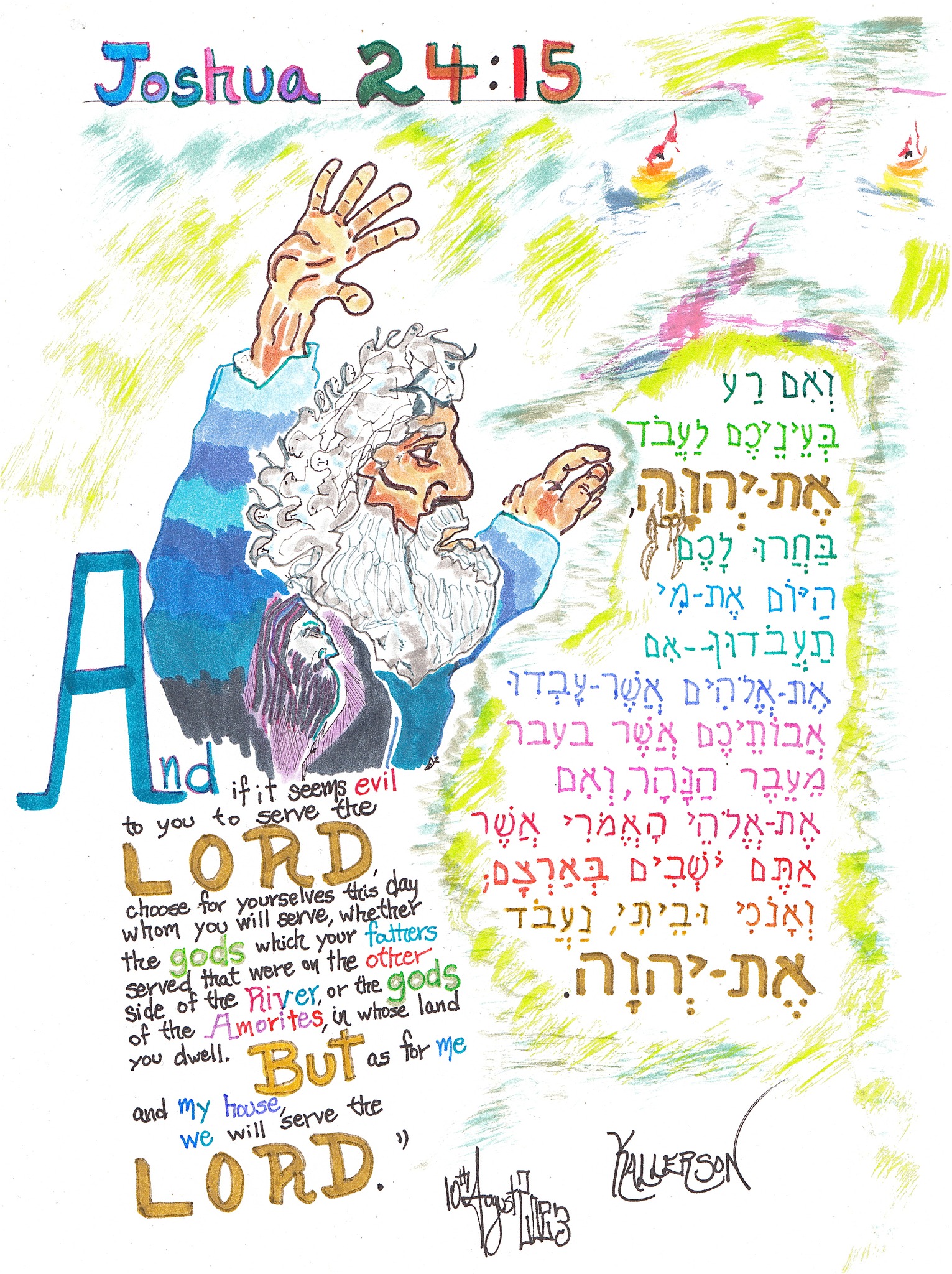
Artwork by Douglas Kallerson
Joshua 24:6-15
For He Is a Holy God, Part II
These first two sermons from Joshua 24 have been mostly recounting what has taken place. Joshua has done this to teach the people a particular truth: that the Lord has been faithful to the people, and He brought them into their promised homeland, Canaan.
The Lord, through Joshua, has selected details that are relevant to this coming about in his recounting. As noted last week, the giving of the law was notably missing from those details.
Israel’s inability to go into Canaan prior to the wilderness wanderings was not because of disobeying the law. It was because the people did not have faith in the Lord. In rejecting His word, He rejected them. This is not at all unlike the speech Stephen gave to the people in Acts 7.
Though the main subject of the speech in Acts 7 deals with the people’s rejection of the Lord rather than the Lord’s faithfulness, the final verses of the passage today are centered on the people remaining faithful to the Lord.
The people were unfaithful to the word of the Lord in Numbers, and the people were unfaithful to the Word, who is the Lord, in Acts. After both, a time of punishment came upon them…
Text Verse: “Then God turned and gave them up to worship the host of heaven, as it is written in the book of the Prophets:
‘Did you offer Me slaughtered animals and sacrifices during forty years in the wilderness,
O house of Israel?
43 You also took up the tabernacle of Moloch,
And the star of your god Remphan,
Images which you made to worship;
And I will carry you away beyond Babylon.’” Acts 7:42, 43
In 1979, Bob Dylan released his album Slow Train Coming. He had met the Lord Jesus and put his thoughts into music. One of the songs he wrote was “Gotta Serve Somebody.” He made a point that man is destined to serve somebody. One of the verses says –
“Well, it may be the devil or it may be the Lord
But you’re gonna have to serve somebody.”
In the passage today, Joshua will set a choice before the people. They can serve the Lord or return to the gods of their fathers. In Acts 7, Stephen made a direct connection between Israel’s time in the wilderness and what would come upon them again for rejecting Jesus.
With their rejection of Him, their temple was destroyed and they were removed to the furthest parts of the planet, serving every god imaginable except the Lord who had come to dwell among them. For most of Israel, that continues to this day. That will change, and someday they will be brought into the New Covenant.
Faithfulness to the Lord is what all people should be focused on. Our continued trip through Joshua is filled with wonderful details of this truth. It’s all to be found in His superior word. And so, let us turn to that precious word once again, and… May God speak to us through His word today, and may His glorious name ever be praised.
I. Into the Land of the Amorite (verses 6-10)
6 ‘Then I brought your fathers out of Egypt,
Rather, it reads, “And I brought out your fathers from Egypt.” The words continue with the great acts of the Lord on behalf of Israel. Specifically, they detail the continued deliverance from Egypt that was noted in verse 24:5 with the general words, “Afterward I brought you out.”
The general statement was made, and now the process is being described. Although these elders were probably there at the time of being brought out, they had to be nineteen years old or younger; all others had died in the wilderness. That was seen in Numbers –
“‘As I live,’ says the Lord, ‘just as you have spoken in My hearing, so I will do to you: 29 The carcasses of you who have complained against Me shall fall in this wilderness, all of you who were numbered, according to your entire number, from twenty years old and above. 30 Except for Caleb the son of Jephunneh and Joshua the son of Nun, you shall by no means enter the land which I swore I would make you dwell in. 31 But your little ones, whom you said would be victims, I will bring in, and they shall know the land which you have despised.’” Numbers 14:28-31
By mentioning the fathers, the Lord is indirectly reminding the people of their faithlessness even in the midst of His faithfulness…
6 (con’t) and you came to the sea;
v’tavou ha’yamah – “and you came the seaward.” The word bo signifies to come or go or to come in or go in. In this case, it is not “in” the sea. They came seaward…
6 (con’t) and the Egyptians pursued your fathers with chariots and horsemen to the Red Sea.
The words are abrupt, having no preposition before Red Sea: v’yirdphu mitsrayim akhare avotekhem b’rekhev u’v’pharashim yam suph – “and pursued Egypt after your fathers in chariot and in horsemen: Red Sea.” The account in Exodus says –
“And the Lord hardened the heart of Pharaoh king of Egypt, and he pursued the children of Israel; and the children of Israel went out with boldness. 9 So the Egyptians pursued them, all the horses and chariots of Pharaoh, his horsemen and his army, and overtook them camping by the sea beside Pi Hahiroth, before Baal Zephon.” Exodus 14:8, 9
7 So they cried out to the Lord;
va’yitsaqu el Yehovah – “And they cried unto Yehovah.” This is recorded in Exodus 14, leaving out much of the detail, but simply focusing on what is most pertinent to the current narrative –
“And when Pharaoh drew near, the children of Israel lifted their eyes, and behold, the Egyptians marched after them. So they were very afraid, and the children of Israel cried out to the Lord.” Exodus 14:10
There was a need, the people cried out in their need…
7 (con’t) and He put darkness between you and the Egyptians,
More precisely, “and He put darkness between you and between the Egyptians.” Here is a word found nowhere else in Scripture, maaphel. It comes from the adjective aphel which is also only found once in Scripture –
“Is not the day of the Lord darkness, and not light?
Is it not very dark [aphel], with no brightness in it?” Amos 5:20
Thus, it would be an opaque gloomy darkness. This event was recorded in Exodus 14 as well –
“And the Angel of God, who went before the camp of Israel, moved and went behind them; and the pillar of cloud went from before them and stood behind them. 20 So it came between the camp of the Egyptians and the camp of Israel. Thus it was a cloud and darkness to the one, and it gave light by night to the other, so that the one did not come near the other all that night.” Exodus 14:19, 20
With this opaque gloomy darkness, the Egyptians would be unable to see the disaster that lay ahead of them…
7 (con’t) brought the sea upon them, and covered them.
Not a single translation that I read correctly translates these words. The two that got it partially right are:
“and He sets thick darkness between you and the Egyptians, and brings the sea over him, and covers them” LSV
“and he will put darkness between you and between Egypt, and he will bring the sea upon him, and will cover him;” SLT
Rather, it is singular: va’yave alav eth ha’yam vay’kasehu – “And brought upon him the sea and covered him.” The word Egyptians is plural and the two pronouns are singular. As in verse 24:5, where the pronoun was also singular, it is referring to Pharaoh who represents the nation.
Ultimately, the battle was the Lord against Pharaoh and Pharoah didn’t measure up. This was recorded in Exodus 14 as well –
“And Moses stretched out his hand over the sea; and when the morning appeared, the sea returned to its full depth, while the Egyptians were fleeing into it. So the Lord overthrew the Egyptians in the midst of the sea. 28 Then the waters returned and covered the chariots, the horsemen, and all the army of Pharaoh that came into the sea after them. Not so much as one of them remained.” Exodus 14:27, 28
With the victory recorded, the Lord sums up the matter…
7 (con’t) And your eyes saw what I did in Egypt.
From the first three signs Moses presented to the elders of Israel, through the many plagues upon the land, even to the total destruction of the Egyptian army in the Red Sea, the people were firsthand witnesses. They didn’t read about it in a scroll or hear about it from their fathers, but they were there and saw with their own eyes.
Of note is the changing from the third person to the first person in this verse –
“And they cried out to Yehovah. And He put darkness between you and between the Egyptians, and brought [3rd p.] upon him the sea, and He covered him. And saw your eyes what I did in Egypt.”
The words were in the first person from verse 3 through verse 6. They suddenly change to the third person and then return to the first person. The reason seems to be that both are speaking of God in Christ.
The darkness was attributed to the Angel of God, a type of Christ, going between the camps. The covering of the Egyptians was said to be done by Moses’ hand, but that is explained by Exodus 14:16, which says –
“But lift up your rod, and stretch out your hand over the sea and divide it. And the children of Israel shall go on dry ground through the midst of the sea.”
The rod, typical of the leveraged power of God in Christ as was seen in the Exodus sermons, was the action that destroyed the Egyptians. One can think of Jesus’ work on the cross and see the reason for the change from the first to the third person.
However, and despite the marvelous work of the Lord, and without stating the obvious reason for it, the Lord next says…
7 (con’t) Then you dwelt in the wilderness a long time.
va’teshvu va’midbar yamim rabim – “and dwelt in the wilderness days many.” This was inclusive of traveling to Sinai, being at the mountain during the time of receiving the law and constructing the sanctuary, departing for Egypt, spying out the land, rejecting the Lord by refusing to enter Canaan, and being sentenced to die in the wilderness until the adult generation had perished. The period of “many days” was forty years. That said, the Lord continues…
8 And I brought you into the land of the Amorites,
Amorite is singular. The Lord brought Israel the people into the land of the nation of the Amorite, meaning Renown. This begins the third section of the discourse, which is The Move into the Land of the Amorites on the East of the Jordan, and their Defeat.
The Lord is preparing to bring Israel into Canaan, but there were foes to face prior to entry into the land. The specifics of this are recorded in Numbers 21:21-31, but are summed up in the words, “Thus Israel dwelt in the land of the Amorites” (Numbers 21:31). It is the nation of the Amorite…
8 (con’t) who dwelt on the other side of the Jordan,
ha’yoshev b’ever ha’yarden – “The dweller in side the Jordan.” This foe was east of the Jordan and had to be dealt with prior to Israel’s entry into the land…
8 (con’t) and they fought with you.
This was inclusive of several battles, but two of them are especially highlighted. The first was with Sihon king of the Amorites, the main verses of which say –
“Then Israel sent messengers to Sihon king of the Amorites, saying, 22 ‘Let me pass through your land. We will not turn aside into fields or vineyards; we will not drink water from wells. We will go by the King’s Highway until we have passed through your territory.’ 23 But Sihon would not allow Israel to pass through his territory. So Sihon gathered all his people together and went out against Israel in the wilderness, and he came to Jahaz and fought against Israel. 24 Then Israel defeated him with the edge of the sword, and took possession of his land from the Arnon to the Jabbok, as far as the people of Ammon; for the border of the people of Ammon was fortified.” Numbers 21:21-24
The second was with Og, king of Bashan, also in Numbers 21 –
“Then Moses sent to spy out Jazer; and they took its villages and drove out the Amorites who were there.
33 And they turned and went up by the way to Bashan. So Og king of Bashan went out against them, he and all his people, to battle at Edrei. 34 Then the Lord said to Moses, ‘Do not fear him, for I have delivered him into your hand, with all his people and his land; and you shall do to him as you did to Sihon king of the Amorites, who dwelt at Heshbon.’ 35 So they defeated him, his sons, and all his people, until there was no survivor left him; and they took possession of his land.” Numbers 21:32-35
The Amorite refused Israel’s request to allow them to pass through their land and came out against them in battle…
8 (con’t) But I gave them into your hand, that you might possess their land, and I destroyed them from before you.
As is so often the case, the Lord notes that despite Israel having waged the war, it was He who gave the victory. Without the Lord, they could not prevail, but with His presence among them, they could not lose.
9 Then Balak the son of Zippor, king of Moab, arose to make war against Israel,
The word lakham, to fight, battle, or war against another is used. However, no battle took place against Moab. This is not a contradiction. Rather, it says that Balak arose to make war against Israel. It doesn’t say he made war against Israel.
Knowing that Israel had defeated Sihon and Og, he knew they were a force to be reckoned with. And so, in order to wage war, he determined to have the battle essentially won before he even entered into it. Therefore, he arose to make war…
9 (con’t) and sent and called Balaam the son of Beor to curse you.
The substance of this is addressed at the opening of Numbers 22 and it explains how he planned to defeat Israel –
“Now Balak the son of Zippor saw all that Israel had done to the Amorites. 3 And Moab was exceedingly afraid of the people because they were many, and Moab was sick with dread because of the children of Israel. 4 So Moab said to the elders of Midian, “Now this company will lick up everything around us, as an ox licks up the grass of the field.” And Balak the son of Zippor was king of the Moabites at that time. 5 Then he sent messengers to Balaam the son of Beor at Pethor, which is near the River in the land of the sons of his people, to call him, saying: “Look, a people has come from Egypt. See, they cover the face of the earth, and are settling next to me! 6 Therefore please come at once, curse this people for me, for they are too mighty for me. Perhaps I shall be able to defeat them and drive them out of the land, for I know that he whom you bless is blessed, and he whom you curse is cursed.” Numbers 22:2-6
Despite his cunning plan, he misunderstood the relationship of the Lord to Israel…
10 But I would not listen to Balaam;
The narrative in Numbers 22 specifically says again and again that Balaam spoke to the Lord, meaning Yehovah. He was familiar with the worship of the Lord just as Job was. However, his understanding of the Lord was certainly incorrect.
Further, his understanding of the relationship of the Lord with Israel was not known until the Lord revealed it to him…
10 (con’t) therefore he continued to bless you.
v’barekh barokh etkhem – “And blessing he blessed you.” This is recorded in Numbers 23 and 24. The first two times Balaam sought to curse Israel in accord with the request of Balak, the Lord instead sent a word of blessing. Finally, Balaam gave up and prophesied his own word of blessing over Israel without the Lord’s direction.
10 (con’t) So I delivered you out of his hand.
v’atsil etkhem mi’yado – “And I delivered you from his hand.” This is probably directly referring to Balak who had arisen to go to war with Israel, but it is inclusive of the means of his strategy, meaning the employment of Balaam. With the events complete, the last verse of Numbers 24 said, “So Balaam rose and departed and returned to his place; Balak also went his way.”
Though Israel would meet Balaam again in Numbers 31 and kill him with the sword, the narrative here is focused on the threat of being cursed by the Lord through the machinations of Balaam. Israel was delivered from this possibility. With that, the narrative turns to the great moment hoped for since the time of Abraham…
Your eyes saw what I did in Egypt
And the great deeds I accomplished there
The power of Pharoah was stripped
To Me, what god would you compare?
I led you through the wilderness
Even to the land of the Amorite
But of his power who would confess?
When I destroyed him from your sight
I brought you to the Jordan by My hand
And I brought you through it as well
I placed you in the most beautiful land
And it is there that you now dwell
Speak of the deeds of Lord all your days
Be sure to honor Him and sing out His praise
II. We Will Serve the Lord (verses 11-15)
11 Then you went over the Jordan and came to Jericho. And the men of Jericho fought against you—also the Amorites, the Perizzites, the Canaanites, the Hittites, the Girgashites, the Hivites, and the Jebusites.
Although a large number of versions follow this general translation, it misses the point. First, the word translated as “men” is the plural of baal. It signifies a lord, master, husband, etc. It refers to one who has supreme authority over those under him.
Jericho, as the first point of battle, is being used as a summary of the inhabitants of the land for the subsequent battles –
“And you passed through the Jordan and came to Jericho, and fought against the lords [baale] of Jericho: The Amorite, and the Perizzite, and the Canaanite, and the Hittite, and the Girgashite, the Hivite, and the Jebusite” (CG).
It is as if Jericho is the main location of Canaan because it was first engaged in battle. The “lords of Jericho,” then speak of the leaders of all the ethnic groups within Canaan.
These same people groups, although mentioned in a different order, were referred to by Moses in Deuteronomy 7 –
“When the Lord your God brings you into the land which you go to possess, and has cast out many nations before you, the Hittites and the Girgashites and the Amorites and the Canaanites and the Perizzites and the Hivites and the Jebusites, seven nations greater and mightier than you, 2 and when the Lord your God delivers them over to you, you shall conquer them and utterly destroy them. You shall make no covenant with them nor show mercy to them. 3 Nor shall you make marriages with them. You shall not give your daughter to their son, nor take their daughter for your son. 4 For they will turn your sons away from following Me, to serve other gods; so the anger of the Lord will be aroused against you and destroy you suddenly. 5 But thus you shall deal with them: you shall destroy their altars, and break down their sacred pillars, and cut down their wooden images, and burn their carved images with fire.” Deuteronomy 7:1-5
The contents of this verse convey the fourth major section of the discourse, The Move through the Jordan and the Subduing of the Land of Canaan. Israel defeated those who came against them. Israel engaged these foes…
11 (con’t) But I delivered them into your hand.
Though speaking to Israel in the plural, He notes their united nature in what transpired: va’eten otham b’yedkhem – “And gave them [pl.] into your hand [sg.].” Israel was given the victory because of the Lord’s granting of it to them.
With that, and despite still speaking about the subduing of the land, I would take the next verse as the final section of the discourse which is The Planting of Israel in the Land of Promise…
12 I sent the hornet before you which drove them out from before you,
va’eshlakh lipnekhem eth ha’tsirah vat’garesh otham mip’nekhem – “And I sent before your faces the hornet, and it drove out them from before your faces.” This is the last of three times that the hornet is mentioned in the Bible.
It is derived from tsara, to be struck with leprosy. Thus it is an afflicter, like leprosy. The Lord sent this afflicter, the hornet, before Israel in order to defeat the enemy, driving them out. Due to the article, “the hornet,” the language is to be taken metaphorically.
Similar terminology is used concerning bees in Deuteronomy 1:44 and Psalm 118:12. There, bees are equated with one’s enemies, not literal insects.
Then, Joshua says that this is fulfilled in the case of the Amorites in the next clause. However, Moses, speaking of the same battle, showed that it was, in fact, Israel who defeated them –
“And at that time we took the land from the hand of the two kings of the Amorites who were on this side of the Jordan, from the River Arnon to Mount Hermon…” Deuteronomy 3:8
That was repeated in Deuteronomy 4:47 and it was referring to the kings Sihon and Og. Therefore, this is referring to a connection between the hornet and its associated word meaning leprosy.
The Lord promised health and long life to Israel if they held to His laws. As they were going into a land defiled by those things which are opposed to a healthy lifestyle, the enemy had been, or would be, afflicted with disease to the point where they were incapable of standing up to Israel’s armies.
Thus, “the hornet” is a metaphor for God’s judgment of sickness upon them, preparing them for destruction by Israel. As the Bible records that Israel actually faced these foes in battle, this is a reasonable explanation for the term “the hornet” which is said to have been sent before them.
The same types of effects are noted upon the people of Israel during their own times of siege from the enemies who came against them.
The overall evidence demonstrates that the words “the hornet” are speaking of the effects upon the people as a result of their destruction by Israel, as the Lord led them. As noted, this included…
12 (con’t) also the two kings of the Amorites, but not with your sword or with your bow.
The word “also” is not in the text and it confuses the substance of what is said: sh’ne malkhe ha’emori lo b’karvkha v’lo b’qashtekha – “two kings the Amorite, no in your sword and no in your bow.” Pretty much everyone says this is referring to the two kings east of the Jordan, Sihon and Og.
Rather, it pertains to two main kings, but it is referring to Amorites on both sides of the Jordan. This goes back, for example, to Joshua 10, where it said –
“Therefore the five kings of the Amorites, the king of Jerusalem, the king of Hebron, the king of Jarmuth, the king of Lachish, and the king of Eglon, gathered together and went up, they and all their armies, and camped before Gibeon and made war against it.” Joshua 10:5
There, as quite often is the case elsewhere, it is singular, showing the united nature of the people: va’yeas’phu va’yaalu khameshet malkhe ha’emori – “And gathered together and went up five kings the Amorite.” It is five kings, but one people, even though they were not all Amorites.
Rather, they included Hittites, Jebusites, etc. But they are lumped together as being a part of “the Amorite.” After the battle, it repeated the notion that the Lord delivered up the Amorite before the children of Israel.
In this chapter, the listing given in the previous verse began with the Amorite. Thus, the rest of the people groups are listed under the Amorite. There was the Amorite east of Jordan, and there was the Amorite west of the Jordan. The words speak of the total victory over the enemies in all the land they possess.
It is because of these words that I say this belongs in the final section of the discourse, that of The Planting of Israel in the Land of Promise. This verse is only referring to the battles after they have been completed in the narrative.
The defeat of the two kings was recorded in verses 24:8 & 11. The defeat in 24:8 was the king of the Amorite (lumped together as one) east of the Jordan and the defeat in 24:11 was the king of the Amorite (lumped together as one) west of the Jordan.
Therefore, this is more an explanation that rest has been granted than a description of the process of granting it. The Lord provided the rest through His efforts. With that, He then reaffirms that notion…
13 I have given you a land for which you did not labor,
More precisely: “And I have given to you a land which not you did become weary in her.” The word “for” implies attaining the land, but that is not what is being conveyed. It is referring to the things in the land. In other words, the Lord gave them the land as noted in the previous verse.
But within the land, there was no need to then start making it productive. That was all set up for them by the previous inhabitants who the Lord drove out. Forests were cleared, wells were dug, roads were in place, thorns would have been burned off (and Israel is full of thorns!), etc.
This is indicated by the use of the word yaga, to become weary. It comes from a primitive root signifying to grasp. As such, it means to be exhausted, tire, toil, be weary, and so on. When one is tired, he will grasp onto something to hold himself up. Israel did not have this problem. And more, the next words are said in a similar fashion…
13 (con’t) and cities which you did not build, and you dwell in them;
The translation is just right. The cities were there, they were cleared of inhabitants, and Israel moved right in and started cooking dinner that night. And more…
13 (con’t) you eat of the vineyards and olive groves which you did not plant.’
The words are fine but reversed: “Vineyards and olive groves which not you did plant, you eat.” At the first harvest, all they had to do was go out and start plucking produce off the vines and trees. After that, the maintenance would be up to them. Israel was given a land of abundance by the Lord. He did everything to prepare it for them in advance.
If one thinks about it, if the land was divided into languages at the time of Peleg, who was born in the year 1758 Anno Mundi, and Abraham received his call in 2084AM, then the population of Canaan at the time would not have been great.
However, with the addition of almost five hundred years between the promise and Israel’s entry into the land (Joshua began in the year 2555AM), there would have been many more people, many more cities, much more productive land, etc. The Lord prepared everything by His wisdom to ensure Israel could immediately move in and be secure.
As for the contents of this verse, it is exactly what Moses said would be the case –
“So it shall be, when the Lord your God brings you into the land of which He swore to your fathers, to Abraham, Isaac, and Jacob, to give you large and beautiful cities which you did not build, 11 houses full of all good things, which you did not fill, hewn-out wells which you did not dig, vineyards and olive trees which you did not plant—when you have eaten and are full— 12 then beware, lest you forget the Lord who brought you out of the land of Egypt, from the house of bondage.” Deuteronomy 6:10-12
As this is so, and as Moses also warned, Joshua continues…
14 “Now therefore, fear the Lord, serve Him in sincerity and in truth,
v’atah yeru eth Yehovah v’ivdu oto b’tamim u-b’emeth – “And now, fear Yehovah and serve Him in perfection and in truth.” The word fear signifies to have a fearful reverence of the Lord. In treating Him flippantly, He will be displeased and consequences for that attitude will result.
The word translated as perfection, tamim, is found in much of the Old Testament. However, it is found mostly in three books: Leviticus, Numbers, and Ezekiel.
In those books, it is mostly used in reference to the unblemished nature of the sacrifices offered to the Lord. They were to be perfect because they are given as typical of the Lord. The idea is that just as the Lord is perfect, so is to be the service of the Lord’s people toward Him.
The word emeth, or truth, is from aman, to confirm or support. Thus, there is a sense of assuredness, establishment, and faithfulness being conveyed. In this, the people were not to simply go through the motions, nor just pay lip service. Rather, they were to serve perfectly and faithfully.
But more, to serve in truth would be to serve in accord with the word given by the Lord through Moses. If the Lord is perfect, then the word He gave was perfect as well. As the word anticipated the coming of Jesus (John 5:39, etc.), then the logical deduction to be made is that only in serving the Lord through Jesus is one serving Him in perfection and in truth.
Jesus conveyed this thought in John 4 –
“Jesus said to her, ‘Woman, believe Me, the hour is coming when you will neither on this mountain, nor in Jerusalem, worship the Father. 22 You worship what you do not know; we know what we worship, for salvation is of the Jews. 23 But the hour is coming, and now is, when the true worshipers will worship the Father in spirit and truth; for the Father is seeking such to worship Him. 24 God is Spirit, and those who worship Him must worship in spirit and truth.’
25 The woman said to Him, ‘I know that Messiah is coming’ (who is called Christ). ‘When He comes, He will tell us all things.’
26 Jesus said to her, ‘I who speak to you am He.’” John 4:21-26
As for Israel at the time of Joshua, in order to properly serve the Lord, Joshua says…
14 (con’t) and put away the gods which your fathers served on the other side of the River and in Egypt. Serve the Lord!
Rather than a separate thought as rendered here, it is all one sentence, “…and serve the Lord.” The narrative here implicitly returns to the Genesis account where Jacob said the same thing to his family –
“And Jacob said to his household and to all who were with him, ‘Put away the foreign gods that are among you, purify yourselves, and change your garments. 3 Then let us arise and go up to Bethel; and I will make an altar there to God, who answered me in the day of my distress and has been with me in the way which I have gone.” 4 So they gave Jacob all the foreign gods which were in their hands, and the earrings which were in their ears; and Jacob hid them under the terebinth tree which was by Shechem.’” Genesis 35:2-4
As was seen previously, the gathering is in Shechem, the same location as that account in Genesis. But notice also that Joshua clearly says that not only did the fathers on the other side of the Euphrates worship other gods, but so did the fathers who lived in Egypt.
They had fallen into the world of idolatry as is evidenced in Leviticus 17:7 and Amos 5:25. The latter is then cited by Stephen in Acts 7, as noted in our text verse. They had to be called out of that in order to make them a people prepared for the Lord. As these things are only anticipatory of the coming of Christ, one can more fully understand the words of Zechariah –
“He will also go before Him in the spirit and power of Elijah, ‘to turn the hearts of the fathers to the children,’ and the disobedient to the wisdom of the just, to make ready a people prepared for the Lord.” Luke 1:17
John the Baptist was to prepare Israel for the coming Messiah. Israel rejected Him and were exiled. Someday, they will be come to Christ. Hence, the return of Elijah as one of the two witnesses of Revelation is ahead. As for Israel under Joshua…
15 And if it seems evil to you to serve the Lord, choose for yourselves this day whom you will serve,
There is a strong emphasis in the words: v’im ra b’enekhem la’avod eth Yehovah bacharu lakhem ha’yom eth mi taavodun – “And if evil in your eyes to serve Yehovah, choose to you the day whom you will (surely) serve.” As Bob Dylan said, “…you’re gonna have to serve somebody.”
Joshua is essentially letting Israel’s leaders know this. Either one will serve the Lord or he will find other gods to serve, even if it is the god of self because man is designed to serve someone. Or maybe…
15 (con’t) whether the gods which your fathers served that were on the other side of the River,
im eth elohim asher avedu avothekhem asher b’ever ha’nakhar – “if gods which served your fathers which in side the River.” It means the gods of Mesopotamia across the Euphrates. These were household gods, gods of stone on the street corners, etc. They were those things fashioned and designed by man for the purpose of being man’s gods…
15 (con’t) or the gods of the Amorites, in whose land you dwell.
v’im eth elohe ha’emori asher atem yoshvim b’artsam – “And if gods the Amorite which you dwell in their land.” These gods leaned toward nature and creation, such as Baal, Asherah, the sun, moon, stars, and so forth.
The connection between all of them is that they are false gods of man’s devising. They are powerless to assist and powerless to save. Whereas…
*15 (fin) But as for me and my house, we will serve the Lord.”
v’anokhi u-beiti naavod eth Yehovah – “And I, and my house, we will serve Yehovah.” He has made the proclamation and it is essentially an eternal one. The reason is because there is no record of Joshua’s family apart from his father Nun.
It says he is from the tribe of Ephraim in Numbers 13:8, and although there is a Joshua recorded in 1 Chronicles 7:27, that may not even be the same Joshua. The father’s name is spelled differently, Non instead of Nun. But even if it is the same Joshua, there is no record beyond him, it simply says, “Non, his son, and Joshua, his son.” That would make him the last of his house.
Therefore, as there is no record of Joshua having a wife or children, his proclamation – from a scriptural sense – extends the word “house” to those who are of his caliber and faith rather than a recorded family. The same thought is expressed by Paul in Galatians 6 –
“Therefore, as we have opportunity, let us do good to all, especially to those who are of the household of faith.” Galatians 6:10
In this, one can see Joshua as a type of Christ, he being the head of the house of faith just as Jesus is the head of the household of the faithful in Him. Joshua and his life are being carefully depicted again and again to reveal the Person and work of the Lord.
And this is exactly what the word wants us to see. Everything is centered on the coming of Jesus Christ and then the further explanation and revelation of Him into the future. It is He who is the focal point of our understanding of God as well as our experience with Him.
God is in the infinite realm; we are in the finite realm. The two cannot interact without a connector between the two. But even more, God is holy and pure. Man is fallen and tainted. God in Christ is the Purifier and Connector. He is the Way to God and the Door through whom access is finally obtained.
Without Him there is no hope. But with Him, there is absolute surety. Thank God for Jesus Christ who alone gives us the joy of restoration and reconciliation with our heavenly Father. Yes, thank God for Jesus Christ our Lord.
Closing Verse: “You drove out the nations with Your hand,
But them You planted;
You afflicted the peoples, and cast them out.
3 For they did not gain possession of the land by their own sword,
Nor did their own arm save them;
But it was Your right hand, Your arm, and the light of Your countenance,
Because You favored them.” Psalm 44:2, 3
Next Week: Joshua 24:16-28 The people need to be properly shod to walk before the Lord carefully… (For He Is a Holy God, Part III) (57th Joshua Sermon)
The Lord has you exactly where He wants you. He has a good plan and purpose for you. It is He who has defeated the enemy and who now offers His people rest. So, follow Him and trust Him and He will do marvelous things for you and through you.
For He Is a Holy God, Part II
‘Then I brought your fathers out of Egypt
And you came to the sea as directed by Me
And the Egyptians pursued your fathers
With chariots and horsemen to the Red Sea
So they cried out to the LORD
And He put darkness between you and the Egyptians, brought the
———-sea upon them, and covered them too
And your eyes saw what I did in Egypt
Then you dwelt in the wilderness a long time; the days did accrue
And I brought you into the land of the Amorites, who dwelt on the
———-other side of the Jordan
And they fought with you; a battle did ensue
But I gave them into your hand, that you might possess their land
ZAnd I destroyed them from before you
Then Balak the son of Zippor, king of Moab
Arose to make war against Israel
And sent and called Balaam the son of Beor
To curse you, that prophesying dumbbell
But I would not listen to Balaam
Therefore he continued to bless you
So I delivered you out of his hand
Because Balak’s plans were askew
Then you went over the Jordan and came to Jericho
And the men of Jericho fought against you
Also the Amorites, the Perizzites, the Canaanites
The Hittites, the Girgashites, the Hivites, and the Jebusites too
But I delivered them into your hand
My victory over them was grand
I sent the hornet before you
Which drove them out from before you as you know
Also the two kings of the Amorites
But not with your sword or with your bow
I have given you a land for which you did not labor
And cities which you did not build, such was your grant
And you now dwell in them
You eat of the vineyards and olive groves which you did not plant
“Now therefore, fear the LORD, serve Him in sincerity and in truth
And put away the gods your hearts have inclined toward
Which your fathers served on the other side of the River
———-and in Egypt
Serve the LORD!
And if it seems evil to you to serve the LORD
Choose for yourselves this day whom you will serve
Whether the gods which your fathers served
That were on the other side of the River, if you have the nerve
Or the gods of the Amorites, in whose land you dwell
But as for me and my house, we will serve the LORD
———-so to you I tell
Lord God, turn our hearts to be obedient to Your word
Give us wisdom to be ever faithful to You
May we carefully heed each thing we have heard
Yes, Lord God may our hearts be faithful and true
And we shall be content and satisfied in You alone
We will follow You as we sing our songs of praise
Hallelujah to You; to us Your path You have shown
Hallelujah we shall sing to You for all of our days
Hallelujah and Amen…
6 ‘Then I brought your fathers out of Egypt, and you came to the sea; and the Egyptians pursued your fathers with chariots and horsemen to the Red Sea. 7 So they cried out to the Lord; and He put darkness between you and the Egyptians, brought the sea upon them, and covered them. And your eyes saw what I did in Egypt. Then you dwelt in the wilderness a long time. 8 And I brought you into the land of the Amorites, who dwelt on the other side of the Jordan, and they fought with you. But I gave them into your hand, that you might possess their land, and I destroyed them from before you. 9 Then Balak the son of Zippor, king of Moab, arose to make war against Israel, and sent and called Balaam the son of Beor to curse you. 10 But I would not listen to Balaam; therefore he continued to bless you. So I delivered you out of his hand. 11 Then you went over the Jordan and came to Jericho. And the men of Jericho fought against you—also the Amorites, the Perizzites, the Canaanites, the Hittites, the Girgashites, the Hivites, and the Jebusites. But I delivered them into your hand. 12 I sent the hornet before you which drove them out from before you, also the two kings of the Amorites, but not with your sword or with your bow. 13 I have given you a land for which you did not labor, and cities which you did not build, and you dwell in them; you eat of the vineyards and olive groves which you did not plant.’
14 “Now therefore, fear the Lord, serve Him in sincerity and in truth, and put away the gods which your fathers served on the other side of the River and in Egypt. Serve the Lord! 15 And if it seems evil to you to serve the Lord, choose for yourselves this day whom you will serve, whether the gods which your fathers served that were on the other side of the River, or the gods of the Amorites, in whose land you dwell. But as for me and my house, we will serve the Lord.”