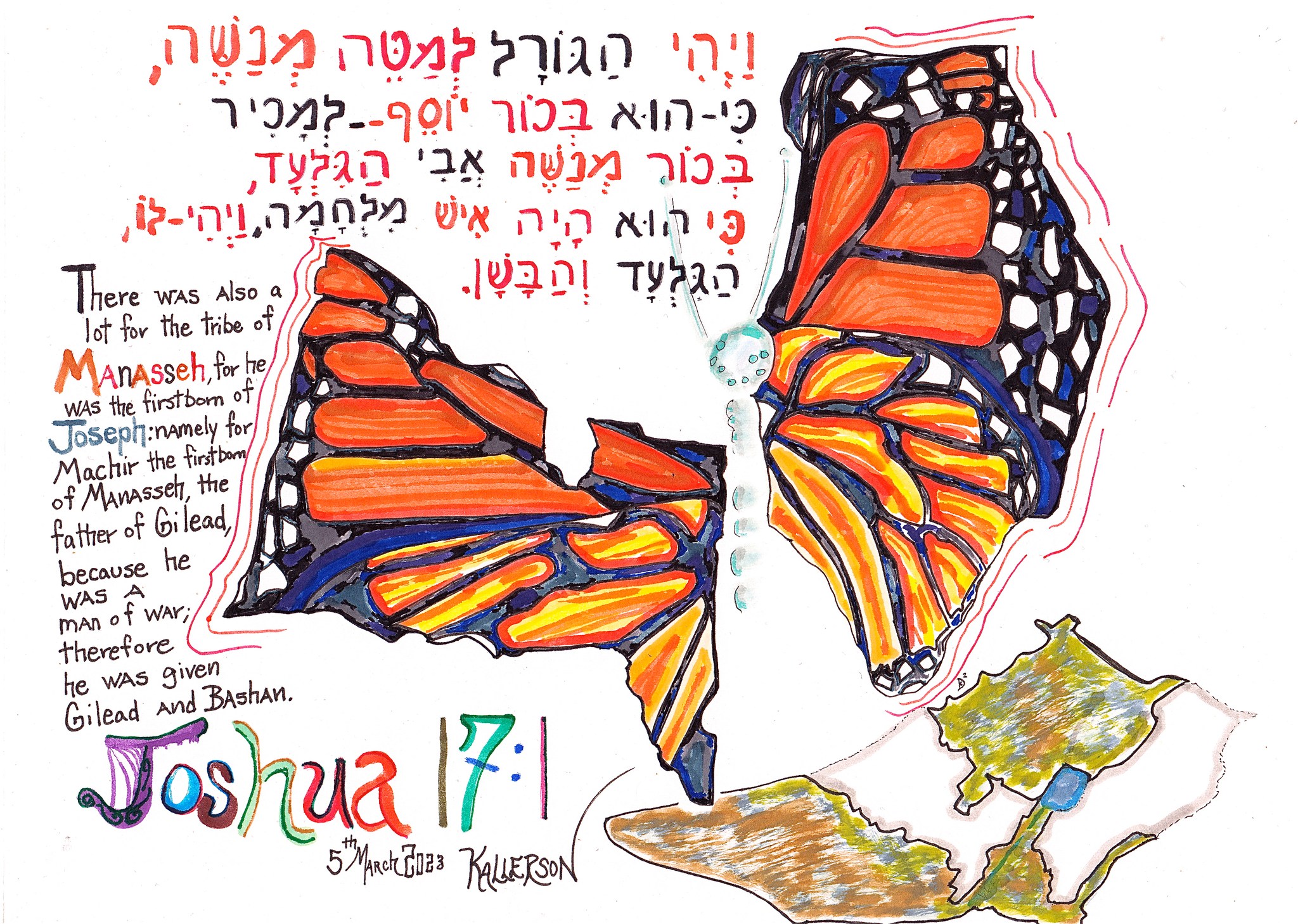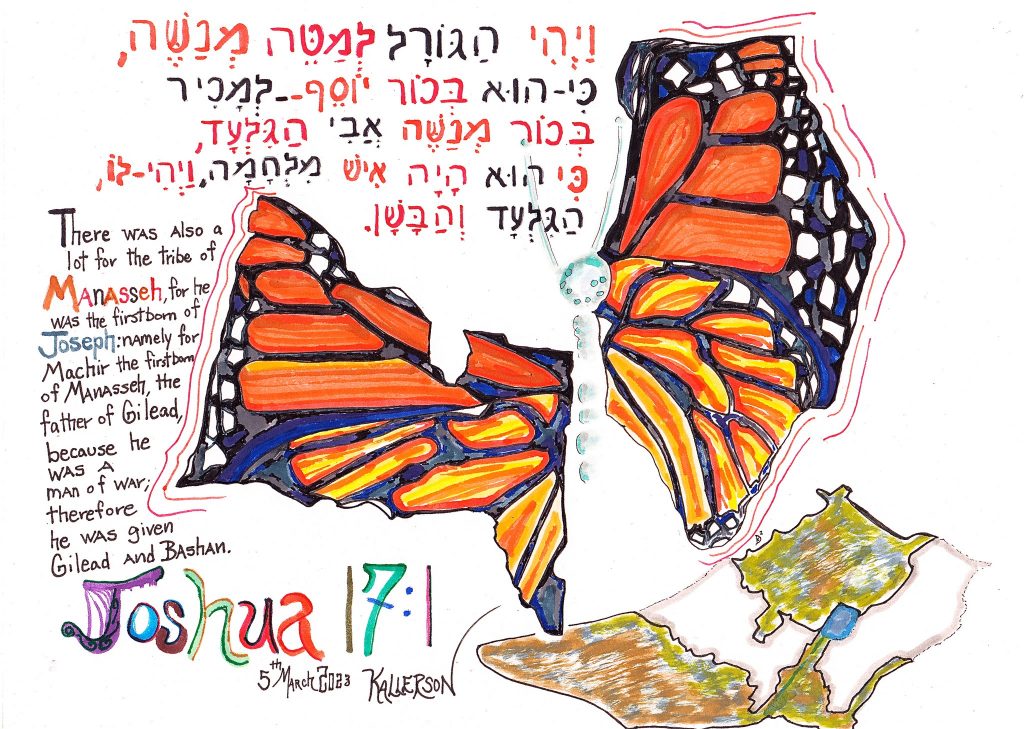
Artwork by Doug Kallerson.
Joshua 17:1-13
The Inheritance of Joseph – Manasseh (West)
A portion of our verses today deal with the five daughters of Zelophehad. They were introduced in an offhand manner in Numbers 26, and then they were brought to the forefront of the narrative in Numbers 27.
The particular issue concerning them was that of inheritance of land. It was a complicated matter that had to be settled by the Lord. The Lord’s decree was given, and it completely resolved the matter for them at the time.
However, the decree concerning the inheritance brought another issue to the surface that needed a resolution. If not resolved, the daughters’ inheritances could easily cause problems for their entire tribe, and – by extension – the tribal rights of the entire nation.
One thing would lead to another. Without a suitable resolution, there would eventually be breakdown in the structure of the nation. Small things can lead to major problems if not thought through.
It isn’t that the Lord wasn’t aware of these details in advance. Rather, He knew exactly what the consequences of such a matter would be. But to ensure that these things were written directly into the law, He allowed the people to think through the issues and come forward for His judgment.
Text Verse: “I will deliver you from the Jewish people, as well as from the Gentiles, to whom I now send you, 18 to open their eyes, in order to turn them from darkness to light, and from the power of Satan to God, that they may receive forgiveness of sins and an inheritance among those who are sanctified by faith in Me.” Acts 26:17, 18
When Paul spoke about his conversion and the purpose of it, the Lord gave him several reasons for the ministry he had been chosen for such as opening the Gentile’s eyes, turning them from darkness to light, and so on. But the main purposes for the individual were forgiveness of sins and the granting of an inheritance.
The idea of an inheritance is having something bestowed at a particular time for an heir. The daughters of Zelophehad were told they would be granted an inheritance in the name of their father. Later, it was resolved that certain conditions had to be met in order for that inheritance to be granted.
Now, because they had met those conditions, the inheritance awaits them. This is such an important issue that these girls’ situation has been given more time in Scripture than many other figures of seemingly greater importance.
The details are methodically recorded in order to show us a part of what God has done in Christ in typology. Because of Him, we have the opportunity to obtain the inheritance set aside for those who meet the conditions set forth.
The ladies came forward to claim their inheritance. They didn’t go forward and say, “We hope we still have this available to us.” They cited the law and that was that. Nothing was said of their individual lives after meeting the stated conditions because those details are irrelevant. They did what was expected of them, and the matter was resolved.
How many people have met the stated conditions for receiving the inheritance, received the guarantee provided, and yet walk about in absolute insecurity in their minds concerning what is granted? They hold the guarantee! It was made by God who does not lie. All they need to do is claim it when the time comes.
If you are somehow troubled as to whether or not your salvation is secure, that is because you misunderstand what God did. It is not because Christ’s work is somehow lacking. Don’t let anyone disqualify you from the joy of knowing, one hundred percent, that you are saved if you have called on Jesus. Trust the word! You are.
Hints of this state in which you stand because of Jesus are found today in His superior word. And so, let us turn to that precious word once again, and… May God speak to us through His word today, and may His glorious name ever be praised.
I. A Lot for the Tribe of Manasseh (verses 1-6)
There was also a lot for the tribe of Manasseh,
v’hi ha’goral l’mateh m’nasheh – “And was the lot to tribe Manasseh.” Manasseh means He Shall Forget, but also From a Debt. He was the first son of Joseph and was born in Egypt. He and his brother Ephraim were adopted as sons of Jacob for inheritance rights.
Half the tribe of Manasseh has already received an inheritance east of the Jordan as was meticulously recorded several times. Of him, it says…
1 (con’t) for he was the firstborn of Joseph:
There is an emphasis in the words: ki hu bekor yoseph – “For HE firstborn to Joseph.” Despite having already received an inheritance east of the Jordan because of the valor of Machir, as recorded in Numbers and as restated by Moses in Deuteronomy 3:15, he was also granted land along with the other tribes west of the Jordan.
The reason for the emphasis is that despite Ephraim receiving the blessing of Jacob over Manasseh as recorded in Genesis 48, he was to receive the double portion based on the rights of the firstborn. That double portion is restated next for clarity…
1 (con’t) namely for Machir the firstborn of Manasseh, the father of Gilead,
Machir means Salesman. Gilead means Perpetual Fountain. As a historical point, though this is speaking of Machir, it means the family of Machir. They are being referred to as Machir for the purpose of inheritance. Machir died long ago. Further, one might think this is referring to Machir’s son, Gilead, recorded in Numbers 26 –
“The sons of Manasseh: of Machir, the family of the Machirites; and Machir begot Gilead; of Gilead, the family of the Gileadites.” Numbers 26:29
However, the name in this verse in Joshua is prefixed by an article: l’makhir bekor m’nasheh avi ha’gil’ad – “to Machir firstborn Manasseh father the Gilead.” Therefore, this is not speaking of his son Gilead, but of the land of Gilead – the Gilead.
What appears to have happened is that Machir named his son Gilead before the land of Gilead was taken in battle. 1 Chronicles 7:14 says that Manasseh bore Machir by a concubine from Aram. This would explain why he then named his own son Gilead, which was in the land of Aram.
Gilead is the border area between Syria and Canaan. Machir may have called Gilead this to honor the union between the two people groups from which he came. It also explains why this is said in Numbers 32 –
“And the children of Machir the son of Manasseh went to Gilead and took it, and dispossessed the Amorites who were in it. 40 So Moses gave Gilead to Machir the son of Manasseh, and he dwelt in it.” Numbers 32:39, 40
The same place from which Machir’s son was named – because of the union between his father and mother, Manasseh and Manasseh’s Aramitiss concubine – became their possession. It appears he was determined to obtain this land because of its connection to his genealogy. Thus, it next says…
1 (con’t) because he was a man of war; therefore he was given Gilead and Bashan.
Gilead means Perpetual Fountain. Bashan means Place of Fertile Soil. There is again an emphasis in the words: ki hu hayah ish milkhamah vayhi lo ha’gil’ad v’ha’bashan – “for HE was man war and was to him the Gilead and the Bashan.” Thus, the term “father of the Gilead” refers to his status as the possessor of this land.
Likewise, the words “father of Gilead,” without the article, means that he is the father of the person named Gilead. He was a man of war, intending to obtain this land. He fought and subdued it, and so Moses gave it to him. But he also named his son after the land. That covers what belonged to this tribe east of Jordan. Next, the second portion will be detailed…
2 And there was a lot for the rest of the children of Manasseh according to their families:
Here, a verb is used in place of a noun: vayhi livne m’nasheh ha’notarim l’mishp’hotam – “And was to sons Manasseh, the remainings, to their families.” As Machir obtained an inheritance east of the Jordan, and as these families intended to enter Canaan proper, giving them an inheritance west of Jordan fulfills the double portion requirement given to the firstborn son.
2 (con’t) for the children of Abiezer, the children of Helek, the children of Asriel, the children of Shechem, the children of Hepher, and the children of Shemida;
Abiezer means My Father is Help. Khelek means Portion or Smooth. Depending on the root word used, Asriel means God Has Filled with Joy or Vow of God. Shechem means Shoulder. Khepher means either Well (from dig) or Shame. Shemida means Knowing the Name or Fame of Knowledge.
2 (con’t) these were the male children of Manasseh the son of Joseph according to their families.
The original is more precise: “these sons Manasseh, son Joseph, the males, to their families.” The word “sons” here means “descendants” because it is accepted that Manasseh had only one son, Machir. Therefore, these are probably grandchildren of Manasseh and sons of Gilead.
Despite that, the reason for this specificity is realized in the next verses. It is a problem that arose during the wilderness wanderings and the resolution of it required Moses to go directly to the Lord for a decision to be made…
3 But Zelophehad the son of Hepher, the son of Gilead, the son of Machir, the son of Manasseh, had no sons, but only daughters.
Because inheritances are given through the male, this would cause a problem when the women married. If they married outside of the tribe of Manasseh, then the land would transfer to the son of the father and thus away from the tribe of Manasseh.
As Hepher was one of the six main families, the tribe could ostensibly lose one-sixth of their land to other tribes. This could be the case at any point in Israel’s future if a father had only daughters. The inheritances would become so convoluted that tribal lands would no longer truly exist. Tselophekhad means Shadow of Fear.
3 (con’t) And these are the names of his daughters: Mahlah, Noah, Hoglah, Milcah, and Tirzah.
Makhlah means Infirmity. Noah signifies Shaky Girl or Wandering. Khaglah means Turning in Joy. It is akin to the word khag which is a festival. Milkhah means Queen. Tirtsah means Well-pleasing or Delight.
Now that the inheritance is ready, the matter previously brought before Moses and settled at the word of the Lord is brought forth again to ensure that what was decided will come to pass…
4 And they came near before Eleazar the priest, before Joshua the son of Nun, and before the rulers, saying,
These five women are coming to ensure the promise of the Lord would be accomplished. They were obedient to marry within their tribe. In so doing, their children would receive a portion in the name of their father within the tribe also…
4 (con’t) “The Lord commanded Moses to give us an inheritance among our brothers.”
This was recorded in Numbers 27 –
“And the Lord spoke to Moses, saying: 7 ‘The daughters of Zelophehad speak what is right; you shall surely give them a possession of inheritance among their father’s brothers, and cause the inheritance of their father to pass to them. 8 And you shall speak to the children of Israel, saying: ‘If a man dies and has no son, then you shall cause his inheritance to pass to his daughter. 9 If he has no daughter, then you shall give his inheritance to his brothers. 10 If he has no brothers, then you shall give his inheritance to his father’s brothers. 11 And if his father has no brothers, then you shall give his inheritance to the relative closest to him in his family, and he shall possess it.’ And it shall be to the children of Israel a statute of judgment, just as the Lord commanded Moses.” Numbers 27:6-11
The only caveat is that these ladies had to marry men within their tribe. That judgment comprises the contents of Numbers 36. After it was rendered, it then said –
“Just as the Lord commanded Moses, so did the daughters of Zelophehad; 11 for Mahlah, Tirzah, Hoglah, Milcah, and Noah, the daughters of Zelophehad, were married to the sons of their father’s brothers. 12 They were married into the families of the children of Manasseh the son of Joseph, and their inheritance remained in the tribe of their father’s family.” Numbers 36:10-12
With their obedience noted, it next says…
4 (con’t) Therefore, according to the commandment of the Lord, he gave them an inheritance among their father’s brothers.
This was a huge amount of land and so any deviation would have caused an immense upheaval in the tribal land grant to Manasseh. But with the decisions of the Lord rendered, the grant would remain forever unchanged. Therefore…
5 Ten shares fell to Manasseh,
va’yiplu khavle m’nasheh asarah– “and fell cords Manasseh ten.” Here the word khevel or “cord” is used. Cords were used for measuring long distances. Hence, it is metaphorically used to speak of a tract of land. Ten individual tracts were measured out according to the families of Manasseh.
At first, the number of parcels seems to make no sense. How could there be six sons named, but ten divisions of the land? It is because Hepher, having no sons, is divided among his five daughters. Thus, there are the parcels of his five brothers and five parcels for his daughters. This was…
5 (con’t) besides the land of Gilead and Bashan, which were on the other side of the Jordan,
These ten shares, along with those adjoining them on the other side of the Jordan pretty much span the total breadth of the land inhabited by Israel. They almost appear like wings in the midst of the other tribal grants because of the vast amount of land they encompass. The number of parcels being ten is then explicitly explained, which is…
6 because the daughters of Manasseh received an inheritance among his sons;
ki benoth m’nasheh nakhalu nakhala betok banav – “for daughters Manasseh inherited an inheritance in midst his sons.” The record of the entire process of this event is extremely precise since the matter first arose in Numbers 27.
The meticulous nature of chronicling this land division for the daughters is most remarkable, but it sets the precedent for all time concerning this issue and it shows the importance of both maintaining the name of the dead as well as maintaining the integrity of the tribal inheritances according to their original layout. With this settled, the division of Manasseh on both sides of the Jordan is mentioned one last time…
6 (con’t) and the rest of Manasseh’s sons had the land of Gilead.
v’erets ha’gil’ad hayethah livne m’nasheh ha’notarim – “And land the Gilead had sons Manasseh, the remainings.” The same verb used in verse 2 when referring to those west of the Jordan is now used of those east of the Jordan. The implication is that the tribe is not a whole without considering both allowances. Together, they form the double portion of the oldest son of Joseph who was then adopted by Jacob as his own.
An inheritance awaits us that is sure and true
It is given to all who come forward and receive
It was secured by Christ Jesus, Faithful and True
It is ours for the taking if we just believe
Calling on Jesus is what is good in God’s sight
The inheritance is ours, though we did nothing it to receive
Eternal life, dazzling and bright
Is ours for the taking if we just believe
Don’t fail to come forward; hear the plea
It is waiting if you will but receive
You and all the saints, around the glassy sea
It is yours for the taking if you just believe
II. The Borders of Manasseh (verses 7-13)
7 And the territory of Manasseh was from Asher to Michmethath, that lies east of Shechem;
The actual borders of Manasseh’s inheritance in Canaan are the subject of the next verses. Verses 7-10 detail the southern borders, beginning in the east. Verses 10 and 11 define the northern and eastern borders.
The first border begins at Asher or Happy. This is not the tribe of Asher, but a location known as such. It then goes to Michmethath, meaning Concealment or maybe Hiding Place. As it is prefixed by an article, it would be The Hiding Place. This location rests, as the Hebrew reads, “upon the face of Shechem.” Hence, its location stands before Shechem.
7 (con’t) and the border went along south to the inhabitants of En Tappuah.
More literally, it reads, “and went the border unto the right, unto dwellers En Tappuah.” Tappuakh comes from naphakh, signifying to breathe or blow. It means Love Apple and also breath. Being preceded by En, or Spring, it means Spring of the Love Apple or Eye of the Apple or Spring (Eye) of Breath. The word for eye and spring are identical in Hebrew.
Saying “to the inhabitants of En Tappuah” is a bit odd, but it means that the city itself did not belong to Manasseh. Rather, the border went as far as those residing in the country around Tappuah where there was a spring. That is seen in the next words…
8 Manasseh had the land of Tappuah, but Tappuah on the border of Manasseh belonged to the children of Ephraim.
The wording is a bit more precise: lim’nasheh hayethah erets tapuakh v’tapuakh el gebul m’nasheh livne ephrayim – “To Manasseh had land Tappuah, and Tappuah unto border Manasseh to sons Ephraim.” There is land in the area of Tappauh that belonged to Manasseh, but the city and maybe any land outside of it, right up to the border of Manasseh, belonged to Ephraim.
9 And the border descended to the Brook Kanah, southward to the brook.
The name Kanah comes from qaneh, reeds. Hence, it is the brook of reeds. But the reed is used as a measuring stick coming from the verb qanah, to acquire or possess. Hence, I would translate the two words together as Inheritance of the Possessor. Of this border, it next says…
9 (con’t) These cities of Ephraim are among the cities of Manasseh.
It is debated if this means the cities already mentioned (Asher, Michmethath, En Tappuah, and Tappuah), or if it is referring to cities on the border that descended to the river from the previous clause. Either way, the point is that there are cities that were filled with those from the tribe of Ephraim within the borders of Manasseh. This was already seen in Joshua 16:9.
9 (con’t) The border of Manasseh was on the north side of the brook;
The meaning is that even though the cities of Ephraim are north of the brook, the border of Manasseh goes to the north side of the brook. Thus, the Ephramite cities lie within the border of Manasseh, which is north of the brook. It may be confusing, but it is being stated explicitly so that the details are recorded, and the ownership of the cities is defined.
9 (con’t) and it ended at the sea.
v’hi tos’otav ha’yamah – “And his outgoings the sea-ward.” It means that the border continues until it reaches the sea.
10 Southward it was Ephraim’s, northward it was Manasseh’s,
Again, to ensure the border is perfectly understood, it restates the matter in another way, using the brook as a reference: negbah l’ephrayim v’tsaphonah lim’nasheh – “Southward to Ephraim and northward to Manasseh.” This despite the location of cities that are occupied by people of Ephraim.
10 (con’t) and the sea was its border.
It is speaking in the masculine of Manasseh as a person: “And was the sea his border.” The land represents the person, Manasseh, as much as the tribe fills the land. Next…
10 (con’t) Manasseh’s territory was adjoining Asher on the north and Issachar on the east.
There is an emphasis in the words: u-b’asher yip’geun mi’tsaphon u’b’yisakhar mi’mizrakh – “And in Asher impinged (certainly) from north, and in Issachar from east.”
The border of Manasseh followed the sea from Ephraim as far as Asher where they impinged upon one another. It then went eastward until it reached Issachar. From there, it went around Issachar and would have come to the Jordan where it went southward to Ephraim.
11 And in Issachar and in Asher, Manasseh had Beth Shean and its towns, Ibleam and its towns, the inhabitants of Dor and its towns, the inhabitants of En Dor and its towns, the inhabitants of Taanach and its towns, and the inhabitants of Megiddo and its towns
Issachar means He is Wages. Beth Shean means House of Ease or House of Security. Ibleam means Devouring the People or The People Flow Forth. Dor means To Dwell, but it is identical to the word translated as generation, as in the time period of one’s dwelling. En Dor would be the Spring of Dor.
The meaning of Taanakh is uncertain. Some think it is derived from an Egyptian word; others from an Arabic word. There is no corresponding root word found in Scripture. Megiddo comes from gadad, to penetrate or cut. Hence it signifies Invading or Intruding.
11 (con’t) —three hilly regions.
The words are complicated: sh’loshet ha’naphet – “three the naphet.” naphet is variously translated as counties, regions, coastal districts, heights, villages, etc. Some translations punt and make it a name “The third is Napheth.” It comes from noph, meaning height. So it is probably the three heights or hilly regions.
The point of the verse is to show that just as Ephraim had cities within Manasseh, so Manasseh had cities within Asher and Issachar. The repeated words “the inhabitants” means that contrary to the word of the Lord, those who dwelt in the cities and their villages were not exterminated as stated in the law…
12 Yet the children of Manasseh could not drive out the inhabitants of those cities,
v’lo yakh’lu bene m’nasheh l’horish eth he’arim ha’eleh – “And no able sons Manasseh to dispossess the cities, the these.” This is the same thing said of Judah in Joshua 15:63. Saying they were not able almost makes it seem excusable. That continues to be the perception in the next words…
12 (con’) but the Canaanites were determined to dwell in that land.
va’yovel ha’k’naani la’sheveth ba’arets ha’zoth – “And determined the Canaanite to dwell in land the this.” They were determined, so Manasseh had no choice but to live with them. This shows both a lack of trust in the power of the Lord, and an unwillingness to ask the other tribes to simply assist them in destroying the natives. This is perfectly evident from the next words…
*13 (fin) And it happened, when the children of Israel grew strong, that they put the Canaanites to forced labor, but did not utterly drive them out.
The word Canaanite is singular and there is an emphasis in the Hebrew: “And was when strong, sons Israel, and gave the Canaanite to forced labor, and dispossessing no dispossessed him.” If they were able to make these people submit to forced labor, then they were able to exterminate them. They just didn’t.
Like the tribe of Ephraim, this became a marriage of convenience for Manasseh and of inconvenience, but acceptable tolerance, to the Canaanite.
Giving thanks to God who has qualified us
To be partakers of the inheritance
It is a done deal through our Lord Jesus
Of losing it, there is just no chance
He has delivered us from the power of darkness
And He has conveyed us into the kingdom of the Son of His love
Without Christ, there would be no hope; what a mess
But because of Him, assurance of glory rains down from above
In Him we have redemption through His blood
And in Him there is the forgiveness of all of our sins
Come to Christ and be immersed in the cleansing flood
Come to Christ who for you the victory wins
III. An Assured Inheritance
The first verse of the chapter reintroduced Machir and his inheritance east of the Jordan. That was stated again to ensure that there is no doubt that the inheritance west of the Jordan is distinct from that east of it.
Verse 2 begins to detail this inheritance of Manasseh, which means To Forget but it also means From a Debt. Mentioning him anticipates Christ who came to pay Adam’s debt and who, in the process, allows that debt to be forgotten before God.
The verse also mentions that Manasseh is the son of Joseph, or He Shall Add. Christ is the One who adds those to be saved. Joseph also means Take Away. Christ is the One who takes away the reproach of those He saves.
The inheritance west, in Canaan, is given to six sons of Manasseh. The number six signifies man, especially fallen man. These six sons anticipate Christ who came in the form of sinful man. But the focus is on the fifth son, Khepher, or Shame.
Five is the number of grace. Khepher anticipates Christ who bore our shame in order to redeem us. From there, Zelophehad, or Shadow of Fear, is named. He had no sons, only daughters, and they are named in the text.
He anticipates people who have no inheritance. Thus they live in the shadow of fear. And yet, the Lord guaranteed them an inheritance by His word and according to law.
That same Lord who secured the inheritance through His work also fully rendered the payment for the inheritance. He grants it to those who, seemingly deprived of it, are exalted to the obtaining of it.
The law provided the path for Zelophehad’s name to be continued and to ensure that the inheritance would not fail. This is seen in the names of those in his family. Zelophehad represents those born in sin, in the “shadow of fear.” As Hebrews says –
“Inasmuch then as the children have partaken of flesh and blood, He Himself likewise shared in the same, that through death He might destroy him who had the power of death, that is, the devil, 15 and release those who through fear of death were all their lifetime subject to bondage.” Hebrews 2:14, 15
This state of fear of death, brings forth Mahlah, or the sickly, infirm person, bound in sin. There is a state of pain because of the fallen condition in which man exists. Such a person, like Cain, is left in a land of wandering, represented by Noah. This lasts until the person finds Christ.
At that time, Hoglah, or Turning of Joy, enters into the picture. And in that turning of joy in obtaining the inheritance, Royalty is bestowed upon that soul, represented by Milcah, or Queen. In Revelation 1, this is recorded –
“To Him who loved us and washed us from our sins in His own blood, 6 and has made us kings and priests to His God and Father, to Him be glory and dominion forever and ever. Amen.” Revelation 1:5, 6
In this state, and as inheritors of the divine promises of God found in Christ, His people are found well pleasing to God, represented by Tirzah.
These five came before Eleazar, or Whom God Helps, and Joshua, or The Lord is Salvation, who is the son of Nun, meaning Propagate or Increase. The names tell the story. They reflect the Lord in the various roles He serves in order to increase the family of God, securing the inheritance for them.
The daughters remind these men that the Lord commanded Moses to give them an inheritance among their brothers. This implicitly expresses the doctrine of eternal salvation. They were given the promise, the conditions were met, the law was satisfied according to the word of the Lord, and they have come to collect the inheritance.
It is well reflected in Ephesians 1:14 where the giving of the Holy Spirit upon belief in the completed substitutionary work of Christ brings about the guarantee, the pledge of salvation. It is a pledge granted to the one saved and payable by the One who gave it.
This explains why verse 3 began with a listing of the genealogy of Zelophehad, naming Hepher, Gilead, Machir, and Manasseh. Those of Manasseh on both sides of the Jordan descend from Manasseh’s son Machir. The root of Machir is makhar, to sell.
It is used in Isaiah 52, just before the words about the coming Suffering Servant, saying –
“For thus says the Lord:
‘You have sold yourselves for nothing,
And you shall be redeemed without money.’” Isaiah 52:3
It is man who sold himself and Jesus who redeemed us. That then explains why the chapter began with the inheritance east of the Jordan. Machir inherited the Bashan, the Place of Fertile soil, and the Gilead, the Perpetual Fountain. Being the only son of Manasseh, he actually inherits both land grants which went to Manasseh as the firstborn of Joseph.
The fertile soil is the word of God. The perpetual fountain anticipates the Spirit ceaselessly coming forth. This is how the inheritance comes about: hearing the word and receiving the Spirit. The inheritance west of the Jordan was then noted as being ten shares. Ten “implies that nothing is wanting; that the number and order are perfect; that the whole cycle is complete” (Bullinger).
The inheritance is not wanting in any way. It is complete. This is why it specifically recorded that it was “because the daughters of Manasseh received an inheritance among his sons.” Without this, the inheritance would be incomplete. But it is perfect. It is a resounding note of the wholeness of the work of Christ.
With this understood, the verses after that defined the borders of Manasseh, each anticipating the work of the Lord in one way or another, as has been the case with the previous tribal allotments.
They also noted the overlapping cities with the tribes they border. Each of these certainly has typological fulfilments. The meaning of which will surely include the work of Christ and its effects on His people, focusing on the guaranteed inheritance of the saints. This is certain because many of the same names were used as in Chapter 16. Historically, the record is necessary to properly define the land, the borders, and the possessions for the tribal inheritances.
As for the final verses that detail Israel’s failures concerning the inhabitants they did not drive out, those are necessary to explain why things in Israel later continued to fail as they did. Each of these recorded failures is actually a violation of the law. As such, it shows the collective guilt of the people.
Because of their guilt, the Lord would send corrective measures which temporarily returned them to the right path, but time and again, they fell back into their waywardness. As such, each cycle only further emphasized Israel’s need for a Messiah.
The nation could not save itself, nor could any individual within the nation save himself. The law highlighted the fallen nature of man and the guilt he bears for failing to measure up to God’s perfection.
But remember, these people had received their inheritance. Despite that, the failures continued. That is a lesson all by itself for each of us. We have received our inheritance in Christ, and yet we – like Israel – still fail the Lord. We need His salvation until the inheritance is finally realized in its fullness.
It is faith in Jesus that grants the inheritance, and it is Jesus’ sustaining salvation that guarantees it will come. This is the lesson of Israel. God covenanted with them, and He has continued to sustain them all these years because of His faithfulness.
In Christ, God has covenanted with us, and He is faithful to uphold that, even when we fail. Thank God for Jesus who makes this possible. We have a sure and marvelous hope set before us because of what He has done and what He continues to do. Yes, thank God for Jesus Christ our Lord.
Closing Verse: “Cast your burden on the Lord,
And He shall sustain you;
He shall never permit the righteous to be moved.” Psalm 55:22
Next Week: Joshua 17:14-18 Out of nothing, just a clean slate… (You Shall Create) (35th Joshua Sermon)
The Lord has you exactly where He wants you. He has a good plan and purpose for you. It is He who has defeated the enemy and who now offers His people rest. So, follow Him and trust Him and He will do marvelous things for you and through you.
The Inheritance of Joseph – Manasseh (West)
There was also a lot for the tribe of Manasseh
For he was the firstborn of Joseph, a deal not too bad
Namely for Machir the firstborn of Manasseh
The father of Gilead
Because he was a man of war, he got his war game on
Therefore he was given Gilead and Bashan
And there was a lot for the rest of the children of Manasseh
According to their families, as the record does convey
For the children of Abiezer, the children of Helek, the children
———-of Asriel
The children of Shechem, the children of Hepher, and the children
———-of Shemida also
These were the male children of Manasseh the son of Joseph
According to their families as the records show
But Zelophehad the son of Hepher, the son of Gilead
The son of Machir, the son of Manasseh, had no sons, but only
———-daughters, boo hoo
And these are the names of his daughters:
Mahlah, Noah, Hoglah, Milcah, and Tirzah too
And they came near before Eleazar the priest
Before Joshua the son of Nun, and before the rulers, saying
“The LORD commanded Moses to give us an inheritance
———-among our brothers”
So they were conveying
Therefore, according to the commandment of the LORD
———-such was His druthers
He gave them an inheritance among their father’s brothers
Ten shares fell to Manasseh, besides the land of Gilead and Bashan
Which were on the other side of the Jordan, a place not so bad
Because the daughters of Manasseh received an inheritance
———-among his sons
And the rest of Manasseh’s sons had the land of Gilead
And the territory of Manasseh
Was from Asher to Michmethath, ooh rah
That lies east of Shechem
And the border went along south to the inhabitants of En Tappuah
Manasseh had the land of Tappuah
But Tappuah on the border of Manasseh belonged to the children
———-of Ephraim, according to the book
And the border descended to the Brook Kanah
Southward to the brook
These cities of Ephraim are among the cities of Manasseh
That’s how it turned out to be
The border of Manasseh was on the north side of the brook
And it ended at the sea
Southward it was Ephraim’s, northward it was Manasseh’s
And the sea was its border
Manasseh’s territory was adjoining Asher on the north
And Issachar on the east according to the tribal order
And in Issachar and in Asher, Manasseh had Beth Shean
———-and its towns
Ibleam and its towns, the inhabitants of Dor and its towns as well
The inhabitants of En Dor and its towns, the inhabitants of Taanach
———-and its towns
And the inhabitants of Megiddo and its towns—three hilly regions
———locations pretty swell
Yet the children of Manasseh could not drive out the inhabitants
———-of those cities
But the Canaanites were determined to dwell in that land
———-so Manasseh, no doubt
And it happened, when the children of Israel grew strong
That they put the Canaanites to forced labor, but did not
———-utterly drive them out
Lord God, turn our hearts to be obedient to Your word
Give us wisdom to be ever faithful to You
May we carefully heed each thing we have heard
Yes, Lord God may our hearts be faithful and true
And we shall be content and satisfied in You alone
We will follow You as we sing our songs of praise
Hallelujah to You; to us Your path You have shown
Hallelujah we shall sing to You for all of our days
Hallelujah and Amen…
There was also a lot for the tribe of Manasseh, for he was the firstborn of Joseph: namely for Machir the firstborn of Manasseh, the father of Gilead, because he was a man of war; therefore he was given Gilead and Bashan. 2 And there was a lot for the rest of the children of Manasseh according to their families: for the children of Abiezer, the children of Helek, the children of Asriel, the children of Shechem, the children of Hepher, and the children of Shemida; these were the male children of Manasseh the son of Joseph according to their families.
3 But Zelophehad the son of Hepher, the son of Gilead, the son of Machir, the son of Manasseh, had no sons, but only daughters. And these are the names of his daughters: Mahlah, Noah, Hoglah, Milcah, and Tirzah. 4 And they came near before Eleazar the priest, before Joshua the son of Nun, and before the rulers, saying, “The Lord commanded Moses to give us an inheritance among our brothers.” Therefore, according to the commandment of the Lord, he gave them an inheritance among their father’s brothers. 5 Ten shares fell to Manasseh, besides the land of Gilead and Bashan, which were on the other side of the Jordan, 6 because the daughters of Manasseh received an inheritance among his sons; and the rest of Manasseh’s sons had the land of Gilead.
7 And the territory of Manasseh was from Asher to Michmethath, that lies east of Shechem; and the border went along south to the inhabitants of En Tappuah. 8 Manasseh had the land of Tappuah, but Tappuah on the border of Manasseh belonged to the children of Ephraim. 9 And the border descended to the Brook Kanah, southward to the brook. These cities of Ephraim are among the cities of Manasseh. The border of Manasseh was on the north side of the brook; and it ended at the sea.
10 Southward it was Ephraim’s, northward it was Manasseh’s, and the sea was its border. Manasseh’s territory was adjoining Asher on the north and Issachar on the east. 11 And in Issachar and in Asher, Manasseh had Beth Shean and its towns, Ibleam and its towns, the inhabitants of Dor and its towns, the inhabitants of En Dor and its towns, the inhabitants of Taanach and its towns, and the inhabitants of Megiddo and its towns—three hilly regions. 12 Yet the children of Manasseh could not drive out the inhabitants of those cities, but the Canaanites were determined to dwell in that land. 13 And it happened, when the children of Israel grew strong, that they put the Canaanites to forced labor, but did not utterly drive them out.