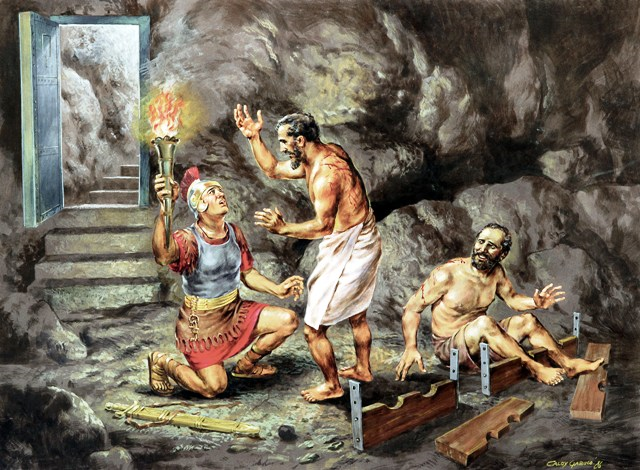
Acts 13:52

Fancy stuff. Vermont State Capitol

Wednesday, 1 February 2023

And the disciples were filled with joy and with the Holy Spirit. Acts 13:52

Note: You can listen to today’s commentary courtesy of our friends at “Bible in Ten” podcast. (Click Here to listen).

You can also read this commentary, with music, courtesy of our friends at “Discern the Bible” on YouTube. (Click Here to listen), or at Rumble (Click Here to listen).

In the previous verse, Paul and Barnabas “shook off the dust from their feet” against those who expelled them from the region. They were now set to continue elsewhere with the evangelization of those they encountered, but they had made a life-changing difference in many while in the region of Pisidia, as testified to in the final words of Chapter 13 which begin with, “And the disciples.”

This is not referring to Paul and Barnabas but to the converts in the area, both Jew and Gentile. The word translated as “disciples” is mathétés. It signifies a learner or a disciple. It is thus not referring to Paul and Barnabas who provided the instruction, but to those who received it. That it is a word that refers to both Jews and Gentiles is most poignantly revealed in Acts 15. There, when referring specifically to the Gentiles, it says –

“Now the apostles and elders came together to consider this matter. And when there had been much dispute, Peter rose up and said to them: ‘Men and brethren, you know that a good while ago God chose among us, that by my mouth the Gentiles should hear the word of the gospel and believe. So God, who knows the heart, acknowledged them by giving them the Holy Spirit, just as He did to us, and made no distinction between us and them, purifying their hearts by faith. 10 Now therefore, why do you test God by putting a yoke on the neck of the disciples [mathétés] which neither our fathers nor we were able to bear? 11 But we believe that through the grace of the Lord Jesus Christ we shall be saved in the same manner as they.’” Acts 15:6-11

The noun mathétés is not used after Acts 21, but the verb from which it is derived, manthanó, is used by Paul in nine of his epistles. If one learns, he is a disciple. The idea is that those now referred to by Luke are those in the region of Antioch of Pisidia, both Jews and Gentiles, that had received the gospel of Jesus Christ. With that noted, Luke records that they “were filled with joy.”

This is the exhortation Paul will later write to those in Thessalonica and elsewhere, saying, “Rejoice always” (1 Thessalonians 5:16). These disciples apparently didn’t need the exhortation but were simply filled with joy because of the freedom they now found by being in Christ. Along with that, Luke completes the verse and the chapter, saying, “and with the Holy Spirit.”

Again, this is as stated elsewhere by Paul, such as –

“Therefore do not let your good be spoken of as evil; 17 for the kingdom of God is not eating and drinking, but righteousness and peace and joy in the Holy Spirit.” Romans 14:16, 17

As for the whole thought of being “filled with joy and with the Holy Spirit,” the verb is both imperfect and it is in the passive or middle voice. The meaning is that they were filled and continued to be filled (the imperfect tense), and they were both agents of the action and yet concerned with the action (middle voice).

In other words, the Spirit acted upon them as they interacted with God through the knowledge they possessed. The joy and the filling came about by the mutual relationship that was occurring in their lives.

Life application: Why is it that we may be lacking joy and the filling of the Spirit? It is because we have lost focus on what it means to be saved. When we are saved, at that moment in time, it becomes the main issue of our life. We let go of our sin, acknowledging it before God and placing it on Christ. The burden and the debt were lifted from us, and we experienced the knowledge that God had done this for us, apart from any effort.

That brought the joy and the filling of the Spirit. Eventually, we allowed this current life to overtake our thoughts. We struggle at work, we fight with family or friends, our faithful dog dies, or we have our car repossessed. In this, we are no longer filled with joy and the Holy Spirit. Why? Because it is no longer the central focus of our existence. This is not how our life is to be conducted.

Rather, the most important event in our life occurred the moment we came to Jesus. Since that time, and forevermore, nothing will come to pass that can exceed the weight and marvel of what took place. The problem isn’t that the moment is over and gone forever. Rather, our focus has turned from that key and pivotal event.

Instead of having the attitude that existed then, our eyes, our attention, and thus our lives are redirected to that which is of less value, and we are consumed by the world once again. Rather than “Work is such a burden, but it is nothing compared to Jesus,” we collapse under our own misery.

Rather than “My wife says she is leaving me, but Jesus will never leave nor forsake me,” we have placed this temporary and earthly relationship above the Lord. Rather than “I miss Fido so much, but Jesus gave him to me for a span and I am so grateful for those years,” our thoughts are consumed with this loss as if the dog is more important than the relationship we have with God in Christ. This is true with any earthly relationship or possession.

The key to joy is not focusing on what this world offers, no matter how great it was or how great it might be. The key to the joy the Bible speaks of is to know that God saved us, He is there with us, and we are guaranteed to have a restoration that is beyond anything we can imagine at this point. God has done it, God is with us now as we await its completion, and God will bring us to that state of completion, without fail.

This is the heart of joy in the Lord. And this is why so many Christians are so miserable in their walk with Him. They either have had their eyes redirected from what Jesus has done, or they believe that what Jesus has done is conditional. Who can have joy and be filled with the Holy Spirit at such times? Rather, FIX YOUR EYES ON JESUS and be ASSURED OF YOUR SALVATION because the word assures you of it. Be FILLED WITH JOY AND WITH THE HOLY SPIRIT all your days. To the glory of God who is with you as you continue this walk to glory.

Heavenly Father, forgive us for diverting our eyes from Jesus and looking back to this temporary, fallen, and even dirty existence. We have the purity of Christ before us, and yet we cling to that which is hopeless and miserable. And, Lord God, forgive us for questioning Your word and the salvation that You have granted to us. It is no longer about us, but about Jesus, when we call out to You through Him. Forgive us for such a faithless attitude. Redirect us and reassure us, and we will be sound in Christ once again. Amen.


Acts 13:51

The continued journey.

Tuesday, 31 January 2023

But they shook off the dust from their feet against them, and came to Iconium. Acts 13:51

Note: You can listen to today’s commentary courtesy of our friends at “Bible in Ten” podcast. (Click Here to listen).

You can also read this commentary, with music, courtesy of our friends at “Discern the Bible” on YouTube. (Click Here to listen), or at Rumble (Click Here to listen).

In the last verse, Paul and Barnabas were expelled from the region of Antioch of Pisidia. With that, Luke next records, “But they shook off the dust from their feet.”

This was obviously a way of demonstrating their displeasure with those who had expelled them, revealing that even the dust on the apostles’ feet that was associated with those of Antioch was detestable. It is what Jesus instructed His apostles in Israel to do, if necessary, while proclaiming the kingdom of God, as is testified to in the gospels –

“Whatever house you enter, stay there, and from there depart. And whoever will not receive you, when you go out of that city, shake off the very dust from your feet as a testimony against them.” Luke 9:4, 5

This is recorded in Matthew and Mark as well. Matthew’s words explain the matter further –

“Now whatever city or town you enter, inquire who in it is worthy, and stay there till you go out. 12 And when you go into a household, greet it. 13 If the household is worthy, let your peace come upon it. But if it is not worthy, let your peace return to you. 14 And whoever will not receive you nor hear your words, when you depart from that house or city, shake off the dust from your feet. 15 Assuredly, I say to you, it will be more tolerable for the land of Sodom and Gomorrah in the day of judgment than for that city!” Matthew 10:11-15

Quite often, this act of Paul and Barnabas is directly associated with the words of the Lord in those gospel passages, such as –

“The act was one of literal obedience to our Lord’s commands (see Note on Matthew 10:14), and may fairly be regarded as evidence that that command had come to the knowledge of Paul and Barnabas as well as of the Twelve.” Charles Ellicott

Actually, there is nothing to suggest this, for several reasons. One is that if this were “literal obedience to the Lord,” then other such instances where they failed to do this would be considered “literal disobedience to the Lord.” Further, the surrounding context of Jesus’ words demonstrates that this was never to be taken as a command during the church age, such as other words found in Matthew 10, and which are also summed up in the other gospels as well –

“These twelve Jesus sent out and commanded them, saying: ‘Do not go into the way of the Gentiles, and do not enter a city of the Samaritans. But go rather to the lost sheep of the house of Israel. And as you go, preach, saying, ‘The kingdom of heaven is at hand.’ Heal the sick, cleanse the lepers, raise the dead, cast out demons. Freely you have received, freely give. Provide neither gold nor silver nor copper in your money belts, 10 nor bag for your journey, nor two tunics, nor sandals, nor staffs; for a worker is worthy of his food.’” Matthew 10:5-10

If Paul and Barnabas were following the command of the Lord from the gospels, they would not have been going to the Gentiles, they would not have been carrying money, which they obviously did in order to sail on ships, etc. Rather, Jesus’ words were to the twelve apostles and were directed to the ministry within Israel while still under the law.

With Jesus’ work completed, a new dispensation had entered. The shaking of dust off of their feet was obviously a sign that was known and practiced at the time, and which Jesus directed his apostles to employ for those who saw them do it as a witness against them. The same is true with Paul and Barnabas. This is all the more evident because, in Acts 18, Paul uses a different method of employing the same general thought –

“When Silas and Timothy had come from Macedonia, Paul was compelled by the Spirit, and testified to the Jews that Jesus is the Christ. But when they opposed him and blasphemed, he shook his garments and said to them, ‘Your blood be upon your own heads; I am clean. From now on I will go to the Gentiles.’” Acts 18:5, 6

This was a similar sign of displeasure that was directed to his Jewish audience. It was something they would have fully understood from their own Scriptures –

“Then I called the priests, and required an oath from them that they would do according to this promise. 13 Then I shook out the fold of my garment and said, ‘So may God shake out each man from his house, and from his property, who does not perform this promise. Even thus may he be shaken out and emptied.’” Nehemiah 5:12, 13

If Jesus’ words were still in effect, Paul and Silas would have needed to shake the dust off of their feet at that time as well. But verse 13:51 is the only instance in Acts where this is recorded. The use of such gestures is simply a way of demonstrating frustration at the circumstances that have arisen. In this case, it was shaking off the dust of the feet “against them,” meaning the Jews, the devout and prominent women, and the chief men of the city mentioned in the previous verse.

Of this, Ellicott rightly says, “It was in itself, however, the language of a natural symbolism which every Jew would understand.” Even more, anyone – Jew or Gentile – would understand with only a moment of thought.

If this were a sign as commanded by the Lord, it would then include all of the inhabitants of the city as noted in the Matthew citation above. But the city was also filled with new believers. The action was not directed against them. It was merely an open gesture of displeasure to those who had been so rude to them. With that, it next says that they “came to Iconium.”

The name in Greek is Ikonion. Strong’s supposes the name is derived from eikon, meaning “image,” and thus it means “Image like.” On the other hand, John Gill says –

“It was called by the Syrians, ‘Ik-ona’, which signifies ‘the bosom of sheep’; the country round about it being famous for feeding great numbers of sheep; and here afterwards was a church of Christ, a bosom for his sheep.”

Of this location, the 19th Century theologian Albert Barnes provides these words –

“This was the capital of Lycaonia. It is now called Konieh, and is the capital of Caramania. ‘Konieh extends to the east and south over the plain far beyond the walls, which are about two miles in circumference … Mountains covered with snow rise on every side, excepting toward the east, where a plain, as flat as the desert of Arabia, extends far beyond the reach of the eye’ (Capt. Kinnear). ‘Little, if anything, remains of Greek or Roman Iconium, if we except the ancient inscriptions and the fragments of sculptures which are built into the Turkish walls.’ ‘The city wall is said to have been erected by the Seljukian sultans: it seems to have been built from the ruins of more ancient buildings, as broken columns, capitals, pedestals, bas-reliefs, and other pieces of sculpture contribute toward its construction. It has 80 gates, of a square form, each known by a separate name, and, as well as most of the towers, embellished with Arabic inscriptions … I observed a few Greek characters on the walls, but they were in so elevated a situation that I could not decipher them’ (Capt. Kinneir).”

Today, the name is Konya. It is a major city in Turkey, being the sixth most populous and having over two million residents.

Life application: Understanding the dispensational model for interpreting the Bible is crucial to possessing proper theology. When someone claims that the words of Jesus in a particular section of the synoptic gospels still applies today, just take them to the surrounding verses and ask them, “Then why aren’t you doing this also.” There will almost always be obvious indicators that Jesus was speaking only to Israel about matters that pertain solely to them.

To tear verses out of their context, and then shove them into church-age doctrine, is damaging for several reasons. Probably the main reason is that an inevitable contradiction in theology will arise. What is prescribed in the epistles is based upon the finished, final, and forever work of Jesus Christ. What is presented in the gospels is not. In those gospels, He was still in the process of fulfilling the law, and his apostles and disciples were a part of that until His work was complete.

Once the law was fulfilled and set aside, Jesus gave them new instructions and poured out His Spirit on them to lead them in a new direction. This includes Paul. These instructions are now found in the epistles.

Having said this, dispensationalism can be taken too far, wrongly dividing the church age further than intended. This mainly comes from a lack of scholarship in understanding the symbolism and typology of the Old Testament, something that pointed to the work of Jesus. This was not “Jewish” symbolism, but “Christ-centered” symbolism. By misunderstanding this, heretical teachings have arisen that further, and incorrectly, divide the church.

Be careful what you assimilate. Everything must be taken in its proper context. When this does not occur, you are assured of having unsound doctrine.

Glorious Lord Jesus, thank You for Your work under the law to free man from law and to bring us into the state of grace that brings us back to our heavenly Father. For those who have come to You, we are safe and secure forever from condemnation. Thank You, Lord, for what You have done. All glory to Your magnificent name! Amen.


Acts 13:50

Looking out window of Vermont State Capitol.

Monday, 30 January 2023

But the Jews stirred up the devout and prominent women and the chief men of the city, raised up persecution against Paul and Barnabas, and expelled them from their region. Acts 13:50

Note: You can listen to today’s commentary courtesy of our friends at “Bible in Ten” podcast. (Click Here to listen)

You can also read this commentary, with music, courtesy of our friends at “Discern the Bible” on YouTube. (Click Here to listen), or at Rumble (Click Here to listen).

The previous verse noted that “the word of the Lord was being spread throughout all the region.” Because the gospel is a message of freedom, and because Satan and his followers hate freedom, blowback from the apostle’s efforts was inevitable. This had repeatedly been the case since the first proclamation of the gospel by Peter in Acts 2. With the successful efforts of Paul and Barnabas in the region, the resulting antagonistic attitude of the opposition grew. Luke now records who was behind it, beginning with, “But the Jews.”

The contrast between Paul and Barnabas, who are both Jews, and “the Jews” noted here is bold and striking. Despite being Jews, Paul and Barnabas have a message to convey that goes beyond the Jewish people. The Jews do not. Their message is one of bondage. If there are those who are not Jews who accept their message, they are brought into a position of subservience, not freedom.

On the other hand, the message of Jesus allows people to remain who they are in a manner that is not seen in the message of the Jews. The gospel calls for a change in heart toward God, and it is offered to anyone of any station in life. This is not the case with the Jews as is seen in the next words. They “stirred up the devout and prominent women and the chief men of the city.”

The Jews did not go out into the streets and alleys and proclaim freedom from sin. Instead, they established themselves in a city, brought their religion with them, and allowed the prominent and wealthy to join them, thus gaining influence at the higher levels. Though a bit long, the words of Charles Ellicott explain this situation –

“The fact stated brings before us another feature of the relations between Jews and Gentiles at this period. They ‘compassed sea and land to make one proselyte’ (Matthew 23:15). They found it easier to make proselytes of women. Such conversions had their good and their bad sides. In many cases there was a real longing for a higher and purer life than was found in the infinite debasement of Greek and Roman society, which found its satisfaction in the life and faith of Israel. (See Notes on Acts 17:4; Acts 17:12.) But with many, … the change brought with it new elements of superstition and weakness, and absolute submission of conscience to its new directors, and thus the Rabbis were often to the wealthier women of Greek and Roman cities what Jesuit confessors were in France and Italy in the seventeenth and eighteenth centuries. Here we get the darker side of the picture. The Jews stir up the women of the upper class, and they stir up their husbands. The latter were content apparently to acquiesce in their wives accepting the Judaism with which they had become familiar, but resented the intrusion of a new and, in one sense, more exacting doctrine.”

It is these Jews, with a finger on those who were politically established and who possessed great wealth, that “raised up persecution against Paul and Barnabas.” Here, Luke uses a word, epegeiró, for the first of two times in Scripture. It signifies “to rouse upon.” In other words, their influence is used upon the minds of the people to stir them up against the message that has been conveyed. In their arousal, it is to a state of persecution against Paul and Barnabas.

The type of persecution the apostles faced is not stated, but exacting examples of such persecution will be seen as Acts continues. Quite often, it will be because of the Jews who oppose them.

A notable example of this is found in Acts 19. In that chapter, there was a great disturbance that resulted from Paul’s sharing of the gospel. In proclaiming Jesus as God, it means that idols are false gods. Because of this, a state of friction arose in Ephesus because of the great idol that was worshipped there. Smaller images of the great statue of Diana were made for people to purchase. But if the gospel flourished, these idol makers would lose their source of revenue. Hence, those who made them stirred up the masses. There it says –

“And they drew Alexander out of the multitude, the Jews putting him forward. And Alexander motioned with his hand, and wanted to make his defense to the people.” Acts 19:33

The Jews used the situation in Ephesus as a pretext to silence the spread of the gospel. But even more, this may be the same Alexander who continued to harass Paul as noted in 2 Timothy –

“Alexander the coppersmith did me much harm. May the Lord repay him according to his works. 15 You also must beware of him, for he has greatly resisted our words.” 2 Timothy 4:14, 15

If this is the same Alexander, he not only wanted to silence the gospel because he had rejected it, but he also profited off the sales of these idols. That could be inferred from his being a coppersmith. It is this same attitude that caused the Jews to stir up those in Antioch against Paul and Barnabas. From there, Luke notes they “expelled them from their region.”

With the message widely spread in the area, and with the Jews exerting their influence over those in power, the Lord knew that it was time for the apostles to move on. What initially seems like a defeat will prove to be another victory as Chapter 14 opens. The apostles will move on and bring the message to another area where a great multitude will again receive their message.

Life application: The Jews brought their situation upon themselves. Exactly as the Law of Moses said would occur, they went into an extended period of punishment for their rejection of Jesus. But it should not go without noting that this included Paul too. He was as opposed to the message of Jesus as anyone. And yet, the Lord, through His grace and mercy, brought Paul to Himself –

“For you have heard of my former conduct in Judaism, how I persecuted the church of God beyond measure and tried to destroy it. 14 And I advanced in Judaism beyond many of my contemporaries in my own nation, being more exceedingly zealous for the traditions of my fathers.
15 But when it pleased God, who separated me from my mother’s womb and called me through His grace, 16 to reveal His Son in me, that I might preach Him among the Gentiles, I did not immediately confer with flesh and blood, 17 nor did I go up to Jerusalem to those who were apostles before me; but I went to Arabia, and returned again to Damascus.” Galatians 1:13-17

This is further explained by Paul to Timothy –

“And I thank Christ Jesus our Lord who has enabled me, because He counted me faithful, putting me into the ministry, 13 although I was formerly a blasphemer, a persecutor, and an insolent man; but I obtained mercy because I did it ignorantly in unbelief. 14 And the grace of our Lord was exceedingly abundant, with faith and love which are in Christ Jesus.” 1 Timothy 1:12-14

Paul was given grace and mercy, and he used it to the glory of God from that moment on. And despite his anger at the state of his people in rejecting Christ Jesus, he understood their attitude because he had shared in it. His first allegiance was always to Jesus, but he also remained troubled in his heart over the state of his people (See Romans 9:1-3).

This should be our attitude as well, both to the Jews and to the Gentiles who have rejected Jesus. We should be angry at their state of rebellion and their active resistance to the gospel. But we should also be troubled in our hearts at their pitiful state of condemnation. In other words, we should be willing to go in both directions.

We should strive against them as they attack the message while striving with the gospel’s proclamation in hopes that some may be saved. Let us do our best to be responsible with our state in Christ in this manner. Hold fast to the truth of the gospel proclaiming it and allowing it to have the effect that God intends for it at any given time and place.

Help us, Lord God, to never be shy about being Christians. May we faithfully proclaim that we are saved believers of Christ who will stand on His gospel no matter what. Those who oppose it will receive what they are due. And those who accept it will be granted Your mercy and forgiveness. May our words go forth! From there, they will do as You have purposed. Help us to be responsible and to speak out so that this can happen. Amen.


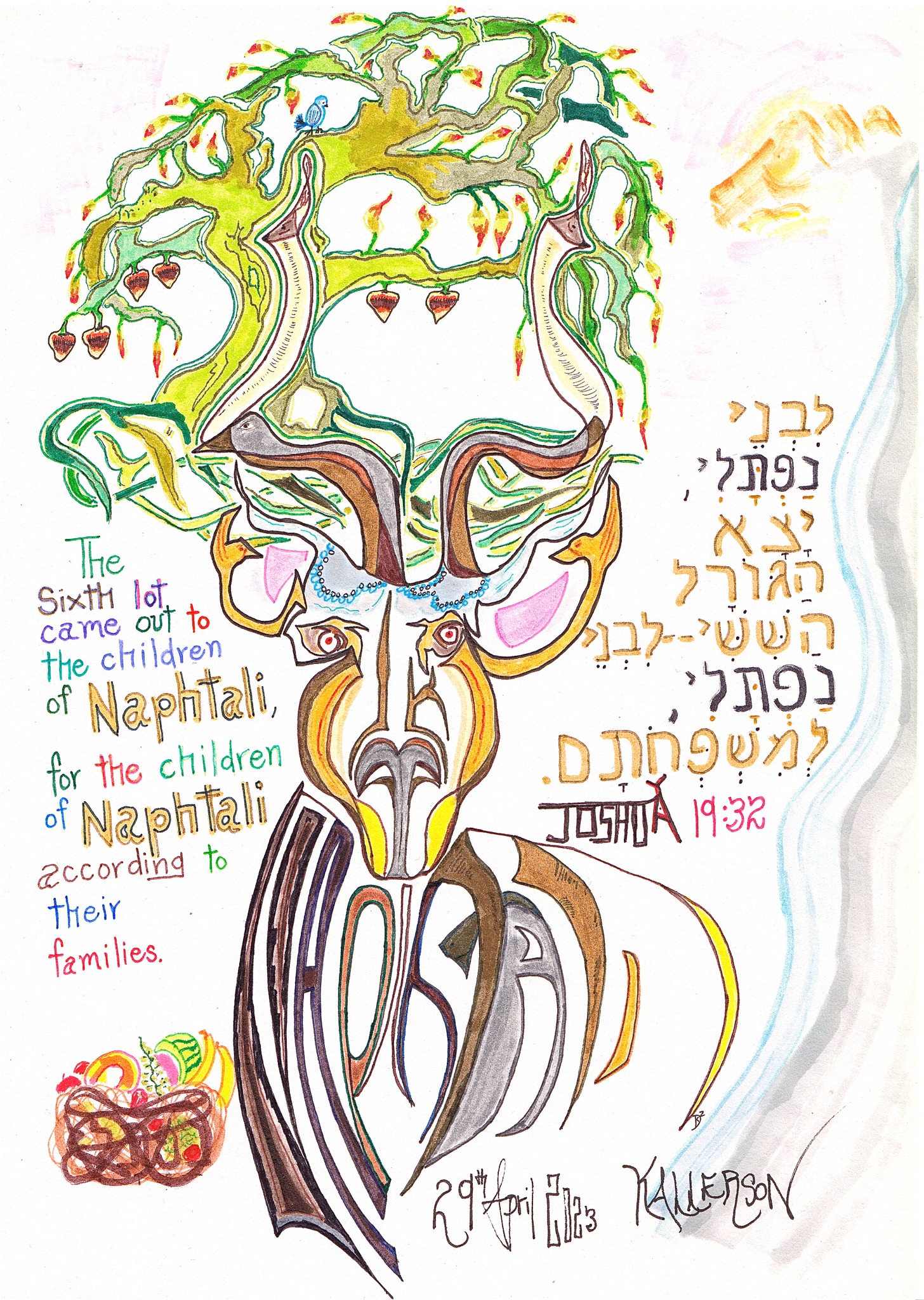
Joshua 14:1-5 (No Part to the Levites)

Artwork by Doug Kallerson.

Joshua 14:1-5
No Part to the Levites

In 1972, the Miami Dolphins, under coach Don Shula, had what became known as “the Perfect Season.” They went 14-0. Many of the players became household names. I remember watching them and being excited about the team despite not really caring much about sports. One can kind of get caught up in something like that.

But despite having a perfect season, each player was imperfect, and each game had its own flaws. There were fumbles, there were interceptions, and so on. And so, there is the dichotomy between the imperfect team and their perfect season. The two are seemingly at odds with one another, and yet they really aren’t. Out of imperfection, perfection arose.

The Bible shows us what is perfect and what is flawed. At times, it shows us this explicitly, and at times it does so in veiled ways. It also shows us how something that is seemingly imperfect can be made perfect. We’ll see something along those lines in our verses today.

Text Verse: “How then can man be righteous before God?
Or how can he be pure who is born of a woman?
If even the moon does not shine,
And the stars are not pure in His sight,
How much less man, who is a maggot,
And a son of man, who is a worm?” Job 25:4-6

Despite often not speaking rightly about the Lord, the questions of Bildad the Shuhite are still valid. How can man, who is by nature unrighteous, be considered righteous before God? In understanding the work of Christ, we can know that with God, it is possible.

How can a person who is born of a woman be pure? Being a human implies bearing sin, simply because sin is transmitted from father to child. So, how can one who is born of a woman be pure? With God in Christ, that too is possible.

As for stars not being pure in the sight of God, that depends on the nature and meaning of the word “star.” One thing that is tainted and impure can be emblematic of another thing that is not. We have seen that in typology innumerable times in our study of the Old Testament.

For example, Joshua may have been a fallen, sinful man, but he could still anticipate and picture the perfect, unblemished Lord Jesus. Likewise, despite the imperfection of the individual members of the team, the Miami Dolphins were still able to have the perfect season

This sermon is entitled No Part to the Levites, but that is only in relation to a tribal land grant, one that reveals imperfection. And yet, in the imperfection of the land inheritance of the tribes of Israel, there is still a note of a double measure of spiritual perfection. How? Well, stick around and we will evaluate the matter.

Nifty things such as this are to be found in His superior word. And so, let us turn to that precious word once again, and… May God speak to us through His word today, and may His glorious name ever be praised.

I. And They Divided the Land (verses 1-5)

These are the areas which the children of Israel inherited in the land of Canaan,

After designating the inheritance east of the Jordan to the three-and-one-half tribes, the narrative now turns to the inheritance in the land of Canaan proper. This is the land…

1 (con’t) which Eleazar the priest, Joshua the son of Nun, and the heads of the fathers of the tribes of the children of Israel distributed as an inheritance to them.

It is of note that Eleazar (God Has Helped) is placed prior to Joshua. The reason for this goes back to Joshua’s inauguration –

“And the Lord said to Moses: ‘Take Joshua the son of Nun with you, a man in whom is the Spirit, and lay your hand on him; 19 set him before Eleazar the priest and before all the congregation, and inaugurate him in their sight. 20 And you shall give some of your authority to him, that all the congregation of the children of Israel may be obedient. 21 He shall stand before Eleazar the priest, who shall inquire before the Lord for him by the judgment of the Urim. At his word they shall go out, and at his word they shall come in, he and all the children of Israel with him—all the congregation.’” Numbers 27:18-21

Eleazar is the one to determine the will of the Lord. He then conveys that will to Joshua. One must know the will of the Lord prior to abiding by that will. In the case of the division of the land, it will come from the Lord through the hand of Eleazar.

From there Joshua will oversee the process and direct it through the fathers of the tribes. The word translated as tribe, mateh, signifies the genealogical aspect of the tribe rather than the political aspect.

As for the fathers of the tribes, it is rather surprising that they have already been named and designated for this purpose in Numbers 34:16-28. Although that passage was not too long before entrance into Canaan, the narrative now follows after seven years of war within the land.

And yet, it can be assumed that they have all survived in order to receive their inheritance and portion it out to their tribes. Were it not so, a replacement would have been named.

Their inheritance was by lot,

b’goral nakhalatam – “In lot their inheritance.” This is now the first of twenty-six times that the goral, or lot, will be mentioned in Joshua. The word comes from an unused root meaning to be rough, such as a stone. Hence, it is a pebble used for the purpose of determining lots. At times, it is used to indicate a portion or destiny, such as “this is my lot in life.”

2 (con’t) as the Lord had commanded by the hand of Moses, for the nine tribes and the half-tribe.

This is what was specifically detailed in Numbers 34:16-29 and which was summed up with the words, “These are the ones the Lord commanded to divide the inheritance among the children of Israel in the land of Canaan” (Numbers 34:29).

Hence, the narrative now is given to show strict obedience to the words set forth by the Lord through Moses. Notably in those verses, however, there is no mention of Reuben, Gad, or the other half-tribe of Manasseh. The reason for that is…

For Moses had given the inheritance of the two tribes and the half-tribe on the other side of the Jordan;

This was specifically stated in Numbers 34:14, 15. Their land had been subdued and the inheritance was given, provided they helped the other tribes to subdue their inheritances west of the Jordan.

What is notable concerning these stated allotments is that though there are twelve tribes recorded as receiving an inheritance, there are actually thirteen land allotments:

Two and one-half east of the Jordan = 3
Nine and one-half west of the Jordan = 10

The number thirteen in Scripture signifies “rebellion, apostasy, defection, corruption, disintegration, revolution, or some kindred idea” (Bullinger). This is pretty much the constant theme of Israel throughout their years. The number of their inheritances forms a picture of their attitude and their conduct before the Lord.

Despite this, there is one more tribe to consider…

3 (con’t) but to the Levites he had given no inheritance among them.

This defines the fourteenth division which is spread among the thirteen divisions. This is the third time in just two chapters that this has been stated. Levi is given no land inheritance. However –

“Only to the tribe of Levi he had given no inheritance; the sacrifices of the Lord God of Israel made by fire are their inheritance, as He said to them” (13:14).

“But to the tribe of Levi Moses had given no inheritance; the Lord God of Israel was their inheritance, as He had said to them” (13:33).

“…but to the Levites he had given no inheritance among them” (14:3).

And so, despite there being no land inheritance for Levi, there actually is an inheritance for them. As such, the number of inheritances now extends to fourteen, the number Bullinger defines as “a double measure of spiritual perfection” and “the number associated with the incarnation.”

One can see that despite Israel’s rebellion and apostasy in the earthly realm, because of Levi, the Lord has placed His stamp upon them in the spiritual realm. The wisdom of God is carefully revealed in everything that is seen in these tribal allotments.

Next, the note of how one tribe became two is stated again…

For the children of Joseph were two tribes: Manasseh and Ephraim.

If this were not detailed in Scripture, there would be an imperfection of division, both as tribes and in land grants. However, Jacob adopted the two sons of Joseph, thus giving him a double portion of land. But this then brings in another multiple of fourteen. Though there are twelve natural sons of Jacob, there are fourteen reckoned to Israel –

Twelve: Reuben, Simeon, Levi, Judah, Dan, Naphtali, Gad, Asher, Issachar, Zebulun, Joseph, and Benjamin.

Fourteen: Reuben, Simeon, Levi, Judah, Dan, Naphtali, Gad, Asher, Issachar, Zebulun, Joseph (and Manasseh and Ephraim), and Benjamin.

This then corresponds to twelve/fourteen apostles –

Twelve: Simon/Peter, Andrew, James the son of Zebedee, John, Philip, Bartholomew, Thomas, Matthew, James the son of Alphaeus, Lebbaeus (Thaddaeus), Simon the Canaanite, Judas Iscariot.

Fourteen: Simon/Peter, Andrew, James the son of Zebedee, John, Philip, Bartholomew, Thomas, Matthew, James the son of Alphaeus, Lebbaeus/Thaddaeus, Simon the Canaanite, Judas Iscariot (replaced by Matthias), Saul/Paul.

As for the imperfection of the land inheritance for Israel, that is seen in the next words…

4 (con’t) And they gave no part to the Levites in the land,

This is based upon what has already been repeatedly said and which was noted again in verse 3. No tribal land inheritance is given to the tribe of Levi because they will be spread out among the tribes as those who minister the law among the people.

This was first prophesied by Jacob in Genesis 49 –

“Simeon and Levi are brothers;
Instruments of cruelty are in their dwelling place.
Let not my soul enter their council;
Let not my honor be united to their assembly;
For in their anger they slew a man,
And in their self-will they hamstrung an ox.
Cursed be their anger, for it is fierce;
And their wrath, for it is cruel!
I will divide them in Jacob
And scatter them in Israel
.” Genesis 49:5-7

Because of what they did in Genesis 34 by killing the males in Shechem, Jacob prophesied over these two sons that they would be divided and scattered.

Though seemingly a negative, the reason for their scattering within Israel occurs for Levi because of their bravery before the Lord at the time when Israel made the golden calf to worship –

“Now when Moses saw that the people were unrestrained (for Aaron had not restrained them, to their shame among their enemies), 26 then Moses stood in the entrance of the camp, and said, ‘Whoever is on the Lord’s side—come to me!’ And all the sons of Levi gathered themselves together to him. 27 And he said to them, ‘Thus says the Lord God of Israel: “Let every man put his sword on his side, and go in and out from entrance to entrance throughout the camp, and let every man kill his brother, every man his companion, and every man his neighbor.”’ 28 So the sons of Levi did according to the word of Moses. And about three thousand men of the people fell that day. 29 Then Moses said, ‘Consecrate yourselves today to the Lord, that He may bestow on you a blessing this day, for every man has opposed his son and his brother.’” Exodus 32:25-29

Levi took up arms against his own brothers. This was reckoned to them as the reason for a particular blessing from the Lord which is that He would be their inheritance. To understand that, one must then understand how this came about.

At the Exodus, the Lord killed the firstborn of Egypt, including both man and beast. As He spared them in Israel, the law of the firstborn was enacted –

“And it shall be, when the Lord brings you into the land of the Canaanites, as He swore to you and your fathers, and gives it to you, 12 that you shall set apart to the Lord all that open the womb, that is, every firstborn that comes from an animal which you have; the males shall be the Lord’s. 13 But every firstborn of a donkey you shall redeem with a lamb; and if you will not redeem it, then you shall break its neck. And all the firstborn of man among your sons you shall redeem14 So it shall be, when your son asks you in time to come, saying, ‘What is this?’ that you shall say to him, ‘By strength of hand the Lord brought us out of Egypt, out of the house of bondage. 15 And it came to pass, when Pharaoh was stubborn about letting us go, that the Lord killed all the firstborn in the land of Egypt, both the firstborn of man and the firstborn of beast. Therefore I sacrifice to the Lord all males that open the womb, but all the firstborn of my sons I redeem.’ 16 It shall be as a sign on your hand and as frontlets between your eyes, for by strength of hand the Lord brought us out of Egypt.” Exodus 13:11-16

The firstborn of all belonged to the Lord and was to be sacrificed to Him. To avoid the obvious difficulties of such a situation, the firstborn males were to be redeemed.

Next, in Numbers, the selection of the Levites in place of the firstborn of Israel was made. Hence, they would belong solely to the Lord and not be reckoned for a tribal land inheritance –

“Then the Lord spoke to Moses, saying: ‘Take the Levites from among the children of Israel and cleanse them ceremonially. Thus you shall do to them to cleanse them: Sprinkle water of purification on them, and let them shave all their body, and let them wash their clothes, and so make themselves clean. Then let them take a young bull with its grain offering of fine flour mixed with oil, and you shall take another young bull as a sin offering. And you shall bring the Levites before the tabernacle of meeting, and you shall gather together the whole congregation of the children of Israel. 10 So you shall bring the Levites before the Lord, and the children of Israel shall lay their hands on the Levites; 11 and Aaron shall offer the Levites before the Lord like a wave offering from the children of Israel, that they may perform the work of the Lord. 12 Then the Levites shall lay their hands on the heads of the young bulls, and you shall offer one as a sin offering and the other as a burnt offering to the Lord, to make atonement for the Levites.
13 ‘And you shall stand the Levites before Aaron and his sons, and then offer them like a wave offering to the Lord. 14 Thus you shall separate the Levites from among the children of Israel, and the Levites shall be Mine. 15 After that the Levites shall go in to service the tabernacle of meeting. So you shall cleanse them and offer them like a wave offering. 16 For they are wholly given to Me from among the children of Israel; I have taken them for Myself instead of all who open the womb, the firstborn of all the children of Israel. 17 For all the firstborn among the children of Israel are Mine, both man and beast; on the day that I struck all the firstborn in the land of Egypt I sanctified them to Myself. 18 I have taken the Levites instead of all the firstborn of the children of Israel. 19 And I have given the Levites as a gift to Aaron and his sons from among the children of Israel, to do the work for the children of Israel in the tabernacle of meeting, and to make atonement for the children of Israel, that there be no plague among the children of Israel when the children of Israel come near the sanctuary.’” Numbers 8:5-19

At that time, it still has not been recorded that Levi would receive no land inheritance. That is first seen in Numbers 18 –

“Then the Lord said to Aaron: ‘You shall have no inheritance in their land, nor shall you have any portion among them; I am your portion and your inheritance among the children of Israel.
21 “Behold, I have given the children of Levi all the tithes in Israel as an inheritance in return for the work which they perform, the work of the tabernacle of meeting. 22 Hereafter the children of Israel shall not come near the tabernacle of meeting, lest they bear sin and die. 23 But the Levites shall perform the work of the tabernacle of meeting, and they shall bear their iniquity; it shall be a statute forever, throughout your generations, that among the children of Israel they shall have no inheritance. 24 For the tithes of the children of Israel, which they offer up as a heave offering to the Lord, I have given to the Levites as an inheritance; therefore I have said to them, ‘Among the children of Israel they shall have no inheritance.’” Numbers 18:20-24

As is seen there, it is Aaron – meaning the priestly class – who was told that he would receive no land inheritance and Levi would be attached to them in the service of the Lord. The Levites were to stand between the people and the priests in the service of the tabernacle while the priests ministered between the people and the Lord.

Because of this service, those tithes that were presented to the Lord as a heave offering, meaning the third-year tithes, were to belong to the Levites. These tithes were considered the Lord’s portion. As such, it is said that the Lord is Levi’s inheritance.

From this tithe of the land, the Levites were then to offer up a tenth of that for the priests –

“Then the Lord spoke to Moses, saying, 26 ‘Speak thus to the Levites, and say to them: ‘When you take from the children of Israel the tithes which I have given you from them as your inheritance, then you shall offer up a heave offering of it to the Lord, a tenth of the tithe. 27 And your heave offering shall be reckoned to you as though it were the grain of the threshing floor and as the fullness of the winepress. 28 Thus you shall also offer a heave offering to the Lord from all your tithes which you receive from the children of Israel, and you shall give the Lord’s heave offering from it to Aaron the priest. 29 Of all your gifts you shall offer up every heave offering due to the Lord, from all the best of them, the consecrated part of them.’ 30 Therefore you shall say to them: ‘When you have lifted up the best of it, then the rest shall be accounted to the Levites as the produce of the threshing floor and as the produce of the winepress. 31 You may eat it in any place, you and your households, for it is your reward for your work in the tabernacle of meeting. 32 And you shall bear no sin because of it, when you have lifted up the best of it. But you shall not profane the holy gifts of the children of Israel, lest you die.’” Leviticus 18:25-32

What is presented to the Levites is a tithe to the Lord. What is then presented to the priests, the tithe of the tithe, is reckoned as if it was the actual produce of the Levites, even though they had no land inheritance. Therefore, even though they had no land grant, those tithes from the third-year tithes are given as if they had their own land.

With this understood, the reason for their receiving no land inheritance is more perfectly seen. Their siding with the Lord at the incident of the golden calf became the defining moment which fulfilled the prophecy of Jacob, and which allowed them to receive the Lord as their inheritance.

Moses spoke of this as he blessed the tribes before his death. In his blessing upon Levi, a portion of his words said –

“Who says of his father and mother,
‘I have not seen them’;
Nor did he acknowledge his brothers,
Or know his own children;
For they have observed Your word
And kept Your covenant.” Deuteronomy 33:9

To more perfectly understand Moses’ words, those lines from Deuteronomy concerning Levi should be reexamined…

*Who says of his father and mother,

Levi is referred to by a verb prefixed by an article: ha’omer l’aviv u-l’imo – “The sayer to his father and to his mother.” Here, it is referring to Levi as if he is an individual, a collective in the singular. He says…

*‘I have not seen them’;

It is singular: lo’reitiv – “Not I have seen him.” The mother is the wife of the father and so the singular stands for both. The father and the mother are there, but it is as if they are not seen, and they are not regarded. The same attitude is again seen in the next words…

*Nor did he acknowledge his brothers,

v’eth ekhav lo hikir – “And his brothers no regard.” Moses says that even though Levi had brothers, his mind was not on them when called to do what he must do. Moses is making a point about Levi’s priorities. Moses next says…

*Or know his own children;

v’eth banav lo yada – “And sons no know.” Any children of Levi are as if they are not even his when he is called to act. Levi doesn’t see the parents before him, doesn’t regard the brothers around him, and he doesn’t know his own sons.

Despite them being the closest of family relationships, Moses speaks of Levi’s priorities. What is it that Levi has put first? To tell us, Moses slips into the plural…

*For they have observed Your word

ki shameru imratekha– “For they have heeded Your word.” The plural now speaks of the people of the tribe. They are Levi, but they are also Levites. The actions of the people are being highlighted.

The word of the Lord takes precedence over even the closest of family relationships. If parents, siblings, or even children come between a person and the Lord, they are to be overlooked, disregarded, and treated as a stranger. Nothing can come between the faithful and the word of the Lord. Levi accepted the premise and applied it…

*And kept Your covenant.

uberitekha yintsoru – “And Your covenant they have guarded.” The covenant of the Lord, which is based upon the word of the Lord, must take priority. To not heed it is to find death. To heed it is to find life. All family relations will end, but the covenant and the word remain. Levi was presented with a choice at the time of the golden calf, and they chose the side of the Lord.

Levi put the word of the Lord, and His covenant, first. They went throughout the camp without recognizing faces, and they slew any who came before them. Because of this, they and those attached to them were granted the high honor of the priestly class.

Their zeal for the Lord was a highlight among all of the failings of Israel, and – indeed – all the failings of Levi, including those of Moses and Aaron. What they did was a demonstration of what the Lord finds pleasing above all else, meaning faith in Him and attendance to His word.

It is for this reason that Levi was particularly chosen to not receive any land inheritance. There is a perfection in the numbering of the tribes (14) and an imperfection in the number of earthly land grants (13) that only becomes perfect when the Lord is included in the inheritance, revealed through the spiritual inheritance of Levi.

One might ask, “How can perfection come from imperfection?” Indeed, it was essentially the question implied in the Red Heifer sacrifice, and that is implied here again in the designation of land grants. The answer is, “When the Lord is involved, that which is imperfect can be perfected.”

In this case, it is because of the separation of Levi and yet the inclusion of Levi. They were not counted for a land grant. However, they were given property…

4 (con’t) except cities to dwell in, with their common-lands for their livestock and their property.

This is dealt with several times, but the provision for Levitical cities is found in Numbers 35 –

“And the Lord spoke to Moses in the plains of Moab by the Jordan across from Jericho, saying: ‘Command the children of Israel that they give the Levites cities to dwell in from the inheritance of their possession, and you shall also give the Levites common-land around the cities. They shall have the cities to dwell in; and their common-land shall be for their cattle, for their herds, and for all their animals. The common-land of the cities which you will give the Levites shall extend from the wall of the city outward a thousand cubits all around. And you shall measure outside the city on the east side two thousand cubits, on the south side two thousand cubits, on the west side two thousand cubits, and on the north side two thousand cubits. The city shall be in the middle. This shall belong to them as common-land for the cities.’” Numbers 35:1-5

And again, in the next verses, the Lord designated some of their cities as cities of refuge, and then designated the total number of cities to be given them –

“Now among the cities which you will give to the Levites you shall appoint six cities of refuge, to which a manslayer may flee. And to these you shall add forty-two cities. So all the cities you will give to the Levites shall be forty-eight; these you shall give with their common-land. And the cities which you will give shall be from the possession of the children of Israel; from the larger tribe you shall give many, from the smaller you shall give few. Each shall give some of its cities to the Levites, in proportion to the inheritance that each receives.” Numbers 35:6-8

All of these cities will be named and appointed in the coming chapters of Joshua. However, the fact that they receive no individual tribal inheritance is most appropriately dealt with now, before the division of the lands to the other tribes.

With that noted and understood, this section is complete with the words…

*5 (fin) As the Lord had commanded Moses, so the children of Israel did; and they divided the land.

This is a preemptory statement anticipating the actual division of the land as recorded in the coming chapters. Each step of the process is logical and necessary to first lay the framework for what is anticipated and to then actually comply with the command that was given by the Lord through Moses.

You shall bear the iniquity of the sanctuary
Upon Your priesthood, it shall fall
Those who are unclean but who come to Me
You shall bear it for one and all

And You shall attend to the duties of the Sanctuary
And the duties of the altar, that terrible cross
That no wrath may come upon those who belong to Me
You shall bear it, and of them, there shall be no loss

Behold, I have taken You from among all the firstborn
Only You are the First-begotten of Me
Your body shall be bruised, and it shall be torn
But through it, You shall make holy those for My Sanctuary

II. Pictures of Christ

The division of the land is an obvious anticipation of Christ’s dividing the inheritance to the saints. The dividing is said to be by Eleazar (Whom God Helps), Joshua (The Lord is Salvation) the son of Nun (Propagate, or Increase), and the fathers of the tribes.

In Numbers 27, it noted that Eleazar would inquire before the Lord for Joshua at the judgment of the Urim, meaning Lights. Although it cannot be known for certain, it seems likely based on that Numbers passage that this is what is used as the lot for determining the land divisions.

In type, Jesus is both the High Priest of the New Covenant and the Leader of the people of God, filling both roles. It indicates that He is the One who obtains the revelation from God and who then exercises the authority over what God has determined.

Once the will of the Lord is known, Jesus in His Mediatorial Role, then Jesus, in His role as the Savior, carries through with the action. And both of these anticipate Christ in His deity who both knows and then performs the counsels of God.

As noted in verse 3, the combination of the tribes east and west of Jordan comes to thirteen land allotments. The number reflects the state of the people, steeped in rebellion, apostasy, and so on. However, in the same verse, the Levites are mentioned, noting that they have no inheritance among Israel.

And yet, that must be taken in light of the other verses that indicate they do have an inheritance, just not a land inheritance. Their inheritance is the Lord. Within Levi are the priests and the Levites. The priests anticipate Christ in His priestly role. The Levites anticipate Christ representing the Firstborn.

The offerings to (and of) the tabernacle have all been seen to anticipate Christ, He is the first and best of all of those things offered. In Christ, God has given them as a gift to the world. Levi, being the fourteenth inheritance, is like the glue that makes everything else bind together.

In Levi, as Bullinger noted, is the double measure of spiritual perfection and the anticipation of the incarnation. As noted in verse 3, despite Israel’s rebellion and apostasy in the earthly realm, because of Levi, the Lord has placed His stamp upon Israel in the spiritual realm.

This is only an anticipation of Jesus who actually performs these functions. He is the One who makes the inheritance both possible and complete for Israel, and thus for all people.

In verse 4, it mentioned Joseph being divided into two tribes, Manasseh and Ephraim. In remembering the meaning of the names, the anticipations of Christ are seen.

Joseph is derived from two words that indicate “He Shall Add” and “Take Away.” Joseph then anticipates Christ who takes away man’s reproach and then adds him to God’s people. He is then divided into Manasseh and Ephraim.

Manasseh means “To Forget” but it also means “From a Debt.” He pictures Christ who came to pay Adam’s debt and who, in the process, allows that debt to be forgotten before God.

Ephraim means “Twice Fruitful”, but it also means “Ashes.” He pictures Jesus. He is twice fruitful in the land of His affliction, prevailing over the law and thus becoming the Savior of both Jew and Gentile, but His work also meant that sin was judged in Him; thus the ashes, signifying His afflictions.

The specific inclusion of the names of Joseph and his sons is given as a reminder of what the Lord has done and how it is revealed in the assignment of the tribal inheritances. Without this reminder, the perfection of the numbering of the tribes for the land inheritance would not be properly aligned as it should be.

But with its inclusion, the typology for our own spiritual inheritances is revealed. And then it immediately gave the reminder that Levi had no part in the land. Because Levi, who anticipates Christ, has the Lord as their inheritance, there is no need for a land grant.

Likewise, the only thing Christ is said to inherit is found in Hebrews 1:4 where “He has by inheritance obtained a more excellent name than they.” This is a note that through His resurrection, He has proved that He is the Son of God and thus the full inheritance of the Father belongs to Him.

In other words, just as the Lord is Levi’s inheritance, so the Lord is Jesus’ inheritance. What belonged to the Lord from Israel passed to and through Levi. What belongs to the Lord from redeemed humanity passes to and through Jesus.

In verse 4, it noted that despite not having a land inheritance, Levi was given cities to dwell in. This was detailed in Numbers 35. These cities are interspersed throughout all of Israel on both sides of the Jordan.

As seen, the allocation of these will be detailed later in Joshua, but the sense of this is that if Levi anticipates Christ in so many ways, this must as well. And that is stated by Paul in 2 Corinthians 6, which says –

“I will dwell in them
And walk among them.
I will be their God,
And they shall be My people.” 2 Corinthians 6:16

The actual residing of Levi among Israel was to keep the people’s focus, understanding, and thoughts concentrated on the Lord. They were to minister to the people in the things of the Lord, keeping them properly educated in the law and so forth. Someday the fulfillment of that will be seen when we dwell in heaven and Christ dwells in us and walks among us.

Everything mentioned about Levi throughout the books of Moses and now into Joshua is given to help us understand the work of Christ on our behalf and then to point us to our relationship with God because of Him.

Every detail concerning Levi, as a tribe, their duties, concerning their inheritance, all of it, is given in anticipation of Christ to come. It is an incredible thing to consider, but it is not unexpected. God used this imperfect tribe that is a portion of the imperfect people known as Israel to reveal to us the perfection of Christ Jesus.

What an amazing thing He has done and is doing in His word as we travel through it. From one turn of the page to the next, there is a continuous stream of wonder and delight. Thank God for His precious word and thank God for Jesus Christ who is revealed in that word. Indeed, thank God for Jesus Christ our Lord.

Closing Verse: “But now the righteousness of God apart from the law is revealed, being witnessed by the Law and the Prophets, 22 even the righteousness of God, through faith in Jesus Christ, to all and on all who believe.” Romans 3:21, 22

Next Week: Joshua 14:6-15 What is recorded in the Bible about Joshua is pretty swell… (He Wholly Followed the Lord God of Israel) (30th Joshua sermon)

The Lord has you exactly where He wants you. He has a good plan and purpose for you. It is He who has defeated the enemy and who now offers His people rest. So, follow Him and trust Him and He will do marvelous things for you and through you.

No Part to the Levites

These are the areas which the children of Israel
Inherited in the land of Canaan, land where they could
———-sing and dance
Which Eleazar the priest, Joshua the son of Nun, and the heads of
———-the fathers of the tribes
Of the children of Israel distributed to them as an inheritance

Their inheritance was by lot
As the LORD had commanded, so he did prescribe
By the hand of Moses
For nine tribes plus Manasseh’s half-tribe

For Moses had given the inheritance
Of the two tribes and the half-tribe for their livin’
On the other side of the Jordan
But to the Levites he had no inheritance among them given

For the children of Joseph were formed tribes:
———-Manasseh and Ephraim
And they gave no part to the Levites in the land
Except cities to dwell in, with their common lands
For their livestock and their property, just as was planned

As the LORD had commanded Moses, so the children of Israel did
And they divided the land laying out the grid

Lord God, turn our hearts to be obedient to Your word
Give us wisdom to be ever faithful to You
May we carefully heed each thing we have heard
Yes, Lord God may our hearts be faithful and true

And we shall be content and satisfied in You alone
We will follow You as we sing our songs of praise
Hallelujah to You; to us Your path You have shown
Hallelujah we shall sing to You for all of our days

Hallelujah and Amen…


These are the areas which the children of Israel inherited in the land of Canaan, which Eleazar the priest, Joshua the son of Nun, and the heads of the fathers of the tribes of the children of Israel distributed as an inheritance to them. Their inheritance was by lot, as the Lord had commanded by the hand of Moses, for the nine tribes and the half-tribe. For Moses had given the inheritance of the two tribes and the half-tribe on the other side of the Jordan; but to the Levites he had given no inheritance among them. For the children of Joseph were two tribes: Manasseh and Ephraim. And they gave no part to the Levites in the land, except cities to dwell in, with their common-lands for their livestock and their property. As the Lord had commanded Moses, so the children of Israel did; and they divided the land.


Acts 13:49

Cam checking out a guy leaning on a musket.

Sunday, 29 January 2023

And the word of the Lord was being spread throughout all the region. Acts 13:49

Note: You can listen to today’s commentary courtesy of our friends at “Bible in Ten” podcast. (Click Here to listen)

You can also read this commentary, with music, courtesy of our friends at “Discern the Bible” on YouTube. (Click Here to listen), or at Rumble (Click Here to listen).

By citing Isaiah, Paul and Barnabas have noted that the message of Christ was to be a light to the Gentiles, leading to salvation to the ends of the earth. In their stating this, the Gentiles of Antioch of Pisidia “were glad and glorified the word of the Lord.” From there, it noted that those who believed were appointed to eternal life. Now it says, “And the word of the Lord.”

This certainly has the full meaning of “The Lord God of Israel who has come in the person of Jesus Christ.” In other words, it was the “word of the Lord” through Isaiah that made the Gentiles rejoice. And it was the word concerning the Lord Jesus, as the fulfillment of the words of Isaiah, that brought them to salvation. Hence, “the word of the Lord” is the full message of the God of Israel.

If one of the people listening said, “Why do we need to be saved?” Paul or Barnabas could tell them about the fall of man in Genesis. If one of them in the audience said, “But all paths lead to God,” one of the apostles could speak about the exclusivity of salvation because it is the work of God and not of man. As this is so, then God – who is not fickle – would not accept any other path than that designated by Him.

The word of the Lord from the Hebrew Scriptures would provide the baseline for understanding what the situation of man was and what God was doing about correcting it. The word of the Lord concerning Jesus would explain what God had brought about in fulfillment of that plan. With this in mind, it next says that this word of the Lord “was being spread.”

The word used here, diapheró, signifies “to carry through.” For example, when the head of John the Baptist was brought before Herod, the word pheró was used. It was carried to him. The prefix dia signifies “through.” This is what happened in Acts 5. The early persecution of the church did not dissuade the gospel’s proclamation. Rather, it enhanced it. The apostles dug in and continued to proclaim the word. In Acts 5:16, it says –

“Also a multitude gathered from the surrounding cities to Jerusalem, bringing sick people and those who were tormented by unclean spirits, and they were all healed.”

This also happened after the death of Stephen, the persecution at that time only increased the spread of the gospel –

“At that time a great persecution arose against the church which was at Jerusalem; and they were all scattered throughout the regions of Judea and Samaria, except the apostles.” Acts 8:1

As the leaders of Israel persecuted the early church, it spread. Now with the opposition to the message of Paul and Barnabas by the Jews in Antioch, the gospel has continued to spread in a great new way, going forth to the Gentiles. These men carried the word through each area they went which was “throughout all the region.”

Of this, Charles Ellicott notes, “This clearly involves a considerable period of active working. It was not in Antioch only, but in the “region” round about, the border district of the three provinces of Phrygia, Lycaonia, and Galatia, that the new faith was planted.”

Life application: Just when people think they have their fingers pressed upon God’s people and His word, they find that their actions have increased the spread of the gospel. If people are willing to be chased from their homes for being Christians, they will continue to be Christians where they are chased to. When they get where they are going, they will be more, not less, willing to share their faith.

This has been proven true throughout history. For those who truly believe the word, there will only be an increased passion to share their message when asked who they are and what brought them to where they are. It is true that this happens with false religions and false sects of Christianity as well, but this is something that must come about because of the fallen state of the world.

Mormonism flourished in the US because of the religious protections provided for those who practiced it. This is also true with numerous other aberrant cults that arose around the same time. But the true message of the gospel also was allowed to expand as well. People have choices to make, and they are responsible for what they believe. The onus is on man to think through what is presented, to accept what is right, and to be saved in believing what is true.

The very nature of how the gospel is communicated calls out for man’s response – “Believe and be saved. But be careful what you believe.” There is one message of salvation that is found in the one gospel message.

Lord God, just when the world thinks it has stopped the message of Jesus from going any further, it finds out that it has not only gone further, but it has flourished. Your word has stood the test of time, and it has spread to the uttermost part of the earth. It is so wonderful to be a part of Your glorious plan of the ages. Thank You for Jesus who has made this possible! Amen.