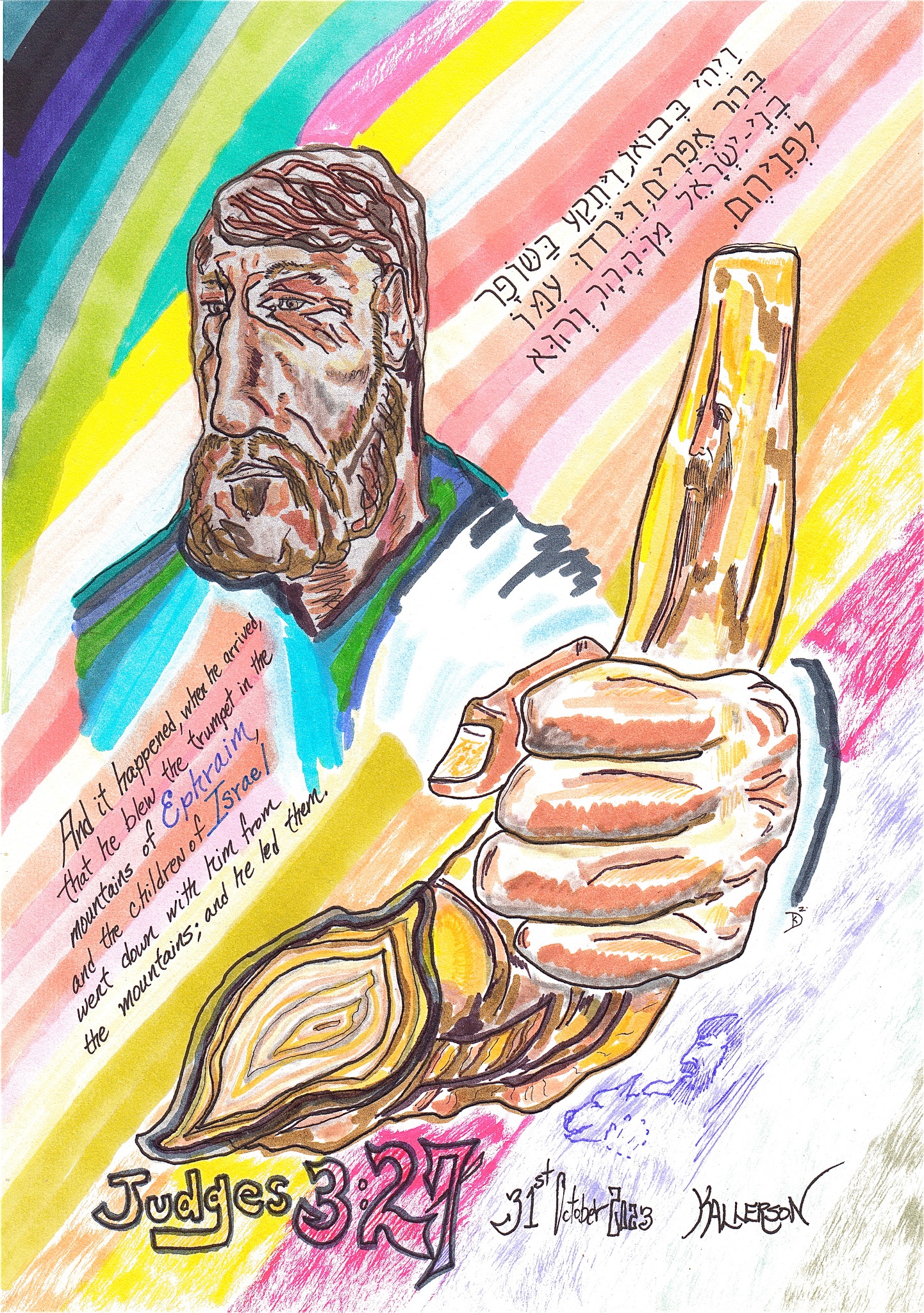
Artwork by Douglas Kallerson.
Judges 3:24-31
Ehud, Judge of Israel, Part II
Many years ago, I heard that there are so many laws in the federal government of the United States that all one has to do is exist here to be guilty of breaking one law or another. The system is set up for its citizens to fail. For those who consider not playing along with whoever is in power, that may actually be used against you.
If that was forty years ago, considering how many laws have been passed since then, just imagine how many laws we are breaking at any given moment without even realizing it in the present time.
And that is only federal laws. We have state and local laws bearing down on us as well. But this is not supposed to be the case with the giving of law. Those who naturally do what is right should not be subject to laws that make them guilty when they are not doing anything wrong.
Paul takes the time to explain this to Timothy, and his words reveal to us reasons for which law should be given…
Text Verse: “But we know that the law is good if one uses it lawfully, 9 knowing this: that the law is not made for a righteous person, but for the lawless and insubordinate, for the ungodly and for sinners, for the unholy and profane, for murderers of fathers and murderers of mothers, for manslayers, 10 for fornicators, for sodomites, for kidnappers, for liars, for perjurers, and if there is any other thing that is contrary to sound doctrine, 11 according to the glorious gospel of the blessed God which was committed to my trust.” 1 Timothy 1:8-11
Establishing laws against such things as Paul presents here is sound and reasonable. In the Bible, the giving of the law has several purposes, some of which we will see as we analyze things today.
The problem with God giving us law, however, is not in the law itself or with Him. Rather, the problem rests within us. Adam was given a law, but he had no experiential knowledge of what the consequences of violating that law would be. He was told what they would be, but without that experiential knowledge, he could not understand what he was told.
This was not because of a defect in Adam. Rather, Adam’s lack of knowledge was simply a limitation that he was expected to deal with after being told what not to do. He didn’t obey, and sin entered the world.
The law stands as an enemy against us when we do not comply with it. That is just how it is. Unfortunately, being in a land where you wake up guilty before the law means that you are an enemy of the lawgiver at all times. This is how it is in the United States, and it is how the world is before God.
Because of sin, which resulted from failing to observe the law, the whole world stands guilty already. That is our default position, and without someone to remove that guilt, along with the burden of the law, we will remain forever condemned. Enter Jesus.
It’s all to be found in His superior word. And so, let us turn to that precious word once again, and… May God speak to us through His word today, and may His glorious name ever be praised.
I. And Ehud Escaped (verses 24-31)
24 When he had gone out,
Rather, it simply and emphatically says: v’hu yatsa – “And HE went out.” Ehud had gone through the porch (the misdronah) in the previous verse, shutting the doors of the loft behind him and locking them. With his safe exit from the main building, it next says…
24 (con’t) Eglon’s servants came to look, and to their surprise,
The words are sequentially stated: va’avadav bau vayiru v’hineh – “and his servants come in, and look, and behold…” Taken together with the previous clause, the sequential nature is more prominent,
And HE went out, and his servants come in, and look, and behold…” Each “and” is given to elicit excitement at the unfolding events, the next of which is what the servants saw…
24 (con’t) the doors of the upper room were locked.
dalthoth ha’aliyah neuloth – “doors the loft locked.” It appears from this that the servants must have known that Ehud had left. Otherwise, they wouldn’t be surprised. But knowing he was gone, they come up to attend to the king, and the door is locked. Therefore, being locked from the inside, they think it must have been Eglon who locked it. This would not be uncommon based on the next words…
24 (con’t) So they said, “He is probably attending to his needs in the cool chamber.”
The words again bear emphasis: vayomeru akh mesik hu eth raglav ba’khadar hamqerah – “And they said, “Only, covering HE feet in chamber the coolness.” It is a euphemism used for the first of two times in Scripture. There are two suggested meanings.
The first is a later interpretation, meaning to take a nap. One lays down and covers his feet when sleeping. Hence, when Ruth went to Boaz at the threshing floor, she uncovered his feet.
The second, and more likely meaning, is clothes covering the feet while relieving oneself. Usually, the bare or sandaled feet are uncovered, and the rest of the body is covered, but at this time, the opposite is true.
An example of this is found in the story of King Saul. It is unlikely, although possible, that Saul went into a cave in 1 Samuel 24 to take a nap. Rather, he surely went in for privacy while relieving himself –
“So he came to the sheepfolds by the road, where there was a cave; and Saul went in to attend to his needs. (David and his men were staying in the recesses of the cave.)” 1 Samuel 24:3
As for the word kheder, or chamber, it signifies an inner chamber. In this case, as there is a main room for conducting Eglon’s normal affairs, and there is an inner chamber for conducting his discreet affairs. Today, we would simply say, “He is in the john.”
25 So they waited till they were embarrassed, and still he had not opened the doors of the upper room.
vayakhilu ad bovosh v’hineh enenu poteakh dalthoth ha’aliyah – “And whirled until ashamed, and behold, not he opened doors the loft.” The word khul signifies to whirl, dance, or writhe. The sense is that the servants are waiting there and, as people do, shaking their heads, shuffling their feet, and flailing their arms in a “What the heck?” manner.
At one point, they can no longer be considered blameless for tarrying. And yet, at some point, they cannot be considered blameless for barging in while the king is tending to business. And so they annoyingly stood around whirling, unable to decide when the right moment to act would be…
25 (con’t) Therefore they took the key and opened them.
vayiq’khu eth ha’maphteakh – “And took the opener.” It is a word found only here and in Isaiah 22:22, maphteakh. It comes from pathakh, to open. Thus it is the opener, the key. Ellicott notes, “The ancient key was simply a bar of wood, hooked at the end, which passed through a hole in the door and caught the bolt inside.” Finally deciding that action was necessary, they got the spare key and opened the door…
25 (con’t) And there was their master, fallen dead on the floor.
The words are short and abrupt: v’hineh adonehem nophel artsah meth – “And behold, their lord fallen earthward, died.” Eglon had seen better days…
26 But Ehud had escaped while they delayed, and passed beyond the stone images and escaped to Seirah.
v’ehud nimlath ad hithmahmhem v’hu avar eth ha’pesilim vayimalet hasiratha – “And Ehud escaped until their tarrying, and passed through the carved images, and escaped the Seirah-ward.” The servants tarried, allowing Ehud to escape. He took the route through the carved images, making his escape in the direction of the Seirah.
Seirah (Heb: Seirath) is found only here. It is derived from a general root שער (s’r) and “appears to primarily express intense negative emotion or the experience of violence. Curiously, it also yields words that have to do with hair” (Abarim).
Though associated with various words, the connotation of hair fits the context. Thus, it means Rough, Hairy, Bristly, or Goat (because of the goat’s bristly hair). As has been explained many times in previous sermons, hair in the Bible signifies an awareness, especially an awareness of sin.
27 And it happened, when he arrived, that he blew the trumpet in the mountains of Ephraim,
v’hi b’vovoto vayitqa ba’shophar b’har ephrayim – “And it was in his coming, and blew in the shophar in Mount Ephraim.” What may be the case is that the Seirath of the previous verse could be a wooded or brambly area, giving the appearance of hair. Whether a general location or a city, upon his coming to the area, he gave a blast on the shophar in Mount Ephraim to call the people to gather.
This was a signal that was probably preplanned, just as was the making of the special sword to nix Eglon. At the blowing of the shophar, the people came.
As always, a mount (har) is a lot of something gathered. It is synonymous with a large but centralized group of people. Ephraim means Twice Fruitful with a secondary meaning of Ashes.
27 (con’t) and the children of Israel went down with him from the mountains; and he led them.
vayerdu imo bene Yisrael min ha’har v’hu liphnehem – “And descended with him sons Israel from the mount, and he to their faces [meaning before them].” The Israelites followed Ehud as they descended the mount…
28 Then he said to them, “Follow me, for the Lord has delivered your enemies the Moabites into your hand.”
The plural is mixed with the singular concerning the foe: vayomer alehem ridpu akharay ki nathan Yehovah eth oyvekhem eth moav b’yedkhem – “And said to them, ‘Pursue after me, for gave Yehovah your enemies, Moab, in your hand.”
One can see the excitement Ehud must have felt, “Pursue after me!” He is challenging them to keep up as they rushed toward the battle ahead. He had tasted the blood of Eglon, and he was ready to meet every lesser foe that he encountered. But he gives the credit for the already-won battle to the Lord – “Yehovah gave … into your hand…”
28 (con’t) So they went down after him, seized the fords of the Jordan leading to Moab, and did not allow anyone to cross over.
v’yerdu akharav vayilkdu eth mabroth ha’yarden l’moav v’lo natnu ish la’avor – “And descended after him, and seized fords the Jordan to Moab and no gave man to pass over.” The meaning is that, despite Moab being east of the Jordan, there were Moabite warriors stationed west of the Jordan.
In their advancing, Israel took advantage of the situation and seized the fords of the river so that none of the Moabites could retreat into their land. John Lange thinks that Eglon was the king over only the western area of Moab. Or it could be that he was king over all of it but chose to reside in the fair area west of the Jordan. Either way…
29 And at that time they killed about ten thousand men of Moab,
vayaku eth moav ba’eth ha’hi ka’asereth alapim ish – “And struck Moab in the time, the it, according to ten thousand men.” There is no reason to assume the number is off by much, as in “about.” As these were warriors of Moab, they would be stationed according to units across the Jordan, probably rotating on a regular basis.
Therefore, there were probably just ten thousand, according to a standard calculation, like any military force. Ten thousand is simply a derivative of ten. Therefore, if the number has typological significance, it would be based on that.
Bullinger says of it, “Completeness of order, marking the entire round of anything, is, therefore, the ever-present signification of the number ten. It implies that nothing is wanting; that the number and order are perfect; that the whole cycle is complete.”
These men were…
29 (con’t) all stout men of valor; not a man escaped.
kal shamen v’kal ish khayil v’lo nimlath ish – “All fat, and all man valor, and no escaped man.” Of this, Ellicott astonishingly says, “…the word being the same as that used in Judges 3:17 to describe the fatness of Eglon.” It’s only a few verses earlier, and yet he didn’t check to confirm this.
It’s a good lesson that I have had to learn myself. Never trust anything you read, even from the greatest of scholars, until you have checked it out for yourself.
As for the word in verse 3:17, bari, or fat, it ultimately comes from a word meaning “to feed.” In this verse, it is the adjective shamen, coming from the verb shamen, to grow fat, and certainly signifying robust. They were well-fed and brave fighters, and yet they all perished at the hand of Israel. Despite it being a different word, Stanley is close to the intent of the verbiage, saying –
“The narrative ends, as it had begun, with its half-humorous allusion to the well-fed carcases of those who, corpulent like their chief, lay dead along the shore of the river.” Arthur Stanley
Other than calling them corpulent, the idea is correct. Eglon was overfed, and his men were well fed, all from the labors of Israel. And yet, Israel defeated them while probably in a state of lacking their own bread…
30 So Moab was subdued that day under the hand of Israel.
vatikana moav ba’yom ha’hu takhat yad Yisrael – “And humbled Moab in the day, the it, under hand Israel.” This does not mean that Moab became subject to Israel. Otherwise, it would be indicated, such as in 2 Samuel –
“Then he defeated Moab. Forcing them down to the ground, he measured them off with a line. With two lines he measured off those to be put to death, and with one full line those to be kept alive. So the Moabites became David’s servants, and brought tribute.” 2 Samuel 8:2
It simply means that they were humbled and licked their wounds in their own land. Understanding this, it next says…
30 (con’t) And the land had rest for eighty years.
va’tishqot ha’arets shmonim shanah – “And reposed the land eighty years.” The word shaqat comes from an unused root meaning to repose. Late Hebrew gives the idea of sinking down. One can think of lying in a hammock and looking around without fear, maybe slumbering a bit in the process.
This does not necessarily mean that all of Israel was in this state but the area where the judge ruled. As was noted in the introductory comments to Judges, there must be overlap in the times of various judges based on the number of years stated by Paul in Acts 13:20.
As for the duration, eighty is the product of eight and ten. Eight, or shmoneh, comes from shamen, the verb just described – “to grow fat.” Thus, it is the superabundant number and the number of new beginnings. The meaning of ten has already been described.
With this state of ease noted, it next says…
31 After him was Shamgar the son of Anath,
v’akharav hayah Shamgar ben Anath – “And after him, was Shamgar, son Anath.” The derivation of the name Shamgar is uncertain. However, some see it as a reversal of the name of Moses’ son Gershom. If so, then it would be from the words sham (there) or shem (name) and (stranger). Hence, There a Stranger or Named/Called a Stranger.
Shamgar is also mentioned in Judges 5:6 –
“In the days of Shamgar, son of Anath,
In the days of Jael,
The highways were deserted,
And the travelers walked along the byways.”
He is noted as the son of Anath. That name comes from anah, a word having four distinct meanings: to answer or respond; be occupied with; to afflict, oppress, or humble; or to sing. Thus, it can mean Answer, Business, Affliction, or Singing. The typology here points to Affliction. Of him, it says…
31 (con’t) who killed six hundred men of the Philistines with an ox goad;
vayak eth plishtim shesh meoth ish b’malmad ha’baqar – “And struck Philistines – six hundred man – in goad the ox.” The word malmad is found only here. It comes from lamad, to teach or learn. The idea is that when one goads an ox, he will learn from it.
The ox, or baqar comes from the verb baqar, to inquire or seek. The connection is that as the ox is used for plowing, the ground is opened up, revealing what is beneath.
Barnes describes the ox goad saying, “An instrument of wood about eight feet long, armed with an iron spike or point at one end, with which to spur the ox at plow, and with an iron scraper at the other end with which to detach the earth from the plowshare when it became encumbered with it.”
The idea of teaching a bull or heifer is seen elsewhere, such as –
“Ephraim is a trained [lamad] heifer
That loves to thresh grain;
But I harnessed her fair neck,
I will make Ephraim pull a plow.
Judah shall plow;
Jacob shall break his clods.” Hosea 10:11
There are varying degrees of skepticism in regard to the claim concerning Shamgar’s success, such as that he didn’t do it alone, but with others in a battle. However, being the leader, it was all credited to him. Such an explanation is hard to justify when we just got done with an account that explicitly included the efforts of others.
There is nothing to say that he did this in one battle. Note what it says in 2 Samuel 23:8 –
“These are the names of the mighty men whom David had: Josheb-Basshebeth the Tachmonite, chief among the captains. He was called Adino the Eznite, because he had killed eight hundred men at one time.”
First, this guy was a captain, implying that he had men under him. Also, it says that he killed eight hundred at one time.
This may be the case with Shamgar, or it may be that he singlehandedly killed six hundred in a series of encounters with the Philistines. Of the number, it is derived from six and ten.
Bullinger defines six, saying, “…it has to do with man; it is the number of imperfection; the human number; the number of MAN as destitute of God, without God, without Christ.” Simply stated, it speaks of fallen man. Again, the meaning of ten was noted earlier.
The name Philistine comes from palash, signifying to roll in the dust as an act of mourning. It can take on several meanings, including Grievers, Burrowers, or Weakeners.
*31 (fin) and he also delivered Israel.
There is an emphasis in the words: vayosha gam hu eth Yisrael – “And saved – also he – Israel.” This emphasis seems to indicate that it was around the same time as Ehud. While Ehud was delivering those on the eastern side of the land, it appears Shamgar was delivering on the western side.
What is this intriguing passage telling us? Why do you suppose the Lord has given such minute detail about things that are almost embarrassing for us to read and consider? Let’s find out.
A place where atonement is made
Where sins are covered and taken away
What a glorious, marvelous trade
When through grace we were cleansed. Oh, what a day!
The law is satisfied, and we have atonement
The guilt of our deeds is taken away
What Christ has done, such a marvelous event
We are free from our guilt. Oh, what a day!
Thank You, O God, for Jesus Christ our Lord
He accomplished it all; our guilt is taken away
Through Him, the victory is scored
Truly, what a marvelous, glorious day!
II. Pictures of Christ
The focus of the passage is Israel doing the evil in the eyes of Yehovah. Because of that, the Lord placed them under subjection to Eglon, king of Moab. Evil comes about from violating God’s law. Eglon, Heifer-like, stands as a type of violation of the law.
The first noted transgression of the law is found in Exodus 32 when Aaron made the golden calf, the egel. Thus, it stands as representative of all future violations of the law, as typified by Eglon (transgression of the law) king of From Father (the power of the devil) –
“You are of your father the devil, and the desires of your father you want to do. He was a murderer from the beginning, and does not stand in the truth, because there is no truth in him. When he speaks a lie, he speaks from his own resources, for he is a liar and the father of it.” John 8:44
That power is strengthened against Israel “because they had done evil in the sight of the Lord” (verse 12). To bolster his strength, Eglon (transgression of the law) gathered A People and The People Who Wring Off. It signifies those without and those within who are attempting to overthrow God’s purposes, meaning those without the law of Moses and those who abuse the law of Moses.
Together, they went and struck Israel and took possession of City the Palms, meaning City the Upright Ones. The purpose of the law, to bring about righteousness, is taken over by transgressions of the law. In other words, it is showing us that by law is the knowledge of sin, but that law cannot justify anyone (Romans 3:20).
Instead, Israel served Eglon (transgression of the law) eighteen years. No matter which way eighteen is divided, there is the sense that man is not under the Lord but under transgression (2) and thus under judgment (9), and that it is for a divinely perfect period of time (3) where he remains fallen and destitute of God (6).
That is seen in the words of Paul –
“But when the fullness of the time had come, God sent forth His Son, born of a woman, born under the law, 5 to redeem those who were under the law, that we might receive the adoption as sons.” Galatians 4:4, 5
However, in their state of subjection, represented by the words “when the children of Israel cried out to the Lord,” He raised up a Deliverer for them. Ehud anticipates Christ. He is described as “Ehud son Gera, son the right, man bound hand right.”
Depending on the root, Ehud means either One Who Praises or United. Either can point to the Lord. He praises God, for example, in Psalm 22:25. He is united to God in the incarnation. Because of this, there is no need to be dogmatic about which root the name came from.
Son of Gera, among other things, means Son of Sojourning. A son in Scripture often simply indicates one who has a particular attribute. A son of a fool is a fool. Jesus came and sojourned among us. Thus, He is a Son of Sojourning.
Benjamite, or benhay’mini, Son of the Right, is an exact description of Jesus in Luke 22:69. As it says –
“Hereafter the Son of Man will sit on the right hand of the power of God.”
Saying he is bound in his right hand would signify His state in the incarnation where He set aside His power and authority, signified by the right hand –
“Let this mind be in you which was also in Christ Jesus, 6 who, being in the form of God, did not consider it robbery to be equal with God, 7 but made Himself of no reputation, taking the form of a bondservant, and coming in the likeness of men.” Philippians 2:5-7
It is Ehud by whom Israel sent an offering (minkhah) in his hand to Eglon, king of Moab. It points to Jesus. He is the true offering –
“Sacrifice and offering [minkhah] You did not desire;
My ears You have opened.
Burnt offering and sin offering You did not require.
7 Then I said, ‘Behold, I come;
In the scroll of the book it is written of me.
8 I delight to do Your will, O my God,
And Your law is within my heart.’” Psalm 40:6-8
Think of it! He is “bound in His right hand,” meaning Christ in His incarnation. And it is in his hand (meaning Ehud’s left and weaker hand) that the minkhah is presented. It points to Christ in His lowly state. And so, what does he do? “And made to him, Ehud, sword.”
As has been seen many times, the word sword, kherev, is a picture of the law given at Horeb. They are spelled the same in the Hebrew – חרב. And, to confirm the symbolism, this is said to be a two-edged sword, another description of the word of God –
“For the word of God is living and powerful, and sharper than any two-edged sword, piercing even to the division of soul and spirit, and of joints and marrow, and is a discerner of the thoughts and intents of the heart.” Hebrews 4:12
Why the unique word gomed, the length of the sword, was provided is hard to say. My best guess would be that it shows the closeness and intimacy of Christ with the law. Next, it was noted that it was girded on his thigh. That is anticipated in the Psalms when referring to the coming Messiah –
“Gird Your sword upon Your thigh, O Mighty One,
With Your glory and Your majesty.” Psalm 45:3
Next, it noted that Ehud brought the tribute (minkhah) to Eglon, king of Moab. That symbolism has already been explained. It then noted his extremely corpulent nature.
As Eglon represents transgression of the law, the symbolism becomes perfectly obvious. Transgression abounds in a superlative way because of law. It literally feeds (bari) off of the law. That is stated by Paul in Romans 7 and Galatians 3.
Noting that Ehud sent those who brought the tribute away, accompanied by the emphatic “And HE – turned back” is a way of saying that Christ alone would accomplish what was necessary to end transgressions of the law. This turning was “from the carved images which by the Gilgal.”
It is hard to be dogmatic about what this is saying, but the Gilgal has repeatedly signified “the Liberty.” Therefore, it seems that it is indicating the closeness of idolatry to finding the Liberty. It is almost an impossible task that only Christ could accomplish. He turned back from the entourage with his secret message for the king.
In bringing it, the attendants were excused. It is a faceoff between the two alone, Christ, and the power of transgression of the law. Ehud approached; Jesus approached. The message is from God: Eglon arose from his throne; transgression of the law arose from its position of power.
No sooner did Eglon arise than Ehud reached with his left (covered) hand. The left hand pictures Christ in His humanity covering His deity. He took the sword, the law, from the right thigh, the side of strength and power, and the base upon which He stands (the thigh), and thrust it into Eglon’s belly.
The belly is what feeds the body as food is processed. The entire sword, the full and complete law, went into Eglon (transgression of the law). In other words, it is a picture of the complete atonement of transgressions of the law. It represents the full, final, finished, and forever satisfaction of the law through Christ’s work. The sword went in, the fat covered it over, and he did not draw the sword out of the belly. It is finished.
Next, the highly complicated words of verses 22 and 23 were stated. The actual meaning of those words is obscure, and several possibilities were given. They can be summed up with the thought, “The sword came out of Eglon’s parshdonah. Meanwhile, Ehud went out of Eglon’s misdronah.”
The law came out of “transgression of the law” in a way that it was distinct and in the place where it divides, destroying its ability to do so. Meanwhile, Jesus came out of the arrangement of “transgression of the law,” meaning living under the law with the possibility of violating it as Adam did. Even if we don’t know what the Hebrew literally says, we can know what it typologically represents.
From there, the doors of the loft were closed and locked, and it emphatically said, “and HE went out.” It speaks of the total victory of Christ over the power of the law.
Despite that, and as evidenced by the servants going to the room, waiting for Eglon to come out, and finally going in to discover him dead on the floor, this doesn’t mean that the law cannot still hold sway over others who have not come to Christ.
Hence, it said that Ehud escaped and passed through the carved images, signifying Christ’s total victory over them, and escaped to the Seirath, the Hairy. It signifies Christ making the awareness of sin (hair signifies an awareness, especially an awareness of sin) available to all.
In his arrival, Ehud blew the trumpet in Mount Ephraim to gather the people. Saying this was in the mount (har) points to the effect of His work, the mountain being synonymous with a large but centralized group of people. It refers to the uniting of all believers as one in Christ.
Noting the name Ephraim adds further meaning. Ephraim means Twice Fruitful. It signifies that Christ’s work has produced fruit in the conversion of both Jews and Gentiles. The secondary meaning of Ashes speaks of the price He paid to make this possible which was the afflictions He endured.
Being gathered, Ehud (Jesus) implored those with him to pursue after him because Yehovah gave their enemies, Moab, into their hand. God in Christ has given power over the law, the enemies From Father, into our hand through the work of Jesus.
It next said that Israel went down and seized the fords of the Jordan (Christ, the Descender), leading to Moab (From Father). None could cross over. There is the law, and there is grace, and there is no crossing between the two –
“And I testify again to every man who becomes circumcised that he is a debtor to keep the whole law.” Galatians 5:3
Finally, verse 29 noted that ten thousand men of Moab were struck, and not one escaped. “It implies that nothing is wanting; that the number and order are perfect; that the whole cycle is complete” (Bullinger). For those who come to God through the grace found in Christ, every single foe (the entire law, without exception) is defeated.
The use of the word bari in relation to Eglon and shamen in relation to the soldiers, both translated as fat, is purposeful. A point is being made: transgression of the law feeds on the law as its source of sustenance, as in Romans 3:20. However, transgressions of the law increase guilt before God, as in Romans 3:19.
From there, it then said that Moab, From Father was humbled under the hand of Israel. The law which allows the devil to have power was humbled, and Christ the Lord is exalted.
The final note of there being eighty years is a nice touch. As eight is derived from the same word as fat (shamen), it speaks of the superabundant nature (8) of the victory and that the entire cycle is complete in what Christ has done (10).
With the exploits of Ehud complete, the narrative turned to Shamgar the son of Anath. He is a quick picture of Christ – There a Stranger, Son of Affliction. Both look to Christ, a Stranger come to dwell among us, and One who identifies with Affliction.
Killing the Philistines, the Weakeners, with an ox goad, looks to the victory that comes from pursuing the knowledge of Christ, which is, obtained through the word that tells us of Him. The ox, as noted, comes from a root signifying to inquire or seek. The goad comes from a root signifying to teach.
Thus, the Philistines, those who weaken others spiritually, are destroyed through diligent search and proper instruction. Noting that six hundred were struck reveals fallen man (6) with the whole cycle being complete and nothing is wanting (10).
We have been given the word of instruction. It is available to those who inquire of it, and it is fully capable of eliminating the power of those who would attempt to weaken them.
The last words of the chapter said, “And saved – also he – Israel.” As noted then, it seems to mean that he was a judge at the same time as Ehud. Christ destroyed transgression of the law by using the law, He continues to separate those who rely on the law for their justification, and He has saved Israel through the instruction that He has provided in His word.
Chapter 3 of Judges has continued the typological pictures of Christ and the magnificent things He has done for us. Eglon, transgression of law, isn’t something ethereal that we can only hypothesize about. It is exactly what Paul describes in Romans, Galatians, and elsewhere.
By law is the knowledge of sin, and by law, man becomes guilty before God. In giving more law, more transgression occurs. But all of what He has done has been a lesson for us, if we are willing to pay heed. He has used a real group of people with serious issues of rebellion to show us exactly what is wrong with us.
The story of Israel is simply a microcosm of the greater story of humanity. God is using them to tell us what is wrong, how He will fix it, and how desperately we need Him to do so. Pay heed to the lesson of the law. It keeps being reintroduced, story after story, to get us to wake up.
Jesus. We need Jesus. Without Him, there is no hope. With Him, there is absolute hope with no uncertainty at all. This is what we are again shown in this wonderful passage from God’s Superior Word.
Closing Verse: “Now we know that whatever the law says, it says to those who are under the law, that every mouth may be stopped, and all the world may become guilty before God.” Romans 3:19
Next Week: Judges 4:1-16 Hoorah! A great story to tell – until it is done… (Deborah, Judge of Israel, Part I) (11th Judges Sermon)
The Lord has you exactly where He wants you. He has a good plan and purpose for you. It is He who judges His people according to their deeds. So, follow Him, live for Him, and trust Him, and He will do marvelous things for you and through you.
Ehud, Judge of Israel, Part II
When he had gone out
Eglon’s servants came to look, and to their surprise, as
———-the account reads
The doors of the upper room were locked. So they said
“He is probably in the cool chamber attending to his needs”
So they waited till they were embarrassed
And still he had not opened the doors of the upper room
Therefore they took the key and opened them
And there was their master, fallen dead on the floor
———-a scene of doom
But Ehud had escaped while they delayed, oorah!
And passed beyond the stone images and escaped to Seirah
And it happened, when he arrived
That he blew the trumpet in the mountains of Ephraim
And the children of Israel went down with him from the mountains
And he led them, a great day it would seem
Then he said to them, “Follow me
For the LORD has delivered your enemies the Moabites into
———-your hand
So they went down after him, seized the fords of the Jordan
———-leading to Moab
And did not allow anyone to cross over, so it was planned
And at that time they killed about ten thousand men of Moab
All stout men of valor; not a man escaped (hooray and cheers!)
So Moab was subdued that day under the hand of Israel
And the land had rest for eighty years
After him was Shamgar the son of Anath
Who had a great story to tell
He killed six hundred men of the Philistines with an ox goad
And he also delivered Israel
Lord God, turn our hearts to be obedient to Your word
Give us wisdom to be ever faithful to You
May we carefully heed each thing we have heard
Yes, Lord God may our hearts be faithful and true
And we shall be content and satisfied in You alone
We will follow You as we sing our songs of praise
Hallelujah to You; to us Your path You have shown
Hallelujah we shall sing to You for all of our days
Hallelujah and Amen…
24 When he had gone out, Eglon’s servants came to look, and to their surprise, the doors of the upper room were locked. So they said, “He is probably attending to his needs in the cool chamber.” 25 So they waited till they were embarrassed, and still he had not opened the doors of the upper room. Therefore they took the key and opened them. And there was their master, fallen dead on the floor.
26 But Ehud had escaped while they delayed, and passed beyond the stone images and escaped to Seirah. 27 And it happened, when he arrived, that he blew the trumpet in the mountains of Ephraim, and the children of Israel went down with him from the mountains; and he led them. 28 Then he said to them, “Follow me, for the Lord has delivered your enemies the Moabites into your hand.” So they went down after him, seized the fords of the Jordan leading to Moab, and did not allow anyone to cross over. 29 And at that time they killed about ten thousand men of Moab, all stout men of valor; not a man escaped. 30 So Moab was subdued that day under the hand of Israel. And the land had rest for eighty years.
31 After him was Shamgar the son of Anath, who killed six hundred men of the Philistines with an ox goad; and he also delivered Israel.