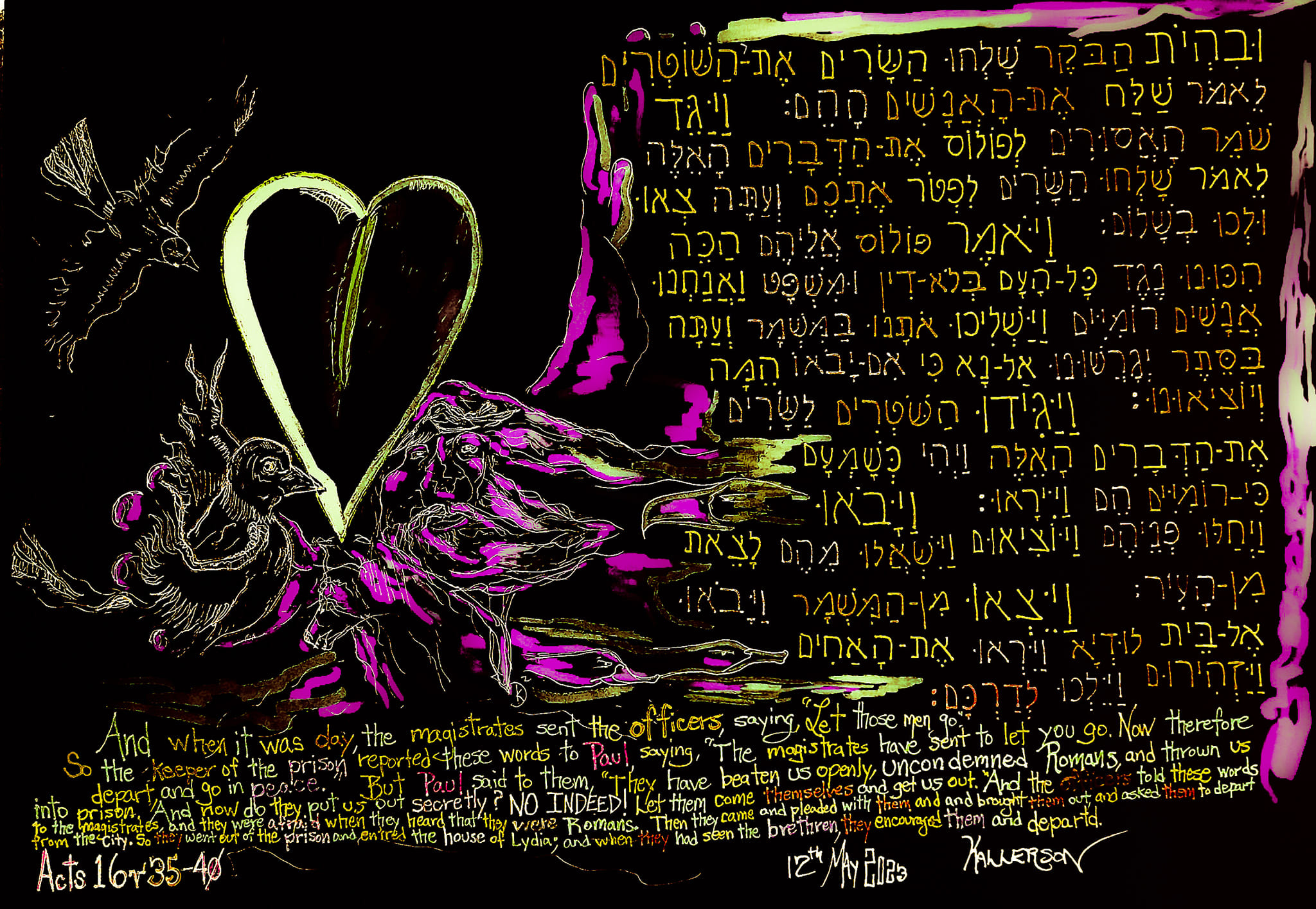
Artwork by Douglas Kallerson
Joshua 20:1-9
Cities of Refuge
Speaking personally, I love the word of God so deeply that I often have to stop and reflect on it. To love the Lord but not His word is illogical. “I love Jesus so much! I just don’t really like the Bible.” Such a thought cannot be.
Likewise, to say, “I love the Bible. It is so deep and its mysteries are so profound,” may sound quite wonderful, but does a person who says that love the Giver of the word as much as he loves the word itself? Making the Bible into an idol is not difficult. It is actually as common as people in pews on Sunday morning in some churches.
Some people may idolize a particular version of the Bible. Others turn what the Bible may be conveying about the spirit world, specific patterns, numerical calculations, etc. into an idol. And yet, there is not a deep-seated love for, or honoring of, the Lord who spoke out the word. That, too, is illogical.
The two, the Lord and His word, are not to be separated. What the Lord speaks out is a reflection of who He is. We are to love the word because it is His word. We are to love the Lord who has revealed Himself through the word.
We are to seek out its mysteries because they reveal aspects of Him to us. In it, we find wisdom, love, truth, hope, anticipation of fellowship, and so much more. These are things that stem from Him, from His very being.
Text Verse: “I rejoice at Your word
As one who finds great treasure.” Psalm 119:162
What got me thinking about these things is what it says in verse 2 of our passage today. We are reading the words of the Lord when we read the Bible. Therefore, we need to consider this as we read it. God is revealing Himself to us through the word.
In turn, the word is revealing God to us when we read it. If we really want to know who He is and what He is like, we can find out by reading the Bible.
If we read the Bible looking for mysteries that God has placed there, without considering God who put them there, we are wasting our time. People do that.
There are websites dedicated to Bible codes. They attempt to tell the future, explain why things have happened or will happen, and so on. And yet, those sites are often frequented by, or even owned by, unbelievers.
Today, we will look into the mysteries of the cities of refuge again as we did in Numbers 35. I admit, I plagiarized the details of that sermon for this one. But it is so filled with the marvel of what God has done through Jesus that it is as exciting to me today as when I weighed its meaning some years ago.
This is what the Bible is about: Exploring the word of God because it is God’s word. The beauty of Jesus Christ is too precious to overlook when we are exploring the word. Let us have both a heart for God in Christ and a love for the word that tells us of Him. This is the sweet spot.
Such great things are to be found in His superior word. And so, let us turn to that precious word once again, and… May God speak to us through His word today, and may His glorious name ever be praised.
I. He May Dwell Among Them (verses 1-6)
The Lord also spoke to Joshua, saying,
As so often was the case in the books of Moses, the word translated as “also” is “and” in the original. Though the words are recorded immediately after the final parceling of the land to the various tribes, the words here may have occurred at any point. What is stated is categorical, not necessarily chronological.
The reason this is categorical is because these cities are being appointed before the appointment of the Levitical cities, which starts in the next chapter. This is the opposite of Numbers 35 where the command was given to provide Levitical cities, out of which were to then be taken cities of refuge. That is recorded in Numbers 35:1-8.
What is to be conveyed in the coming verses is in fulfillment of the words of law found mostly in Numbers 35, but which is also mentioned in Exodus 21:13 and Deuteronomy 4 & 19. With that, the words of the Lord to Joshua begin with…
2 “Speak to the children of Israel, saying:
This is a phrase commonly spoken by the Lord in Leviticus and Numbers when He spoke to Moses. This is the only time the exact phrase is used in Joshua, and it is based upon the words of Numbers 35:9-34 which are the same as here –
“Then the Lord spoke to Moses, saying, 10 ‘Speak to the children of Israel, and say to them: ‘When you cross the Jordan into the land of Canaan, 11 then you shall appoint cities to be cities of refuge for you, that the manslayer who kills any person accidentally may flee there.’” Numbers 35:9-11
That appointment begins to be seen in the next words…
2 (con’t) ‘Appoint for yourselves cities of refuge,
There is an article before “refuge” that should be included: tenu lakhem eth are ha’miqlath– “appoint to you cities the refuge.” The word translated as refuge is miqlath. It is seen twenty times, but only two of them are outside of Numbers 35 and Joshua 20 & 21. Those other two are in 1 Chronicles 6 which simply repeats the granting of the cities.
However, the article is combined with miqlat only four times: in Numbers 35:6, Joshua 20:2, and 1 Chronicles. For example, in Numbers 35, the word miqlath is used eleven times, but only the first time was the article included –
“Now among the cities which you will give to the Levites you shall appoint six cities of [the] refuge, to which a manslayer may flee.” Numbers 35:6
In other words, there are cities of refuge which, when taken together, form “the Refuge.” That is what is again being addressed by the Lord to Joshua.
The word miqlath comes from the word qalath, which is found only in Leviticus 22:23 and which, surprisingly, means “stunted.” In Leviticus, it referred to not offering anything stunted to the Lord for fulfilling a vow.
The connection between the words is the idea that when one is in a place of refuge, or asylum, they are taken in. Their lives are thus stunted from going out. One might say they are cities of the stunted, but in the sense that they are cities of the protected. These cities are next said by the Lord to be…
2 (con’t) of which I spoke to you through Moses,
asher dibarti alekhem b’yad mosheh – “which I spoke to you in hand Moses.” Think of what is said! The Lord spoke “in the hand of Moses.” What Moses wrote is the word of the Lord. This means that what is compiled IS the word of God.
It is conveyed directly from His mouth to the paper and ink held by the hand of Moses. From there, it is read into the ear of the hearer or the mind of the reader. If people truly grasped the magnitude of these words, they would – wisely – treat the words of Scripture with care and humility.
Two significant points can be deduced from what has been said. The first is that because the Lord is referring to information coming from Exodus, Numbers, and Deuteronomy, He considered these books as a part of a whole.
The second is based on the fact that the same formula is used here in Joshua as was used in Numbers 35, “And the Lord spoke to Joshua saying.” However, new information is added to that which was given to Moses. And so, what Joshua is recording for the hearing of the people is also the direct spoken word of God and it bears the same weight and authority as the books of Moses because they are a continuation of what Moses had received. With that considered…
3 that the slayer who kills a person accidentally or unintentionally may flee there;
The Hebrew is difficult but precise: lanus shamah rotseakh makeh nephesh bishgagah bivli daath – “to flee there slayer, striker soul in inadvertence, in lack of knowledge.” The repetition of the thought, being stated in two different ways, is to ensure that someone who purposefully killed another was not entitled to such an allowance.
However, a person who inadvertently struck another person, killing him without premeditation was to be given the opportunity to flee to such a city of refuge as a protection, as it next says…
3 (con’t) and they shall be your refuge from the avenger of blood.
The word translated as avenger is a verb, not a noun: v’hayu lakhem l’miqlath mi’goel ha’dam – “and shall be to you to refuge from avenging the blood.”
The word is gaal, to redeem or act as a kinsman. In this case, the word is translated as avenge, but it is the blood that is being redeemed through the act. Using avenge makes it understandable to us. It is, however, as if the blood is being bought back through the act of avenging.
The cultural allowance and expectation were that when blood was shed, there was to be an avenging of it. This is a protection from that. The avenger is the one who would carry out the act, but it is safety from the act of vengeance itself that is being focused on.
The words of the next verse are not found in the books of Moses. They are a fuller explanation of what is to be done when a person accidentally slays another. As these words are new, and as they are words spoken by the Lord to Joshua, it confirms what was said in verse 2. They bear the same weight and authority as what was spoken to Moses because they continue what Moses received.
4 And when he flees to one of those cities,
The words are not speaking of a specific person. Rather, it is a general statement about anyone in this category: v’nas el akhath me’he’arim ha’eleh – “And fleer unto one from the cities, the these.” It speaks of any such person who was described in the previous verse and who was to make a choice from the named cities of refuge to run there.
4 (con’t) and stands at the entrance of the gate of the city,
v’amad petakh shaar ha’ir – “And stands door gate the city.” The man comes to the gate of the city, specifically the entryway to it, and demonstrates his intention to enter the city. If the person is a manslayer, then he must first present his case…
4 (con’t) and declares his case in the hearing of the elders of that city,
The wording is very specific: v’diber b’azene ha’ir ha’hi eth d’varav – “and speaks in ears elders the city, the he, words his.” In other words, he is presenting his case in his own words directly to the elders of the city. Nobody is speaking for him. The matter is his and his alone: “I have slain a man inadvertently and without premeditation and I desire refuge in your city.” If so…
4 (con’t) they shall take him into the city as one of them, and give him a place, that he may dwell among them.
The precision of wording continues: v’as’phu oto ha’irah alehem v’nat’nu lo maqom v’yashav imam – “And gathered him, the city-ward, into them and give to him place. And dwelling with them.” Everything is stated carefully to ensure the matter is exactingly understood and precisely carried out.
Obviously, if he is lying, that will be determined at a trial which is carefully specified in Numbers 35. However, for the record of Joshua, the assumption is that of a person who is innocent and is determined to be so at the required hearing.
There is no need to repeat those details. The focus here is solely on the designation of the city and what it means to the person who is accepted into it because of his innocence. If so…
5 Then if the avenger of blood pursues him,
The words are verbs, making the clause one of action: v’ki yirdoph goel ha’dam akharav – “And according to pursuing avenging the blood after him.” The action of the avenger, not the avenger himself, is what is focused on. It is as if the process itself is alive. If the avenging comes following after…
5 (con’t) they shall not deliver the slayer into his hand,
v’lo yasgiru eth ha’rotseakh b’yado – “and no shut up the slayer in his hand.” The meaning is to deliver. But the only way to describe it properly is that it would be as if the avenging force held out his hand like the angel of death and the elders took the poor fellow and handed him over. The avenging force would shut him up in his hand, taking away the freedom from death that he deserved…
5 (con’t) because he struck his neighbor unintentionally, but did not hate him beforehand.
ki vivli daath hikah eth reehu v’lo sone hu lo mitmol shilshom – “because in lack of knowledge struck his neighbor and no hated he to him from yesterday, day before yesterday.” The words presuppose the innocence of anyone who is admitted into the city and is later found innocent. In other words, he is innocent until proven guilty, or he is just innocent altogether.
As long as the innocence was confirmed, at no time is he to be returned to the one avenging because the slaying was in innocence. Despite the guilt he bore as a manslayer, his life was to be spared while he remained within the sanctuary of refuge.
6 And he shall dwell in that city until he stands before the congregation for judgment,
The translation is fine except it says, “for the judgment.” It is the specific judgment that is to be held by the congregation as indicated in Numbers –
“However, if he pushes him suddenly without enmity, or throws anything at him without lying in wait, 23 or uses a stone, by which a man could die, throwing it at him without seeing him, so that he dies, while he was not his enemy or seeking his harm, 24 then the congregation shall judge between the manslayer and the avenger of blood according to these judgments. 25 So the congregation shall deliver the manslayer from the hand of the avenger of blood, and the congregation shall return him to the city of refuge where he had fled, and he shall remain there until the death of the high priest who was anointed with the holy oil.” Numbers 35:22-25
The meaning is that the people of the city of refuge where the manslayer went sent him, probably under Levitical guard, back to the city where the killing had taken place. There would have been a preliminary trial at the Levitical city to see if he even qualified to be taken in.
Once summoned for a trial he would have been conducted to the city where the offense occurred for that trial. If guilty, he would be executed by the hand of the avenger. However, if found innocent, he would be returned to the Levitical city for refuge which would last for a set but indeterminate amount of time. This was, as just noted…
6 (con’t) and until the death of the one who is high priest in those days.
ad moth ha’kohen ha’gadol asher yihyeh ba’yamim ha’hem – “until death the priest, the great, who is in the days, the those.” This makes the period of time he was to remain in the city of refuge completely unknowable.
One can see the providence of God in this. If what he did was the day when a new and young high priest was ordained, he may be there for the remainder of his life. If what he did was a week before the current high priest died, he would only have to be in refuge for that one week.
The reason for this mandate and this provision is two-fold. The first reason is that ha’kohen ha’gadol, or “the priest, the great,” represented the nation before God. He did this with the holy offerings, and in his mediatorial role on the Day of Atonement. This is seen several times, but two pertinent examples are found in Exodus and Leviticus –
“So Aaron shall bear the names of the sons of Israel on the breastplate of judgment over his heart, when he goes into the holy place, as a memorial before the Lord continually. 30 And you shall put in the breastplate of judgment the Urim and the Thummim, and they shall be over Aaron’s heart when he goes in before the Lord. So Aaron shall bear the judgment of the children of Israel over his heart before the Lord continually.” Exodus 28:29,30
&
“Why have you not eaten the sin offering in a holy place, since it is most holy, and God has given it to you to bear the guilt of the congregation, to make atonement for them before the Lord? 18 See! Its blood was not brought inside the holy place; indeed you should have eaten it in a holy place, as I commanded.” Leviticus 10:17, 18
The high priest bore the judgment of the children of Israel, and the priest bore the guilt of the congregation through the eating of the sin offering. As the high priest was ultimately responsible for all such judgment, and for the rites of atonement on the Day of Atonement, he bore the guilt of the people. In the case of the manslayer, another thought, however, comes into play. Two more verses are needed to see this –
“Moreover you shall take no ransom for the life of a murderer who is guilty of death, but he shall surely be put to death.” Numbers 35:31
&
“So you shall not pollute the land where you are; for blood defiles the land, and no atonement can be made for the land, for the blood that is shed on it, except by the blood of him who shed it.” Numbers 35:33
The intentional manslayer must be put to death. Period. Nothing else was acceptable. But the one deemed innocent is also guilty of shedding blood, for which no atonement can be made, except by the blood of the one who shed it. Therefore, the Day of Atonement, where all other sins were atoned for, could not atone for his act.
However, because the high priest bore the judgment and the guilt of the manslayer, his death alone could expiate those sins. When he died, because he bore the guilt of the act, the act of the law – and thus the law of the act – died with him. The manslayer was now free from his guilt.
This is why the same word is used for both murderer and manslayer. The guilt of bloodshed is the same for both, regardless of it being intentional or unintentional. In Numbers 35, the word that defines the act, ratsakh, is first found as a precept of the law itself in the Sixth Commandment, “You shall not murder.”
People question if what Paul refers to in Colossians 2, and what the author of Hebrews says in Hebrews 7, 8, and 10 about the law being annulled in Christ, actually applies to the Ten Commandments. What is presented here answers that question. The Ten Commandments are the basis for the law, and they are – along with the entire law – annulled, obsolete, and set aside in Christ because Christ, the fulfillment of the law, was nailed to the cross.
The second reason is because in this there is a typological prefiguring of Christ. That will be explained later, but simply stated for now, the high priest was the mediator of the law. As this is so, the final judgment of the law, whether he officiated at the trial or not, was his.
As far as the person in the city of refuge, the time of his dwelling there would be solely up to that one determination – the death of the great priest – but it stood firm. At no time could he leave and be safe from the avenger of blood otherwise. This is seen next…
6 (con’t) Then the slayer may return and come to his own city and his own house, to the city from which he fled.’”
az yashuv ha’rotseakh u-ba el iro v’el beto el ha’ir asher nas misham – “Then returning the slayer and come unto his city and unto his house, unto the city which fled from there.” The guilt of blood was atoned for by the death of the high priest. Because of this, the avenger of blood no longer had the right to take the life of the slayer. If he presumed to do so and carried through with his intent, he would then be tried as a murderer.
On the other hand, if the slayer left the city before the death of the high priest, and if he was caught and killed by the avenger of blood, no blood guilt could be imputed to the avenger –
“But if the manslayer at any time goes outside the limits of the city of refuge where he fled, 27 and the avenger of blood finds him outside the limits of his city of refuge, and the avenger of blood kills the manslayer, he shall not be guilty of blood, 28 because he should have remained in his city of refuge until the death of the high priest. But after the death of the high priest the manslayer may return to the land of his possession.” Numbers 35:26-28
Do not defile the land in which you live
For in the midst of you, there I dwell
To you the blessings of heaven, I will give
Or from Me will come the tortures of eternal hell
For I dwell among you; even I, the Lord
Therefore, be holy as I am holy – this you must be
In this, you will receive my promised reward
And peace shall exist between you and Me
Do not profane the land, but keep it pure and undefiled
And between us there will be a state of harmony
In this, upon you I shall have smiled
And together we shall dwell for all eternity
II. Consecrated Cities (verses 7-9)
7 So they appointed Kedesh in Galilee, in the mountains of Naphtali, Shechem in the mountains of Ephraim, and Kirjath Arba (which is Hebron) in the mountains of Judah.
Rather than “appoint,” it reads “consecrated,” or “sanctified” to express what occured: va’yaqdishu eth qedesh ba’galil b’har Naphtali v’eth shekhem b’har Ephraim v’eth qiryat arba hi khevron b’har Yehuda – “And consecrated Qedesh in the Galilee in Mount Naphtali, and Shechem in Mount Ephraim, and Kiryat Arba, it Hebron, in Mount Judah.”
The cities are listed from north to south and are strategically chosen to make fleeing to one of them as easy as possible from any point within the borders of Canaan.
Qedesh means Holy. Ha’Galil, or The Galilee, signifies a circular district, it is identical to galil, to pivot or turn. That, in turn, comes from galal, to roll away. Thus, like Gilgal it is The Liberty.
Naphtali means My Twistings or My Wrestlings, but it has a secondary meaning of Crafty. Shechem is identical to shekem, shoulder. Thus, it literally means Shoulder. However, that comes from shakam signifying to incline, as inclining the shoulder to a burden. Hence, it is normally translated as to rise or start early. Abarim defines Shechem as “(Having a Sense of) Responsibility.”
Ephraim means both Twice Fruitful and Ashes. Qiryath Arba means City of Four; Khevron means Alliance. Judah means Praise. Along with these, three others were already set apart by Moses in Deuteronomy 4…
8 And on the other side of the Jordan, by Jericho eastward, they assigned Bezer in the wilderness on the plain, from the tribe of Reuben, Ramoth in Gilead, from the tribe of Gad, and Golan in Bashan, from the tribe of Manasseh.
In contrast to the cites west of the Jordan, these are named from south to north. They are said to be beyond Jordan Jericho (the Descender/ Place of Fragrance) eastward, a word meaning to arise or appear.
The first is Betser. The name comes from batsar, meaning to enclose or make inaccessible, and so it means Fortress or Defense. However, it is identical to the word betser which means “precious ore.” That is seen only in Job 22 –
“Then you will lay your gold in the dust,
And the gold of Ophir among the stones of the brooks.
25 Yes, the Almighty will be your gold
And your precious silver.” Job 22:24, 25
The idea is that the ore is what people use as a defense or a protection, but the person would put away this protection and trust in the Lord as his gold – meaning his protection – instead.
Betser is said to be “in the wilderness, in the plain.” The midbar, or wilderness, is a place of God’s grace and of closeness to God, but it is also a place of testing. Next, ha’mishor, or “the plain,” is a word that signifies a level place. Thus, it figuratively speaks of uprightness. It is “the place of uprightness.” Reuben means See, a Son.
Ramoth comes from rum, meaning “high” or “exalted.” Thus, it signifies Heights, or Lofty Place. The Gilead means, The Perpetual Fountain. Gad means Troop or Fortune. It signifies “a fortune for which a troublesome, invasive effort is made” (Abarim).
Golan comes from golah, meaning Exile. The NET Bible also defines it as “Their Captivity: Their Rejoicing.” The Bashan means something like The Place of Fertile Soil. Manasseh means He Shall Forget/From a Debt. With this noted, it next says…
9 These were the cities appointed for all the children of Israel and for the stranger who dwelt among them,
eleh hayu are ha’muadah l’kol bene Yisrael v’la’ger ha’gar b’tokam – “These were cities the Asylum to all sons Israel and to the stranger, the soujourning, in their midst.” Here is a word found only this once in the Bible, muadah. It is a noun meaning appointed, coming from yaad, to appoint. Being prefixed by an article, it signifies the Asylum.
Six cities have been designated. Six is the number of man, especially fallen man. It is five plus one, or grace plus man’s addition to it. It is seven minus one or coming short of spiritual perfection. These are given so…
9 (con’t) that whoever killed a person accidentally might flee there,
la’nus shamah kal makeh nephesh bishgagah – “to flee there all striking a soul in inadvertence.” The repetition of this from verse 3 produces its own stress on the fact that this only applies to those who slayed another accidentally. If he was known to have killed a person willfully, he was not to be permanently admitted into the Asylum. But for the one who slayed by accident, he was brought in for safety…
*9 (fin) and not die by the hand of the avenger of blood until he stood before the congregation.
v’lo yamuth b’yad goel ha’dam ad am’do liphne ha’edah – “and no dying in hand avenging the blood until he stands before the congregation.” Obviously, until there was a trial, the receiving city of refuge would not know if he was guilty or not.
Until that was determined, there was provision for protection. If he was innocent of intentional murder, he would be admitted permanently until his death or the death of the high priest.
Where can I go to save my life?
How can I get free from what has been done?
I killed a man, but not by strife
In innocence have I slain this one
But the avenger of blood waits for me
To take my life for what I have done
Is there a place where I can flee?
Is there a place where I can run?
Who will save me from what has come about?
Who can rescue me from what I have done?
Is there a chance for me? How will it come about?
Lord, my only hope is that to You I run
III. Pictures of Christ
By listing these cities of refuge prior to naming the Levitical cities, it emphasizes them as the cities of refuge, not that they are Levitical cities. This same idea was expressed in Numbers 35 where it said, “And the cities which you will give to the Levities – six cities, the refuge.”
The number six in Scripture speaks of man. Specifically, it speaks of the imperfection of man. It is five plus one, or grace plus man’s addition to it. It is seven minus one, or coming short of spiritual perfection. The number of cities is purposeful, and the meaning of these cities of refuge will reveal why six is the chosen number.
These, even before being named, are referred to as a whole, ha’miqlath, the Refuge. Coming from qalath, stunted, is not to be taken negatively. Rather, it is the state in which the person exists, meaning protected. It is the thought expressed by Paul in our relationship to Jesus –
“For you died, and your life is hidden with Christ in God. 4 When Christ who is our life appears, then you also will appear with Him in glory.” Colossians 3:3, 4
It is to these cities that one who killed accidentally could flee for refuge from “avenging the blood.” In this sense, the idea of blood is directly equated to life. There is to be a redeeming of the life lost by the one who shed the blood.
To save the person from this act because it was inadvertent, even though he is guilty of it, the cities of refuge were consecrated. They are a place of grace for those who fall short, but who seek refuge. The cities themselves do not save; they only protect. And they only do so by the voluntary act of the man staying in them.
Thus, the cities were anticipatory of Christ for Israel. One under the law still had the hope of Messiah, and in such a hope, the sin of the man was not imputed. This was spoken by David, and cited by Paul with these words –
“But to him who does not work but believes on Him who justifies the ungodly, his faith is accounted for righteousness, 6 just as David also describes the blessedness of the man to whom God imputes righteousness apart from works:
7 ‘Blessed are those whose lawless deeds are forgiven,
And whose sins are covered;
8 Blessed is the man to whom the Lord shall not impute sin.’” Romans 4:5-8
David was a man under the law. It was a law that said sin was to be imputed. And yet David wrote that there was a blessedness for the man to whom the Lord did not impute sin. The law is of works, and yet a person could be deemed righteous by faith.
The city of refuge was such a place. The man was guilty, but his guilt could be taken away, although not by law. It could only be taken away by a provision of grace within the law – the anticipation of Messiah.
This was seen in the law when the priests ate the sacrifice of the sin offering in order to bear the sins of the people. However, Hebrews says that such sacrifices actually did nothing. The blood of bulls and goats could not take away sin. And so, these sacrifices were only anticipatory of the coming of Christ.
It was seen in each of the countless sacrifices of Leviticus and Numbers. Every detail anticipated Christ. And so, the sin animal offerings eaten by the priests did not actually take away the sin. The high priest alone bore the sin of the people in an anticipatory manner. That anticipation was of Christ to come.
And that leads to what is said of the high priest. He was the one anointed with the oil of the priesthood. That takes us back to Leviticus and what the anointing anticipated. The word mashakh, or anoint, is the root of mashiakh, Messiah, or Anointed One. In Isaiah 61, that Anointed One was anticipated –
“The Spirit of the Lord God is upon Me,
Because the Lord has anointed Me
To preach good tidings to the poor;
He has sent Me to heal the brokenhearted,
To proclaim liberty to the captives,
And the opening of the prison to those who are bound.” Isaiah 61:1
Luke says that Christ went into the synagogue, read that portion of Scripture, and stated that it was fulfilled in their hearing. He was proclaiming that He was the One anointed by God as Messiah.
Those who had transgressed the law through bloodshed were safe in the Levitical city of refuge. When the high priest was alive, he bore the judgment and guilt of the offender. His role was given as an anticipatory type of Christ.
When Christ came, He actually could bear the guilt – and He did. He is the fulfillment of the Levitical city of refuge, of the animal bearer-of-guilt substitute, and also of the anointed high priest who then bore the guilt.
In that capacity, and with that burden of guilt, He died. As we said of the high priest of Israel, we can now say of the fulfillment of that high priestly position in Christ. When He died, because He bore the guilt of the act, the act of the law – and thus the law of the act – died with Him. The manslayer was now free from his guilt.
This is what Paul wrote about in Colossians 2. Though he is speaking to Gentiles, the premise remains the same concerning what occurred –
“And you, being dead in your trespasses and the uncircumcision of your flesh, He has made alive together with Him, having forgiven you all trespasses, 14 having wiped out the handwriting of requirements that was against us, which was contrary to us. And He has taken it out of the way, having nailed it to the cross. 15 Having disarmed principalities and powers, He made a public spectacle of them, triumphing over them in it.” Colossians 2:13-15
The Anointed One, the Messiah, the true High Priest, died on the cross of Calvary, and the power of the law died with Him. In that death, the law is taken away, and the captives are set free.
Some claim that the idea of the city of refuge means that a person could lose his salvation. If he left the city, he was subject to the avenger of blood. Such is exactly the opposite. That is speaking of before, not after, the high priest dies.
That looked to Israel before the coming of Messiah. Those who trusted in Messiah, died in faith. They were kept in the City of Refuge until His coming. In the death of Messiah, the captives are freed. This thought cannot be taken to indicate a loss of salvation. Rather, it loudly proclaims eternal salvation.
As for the names of the cities, they explain the state of those in relation to Christ:
Kedesh in Galilee in Mount Naphtali speaks of those made Holy (Qedesh) in Liberty (Galil), meaning freedom from the law. Being in Mount Naphtali signifies a gathering of people brought in because of the work of Christ (Naphtali, My Wrestlings).
Shechem, (Having a Sense of) Responsibility, looks to the believer who understands his violation of the law and has accepted Christ’s fulfillment of it. Being in Mount Ephraim, Twice Fruitful/Ashes, signifies a gathering of people brought in because of the work of Christ – Jew and Gentile –
because of His sufferings, hence the ashes.
Kirjath Arba, City of Four. Four “is emphatically the number of Creation; of man in his relation to the world as created … It is the number of things that have a beginning, of things that are made, of material things, and matter itself. It is the number of material completeness. Hence it is the world number, and especially the ‘city’ number” according to Bullinger.
Calling it Hebron, Alliance, looks to the relationship established between Christ and His people because of His work. Being in Mount of Judah, Praise, signifies a gathering of people who have been brought in because of Christ who is the Praise of God.
With those noted, verse 8 then renamed the cities east of the Jordan (the Descender/Christ in His incarnation) by Jericho (Place of Fragrance/surety of heaven) eastward (before the coming of Christ). It is all given in anticipation of the work of Christ.
Bezer, Defense, signifies that the manslayer can run to the Defense found in Christ, laying aside his own “gold” or protection, coming to the One who will protect him in Himself.
It is in the wilderness, the place where God’s grace is displayed, and it is in the plain, the place of the uprightness. As Paul says in Romans 10:4, “For Christ is the end of the law for righteousness to everyone who believes.” It is the state that one possesses in coming to Messiah.
That is found in the territory of Reuben, or See, a Son. It refers to the sonship relationship that has been established.
Ramoth – The manslayer can run to the Lofty Place. Though his actions deserve death, in Christ, God is willing to accept the one who comes to Him through Christ. As it says in 1 Peter 5:6, “Therefore humble yourselves under the mighty hand of God, that He may exalt you in due time.”
In this, the person comes to the Gilead, The Perpetual Fountain, and is granted eternal life. Being in the land of Gad, it signifies a fortune for which a troublesome, invasive effort is made. In other words, it acknowledges the trials Christ went through in order to bring him to this spot of favor.
Golan – Exile. The person who flees into exile is the freest person of all, if it is captivity in Christ. As Paul says in 2 Corinthians 10:5, “…bringing every thought into captivity to the obedience of Christ.” This is said to be in the Bashan, or “The Place of Fertile Soil.”
It speaks of the fertile soil of the word of God. As Romans 10:17 says, “So then faith comes by hearing, and hearing by the word of God.” It was then said to be in the land of Manasseh, or He Shall Forget/From a Debt, signifying that Christ shall forget the past deeds of the person who has come to Him as He has paid their sin debt. The person is secure in the place of refuge, meaning Christ.
A careful study of the words shows that the Lord is conveying to believers the work of Christ and their state in these six cities of refuge, set aside for fallen man to be kept secure in Christ until the day he is brought back into the presence of God.
It must be remembered that if the manslayer left the city of refuge, it meant that he was under law, not under grace. That choice remains today. One can choose law, or he can choose grace, but he cannot have both. The author of Hebrews makes this clear when speaking of the New and the Old covenants –
“But Christ came as High Priest of the good things to come, with the greater and more perfect tabernacle not made with hands, that is, not of this creation. 12 Not with the blood of goats and calves, but with His own blood He entered the Most Holy Place once for all, having obtained eternal redemption. 13 For if the blood of bulls and goats and the ashes of a heifer, sprinkling the unclean, sanctifies for the purifying of the flesh, 14 how much more shall the blood of Christ, who through the eternal Spirit offered Himself without spot to God, cleanse your conscience from dead works to serve the living God? 15 And for this reason He is the Mediator of the new covenant, by means of death, for the redemption of the transgressions under the first covenant, that those who are called may receive the promise of the eternal inheritance.” Hebrews 9:11-15
Under law, the priest died and stayed dead but the law continued to condemn. In Christ, the High Priest died to remove the law, but because of the resurrection, He lives forever. His grace is offered freely unto eternal salvation.
The apostle John says that if we hate our brother, it is an act of murder. The intent of the heart is what God looks at, and we have all been found guilty because of the law. It may have been unintentional, but the stain remains. However, in Christ, we have a better hope than our failed actions. As Hebrews says –
“Thus God, determining to show more abundantly to the heirs of promise the immutability of His counsel, confirmed it by an oath, 18 that by two immutable things, in which it is impossible for God to lie, we might have strong consolation, who have fled for refuge to lay hold of the hope set before us.” Hebrews 6:17, 18
Israel had cities of refuge set up until the coming of Christ. The tragically flawed thinking that we must continue to adhere to the Law of Moses since His coming is shown false in this passage.
In fact, it is a self-condemning act because such a person rejects what the law only anticipated – freedom in Christ. We have a Place of Refuge that we can flee to, in order to keep us from death. Let us flee to the grace of God in Christ and be saved from what we otherwise deserve.
Closing Verse: “O Lord, You have pleaded the case for my soul;
You have redeemed my life.” Lamentations 3:58
Next Week: Joshua 21:1-8 They’ll need these as the population starts a’swellin’… (Cities to Dwell In) (45th Joshua Sermon)
The Lord has you exactly where He wants you. He has a good plan and purpose for you. It is He who has defeated the enemy and who now offers His people rest. So, follow Him and trust Him and He will do marvelous things for you and through you.
Cities of Refuge
The LORD also spoke to Joshua, saying
“Speak to the children of Israel,” so He was relaying
“Appoint for yourselves cities of refuge
Of which I spoke to you through Moses, as you are aware
That the slayer who kills a person
Accidentally or unintentionally may flee there
“And they shall your refuge be
From the avenger of blood as directed by Me
“And when he flees to one of those cities
And stands at the entrance of the city gate
And declares his case in the hearing
Of the elders of that city, on that date
“They shall take him into the city
As one of them, so to you I tell
And give him a place
That he may among them dwell
“Then if the avenger of blood pursues him
They shall not deliver the slayer into his hand
Because he struck his neighbor unintentionally
But did not hate him beforehand
“And he shall dwell in that city
Until he stands for judgment before the congregation
And until the death of the one
Who is high priest in those days, the mediator for the nation
“Then the slayer may return and to his own city he shall tread
And his own house, to the city from which he fled”
So they appointed Kedesh in Galilee, in the mountains of Naphtali
Shechem in the mountains of Ephraim also
And Kirjath Arba (which is Hebron)
In the mountains of Judah is where the third was to go
And on the other side of the Jordan, by Jericho eastward
They assigned Bezer in the wilderness on the plain
———-from the tribe of Reuben on that day
Ramoth in Gilead, from the tribe of Gad
And Golan in Bashan, from the tribe of Manasseh
These were the cities appointed for all the children of Israel
And for the stranger who dwelt among them, so we understand
That whoever killed a person accidentally might flee there
And not die by the avenger of blood’s hand
Until he stood before the congregation
These were the cities designated for all the nation
Lord God, turn our hearts to be obedient to Your word
Give us wisdom to be ever faithful to You
May we carefully heed each thing we have heard
Yes, Lord God may our hearts be faithful and true
And we shall be content and satisfied in You alone
We will follow You as we sing our songs of praise
Hallelujah to You; to us Your path You have shown
Hallelujah we shall sing to You for all of our days
Hallelujah and Amen…
The Lord also spoke to Joshua, saying, 2 “Speak to the children of Israel, saying: ‘Appoint for yourselves cities of refuge, of which I spoke to you through Moses, 3 that the slayer who kills a person accidentally or unintentionally may flee there; and they shall be your refuge from the avenger of blood. 4 And when he flees to one of those cities, and stands at the entrance of the gate of the city, and declares his case in the hearing of the elders of that city, they shall take him into the city as one of them, and give him a place, that he may dwell among them. 5 Then if the avenger of blood pursues him, they shall not deliver the slayer into his hand, because he struck his neighbor unintentionally, but did not hate him beforehand. 6 And he shall dwell in that city until he stands before the congregation for judgment, and until the death of the one who is high priest in those days. Then the slayer may return and come to his own city and his own house, to the city from which he fled.’”
7 So they appointed Kedesh in Galilee, in the mountains of Naphtali, Shechem in the mountains of Ephraim, and Kirjath Arba (which is Hebron) in the mountains of Judah. 8 And on the other side of the Jordan, by Jericho eastward, they assigned Bezer in the wilderness on the plain, from the tribe of Reuben, Ramoth in Gilead, from the tribe of Gad, and Golan in Bashan, from the tribe of Manasseh. 9 These were the cities appointed for all the children of Israel and for the stranger who dwelt among them, that whoever killed a person accidentally might flee there, and not die by the hand of the avenger of blood until he stood before the congregation.