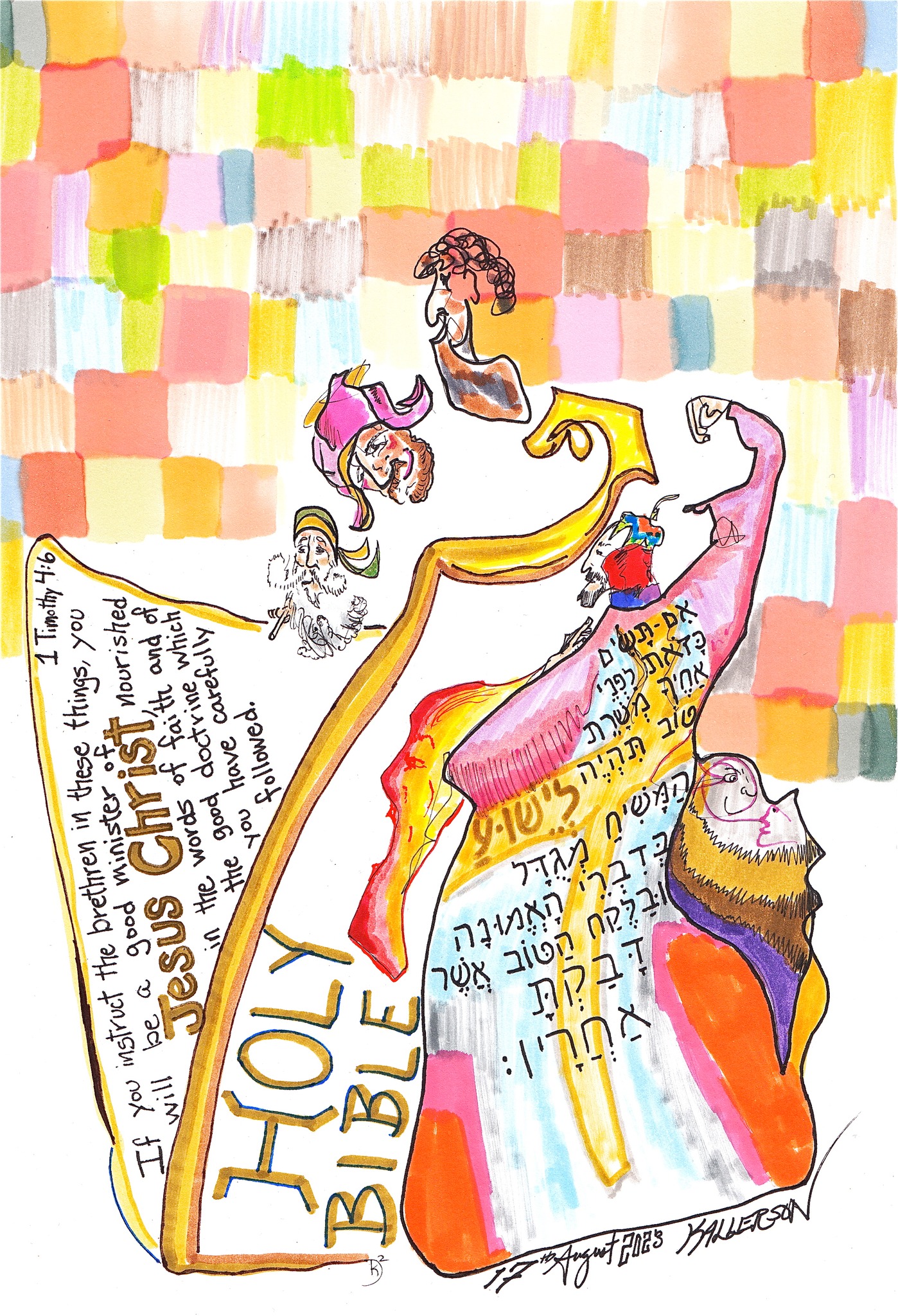
Artwork by Douglas Kallerson
Joshua 24:16-28
For He Is a Holy God, Part III
There are countless ways to conduct a church service. For the most part, if the heart is right in the pastor, if he is properly directed to the truth of the Lord, and if he competently handles the word, the way the service is conducted will be more up to the preferences of the pastor and the congregants than anything else.
People go where they feel comfortable. This is why I never have a problem with people coming once to the Superior Word and then not returning. They didn’t benefit from what I was saying in the way that they would prefer.
Some pastors can take a passage from Joshua, say almost nothing about the passage itself, and still give a sermon that edifies the people who listen. That isn’t my style, but as long as he is preaching a message in line with the word in some manner, who could argue against it?
As for what I believe is important in a church service, and why I do things as I do, it is because being grounded in the word is the surest way of not being misled or completely swept away from the faith. If you want to know the importance of people being grounded, listen to these words from Adam Clarke based on his evaluation of Joshua 24:16 –
“God forbid that we should forsake the Lord – That they were now sincere [meaning the people speaking to Joshua] cannot be reasonably doubted, for they served the Lord all the days of Joshua, and the elders that outlived him, Joshua 24:31; but afterwards they turned aside, and did serve other gods. ‘It is ordinary,’ says Mr. Trapp, ‘for the many-headed multitude to turn with the stream – to be of the same religion with their superiors: thus at Rome, in Diocletian’s time, they were pagans; in Constantine’s Christians; in Constantius’s, Arians; in Julian’s apostates, and in Jovinian’s, Christians again! And all this within less than the age of a man. It is, therefore, a good thing that the heart be established with grace.’” Adam Clarke
Text Verse: “If you instruct the brethren in these things, you will be a good minister of Jesus Christ, nourished in the words of faith and of the good doctrine which you have carefully followed.” 1 Timothy 4:6
In the church where I was ordained, a defective person was selected to be the pastor and he ran the church, a big and thriving one, right into the ground. That can and does happen. But the thing that shocked me most was where some of the people who attended went when they left the church.
Some went off to Charismatic churches, some became full-blown Calvinists, some to reformed churches, and some have now taken the path down Woke Way. Others stopped going to church, etc. None of those things were because of failed doctrine by the previous pastors. Rather, their doctrine was sound and biblically based.
The problem then had to be that the congregants didn’t regard learning the word and doctrine as an important part of their walk. That bothered me, and it continues to bother me. Imagine what Clarke said. In the span of a single lifetime, Rome converted several times between some pretty disparate beliefs.
What we need as people are warnings, real sincere warnings about the cost of not paying heed to instruction. Here in the US, we didn’t pay heed to our Founding Fathers’ words. We often don’t pay heed to street signs or to other laws that will keep us from harm. We ignore our consciences too.
One thing I constantly warn about this church about is doctrine. Pay heed to yourself and your doctrine. I can’t think of anything more important to the believer in Christ than that one point.
Joshua will warn the people about this today. Will Israel pay heed? Great lessons such as this are to be found in His superior word. And so, let us turn to that precious word once again, and… May God speak to us through His word today, and may His glorious name ever be praised.
I. A Witness to You (verses 16-28)
16 So the people answered and said: “Far be it from us
It is the same expression used in Joshua 22:29, khalilah lanu – “Profane thing to us.” The idea itself is utterly repugnant to them. It would be something that was defiling in and of itself, and it would be a mark of apostasy. That is then further explained with the words…
16 (con’t) that we should forsake the Lord to serve other gods;
me’azov eth Yehovah la’avod elohim akherim – “from forsaking Yehovah to serve gods other.” The people are adamant that they will remain faithful to the Lord and not forsake him.
In Joshua 22, the eastern tribes were accused of rebellion, thus eliciting their response of denial. Here, Joshua is certain they will forsake Him –
“Far be it from us that we should rebel against the Lord, and turn from following the Lord this day…” Joshua 22:29
“Far be it from us that we should forsake the Lord to serve other gods.” Joshua 24:16
There is no doubt about their sincerity, but as Adam Clarke noted, there is also the truth that people will closely follow a human leader at the expense of faithful obedience to the Lord. For now, however, the people explain the reason for their firm stand…
17 for the Lord our God is He who brought us and our fathers up out of the land of Egypt,
It is an emphatic statement that includes a verb being used as a noun: ki Yehovah elohenu hu ha’maaleh otanu v’eth avotenu – “For Yehovah our God, He, the Bringer Up us and our fathers.” Their adamant proclamation is based on the fact that it was the Lord who delivered them.
Holding to this in the future will require at least two things: 1) That the people will tell about the deeds of the Lord to the next generations, and 2) that the people will have faith that what they were told was true.
To get this, we can look at any major discipline in Scripture, such as creation, salvation, the resurrection, etc. For example, to hold to the creation narrative, we need to read about it in the Bible. However, we also need to believe what it says is true. As for Israel, their words continue with…
17 (con’t) from the house of bondage,
Rather: mi’beith avadim – “from house slaves.” They were slaves in Egypt and the Lord brought them out to be free men. However, when one is under law, he is in bondage (Galatians 4:24), a slave to the law. Jesus, Peter, and Paul each acknowledge this in their words. Next, they say…
17 (con’t) who did those great signs in our sight,
v’asher asah l’enenu eth ha’othoth ha’gedoloth ha’eleh – “And who did to our eyes the signs, the great, the these.” There is no need to take the words of the verse 18 which include “the Amorites” and thus say that this is only speaking of things that occurred prior to their encountering the Amorites.
The people are making a general statement that the Lord had done great things in their sight from the time they left Egypt until that day. They are speaking of the absolute trustworthiness of the Lord to preserve them from start to finish. This is stated next, saying…
17 (con’t) and preserved us in all the way that we went and among all the people through whom we passed.
The wording is more specific: vayishmerenu b’kal ha’derek asher halaknu bah u-b’kol ha’amim asher avarnu b’qirbam – “And kept us in all the way which we walked in, and in all the peoples which we passed in their midst.” As just noted, this does not have to exclude what is next said. It is an all-inclusive statement of protection, from beginning to end.
The next words go from Israel’s protection to the dispossession of the enemies…
18 And the Lord drove out from before us all the people, including the Amorites who dwelt in the land.
The word “and” in this verse probably should be taken as “even.” In other words, the Amorite is being used collectively to speak of all the people: v’garesh Yehovah eth kal ha’amim v’eth ha’emori yoshev ha’arets me’panenu – “And drove out, Yehovah, all the peoples, even the Amorite, dwelled the land before our faces.”
There were many people groups in Canaan, identified by the plural “peoples.” However, the Amorite has been a term used in this chapter to speak of all of them as one group. Because of this faithful attention by the Lord as He tended to Israel…
18 (con’t) We also will serve the Lord, for He is our God.”
The words are emphatic: gam anakhnu naavod eth Yehovah ki hu elohenu – “Also, we will serve Yehovah for He our God.” This is the response to Joshua’s words of verse 15. They have worked through the reason for it before stating it.
Joshua presented them with a list of gods they could choose from and then he said whom he would serve. Israel countered with all that the Lord had done for them and thus they affirm He is their God –
“And I, and my house, we will serve [naavod] Yehovah.” (v. 15)
“Also, we will serve [naavod] Yehovah for He our God.” (v. 18)
19 But Joshua said to the people, “You cannot serve the Lord,
The word “cannot” can be construed in different ways. Rather: vayomer Yehoshua el ha’am lo tukelu la’avod eth Yehovah – “And said Joshua unto the people, ‘No you able to serve Yehovah.’” The word yakol speaks of power or ability. Joshua doesn’t tell them they cannot serve the Lord, as if they were not permitted to do so, but because they are not able to do so. It is something beyond their ability to perform. He next gives the emphatic reasons for this…
19 (con’t) for He is a holy God. He is a jealous God;
In the first clause, Joshua uses the majestic plural, elohim, united with the plural holies, thus giving the superlative sense of most holy: ki elohim qedoshim hu el qano hu – “for God holies, He; God jealous, He.” Both clauses are emphatic. The first speaks of the many perfections of the Lord while the second refers to the adamant state in which He guards His name.
It is because of this that Israel is not able to serve Him. Joshua already knows that they are prone to fail and of their hardheadedness and obstinance in recklessly pursuing sin…
19 (con’t) He will not forgive your transgressions nor your sins.
It is incorrect: yisa l’pishakhem u’l’khatotekhem – “He will not bear to your transgression and (even) to your sins.” Rather than “forgive” it means that the Lord will not put up with their wrongdoing. This is then defined by Joshua, first in the singular, “your transgression.”
This is the only time the noun pesha, or transgression, is used in Joshua. It signifies a state of national revolt. He notes the collective nature of that by saying, “your sins.” The sins of the people when unchecked through punishment or repentance, become a national transgression. With that, Joshua again brings in the thought of serving other gods…
20 If you forsake the Lord and serve foreign gods, then He will turn and do you harm and consume you, after He has done you good.”
It is not a conditional if, but an adamant when: ki taazvu eth Yehovah v’avadtem elohe nekhar v’shav v’hera lakhem v’kilah etkhem akhare asher hetiv lakhem – “When you forsake Yehovah and serve gods foreign, and He turns, and He does evil to you, and He finishes you, after which he has done good to you.”
Joshua takes their words of verse 16, and turns them around:
“Profane thing to us from forsaking Yehovah to serve gods other.” (vs. 16)
“When you forsake Yehovah and serve gods foreign.” (vs. 20)
The word translated as foreign is nekar. It comes from the verb nakar which signifies “to recognize.” They have claimed that they know the Lord by the great things He has done in their sight. And yet, Joshua says they will forsake Him and recognize foreign gods rather than Him.
One could say that verses like Malachi 3:6 cannot be true. It says, “For I am the Lord, I do not change.” If God treats Israel in one manner and then turns and treats them in another manner, then it must be that the Lord has changed. Incorrect.
It is Israel that changes in relation to the Lord. Joshua is making this plain and clear. The response of the Lord to the actions of the people is consistent with His holy and jealous nature. Throughout Israel’s history, this truth will be on display, and yet, Israel will rarely comprehend or even acknowledge it. Not perceiving that Joshua knows better than they do, they respond again…
21 And the people said to Joshua, “No, but we will serve the Lord!”
Joshua has spoken clearly and emphatically concerning the matter. Israel has responded assuredly to him that they will, in fact, prove him wrong. Notice the structure –
“And I, and my house, we will serve [naavod] Yehovah.” (v. 15)
“Also, we will serve [naavod] Yehovah for He our God.” (v. 18)
“And said Joshua unto the people, ‘No you able to serve [la’avod] Yehovah.’” (vs. 19)
“And said the people to Joshua, ‘No, for Yehovah we will serve [naavod].’”
Their response of lo ki, “No, for,” is a claim that they are able to serve Him and they will serve Him. Because of their adamant proclamation, it next says…
22 So Joshua said to the people, “You are witnesses against yourselves that you have chosen the Lord for yourselves, to serve Him.”
Rather than “against yourselves,” it reads: edim atem ba’khem ki atem b’khartem la’khem eth Yehovah la’avod oto – “Witnesses you in yourselves for you have chosen to you Yehovah, to serve Him.” The words “in yourselves” may ultimately be a witness against them, but the immediate sense is that they have now made the choice that was previously set before them in verse 15 –
“And if evil in your eyes to serve Yehovah, choose [bakhar] to you the day whom you will (surely) serve.” (vs. 15)
“Witnesses you in yourselves for you have chosen [bakhar] to you Yehovah, to serve Him.” (vs. 22)
With the choice acknowledged by Joshua, the people respond accordingly…
22 (con’t) And they said, “We are witnesses!”
vayomeru edim – “And they said, ‘Witnesses.’” They have made the choice and witnessed in themselves that it is so. Therefore, they are accountable for the words they have spoken. In the future, if they fail to serve the Lord, their words will be witnesses against them.
Of this verse, the Pulpit commentary says, “And it is well to observe … that such an excuse never was pleaded afterwards, that the obligation, though evaded, was never disavowed.”
I just can’t agree with that. To ask, “Why has this happened to us,” is to implicitly avow that there is no guilt on their part. But this type of sentiment is seen repeatedly later in their history. A classic example of this is found in Jeremiah –
“And it shall be, when you show this people all these words, and they say to you, ‘Why has the Lord pronounced all this great disaster against us? Or what is our iniquity? Or what is our sin that we have committed against the Lord our God?’ 11 then you shall say to them, ‘Because your fathers have forsaken Me,’ says the Lord; ‘they have walked after other gods and have served them and worshiped them, and have forsaken Me and not kept My law. 12 And you have done worse than your fathers, for behold, each one follows the dictates of his own evil heart, so that no one listens to Me. 13 Therefore I will cast you out of this land into a land that you do not know, neither you nor your fathers; and there you shall serve other gods day and night, where I will not show you favor.’” Jeremiah 16:10-13
It could be that the instruction to the people was so lacking that they had no idea they were not to follow, serve, and worship other gods, but that seems much less likely than that they ignored their obvious guilt.
The evidence of this is found in Israel today as well as the church. What the Lord expects is known to both, but that is disavowed as frequently as leaves fall in the autumn. Here is another explicit example in Jeremiah –
“Then all the men who knew that their wives had burned incense to other gods, with all the women who stood by, a great multitude, and all the people who dwelt in the land of Egypt, in Pathros, answered Jeremiah, saying: 16 ‘As for the word that you have spoken to us in the name of the Lord, we will not listen to you! 17 But we will certainly do whatever has gone out of our own mouth, to burn incense to the queen of heaven and pour out drink offerings to her, as we have done, we and our fathers, our kings and our princes, in the cities of Judah and in the streets of Jerusalem. For then we had plenty of food, were well-off, and saw no trouble. 18 But since we stopped burning incense to the queen of heaven and pouring out drink offerings to her, we have lacked everything and have been consumed by the sword and by famine.’” Jeremiah 44:15-18
The people had been given the word of the Lord from Moses. Jeremiah also spoke the word of the Lord for them, and yet they disavowed their conduct as being responsible for their troubles. As for the people’s words to Joshua, he next directs them accordingly…
23 “Now therefore,” he said, “put away the foreign gods which are among you,
v’atah hasiru eth elohe ha’nekhar asher b’qirb’khem – “And now, put away gods the foreign which in your midst.” It isn’t known if Joshua is speaking instructionally in an if/then manner or if he is actually implying that there are foreign gods to be found among the people.
It is hard to imagine that, especially with the mandates of the law so obviously fresh among the people. But it is not impossible. The account in Judges 2, if connected to this account now, does seem to imply it though.
It seems his words are instructional, “If you see them among you, put them away.” This also appears likely based on verse 31 saying that Israel served the Lord all the days of Joshua. Either way, if there were foreign gods among them, they are privately held, not publicly on display as they will be in the future.
23 (con’t) and incline your heart to the Lord God of Israel.”
v’hatu eth l’vavkhem el Yehovah elohe Yisrael – “And extend, to your heart, unto Yehovah, God Israel.” This statement makes me think that the previous clause was instructional.
He is telling them this as a guide and a guard into the future, not an accusation about their conduct in the present. This is more likely because there is no follow-up to his words noted by the people, as the Bible is accustomed to providing when such is the case.
24 And the people said to Joshua, “The Lord our God we will serve, and His voice we will obey!”
eth Yehovah elohenu naavod u-b’qolo nishma – “Yehovah our God we will serve, and in His voice we will hear.” This is the third time this has been stated –
“And answered the people, and said… Also, we will serve [naavod] Yehovah for He our God.” (vs 16 & 18)
“And said the people to Joshua, ‘No, for Yehovah we will serve [naavod].’” (vs. 21)
“And said the people to Joshua, ‘Yehovah our God, we will serve [naavod], and in His voice we will hear.” (vs. 24)
The threefold repetition stands as an emphatic and complete witness to the matter. As such, their words are binding upon themselves, those under them, and those who follow them. Because of this, it next says…
25 So Joshua made a covenant with the people that day,
vayikroth Yehoshua berith la’am ba’yom ha’hu – “And cut, Joshua, covenant to the people in the day, the it.” To cut a covenant means to sacrifice an animal or animals to solidify the matter. This was seen in Exodus 24 –
“And Moses took half the blood and put it in basins, and half the blood he sprinkled on the altar. 7 Then he took the Book of the Covenant and read in the hearing of the people. And they said, ‘All that the Lord has said we will do, and be obedient.’ 8 And Moses took the blood, sprinkled it on the people, and said, ‘This is the blood of the covenant which the Lord has made with you according to all these words.’” Exodus 24:6-8
This is explained in detail in Hebrews 9 –
“For where there is a testament, there must also of necessity be the death of the testator. 17 For a testament is in force after men are dead, since it has no power at all while the testator lives. 18 Therefore not even the first covenant was dedicated without blood. 19 For when Moses had spoken every precept to all the people according to the law, he took the blood of calves and goats, with water, scarlet wool, and hyssop, and sprinkled both the book itself and all the people, 20 saying, ‘This is the blood of the covenant which God has commanded you.’ 21 Then likewise he sprinkled with blood both the tabernacle and all the vessels of the ministry. 22 And according to the law almost all things are purified with blood, and without shedding of blood there is no remission.” Hebrews 9:16-22
With that understood, it next says…
25 (con’t) and made for them a statute and an ordinance in Shechem.
Almost every translation says “them,” but that is not what it says: vayasem lo khoq u-mispat bishkhem – “And set to him statute and ordinance in Shechem.” Exactly what this means is hard to say. It is very similar to Exodus 15:25 where it says of Moses, “There set to him statute and ordinance and there He tested him.”
With only a very few exceptions, everyone incorrectly translates the pronoun as “them.” But does it mean the Lord set the statute for Moses, and there the Lord tested him? Or does it refer to Israel in the singular? The next verse in Exodus is all in the singular as well.
My guess is that he was speaking solely to Moses as the leader of His people and thus representative of all the people. The singular being taken for the collective.
Here in Joshua, it cannot be “covenant,” as in, “set to the covenant a statute and ordinance.” This is because the word berith is feminine. Thus, the words of this clause would have a gender mismatch.
It may be referring to Israel as a single entity, or it may be referring to the Lord. Because the preceding verses have presented the voluntary words of the people concerning their serving the Lord, He being the reference is not out of possibility. It would take us back to the opening words of the chapter –
“And gathered Joshua all tribes Israel Shechem-ward, and called to elders Israel, and to his heads, and to his judges, and to his officers and stationed themselves before the God.” Joshua 24:1
“And cut, Joshua, covenant to the people in the day, the it, and set to Him statute and ordinance in Shechem.” Joshua 24:25
If so, the statute and ordinance would not be for the Lord to obey, but for Him to monitor concerning the people’s obedience. That seems more likely based on what is coming in the next two verses…
26 Then Joshua wrote these words in the Book of the Law of God.
vayiktov Yehoshua eth ha’devarim ha’eleh b’sepher torath elohim – “And wrote, Joshua, the words, the these, in book Law God.” The big question here is, “What words did he write?” Is it only what has transpired here in Chapter 24? Or does it mean the whole book of Joshua, inclusive of these words?
This takes us back to what was said in the first sermon of Chapter 24. If this gathering at Shechem is the same as that recorded in Joshua 8, it would mean that the law was read at this time, and it would then follow logically that Joshua would read what he had compiled. Charles Ellicott says concerning this verse –
“Primarily ‘these words’ appear to refer to the transaction just recorded. But it must be observed that this is also the second signature among the sacred writers of the Old Testament. The first is that of Moses, in Deuteronomy 31:9 : ‘Moses wrote this law, and delivered it unto the priests,’ &c. The next signature after Joshua’s is that of Samuel (1Samuel 10:25): ‘Samuel told the people the manner of the kingdom, and wrote it in the [not a] book, and laid it up before the Lord.’ We have here a clue to the authorship of the Old Testament, and to the view of the writers who succeeded Moses in what they did. They did not look upon themselves as writers of distinct books, but as authorised to add their part to the book already written, to write what was assigned to them ‘in the book of the law of God.’ The unity of Holy Scripture is thus seen to have been an essential feature of the Bible from the very first.” Charles Ellicott.
Whether this is only referring to the words of Chapter 24 or of all of Joshua’s writings, it next says…
26 (con’t) And he took a large stone, and set it up there under the oak that was by the sanctuary of the Lord.
Rather: vayiqah even gedolah vay’qimeha sham takhath ha’alah asher b’miqdash Yehovah – “and took stone, whopping, and set it up there under the oak which in sanctuary Yehovah.” The stone is a witness between the two parties to the covenant that has been set forth.
This is why my thoughts about the use of the singular in the previous verse may be referring to the Lord. The statute and judgment were set before Him, the God, to monitor. The stone stands as a witness to this fact. Standing it under the tree indicates that this is may have been the same tree that was standing when this occurred –
“And Jacob said to his household and to all who were with him, ‘Put away the foreign gods that are among you, purify yourselves, and change your garments. 3 Then let us arise and go up to Bethel; and I will make an altar there to God, who answered me in the day of my distress and has been with me in the way which I have gone.’ 4 So they gave Jacob all the foreign gods which were in their hands, and the earrings which were in their ears; and Jacob hid them under the terebinth tree which was by Shechem.” Genesis 35:2-4
As that was hundreds of years earlier, that tree is either very old, or another tree has grown in its place. Either way, the stone now being erected is a witness to Israel of the past and of what is expected in the future.
Saying it is “in the sanctuary of the Lord” means that it is in the place set apart as holy to the Lord. That was carefully detailed in the first sermon of Chapter 24 where it noted altars built by both Abraham and Jacob in this area.
27 And Joshua said to all the people, “Behold, this stone shall be a witness to us,
Notice that Joshua includes himself in the address: hineh ha’even ha’zoth tihyeh banu la’edah – “Behold, the stone, the this shall be to us to witness.” The stone is personified here, indicating that it stands as representative of the Lord who is the other party involved in the covenant.
To ignore that the Lord heard the words by ignoring the covenant based on the words would make them as senseless as the inanimate stone that is used as representative of the Lord.
As for the stone, regardless as to whether or not these events are occurring at the same time as the ceremony in Joshua 8, it is certain that the great and impressive altar that was built in that chapter was already standing. As this is so, this stone was not used in the building of the altar, even though it was in that area. As such, it makes its own picture of Christ –
“The stone which the builders rejected
Has become the chief cornerstone.
23 This was the Lord’s doing;
It is marvelous in our eyes.” Psalm 118:22, 23
The altar pictured Christ, but this stone does as well because it stands as representative of the covenant that has been cut between Israel and the Lord. As it next says…
27 (con’t) for it has heard all the words of the Lord which He spoke to us.
The stone, representing the words of the Lord from verses 24:2-13, is said to have heard. This then is to be a permanent reminder of what He said. When it is seen, what was said is to be called to mind.
However, because this account about the stone is recorded in the continuing Torah of God, those words also call to mind the stone each time they are read. As such, whether physically standing in front of a person or being read out of the Law…
27 (con’t) It shall therefore be a witness to you, lest you deny your God.”
There is a strong emphasis in the words: v’hayetah ba’khem l’edah pen t’khashun b’lohekhem – “And it shall be in you to witness, lest you (surely) lie in your God.”
The word kakhash comes from a primitive root meaning to be untrue in word or in deed. The people have repeatedly said that they will serve the Lord. Thus, if they fail to do this by serving other gods, they will have lied against the Lord. The warning is set. With that, it next says…
*28 (fin) So Joshua let the people depart, each to his own inheritance.
It is more succinct: vayshalakh Yehoshua eth ha’am ish l’nakhalato – “And sent, Joshua, the people; man to his inheritance.” This ends the main narrative portion of the book of Joshua. The final five verses will detail the death and burial of Joshua along with a few other key points relevant to close out the book.
Let us fear the Lord all our days
Serving in sincerity and truth as well
He is worthy of all our praise
For He has saved us from the clutches of hell
It was by grace alone that we have been saved
It was solely by the merits of our Lord Jesus
By His works alone the path was paved
See! Such wonderful things He has done for us
Praises to our God and King!
All glory and honor belong to Him alone
For all of eternity to Him we shall sing
He is the faithful witness, the rejected Stone
This was the Lord’s doing, so marvelous in our eyes
He is Jesus our Hope and our heavenly Prize
II. Explaining the Passage
Despite the large number of verses that comprise these past three sermons, the explanation of why they are recorded is short and simple to understand. Many of the anticipations of Christ have been given already as we have gone through the verses, and so there is no need to repeat them now.
Simply stated, Joshua 24 began with all of the tribes being gathered together to Shechem. As has been seen in previous sermons, Shechem, [Having a Sense of] Responsibility, looks at the believer who understands his violation of the law and has accepted Christ’s fulfillment of it.
Throughout Joshua, that has been seen again and again in typology. Christ fulfilled the law, Christ died in fulfillment of the law, etc. The number of pictures concerning this have been abundant. These people are not under law, but under grace. This is what the words to the people from the Lord in verses 2-13 clearly indicated.
Everything was showing how God, working to maintain the proper worship of the Lord, continued His plan of redemption. He called out Abraham from the land where they served other gods, He led him to Canaan and gave him Isaac. To Isaac was given Jacob.
However, a note about Esau comes right out of the blue – “To Esau I gave the mountains of Seir to possess.” That is a picture of the Lord allowing the made man (Adam and his descendants) to continue in the world with the awareness of sin (pictured by Mount Seir), even if he is not imputed sin because “sin is not imputed when there is no law” (Romans 5:13).
In the meantime, the Lord called out a particular group of people to ensure that the proper worship of the Lord continued. As was noted, the one main point that was strikingly omitted out of all of the Lord’s words – from Abraham all the way through – is any mention of the law.
Everything the Lord stated constituted His grace being bestowed upon this select line without any hint of them having earned what they received. This went even to the granting of land, cities, vineyards, and olive groves. All Israel had to do was believe, follow, and receive.
Everything in those details, from the calling of Abraham on, has anticipated the coming of Messiah. It was He who each person in the line of promise pictured. It was He who was anticipated in the Exodus from Egypt and the time of their rejection of Him in the wilderness.
He was the one anticipated in all of the battles leading up to and following their entrance into Canaan. It was His fulfillment of the law (which remained unstated to the people to demonstrate this) that secured their inheritance for them. He is both the Provider of the inheritance and the reason for it. All of it was noted as grace upon His people.
Joshua is coming to a close. Israel has its inheritance, and it will dwell in it. This will be true with Israel of the future when they finally receive Jesus as a nation. But the heart of man is prone to wander. This is the reason for the continuous back and forth between Joshua and the people in today’s verses.
Israel will someday receive the Lord, but even after this, they must be faithful to Him. This final passage of Joshua is given to warn them of that. Even during the millennial reign of Christ, they will have free will, and they will need to hold fast to the Lord, serving Him.
Though the number of verses concerning this is only a few, it is still evident that the people can choose or reject Jesus. A notable example of this is found in Isaiah 65 –
“For behold, I create new heavens and a new earth;
And the former shall not be remembered or come to mind.
18 But be glad and rejoice forever in what I create;
For behold, I create Jerusalem as a rejoicing,
And her people a joy.
19 I will rejoice in Jerusalem,
And joy in My people;
The voice of weeping shall no longer be heard in her,
Nor the voice of crying.
20 “No more shall an infant from there live but a few days,
Nor an old man who has not fulfilled his days;
For the child shall die one hundred years old,
But the sinner being one hundred years old shall be accursed.” Isaiah 65:17-20
Israel is being told in typology that just because they will be nationally saved, they can depart from the Lord, and so they must be careful to properly serve Him.
Both Joshua and the stone picture Jesus. He is the One to establish the faith and He is the witness to the fact that Israel has agreed to the proper worship of Him, because He is the incarnate Lord God.
This is more certain because it says that before he set up the stone, Joshua wrote those words in the Book of the Law of God. Jesus is the incarnate Word. That which is written in the Torah of God is written in anticipation of Him.
Whether or not the stone that Joshua set up is still there is irrelevant. It is written in the word, and thus it is an eternal testament to the stone which is the witness of what is recorded there.
The Lord gave Israel a history lesson to remind them of where they had come from, why they were where they are, and how that came about. They are being told to hold fast to the Lord who saved them by grace.
It may even be that Israel of the future will read this final chapter of Joshua, notice the remarkable lack of any mention of the law, and finally realize that they have been pursuing the wrong avenue to pleasing God all along. They look to the law as a means to an end when, in fact, it has nothing to do with their being right with God, except as it is fulfilled in Jesus.
As just said a moment ago, Jesus is the true focal point for the worship of God because He is the Lord God. Whatever worship Israel conducts in the millennium will be centered on this fact.
For those in the church who believe this, our future is set already. There is no need to be admonished of such things. What we need to be admonished about is living in a right and proper manner while we are here. Though our salvation is not in question, our lives will be less fulfilling apart from holy and obedient living, and our rewards will be based upon that.
And more, if we let our guard down, our own children and those around us may be the ones to find out, all too late, that we failed to live uprightly. It is our responsibility to do this as Christians, and to share the reason for the hope we have with those we encounter in our walk (1 Peter 3:15). Let us do so, to the glory of the Lord who bestowed His wonderful grace upon us.
Closing Verse: “Therefore, since we are receiving a kingdom which cannot be shaken, let us have grace, by which we may serve God acceptably with reverence and godly fear. 29 For our God is a consuming fire.” Hebrews 12:28, 29
Next Week: Joshua 24:29-33 Our trip through the book has been hugely fun… (Joshua the Son of Nun) (58th and Final Joshua Sermon)
The Lord has you exactly where He wants you. He has a good plan and purpose for you. It is He who has defeated the enemy and who now offers His people rest. So, follow Him and trust Him and He will do marvelous things for you and through you.
For He Is a Holy God, Part III
So the people answered and said:
“Far be it from us that we should forsake the LORD
———-to serve other gods, we would be flipped!
For the LORD our God is He who brought us
And our fathers up out of the land of Egypt
From the house of bondage
Who did those great signs in our sight leaving the enemy aghast
And preserved us in all the way that we went
And among all the people through whom we passed
And the LORD drove out from before us all the people
Including the Amorites who dwelt in the land
We also will serve the LORD
For He is our God, ever near at hand
But Joshua said to the people
“You cannot serve the LORD, as surely as I live
For He is a holy God; He is a jealous God
He will not your transgressions nor your sins forgive
If you forsake the LORD and serve foreign gods
Then He will turn and do you harm and consume you
———-hear my word
After He has done you good
And the people said to Joshua, “No, but we will serve the LORD!”
So Joshua said to the people
“You are witnesses against yourselves this day
That you have chosen the LORD for yourselves, to serve Him.”
And they said, “We are witnesses, so we say
“Now therefore,” he said, “put away the foreign gods which are
———-among you, so to you I tell
And incline your heart to the LORD God of Israel
And the people said to Joshua on that day
“The LORD our God we will serve, and His voice we will obey!”
So Joshua made a covenant with the people that day
And made for them a statute and an ordinance in Shechem
———-yes, down Shechem way
Then Joshua wrote these words
In the Book of the Law of God, His infallible word
And he took a large stone, and set it up there under the oak
That was by the sanctuary of the LORD
And Joshua said to all the people
“Behold, this stone shall be a witness to us not to defraud
For it has heard all the words of the LORD which He spoke to us
It shall therefore be a witness to you, lest you deny your God
So Joshua let the people depart
Each to his own inheritance they did start
Lord God, turn our hearts to be obedient to Your word
Give us wisdom to be ever faithful to You
May we carefully heed each thing we have heard
Yes, Lord God may our hearts be faithful and true
And we shall be content and satisfied in You alone
We will follow You as we sing our songs of praise
Hallelujah to You; to us Your path You have shown
Hallelujah we shall sing to You for all of our days
Hallelujah and Amen…
16 So the people answered and said: “Far be it from us that we should forsake the Lord to serve other gods; 17 for the Lord our God is He who brought us and our fathers up out of the land of Egypt, from the house of bondage, who did those great signs in our sight, and preserved us in all the way that we went and among all the people through whom we passed. 18 And the Lord drove out from before us all the people, including the Amorites who dwelt in the land. We also will serve the Lord, for He is our God.”
19 But Joshua said to the people, “You cannot serve the Lord, for He is a holy God. He is a jealous God; He will not forgive your transgressions nor your sins. 20 If you forsake the Lord and serve foreign gods, then He will turn and do you harm and consume you, after He has done you good.”
21 And the people said to Joshua, “No, but we will serve the Lord!”
22 So Joshua said to the people, “You are witnesses against yourselves that you have chosen the Lord for yourselves, to serve Him.”
And they said, “We are witnesses!”
23 “Now therefore,” he said, “put away the foreign gods which are among you, and incline your heart to the Lord God of Israel.”
24 And the people said to Joshua, “The Lord our God we will serve, and His voice we will obey!”
25 So Joshua made a covenant with the people that day, and made for them a statute and an ordinance in Shechem.
26 Then Joshua wrote these words in the Book of the Law of God. And he took a large stone, and set it up there under the oak that was by the sanctuary of the Lord. 27 And Joshua said to all the people, “Behold, this stone shall be a witness to us, for it has heard all the words of the Lord which He spoke to us. It shall therefore be a witness to you, lest you deny your God.” 28 So Joshua let the people depart, each to his own inheritance.